The World of Stonehenge is the latest in a series of impressive exhibitions at the British Museum devoted to European prehistory: a worthy successor to Ice Age Art in 2012 and Celts: art and identity in 2015. Like them, it has already attracted significant public attention, with a raft of positive reviews in the press. Indeed, given the quality and range of material on display, it could hardly fail to be a success. Not only does it gather together key objects from a series of British and Irish museums, but also a range of striking artefacts from continental Europe. Among these, first place must surely go to the Nebra ‘sky disc’; but there are also major finds from France, Switzerland, Denmark and northern Italy that will not previously have been seen in Britain.
The exhibition is mainly arranged fairly conventionally in chronological order, supplemented by thematic headings. A brief introduction focuses on a carved slab from Val Camonica in northern Italy and the perforated cup from Ayton Moor in North Yorkshire, the latter perhaps reproducing in its fenestrated sides the form or a memory of Stonehenge. This room also displays a video illustrating a range of megalithic monuments from Britain and Western Europe. The video and its accompanying panel are more or less the only place in the exhibition where Stonehenge is set within the context of the broader family of megalithic monuments, with the message that although it may be unique in its design, Stonehenge must be understood as part of an already well-established tradition that had begun some 2000 years earlier in north-west France. For the rest of the exhibition, the emphasis is—very naturally in a museum context—on artefacts. And what artefacts they are. Yet a museum exhibition about a field monument feels inevitably (to borrow a phrase) a little like Hamlet without the prince. More might have been done to remind visitors that the world of Stonehenge was not only a world of prestigious portable objects but also of major monuments.
‘Working with Nature’ begins the build-up to the period of Stonehenge, showing material from the Mesolithic and Neolithic: the mysterious shaman burial from Bad Dürrenberg in Germany, one of the well-known Star Carr antler headdresses, and wood gnawed by beavers and scratched by bears. Turning the corner, we are confronted by a veritable wall of Neolithic stone axes; a panel on the opposite wall illustrates the movement of jadeitite axes from Alpine sources in Italy to Britain and northern Europe. There are also organics—a section of the Sweet Track from the Somerset Levels and the curious wooden tridents from Ehenside Tarn. The Coneybury Anomaly—a pit near Stonehenge where farmers and foragers may have feasted together (Gron et al. Reference Gron2018)—sets the scene for the transition from Mesolithic to Neolithic in Britain, along with the recent DNA evidence for substantial immigration. A little further on, Stonehenge itself makes its first appearance in the form of the Salisbury Museum bluestone and artefacts from the cremation burials.
As we move along the gallery, the list of spectacular objects (‘Sermons in Stone’) begins to grow. On one side are the chalk drums from Folkton, now joined by a fourth example recently discovered at Burton Agnes and on display here for the first time in a major exhibition. Nearby is the perforated flint macehead from Knowth, along with similar examples from Wales and Scotland, and a series of the enigmatic carved stone balls. On the opposite wall are artefacts from Skara Brae and recently excavated material from Ness of Brodgar, followed by material from Durrington Walls. Then there are more carved slabs from Val Camonica, set alongside rock art and megalithic art from Cumbria and Cairnholy, and a panel displaying stone mauls from Stonehenge and explaining how the sarsens were shaped. In the final section of this long room (‘Making Metal’) we are confronted by a set of preserved timbers from Seahenge, craggy and sculptural in the carefully arranged lighting, and graphically illustrating the essential role of organics for understanding prehistoric monuments.
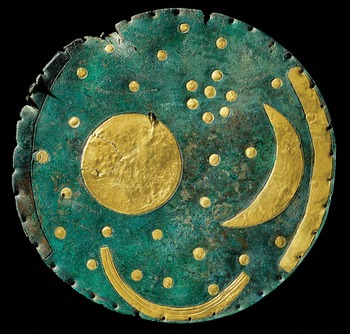
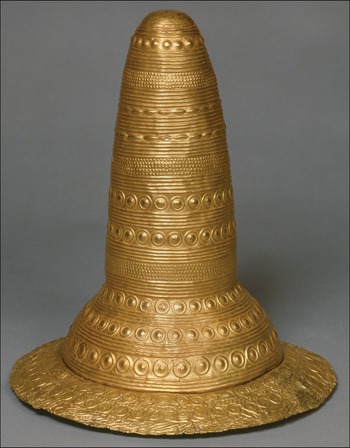
A special room with subdued lighting, ‘Under One Sky’, is devoted to what many will consider the star exhibits, pride of place going to the ‘sky disc’ from Nebra (Figure 1). The opportunity to study this fascinating artefact at first hand (and at leisure—there was no crush of visitors) will be one of the key attractions for prehistorians. An adjacent case holds the rest of the Nebra material: two identical bronze swords, axes and spiral arm-rings, and a chisel. Also displayed here is the Mold gold cape, a set of sheet gold lunulae and gold discs with solar motifs, and two of the enigmatic gold cones (from Avanton and Schifferstadt) with their rich panoply of embossed symbols (Figure 2). It is hard to imagine any of these being worn, but if so, they must have made an impressive sight.
The ‘sky disc’ from Nebra, Germany, c. 1600 BC (photograph courtesy of the State Office for Heritage Management and Archaeology Saxony-Anhalt, Juraj Lipták, and the British Museum).

The Schifferstadt gold cone, c. 1600 BC, which was found with three bronze axes in Rhineland-Palatinate, Germany (photograph courtesy of Historisches Museum der Pfalz Speyer and the British Museum).

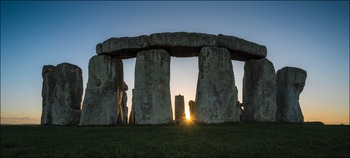
‘Under One Sky’ falls chronologically between the Neolithic and Bronze Age sections of the exhibition, and that, in a sense, gives it the impression of being out of time. Indeed, a range of periods is represented here: the lunulae and discs date probably to the last centuries of the third millennium BC, the gold cones to the mid-second millennium BC, and the Nebra disc to perhaps 1600 BC. The connection with Stonehenge is established by a panel on the solstice sunrise (Figure 3), although the sarsens must pre-date Nebra by almost a millennium. Although this telescoping of time makes for an impressive combination of artefacts, it masks some aspects of regional variation and chronological change which are so well represented otherwise in the exhibition.
Stonehenge at sunrise (photograph © English Heritage; courtesy of the British Museum).

The next room, ‘Raising the Dead’, takes us initially backwards in time to the Beaker period. Here again, recent DNA evidence for population change in the third millennium BC is explained as background to a ‘major change’ c. 2500 BC. A welcome surprise is the presence of two of the famous carved stelae from the megalithic Petit-Chasseur tombs at Sion in Switzerland. The Early Bronze Age is represented by grave assemblages from the Stonehenge area (Bush Barrow) and further afield (from Clandon in Dorset to jet beads and buttons from Scotland, and overseas to Leubingen, in Thuringia); but already, connections with Stonehenge are becoming more tenuous.
‘To the Sea’, although no less fascinating than the earlier parts of the exhibition, takes us on into the Late Bronze Age. The growing importance of cross-Channel connections (hence the title) is exemplified by the Salcombe and Langdon Bay shipwrecks, and a series of model boats. Interwoven with this is another Late Bronze Age theme: the rise of warfare and warrior equipment (including a 3D print of part of the Tollense battlefield (see Jantzen et al. Reference Jantzen2011; Uhlig et al. Reference Uhlig2019)).
This is a spectacular collection of objects and an excellent display of some of the highlights of British and European prehistory. With Stonehenge in the title, it will draw visitors from far and wide, and indeed Stonehenge and its landscape provide a linking theme throughout. Special panels convey the results of recent work on Stonehenge and its surroundings, and on the bluestone quarries in South Wales. Yet not all of the artefacts in the display have a close connection with the site, and one is left wondering where the ‘World of Stonehenge’ might be thought to begin and end, both in space and time. Indeed, the very last section of the exhibition, ‘The Last of the Light’, explicitly states that “By 3,800 years ago, the world of Stonehenge had changed … The result was the end of the era charted by this exhibition”. That said, the decision to continue the story into later centuries provides the opportunity to display yet more fascinating finds both from the British Museum's own collection and from continental museums. It is an exhibition that I shall certainly visit again before it closes in July.