Non-violent protest is a key phenomenon in modern politics.Footnote 1 The permanence of protest in advanced democracies makes popular pressure a constant source of influence on government.Footnote 2 In emerging democracies, non-violent protest helps to terminate authoritarian regimes; and where protest is more widespread, transitions to democracy are more successful.Footnote 3 In general, governments are more accountable and responsive where non-violent protest is more widespread.Footnote 4
Few studies examine non-violent protest against broad cross-national evidence.Footnote 5 Even fewer studies use a multi-level approach to uncover how individual and ecological factors interact in shaping protest. An exception is a recent study by Dalton, van Sickle and Weldon (DVW) who analyse non-violent protest on the broadest available evidence.Footnote 6 Because non-violent protest is a typical phenomenon of developed societies, DVW study protest in a developmental framework.Footnote 7 The authors assess development by the richness of opportunities and resources for collective action. They find that both opportunities and resources favour non-violent protest and much more so than an alternative influence: grievance.Footnote 8
Next to grievance, DVW examine other psychological variables, most notably post-materialism. The reason is that prior research has identified post-materialism as a value orientation that motivates non-violent protest.Footnote 9 However, DVW examine values only as an individual-level attribute. The authors overlook that the social prevalence of a value can exert its own – ecological – effect on protest.Footnote 10 Although neglecting the ecological effects of values is common practice, it is inappropriate from both a multi-level perspective and a developmental point of view.
Various development theories describe a link between development, values and behaviour. This link is as follows: (a) development increases the prevalence of ‘modern’ values in a society; (b) modern values have a mobilizing, participatory and activating impetus; (c) as modern values become more prevalent, mass patterns of behaviour change towards more frequent collective action, including protest.Footnote 11
With this description, development theories focus on the social prevalence of values: the dominant perspective on values is an ecological one. An ecological perspective is ‘natural’ from the viewpoint of culture because – as a collective property – culture is manifest in the social prevalence of values.Footnote 12
A recent approach in development theory follows this premise and examines values as an ecological property of cultures. Inglehart and Welzel advocate this approach as the ‘human empowerment’ framework. Through a series of contributions, the authors conceptualize development as a threefold process of human empowerment that advances (a) the opportunities, (b) the resources and (c) the motivations of people to raise their voices and express shared concerns.Footnote 13 As Inglehart and Welzel argue, the motivation to express concerns becomes manifest in a set of ‘emancipative’ values. The expressive impetus of emancipative values encourages action, including protest.Footnote 14 However, emancipative values encourage only non-violent protest, because these values involve humanitarian ideals that reject violence against people.Footnote 15 At any rate, non-violent protest is assumed to become more widespread as emancipative values become more prevalent.
The assumption that emancipative values encourage non-violent protest is an individual-level hypothesis; the assumption that the prevalence of emancipative values leads to the prevalence of non-violent protest is a societal-level hypothesis. Testing both hypotheses requires a multi-level design that includes both an individual-level and a societal-level measure of values.
There are two possibilities as regards the societal-level effect of values on protest. One is that the effect is a sheer ‘echo effect’: it is just the accumulation of the individual effects in a mass of people. If that is all, a multi-level model will show no societal-level effect of emancipative values beyond their individual-level effect. The alternative possibility is that the effect is truly ‘ecological’: the prevalence of emancipative values at the societal level has an independent effect on non-violent protest, in addition to people's own emancipative values.
To expect an ecological effect of values is plausible if values are intuitively felt as being prevalent by most members of a society. Key assumptions of value research support this proposition. Values are internalized goals, and goals establish action priorities that guide behaviour.Footnote 16 Such behaviour includes communication and other forms of interaction through which people signal their values to the outer world. Consequently, prevalent values do not remain hidden. Their prevalence becomes intuitively known, which generates a mental ‘climate’ that everyone feels. A mental climate is a constitutive element of a society's culture.Footnote 17
With respect to emancipative values, we hypothesize two ecological effects. We derive both effects from the same assumption: because emancipative values encourage protest, more people protest when emancipative values are more prevalent (under otherwise equal conditions). If this is so, two assumptions follow suit.
First, even people who do not emphasize emancipative values are more exposed to protest when emancipative values are more prevalent. Through social contagion, protest intrudes into these people's repertoires as well. As a result, all people protest more than they would under less prevalent emancipative values. We call this an elevator effect.
Second, if emancipative values are more prevalent, people who strongly emphasize these values encounter each other more frequently. As a matter of social confirmation, frequent encounters reinforce any impulse inherent in strong emancipative values, including protest. We call this an amplifier effect.Footnote 18 In short, we expect that more prevalent emancipative values (1) elevate an entire society's protest level and (2) amplify the extent to which the individuals’ emancipative values encourage protest.
To demonstrate these hypotheses, we re-examine the broadest existing model of non-violent protest, the DVW Model, under the inclusion of a societal-level measure of values. We proceed in four steps. First, we specify the object of study: non-violent protest. Second, we summarize the DVW Model. Third, we re-examine this model based on broader evidence from the fifth and other rounds of the World Values Surveys. The re-examination confirms the hypothesized ecological effects. Fourth and finally, the concluding section discusses the implications of this finding.
The Object of Study: Non-violent Protest
Ever since Political Action was published in 1979, analysing mass surveys has been a tried-and-tested approach to studying non-violent protest.Footnote 19 This approach regularly produces meaningful insights that correspond with findings from media content analyses and direct observation.Footnote 20 Compared to these methods, the advantage of mass surveys is their broad country coverage. This applies in particular to the World Values Surveys (WVS), which provide representative data on mass protest from all over the world.Footnote 21
Using WVS data, DVW ask why non-violent protest becomes part of people's action repertoires – repertoires that can be activated for various goals at various times. Specifically, the authors examine the variety of protest activities in which a respondent has participated. The set of activities includes: ‘signing petitions’, ‘joining in boycotts’, ‘attending peaceful demonstrations’, ‘joining unofficial strikes’ and ‘occupying buildings or factories’. Although these activities are confrontational, they are distinct from violent revolts. We are dealing with non-violent protest.
The DVW Model of Protest
To explain protest, DVW specify two components of human empowerment at both the societal and the individual level: opportunities and resources for action. At the societal level, opportunities are measured by a society's rule of law score on the World Bank's ‘good governance’ indicators. Resources are measured by a society's per capita gross domestic product (GDP). Data have been extracted for the year of the survey in each country.Footnote 22
At the individual level, opportunities for action are measured by the number of a person's memberships in voluntary groups. Resources for action are measured by a person's level of education. In contrast to opportunities and resources, values are only measured at the individual level. Specifically, post-materialist values are included as a protest-encouraging disposition – next to leftist orientations, which is another protest-encouraging disposition.
As a rival explanation of protest at the individual level, DVW invoke grievance theory. They operationalize ‘grievance’ with ‘dissatisfaction measures’, using life satisfaction and trust in parliaments as inverse indicators of dissatisfaction. The authors find the following: grievance has a negligible effect on non-violent protest while opportunities and resources favour non-violent protest strongly and do so in both their individual-level and societal-level manifestations. Values also explain protest but, since they are only modelled at the individual level, it is an open question whether values also have an ecological effect on protest.
Re-Examining the DVW Model
Modifications within the DVW Model
DVW test their model on fifty societies covered in the fourth round of the WVS, conducted from 1999 to 2001. This raises the question of whether the results are specific to this round of the WVS. To examine this question, we replicate the DVW Model with the third to fifth rounds of the WVS. This adds another thirty societies, providing a considerably broader country sample.Footnote 23 These societies represent all culture zones of the world and are found on every level of economic development and democratic achievement. For an overview of the eighty societies covered, see Figure 2 below.
If we include data from the fifth round of the WVS, we must modify the protest index. The reason is that two protest actions, ‘joining unofficial strikes’ and ‘occupying buildings or factories’, have been deleted in the fifth round. This reduction leaves us with three protest activities: ‘signing petitions’, ‘joining in boycotts’ and ‘attending peaceful demonstrations’. The reduction might seem problematic, but in fact there are reasons why dropping unofficial strikes and occupying buildings from our earlier batch of data improves the measurement. First, these activities are closer to violence, so including them blurs the focus on non-violent protest. Second, these activities stick out from the others as being by far the least popular ones. They are used in every sample by such minor proportions of the respondents (consistently below 5 per cent) that responses are fully within the margin of sampling error.Footnote 24 For these reasons, dropping unofficial strikes and occupying buildings is not a loss. It is even a gain in conceptual terms, because the remaining three activities are unambiguous with respect to non-violence.
We create two versions of a protest index. The first version is equivalent to DVW's index. To create this index, we code ‘have done’ for each activity 1 and everything else 0. Then we average the responses over the three activities, yielding a four-point index from minimum 0 for having done no activity to maximum 1.0 for having done all three activities. The second index takes into account whether a respondent ‘might do’ the respective activity, indicating imagined action. This makes sense from the viewpoint of protest repertoires. Using survey data, we deal with reported rather than observed action. Accordingly, remembered action (‘have done’) might simply indicate a stronger predisposition to act than imagined action (‘might do’). Yet, even if the predisposition to act is weak in the case of imagined action, it is different from an anti-disposition, as in the case of refused action (‘would never do’). For this reason, imagined action should obtain some weight in the measurement of protest repertoires.
We rank imagined action greater than 0, but place it closer to refused than remembered action. Concretely, we code refused action 0, imagined action 0.33 and remembered action 1.0 for each of the three actions. The final score is the average over all three actions. This average yields a more fine-grained 0–1.0 index. It indicates a person's tendency to protest, with a priority for remembered over imagined protest.
All of the following results are statistically slightly weaker with the first than with the second index but similar in significance and size of relative effect. The similarity is not surprising because the two indices correlate at r = 0.93 in the country-pooled dataset of the third to fifth WVS rounds (N = 231,068). Still, we prefer to display results obtained from the second index, because it factors in more information and has better scale quality.Footnote 25
We apply two further modifications within the DVW framework. To begin with the societal-level variables, we replace the ‘rule of law’ index with the ‘voice and accountability’ index from the same database. The reason is that rule of law is not a measure of opportunities for action (which is what DVW want to measure). High rule-of-law scores indicate strength in law enforcement. Law enforcement can be strong in non-democratic states that forbid rather than allow the actions under consideration here.Footnote 26 Singapore and Saudi Arabia are obvious cases in our sample: these countries’ non-democratic regimes have high rule-of-law scores. To measure opportunities for action it is better to use an index of democracy, and so we use the ‘voice and accountability’ index. This index summarizes information of various established democracy indices.Footnote 27
As concerns the individual-level manifestation of opportunities, we modify the group involvement index. DVW sum up membership in all groups asked in the WVS. In so doing, they ignore the fact that groups differ in the extent to which they provide opportunities for action.Footnote 28 Hence, our measure favours ‘connected’ over ‘isolated’ groups as identified by Paxton.Footnote 29
We standardize all variables for their theoretical range, setting each variable's possible minimum at 0 and its maximum at 1.0, with fractions of 1.0 indicating intermediate positions.Footnote 30 Regression coefficients are thus comparable across different variables: they indicate the ratio at which change in a variable's scale range translates into change in the same scale range of the dependent variable.Footnote 31
Replicating the DVW Model with these modifications reproduces their findings on a broader basis of evidence.Footnote 32 This is shown in the first two models of Appendix Table 1.Footnote 33 As in the DVW Model, grievance has a negligible effect on non-violent protest while opportunities and resources favour non-violent protest strongly and do so in both their individual-level and societal-level manifestations. Values affect protest in a highly significant and moderately positive way at the individual level (the only level where values are modelled).
The ‘Ecological’ Effects of Emancipative Values in a Multi-level Perspective

Notes: Entries are unstandardized regression coefficients with T-values in parentheses. Significance levels: the unasterisked values are not significant, but *p < 0.100, **p < 0.050, *** p < 0.010. Individual-level variables are ‘group-mean centred’, societal-level variables are ‘grand-mean centred’. Percentage error reduction calculated from change in random variance component related to null model. Models calculated with HLM 6.08. Data source is WVS rounds 3 to 5 (1995–2005), using the latest or only available survey for each society. National samples weighted to equal size without changing the total number of observations: N = 907 per sample.
In the light of this result, it is clear that neither the broadening of the evidence nor modifications in variable specification alter the results of the DVW Model. But what happens if we extend the DVW Model by including an ecological measure of values?
Extending the DVW Model
We extend the DVW Model by specifying an ecological effect of values, in addition to an individual-level effect. Applying the human empowerment framework, we consider ‘emancipative values’ as the most relevant value orientation for non-violent protest.
Emancipative values emphasize freedom of expression for everyone. The expressive impetus should encourage protest because protest is an inherently expressive activity. But emancipative values involve humanitarian ideals, so they should only motivate non-violent protest that does not risk humans’ physical integrity.
The index of emancipative values has been continuously improved.Footnote 34 The most recent version includes twelve items whose wording we report under ‘Variable Description’ in the Appendix. The criteria for selection are that an item indicates an emphasis on equal freedom of expression, and that it has been fielded in consecutive rounds of the WVS. The index of emancipative values is constructed hierarchically, which is justified by the hierarchical factor analysis documented in Appendix Figure 1. At the first level of generalization, we average the twelve items into four sub-indices for emphases on ‘personal autonomy’, ‘lifestyle tolerance’, ‘gender equality’ and ‘people's voice’. At the second level of generalization, we average the four sub-indices into the overall index of emancipative values. Since all items are coded 0 for the least and 1 for the most emancipative position, the overall average provides a multi-point index from minimum 0 to maximum 1.0.
At the individual level, we replace post-materialist values with emancipative values. Post-materialist values coincide with one of the four constituents of emancipative values, ‘people's voice’. Therefore, the inclusion of emancipative values requires the exclusion of a separate measure of post-materialism. If we just add this further modification to the DVW Model, we still replicate the previous results, with one noteworthy difference: the coefficient for emancipative values is twice as large as the one for post-materialist values (compare the third models in Appendix Table 1 and Table 1).
The key extension is to model the ecological effects of emancipative values. To do so, we include a social prevalence measure of emancipative values, indicating a society's ‘emancipative climate’. As hypothesized, we expect the emancipative climate to show two ecological effects: (1) an elevation effect that lifts people's protest above the level that their own emancipative values predict; (2) an amplifier effect that enhances the effect of people's own emancipative values on protest.
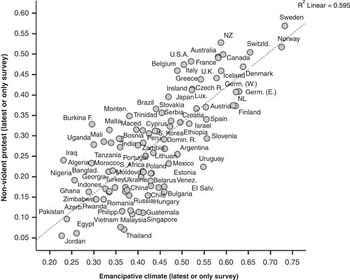
In the case of a fine-graded multi-point index, the arithmetic mean is the most accurate prevalence measure. At least, this is true when the within-societal distributions are single-peaked and clustered about the mean. The index of emancipative values meets these requirements: in each WVS sample, the distribution of emancipative values is single-peaked and clustered about the mean.Footnote 35 Thus, we measure a society's emancipative climate by its respondents’ average on the emancipative values index, ranging from 0.22 in Iraq to 0.75 in Sweden.Footnote 36
In the language of multi-level models, the hypothesized ecological effects of emancipative climates constitute (1) a ‘random intercepts’ model in the case of the elevator effect and (2) a ‘random slopes’ model in case of the amplifier effect. Denoting protest as P, individual-level emancipative values as Ei and societal-level emancipative values as Es,Footnote 37 our hypotheses are formalized by the following equations:

Note: r, u0 and u1 are error terms.
In the language of these symbols, the ecological hypotheses suggest that the regression coefficients γ01 and γ11 are significant and positive.
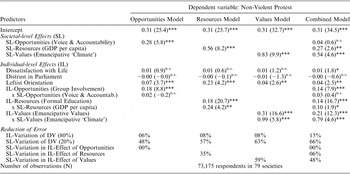
As we have seen, neither differences in sample composition nor in variable modification alter the findings of the DVW Model, but including the ecological measure of emancipative values does. The multi-level models in Table 1 evidence this point.Footnote 38 The first three models introduce each societal-level component of human empowerment – opportunities, resources, values – separately. Consistent with the previous logic, we specify a two-level model for each of the three components of human empowerment, testing (1) whether the component's individual-level manifestation increases protest, and (2) whether the component's societal-level manifestation (a) elevates and (b) amplifies its individual-level effect.Footnote 39 A comparison of the three models will show if our suggestion that values have the strongest ecological effect among the three components of empowerment is correct.
Comparing the separate models, it is clear that the components of human empowerment operate in the same direction. This is evident in three respects. First, the individual-level manifestations of all three components increase people's protest significantly. Second, the societal manifestations of each component elevate people's protest above the level that these people's individual characteristics suggest. Third, the societal-level manifestations of two components amplify the protest effects of the same components’ individual-level manifestations. This is true for resources and values.
But there are also three noteworthy differences. First, individual-level values favour protest more strongly than resources or opportunities favour protest. Specifically, change in individual-level values translates at a ratio of 1:0.31 into change in protest; change in opportunities and resources translates at a ratio of only 1:0.18.Footnote 40 Second, societal-level values elevate protest more than opportunities or resources elevate protest. This is obvious not only from the larger coefficient for values (0.83 compared to 0.56 for resources and 0.28 for opportunities) but also from the larger amount of explained variance: values explain 63 per cent of the cross-national variation in protest, while resources and opportunities explain 57 and 48 per cent, respectively. Third, societal-level values amplify the effect of individual-level values by a much higher factor (0.99) than societal-level resources amplify the effect of individual-level resources (0.24). Opportunities show no amplifier effect whatsoever.Footnote 41
Figure 1 visualizes the elevator and amplifier effects of emancipative values, contrasting societies with weak and strong emancipative climates. Figure 2 plots a society's protest level against its emancipative climate.
Two ecological effects of emancipative values: elevation and amplification

The elevation effect of emancipative values: the cross-sectional evidence

The combined model in Table 1 shows that the findings of the separate models hold under mutual controls.Footnote 42 Not only do values show a stronger individual-level effect on protest than do opportunities and resources, societal-level values also show stronger elevator and amplifier effects than is true for resources and opportunities.Footnote 43 Opportunities even turn insignificant when resources and values are controlled. This shows that, at the societal level, opportunities do not matter in and by themselves; they only matter in conjunction with the resources and values that favour protest. At any rate, among the three components of human empowerment, values are most directly relevant for protest.
Our analysis shows that values are more directly relevant to protest than resources. Previous findings show that values emerge to a large extent in response to resources.Footnote 44 Combining these two insights, the obvious conclusion is that resources affect protest mostly in so far as these resources generate protest-encouraging values. The longitudinal analysis below supports this conclusion even more.Footnote 45
The Longitudinal Evidence
DVW make no attempt to validate their findings longitudinally. Thus, their model does not establish a dynamic relationship. This is a crucial limitation: in the absence of a dynamic relationship, no causal interpretation is possible.
The WVS is not a panel study, so we cannot establish a dynamic relationship at the individual level. But the ecological effect of emancipative climates can be examined for its dynamic underpinnings. If we can indeed establish a dynamic effect of emancipative climates on protest, we have reason to assume that there is a causal relationship. The key question in a dynamic perspective is whether change in a society's level of protest is a reaction to change in the emancipative climate, To answer this question, we model a society's protest level at a later time t 2 as a function of:
(a) this society's protest level at an earlier time t 1, and
(b) change in the society's emancipative climate, as well as change in the other two components of human empowerment from time t 1 to time t 2.
Denoting a society's protest as P, opportunities as O, resources as R and emancipative climates as E, we can formulate this model by the following equation:

This is a lagged dependent variable model that includes the earlier level of protest among the predictors of protest. Doing so ensures that the results are not driven by a causal path from earlier protest on its predictors. This controls for reverse causality and removes endogeneity from the model. Apart from that, the β-coefficient for the lagged dependent variable tells us to what extent a society's level of protest is self-perpetuating over time. The β-coefficients of the delta-variables tell us to what extent protest at time t 2 has been elevated above its level at time t 1 by change from time t 1 to time t 2 in the respective variable.
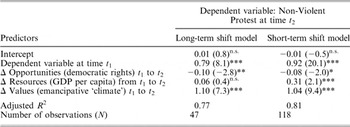
We apply this logic in two variants: a long-term shift model and a short-term shift model. In the long-term shift model, we analyse all forty-seven societies that have been surveyed at least twice and for which the time distance between the earliest and the latest survey covers ten years or more. In this variant, t 1 is specified as the time of the earliest available survey of a society and t 2 as the time of the latest. Here, each society is included only once, so no correction for serial correlation between repeated observations is necessary. The result is shown in the left-hand panel of Table 2.
Emancipative Values’ Elevation Effect in the Longitudinal Dimension

Notes: Entries are unstandardized regression coefficients with T-values in parentheses. Significance levels: the unasterisked values are not significant, but *p < 0.100, **p < 0.050, ***p < 0.010. Short-term shift model includes dummies for the temporal component (fixed effects) to control for serial correlation. Coefficients estimated with ‘seemingly unrelated regressions’ in STATA. For the full system of regressions, see Appendix Table 2. Diagnostics for multicollinearity (variance inflation factors), heteroscedasticity (White test) and influential cases reveal no violation of ordinary least squares assumptions.
In the short-term shift model, we include all societies that have been surveyed at least twice with no restriction as regards the temporal distance between two surveys. As t 1 we specify the time of the previous survey and as t 2 the time of the following survey. In this analysis, societies appear in repeated observations, which require a correction for serial correlations. Thus, we estimate a fixed-effects model as regards the temporal component, introducing a dummy for each of the five time points of the WVS. The effects of these dummies are not of interest, so they are not displayed. We document the results of the short-term shift model in the right-hand panel of Table 2.
For a number of countries, the temporal scope reaches back to 1990 and in some cases even to 1980, the times when the first two rounds of the WVS were conducted. But the ‘voice and accountability’ index is unavailable before 1995. For this reason, we use a different democracy index to measure political opportunities. To be precise, we use an inverted and rescaled version of the Freedom House ratings, which are further qualified by data on human rights repression from the Cingranelli and Richards database.Footnote 46 This index measures democratic freedoms to the extent that they are not undermined by human rights repression. A description of this democracy index is included in the Appendix. It correlates at r = 0.95 (N = 80) with the ‘voice and accountability’ index and is hence a decent surrogate.
In the key points, the results of the two models are similar. Most importantly, change in values from t 1 to t 2 elevates protest at time t 2 above its level at t 1, and it does so more strongly than change in opportunities (whose effect is negative) or change in resources (whose effect is insignificant). This pattern is somewhat less pronounced in the short-term shift model than in the long-term shift model, because, over shorter periods of time, the self-perpetuation of protest is stronger. Yet, it is clear that among the three components of human empowerment, change in values affects protest more strongly than change in opportunities or resources.
The negative coefficient for change in opportunities is noteworthy. It shows that the widening of opportunities diminishes protest. This reflects the fact that in many societies democratization opened opportunities in response to swelling mass protest, which then resulted in diminished protest after the opening. Accordingly, if one includes a dummy variable measuring whether a country experienced a transition to democracy (coded 1) or not (coded 0), the negative effect of change in opportunities turns insignificant. The other effects remain unaffected.
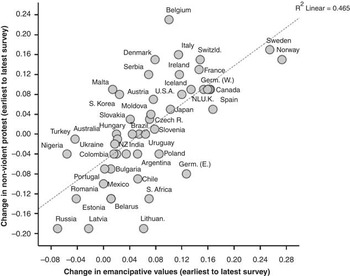
Using a reciprocal system of ‘seemingly unrelated regressions’ (SUR), we examine the models in Table 2 also in the opposite direction, testing the effect of change in protest on change in values. In this direction, we also find a significant and positive effect. Accordingly, changes in the two variables constitute a co-evolutionary system of mutual enforcement. However, the system is asymmetrically reciprocal, operating more strongly from values on protest than in the opposite direction. While change in values favours change in protest at a ratio of 1:1, change in protest favours change in values only at a ratio of 1:0.54 (1:0.48 in the short-term model). This finding suggests that the effect of values on protest is causal. The results of this analysis are documented in Appendix Table 2. For illustrative purposes, Figure 3 plots change in protest from the earliest to the latest available survey against change in values from the earliest to the latest available survey.
The elevation effect of emancipative values: the longitudinal evidence

Conclusion
Most models of human behaviour use psychological variables, including value orientations, but usually the effects of values are examined only at the individual level. The possibility that values have genuine ecological effects is largely overlooked. This is a shortcoming. The social prevalence of a value constitutes a cultural factum in its own right that affects individual behaviour irrespective of whether the individual in question holds the respective value.
This has been demonstrated for a value orientation – emancipative values – and a behaviour – non-violent protest – that both emerge as the process of human empowerment advances. Specifically, we found that the prevalence of emancipative values elevates non-violent protest above the level that people's own emancipative values (and other individual characteristics) suggest. We also found that the prevalence of emancipative values amplifies the extent to which people's own emancipative values elevate their protest activity. These findings hold against various controls and in a longitudinal analysis, which gets us closer to a causal interpretation.
These findings call for a re-examination of human behaviour in multi-level models: psychological variables should not only be tested for their individual-level effects but also for their ecological effects. Only this gives culture its full weight in our effort to explain behaviour.