Introduction
Bulimia nervosa (BN) is an eating disorder with debilitating physical and psychological effects (Becker et al. Reference Becker, Grinspoon, Klibanski and Herzog1999). Moreover, BN severely affects the quality of life of both affected individuals (Simon et al. Reference Simon, Schmidt and Pilling2005) and their families (Winn et al. Reference Winn, Perkins, Walwyn, Schmidt, Eisler, Treasure, Berelowitz, Dodge, Frost, Jenkins, Johnson-Sabine, Keville, Murphy, Robinson and Yi2007). Winn et al. (Reference Winn, Perkins, Walwyn, Schmidt, Eisler, Treasure, Berelowitz, Dodge, Frost, Jenkins, Johnson-Sabine, Keville, Murphy, Robinson and Yi2007) found that the majority of caregivers of individuals with BN experienced significant psychological distress of their own; caregivers' distress was comparable to that of caregivers of individuals with psychosis. The economic costs of BN are also astounding; for example, Simon and colleagues found that costs for BN in Germany were €10 million in 1998 alone. Further, these expenditures are likely underestimated, as only a small proportion of affected individuals seek treatment (Cachelin et al. Reference Cachelin, Veisel, Barzegarnazari and Striegel-Moore2000; Simon et al. Reference Simon, Schmidt and Pilling2005). Thus, BN has significant costs for individuals, families and society.
Despite the devastating effects of BN, and its relatively high prevalence among women in Western society (approximately 1.5% among women in the United States; Hudson et al. Reference Hudson, Hiripi, Pope and Kessler2007), many questions remain about the etiology of this disorder. Emphasis has long been placed on the influence of familial interaction styles and socio-cultural factors on the etiology of eating disorders (for reviews, see le Grange, Reference le Grange, Wonderlich, Mitchell, De Zwaan and Steiger2005; Becker & Fay, Reference Becker, Fay, Wonderlich, Mitchell, de Zwaan and Steiger2006). However, in the last two decades, twin studies have suggested that genetic factors significantly influence BN symptomatology (Kendler et al. Reference Kendler, MacLean, Neale, Kessler, Heath and Eaves1991, Reference Kendler, Walters, Neale, Kessler, Heath and Eaves1995; Bulik et al. Reference Bulik, Sullivan and Kendler1998, Reference Bulik, Sullivan, Wade and Kendler2000; Sullivan et al. Reference Sullivan, Bulik and Kendler1998; Bulik, Reference Bulik2005).
Nevertheless, the validity of the conclusions drawn from twin research, like all psychological research, is dependent upon the quality of both the operationalization of the constructs (or latent variables) of interest and the measurement approach used to assess these constructs. The operationalization of BN can be problematic, particularly because diagnostic criteria have changed across revisions of the DSM and, currently, the BN criteria, like those of all eating disorders, are hotly debated (e.g. Bulik et al. Reference Bulik, Hebebrand, Keski-Rahkonen, Klump, Reichborn-Kjennerud, Mazzeo and Wade2007; Wilfley et al. Reference Wilfley, Bishop, Wilson and Agras2007). Previous studies of the heritability of BN (Kendler et al. Reference Kendler, MacLean, Neale, Kessler, Heath and Eaves1991, Reference Kendler, Walters, Neale, Kessler, Heath and Eaves1995; Bulik et al. Reference Bulik, Sullivan and Kendler1998; Sullivan et al. Reference Sullivan, Bulik and Kendler1998) have generally investigated this disorder using a ‘sum score’ approach, in which items assessing DSM criteria are aggregated to form a diagnostic composite. However, more recent research has suggested that, because individual items are rarely pure indicators of a single latent factor, sum scores might confound measurement of the latent trait by ignoring item-specific variance components (Neale et al. Reference Neale, Lubke, Aggen and Dolan2005). For example, if the amount of heritability differed greatly for individual items, the heritability of their sum score could be either over- or underestimated. Further, individual symptoms of a disorder such as BN are likely differentially influenced by genetic and environmental factors (Bulik et al. Reference Bulik, Hebebrand, Keski-Rahkonen, Klump, Reichborn-Kjennerud, Mazzeo and Wade2007). Thus, the current study used an item-factor approach, including all items assessing DSM-IV criteria for BN, to assess additive genetic, common environmental and unique environmental influences on this disorder.
In addition to the construct validity of BN measures, the validity of the twin model itself is dependent upon non-violation of the equal environment assumption (EEA). The EEA posits that MZ and DZ twins share to an equal extent those environmental influences that are: (a) etiologically relevant to the trait or diagnosis under investigation; (b) not elicited by the twins (Kendler et al. Reference Kendler, Neale, Kessler, Heath and Eaves1993; Klump et al. Reference Klump, McGue and Iacono2000b). The validity of the EEA is trait-specific and must be examined for each diagnosis of interest. If the EEA is violated, then greater MZ (versus DZ) correlations could be a result of non-genetic effects and heritability may be over-estimated (Fairburn et al. Reference Fairburn, Cowen and Harrison1999). Previous studies have examined the validity of the EEA in eating disorders (e.g. Kendler et al. Reference Kendler, Neale, Kessler, Heath and Eaves1993; Hettema et al. Reference Hettema, Neale and Kendler1995; Bulik et al. Reference Bulik, Sullivan and Kendler1998; Klump et al. Reference Klump, Holly, Iacono, McGue and Willson2000a), and results have generally suggested that this assumption was not violated, with a few exceptions (e.g. Hettema et al. Reference Hettema, Neale and Kendler1995). However, no previous studies have used a quantitative factor-score measure of twins' environments, such as that recently evaluated by Mitchell et al. (Reference Mitchell, Mazzeo, Bulik, Aggen, Kendler and Neale2007), as a definition variable, or moderator, within a biometric model. This approach enables a direct examination of the moderating influence of rearing twins similarly (i.e. EEA factor scores) during childhood and adolescence. This separate assessment of childhood and adolescent environment seems particularly relevant to eating disorders, as research has suggested that the influence of genetic and environmental factors changes over the course of development, particularly following puberty in girls (e.g. Klump et al. Reference Klump, McGue and Iacono2000b).
Thus, the present study had two aims. First, we examined genetic and environmental contributions to variance specific to each BN symptom (as well as the overall BN liability) using an item-factor modeling approach. This method resolves many problems associated with summing items assessing symptoms of an overall diagnosis. Use of this modeling method enables investigation of: (a) how strongly BN symptoms (observed variables) are related to the latent trait (BN); and (b) the proportions of variance due to genetic and environmental influences for the latent trait and individual items (Neale et al. Reference Neale, Lubke, Aggen and Dolan2005). Second, we investigated the validity of the EEA, as applied to BN, in a population-based sample of female twins. The following sections briefly review: (1) evidence for genetic influences on BN symptoms; (2) previous investigations of the validity of the EEA for BN.
Heritability of bulimia nervosa symptoms
Binge eating
Previous studies have found that additive genetic effects account for significant variance in binge eating, with heritability estimates ranging from 41% to 82% (Bulik et al. Reference Bulik, Sullivan and Kendler1998, Reference Bulik, Hebebrand, Keski-Rahkonen, Klump, Reichborn-Kjennerud, Mazzeo and Wade2007; Sullivan et al. Reference Sullivan, Bulik and Kendler1998; Reichborn-Kjennerud et al. Reference Reichborn-Kjennerud, Bulik, Kendler, Røysamb, Maes, Tambs and Harris2003.). However, operationalization of this construct has been critiqued due to difficulties interpreting specific aspects of the definition, including ‘loss of control’, ‘large amount’ and ‘short period of time’ (Bulik et al. Reference Bulik, Hebebrand, Keski-Rahkonen, Klump, Reichborn-Kjennerud, Mazzeo and Wade2007; Wilfley et al. Reference Wilfley, Bishop, Wilson and Agras2007). Thus, estimates of genetic and environmental influences might be confounded by these limitations. Use of item-factor modeling can help address this interpretive issue by providing separate estimates for items assessing binge eating and perceived loss of control.
Compensatory behaviors
A range of compensatory behaviors could be included under this criterion (including vomiting, laxative/diuretic abuse and excessive exercise); however, the most frequently studied is self-induced vomiting. This symptom is significantly influenced by additive genetic factors [e.g. a2=0.72, 95% confidence interval (CI) 0.55–0.88; Sullivan et al. Reference Sullivan, Bulik and Kendler1998]. Moreover, as Bulik et al. (Reference Bulik, Hebebrand, Keski-Rahkonen, Klump, Reichborn-Kjennerud, Mazzeo and Wade2007) noted in their review, self-induced vomiting appears to be more reliably measured than binge eating, which can be challenging to assess due to the difficulties involved in interpreting this criterion discussed in the previous paragraph.
Binge eating frequency and duration
Twin studies have not examined heritability of the BN criterion, requiring that binge eating occurs for at least 3 months (Bulik et al. Reference Bulik, Hebebrand, Keski-Rahkonen, Klump, Reichborn-Kjennerud, Mazzeo and Wade2007). However, researchers have found few, if any, differences between participants who binged once per week and those who binged more frequently. For example, Spoor et al. (Reference Spoor, Stice, Burton and Bohon2007) found no differences in degree of psychosocial impairment or mental health care utilization between women who engaged in binge eating and compensatory behavior at subthreshold (one to seven times per month) and threshold (eight or more times per month) levels. These authors also found that duration of BN symptomatology was not associated with either psychosocial impairment or mental health care utilization. Based on these results, Spoor et al. conclude that the DSM-IV frequency criterion for BN may be excessive.
Undue influence of weight and shape on self-evaluation
As Mazzeo et al. (Reference Mazzeo, Mitchell, Bulik, Reichborn-Kjennerud, Kendler and Neale2009) have noted, findings regarding the influence of genetic and environmental factors on weight concern or the undue influence of appearance on self-evaluation have been mixed, with some studies indicating that this construct is significantly influenced by shared and unshared environment (e.g. Wade et al. Reference Wade, Martin and Tiggemann1998; Reichborn-Kjennerud et al. Reference Reichborn-Kjennerud, Bulik, Kendler, Roysamb, Tambs, Torgersen and Harris2004), and others finding that additive genetic factors contribute significantly (Keski-Rahkonen et al. Reference Keski-Rahkonen, Bulik, Neale, Rose, Rissanen and Kaprio2005). These inconsistencies may be related to variability in the measures used and subtle differences in the latent constructs assessed (Bulik et al. Reference Bulik, Hebebrand, Keski-Rahkonen, Klump, Reichborn-Kjennerud, Mazzeo and Wade2007).
In the only study to date to use an item-factor modeling approach to assess the genetic and environmental contributions of variance to the influence of weight on self-evaluation, Mazzeo et al. (Reference Mitchell, Mazzeo, Bulik, Aggen, Kendler and Neale2009) found evidence of moderate influences of additive genetic factors (a2=0.29) on liability to this construct within a sample of Norwegian female twins. Unshared environment was the strongest contributor to variance in this construct (e2=0.62), while the influence of shared environment was small (c2=0.08). However, in addition to the measurement and construct validity issues noted above, results were also likely influenced by the questionnaire format. Specifically, because this was a population-based survey of numerous disorders, gateway items were used to reduce participant burden. Thus, only a subgroup of the sample, namely, those with a low enough body mass index (BMI) to be considered for the anorexia nervosa (AN) diagnosis, were included in the analyses. The authors concluded that their results suggest that genetic and environmental factors might operate differently within individuals already at a low BMI, compared with the general population. Moreover, these findings highlight the importance of studying specific symptoms within subgroups of interest, as heritability may differ across subgroups that vary in their risk of the disorder under investigation.
The equal environment assumption in twin studies of bulimia nervosa
The second aim of the present study was to investigate further the validity of the EEA, applied to BN, in a population-based sample of female twins. A variety of twin environment measures have been used in previous studies. For example, Kendler et al. (Reference Kendler, Neale, Kessler, Heath and Eaves1993) conducted one of the first tests of the EEA in twin studies of BN and found that parents' perceptions of their twins' zygosity had no effect on rates of broadly defined BN in a population-based sample.
Similar results (based on the same sample) were found by Sullivan et al. (Reference Sullivan, Bulik and Kendler1998), who measured six aspects of common environment: childhood treatment (e.g. being dressed alike); co-socialization during childhood and adolescence; similitude (e.g. emphasis placed by parents and teachers on twins' similarity); physical similarity (rated using photographs); degree of adult contact; parents' ratings of the degree to which they emphasized twins' similarities. No EEA violations were found for either binge eating or vomiting.
However, other investigations have raised concerns about the validity of the EEA in twin studies of eating disorders. Bulik et al. (Reference Bulik, Sullivan and Kendler1998) investigated the EEA (using the measures described above) in a study of binge eating and broadly defined BN. They did not find any EEA violations for binge eating; however, twin co-socialization was associated with BN concordance. Hettema et al. (Reference Hettema, Neale and Kendler1995) examined the validity of the EEA in a range of psychiatric disorders, including broadly defined BN. EEA was evaluated using ratings of twins' physical similarity in photographs, as well as parents' and twins' assessments of physical similarity. Results indicated that twins who looked more alike were more vulnerable to BN.
Nonetheless, limitations of Hettema et al.'s study (Reference Hettema, Neale and Kendler1995) have been noted (Klump et al. Reference Klump, Holly, Iacono, McGue and Willson2000a). Klump and colleagues note that physical similarity and BN status might have been confounded in the Hettema et al. study because the photographs used were of adult twins, the majority of whom had passed the average age of onset for BN (sample mean age 30.1 years). Thus, it is unclear whether physical similarity was evident before the development of BN, or whether concordant twins became more physically similar because of the effects of eating disorder symptomatology on their appearance. Consequently, Klump et al. (Reference Klump, Holly, Iacono, McGue and Willson2000a) studied adolescents and included multiple measures of physical similarity, including photographs, body shape ratings and BMI. They found no associations between physical similarity and twins' scores on a measure of eating attitudes and behaviors, supporting the validity of the EEA.
The current study incorporates factor scores on latent EEA traits into a twin model as definition variables to determine the magnitude of potential EEA violations. If results indicate that the EEA is violated, then those aspects that contribute to twin similarity in eating pathology can be used as moderators in subsequent research. Further, this study uses a recently validated measure of the EEA (Mitchell et al. Reference Mitchell, Mazzeo, Bulik, Aggen, Kendler and Neale2007), which assesses both childhood and adolescent aspects of twins' environment. Measurement of both these time periods is particularly relevant to studies of eating disorders, as genetic and environmental influences on liability appear to operate differently in girls of different ages (e.g. Klump et al. Reference Klump, McGue and Iacono2000b, Reference Klump, Burt, McGue and Iacono2007; Silberg & Bulik, Reference Silberg and Bulik2005).
Method
Participants
This study includes MZ (n=614) and DZ (n=410) female twins from the population-based Virginia Twin Registry (Kendler & Prescott, Reference Kendler and Prescott1999), now part of the Mid-Atlantic Twin Registry. DZ female twins with male co-twins were not included in these analyses. A total of 27 participants met criteria for BN, as defined by DSM-IV criteria (APA, 2000). The mean age of twins in this study was 40.44 (s.d.=8.34).
These data, which were part of a multi-wave, ongoing data collection, have been described elsewhere (Kendler & Prescott, Reference Kendler and Prescott2006). Of note, this sample overlaps with those used in earlier studies of BN (Kendler et al. Reference Kendler, MacLean, Neale, Kessler, Heath and Eaves1991, Reference Kendler, Walters, Neale, Kessler, Heath and Eaves1995; Bulik et al. Reference Bulik, Sullivan and Kendler1998).
Measures
Bulimia nervosa symptoms
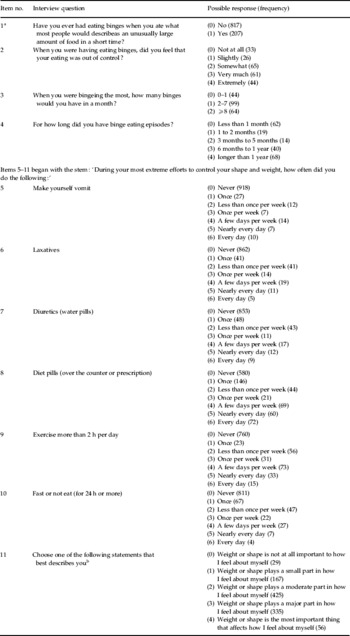
Items based on DSM-IV (APA, 2000) criteria for BN were adapted from the Structured Clinical Interview for DSM-IV (First et al. Reference First, Spitzer, Gibbon and Williams1997) and administered in a self-report survey (see Table 1 for a summary of items). Of note, if participants reported never binge eating, they skipped subsequent items related to binge eating; however, they did answer items assessing compensatory behaviors and the influence of weight on self-evaluation. A total of 207 women reported that they had ever binged. Binge eating was scored dichotomously; all other items were assessed using ordinal scales. The item assessing the number of binges per month used a free-response format. These responses were trichotomized (0–1, 2–7 and ⩾8 binges per month) for model-fitting
Item numbers, corresponding interview questions, and scoring

a If participants indicated that they had never binged, they skipped to the next section of the questionnaire.
b This is a general question and is not specific to any time period.
Equal environments
Seven items measuring twins' equal environments were included in the survey (Kendler & Gardner, Reference Kendler and Gardner1998). These items, which assess childhood and teenage environmental similarity, were based on Loehlin & Nichols' (Reference Loehlin and Nichols1976) work. Using exploratory and confirmatory factor analytic techniques, Mitchell et al. (Reference Mitchell, Mazzeo, Bulik, Aggen, Kendler and Neale2007) extracted two correlated (r=0.59) factors, labeled ‘child’ and ‘teen’ and confirmed that two items loaded on each factor. The child factor is assessed by the items, ‘when you were children, up to the age of 13, how often did you and your twin share the same room?’ and ‘when you were children, how often did you and your twin dress alike?’ The teen factor is assessed by the items, ‘as teenagers, how often would you and your twin have the same friends?’ and ‘as teenagers, how often would your twin go out with you if you went to the movies or a dance?’ In the current study, factor scores were created for the child and teen factors; these were used as definition variables in the model of the impact of equal environments on BN. Note, only one factor score per twin pair was used in the models.
Analyses
Factor scores were estimated from the factor model of the equal environments items using Mplus (Muthén & Muthén, 1998–Reference Muthén and Muthén2006). Mx (Neale et al. Reference Neale, Boker, Xie and Maes2003) was used for twin modeling. An item-factor modeling approach (Neale et al. Reference Neale, Aggen, Maes, Kubarych and Schmitt2006a) was used for the analyses. This method, which has been applied to the analysis of AN symptoms (Mazzeo et al. Reference Mazzeo, Mitchell, Bulik, Reichborn-Kjennerud, Kendler and Neale2009), is a latent trait model that is formally equivalent to a two-parameter normal ogive item response and is an application of the common factor model to multivariate binary or ordinal data, such that the likelihood of item data is computed conditional on the latent trait. The model estimates a ‘location’ on the factor liability scale for each diagnostic criterion, which is the point on the liability scale where there is 0.5 probability of endorsing the criterion. That portion of variance unique to each BN criterion, and not accounted for by the common factor, was also estimated. Marginal maximum likelihood estimation was used, in which the overall likelihood is computed by integrating over the latent trait. This method utilizes a finite mixture distribution, which is specified for points on the latent trait. Gaussian quadrature weights were used to weight the likelihood at latent trait values; the weighted likelihoods are summed in order to compute the overall likelihood. Of note, use of at least 10 points provides a good approximation (Neale et al. Reference Neale, Aggen, Maes, Kubarych and Schmitt2006a).
Due to skip patterns in the survey (regarding binge eating, noted above), there were missing data. Selection effects from ‘gateway’ items can impact estimation of the covariation among the items, which is essential for fitting the factor model. Specifically, for a single binary gateway item with individual record data, there will be no variance on the gateway item when data on the probe items are available, because individuals must endorse the gateway item in order to be asked the probe items. Ultimately, this zero variance problem can affect validity of factor analyses. However, joint analysis of gateway and probe items collected from twin pairs overcomes this problem, because the covariance between the gateway item and the co-twin's probe items is available (Neale et al. Reference Neale, Harvey, Maes, Sullivan and Kendler2006b).
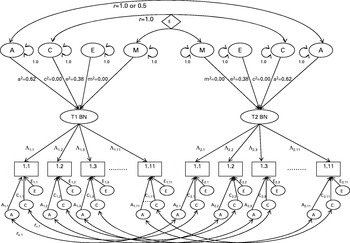
Three main types of parameters are estimated in this model: (1) thresholds (location), which reflect the probabilities that the BN symptoms are endorsed; (2) factor loadings, which estimate association between the latent trait and each of the symptoms; (3) sources of variance of the latent trait. The factor variance is partitioned into influences due to additive genetic (A), shared environment (C) and specific or individual environment (E) effects. A fourth source of variance was also estimated: that due to shared twin experiences (M). Factor scores (first child and then teen) were added as a moderator of the shared environment covariance parameter (Fig. 1).
Factor scores. Only four items per twin are shown. ◊=factor scores on the latent equal environment assumption trait as a definition variable. Λ1.1 denotes the factor loading for the first item, for twin 1. A1.1 denotes the residual variance due to A for the first item, for twin 1. r a.1=1.0 or 0.5 and denotes the twin correlation for the residual components due to A for the first item, etc. r c.1=1.0 and denotes the twin correlation for the residual components due to C for the first item, etc.

In biometric modeling, additive genetic effects are specified to contribute twice as much to the covariance between MZ twins as DZ twins because, generally, MZ twins share all of their genes, whereas DZ twins on average share half. Environmental influences shared by members of a twin pair are specified to correlate 1.0 among twins, regardless of whether they are MZ or DZ. Specific environmental influences are those that are assumed to be unique to each twin and therefore uncorrelated among MZ and DZ twin pairs. In this model, each item's observed variance is decomposed into two types: that shared with the latent factor and that portion unique to the item (residual or unique variance), including measurement error. Residual variance for each item was partitioned into A, C, and E influences.
An ACE model was compared with the full ACEM model to test for EEA violations using a likelihood ratio test (Δχ2). A significant χ2 difference indicates that model fit worsens when parameters are fixed to zero. If dropping the path from M does not significantly worsen model fit, the EEA is tenable. CIs are reported as well, to evaluate further the statistical precision of the measured similarity parameter and of the A, C and E parameters. Akaike's Information Criterion (AIC) values for the models, computed as −2lnL to 2df (Akaike, Reference Akaike1987) are also reported. However, this index, under certain conditions, may over-simplify models (Sullivan & Eaves, Reference Sullivan and Eaves2002) and was not used to evaluate model fit.
Results
Child equal environment factor
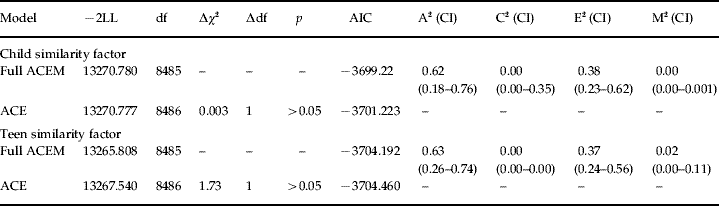
An ACEM item-factor model was first fit to the MZ and DZ twin data (see Table 2 for fit statistics for all models). The MZ correlation (r=0.62) was higher than the DZ correlation (r=0.31), suggesting that BN is heritable. The largest proportion of variance in latent BN liability was due to additive genetic effects (a2=0.62, 95% CI 0.18–0.76), with the remainder due to unique environmental influences (e2=0.38, 95% CI 0.23–0.62); the effects of the common environment (c2=0.00, 95% CI 0.00–0.35) and measured similarity (m2=0.00, 95% CI 0.00–0.001) were estimated at nearly zero. A comparison of the ACE model to the full ACEM model indicated that dropping the moderation parameter on the shared environment covariance did not significantly worsen model fit, as indicated by a χ2 test (Δχ2=0.003, df=1, p>0.05).
Summary of fit information for the full ACEM model as well as ACE, AE, and CE submodels

−2LL, −2 log-likelihood; AIC, Akaike's Information Criterion; CI, 95% confidence intervals; A, additive genetic influence on the latent trait; C, common environmental influence on the latent trait; E, unique environmental influence on the latent trait.
Thus, the AE model provided the most parsimonious fit (AIC −3708.788).
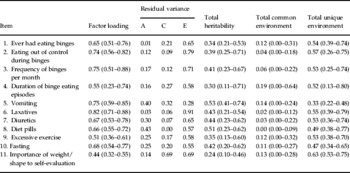
This model also provides information regarding the covariation among the BN criteria and their variances. This information is obtained by examination of the latent BN factor loadings and residual variances. All factor loadings were significant, ranging from 0.45 to 0.82 (Table 3). Residual variance for each item was partitioned into A, C and E influences. For nearly all items, the largest amount of residual variance was due to unique environment and measurement error (Table 3). However, the majority of residual variance for vomiting (40%; item 5) and diet pills (43%; item 8), which are compensatory behaviors, was due to additive genetic effects. Several items had modest residual variance due to common environmental factors: binge eating (21%, item 1); duration of binges (27%, item 4); use of vomiting (32%, item 5); excessive exercise (17%, item 9); fasting (20%, item 10); influence of weight and shape on self evaluation (69%, item 11).
Item factor loadings, residual variances, and heritability estimates (95% confidence intervals)

A, Additive genetic influence on the latent trait; C, common environmental influence on the latent trait; E, unique environmental influence on the latent trait.
Total heritability for each individual item (i) was computed as the product of the item's squared factor loading (λ) and a2 for the latent trait, added to the product of one minus the item's squared factor loading and the amount of the item's residual variance due to A, termed as2. This equation, where λi is the factor loading for the ith item, is as follows:

Similarly, total shared and unique environmental influences on each item were computed using this equation, respectively substituting c2 or e2 and residual variance due to C or E. Four items (5, 6, 7, 8), assessing use of vomiting, laxatives, diuretics and diet pills as compensatory behaviors, had heritability estimates ranging from 0.43 to 0.53. Loss of control during binges (item 2), frequency of binge eating (item 3) and fasting as compensatory behavior (item 10) had estimates ranging from 0.39 to 0.42. Heritability estimates for binge eating (item 1) and use of excessive exercise as a compensatory behavior (item 9) were 0.34 and 0.35, respectively. Finally, binge eating duration (item 4) and the effect of weight and shape on self-evaluation (item 11) had heritability estimates of 0.30 and 0.24, respectively.
Teen equal environment factor
The same model was fit to the data using factor scores on the teen similarity factor as a definition variable. We do not present factor loadings and item-specific variances for this model, as these results are nearly identical to the previous model. As with the child factor, the effect of measured similarity was estimated at nearly zero (95% CI 0.00–0.11). Dropping this parameter from the full ACEM model did not significantly worsen fit (see Table 2).
Discussion
Diagnosis and classification of eating disorders, including BN, has recently received a great deal of scrutiny (e.g. Bulik et al. Reference Bulik, Hebebrand, Keski-Rahkonen, Klump, Reichborn-Kjennerud, Mazzeo and Wade2007) and some have suggested that current DSM-IV criteria have ‘fundamental flaws’ (Fairburn & Cooper, Reference Fairburn and Cooper2007, p. S107). One challenge is that current eating disorder diagnoses comprise a range of specific symptoms, of which a minimum count is required to meet diagnostic criteria. This may not be optimal if individual symptoms do not relate to the underlying disorder phenotype in the same way. Further, from a genetic epidemiological perspective, it is plausible that distinct criteria are differentially influenced by genetic or environmental factors. This study used an item-factor model to investigate the influence of genetic and environmental factors to both the overall BN diagnosis and to specific symptoms. This study also evaluated the validity of the EEA, applied to BN, as this assumption is fundamental to twin research.
Results indicated that BN liability was significantly influenced by additive genetic factors; unique environmental factors also significantly influenced BN at the factor level, but to a lesser degree. In a study examining the genetic epidemiology of broadly defined BN, Bulik et al. (Reference Bulik, Sullivan and Kendler1998) also found that an AE model provided the best fit. Further, these authors found a similar heritability estimate (60%) when BN was assessed using a single interview.
Item-level analyses suggest that, although the overall diagnosis of BN may be highly influenced by genetic factors, not all symptoms are equally heritable. In particular, current results are consistent with studies supporting the role of environmental factors on the influence of weight on self-evaluation (e.g. Wade et al. Reference Wade, Martin and Tiggemann1998; Reichborn-Kjennerud et al. Reference Reichborn-Kjennerud, Bulik, Kendler, Roysamb, Tambs, Torgersen and Harris2004). Further, the unique environment most strongly influenced liability to this symptom in this study. Thus, perhaps, important targets for intervention and prevention are experiences that occur outside of the family, such as competing in an appearance-oriented activity or sport (e.g. dance, modelling, or gymnastics), teasing by peers or stressors such as abuse, which are only experienced by one member of a twin pair. However, additional research is needed to evaluate this hypothesis, because (E), the component of the model that evaluates unique environmental experiences, also assesses variance attributable to measurement error. These two sources of variance cannot be separated in traditional twin models. Thus, future studies should attempt to extend the current findings and evaluate measurement error and unshared experiences separately.
Results of this study also indicated that self-induced vomiting was the symptom most strongly influenced by additive genetic factors. Sullivan et al. (Reference Sullivan, Bulik and Kendler1998) also found a strong influence of additive genetic effects on self-induced vomiting, although their heritability estimate was somewhat higher. Of note, binge eating was only moderately influenced by additive genetic effects; the unique environment contributed most strongly to variance in this symptom. This heritability estimate is lower than that obtained in previous studies of binge eating (which have ranged from 41% to 82%; Bulik et al. Reference Bulik, Sullivan and Kendler1998, Reference Bulik, Hebebrand, Keski-Rahkonen, Klump, Reichborn-Kjennerud, Mazzeo and Wade2007; Sullivan et al. Reference Sullivan, Bulik and Kendler1998; Reichborn-Kjennerud et al. Reference Reichborn-Kjennerud, Bulik, Kendler, Røysamb, Maes, Tambs and Harris2003). However, differences in analytic strategy, particularly the current study's use of the item-factor approach, might partially account for these inconsistencies.
The remainder of BN symptoms assessed in this study appear to be best accounted for by a mixture of moderately strong additive genetic factors and unique environmental influences. As noted above, the unique environment component of item-level variance in this model also includes measurement error. Repeated measures might be used to estimate variance due to this latter source. These results are consistent with those of another investigation (Wade et al. Reference Wade, Bergin, Martin, Gillespie and Fairburn2006), which found that unique environmental factors contributed substantially to the number of lifetime eating disordered behaviors. Future research should examine the influence of specific experiences on the development of eating disorder symptoms in individuals with known genetic risk for AN or BN. Such work would facilitate understanding of potential gene environment interactions and inform prevention. Individual differences in methylation may also contribute to the specific environment variance component, as MZ twins do not correlate perfectly for their gene activation (Kato et al. Reference Kato, Iwamoto, Kakiuchi, Kuratomi and Okazaki2005). In addition, further investigation of the structure of BN is warranted; the current results suggest that, although all items had relatively large loadings on the latent diagnostic factor, some, most notably the influence of weight on self-evaluation, were lower.
Finally, results of the current study suggested that the EEA was not violated. It is important to examine this assumption because it is fundamental to the validity of results yielded by twin modeling. This study used a recently validated measure of the EEA (Mitchell et al. Reference Mitchell, Mazzeo, Bulik, Aggen, Kendler and Neale2007) and found no evidence of any violations, consistent with the majority of previous studies in this area (e.g. Kendler et al. Reference Kendler, Neale, Kessler, Heath and Eaves1993; Klump et al. Reference Klump, Holly, Iacono, McGue and Willson2000a).
Limitations of this study should be noted. First, the sample included exclusively European–American female twins. It is unclear whether these results are applicable to men, non-twins or other cultural groups. Second, like many other twin studies, our sample includes a greater proportion of MZ twins and individuals with above-average levels of education (Lykken et al. Reference Lykken, McGue and Tellegen1987). Third, BN symptoms were assessed using single-item measures, which might attenuate reliability (Crocker & Algina, Reference Crocker and Algina1986) and potentially confound heritability estimates. However, given that this was a large population-based survey that addressed multiple disorders and their correlates, the survey needed to be as concise as possible to reduce participant burden and fatigue. Finally, lifetime BN symptoms were evaluated in this study to increase statistical power. Thus, results may have been influenced by recall bias.
Despite these limitations, this study has several strengths, including the use of a large, population-based sample and symptom level modeling. Such results provide much richer data informative to the development of liability indices (Bulik et al. Reference Bulik, Hebebrand, Keski-Rahkonen, Klump, Reichborn-Kjennerud, Mazzeo and Wade2007). Future studies should extend this work to inform treatment and prevention efforts.
Acknowledgements
This research was supported by the National Institutes of Health Grants MH-068520 (Mazzeo), MH-20030 (Mitchell), MH66117–05 (Bulik, Devlin PI), MH-65322 (Aggen and Neale, Neale PI), and MH-40828 (Kendler). We are very grateful to the twins for their participation.
Declaration of interest
None.