INTRODUCTION
Phallusia nigra is a solitary marine tunicate of the ascidian class found in tropical seas around the world. It usually lives in shallow waters, attached to any hard substrate. Like all tunicates, P. nigra has a thick leathery envelope (tunic) containing cellulosic material. Like all solitary ascidians, the tunic encloses a sac-shaped body with separate water entrance and exit tubes (siphons). It feeds on plankton that it filters from seawater with a mucous net. An adult P. nigra may be 10 cm (3.9 inches) long. The tunic is usually velvet black or dark brown, but may be grey in specimens that are younger or live in shaded areas. Its original distribution is unclear: the tropical Western Atlantic Ocean, the Red Sea, and the Indian Ocean have been proposed (da Rocha et al., Reference da Rocha, da Cruz Lotufo and de Almeida Rodrigues1999).
Ascidians have rapid growth rate, usually a short life span of a few months, reach sexual maturity when only a few weeks old, and produce large numbers of short-lived non-feeding planktonic larvae (Lambert Reference Lambert, Sawada, Yokosawa and Lambert2001, Reference Lambert2002). These characters, combined with the lack of predators, make the ascidians very successful invaders and result in the establishment of huge populations that can change the benthic community of a region (Castilla et al., Reference Castilla, Lagos and Cerda2004; Bullard et al., Reference Bullard, Lambert, Carman, Byrnes, Whitlatch, Ruiz, Miller, Harris, Valentine, Collie, Pederson, McNaught, Cohen, Asch, Dijkstra and Heinonen2007; Dijkstra et al., Reference Dijkstra, Sherman and Harris2007; Valentine et al., Reference Valentine, Collie, Reid, Asch, Guida and Blackwood2007) and economically affect commercially important activities, such as fishing and aquaculture (Bourque et al., Reference Bourque, Davidson, MacNair, Arsenault, LeBlanc, Landry and Miron2007).
Although there are a number of marine organisms located from various parts of the world, little information exists from Iranian coastal waters regarding the distribution of ascidian species. Hence, the present study attempts to describe the presence and distribution of P. nigra from the four different stations along the Persian Gulf coastal waters. The current report is the first of its kind on the Iranian coasts to assess the distribution of P. nigra in the region. These baseline data at the regional level are of great importance because they will provide tools for estimating the possible effects on the natural fauna at the invaded sites in the years to come.
MATERIALS AND METHODS
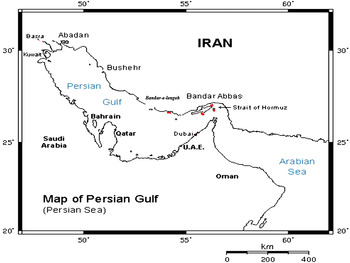
Ascidian specimens were collected from four sites (Larak Island, Hengam Island, Qeshm Island and Bandar-e-Lengeh) along the Iranian coasts (Persian Gulf) using SCUBA and snorkelling diving at depths ranging from 5–15 m between March and November 2011 (Figure 3). Estimation of ascidian populations at the surveyed sites was carried out using underwater visual transects. Direct visual assessment is the method conventionally used and is effective for the direct enumeration of specimens of epifauna (Lokani et al., Reference Lokani, Matoto and Ledua1996). At each site, transects were made covering the different depths. The length of each transect was about 100 m. Five replicates were made at each depth. Along each transect, 5 quadrates of 10 m × 10 m (100 m2) were made. The shallow areas were surveyed by snorkelling and the deep areas were surveyed by SCUBA diving. The population density of ascidians inside each quadrate was counted and expressed as number of individuals per 100 m2. The total population was estimated for all the surveyed sites.
Upon sampling, the ascidians were narcotized with menthol crystals in a closed jar to prevent evaporation of the menthol and transferred to the Marine Biology Laboratory of Islamic Azad University, Bandar Abbas branch. Only after the samples were fully relaxed, determined by inserting a sharp probe into an open siphon and getting no response, the samples were transferred to a jar with seawater/formalin fixative after rinsing the menthol crystals from the bodies of the animals. The fixative was prepared according to the following formula for 1 l of fixative use: 100 ml of full-strength formaldehyde, 850 ml of seawater, and 50 ml of distilled water (Shenkar & Loya, Reference Shenkar and Loya2009). Taxonomic identification was carried out using authoritative keys and literature, such as Van Name (Reference Van Name1921, Reference Van Name1931, Reference Van Name1945), Kott (Reference Kott1985, Reference Kott1990, Reference Kott1992, Reference Kott2001), Monniot et al. (Reference Monniot, Monniot and Laboute1991) and Monniot & Monniot (Reference Monniot and Monniot2001).
RESULTS
Phallusia nigra (Savigny, 1816) only was identified at all sampling areas (Larak Island, Hengam Island, Qeshm Island and Bandar-e-Lengeh). The highest density was recorded in Bandar-e-Lengeh (85 individuals 100 m2) while the lowest density was recorded in Larak Island (12 individuals 100 m2). In Hengam and Qeshm Islands P. nigra densities were recorded between 45 and 58 individuals 100 m2. Phallusia nigra (Savigny, 1816) is a solitary Ascidiidae, whose individuals are easily recognized by the shiny black dark-blue tunic and smooth surface. The body is oval with elongated siphons separated by a third to half the body length. The openings of the two siphons are round with fringed edges. Its right side is characterized by a thick cartilaginous and smooth-to-the- touch tunic with protrusive blood vessels. Specimens can reach 10 cm in length. Distribution along the north coast of the Persian Gulf was determined at all investigated sites and found to be common in shallow to 15 m depth, overgrowing both natural and artificial substrates. All samples were found to have well developed gonads.
DISCUSSION
In the present study, a maximum number of P. nigra was recorded in Bandar-e-Lengeh. Inasmuch as this station is a major handling port, subsequent heavy transportation may be the cause of P. nigra settling here. Moreover, in this station the presence of concrete submerged blocks, marine floats, buoys, boulders and prolonged unused barges, provide suitable substratum and conditions for ascidian settlement and dispersion.
Next to Bandar-e-Lengeh, the maximum number of P. nigra was recorded in Qeshm Island followed by Hengam Island. This may be because these stations are situated near the fish landing centre with many seagoing mechanized boats and the presence of plenty of boulders and pebbles, which probably provide suitable substratum for the settlement of larval forms of P. nigra.
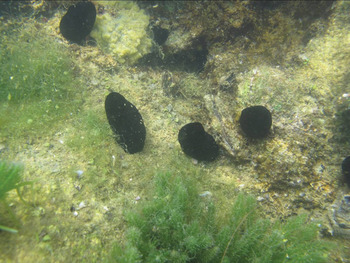
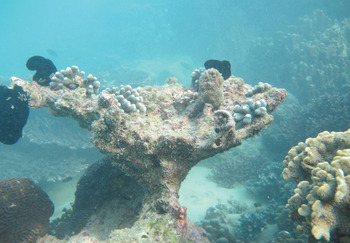
Figures 1 and 2 illustrate the settlement of P. nigra over the coral reef and competition for substrate with gastropods in Larak and Hengam Island stations.
Competition of Phallusia nigra for substrate with gastropods in Hengam Island (Persian Gulf).

Phallusia nigra settlement over the coral reef in Larak Island (Persian Gulf).

The study area in Larak Island, Hengam Island, Qeshm Island and Bandar-e-Lengeh along the Iranian coast (Persian Gulf).

A variety of substrata, such as boulders, pebbles and concrete structures are lacking at Larak Island station. Therefore, the density of P. nigra at this station was comparatively less than other stations. Less suitable environmental conditions were available. Frequent cleaning of the hulls and anchors, and control of water discharge, oyster shells and other shellfish refuse, are important management procedures toward the prevention of species dispersal (Glasby et al., Reference Glasby, Connell, Holloway and Hewitt2007). The avoidance of construction of piers or other structures inside the region which would add artificial substrate for colonization of sessile animals and frequent (less than two months) cleaning of existing structures are other prevention measures that should be followed. According to De Felice et al. (Reference De Felice, Eldredge, Carlton, Eldredge and Smith2001), the origin of P. nigra is disputed; it may be native to the Red Sea and the Indian Ocean area, or to the tropical western Atlantic Ocean. Phallusia nigra was previously recorded from Bahrain (Monniot & Monniot, Reference Monniot and Monniot1997) and Oman (Meliane & Esplà, Reference Meliane, Esplà, Claereboudt, Goddard, Al-Oufi and Mcllwain2001) in this region but this is a first record of this species from the north coast of the Persian Gulf.
CONCLUSION
Ascidians along the Persian Gulf have not received much attention and this study is the first record of P. nigra found along the north coast of the Persian Gulf. Expansion of the geographical range of P. nigra should be further investigated with regard to possible lack of predation, because it has been reported that the species has no epibionts and there is a possibility that its tunic acid could be an important means of protection against predation and bio-fouling (Stoecker, Reference Stoecker1980; Hirose et al., Reference Hirose, Yamashiro and Mori2001). The abundance of P. nigra in natural as well as in artificial substrates does not support the conclusion that there is a native or introduced species in the northern part of the Persian Gulf.
ACKNOWLEGEMENT
We thank Françoise Monniot, National Museum of Natural History Laboratory, Biology of Invertebrates, Paris who had kindly assisted us.