International institutions often lack independent enforcement capabilities. As a result, a large and growing body of literature argues that domestic actors play a crucial role in imposing costs on governments who defect from their agreements. International institutions, and dispute-settlement mechanisms in particular, help facilitate international cooperation because these bodies provide a forum to sound the alarm over violations of an agreement. Hearing this alarm, domestic audiences impose noncompliance costs on governments who do not abide by their international obligations. This threat of ex post punishment helps facilitate cooperation, ex ante. This dynamic is at the core of many broader theories of noncompliance costs, such as those based on the informational role of institutions,Footnote 1 credible commitments,Footnote 2 or audience costs,Footnote 3 and has been applied to a variety of issue areas, from international trade agreementsFootnote 4 to bilateral investment treatiesFootnote 5 to human rights.Footnote 6
Yet if institutional alarms trigger noncompliance costs, why is there significant variation in whether and when the alarm sounds? The Dispute Settlement Understanding (DSU) of the World Trade Organization (WTO) is among the world's most active international courts.Footnote 7 However, few would doubt that hundreds, if not thousands, of explicit tariff barriers and hidden nontariff barriers have escaped DSU scrutiny. WTO members often wait months or years before challenging objectionable trade practices. If the victim need only sound the alarm to mobilize domestic audiences against their government's policies, why wait to initiate a dispute and forgo significant amounts of trade cooperation by delaying the alarm?
Existing theories lack leverage on these questions because they often assume the presence of strong, cooperation-supporting audiences who impose noncompliance costs when they hear an institutional alarm. Yet audiences vary in their preferences and strength, which undoubtedly affects their reaction to institutional alarms. Regarding preferences, audiences can vary in the intensity of their dislike of defections, and they frequently support, rather than oppose, noncompliant government policies. Audiences also vary in their strength or ability to influence policy-makers’ political calculi. Government sensitivity varies over time, for example, according to electoral cycles.
This article advances our understanding of these questions theoretically and empirically. First, I provide a theory of institutions as information providers showing (1) the conditions under which the dynamics entailed in often-referenced theories of noncompliance costs arise endogenously, and (2) how variation in audience features affects international institutions’ ability to generate noncompliance costs. The theory generates a conditional hypothesis regarding audience features and dispute decisions. Sounding the alarm is most valuable to the plaintiff country when domestic audiences in the defendant country are most “favorable,” that is, the audience prefers similar changes to the defendant government's policies as the plaintiff desires and when the defendant government cares about those audiences. When those audiences are less supportive of compliance, disputes are less valuable to the plaintiff or potentially harmful, so plaintiffs delay sounding the alarm.
Using competing risks analysis of the timing of trade disputes against the United States, I find support for this prediction. From the perspective of a potential plaintiff, sounding the alarm is least valuable during politically sensitive times in which there is wider support for protectionist measures. I use election years as a proxy for political sensitivity and unemployment, which is a key macroeconomic indicator associated with support for protectionism, as a proxy for audience preferences. US trading partners are more likely to initiate WTO disputes against the United States during election years with lower unemployment and are less likely during election years with higher unemployment.
Apart from explaining important empirical variation, a theory in which noncompliance costs are derived rather than assumed and in which audience features are allowed to vary delivers both good news and bad news for existing theories. The good news is that there are minimal requirements for a dynamic to arise in which institutions can trigger noncompliance costs. The institution need only provide a public and costly mechanism for governments to use as a signal to domestic audiences, and the preferences of the government sending the signal need only be partially aligned with those of the intended audience. The bad news is that, even when the necessary conditions are met, the magnitude of noncompliance costs, and therefore their ability to influence government behavior (as existing theories argue), is constrained by the preferences and strength of those audiences. The institution cannot facilitate cooperation beyond the level desired by the audience.
Audiences and Alarms
International cooperation entails governments making mutually beneficial policy adjustments, but the costliness of these adjustments makes defecting from cooperation, that is, noncompliance, tempting.Footnote 8 International institutions help generate noncompliance costs, making defection less attractive. Because most institutions lack independent enforcement powers, many theories examine domestic sources of noncompliance costs. In one well-known example, Simmons argues that a government's IMF obligation “mobilizes a new set of external actors (private economic, governmental, and legal) who may exert pressure to comply on a government that is considering or engaging in rule violation.”Footnote 9 Yet, the audiences who potentially impose noncompliance costs often cannot perfectly monitor government behavior. A group of firms may find it costly to pool resources and organize into a special interest group to track relevant government policies; voters may not know whether their government has erected illegal trade barriers and face a collective action problem in acting on this information; a private investor may be uncertain about whether a potential host government is likely to expropriate their investments. International institutions help uninformed audiences gain information about government behavior, empowering them to deter noncompliance.Footnote 10
However, audiences are often assumed to have two features: (1) they support compliance and (2) they have the capacity to impose costs on governments that defect.Footnote 11 In reality, audiences vary significantly along both dimensions. Regarding preferences, audiences do not always support policies that are consistent with their government's international agreements, and often support defections. In the case of trade and the WTO, domestic political audiences often support protectionist measures and oppose compliance with adverse WTO rulings. Support for free trade can vary across individuals and vary across time, waxing or waning depending on macroeconomic conditions.Footnote 12 When times are tough economically, protectionism gains public support.Footnote 13 Similar variation occurs in other contexts in which domestic noncompliance costs are important for cooperation. Domestic constituents vary in their support of a government that discriminates against foreign investment, and foreign investors vary in the degree to which they fear expropriation; citizens vary in the degree to which they demand that their government address human rights violations in other countries, and so on.
Audiences also vary in their ability to inflict costs on defecting governments. In making trade policy, some governments care more about the welfare of special interest groups relative to the broader public, while others place greater weight on aggregate welfare.Footnote 14 Regime type is frequently linked to cross-national variation in the degree to which governments care about broader audiences.Footnote 15 Government sensitivity to audience preferences also varies temporally. According to the vast literature on the political business cycle, in the run-up to elections, politicians are particularly attuned to their constituents’ preferences.
Why would variation in audiences’ preferences and strength affect theories of noncompliance costs? Consider a related literature on domestic constitutional courts. Like most international institutions, domestic courts lack independent enforcement power. How then, can domestic courts constrain policy-makers who might otherwise be free to ignore their rulings? The answer for many domestic courts scholars is based on the audiences who observe those rulings.Footnote 16 As Vanberg writes:
If citizens value judicial independence and regard respect for judicial rulings as important, a decision by elected officials to resist a judicial ruling may result in a loss of public support … The fear of such a backlash can be a forceful inducement to implement judicial decisions faithfully.Footnote 17
A key insight of the domestic courts literature is that audience features affect judicial behavior. If the audience does not support adherence to a ruling, policy-makers have increased freedom to choose policies more to their liking and courts are less likely to rule against those policies.Footnote 18 Domestic courts strategically publicize important rulings, based on the anticipated reaction of public audiences.Footnote 19 Carrubba analyzes an international cooperation setting, showing how an institutional mechanism that reveals the costs of noncompliance can help governments better coordinate their punishment strategies.Footnote 20
I model and empirically test a similar intuition in this study. An audience's reaction to learning about government policies once an institutional alarm is sounded depends on the audience's preferences. A compliance-supporting audience might react negatively to learning that its government has broken its international obligations, while a noncompliance-supporting audience might react with ambivalence or even support. The political strength of the audience magnifies these effects. For a noncompliant government, punishment from a strong procompliance audience is worse than punishment by a weak audience.
Audience features also affect the decision over whether or not to use an international institution to transmit information in the first place. In many international institutions, sounding the alarm is not automatic but rather a strategic decision made by member states. Information about noncompliance is transmitted only when one government makes the strategic decision to use the institution to sound the alarm, for example, with a legalized dispute. The anticipated audience reaction affects whether a prospective litigant will find it worthwhile to initiate a costly dispute. The prospect of activating a strong, compliance-supporting audience is most attractive because of the possibility that the audience can pressure its government to comply. Governments facing potential backlash from politically strong procompliance groups might be less inclined to defect in the first place, whereas a government facing a weak backlash might be less fearful of the repercussions from defections.
Relevant Literature on Trade Disputes
Since I will test predictions relating audience features to the timing of WTO disputes, it is useful to briefly summarize some context-specific literature. For international political economy (IPE) scholars, WTO disputes, where one member “sues” another over WTO-illegal trade barriers, are an oft-studied empirical phenomenon. However, existing studies of DSU disputes focus on explaining the occurrence of disputes rather than their timing.
Legal factors help explain dispute occurrence. If a particular tariff is WTO-legal, then it is less likely to be targeted with a DSU dispute. Countries with higher legal capacities initiate more disputesFootnote 21 and countries consider the relative attractiveness of different legal venues.Footnote 22 Some countries file disputes to placate domestic firms, and firms in “static” industries who can tolerate the lengthy DSU process more strongly lobby their government for litigation.Footnote 23 Disputes are also more likely over higher-stakes issues.Footnote 24 Sattler and Bernauer argue that dyads involving larger countries and trade flows experience more disputes.Footnote 25
Although all of these are undoubtedly important explanations for dispute occurrence, they have less leverage over dispute timing since they focus on variables that are largely time invariant. Although these explanators may change somewhat over time — WTO members might agree to change WTO law such that a previously legal practice becomes illegal — they are less well-equipped to explain variation in dispute timing.
Even within dispute-prone dyads, such as the United States / European Union (EU) dyad, there is significant variation in the timing of disputes. For example, after the George W. Bush administration increased tariffs on European steel, the EU reacted immediately. The EU used the DSU to activate politically important procompliance audiences such as orange growers and textile producers in battleground states.Footnote 26 By mobilizing those domestic audiences against the steel tariffs, the EU convinced the United States to back down. Yet, in other instances, the EU has waited months or years before targeting certain US tariffs with a WTO dispute. The EU waited until June 2003 before challenging one particularly contentious US trade policy practice, known as “zeroing,” despite the fact that this practice had been in use for more than a decade.Footnote 27
To be sure, WTO disputes are not massive political issues that cause groundswell changes in audience opinion in the United States. But the notion that disputes increase the information available to the relevant audiences, like import-competing producers or downstream firms or individual consumers, is gaining microfoundational support. Pelc shows that WTO disputes increase web searches related to the issues involved in the dispute because those affected gather more information about relevant policies.Footnote 28
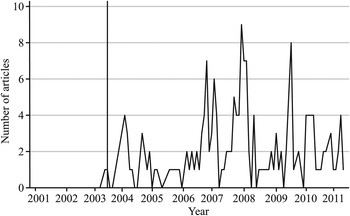
In the earlier US-EU zeroing example, the WTO dispute increased broader awareness and media coverage of the issue in the United States. Figure 1 shows the number of US newspaper and magazine articles covering zeroing over time. Coverage does not begin until June 2003, shortly after the WTO dispute indicated by the vertical black line, when media coverage of zeroing increases sharply, even reaching the pages of the New York Times and Washington Post.Footnote 29 Although these trade issues were far from “capturing the news cycle,” Chang, Golden, and Hill argue that increased media coverage can help the electorate hold politicians accountable.Footnote 30
Amount of US media coverage of zeroing over time

The key here is not that disputes trigger immediate, intense backlashes for or against certain policies, but that potential plaintiffs take into account the political-economic calculus facing the defendant and how the defendant is likely to react. Audience reactions are not the sole determinant of disputes but they can affect decisions at the margin. When times are tough economically, it is easier for politicians to turn to protectionist measures that help save jobs or to stand defiant in the face of a WTO dispute. As economic conditions improve, it is politically easier to support free trade. These conditions can thus affect the defendant's response to a dispute, and in turn, the value to the plaintiff of initiating a costly dispute. Variation in the defendant government's sensitivity to these reactions can magnify or mute the effect of economic conditions.
A Theory of Audience Features and Institutional Alarms
I develop a model of the alarm dynamic in which audience features are allowed to vary and the decision to initiate a costly dispute is endogenous. For concreteness, I describe the model in terms of tariffs and international trade, but the model is generalizable to many international cooperation contexts where an international institution can help an uninformed domestic audience monitor government behavior.
Apart from formalizing the intuition described above, the model has two main benefits. First, it establishes the conditions under which noncompliance costs, like those described in many existing theories, arise endogenously. When those conditions are not met, theories of noncompliance costs arising from domestic audiences are not logically consistent explanations for empirical findings. Understanding these conditions helps assess whether theories like those based on credible commitments or audience costs explain the effects of international institutions in particular contexts.
Second, the model generates empirically testable predictions about how audience features affect government behavior when an institution acts an alarm that triggers domestic noncompliance costs. The appendix contains proofs of all propositions.
The Model
Two countries are trading partners and are members of an agreement that allows them to initiate costly disputes over each other's tariff policies. There are three players in the model: the government of the “Home” country, the “Foreign” government, and an “Audience” within the home country. Each player cares about the tariff, t ∈ ℛ, that the home government levies against imports from the foreign country. The audience can be thought of as any group that lacks perfect information about the home government's tariff policies. For instance, downstream firms paying inflated prices for intermediate production materials may lack perfect information about the tariff policies responsible for those higher prices. Consumers who also pay higher prices as the result of tariffs are similarly uninformed about these policies. These audiences can potentially engage in some costly action to influence the home government's policies. For instance, firms could pay the costs associated with mobilizing into an organized interest group, or constituents can mobilize to punish elected officials or make campaign contributions to the other candidates.
Each of the three players has preferences over the tariff.Footnote 31 The foreign government prefers lower tariffs, and its preferences over tariffs are represented by the utility function: u F (t) = −t. The audience has a most preferred tariff level, t = A, and its preferences over tariff policy are represented by the function: u A (t), which is maximized at t = A, concave, decreasing in t when t > A, and increasing in t when t < A.Footnote 32
The home government's most preferred tariff policy, H, depends on its type. The home government can be a “good” government from the perspective of the audience, and have preferences identical to those of the audience, where H = A. Alternatively, the home government can be a “bad” type whose most preferred policy is t = B > A. There are many ways that politics can drive a wedge between the preferences of the government and the preferences of a particular audience. For example, Grossman and Helpman model government preferences as an aggregation of concern for social welfare and special interest group (SIG) contributions.Footnote 33 SIGs make contributions to rent-seek, and the resulting higher tariffs benefit specific groups, but are costly to aggregate welfare. As a result, the audience's preferences become at least partially aligned with those of the foreign government: both want bad governments to lower tariffs from the levels induced by rent-seeking SIGs. The preferences of the home government are represented by u H (t) and have the same properties as the audience's utility function, apart from the point at which the function is maximized. The probability of a bad home government, Pr(H = B), is λ ∈ (0,1) and is commonly known. The audience does not observe their government's type.
The sequence of the game is as follows. First, Nature selects the home government's type. Next, the home government chooses their initial tariff level, t
1. The foreign government observes the home government's type and initial policy, and draws the costs to initiating a dispute, k, from a commonly known distribution, F(k), which is uniform on the interval
 $\left[{\underline{k}\comma \; \bar k} \right]$
, with
 $\underline{k}\lt 0\lt \bar k$
. These costs, k, describe any of the costs or benefits accrued by the foreign government from a dispute, apart from the dispute's effect on the home government's tariff policy. For instance, these costs could pertain to the actual litigation of legally pursuing a dispute, that is, higher costs. Or they could reflect the domestic pressures to initiate a dispute, such as pressure from interest groups affected by tariffs, with more pressure to file a dispute, acting like a reward for a dispute, (lower costs).Footnote
34
The foreign government then chooses whether or not to initiate a dispute, D or ~D. Whether or not the foreign government observes the home government's type does not affect the results, since the foreign government cares about the home government's type only insofar as it affects the home government's policies. To condense notation, I will refer to F(k) and f(k) as the distribution and accompanying density function for dispute costs.
The audience observes the foreign government's decision over whether to initiate a dispute and then decides whether to pay mobilization costs, m > 0, and mobilize to influence the policy chosen by the home government. If the audience chooses not to mobilize, ~M, then the initial policy chosen by the home government, t 1, is the final policy. If the audience chooses to mobilize, M, then these costs are subtracted from the audience's utility. Additionally, the home government chooses a new policy, t 2, and must partially internalize the preferences of their audience. Specifically, the home government must choose their postmobilization final policy by maximizing an α-weighted combination of their own preferences and those of the audience: U H (t 2) = αu(t 2) + (1 − α)u H (t 2).Footnote 35
The decision to mobilize can be thought of as a decision to gather precise information about the home government's policy, mobilize politically to lobby the government, or make political contributions that are conditioned on changes to policy. All of these are costly actions that can make the home government pay more attention to the preferences of that audience. How much the home government cares about the audience, should the audience mobilize, is represented by α ∈ [0, 1]. For example, if α = 1, mobilization causes the home government to act as though it were a member of that group. If α = 0, mobilization has no effect. Though the audience does not observe the initial policies chosen by the home government or the home government's type, they can potentially condition their mobilization decision on whether or not the foreign government initiates a dispute.
Regarding the generalizability of the model, I describe the model in terms of tariffs, but t could be thought of as any policy covered by an international agreement, where governments can choose policies that are more or less in compliance with their obligations. In pollution control agreements, governments comply by meeting their abatement targets or defect by retaining higher levels of pollution than allowed. In investment agreements, governments choose discriminatory policies, such as tax breaks for domestic firms, that are more or less harmful to foreign investors.
Credible Commitments Equilibrium
I first establish the conditions under which there exists an equilibrium where the key features of existing credible commitments or audience costs theories arise endogenously. Qualitatively, these features are (1) if a government violates an agreement and an another government sounds an institutional alarm, then the violating government suffers noncompliance costs, and (2) the possibility of noncompliance costs encourages governments to cooperate more.
In this model, these qualitative features match an equilibrium with the following features, which I call a “credible commitments equilibrium” (CCE). In a CCE, disputes cause audiences to mobilize and impose noncompliance costs. Without the dispute, the audience does not mobilize. The foreign government initiates disputes strategically, that is, when the expected benefits outweigh the costs. Finally, because of the possibility of a dispute and subsequent mobilization, governments who would otherwise be tempted to defect (bad home governments) choose more compliant initial policies.Footnote 36
Formally, a CCE is one in which:
Definition 1
In a credible commitments equilibrium (CCE):
The audience chooses M|D and ~M| ~ D
The foreign government chooses to litigate if t 1 − t 2 * ≥ k
Good home governments choose t 1g * = A and t 2g * = A
Bad home governments choose t 1b * ∈ (A, B) and t 2b * ∈ (A, t 1b *)
Proposition 1 formally describes the conditions under which a CCE exists.Footnote 37
Proposition 1
A CCE exists if and only if:
-
(i)
 $\hbox{Pr} \left({H=B \vert \sim D} \right)\left[{u_A \left({t_{2b}^{\ast} } \right)- u_A \left({t_{1b}^{\ast} } \right)} \right]\leq m\; \leq \; \hbox{Pr} \left({H=B \vert D} \right)\left[{u_A \left({t_{2b}^{\ast} } \right)- u_A \left({t_{1b}^{\ast} } \right)} \right]$
-
(ii)
$\hbox{Pr} \left({H=B \vert D} \right)\gt \hbox{Pr} \left({H=B \vert \sim D} \right)\gt 0$
.Footnote
38


Condition (i) of Proposition 1 says that mobilization costs must be “just right.” They must be high enough to keep the audience from always mobilizing and low enough to allow them to mobilize when they observe a dispute. If mobilization costs were too low, then the audience would want to mobilize even in the absence of a dispute, causing the foreign government to always eschew disputes because they do not gain any additional benefits from one. If mobilization costs were too high, the audience would not want to mobilize, even after observing a dispute, again causing the foreign government to avoid disputes.
Condition (ii) says that disputes must make audiences think their government is being less cooperative. This condition is straightforward in terms of the intuition of signaling models, but counterintuitive in its implications for the role of litigation costs in international dispute settlement. Condition (ii) says that the audience's posterior beliefs must put more weight on the probability that their government is bad after observing a dispute than in the absence of a dispute. The signal — the dispute — that the audience receives has this effect because litigation is costly, and therefore informative, to the audience. Disputes can be a credible signal only if the foreign government incurs these costs, regardless of whether the dispute affects tariff policy. If litigation costs were too low, as would be the case if the foreign government relied on press releases or other inexpensive media outlets to complain about the home government's noncompliance, then the audience would not gain enough information from the signal to justify spending mobilization costs. The costs incurred by the foreign government from litigation ensure that litigation is not simply “cheap talk.” The optimal level of litigation costs, from the audience's perspective, is not zero. If the audience could pick the distribution of litigation costs, they would balance two concerns: on the one hand, they want the signal to be sent often, but on the other hand, they want the signal to be withheld frequently enough so that it retains its informative value.
The costliness of different dispute-settlement institutions affects the degree of scrutiny that government policies received from disputes and explains why some dispute-settlement bodies have much higher profiles than others.Footnote 39 In 1999, Chile increased tariffs on vegetable oils from Argentina that had a significant effect on Argentine vegetable oil exports to Chile. Argentina first tried to address the tariffs bilaterally, and then through the dispute settlement system of MERCUSOR, a regional trade organization. Chile refused to adjust the tariffs, and even strengthened them. Argentina then took Chile to the WTO's dispute settlement mechanism in 2000. Describing Argentina's experience with regional dispute settlement, Tussie and Delich observe that “the [MERCUSOR] dispute system was out of the public eye and at the same time it was both fast and low-cost. Chile did not, meanwhile, modify its reclassification.”Footnote 40 In contrast, their description of Argentina's experience with the WTO's dispute settlement mechanism notes both the costliness and additional exposure:
Although accessible only to highly profitable sectors because participation is too costly and time consuming, the WTO provides the intangible benefit of exposure. Pressure through exposure can help countries unable or unwilling to retaliate to obtain more favourable results than in bilateral or regional instances.Footnote 41
Condition (ii) also shows how the existence of a CCE also requires the partial alignment of preferences between the foreign government and the audience. The signal sent by a foreign government whose preferences diverge significantly from the audience's is less effective at triggering mobilization. If the foreign government wants tariffs that are much lower than those preferred by the audience, then the audience is less likely to mobilize after a dispute. When the home government chooses a tariff that is higher than the audience's and the foreign government's ideal policy, the foreign government and the audience both prefer lower tariffs than the home government. This “alignment” of preferences facilitates the ability of a dispute to transmit information.
However, if the audience prefers higher tariffs than the home government, this information transmission dynamic breaks down. If the audience preferred higher tariffs than the government, and disputes caused those audiences to mobilize, then the foreign government would not want to ever initiate disputes for fear of activating a protectionist audience. In such a case, the foreign government would file disputes only when they drew sufficiently negative litigation costs to offset the worsening of policy that resulted from the dispute. Snyder and Borghard's recent critique of the theory of audience costs in the context of crisis bargaining notes how the omission of audience preferences in most theories of audience costs is important because of the possibility that the public has more hawkish or dovish preferences than their political leaders.Footnote 42
An example of dispute settlement activating an extreme audience arose in a WTO dispute between Japan and the European Communities as plaintiffs and Canada as the defendant.Footnote 43 In 1965, Canada and the United States signed a bilateral agreement that lowered tariffs on trade in the auto industry. In 1998, approximately four years after the entry into force of the new WTO regime, Japan and the European Communities challenged the US Canada auto agreement at the WTO's new dispute settlement body on the grounds that the pact violated the WTO's most favored nation (MFN) rules against providing special treatment to only select trading partners. Credited with generating significant economic growth, the auto pact was very popular in Canada and was supported strongly by interest groups representing the auto sector. As a result, the audiences activated by the WTO dispute proved extremely hostile to changing this policy in the way the plaintiffs desired. According to one observer:
There was considerable public pressure on federal officials to take a strong stand not only in favour of the cherished Auto Pact but also against “interference” by an international body on a matter of domestic public policy. Once the WTO claim was made public, the significant media attention and the corresponding “court of public opinion” limited the government's ability to enter into a negotiated settlement. At that point, the government had virtually no choice but to defend the Auto Pact vigorously even in the face of certain defeat.Footnote 44
Ironically, the end result of the WTO dispute was for Canada to raise its tariffs, applying them to more countries, to comply with MFN rules. To be sure, miscalculations like this by plaintiffs are rare. Yet they show how the ability of dispute settlement to activate domestic audiences is not always a force for increasing the amount of international cooperation associated with an international institution.
Effects of Audience Features on Equilibrium Behavior
The model also shows how audience features affect a variety of decisions made by each actor. Audience features affect the postdispute policy chosen by governments, the decision to initiate disputes, and the policies chosen by governments in the shadow of possible disputes. I consider each in turn.
Effects of audience features on postdispute policy
First, consider the effects of audience features on postdispute policy. If disputes can trigger audience mobilization, how would mobilization affect the home government's updated policy? Formally, Proposition 2 and Corollary 1 describe how audience features affect the home government's optimal postdispute policy, t 2 *.
Proposition 2
The optimal postmobilization policy, t
2
*
satisfies:
 $\displaystyle{\alpha \over {1 - \alpha }}=\displaystyle{{u_H^{\prime} \left({t_2^{\ast} } \right)} \over { - u_A^{\prime} \left({t_2^{\ast} } \right)}}$
.
Corollary 1
In equilibrium:
(i)
 $\displaystyle{{\partial t_2^{\ast} } \over {\partial A}}\gt 0$
, (ii)
 $\displaystyle{{\partial t_2^{\ast} } \over {\partial \alpha }}\lt 0$
, and (iii)
 $\displaystyle{{\partial t_2^{\ast} } \over {\partial B}}\gt 0$
, for bad home governments.
Proposition 2 says that after a dispute, the home government balances its own preferences over policy with the preferences of the audience. Corollary 1 shows that the audience's preferences and the postdispute policy chosen by the government move in tandem. As the audience or the home government prefer higher tariffs, the home government will choose higher tariffs after mobilization.Footnote 45 However, the effect of the audience's preferences on postdispute policy is conditioned by the audience's strength. As the audience's strength increases, the optimal policy decreases. Stronger audiences “pull” the optimal policy downward, with greater weight, toward the ideal policy of the audience.Footnote 46
The empirical findings of Dai are consistent with this conditional relationship between audience preferences and strength.Footnote 47 Analyzing the 1985 Sulfur Protocol of the LRTAP convention, she finds that countries with procompliance (that is, they supported sulfur reduction) interest groups that were politically stronger and better able to monitor their governments enacted policies that resulted in greater reductions in sulfur emissions.
Effects of audience features on dispute decisions
The foreign government chooses to initiate a dispute when the benefits outweigh the costs. In a CCE, the foreign government benefits from a dispute since it causes the audience to mobilize and thus change the home government's policy. Audience features affect the degree to which mobilization causes the home government to change its policy, which, in turn, affects the probability that the costs of a dispute will be lower than the benefits. Formally, Proposition 3 shows how audience features affect the probability of a dispute.
Proposition 3
For a fixed initial tariff, t 1, and, when H = B, the probability of a dispute, Π(t 1), is: (i) decreasing in A, (ii) increasing in α, and (iii) decreasing in B.
For a particular initial policy, audience features have straightforward effects on the probability of a dispute. As the audience prefers lower tariffs, the foreign government's expected gains from mobilizing that audience with a dispute increase, which expands the range of litigation costs over which the foreign government's gains outweigh their costs. As the audience grows stronger, the benefits from a dispute also increase, increasing the probability that the foreign government will draw litigation costs low enough to justify a dispute. The ideal audience for the foreign government to mobilize with a dispute is one that prefers lower tariffs and which has more sway over their government's policies. Audiences that prefer higher tariffs do not make attractive allies for the foreign government. Similarly, impotent audiences are not worth paying litigation costs to activate. As the home government prefers higher tariffs, it will be more recalcitrant in the face of a mobilized audience, which makes disputes less attractive.
Effects of audience features on predispute policies
The model also shows how audience features affect the degree to which government policy choices are constrained ex ante, in the shadow of potential disputes. Formally, Proposition 4 describes how audience features affect the home government's optimal initial policy.
Proposition 4
The home government's optimal initial policy, t 1 *, is: (i) increasing in A, (ii) decreasing in α, and (iii) increasing in B.
Proposition 4 shows how audiences’ features can magnify or constrain the ability of dispute settlement mechanisms to affect member state behavior, ex ante. Governments that want higher tariff levels face the following tradeoff: they can raise their initial tariff levels, which is better for them if they avoid a dispute. But at the same time, choosing a higher initial tariff increases the probability of a dispute by increasing the relative attractiveness of a dispute to the foreign government.
As the audience prefers lower tariff levels or the audience's strength increases, the home government must make policy in the shadow of potentially more severe consequences from audience mobilization. Stronger potential audiences who prefer lower levels of tariffs make dispute settlement a stronger deterrent to higher initial tariffs for bad governments. When audience punishment is more costly, governments choose more compliance policies ex ante to decrease the likelihood that they will face such punishment.Footnote 48
However, these results also show how the ability of dispute settlement to affect the home government's behavior is tempered by features of the audience. As the audience prefers higher tariff levels, the home government is less constrained by dispute settlement and chooses higher initial tariffs. Similarly, when facing weaker audiences, the specter of a dispute and potential audience mobilization is less frightening.
Effects of audience features on equilibrium dispute probability
The effect of audience features on the home government's initial policy choice complicates a description of how audience features affect the equilibrium probability of a dispute. On the one hand, a more favorable audience from the foreign government's perspective (audiences that are strong and like lower tariffs) makes a dispute more likely. Favorable audiences have a postdispute effect, meaning the foreign government can induce larger changes in the home government's policies after a dispute, as shown in Proposition 3. On the other hand, Proposition 4 says that more favorable audiences also have a predispute effect. The home government anticipates its audience's reaction when choosing its initial policy. Better audiences therefore lower the probability of a dispute by making the home government choose lower initial tariffs.
Proposition 5 describes the conditions under which each effect dominates when considering the equilibrium probability of a dispute, Π(t 1 *).
Proposition 5
If f(t
1
* − t
2
*)[u′
H
(t
2
*) − u′
H
(t
1
*)] ≤ −[1 − F(t
1
* − t
2
*)]u′′
H
(t
1
*) then
 $\displaystyle{{\partial \Pi \left({t_1^{\ast} } \right)} \over {\partial A}} \geq 0$
and
 $\displaystyle{{\partial \Pi \left({t_1^{\ast} } \right)} \over {\partial \alpha }} \leq 0$
.
According to Proposition 5, which effect dominates depends on the curvature of the government's utility function and the shape of the distribution of litigation costs. More importantly, Proposition 5 shows why careful attention needs to be paid to linking the occurrence of disputes with compliance. An often-used dispute settlement mechanism may be an ineffective one, if the frequency of its use reflects its failure to deter initial violations. A rarely used dispute settlement mechanism may be the most effective if governments refrain from severe violations because they fear possible disputes.
One way to gain empirical leverage on the effects of audience features on the probability of a dispute is to consider how connected the pre- and postdispute decisions are for the home government. Empirically linking audience features to the probability of a dispute is most straightforward when the government's initial decision is distinct from its postdispute compliance decision. In other words, if the predispute effect of audience features is negligible — that is, the home government does not anticipate possible audience reactions when making its initial decision — then one can apply the intuition of Proposition 3. I return to this question by assessing evidence of anticipatory behavior in choosing initial policies. In the context considered, I do not find such evidence, but it is possible that, in other contexts, anticipatory behavior makes it difficult to empirically link dispute occurrence with cooperation.
The Timing of Trade Disputes
This section uses data on the timing of WTO disputes against the United States to empirically test one of the model's main predictions — that variation in audience features affects the timing of disputes. Proposition 3 says that foreign governments should be more likely to initiate disputes when the home government is more sensitive to the preferences of audiences who prefer lower tariff levels. On the other hand, the foreign government is less likely to initiate disputes when the home government is more sensitive to the preferences of audiences who prefer higher tariff levels. I show how electoral dynamics, which affect government sensitivity to the preferences of broader constituencies, and macroeconomic conditions, which affect preferences for tariffs and protectionism, jointly influence the probability that the United States’ trading partners initiate WTO disputes over certain US tariffs. The key finding is support for this conditional hypothesis: during election years, as unemployment increases, US trading partners are less likely to initiate WTO disputes against US tariffs.
AD and CVD Background
Before proceeding with a precise description of the data, it is useful to provide background information on the particular set of “potential disputes” considered here — US tariffs that trading partners could potentially object to at the WTO. These tariffs are the result of Antidumping (AD) and Countervailing Duty (CVD) petitions. In the United States, domestic producers can file petitions with federal bureaucratic bodies — the International Trade Commission (ITC) and Department of Commerce (DOC) — requesting that tariffs be levied against foreign goods when those exporters are “dumping:” selling products in the United States at below market price. After a US firm files a petition, the relevant bureaucracies evaluate whether dumping is indeed occurring and whether the US firm has been harmed. If so, they issue an affirmative preliminary ruling, and place tariffs on the goods in question.Footnote 49 The bureaucracies and US petitioning firms then enter into a lengthier evidence-gathering phase in order to make a final ruling. If the bureaucracies issue affirmative final rulings, the preliminary duties stay in place until they expire or are revoked when dumping is deemed to have ceased. Petitions are very successful at the preliminary stage, with the majority receiving an affirmative preliminary ruling.
The tariffs resulting from AD and CVD petitions have been a particularly contentious issue for the DSU. Disputes concerning these petitions make up a large part of the DSU's caseload, and in virtually every case concerning these tariffs, the WTO has ruled in favor of the plaintiff on at least one legal issue.Footnote 50 AD and CVD cases also account for a large proportion of the WTO litigation targeting the United States: of the 111 instances in which the United States has been named as a respondent in a WTO dispute since 1995, forty-two (approximately 38 percent) were focused primarily on AD and CVD actions.Footnote 51 AD/CVD petitions have often generated DSU-actionable trade barriers and foreign governments largely have been successful in their legal challenges.
In short, the AD and CVD processes allow firms to engage in the type of rent-seeking that drives a wedge between tariff policy and the most preferred policy of broader audiences. These tariffs benefit narrow interests while imposing harm on broader audiences in the form of higher prices for consumption and input goods and increased economic distortions.
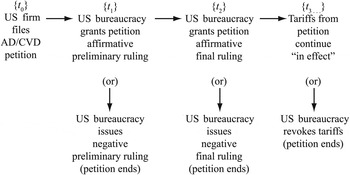
The tariffs resulting from AD and CVD petitions and their subsequent WTO disputes illustrate the puzzle posed at the beginning of this article. If sounding the institutional alarm causes governments to return to compliance, then why don't governments who are victims of noncompliance sound the alarm immediately? Figure 2 depicts the “lifespan” of AD and CVD tariffs, showing how they are initiated, proceed, and are possibly removed. Theoretically, the foreign country targeted by the AD/CVD petition can initiate a WTO dispute regarding that particular petition at any point. In practice (and in the sample described here), WTO disputes are initiated only after affirmative preliminary rulings (after t 1) and before any terminating event (before t 2 or t 3).
Paths along lifespan of AD/CVD petitions

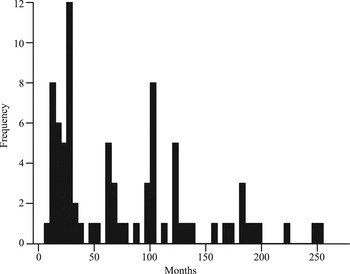
Figure 3 shows the distribution of the length of time elapsing between t 1, an affirmative preliminary ruling, and the time at which the foreign government initiates a DSU dispute over that tariff.Footnote 52 Some tariffs are challenged relatively quickly; the foreign government requests DSU consultations within a few months of the affirmative ruling. Other tariffs are in place for years before the foreign government challenges them at the DSU. These delays are substantively important. Every interval that a WTO-illegal tariff is in place, when it could have been addressed by a dispute, represents forgone cooperation and decreased trade.
Distribution of number of months from tariff initiation to WTO dispute

Data
I first use Bown's Global Antidumping Database and extract all AD and CVD petitions filed by US firms from April 1994 to October 2009.Footnote 53 Each observation in the Bown data set describes one petition and contains information on the time of its initiation, the target country, the rulings of the relevant US bureaucratic bodies at the various stages of the process, the dates of these rulings, and any resulting WTO litigation.Footnote 54
To take advantage of the variation in the covariates (described later), I break each petition into monthly observations so the unit of observation is the petition-month. I first begin observing a petition in the month that it receives the necessary affirmative preliminary rulings and is awaiting a final ruling. This is the first stage of a petition's lifespan in which tariffs are applied. Petitions that do not pass the necessary preliminary rulings do not result in tariffs.Footnote 55 For ease, I refer to petitions that have received affirmative preliminary rulings as “tariffs.”
After a petition receives an affirmative preliminary ruling, the resulting tariff can experience three possible events over the course of its lifespan: a WTO dispute, a negative final ruling, or revocation. A wto dispute occurs in the month in which the country targeted by a particular AD/CVD tariff formally requests DSU consultations over that tariff. A tariff can also receive a negative final ruling from the relevant US bureaucracies or be revoked, both of which terminate the tariff. I group the final two events, negative final ruling and revocation, together and label them as unilateral removal, because these events both stem from decisions made by US actors, whereas a wto dispute is a decision made by foreign actors. I draw the distinction between wto dispute and unilateral removal because it allows me to examine whether the effects of the explanatory variables differ across the type of event under consideration. wto dispute and unilateral removal are called “terminating events,” and I do not observe tariffs after either terminating event has occurred.Footnote 56 If neither terminating event occurs in a particular month, the tariff is labeled as in effect, and it is possible for a tariff to still be in effect at the end of my observation time period, October 2009.
The dependent variable, Y it , is a categorical variable describing the “status” of the tariff i in month t. Y it takes on a distinct numerical coding depending on whether the tariff is in effect or experiences a wto dispute or unilateral removal.Footnote 57 Of the 574 tariffs, approximately 14 percent (seventy-eight tariffs), resulted in a WTO dispute before October 2009. Approximately 55 percent (318 tariffs) ended because of unilateral removal. Tariffs that resulted in a WTO dispute were in effect for approximately seventy-seven months, with a minimum of eight and a maximum of 252. Tariffs that were removed unilaterally were in effect for an average of 96 months, with a minimum of ten and a maximum of 294.
Main Explanatory Variables
The theory's main prediction is that disputes are more likely when domestic audiences support free trade and when the US government is most sensitive to those preferences. To proxy for domestic support for free trade, I use the US unemployment rate. As described earlier, unemployment is one of the “usual macroeconomic suspects” associated with general support for free trade.Footnote 58 Mansfield and Mutz find that voters’ perceptions of free trade and their preferences for protectionist policies are shaped by their perceptions of the effect of trade on the economy as a whole.Footnote 59 These perceptions are strongly influenced by “collective, national-level information,” like the overall unemployment rate.Footnote 60 us unemployment is a six-month moving average of the monthly seasonally adjusted percentage unemployed in the United States.Footnote 61
To proxy for the government's sensitivity to support for free trade, us election year is an indicator variable that is coded 1 in the twelve months preceding the next US presidential election, and 0 otherwise. I focus on presidential elections because the bureaucracies involved in AD and CVD petitions are most closely tied to the executive branch. Additionally, executives are thought to be more responsive to broader constituencies than more narrow-interest legislative members. Since the theory makes a conditional prediction for these variables, I interact us unemployment and us election year.
The ideal data would measure preferences and strength of dispute-specific audiences. In other words, it would be preferable to measure features of the audiences affected, positively or negatively, by the tariffs entailed in particular petitions — as in the US-EU steel tariffs example. The scope of this article and the diversity of the sample make this difficult for the current analysis, which is why I focus on more aggregated measurements of preferences and strength.
According to the theory, during election years, higher unemployment should be associated with a lower probability of a WTO dispute. But the theory does not make predictions about the effects of unemployment and elections on the probability of unilateral removal. This is an attractive feature of my approach, in that it creates an informal “placebo test” of the theory. If unemployment and elections have the predicted effect on the probability of a WTO dispute, but do not have the same effect on the probability of unilateral removal, then the results are more supportive of the theory.
Alternative Explanatory Variables
I also include two variables that measure the potential for retaliation — where country A raises tariffs against country B's exports as punishment for B's tariffs. If the defendant exports a large amount to the plaintiff, disputes should be more likely since the plaintiff has greater trade leverage. When the plaintiff exports more to the defendant, they have less leverage. Retaliation should also increase the probability of unilateral removal. Blonigen and Prusa show that the possibility of retaliation decreases the probability that US bureaucracies rule in favor of firms seeking protection.Footnote 62 us exports measures the percentage of US exports that go to the foreign country and us imports measures the percentage of US imports that come from the foreign country.Footnote 63
The second set of alternative explanations account for plaintiff-side dynamics. I include the most commonly used proxy for a country's legal capacity: their per capita gross domestic product (GDP). The data for plaintiff pcgdp come from the World Development Indicators data set, measured yearly. Macroeconomic and electoral dynamics in the plaintiff country may also affect the probability of a dispute. plaintiff election is an indicator variable that is coded 1 if the foreign country is within twelve months of its next major election, and 0 otherwise. plaintiff unemployment codes the unemployment rate for the plaintiff country. As with US elections and unemployment, I also include their interaction.
Empirical Models
I estimate the effects of the explanatory variables on the status of a tariff (in effect , wto dispute , unilateral removal) in two ways. First, I use a Cox proportional hazards model to estimate the effect of the variables on the risk of a wto dispute for tariff i at time t: h(t|X it ) = h(t)exp(X it β).Footnote 64 This approach has the advantage of being able to estimate the effects of the explanatory variables on the risk of a wto dispute, while leaving the underlying, or baseline risk, of a wto dispute during time t, h(t), unspecified.Footnote 65
The second approach accounts for the possibility of competing risks between the two events. In the data, when one terminating event occurs, it precludes the other event from occurring, for example, when a tariff is unilaterally removed, it cannot then experience a WTO dispute. The Cox approach is best when the risks of a wto dispute and unilateral removal are independent.Footnote 66 Theoretically, there are reasons to suspect that the two risks are not independent. For instance, if a country decided not to initiation a WTO dispute because it thought that the tariff was likely to be unilaterally removed, the independence assumption would be violated.
To account for this possibility, I also model the probability of the two events jointly, using a Bayesian multinomial probit (MNP) model from Imai and Van Dyk that does not require assumptions of independent risks.Footnote 67 The MNP also allows me to compare the effects of the explanatory variables on both risks, analyzing the direction and magnitude of each variable on the risk of a wto dispute and unilateral removal.
Results: Risk of a WTO Dispute
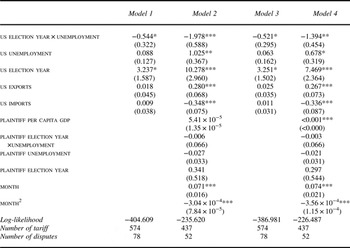
Table 1 shows the coefficients estimated from a series of Cox model specifications.Footnote 68 The first model includes only the main explanatory variables and the retaliation variables: us election year, us unemployment, their interaction, us exports and us imports. The second model adds variables describing plaintiff-side dynamics: plaintiff pcgdp, plaintiff unemployment, plaintiff election and the relevant interaction. The third and fourth models account for possible calendar year trends with a counter variable that begins at 1 for the first calendar month of the data set. I also include the quadratic expansion of the counter.
Cox models: Risk of WTO dispute

Notes: Coefficient estimates from Cox proportional hazards model with robust standard errors. wto dispute is the failure event, with unilateral removal treated as right-censoring. ***p < .01; **p < .05; *p < .10.
The results support the theoretical predictions. During US election years, increased unemployment substantially lowers the risk of a WTO dispute.Footnote 69 From Model 1, during an election year, an increase in unemployment from 3 to 7 percent decreases the risk of a WTO dispute for any particular month by approximately 84 percent.Footnote 70 When unemployment is high, and as a result, pressure in the United States to lower tariffs in the face of a WTO dispute is correspondingly low, potential plaintiffs are less inclined to initiate disputes against the United States. The lack of pressure for compliance, or even the potential of triggering a backlash, make disputes less promising for potential plaintiffs. Conversely, during nonelection years, increased unemployment is weakly associated with a higher risk of a WTO dispute. This is consistent with plaintiffs waiting until nonelection years to initiate WTO disputes. If the plaintiff knows that the United States is in an election year, and is more hostile to free trade because of tough economic times, they are more willing to delay their WTO disputes until less politically sensitive times.
Other theories receive mixed support. For retaliation, increased US exports to the plaintiff are associated with a higher risk of a WTO dispute as predicted. But increased imports from the plaintiff, that is, weakened plaintiff leverage, are also weakly associated with a higher risk of a WTO dispute. Tariffs against richer plaintiffs have a weakly higher risk of WTO disputes. Explanations based on plaintiff unemployment and electoral dynamics receive little support.
Results: Competing Risks
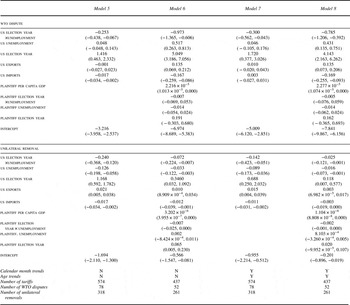
What are the effects of the explanatory variables when accounting for the competing risks of wto dispute and unilateral removal? Table 2 reports summary statistics of the posterior densities for the coefficients in the MNP specifications.Footnote 71 The top half reports the coefficients for the effect of the covariates on the probability of a wto dispute relative to the probability that a tariff remains in effect. The bottom half reports the coefficients for the effect of the covariates on the probability of a unilateral removal relative to the probability that a tariff remains in effect. I report the mean and 95 percent credibility intervals associated with each covariate's posterior density. To (greatly) ease interpretation, I focus on the substantive effects of the variables of interest on the probability of a wto dispute and unilateral removal.
MNP models: Risk of WTO dispute

Notes: Mean of posterior density for each covariate, for wto dispute and unilateral removal, with 95% Bayesian credibility intervals in parentheses. Base category is in effect.
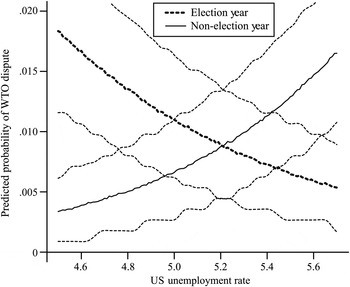
First, Figure 4 shows the effects of us unemployment, broken down by us election year, on the probability of a wto dispute.Footnote 72 The pattern predicted by the theory and that found in the Cox regressions is again apparent. During election years, higher unemployment decreases the probability of a WTO dispute. Other countries are less likely to initiate WTO disputes against the United States during politically sensitive times when broader audiences are more supportive of protectionism. Conversely, higher unemployment increases the probability of a dispute during nonelection years. During times of high unemployment, other countries might delay their WTO disputes until after an election, when policy-makers are less constrained by protectionist pressures. During an election year with 4.6 percent unemployment, a tariff is approximately four times more likely to experience a WTO dispute than during an election year with 5.7 percent unemployment.Footnote 73 The risk of a WTO dispute is approximately 0.5 percent in a high-unemployment election year and 2.1 percent in low-unemployment election years—a substantial increase when considering the relative infrequency of WTO disputes.Footnote 74
Effect of unemployment on probability of WTO dispute, by election year

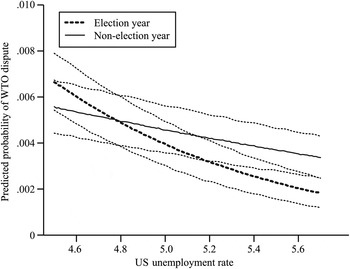
Second, Figure 5 shows the effects of us unemployment, broken down by us election year, on the probability of unilateral removal. The interelectoral dynamics associated with WTO disputes are not present for unilateral removal. During times of higher unemployment, the United States is less likely to unilaterally remove its tariff barriers, regardless of electoral dynamics.Footnote 75 Firms are more successful at winning and keeping protectionist tariffs through AD and CVD petitions when times are bad.
Effect of unemployment on probability of unilateral removal, by election year

This finding is also an informal placebo test of theory. One would not expect the political-economic effects of unemployment and electoral dynamics that affect the probability of a WTO dispute to also affect the decisions of bureaucrats who are making decisions over unilateral removal. Bureaucracies are not elected officials making decisions in the shadow of a possible backlash from a broad constituency. Although bureaucratic agents are influenced political agents who control their purse strings, for example, the chair of the House Ways and Means Committee in the US Congress, those principals are beholden to more narrow constituent interests. It is encouraging for the theory that interelectoral dynamics are present and more pronounced statistically for wto disputes but not for unilateral removal.
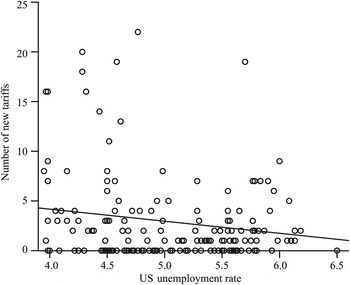
Further support comes from analyzing the relationship between the number of AD and CVD petitions filed and the overall US unemployment rate. As in the discussion of Proposition 5, one would be worried if there was strong evidence that firms or the bureaucracies making decisions over AD and CVD petitions (that is, the decisions at t o and t 1 in Figure 2) anticipated possible WTO disputes (decisions made after t 1). If audience preferences and strength influenced the behavior of firms or the bureaucracies involved in AD and CVD petitions, this could potentially bias these findings relating audience features to WTO disputes. The empirical approach here does not explicitly model the firms’ and bureaucracies’ decisions, so we must check for evidence of the type of anticipatory behavior that would bias the findings. If firms filed fewer petitions in times of low unemployment and more petitions in times of higher unemployment, that is, if audience features affected firm behavior as well as dispute patterns, then that would be evidence that firms possibly anticipated future WTO disputes, and resulting pro-free-trade audience support.
Figure 6 plots the number of new AD and CVD petitions against the US unemployment rate. Fortunately, I do not find evidence of anticipatory behavior. There are not more petitions filed during times of higher unemployment.Footnote 76 This is not surprising. When deciding to file a petition, firms consider their own situation, not overall economic conditions or possible audience reactions to WTO disputes. Because WTO disputes are relatively infrequent and often occur well after a tariff is in place, firms still have an incentive to pursue these tariffs even if they were to be only temporary relief, making it even less likely that audience features and possible WTO disputes are dominant factors in petitioning decisions. Bown models the decision over whether to file a petition and whether a WTO dispute results.Footnote 77 He does not find substantively different results from empirical models that do and do not account for the first stage, or selection decision to file a petition. In the closest existing application to the one conducted here, accounting for actions prior to the decision to initiate a WTO dispute did not significantly change results.
Number of petitions receiving preliminary approval versus US unemployment rate, 1995–2009 (monthly)

In other empirical applications, it would be more important to model each node of the decision-making process. For example, so-called safeguards, as described in Section 201 of the United States’ Trade Act, are a type of trade barrier similar to AD and CVD, but they are controlled more directly by the executive branch. If one were to analyze the effect of audience features on the probability of WTO disputes regarding safeguards, it would be more important to consider possible anticipatory behavior by the executive or president, since, unlike a firm contemplating an AD or CVD petition, the president is likely to make decisions with an eye toward future political and economic repercussions.
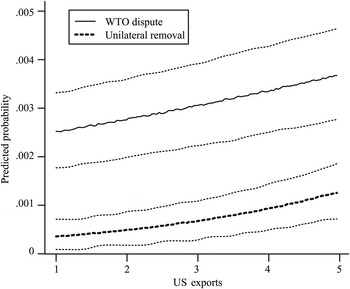
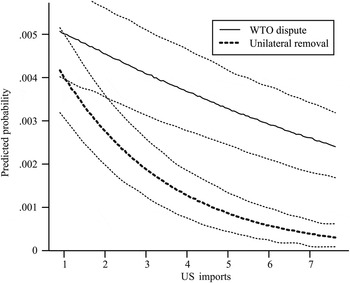
Third, Figures 7 and 8 show the effects of US exports and imports on the probability of a wto dispute and unilateral removal.Footnote 78 As the US exports more to the country targeted by a tariff, the country is more likely to initiate a WTO dispute. Larger countries and countries to whom the US exports more have greater leverage over the United States, and are therefore better able to compel the United States to comply with adverse WTO rulings. The United States is also more likely to unilaterally remove protectionist barriers against these countries. The United States is more restrained overall in its tariffs toward larger partners.
Effect of US exports on probability of WTO dispute and unilateral removal

Effect of US exports on probability of WTO dispute and unilateral removal

The opposite is true of US imports. As the US imports more from a particular country, that country is less likely to initiate WTO disputes against the United States. They have less leverage over the United States even if they were to win a WTO ruling, because of the fear of counterretaliation. The United States is also less likely to unilaterally remove protectionist barriers. This is consistent with existing work that finds import surges and import penetration are an important impetus for petitions.Footnote 79
Conclusion
I developed a theory about how institutional alarms mobilize domestic audiences to impose noncompliance costs. The theory incorporates variation in the preferences and strength of domestic audiences and also the endogenous decision made by member states to use an institution to transmit information. I showed the conditions under which often-referenced dynamics arise endogenously. For existing theories based on credible commitments or audience cost, which generally do not incorporate these features, there is good news and bad news. The good news is that institutions can generate these costs vis-à-vis domestic audiences under very minimal restrictions. The institution need only provide a costly way for a foreign government to signal to uninformed domestic audiences that a government has misbehaved. Dispute settlement bodies provide such a forum because their use is both costly and public. When the preferences of the alarm-sounding government and the relevant domestic audience are sufficiently aligned, such a mechanism can help the home audience better deter its government from choosing policies that are at odds with its international obligations, even when disputes do not occur. Evaluating whether applications of credible commitments or audience costs theories meet these conditions in certain contexts or with regard to particular issue areas should be a priori to asserting those explanations for observed behavior.
The bad news is that these conditions show important limitations on the degree to which the informational role of institutions can create noncompliance costs. Even when the necessary conditions for noncompliance costs to arise endogenously are met, the magnitude of these costs is constrained by the preferences and political strength of the audience in question. The institution cannot take compliance further than the audience is willing to go. At one extreme, when the audience supports noncompliance, providing them information about their government's decision can potentially create incentives to decrease compliance further. Less extreme, though still troubling from the perspective of international cooperation, is the fact that audiences who only weakly prefer compliance or who are politically ineffectual do not generate significant noncompliance costs, and therefore do not constrain their government from misbehaving. Institutions, even when they provide important informational fora, cannot get blood from a stone — they induce cooperation where it is not domestically supported.
I also derived predictions linking audience preferences and strength that shed light on a puzzling empirical phenomenon: the significant variation in the timing of international disputes. Using data on US tariffs and subsequent trade disputes, I showed that disputes are least likely when the government is sensitive to broader audiences who support protectionism. During presidential election years with high unemployment, other countries delay targeting the United States with trade disputes, and are more likely to initiate those disputes during election years with lower unemployment. In addition to providing empirical support for the theory, the empirical analysis also explained substantively important variation. To turn a well-known phrase, trade cooperation delayed is trade cooperation denied. Understanding the timing of these disputes is as important as understanding their occurrence. Although the empirical analysis necessarily considered proxies for “broader” audiences — such as presidential election years and macroeconomic indicators such as unemployment — future research into the preferences and political strength of specific audiences, that is, at the firm level or interest-group level, represents a promising way to further explore these questions.
Supplementary material
Supplementary material for this article is available at: http://dx.doi.org/10.1017/S0020818314000174.