Introduction
Many individuals in the United States utilize the Emergency Response System by dialing 9-1-1. Paramedics evaluate the patients, stabilize them if needed, begin treatment as required, and transport them to a hospital. A common complaint is “chest pain”. Chest pain has multiple etiologies such as cardiac, pulmonary, gastric, esophageal, and musculoskeletal. While many of these causes are benign, some will be life-threatening, and will require immediate identification and treatment. This makes it imperative that emergency medical services (EMS) personnel are able to quickly recognize unstable or potentially unstable cardiac rhythms. Recognition of these disturbances in cardiac rhythm will facilitate proper treatment, earlier definitive intervention(s), and proper transfer of care in the receiving hospital.
Patients transported by ambulance receive a diagnosis and subsequent treatment more quickly upon arrival at a receiving hospital than patients arriving by other means—even without an electrocardiogram (ECG) obtained outside of the hospital.Reference Swor, Anderson and Jackson1 The ability of paramedics to not only perform field ECGs, but then accurately diagnose various unstable rhythms has resulted in reduction in time specific treatments.Reference Morrison, Brooks and Sawadsky2 Various methods have been developed to train paramedics to interpret cardiac rhythms in the field, primarily advanced cardiac life support (ACLS) certification courses and intermittent continuing education.3 Paramedics are trained to identify rhythms indicative of acute ischemic myocardial injuries in the field, based on either a lead II rhythm strip, three-lead or 12-lead ECGReference Brown and Gough, Hawley4–Reference Whitbread, Leah and Bell6 with up to 95% accuracy rates. These accuracy rates are similar to those of emergency department physicians when diagnosing and treating patients with acute ischemic myocardial injuries in the emergency department.Reference Feldman, Brinsfield and Bernard7 However, overall accuracy of ECG interpretation by paramedics is roughly 80% with the greatest discrepancies being tachydysrhythmias and atrioventricular (AV) blocks.Reference Brown and Gough, Hawley4 Increasing the overall accuracy of ECG interpretation by paramedics has the potential to facilitate early and appropriate treatment and decrease patient morbidity and mortality.
The 2005 American Heart Association Guidelines for Cardiopulmonary Resuscitation and Emergency Cardiovascular Care recommend a 12-lead ECG be obtained in the field by EMS personnel.3 It was proposed that a convenient training device (flip book) placed on ambulances and in common areas in the fire station would aid in correct field identification of these cardiac dysrhythmias. This training device contained sample ECG tracings and their associated diagnostic criteria. The goal was to enhance the recognition and interpretation of ECGs, and thereby, reduce delays in treatment and potential complications associated with misinterpretation.
The one-tailed hypothesis was that the readily available flip book would increase correct ECG interpretation by 15%.
Methods
Study Design
This study was a prospective, observational study using a matched pre-test/post-test design. The study period was from November 2008 to December 2008. This study was approved by the Grant Medical Center/ Doctors Hospital Institutional Review Board.
All available paramedics at two local township fire departments that serve the suburban Columbus, Ohio area were approached to participate in this study. One facility was staffed by a total of 64 paramedics (29 full-time paramedics and 35 part-time paramedics), and the other station was staffed by 72 paramedics (59 full-time and 13 part-time). A total of 117 paramedics were advanced cardiac life support (ACLS)-certified, including all of the full-time paramedics, which is a standard of care for full-time paramedics in this community. The remaining paramedics were certified in Basic Life Support (BLS). A total of forty-four paramedics were also trained in Pediatric Advanced Life Support (PALS). It is important that all paramedics are able to recognize ECG rhythms; therefore, all 136 paramedics were approached to participate in this study.
A pre-test consisting of fifteen 12-lead ECGs, without the benefit of a case scenario, was administered by the local EMS Director to all paramedics who agreed to participate in the study during a monthly meeting at the local township fire stations. Once all participating paramedics had completed the pre-tests, flip books were placed on each ambulance and in the fire station common areas. The flip book contained 12-lead ECG examples of normal rhythms (i.e., sinus rhythm, sinus bradycardia, sinus tachycardia), tachyarrhythmias (atrial tachycardia/supraventricular tachycardia, atrial flutter, ventricular tachycardia), bradyarrhythmias (sinus bradycardia, junctional rhythm), bundle branch blocks (left and right), AV blocks (i.e., third degree heart block), irregular heart rhythms (atrial fibrillation, atrial fibrillation with rapid ventricular response, ventricular fibrillation), and rhythms suggesting acute myocardial infarction with descriptive diagnostic criteria for each.Reference Dubin8 Everyone that had access to the station and ambulances had access to this information.
Approximately one month after the flip books were made available to the paramedics, a post-test was administered. The pre- and post-tests were identical and tested the paramedics on their ability to recognize various ECG rhythms.
The pre- and post-tests were administered by the regional EMS director during a regularly scheduled meeting, and collected by him, placed in his secure briefcase immediately following completion, and delivered to the grader who kept the tests in a locked file cabinet.
Each paramedic used the last four digits of his/her paramedic number as their identification/subject number. This number was entered on the pre-test and post-test answer sheets to facilitate accurate pre-/post-test evaluation. The research group did not have access to the name that matches the paramedic number. If a paramedic did not take both the pre- and post-test, their scores were not included in the study.
For those paramedics wishing to take part in the study, consent was implied by the submission of completed pre- and post-tests.
Funding was provided by the Ohio University Centers for Osteopathic Research and Education to cover expenses associated with the creation of the flip books.
Study Variables
The dependent variables were the pre-test and post-test scores. The pre- and post-tests consisted of ECGs and rhythm strips obtained from various patients treated at a community hospital in Columbus, Ohio, and from the following internet site with author’s permission: ecg.bidmc.harvard.edu/maven.Reference Nathanson, McClennen, Safran and Goldberger9 All identifiable patient demographics were removed from the ECGs.
Results
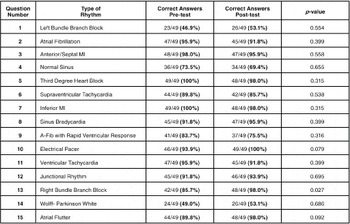
Of the 15 rhythms tested, only three had a pre-test accuracy <80%. Eight of the pre-test rhythms had a pre-test accuracy greater than 90%. Interestingly, Normal Sinus rhythm had a pre-test accuracy of 73.5% and a post-test accuracy of 69.4%.
Left Bundle branch block (46.9% correct) and Wolfe-Parkinson White (49% correct), neither showed statistical improvement in correct scores on the post-test. Right Bundle branch block; however, showed a strong trend but fell short of statistical improvement (85.7% correct to 98% correct).
The statistical analyses were completed using SPSS Version 16.0 (SPSS Inc., Chicago, IL). Descriptive statistics including means and frequencies were generated for both BLS-certified and ACLS-certified paramedics. For question answer variables, paired t-tests were performed. Statistical significance was set at 5% (α = 0.05).
Statistical comparisons were made between the pre- and post-test scores for both the global test and each type of rhythm. Using these data, there were no statistically significant differences in the global ECG interpretation or on individual rhythm interpretations (
Table 1).

Discussion
There are many reasons the use of the flip book may have proven ineffective. First, there was a high recognition rate on the initial test that considerably exceeded the previously quoted 80% interpretation accuracy for EMS noted in Brown’s study.Reference Brown and Gough, Hawley4 It is postulated that a bias may have existed in that the students were looking for abnormalities. This higher recognition rate may have been a function of the experience of veteran paramedics. Information on length of certification or volume of individual runs was not collected. Ultimately, this high pre-test score made it more difficult to detect a difference in the intervention.
Second, even though the paramedics had easy access to the book, it is difficult to determine how much time they spent actually studying the material. Study time was not tracked. Third, it is difficult to determine if there was trouble with comprehension of the material, since there was not an opportunity for the medics to ask for clarification if they did not understand something. It is not clear if the medics actually used the books to confirm their rhythm diagnoses in the field or if they quizzed each other while they were studying. These specific concerns arose out of the analysis of the results of the two rhythms with the lowest pre-test accuracy.
Another limitation was the lack of statistical power, given the minimal sample size not being reached. Many participants had to be excluded due to only taking the pre- or post-test. There also were missing data where some questions were not answered. Further studies should address these limitations.
Conclusions
A flip book with multiple ECG rhythms and definitions without the benefit of any outside support was not effective in improving paramedic identification of ECG rhythms on a post-test. While it is believed that the flip book is a good learning tool, it would be helpful to repeat the study with some minor changes. Suggestions for further research include repeating the study with a larger sample size; utilizing a lecturer to explain how to use the flip book in the most efficient manner; reiterating how to read and interpret ECGs; and answering questions. This would allow the paramedics to utilize the book as a tool to review material. Comparing test scores of paramedic students, and newly certified paramedics as opposed to veteran paramedics also may indicate that the flip books are more suited for use by one group over another.
Abbreviations:
ECG: electrocardiogram
EMS: emergency medical services