INTRODUCTION
The seasonal population dynamics of the crustacean fish ectoparasite, Argulus foliaceus in still-water fisheries were shown to be correlated to temperature and water clarity, but can also be affected by fish stock turnover rates (Taylor et al. Reference Taylor, Sommerville and Wootten2006, Reference Taylor, Wootten and Sommerville2009). In lake systems in temperate climates, the numbers of argulids generally tend to be low in winter (Rizvi, Reference Rizvi1969; Kimura, Reference Kimura1970; Shimura and Egusa, Reference Shimura and Egusa1980; Shafir and Oldewage, Reference Shafir and Oldewage1992; Pasternak et al. Reference Pasternak, Mikheev and Valtonen2000; Gault et al. Reference Gault, Kilpatrick and Stewart2002; Taylor et al. Reference Taylor, Sommerville and Wootten2006), with laboratory experiments suggesting that most lice die off in cold conditions (Kimura, Reference Kimura1970) and after periods of reproduction (Pasternak et al. Reference Pasternak, Mikheev and Valtonen2000).
Argulus foliaceus hatches as a metanauplius stage of ca. 0·8 mm in length. Once the parasite reaches ca. 4·7 mm in length it is deemed to be adult and capable of laying eggs (Rushton-Mellor and Boxshall, Reference Rushton-Mellor and Boxshall1994). Argulus spp. reproduce sexually and male and female parasites mate on or off the host (Kimura, Reference Kimura1970). Several matings may be observed, it is thought that one is sufficient to fertilize all the eggs that a female will ever produce (Kollatsch, Reference Kollatsch1959). Sperm is stored in the female's spermatheca and used to fertilize eggs individually upon laying (Martin, Reference Martin1932; Avanent-Oldewage and Swanepoel, Reference Avenant-Oldewage and Swanepoel1993). A. foliaceus lays its eggs off the host on a suitable firm surface in batches comprising 2–4 rows, with each batch containing up to 400 eggs (Bower-Shore, Reference Bower-Shore1940; Kimura, Reference Kimura1970). Although the parasite can lay eggs up to 10 times, the majority only lay once (Kimura, Reference Kimura1970). At temperatures below 10°C, eggs of A. foliaceus appear to lie dormant, allowing them to survive the colder months unhatched until spring (Gault et al. Reference Gault, Kilpatrick and Stewart2002; Harrison et al. Reference Harrison, Gault and Dick2006; Taylor et al. Reference Taylor, Wootten and Sommerville2009). Taylor et al. (Reference Taylor, Wootten and Sommerville2009) also found egg laying to cease over such periods of low temperature. A rise in water temperature in spring is believed to cause the majority of eggs to hatch over a short period, producing a population of the parasite that is predominantly comprised of metanauplii with a small proportion of older stages which have survived the winter (Shimura, Reference Shimura1983; Shafir and Oldewage, Reference Shafir and Oldewage1992; Pasternak et al. Reference Pasternak, Mikheev and Valtonen2000; Gault et al. Reference Gault, Kilpatrick and Stewart2002; Taylor et al. Reference Taylor, Wootten and Sommerville2009). Populations increase until they peak in the summer at highest temperatures, after which numbers decline with the advent of winter due to mortality following reproduction and the effects of the cold temperatures (Bower-Shore, Reference Bower-Shore1940; Kimura, Reference Kimura1970; Shimura, Reference Shimura1983; Shafir and Oldewage, Reference Shafir and Oldewage1992; Pasternak et al. Reference Pasternak, Mikheev and Valtonen2000; Gault et al. Reference Gault, Kilpatrick and Stewart2002; Taylor et al. Reference Taylor, Wootten and Sommerville2009). There is conflicting information on the number of generations of A. foliaceus that occur in the UK. Gault et al. (Reference Gault, Kilpatrick and Stewart2002) suggested that 2 full generations occur in a year, whereas Rizvi (Reference Rizvi1969) suggested that a generation emerges every 4–5 weeks during the summer suggesting a total of 4 generations. In the case of A. coregoni, Hakalahti et al. (Reference Hakalahti, Pasternak and Valtonen2004b) found that in Finland only 1 true generation occurs in a year, and that abundance increases as a result of extended hatching from an egg bank.
The mechanisms behind the seasonal dynamics of A. foliaceus are currently unknown, and data with which to construct life tables to increase understanding are not available. This is partially due to a lack of readily distinguishable stages in the life cycle of argulids. Although Rushton-Mellor and Boxshall (Reference Rushton-Mellor and Boxshall1994) described each moult between hatching and adult, the differences were subtle and not easily discriminated. In order to control A. foliaceus in still-water trout fisheries, accurate data on the number and timing of generations are vital for the development of effective management strategies and to optimize the timing of interventions. To overcome the difficulties of discriminating the different stages of A. foliaceus, this study applies mixtures (a statistical technique often used by fisheries scientists to discriminate age classes from length-frequency data (Macdonald and Pitcher, Reference Macdonald and Pitcher1979; Macdonald, Reference Macdonald, Summerfelt and Hall1987)) to length-frequency data collected on A. foliaceus with the aim of discriminating and following cohorts of the parasite through time. This is the first time this technique has been applied to a parasite system and, through its use, this study aims to determine the life-cycle of A. foliaceus in natural populations. Additionally, the study aims to establish whether the dynamics of the parasite in UK still-water fisheries are determined by the emergence of cohorts or through delayed recruitment from an egg bank, as observed in Finnish populations of A. coregoni (Hakalahti et al. 2004 a).
MATERIALS AND METHODS
A longitudinal study of 5 still-water trout fisheries was conducted from May 2002 to May 2003. In each site, fish were captured by seine netting to allow specimens of A. foliaceus to be collected and their abundance and prevalence determined in relation to the temperatures and other environmental and management factors (Taylor et al. Reference Taylor, Wootten and Sommerville2009). Details of the study sites, numbers of fish caught at each study visit, methods of temperature collection and parasite sampling techniques are described by Taylor et al. (Reference Taylor, Wootten and Sommerville2009).
Collection, fixation and storage of specimens
Parasites were removed from captured fish using forceps. As with any visual-based sampling it is possible that samples were biased towards the larger more visible parasite stages. Where possible, fish were screened by a second sampler in order to reduce this bias. Each fish sampled was assigned a vial containing 70% ethanol. All parasites removed from a fish were stored in the corresponding vial. On return to the laboratory all parasites were measured using the image analysis methods described below.
Image analysis
Image analysis was used to gain accurate information on the length, species and sex of specimens of Argulus. The image analysis equipment comprised a Pentium 4 personal computer connected to a Zeiss Axiocam MRC digital camera, connected through a trinocular head on an Olympus SZ40 dissecting microscope. A macro to allow the necessary measurements to be taken was written in Zeiss KS300 image analysis software (Imaging Associates, Thame, UK) by Dr J. Bron (Institute of Aquaculture, University of Stirling, UK). All measurements were in microns. The macro was written so that information could be gathered at either ×1 or ×4 magnification and all data were automatically stored in a database. At the start of each session of measurements, the accuracy of the system was checked using a graticule. Specimens were examined individually at ×1 or ×4 depending on the size of the specimen.
Length-frequency/size distribution analysis
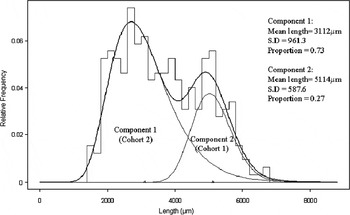
The mean parasite length within each cohort was determined using Rmix (now known as mixdist), a package written for the R environment (R Development Core Team, 2005) by MacDonald (Reference MacDonald2002). This library was used to fit an appropriate statistical distribution (e.g. normal, log-normal) to the observed length-frequency data using Maximum Likelihood methods (Fig. 1). By minimizing the amount of variation between the observed data and the fitted distribution, an estimate of the mean parasite length and degree of variation around this mean in each cohort can be estimated from the distribution. The technique can also be used to discriminate merging cohorts by fitting overlapping distributions to produce a model known as a mixture (Fig. 1). These models also allow an estimation of the proportion of the population that falls into each of the cohorts. Information on proportions was used to calculate the parasite abundance per cohort from the total abundance data.
Example of a mixture model fitted to length frequency data using two log-normal components.

Mixture models were fitted following the examples shown in Du (Reference Du2002). Preliminary models were fitted by eye by specifying the number of cohorts thought to be present and by estimating the mean size of each of these cohorts. The program then refines these initial estimates to produce a model that best fits the data. Models containing different numbers of cohorts or assuming different distributions were then compared statistically to identify which provides the best fit for data from each site visit. Fitting these models when the number of cohorts present is unknown involves a certain amount of subjectivity, so proportions and mean size values obtained through the models were checked against data from the previous month's samples and other sites to see if they were realistic. Hanging rootograms were used to visualize the degree by which the observed data deviated from the expected data (Friendly, Reference Friendly2000), and Chi-squared tests were also used to test how well the mixture model fitted the observed data. Different numbers of cohorts and statistical distributions were compared for each site visit, and the best-fitting model selected.
Because Rushton-Mellor and Boxshall (Reference Rushton-Mellor and Boxshall1994) demonstrated that females can grow faster than males, conditional data were included in all models to allow males and females to be identified. Where multiple cohorts were present, these data provided a method to ensure that they were not a result of differences in the size of males and females i.e. that the smaller cohort was not comprised of all males and the larger of all females. If such separation occurred, such multiple cohorts would be specified as one.
Where serial samples (in this case monthly) have been taken, the technique enables cohorts to be followed through time, allowing growth rate, mortality and recruitment for each cohort to be estimated. Mortality and recruitment to a cohort are assessed by comparing the numbers of parasites found in a cohort at subsequent sample points. This was calculated based on the mean parasite abundance and the proportion of the total population that a cohort represents, compared to the value from the previous month.
Parasite growth
Growth was determined by taking the mean cohort size from one month, subtracting the mean size from the previous month and dividing by the number of days between visits to give growth per day. Growth was plotted against average monthly temperature (obtained from Taylor et al. Reference Taylor, Wootten and Sommerville2009) and analysis of covariance (ANCOVA) was used to determine differences in the relationship between sites. Regression analysis was used to describe the overall relationship in SPSS v.11 (SPSS Inc, Chicago).
Rushton-Mellor and Boxshall (Reference Rushton-Mellor and Boxshall1994) observed metanauplii of A. foliaceus to hatch at 800 μm in length, and to start laying eggs at a minimum length of 4700 μm, thus, at least 3900 μm growth is required before egg laying can occur. Time to adulthood was therefore estimated by dividing 3900 μm by the growth per day in μm as calculated with the growth equation determined through this study.
Hatching period
The size range of distinct, singular cohorts (as opposed to mixed) was used to estimate the period of time over which cohorts of the parasite hatched. In sites and months when such cohorts were present the difference in size between the smallest and largest parasite in the cohort was divided by the growth per day as calculated from the growth equation determined by this study (based on the mean temperature recorded between sample visits). Only cohorts in which the smallest parasite was not larger that 1000 μm were used for the calculation. This was to reduce the influence of faster growth rates in females than males (Rushton-Mellor and Boxshall, Reference Rushton-Mellor and Boxshall1994).
Egg incubation times
Estimates of egg incubation times were made for each cohort observed in site 5 (which provided a relatively unmanaged population of the parasite). This was done using the growth equations developed in this study to estimate the date at which a cohort could start egg laying, and the date at which its progeny hatched. The time-interval between these two dates was taken to be the maximum incubation time and compared to the average water temperature over this period.
RESULTS
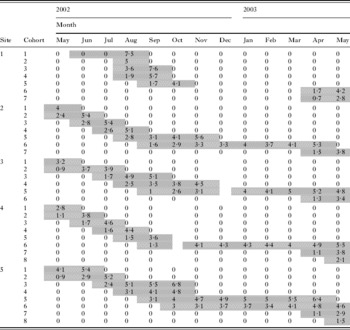
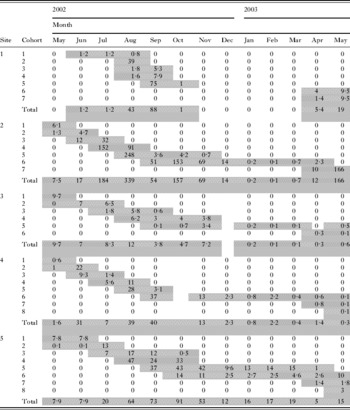
Through the course of the study (2002–2003) a total of seven cohorts were observed in sites 1 and 2, six in site 3 and eight in sites 4 and 5 (Tables 1 and 2). In sites 1, 4, and 5, two cohorts were observed to emerge by May 2003. Whereas, in sites 2 and 3 only one cohort was observed to emerge by May 2003.
The average length (mm) of Argulus foliaceus in each cohort observed in the 5 study sites, May 2002 to May 2003
(Blank cells refer to missed sample visits. Shaded zeros refer to parasite abundance insufficient to allow discrimination of cohorts.)

The abundance of Argulus foliaceus in each cohort observed in the 5 study sites, May 2002 to May 2003
(Blank cells refer to missed sample visits. Shaded zeros refer to very low abundance.)

With the exception of site 1, two cohorts of A. foliaceus were discriminated in each site at the start of the study in May 2002 (Tables 1 and 2). The first cohort was comprised of large parasites more than half minimum adult size (means per site 2·8–4·1 mm); the second was comprised of smaller stages ranging from juvenile to around half minimum adult size (means per site 0·9–2·4 mm). In all cases, total abundance was low, not exceeding 10 parasites per fish. The parasite was absent from site 1 in this month.
By June 2002 low numbers of the parasite had emerged in site 1, these ranged in size but insufficient numbers were obtained to allow discrimination of cohorts. This remained the case until August 2002. In sites 2–5 the first cohort comprising large parasites was absent in July, but a third cohort had emerged in all of these sites. The total abundance of the parasite had increased in sites 2 and 4.
Total abundance remained constant in sites 1 and 3 between June and July. There was a substantial increase in abundance at sites 2 and 5. The abundance in site 4 decreased from 31 to 7 parasites per fish. The second cohort was no longer present in sites 2 and 4, a fourth cohort had, however, emerged in these sites.
Abundance increased in all sites between July and August 2002. In site 1, four cohorts of varying size could now be discriminated. Only two cohorts were present in the other sites. In site 2 the third cohort was absent and a large decrease in the abundance of parasites in the fourth cohort was observed. Substantial recruitment had, however, occurred due to the emergence of a fifth cohort. In sites 3 and 5 a fourth cohort had emerged but the second was now absent.
In September 2002 recruitment was observed in all 5 sites. This caused the emergence of a fifth cohort in sites 1, 3 and 5, and a sixth cohort in sites 2 and 4. At this time, three cohorts were present in sites 1, 3 and 5, and two in sites 2 and 4. Total parasite abundance increased in site 1 and remained constant in sites 4 and 5. Abundance reduced in sites 2 and 3. The reduction in abundance in site 2 was very substantial, and was due to cohort 5 being almost totally removed from the population. This is thought to have been due to the fishery owner using an undisclosed treatment in the fishery just after the August site visit.
After September 2002 no further recruitment was observed until April 2003 in any of the sites except site 5 in which a sixth cohort emerged in October 2002. In site 1 there was a substantial drop in parasite abundance between September and October 2002, after which the parasite became absent from the system. In sites 2–5 there was a substantial reduction in parasite abundance between November 2002 and January 2003. Very low numbers of parasites comprised of a single well-developed cohort survived the winter months in sites 2, 3 and 4. Two such cohorts survived the winter in site 5 in comparatively high numbers. In all 5 sites, the first recruitment of 2003 was observed in April. Two cohorts of juvenile parasites had emerged by the sampling point in April 2003 in site 1. In all other sites only a single cohort of juveniles had emerged, with a second cohort emerging in sites 4 and 5 in May 2003. In site 2, the over-wintering cohort became absent from the system in May 2003, as did the larger of the two over-wintering cohorts in site 5.
Parasite growth
Data from sites 1 and 3 were removed from this analysis as scatter plots showed that small sample sizes caused large variations in the data sets. Normality tests showed that the data on growth per day were not normally distributed (Kolmogorov-Smirnov=0·164, d.f.=45, P=0·004). Scatter plots showed the data to be heteroskedastic, i.e. variability in the growth rates increased as temperature increased. Square-root transformation produced a linear, homoskedastic relationship and normalised the data (Kolmogorov-Smirnov=0·09, d.f.=45, P=0·2). Levene's test showed the data between the 3 remaining sites to be homogeneous (F=2·35, P=0·108). ANCOVA showed there to be no significant differences in the slope (F=0·222, P=0·802) or intercept (F=0·089, P=0·915) of the lines between sites. Data were pooled and subjected to linear regression. This showed a significant relationship between temperature and the root-transformed growth rates (t=10·00, P=0·000). The R2 value showed 69·9% of the variability in the dataset to be explained by temperature. The analysis showed that the relationship between daily growth rates and temperature was described by the following equation:

where: G=Daily growth (μm) and T=Temperature (°C).
The time taken from hatching to adult can be estimated by:

where: D=Development time (days).
These equations demonstrate that the relationship between temperature and growth is not linear.
Duration of hatching
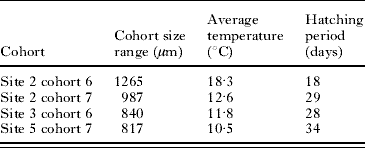
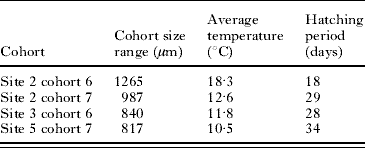
Four cohorts were deemed to be suitable for estimating the period over which a cohort of parasites hatched. Details of the cohorts and hatching periods are presented in Table 3, which suggests that the period between the first and last parasite hatching from a cohort lasts between 18 and 34 days, depending upon temperature.
Hatching period of distinct cohorts of Argulus foliaceus
Egg incubation times
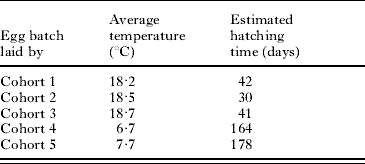
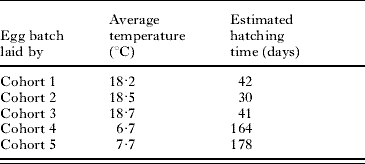
Estimated hatching times are presented in Table 4, which shows that at higher temperatures of ca. 18·5°C hatching took between 30 and 40 days. At lower temperatures of ca. 7·5°C hatching took between 164 and 178 days.
Estimated incubation times for egg batches of Argulus foliaceus laid in site 5
Generalized model of A. foliaceus dynamics
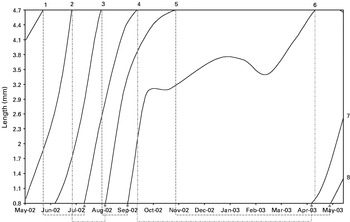
By studying the changes in parasite size and abundance in each cohort it is possible to develop a generalized model of how the parasite's dynamics occur through the course of 1 year. In sites 4 and 5 where no interventions were implemented and angling pressure and management were low, a total of 6 cohorts were identified in a year. Two of these emerged from over-wintered eggs and a third from over-wintered hatched stages of the parasite. Growth data from site 5 were used to develop Fig. 2, which suggests that the final 3 cohorts of the year were the progeny of the first 3. Two of these final cohorts appear to produce eggs that over-winter and give rise to the first 2 cohorts of the year. The third over-winters in its hatched form laying eggs in spring, which hatch to produce the third cohort of the year. These first 3 cohorts produce the subsequent 3. The general pattern appears to be that 2 cohorts emerge between a cohort laying eggs and its progeny emerging (Fig. 2).
Growth profiles from hatching to maturity for each cohort (1–8 as numbered around outer edge) of Argulus foliaceus discriminated at study site 5. Dashed vertical lines show the earliest point at which the parasite could lay eggs. Arrows show the cohorts believed to emerge from each batch of eggs laid.

DISCUSSION
The abundance of the parasite throughout the year varied between waters and appeared to depend on the ecology and management of the lake but, in all cases, followed a clear seasonal pattern with low numbers in spring, an increase throughout the summer before a fall in early winter. From the length/frequency analysis it was possible to determine how recruitment and mortality occur to cause this pattern. This analysis also suggested that in many months multiple cohorts were present, as model fits were poor if only 1 cohort was assumed. Where possible these cohorts were followed through time to assess parasite growth.
Temperature affects positively the growth of hatched stages of A. foliaceus. The higher the temperature, the faster the growth rate and the shorter the time required between hatching and the parasite reaching egg laying size (4·7 mm). By comparing parasite lengths from this study and comparing these to periods of egg laying described by Taylor et al. (Reference Taylor, Wootten and Sommerville2009) it seems that egg laying does not occur much before the parasite reaches 5 mm in length. This finding is similar to Rushton-Mellor and Boxshall's (Reference Rushton-Mellor and Boxshall1994) estimate of 4·7 mm based on laboratory studies.
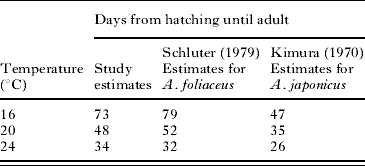
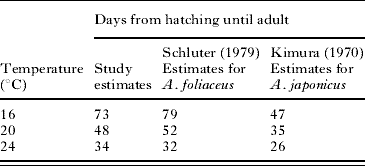
The growth rate of hatched stages of the parasite was shown to increase in an exponential fashion with increases in temperature, as was also observed in laboratory studies on A. foliaceus by Schluter (Reference Schluter1979) and on A. japonicus by Kimura (Reference Kimura1970). Growth estimates from the above model compare favourably to Schluter's (Reference Schluter1979) estimates from laboratory studies, showing the reliability of the model and the utility of length-frequency analysis in determining this information (Table 5). When compared to Kimura's (Reference Kimura1970) development times for A. japonicus the development of A. foliaceus appears to be much slower, especially at lower temperatures (Table 5).
Development times from hatching to adult for Argulus foliaceus and Argulus japonicus, as predicted by the current study and by other authors
Analysis of cohort widths suggests that hatching of A. foliaceus eggs occurs over fairly conserved periods from batches of eggs laid at different times, and not from a prolonged hatching of an egg bank as described for A. coregoni in Finland by Hakalahti et al. (Reference Hakalahti, Hakkinen and Valtonen2004a). Pasternak et al. (Reference Pasternak, Mikheev and Valtonen2000) observed that variability in hatching periods differed between habitats and time of year in A. foliaceus populations in Finland. They found that hatching periods of A. foliaceus were conserved early in the season in both farm and lake habitats, and remained so in the farm throughout the year. In the lake environment, however, hatching of the second generation of the year lasted over 200 days. The authors acknowledged that other studies (Kollatsch, Reference Kollatsch1959; Stammer, Reference Stammer1959; Shafir and van As, Reference Shafir and van As1986) did not find this same level of variability and hypothesize that the degree of variability is driven by host availability. They suggested that in environments with low host density, extended hatching periods occur to increase the chance of successful infection.
The current study simplifies the parasites dynamics in order to understand the basic processes driving the population. In doing so it is assumed that the majority of female parasites laid eggs as soon as they reached adult size and only laid eggs once, as observed by Kimura (Reference Kimura1970). These assumptions correspond to the fact that few parasites over 5 mm were observed at any of the study visits, suggesting that few parasites return to a host after egg laying. Additionally, egg laying times observed by Taylor et al. (Reference Taylor, Wootten and Sommerville2009), correspond to the parasite reaching 5 mm in length, i.e. the start of the egg laying season did not occur until the first cohort of parasite reached 5 mm in length and ended when the last cohort reached this length. Obviously not all parasites will lay eggs as soon as they reach adult size, and some will lay eggs on more than 1 occasion. This could lead to variability in the hatching period of cohorts and is likely to explain the presence of overlapping cohorts (as opposed to discrete cohorts), and may explain the increased length ranges observed in cohorts hatching late in 2002. This period of hatching did not, however, extend to the degree observed by Pasternak et al. (Reference Pasternak, Mikheev and Valtonen2000). The alterative hypothesis that A. foliaceus lays eggs throughout the year which hatch over an extended period not correlated with the time of laying, seems unlikely given the presence of multiple modes observed in the length/frequency data, and the accuracy of growth data obtained from the current study in comparison to laboratory studies.
Estimates of egg incubation times obtained at higher temperatures are similar to those observed by Pasternak et al. (Reference Pasternak, Mikheev and Valtonen2000) who found hatching to start at 25 days after laying at temperatures between 19 and 22°C. Estimates of hatching time from the current study are likely to be less accurate as they were estimated by extrapolating from the cohort data to predict when egg laying and hatching would occur. Estimates at the higher temperatures emphasize this point as considerable variability in the incubation period was estimated at similar temperatures. These estimates also assume that egg laying occurs as soon as the parasite reaches 4·7 mm, which in reality may not be the case, thus leading to overestimates of hatching times. Further investigation is required to establish the effect of temperature on hatching of A. foliaceus eggs and its interaction with light intensity, which Mikheev et al. (Reference Mikheev, Pasternak, Valtonen and Lankinen2001) suggested to be important in the case of A. coregoni.
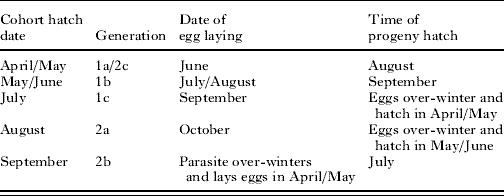
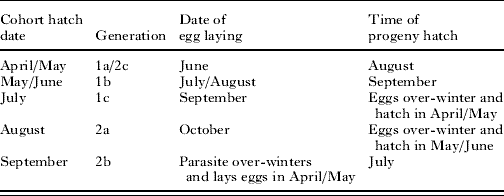
The generalized model of the dynamics of A. foliaceus suggests that 6 cohorts of the parasite can be discriminated through the course of 1 year. The first of these appear to overwinter as hatched stages, the second and third emerge from over-wintered eggs. The progeny of these first 3 cohorts gives rise to a second generation, which equates to the final 3 cohorts hatching in a year. The occurrence of up to 2 full generations occurring in a year is consistent with the findings of Gault et al. (Reference Gault, Kilpatrick and Stewart2002). This strategy of several distinct cohorts over-wintering and hatching at different intervals is likely to ensure parasite survival in the subsequent year, should host availability be low. Obviously, the precise timings of the cohorts will depend on temperature; however, details of the general pattern of the emergence of cohorts under UK conditions are presented in Table 6. One of the main differences in the population dynamics between sites was the presence of overwintering hatched cohorts. Taylor et al. (Reference Taylor, Wootten and Sommerville2009) suggested that stock turnover may play an important role in determining whether overwintering occurs as, when there is little or no parasite recruitment and fish are caught at a high enough rate, the parasite is effectively harvested from the system together with the fish. The presence or absence of an overwintering hatched cohort seems likely to determine the emergence of a third cohort in the subsequent year. The intervention implemented in site 2 in August provides some evidence that removal of a cohort can influence the subsequent dynamics of the parasite. The cohort affected by the treatment was the fifth of the year, which had it have survived to reach adult size would have laid its eggs in October. Based on data from the other sites these eggs should have hatched by the May 2003 sample visit to produce the second cohort of the year; however, no such cohort was observed. Obviously no sample visits were made after May 2003 so it is possible that this cohort emerged after the visit; however, this was the last site to be sampled in May 2003.
Generalized timings of development and egg laying of cohorts of Argulus foliaceus hatching in 1 year in UK still-water trout fisheries
Few other ectoparasites leave their host to lay eggs in the same way as argulids, and those that do (e.g. the fish leech, Piscicola geometra) have received little study making it unclear whether similar mechanisms of dispersal in time occur, i.e. staggering of cohorts. Other mechanisms for dispersal in time are observed in many parasite systems, e.g. Ergasilus spp. develop in the plankton with only adult females being parasitic (Kabata, Reference Kabata, Sniezko and Axelrod1970).
Although length-frequency data have been used previously for parasite studies when life staging is difficult, this is the first time that mixture analysis has been applied to a parasite system, and the results demonstrate its potential to be applied to other such systems. This method successfully allowed data on growth, the origins of cohorts, and the dynamics of individual cohorts to be quantified. This would not have been possible using more subjective length-frequency analysis, as studies on the population dynamics of A. japonicus (Shafir and Oldewage, Reference Shafir and Oldewage1992) and A. coregoni (Hakalahti and Valtonen, Reference Hakalahti and Valtonen2003) demonstrate. Hakalahti and Valtonen (Reference Hakalahti and Valtonen2003) used length-frequency data to study the population structure of A. coregoni in a Finnish fish farm over a 2-year period. However, no form of further analysis was used to formally discriminate cohorts. Although their data showed when recruitment was occurring and the proportion of parasites in each size group at any time of year, they did not provide information that could be used to determine the number of cohorts present at any time and, therefore, could not make any quantitative judgement of growth or mortality.
Shafir and Oldewage (Reference Shafir and Oldewage1992) went further in their analysis of length-frequency data, using probability paper, the traditional pen and paper method described by Harding (Reference Harding1949) and Cassie (Reference Cassie1954). The method elucidated cohorts and followed their growth over a 16-month period; however, according to Macdonald and Pitcher (Reference Macdonald and Pitcher1979), interpretation of data using this method is subjective, difficult to reproduce and varies between analysts. The reliability of Shafir and Oldewage's (Reference Shafir and Oldewage1992) estimates are cast into doubt when compared to findings of laboratory studies by Kimura (Reference Kimura1970) on the development and growth of A. japonicus. Shafir and Oldewage (Reference Shafir and Oldewage1992) estimated that cohorts grew between 2·6 and 4·4 mm over a 6-month period, during which time water temperature was greater than 20°C. Based on Kimura's (Reference Kimura1970) estimates, the time taken to grow to 4·3 mm from hatching to adult at 20°C was 35 days, around 150 days less than that observed by Shafir and Oldewage (Reference Shafir and Oldewage1992). This suggests that either the growth of the parasite is much slower in the wild, or that the estimates obtained through the methods used are unreliable.
In summary, the study has identified that up to 6 cohorts of A. foliaceus can be discriminated in a year depending on the management of the fishery. Three cohorts over-winter: 2 as eggs and 1 as hatched stages, and go on to produce the subsequent first 3 cohorts of the next season. This strategy maximizes the chance of the parasite persisting in the subsequent year by distributing the metanauplii over time and thus increasing the chance of the parasite infecting a host. Information on the timings of cohorts can be built into a management strategy for the parasite. The study showed that there can be a lack of understanding of the timing of interventions by fishery owners and has shown that the period over which interventions should be targeted can be optimized.
Gratitude is extended to all of the sites participating in the survey and the study sponsors: the Environment Agency (EA), the Association of Stillwater Game Fisheries Managers (ASGFM), the Association of Scottish Stillwater Fisheries (ASSF), the British Trout Farmers Restocking Association (BTFRA), the British Trout Association (BTA) and the Salmon and Trout Association (S&TA). Thanks are due to Dr James Bron (University of Stirling, Institute of Aquaculture) for developing the image analysis programme required for the study.