Introduction
Integrative taxonomy is now widely applied to Digenea, challenging the dominance of the morphological species concept (Blasco-Costa et al., Reference Blasco-Costa, Cutmore, Miller and Nolan2016). Traditional species descriptions based on the morphological traits of sexual adults are supplemented with data on other life cycle stages, hosts and molecular genetics (e.g. Galaktionov and Blasco-Costa, Reference Galaktionov and Blasco-Costa2018; Hernández-Mena et al., Reference Hernández-Mena, Pinacho-Pinacho, García-Varela, Mendoza-Garfias and Pérez-Ponce de León2019). These sources of information also provide clues to the detection of cryptic species (e.g. Georgieva et al., Reference Georgieva, Faltýnková, Brown, Blasco-Costa, Soldánová, Sitko, Scholz and Kostadinova2014). Catatropis verrucosa (Frölich, Reference Frölich1789) Odhner, Reference Odhner1905 (Notocotylidae) is a spectacular example of such a case.
While for most digeneans life cycles are unknown (Cribb et al., Reference Cribb, Bray, Olson and Littlewood2003), for ‘C. verrucosa’ three life cycle scenarios have been proposed. (We use quotes for ‘Catatropis verrucosa’ when referring to a heterogeneous group of notocotylids with similar sexual adults that used to be known under this name. Without quotes, Catatropis verrucosa refers to the species according to Kanev et al. (Reference Kanev, Vassilev, Dimitrov and Radev1994) and this is explained in the section Discussion.) All the three scenarios comply with the pattern known for Notocotylidae: a second intermediate host is absent. One line of evidence suggested that the first intermediate hosts are ‘pulmonate’ snails (Planorbidae), cercariae are eyeless, have an underdeveloped tail and do not leave the mollusc (Joyeux, Reference Joyeux1922 interpreted by Dubois, Reference Dubois1951; Odening, Reference Odening1966). Other experiments have shown that the first intermediate hosts are freshwater members of the Caenogastropoda (Bithynia spp.), and cercariae have the typical appearance and behaviour (Erkina, Reference Erkina and Skrjabin1953; Kanev et al., Reference Kanev, Vassilev, Dimitrov and Radev1994). Finally, marine gastropods have also been suspected as possible intermediate hosts for this species (Belopolskaia, Reference Belopolskaia1952). These three life cycles, so contrasting, include sexual adults that lack morphological differences and use ducks as definitive hosts.
To resolve the conflict between the first two scenarios, the new genus Pseudocatatropis Kanev and Vasiliev, Reference Kanev and Vasiliev1986 was erected for the species using ‘pulmonate’ snails (Kanev and Vasiliev, Reference Kanev and Vasiliev1986 cited in Kanev et al., Reference Kanev, Vassilev, Dimitrov and Radev1994). Herein we tested the third scenario – a possible marine life cycle for ‘C. verrucosa’ – and, as a result, described a new species. Our findings raise questions about cryptic species, life cycles and taxonomy in the family Notocotylidae.
Materials and methods
Sampling and morphological analyses
We sampled parasites from birds and snails during 2010–2019 on the coast of the Barents Sea, the White Sea and Iceland (Table 1).
Samples of Catatropis onobae sp. nov. analysed in the study and corresponding accession numbers for sequence data submitted to GenBank

Species names: Somateria mollissima, Onoba aculeus. Locations: PS, Pechora Sea (south-eastern Barents Sea), Vaygach Island; WS, White Sea, Chupa Bay; BS, Murman coast (south-western Barents Sea), Dalniye Zelentsy. The holotype was from the sample marked with an asterisk.
We collected the snails Onoba aculeus (Gould, 1841) from the shore at low tide by using a sieve with a 0.5-mm mesh size. In the laboratory, snails were kept at 4 °C and screened for digenean infection. We placed them individually into the wells of a 24-well cell culture plate filled with seawater and exposed to light for 30 min to 2 h to stimulate emergence of mature cercariae. To obtain rediae, we dissected snails under a stereomicroscope. Cercariae and rediae were studied live as temporary mounts under a compound microscope and photographed. Ethanol-fixed rediae (n = 13) and mature cercariae (n = 16) were transferred to glycerol and photographed under a Leica DM2500 microscope equipped with a Nikon DS-Fi3 camera. These photographs, and those of four living cercariae, were used for measurements in ImageJ 1.52p (Schneider et al., Reference Schneider, Rasband and Eliceiri2012).
We sampled common eiders Somateria mollissima (Linnaeus, 1758) following local legal and ethical regulations. Birds were euthanized and dissected, and adult worms of the genus Catatropis were recovered from the intestinal caeca. First, we observed the live worms under a stereomicroscope and/or a compound microscope, and then we preserved them in 96% ethanol for further studies. We stained most of the adult worms with carmine and several worms with Ehrlich's haematoxylin and Heidenhain's haematoxylin, dehydrated them and mounted in the synthetic medium ‘BioMount’ (Bio Optica, Italy). Drawings were made with Leica DM1000 and DM2500 compound microscopes with bright field and differential interference contrast, both freehand and with a drawing tube. Measurements were made from 18 mounted worms that contained eggs by using the ocular micrometre. Eggs were measured (n = 43) on a Leica DM2500 microscope equipped with a Nikon DS-Fi3 camera with NIS-Elements version 5.00 software. All measurements are given in micrometres.
Tegumental spines were described from the scanning electron microscopy (SEM) photographs. Sample preparation involved transfer from ethanol to acetone, critical point drying (Leica EM CPD300) and sputter coating with a 20-nm gold film (Leica EM SCD500). The surface of the worms was then studied with a Quanta 250 SEM at an accelerating voltage of 15 kV. We measured spines from photographs by using ImageJ 1.52p software (Schneider et al., Reference Schneider, Rasband and Eliceiri2012). At least 20 measurements were made for both length and width in each of the five groups of spines; mean values are given in micrometres. Measurements may be slightly biased because of the varying angles at which spines appear on photographs.
Molecular analyses
To isolate DNA from a single redia or a fragment of an adult worm, we first transferred it to a new 1.5-mL tube without ethanol. To each specimen we then added 200 μL of 5% Chelex® 100 chelating resin, 200–400 mesh (BioRad, USA) and 2 μL of proteinase K (20 mg mL−1, Evrogen, Russia). The tubes were incubated overnight (about 16 h) at 56 °C while being mixed at 850 rpm (Eppendorf Thermomixer R) and for 8 min at 90 °C. DNA appeared in the supernatant following 10 min centrifugation at 16 000 g while cooling to 4 °C (Eppendorf 5415R). We transferred the DNA solution into a new tube and stored it at −20 °C.
We amplified and sequenced fragments of the 28S rRNA gene (LSU) and the ITS1. In all polymerase chain reactions (PCRs), denaturation was at 95 °C (initial 5 min; 30 s in each cycle); annealing (varying Ta) was 30 s in each cycle, and elongation was at 72 °C (1–2 min in each cycle, final 10 min). For the ~500-base pair (bp) D2 LSU fragment, we used forward C2′B (GAAAAGTACTTTGRARAGAGA, Bayssade-Dufour et al., Reference Bayssade-Dufour, Jouet, Rudolfova, Horák and Ferté2000) and reverse D2 (TCCGTGTTTCAAGACGGG, Vân Le et al., Reference Vân Le, Lecointre and Perasso1993) primers, Ta 53 °C, 1-min elongation and 35 cycles. For the ~1200-bp D1–D3 LSU fragment, we used forward digl2 (AAGCATATCACTAAGCGG, Tkach et al., Reference Tkach, Grabda-Kazubska, Pawlowski and Swiderski1999) and reverse 1500R (GCTATCCTGAGGGAAACTTCG, Olson et al., Reference Olson, Cribb, Tkach, Bray and Littlewood2003) primers, Ta 54 °C, 2-min elongation and 40 cycles. For the ~900-bp ITS1 fragment, we used forward BD1 (GTCGTAACAAGGTTTCCGTA) and reverse 4S (TCTAGATGCGTTCGAARTGTCGATG) (Luton et al., Reference Luton, Walker and Blair1992) primers; Ta 55 °C, 1 min elongation and 35 cycles. PCRs were performed in reaction mixtures containing 5 μL of ScreenMix-HS (Evrogen, Russia), 0.5 μL of each primer (10 pmol μL−1), 2 μL of DNA template and 17 μL Milli-Q water with a Veriti thermal cycler (Applied Biosystems, USA). The amplified fragments were separated by electrophoresis in a 1% agarose gel and visualized with Sybr GREEN (Invitrogen, USA) in a ChemiDoc MP imaging system (BioRad, USA).
Sequencing was done directly from the reaction mixture with both PCR primers on an ABI PRISM 3500xl (Applied Biosystems, USA). The chromatograms were processed and analysed by using Geneious 11.1.5 (https://www.geneious.com). We trimmed the ends of unsatisfactory quality and then obtained a consensus from the forward and the reverse sequences. BLAST was used to preliminarily assess similarity. Alignments included our new data and data from GenBank (Table 2). Phylogenetic reconstructions were based on the D1–D3 LSU fragment. To infer a maximum likelihood tree, we used the PhyML 3.3.2 plugin for Geneious 11.1.5 (Guindon et al., Reference Guindon, Dufayard, Lefort, Anisimova, Hordijk and Gascuel2010) with the TVM + I + G model (as estimated by the Akaike information criterion in jModelTest 2.1.10, Guindon and Gascuel, Reference Guindon and Gascuel2003; Darriba et al., Reference Darriba, Taboada, Doallo and Posada2012) and 5,000 bootstrap replicates. To infer a Bayesian tree, we used MrBayes 3.2.6 (Ronquist and Huelsenbeck, Reference Ronquist and Huelsenbeck2003) run in Cipres REST API (Miller et al., Reference Miller, Schwartz, Pickett, He, Klem, Scheuermann, Passarotti, Kaufman and Oleary2015) through a plugin for Geneious 11.1.5 with the GTR + I + G model and 10 000 000 generations.
Sources of the DNA sequences used for analyses

Results
Molecular data
We obtained ITS1 sequences for 29 samples (Table 1); they were 743–893 bp long after trimming and flanked with a short 5.8S rRNA gene fragment at the 3′-end. Differences between sequences were restricted to a few ambiguous positions, resulting in 99.9% pairwise identity. Repeats were not identified in the 5′-region of the sequences. GenBank contained ITS1 sequences of five other notocotylid species (Table 2). Two of them – Notocotylus atlanticus Stunkard, 1966 and Ogmogaster antarctica Johnston, 1931 – had a repeat region that disrupted the alignment. In the 430-bp alignment excluding the repeat region, pairwise identity for six species was 95.1%; in the 841-bp alignment excluding N. atlanticus and O. antarctica, pairwise identity for four species was 90.8%.
We obtained 34 sequences of the LSU fragment, corresponding to samples from 30 different host individuals (Table 1). For samples 78, 93 and 107, several (2–3) worms contributed to independent sequences that were replicates from the same host individual. Nineteen sequences represented the variable D2 domain of the LSU (553–607 bp); 15 sequences represented the longer D1–D3 domain region (1254–1280 bp). There were no nucleotide variations among our sequences. Similarity with other sequences from GenBank was much lower: BLAST hits had identity below 98%. The LSU sequences of 16 other notocotylid species from GenBank (Table 2) were used to infer the phylogenetic position of our samples within the family (Fig. 1).
Position of Catatropis onobae sp. nov. in a phylogenetic tree of Notocotylidae inferred with Bayesian approach. Posterior probabilities are printed at nodes, followed by values of bootstrap support for the same nodes inferred with maximum likelihood method. Diplodiscus subclavatus is used as an outgroup. Scale bar shows substitutions per site. Shaded areas highlight well-supported lineages where the most species have first intermediate host belonging to the Heterobranchia (A) and the Caenogastropoda (B).

The sequences of LSU and ITS1 were identical (except for several ambiguities in the ITS1) for the adult worms from the naturally infected common eiders S. mollissima and for the intramolluscan stages obtained from O. aculeus, so they constituted the life cycle stages of a single species. We consider this species to be new, as justified in the Remarks and Discussion sections.
Description
Family Notocotylidae Kossak, 1911
Catatropis onobae sp. nov.
ZooBank LSID: urn:lsid:zoobank.org:act:7A15AC2A-958C-412A-A707-590F569A07C3
Type-host (definitive): Somateria mollissima (Linnaeus, 1758) (Anatidae) (natural).
Site in definitive host: caeca.
Type-locality: Dyrovaty peninsula, Vaygach Island, Pechora Sea.
Other localities (in definitive host): Chupa Bay, White Sea.
Type material: holotype (on slide 3730-1) and 18 paratypes (on slides 3730-1, 3730-2, 3730-3, 3730-4, 3731-1, 3731-2 and 3731-3), deposited in the Collection of Helminths, section Trematoda, of the Zoological Institute of the Russian Academy of Sciences, St Petersburg, Russia. This material represents paragenophores.
First intermediate host: Onoba aculeus (Gould, 1841) (Caenogastropoda: Littorinimorpha: Rissooidea) (natural). (For gastropod taxonomy, we relied on the World Register of Marine Species (WoRMS Editorial Board, 2020.)
Site in first intermediate host: digestive gland.
Localities (in first intermediate host): Kem-ludy archipelago, Chupa Bay, White Sea; Dalniye Zelentsy, Barents Sea; Grόtta, Grindavik (Iceland).
Representative DNA sequences: 28S rDNA (MN963000–MN963033) and ITS1 (MN962961–MN962989); vouchers (ethanol-preserved; hologenophores for sexual adults and isogenophores for rediae) are deposited in the collection of the Department of Invertebrate Zoology, St Petersburg State University, IDs Not11–Not207 (according to Table 1).
Etymology: the name of the species emphasizes the identity of the first intermediate host, which is one of the key differential features.
Sexual adults (Fig. 2)
General morphological traits typical for notocotylids (Fig. 2A). Body elongate, flattened, margins bend to form ventral concavity, 1775–3375 × 725–1225 (2657 × 961). Living worms pink-orange.
Catatropis onobae sp. nov. sexual adult drawing (A) and scheme showing the position of ventral ridge and lateral papillae (B).

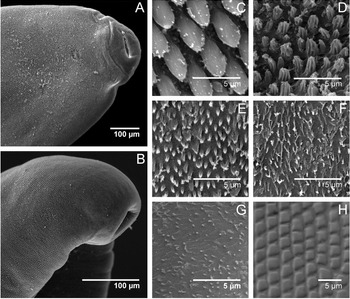
Tegumental spines present both dorsally and ventrally (Fig. 3A and B), most prominent in anterior body region. Spines, at level of genital pore ventrally, scale-shaped with pointed triangular apex and slight longitudinal wrinkles, 5.2 × 2.5 (Fig. 3C). Spines, at about same level dorsally, bear 1–3 longitudinal ridges, 1.6 × 1 (Fig. 3D). Spines, in hind half of body ventrally, lanceolate, 2.2 × 0.8 (Fig. 3E). Spines, dorso-laterally at about 1/2 body, filiform, 0.8 × 0.15 (Fig. 3F); farther back, become smaller and sparser – spines on inner slope at posterior edge 0.33 × 0.14 (Fig. 3G). (For the explanation of the term "inner slop", see Fig. 1, p. 661 in Krupenko and Gonchar (Reference Krupenko and Gonchar2017).) Spines are also visible on whole mounts using light microscopy (Fig. 3H).
Tegumental spines of Catatropis onobae sp. nov. sexual adult. SEM: in the forebody ventrally (A) and dorsally (B); at level of genital pore ventrally (C) and dorsally (D); in the hind body ventrally (E); at about 1/2 body dorso-laterally (F); on the inner slope at the posterior edge (G). Light microscopy, DIC (H).

Ventral surface bears median longitudinal ridge and two lateral rows of 8–12 (9) non-eversible papillae (Fig. 2B). Fore edge of median ridge reaches 33–50% of cirrus sac length; first pair of lateral papillae at its 50–75%, symmetrical or asymmetrical. Last pair of papillae small, immediately posterior to hind edge of median ridge.
Oral sucker subterminal, 125–220 × 130–195 (155 × 168); oesophagus 60–130 (103); caeca pass between vitelline fields and uterus, and between testes and ovary, ending blindly close to rear end of body. Excretory pore dorsal, near posterior body edge.
Testes two, symmetrical, lateral, somewhat elongated and lobed, 100–300 × 210–455 (221 × 352). External seminal vesicle large, coiled, skewed left. Cirrus sac, 610–1250 (952), posterior edge at 40–49 (45) % of body length; enclosing internal seminal vesicle, bulb-shaped pars prostatica and ejaculatory duct. Long cirrus covered with tubercles visible inside cirrus sac; everted cirrus not observed. Genital pore median, at level of caecal bifurcation (n = 11), immediately posterior (n = 17) or, rarely, anterior (n = 2) to it. Ovary intertesticular, slightly lobed, 80–185 × 120–215 (121 × 170); Mehlis' gland anterior to ovary. Uterine transverse loops intracaecal, 14–21, between the Mehlis' gland and cirrus sac. Metraterm with strong muscular walls, 500–1150 (772), 73–92 (83) % of cirrus sac length. Eggs 16.8 (15.3–18.7) × 8.7 (7.6–10.0), bear polar filament at each pole. Filament lengths not assessed, because in whole mounts they were entangled and impossible to measure confidently. Vitelline follicles extracaecal in two compact rows, pretesticular, anterior edge at 50–60 (55) % of body length.
Rediae and cercariae (Fig. 4)
Rediae 218–800 (492) × 106–234 (174), pharynx 31–49 (43) × 31–44 (37). Mature rediae contain germinal balls, embryonic cercariae with tail buds and 3–5 well-developed cercariae.
Microphotographs of Catatropis onobae sp. nov. redia (A) and cercaria (B).

Ethanol-fixed cercarial body 243–361 (300) × 118–180 (145); tail 322–588 (463) × 33–48 (41). Oral sucker 27–40 × 30–43. Mean body size of living cercariae (from photographs) 248–379 (297) × 163–215 (181). Three eyespots and dorsal adhesive pockets present. Main collecting ducts form circle with an anterior diverticulum reaching median eyespot level; thus, morphotype Yenchingensis (see Discussion). Excretory granules 1.45–2.28 (1.86, n = 38), 1–2 in rows across main excretory ducts. Cystogenous glands contain uniform secretory granules.
Remarks
The genus Catatropis Odhner, Reference Odhner1905 includes notocotylids with sexual adults bearing a median ridge and two lateral rows of papillae ventrally (Barton and Blair, Reference Barton, Blair, Gibson, Jones and Bray2002), with two possible exceptions. Catatropis johnstoni Martin, 1956 and Catatropis nicolli Cribb, Reference Cribb1991 lack lateral papillae. According to Cribb (Reference Cribb1991), they should remain within Catatropis; Bayssade-Dufour et al. ( 1996) highlighted that they do not conform to the formal description of the genus. Barton and Blair (Reference Barton, Blair, Gibson, Jones and Bray2002) show concern about inclusion of these two species in Catatropis, but tolerate it following Cribb (Reference Cribb1991). Sexual adults described here belong to the genus Catatropis, according to this classic diagnosis. Several recent taxonomic papers have listed the valid species of this genus and summarized their features (Bayssade-Dufour et al., Reference Bayssade-Dufour, Albaret, Fermet-Quinet and Farhati1996; Flores and Brugni, Reference Flores and Brugni2003, Reference Flores and Brugni2006; Schuster and Wibbelt, Reference Schuster and Wibbelt2012; Izrailskaia et al., Reference Izrailskaia, Besprozvannykh, Tatonova, Nguyen and Ngo2019). We have assembled the available information on all valid Catatropis species, to the best of our knowledge (Supplementary Table S1), except for ‘Catatropis verrucosa’ group that are dealt with separately (see next paragraph). Catatropis onobae differs from the other species in the combination of the following major characters: number of ventral papillae in lateral rows, position of genital opening relative to the caecal bifurcation, relative length of metraterm and cirrus sac, extent of cirrus sac proximal edge, extent of anterior vitelline follicles and definitive host. The species that resemble C. onobae most are Catatropis hatcheri Flores and Brugni, Reference Flores and Brugni2006 and Catatropis chilinae Flores and Brugni, Reference Flores and Brugni2003.
The differences between the sexual adults of C. onobae, C. hatcheri and C. chilinae are very faint. The cirrus sac does not extend as far posteriorly, and vitellibe folicles as far anteriorly, in C. hatcheri and C. chilinae. However, this was estimated only roughly from the figures for these two species. The character that may potentially discriminate all the three species is the metraterm to cirrus sac length ratio: in C. onobae (73–92, mean 83%) it is higher than in C. hatcheri (70%), but lower than in C. chilinae (100%). Additional reason to consider C. hatcheri and C. chilinae distinct from C. onobae is their Patagonian origin, but the true geographic distribution of these species in poorly known. Finally, the first intermediate hosts are important to consider (see the section Discussion).
Representatives of ‘Catatropis verrucosa’ group are similar to C. onobae sp. nov. in morphological features of the sexual adults and are found in the same region. They were likely confused in the past (see the section Discussion). So, we made a separate comparison that included seven sources of information plus the new species, summarized in Supplementary Table S2a. Two species were those justified by Kanev et al., Reference Kanev, Vassilev, Dimitrov and Radev1994 and distinguished mainly based on the identity of the first intermediate host: C. verrucosa (Erkina, Reference Erkina and Skrjabin1953; Kanev et al., Reference Kanev, Vassilev, Dimitrov and Radev1994) and Pseudocatatropis joyeuxi Kanev and Vasiliev, Reference Kanev and Vasiliev1986 (Joyeux, Reference Joyeux1922 based on Dubois, Reference Dubois1951; Odening, Reference Odening1966). Specimens from Odhner (Reference Odhner1905) were included, keeping in mind that they lack clear identification (see the section Discussion). Data of Filimonova (Reference Filimonova1985) were treated as possibly based on a mixture of species, because the text contained neither details on the origin of these samples nor experimental links to the first intermediate hosts. Finally, the original description of Pseudocatatropis dvoryadkini Izrailskaia, Besprozvannykh, Tatonova et al., 2019 was used. Some information is missing from the table and many characters overlap, so conclusive differentiation of species is problematic, but a few comments arise.
(1) Tegumental spines are not mentioned in the two descriptions of P. joyeuxi; this could be a potential discriminating feature, but is more likely due to incomplete descriptions. Tegumental spines are common in Notocotylidae, and are present in C. onobae, C. verrucosa and P. dvoryadkini. (2) Body length and width are evidently smaller in representatives of the genus Pseudocatatropis than in other species. (3) The number of lateral papillae may be meaningful: 9–14 for C. verrucosa, 8 in P. joyeuxi, 6–9 in P. dvoryadkini and 8–12 in C. onobae and samples of Odhner (Reference Odhner1905). This character may be variable and is often inconspicuous in whole mounts (Filimonova, Reference Filimonova1985). However, Pseudocatatropis representatives seem to have the smallest number of papillae, no more than 9. (4) The posterior edge of the cirrus sac is located at 42–50% of the body length in all species and variations in this parameter do not correspond with putative species. (5) The ratio of the metraterm to cirrus sac length is surprisingly low (mean 40%) in the account of Filimonova (Reference Filimonova1985); otherwise, this ratio is lower in P. joyeuxi (63–79%) and P. dvoryadkini (~50%) than in the other two species. (6) As only two of our C. onobae specimens had the genital pore anterior to the oesophagus bifurcation point on the slide, this should not be treated as a diagnostic feature. (7) Catatropis onobae has smaller eggs than those of C. verrucosa; taxonomic applications of this character should be further tested. Overall, morphological features of sexual adults roughly indicate that the species in question are distinct, but do not provide conclusive evidence.
Information on the first intermediate host and cercarial morphological traits was summarized for the same dataset (Supplementary Table S2b). Catatropis onobae has a unique combination of these characters, which we discuss below.
Discussion
We found sexual adults of the genus Catatropis in the caeca of common eiders. Rediae and cercariae from the gastropod O. aculeus matched these sexual adults in the marker DNA sequences. Thus, we elucidated the life cycle of the species that we propose as new, Catatropis onobae sp. nov. It is clearly distinct in the morphology of sexual adults from most other species of the genus, except for C. hatcheri, C. chilinae and ‘C. verrucosa’ that have many similarities. The latter is particularly problematic because it is found in the same geographic region as the new species and could have been misidentified before. Differentiation of sexual adults was discussed in the Remarks section, and below we focus on the taxonomic background, life cycles and phylogeny, with emphasis on C. onobae sp. nov. and ‘C. verrucosa’.
The original description of Fasciola verrucosa Frölich, Reference Frölich1789 provided limited information on this species, but showed that the number of ventral papillae in the lateral rows was 8–12 (Frölich, Reference Frölich1789). The latest re-description claimed that two European freshwater forms of Catatropis should be treated as two separate species (Kanev et al., Reference Kanev, Vassilev, Dimitrov and Radev1994). The key differences between C. verrucosa and a new species, P. joyeuxi, are in their life cycle features, not morphological traits of sexual adults. However, to prove which of the two species has priority in keeping the name C. verrucosa, we need to compare the papillae numbers with those from the original description. This comparison suggests that samples of Erkina (Reference Erkina and Skrjabin1953) and Kanev et al. (Reference Kanev, Vassilev, Dimitrov and Radev1994) (with cercariae of typical appearance and behaviour that develop in Bithynia spp.) should be called C. verrucosa. The second species, P. joyeuxi, has sexual adults with 8 ventral papillae in the lateral rows and stumpy-tailed cercariae that encyst within the first intermediate host, a planorbid snail (Joyeux, Reference Joyeux1922; Odening, Reference Odening1966). Unfortunately, the nature of specimens from the study of Odhner (Reference Odhner1905) – who gave the first detailed account of ‘C. verrucosa’ and transferred the species to Catatropis – remains unclear.
Odhner (Reference Odhner1905) studied samples from eiders and other anatids that he collected on the Swedish west coast, ‘material collected by Creplin from Greifswald’ (Baltic Sea coast) and Levinsen's ‘Arctic’ material (western Greenland, Svalbard). He considered these worms equivalent to Frölich's Fasciola verrucosa, re-described them and transferred them into a new genus he established, Catatropis. But, unlike Frölich, Odhner dealt with the samples from marine ducks, and, for example, common eiders keep almost exclusively to the sea, where they feed mostly on marine bivalves (especially blue mussels), gastropods, crustaceans and fish (Waltho and Coulson, Reference Waltho and Coulson2015). It is doubtful that a parasite of freshwater origin, C. verrucosa, can infect birds with such a diet.
Discoveries of the so-called ‘marine C. verrucosa’ at the Barents and White seas raised similar doubts (summarized in Filimonova, Reference Filimonova1985). Kulachkova (Reference Kulachkova1966) believed that ‘C. verrucosa’ from the long-tailed duck Clangula hyemalis (Linnaeus, 1758) belonged to a species distinct from the freshwater C. verrucosa. Belopolskaia (Reference Belopolskaia1952) predicted that periwinkles were intermediate hosts for ‘C. verrucosa’ that she found in all the examined common eider chicks. We have recently tested this hypothesis, but only another notocotylid species, Tristriata anatis Belopolskaia, 1953, was present in both eiders and periwinkles (Gonchar and Galaktionov, Reference Gonchar and Galaktionov2017, Reference Gonchar and Galaktionov2020). Apparently ‘marine C. verrucosa’ had to be found in some other marine gastropod.
We showed that O. aculeus was infected with intramolluscan stages of C. onobae in the White Sea, in the south-western Barents Sea and in Iceland. In the south-eastern Barents Sea, infection of juvenile eiders suggests that this parasite should also be present in local molluscs. Onoba aculeus occurs in this region (Guryanova and Ushakov, Reference Guryanova, Ushakov and Derjugin1928), but were absent from our samples. Previously notocotylids were recorded in O. aculeus from the Barents Sea, the White Sea and Iceland (Chubrik, Reference Chubrik1966; Gorbushin and Levakin, Reference Gorbushin and Levakin1999; Galaktionov and Skirnisson, Reference Galaktionov and Skirnisson2000; Skirnisson and Galaktionov, Reference Skirnisson and Galaktionov2002). It is possible that these were all accounts of C. onobae. To test this, information on cercarial morphotypes would be useful, but it is not available from the studies mentioned above.
Cercariae of Notocotylidae are uniform, but differ in some details and are classified into morphotypes. These morphotypes are based on the structure of the main collecting ducts of the excretory system (MCD) at the front where they merge (Rothschild, Reference Rothschild1938). Cercariae of C. onobae have Yenchingensis morphotype because they have an extension of the MCD directed to the median eyespot (Fig. 4B). It may distinguish them from the cercariae of C. verrucosa, but data on the latter species are contradictory: the figure suggests Monostomi morphotype (no extension), while the text says that MCD is ‘often with small median vessel extending anteriorly toward median eye-spot’ (Kanev et al., Reference Kanev, Vassilev, Dimitrov and Radev1994). As for the cercariae of P. joyeuxi and P. dvoryadkini, not only they differ in their morphotype, but also have a very contrasting, atypical appearance (Table 3).
Summary of possible differences within and between the two groups of cryptic species in the genera Catatropis and Pseudocatatropis, based on data from studies where life cycle was known (Joyeux, Reference Joyeux1922; Dubois, Reference Dubois1951; Erkina, Reference Erkina and Skrjabin1953; Odening, Reference Odening1966; Kanev et al., Reference Kanev, Vassilev, Dimitrov and Radev1994; Izrailskaia et al., Reference Izrailskaia, Besprozvannykh, Tatonova, Nguyen and Ngo2019, our data)

metr./c.s., ratio of the length of metraterm to the length of cirrus sac; papillae no., number of papillae in each lateral row; mean is given in parenthesis.
The identity of the first intermediate host is a key argument that our material constitutes a new species, C. onobae sp. nov. (Table 3). It is the first species of Catatropis from O. aculeus and from the caenogastropod superfamily Rissooidea. So, it is most obviously distinct from those species that use ‘pulmonate’ hosts (the Heterobranchia) as the first intermediate hosts. These species now get placed in the genus Pseudocatatropis by some researchers (Kanev et al., Reference Kanev, Vassilev, Dimitrov and Radev1994; Izrailskaia et al., Reference Izrailskaia, Besprozvannykh, Tatonova, Nguyen and Ngo2019). Others, however, do not dispute the diagnosis of the genus Catatropis and call the new species from the ‘pulmonate’ snails Chilina dombeiana (Bruguière, 1789) C. chilinae (Flores, Brugni, Reference Flores and Brugni2003). Whether this species should also be transferred to the genus Pseudocatatropis is a matter of larger-scale taxonomic revision of Notocotylidae; existence of Pseudocatatropis was not yet supported in the ‘Keys to Trematoda’ (Barton and Blair, Reference Barton, Blair, Gibson, Jones and Bray2002).
In other Catatropis species where the first intermediate hosts are known, they belong to Caenogastropoda. Melanoides tuberculata (O. F. Müller, 1774) (Cerithioidea) hosts Catatropis vietnamensis Izrailskaia, Besprozvannykh, Tatonova et al., 2019 (see Izrailskaia et al., Reference Izrailskaia, Besprozvannykh, Tatonova, Nguyen and Ngo2019). In other species, the first intermediate hosts belong to the order Littorinimorpha, the superfamily Truncatelloidea: Catatropis lagunae Bayssade-Dufour et al., Reference Bayssade-Dufour, Albaret, Fermet-Quinet and Farhati1996 from Peringia ulvae (Pennant, 1777) (see Bayssade-Dufour et al., Reference Bayssade-Dufour, Albaret, Fermet-Quinet and Farhati1996) and C. hatcheri from Heleobia (=Strobelitatea) hatcheri (Pilsbry, 1911) (Flores and Brugni, Reference Flores and Brugni2006); and four species are from members of the family Bithyniidae: Catatropis indicus Srivastava, 1935 (Rohde and Onn, Reference Rohde and Onn1967; Koch, Reference Koch2002), Catatropis morosovi Gubanov et al., 1966 (Dvoryadkin, Reference Dvoryadkin1987), Catatropis hisikui Yamaguti, 1939 (Besprozvannykh, Reference Besprozvannykh2006) and C. verrucosa (Erkina, Reference Erkina and Skrjabin1953; Kanev et al., Reference Kanev, Vassilev, Dimitrov and Radev1994). The latter, as outlined in the Remarks section, has sexual adults that are almost indistinguishable from those of C. onobae.
Putative differences between C. verrucosa and C. onobae are summarized in Table 3, but they are limited. Because formally, systematics of Digenea relies on the morphological traits of sexual adults, this pair of species can be considered cryptic. They were likely confused not only in the past, but even recently. For example, we now believe that the name C. verrucosa in the paper on musculature of notocotylid sexual adults (Krupenko and Gonchar, Reference Krupenko and Gonchar2017) refers to C. onobae. Furthermore, C. verrucosa (and C. onobae) also were previously confused with P. joyeuxi. Now P. joyeuxi and P. dvoryadkini are in another genus on the basis of their life cycle features and they represent a second possible pair of cryptic – apparently geographically isolated – species. When DNA sequence data for C. verrucosa and P. joyeuxi become available, relationships in each of these two pairs should be clarified.
Phylogenetic positions of C. onobae and P. dvoryadkini (Fig. 1) challenge the traditional concept of the genus Catatropis, which appears polyphyletic. Moreover, representatives of Notocotylus also appear in four different clades on the tree. Similar observations were also made in previous studies (Assis et al., Reference Assis, Lopez-Hernández, Pulido-Murillo, Melo and Pinto2019; Gonchar et al., Reference Gonchar, Jouet, Skírnisson, Krupenko and Galaktionov2019; Izrailskaia et al., Reference Izrailskaia, Besprozvannykh, Tatonova, Nguyen and Ngo2019). These are alarm bells for the fundamentals of notocotylid taxonomy, where the structure of ventral organs (ridges and papillae – their number, combination or absence) served to characterize genera. These traits are apparently homoplastic rather than apomorphic, and ‘Notocotylus’ and ‘Catatropis’ are better suited to denote morphotypes rather than genera. A similar approach has long been applied to notocotylid cercariae (Rothschild, Reference Rothschild1938).
Characters that may correspond to monophyletic groups within the family Notocotylidae are still to be found. On our tree (Fig. 1), two well-supported clades unite species with molluscan hosts mostly from the Heterobranchia (A) and mostly from the Caenogastropoda (B) (see also Assis et al., Reference Assis, Lopez-Hernández, Pulido-Murillo, Melo and Pinto2019; Gonchar et al., Reference Gonchar, Jouet, Skírnisson, Krupenko and Galaktionov2019). However, the position of many species, including C. onobae, is not resolved, most likely indicating a significant lack of sampling across the family. To fill this gap and avoid ambiguities, the first priority is to elucidate complete life cycles of more notocotylids, supplement them with molecular genetic data and look critically at identifying species. In our view, only experimental studies in which intermediate hosts and cercariae are known should be used as references for C. verrucosa (Erkina, Reference Erkina and Skrjabin1953; Kanev et al., Reference Kanev, Vassilev, Dimitrov and Radev1994) and P. joyeuxi (Joyeux, Reference Joyeux1922; Odening, Reference Odening1966). Data from Odhner (Reference Odhner1905) cannot be considered a reliable description of C. verrucosa.
Conclusions
A description of the new species C. onobae became possible as a result of applying an integrative taxonomy approach. Both cercariae and sexual adults of this species were probably documented previously under other names, but could not be recognized. The reason was that the morphological traits of sexual adults alone do not distinguish this species from others. Now, molecular data has helped elucidate the life cycle and this – and specifically the first intermediate host, O. aculeus – was the clue to identification. Combining multiple sources of evidence for other members of the Notocotylidae will allow investigators to revise the classification of this family, which includes at least two polyphyletic genera.
Supplementary material
The supplementary material for this article can be found at https://doi.org/10.1017/S0031182020001808.
Acknowledgements
The authors are grateful to the White Sea Biological Station of the Zoological Institute of the Russian Academy of Sciences (ZIN RAS) and the Educational and Research Station ‘Belomorskaia’ of St Petersburg University (SPbU) for providing fieldwork infrastructure. Sampling in Iceland would have been impossible without the support from Dr Karl Skírnisson. They also acknowledge the research resource centre ‘Molecular and Cell Technologies’ of SPbU, the Laboratory of Molecular Systematics and the ‘Taxon’ centre of shared facilities of ZIN RAS for access to facilities. Special thanks are due to Dr Anna Romanovich and Dr Alexei Masharsky for their invaluable work in high quality and timely sequencing.
Financial support
The study was funded by Russian Science Foundation grant number 18-14-00170 to K.G. and A.G. The SEM study was partially supported by the research programme of ZIN RAS, project number AAAA-A19-119020690109-2.
Conflict of interest
The authors declare there are no conflicts of interest.
Ethical standards
This study was conducted in compliance with all institutional, national and international guidelines on the care and use of animals.