The results of the most extensive and intensive investigation of the putative effects of early child care on child development to date yield several general conclusions. The first is that family factors and processes appear far more influential with respect to child development, in the absence of any discounting for effects of shared genes, than does child care experience in this naturalistic, longitudinal study (NICHD Early Child Care Research Network [ECCRN], 2006; NICHD ECCRN & Duncan, Reference Duncan2003). Second, small to modest significant effects of child care appear to endure through adolescence, though they often dissipate in strength over time (Belsky et al., Reference Belsky, Vandell, Burchinal, Clarke-Stewart, McCartney and Owen2007; Vandell, Belsky, Burchinal, Steinberg, & Vandergrift, Reference Vandell, Belsky, Burchinal, Steinberg and Vandergrift2010). Third, more time spent in any kind of nonmaternal care across the infant, toddler, and preschool years, and particularly in center-based care, predicts higher levels of externalizing problem behavior, though time in care is not related to clinical-level behavior problems (Belsky et al., Reference Belsky, Vandell, Burchinal, Clarke-Stewart, McCartney and Owen2007). Fourth, more attentive, responsive, and stimulating care (i.e., child care that is evaluated as higher in quality based upon repeated and extensive observational assessments from age 6 to 54 months) is associated with enhanced cognitive–linguistic functioning (NICHD ECCRN & Duncan, Reference Duncan2003).
The links between high-quality and positive child outcomes have been replicated internationally in many other studies beyond the NICHD study, including longitudinal studies in the United Kingdom (Sylva, Melhuish, Sammons, Siraj-Blatchford, & Taggart, Reference Sylva, Melhuish, Sammons, Siraj-Blatchford and Taggart2012), Canada (Côté et al., Reference Côté, Mongeau, Japel, Xu, Séguin and Tremblay2013), and Chile (Leyva et al., Reference Leyva, Weiland, Barata, Yoshikawa, Snow and Treviño2015), among many others. In contrast, links between time in care and outcomes are somewhat more mixed in other international, longitudinal studies (Zachrisson, Dearing, Lekhal, & Toppelberg, Reference Zachrisson, Dearing, Lekhal and Toppelberg2013).
The finding that more stimulating care is associated with enhanced cognitive development has led to efforts aimed at determining why some children receive higher quality care while others do not. Research suggests that the determinants of quality care are multifarious, including factors related to national and local early childhood policies and resources; factors related to the child care setting, such as staff quality, training, and support; and factors related to the family, such as parental income, education, and child care preferences (Bronfenbrenner & Morris, Reference Bronfenbrenner and Morris2006; NICHD ECCRN, 1996; Shonkoff & Phillips, Reference Shonkoff and Phillips2000; Sylva, Stein, Leach, Barnes, & Malmberg, Reference Sylva, Stein, Leach, Barnes and Malmberg2007).
In addition, transactional models of typical and atypical child development highlight the importance of bidirectional influences on children and their environment (Bronfenbrenner & Morris, Reference Bronfenbrenner and Morris2006; Knafo & Jaffee, Reference Knafo and Jaffee2013). Children's influence on parenting behavior, family dynamics, and peer group selection, among other domains, have been shown to have important implications for understanding typical developmental as well as psychopathology (Anderson, Lytton, & Romney, Reference Anderson, Lytton and Romney1986; Bell, Reference Bell1968; Crouter & Booth, Reference Crouter and Booth2003; Lansford et al. Reference Lansford, Criss, Laird, Shaw, Pettit and Bates2011; Pener-Tessler et al. Reference Pener-Tessler, Avinun, Uzefovsky, Edelman, Ebstein and Knafo2013; Scarr & McCartney, Reference Scarr and McCartney1983). However, less is known about the role of the “influential child” on aspects of child care quality and quantity.
Child characteristics such as age, gender, and temperament have been shown to influence the type of child care a child attends (Howes, Whitebook, & Phillips, Reference Howes, Whitebook and Phillips1992; Liang, Fuller, & Singer, Reference Liang, Fuller and Singer2000; Pungello & Kurtz-Costes, Reference Pungello and Kurtz-Costes1999; Singer, Fuller, Keiley, & Wolf, Reference Singer, Fuller, Keiley and Wolf1998). The child characteristic most highly associated with selection into care is age; older children are more likely to be placed in care than are infants (Johansen, Leibowitz, & Waite, Reference Johansen, Leibowitz and Waite1996). Other child characteristics, such as developmental risk factors, have also been examined as predictors of type of care. Loeb, Fuller, Kagan, and Carrol (Reference Loeb, Fuller, Kagan and Carrol2005) found no influence of child cognitive competence on the type of care (e.g., family care, center care, or no care) into which children were placed.
Less frequently examined in this literature, however, is the relationship between child developmental risk factors, such as developmental status, and child care quality, particularly child-specific measures of process quality (Pungello & Kurtz-Costes, Reference Pungello and Kurtz-Costes1999). Child-specific process quality is measured at the individual child level, rather than using global measures of process or structural quality, and developmental theory suggests that indicators of proximal quality that influence children directly will be more important than quality factors that do not have a bearing on their immediate environment or individual experience (Bronfenbrenner & Morris, Reference Bronfenbrenner and Morris2006; Marshall, Reference Marshall2004).
Child characteristics could evoke quality of care due to a caregiver reacting to, or interacting with, a child's particular physical, cognitive, or behavioral attributes and thus providing lower or higher quality care. These associations might best be understood in the context of a transactional framework, in which children's early skills prompt particular caregiver practices, and these caregiver practices in turn affect subsequent changes in children's skills. Regarding quantity of care, a parent might react to a child's particular physical, cognitive, or socioemotional characteristic and put the child in care for more or fewer hours.
As children in the United States and other industrialized countries are increasingly spending more time in child care, as well as entering nonparental care at younger ages, identifying child effects on quality and quantity of care is important. In addition, understanding child effects on child care might be key to highlighting the transactional processes by which child care quality or quantity influences children's development (Marshall, Reference Marshall2004), particularly those at greatest risk of psychopathology (Ellis, Boyce, Belsky, Bakermans-Kranenburg, & van IJzendoorn, Reference Ellis, Boyce, Belsky, Bakermans-Kranenburg and van IJzendoorn2011).
Having a better understanding of whether and how child characteristics might influence quantity or quality of caregiving is also important because, to the extent that child characteristics nonrandomly “select” particular children into varying quality or quantity of child care, these factors should be controlled for in observational studies of child care's effects on development. To the extent that child effects on child care exist, not controlling for them in nonexperimental studies may bias estimates of contextual factors on development (Singer et al., Reference Singer, Fuller, Keiley and Wolf1998).
Thus, the purpose of the current, two-study report is to test for potential effects of child characteristics on children's child care experience. We focus on how child characteristics influence two aspects of the child care experience that the NICHD ECCRN study has found to be significantly related to later developmental outcomes: language stimulation provided by caregivers and quantity of care. Study 1 examines associations between children's developmental status and the feature of quality of care that emerged as most strongly related to children's cognitive–linguistic development at 2 and 3 years of age (NICHD ECCRN, 2000), namely, linguistic stimulation provided by caregivers. Study 2 is stimulated by findings linking time in any kind of child care and in center care in particular with problem behavior, thereby exploring how select child attributes may predict dosage of child care.
Study 1: Child Effects on Language Stimulation in Child Care
One of the fundamental questions in child language development concerns the role of adult linguistic responsiveness in shaping children's cognitive and language development. Research suggests that although adult language stimulation is not the only factor necessary for healthy language development. It is necessary for the development of language, and adult–child interaction, through language, plays a critical role in all other aspects of early development as well (Cross & Morris, Reference Cross and Morris1980; Hoff & Naigles, Reference Hoff and Naigles2002; Huttenlocher, Haight, Bryk, Seltzer, & Lyons, Reference Huttenlocher, Haight, Bryk, Seltzer and Lyons1991; Snow, Reference Snow, Bornstein and Bruner1989; Tamis-LeMonda, Bornstein, & Baumwell, Reference Tamis-LeMonda, Bornstein and Baumwell2001). The language stimulation environment has also emerged as the key component of quality predicting children's language and cognitive development in studies of child care (NICHD ECCRN, 2000).
Research has clearly shown that the child himself or herself also plays a crucial role in the transactional process of shaping adults’ language stimulation (Bohannon & Marquis, Reference Bohannon and Marquis1977), in that parents’ language input is responsive to children's interests, communicative attempts, and language abilities (Bohannon & Bonvillian, Reference Bohannon, Bonvillian and Berko Gleason1997; Clarke-Stewart, VanderStoep, & Killian, Reference Clarke-Stewart, VanderStoep and Killian1979; Cross, Reference Cross, Waterson and Snow1978; Snow, Reference Snow, Bornstein and Bruner1989; Sokolov, Reference Sokolov1993; Tamis-LeMonda et al., Reference Tamis-LeMonda, Bornstein and Baumwell2001). Child characteristics such as age (Bornstein, Reference Bornstein, Budwig, Uzgiris and Wertsch2000) and capacity for joint attention (Dunham & Dunham, Reference Dunham and Dunham1992) also influence parental speech.
However, less is known about the extent to which children are engaged in a transactional process with nonparental caregivers that shapes the language stimulation they receive. A few studies have provided a basis of evidence that processes similar to those in the parent–child domain are also important within the context of child care. For example, Vallotton (Reference Vallotton2009) found evidence that the clarity of infants’ communicative gestures in response to caregivers predicted increased caregivers’ responsiveness. Girolametto and colleagues (Girolametto, Hoaken, Weitzman, & van Lieshout, 2000; Girolametto & Weitzman, Reference Girolametto and Weitzman2002) have found evidence that younger children, as well as children with developmental delay, evoke less stimulating language environments in the child care context. The Girolametto studies, however, are small, community samples, do not control for all socioeconomic characteristics, only measure caregiver language stimulation at the group level, and do not examine how individual differences between children in the same age group influence language stimulation.
Although the above work is provocative, more research needs to be done to understand the relationship between child cognitive and language characteristics and the child care language stimulation environment, as well as whether this relationship varies by child's age. Given the complexity of give-and-take language interactions, it is difficult to disentangle evocative effects at a single point in time. Instead, a more robust strategy for exploring these questions would involve examining transactional processes that unfold over time, exploring how children's skills at one point in time might predict caregiver practices at a later time, accounting for a wide range of key covariates.
Using a similar lagged approach, researchers have examined child effects on other aspects of the educational context, particularly child–teacher relationship quality (Koles, O'Connor, & McCartney, Reference Koles, O'Connor and McCartney2009). Rudasill, Rimm-Kaufman, Justice, and Pence (Reference Rudasill, Rimm-Kaufman, Justice and Pence2006) examined the association between child temperament and language ability and the quality of the child–caregiver relationship (as reported by the teacher) in a study of 99 prekindergarten students and their teachers. They found that measures of children's temperament and language ability at the beginning of the preschool year were associated with a measure of teacher–child relationship quality at the end of the school year. Not only did bolder children who used less complex language than other children experience more conflict with teachers, but shyer children who used more complex language were more likely to have dependent relationships with their teachers. A similar study, using the NICHD Study of Early Child Care (SECC) sample, found that child shyness, effortful control, and gender of first-grade children contributed to the teacher–child relationship, mediated through the frequency of teacher–child interactions in the classroom (Rudasill & Rimm-Kaufman, Reference Rudasill and Rimm-Kaufman2009). Earlier work also found evidence of child gender effects on teacher quality, with teachers more likely to respond to boys’ disruptive behavior than to girls’ misbehavior, and to girls who were physically proximal (Serbin, O'Leary, Kent, & Tonick, Reference Serbin, O'Leary, Kent and Tonick1973). This research supports the hypothesis that child factors may play a role in influencing other teacher–child interactions, such as language interactions.
If evocative processes do, over time, influence language stimulation received in child care, it raises the question of whether the positive associations between the linguistic richness of childrearing environments and children's cognitive–linguistic skills are, at least in part, the result of evocative child effects. Children with more advanced language or cognitive skills may simply evoke greater amounts of speech and/or higher quality speech from their parents and caregivers. In turn, this stimulation might predict greater child learning, in a virtuous cycle.
For example, the Rudasill et al. (Reference Rudasill, Rimm-Kaufman, Justice and Pence2006) findings are notable because the teacher–child relationship outcome used in their investigation has been treated as an exogenous indicator of child care quality in research attempting to model the effects of good quality care on children's later development (Peisner-Feinberg et al., Reference Peisner-Feinberg, Burchinal, Clifford, Culkin, Howes and Kagan2001). Their results suggest that there is child temperament-related endogeneity in measures of child-specific, child–teacher relationship quality, and raises the question as to whether there might be child cognitive- or language-related endogeneity in measures of child-specific child care language stimulation quality.
To the extent that this is the case, evocative child effects could masquerade in both cross-sectional and longitudinal correlational research as effects of language stimulation on children's language development. Not controlling for such effects in nonexperimental studies may bias estimates of contextual factors on development (Singer et al., Reference Singer, Fuller, Keiley and Wolf1998).
Evocative effects are of concern not only for endogeneity reasons but also for practice- and policy-relevant reasons. If caregivers are providing greater language stimulation to children with already more advanced cognitive or language skills, this may have implications for the ongoing cognitive and language development of children with less advanced skills or for those at risk for poor developmental outcomes (Bohannon & Bonvillian, Reference Bohannon, Bonvillian and Berko Gleason1997).
Thus, Study 1 addresses the following question: do children's developmental skills influence the language stimulation they experience in child care? Based on the research suggesting caregiver and parental tuning to child developmental level, we hypothesize that more developmentally advanced children, in terms of their performance on standard developmental assessments of cognition and language, will evoke and thus receive more language stimulation over time from their caregivers than will less competent agemates. We also hypothesize that the greater language stimulation they receive will in turn result in improved learning over time.
Method
Data for this study come from the NICHD SECC, which arguably includes the most nuanced information about caregiver–child language exchanges of any large-scale data set. The NICHD SECC recruited mothers from hospitals near the following locations throughout 1991: Little Rock, Arkansas; Irvine, California; Lawrence, Kansas; Boston, Massachusetts; Philadelphia, Pennsylvania; Pittsburgh, Pennsylvania; Charlottesville, Virginia; Morganton, North Carolina; Seattle, Washington; and Madison, Wisconsin. The sample plan was not intended to provide a representative national sample but to represent healthy births to nonteen parents at the selected hospitals. Potential participants were selected from among 8,986 mothers giving birth during selected 24-hr sampling periods. The sample of 8,986 mothers was reduced to 5,416 mothers eligible for a phone call 2 weeks after the birth owing to both unplanned attrition (438 cases; mostly refusals) and planned sample exclusions (3,142 cases; mother under 18 years old, multiple births, mother not fluent in English, family expects to move, medical complications, baby being put up for adoption, family lives too far away, family participates in another study, or family lives in an unsafe neighborhood). A conditional subsampling plan was next imposed to ensure that single-parent, low-maternal education, and minority distributional targets were met while continuing random selection of cases. Altogether, 3,015 families were targeted for recruitment.
The sample was further reduced from 3,015 screened mothers to the 1,364 recruited mothers who provided information at the 1-month interview for reasons that were unplanned (1,153 cases; refusals and lack of success with contacts at three different times of the day) and planned (151 cases; baby in hospital more than 7 days, planning to move within 3 years; 185 cases not contacted because enrollment quota was achieved before that family's name appeared on the contact sheets). Thus, because of attrition and the inclusion of the 10 sites selected nonrandomly, the NICHD SECC sample cannot be regarded as statistically representative of any a priori-defined population. Nevertheless, the sample is large and economically, geographically, and ethnically diverse, especially for an observational child care study. For detailed description of recruitment procedures and sample characteristics see NICHD ECCRN (2001).
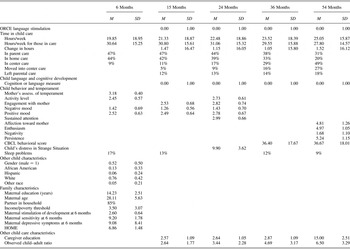
Although Table 1 reports on the entire sample, the analytic sample of Study 1, which focuses on language stimulation in child care, is composed of 670 children who were in nonparental child care at all four time points (49% of total sample). Children excluded from Study 1 (i.e., those not in care throughout the study) were significantly different from included families on nearly all variables (except gender) and were systematically less advantaged (e.g., lower income).
Description of sample and analysis variables

Note: HOME, Home Observation for the Measurement of the Environment; ORCE, Observational Record of the Caregiving Environment. N = 1364.
Procedures and measurement
Procedures and measures are described in terms of the roles that they play in the statistical analysis: key variables of interest (i.e., caregiver language stimulation) and child developmental level as assessed with overall developmental assessments, language assessments, and/or cognitive assessments) and control variables (i.e., family background factors and child care variables).
Variable of interest: Child caregiver language stimulation
Observational assessments of caregiver–child interaction were obtained for children who were in 10 or more hours per week of nonparental care. Observations were conducted during 2 half-day visits scheduled within 2-week intervals at ages 6, 15, 24, 36 months and during 1 half-day visit at 54 months. At each visit, observers completed two 44-min cycles of the Observational Record of the Caregiving Environment (ORCE), during which they coded the frequency of specific caregiver behaviors and then rated the quality of the caregiving. The ORCE format consisted of 44-min cycles, each broken into four 10-min observation periods. In each 10-min period, observers alternated between 30 s of observation and 30 s of recording. During the “observe” intervals, observers focused on the study child's behavior, activities, and interaction with the caregiver or other people. During the “record” intervals, the observer completed the frequency checklist. At the end of the 10-min period, the observer made brief notes and tentative qualitative ratings of behaviors for 2 min. This process was repeated for three 10-min periods. In the final 10-min period, the observer made observations exclusively for the qualitative ratings. Typically four 44-min ORCE cycles, distributed over 2 days, were completed for each child.
Because of the centrality of language stimulation to language and cognitive development, the following subset of observed caregiving behaviors was identified for the NICHD-SECC study as constituting language stimulation, thus serving as the focus of this investigation: the frequency at which the caregiver asks questions of child, responds to the child's vocalizations, and provides other (nonnegative) talk to child. Target children were observed in their child care arrangement with the most hours. All behavioral items were then summed across segments and cycles to yield a total number of segments within which a particular behavior (or set of behaviors) occurred. Most children had a total of 120 segments of information. The individual behavioral variables (e.g., shows positive affect, provides positive physical contact, and responds to child's vocalizations) were scaled to represent the number of times in 60 segments a particular behavior occurred. Composite variables (e.g., language stimulation used in this report) were created as the sum of the standardized individual behavior variables. Final values for the individual and composite behavioral variables were retained only for those children with a minimum of 45 segments. The internal consistency of these composites was high, with Cronbach αs of 0.88, 0.92, 0.90, and 0.66 at 15, 24, 36, and 54 months, respectively. The 54-month reliability was lower due to only two observation cycles being conducted, compared to four cycles at the earlier points in time.
The caregiver behaviors that were categorized as language stimulation varied only slightly by child age. At 15 months, they were: asks questions of child, responds to child's vocalizations, and other talk to child (M = 0, SD = 1; only the standardized composite variable was available). At 24 and 36 months, they were: asks questions of child, responds to child's talk, and other talk to child (24 months M = 50.6, SD = 27.1; 36 months M = 58.4, SD = 30.7). At 54 months, they were: asks questions of child, answers child's question, and other talk to child (M = 36.6; SD = 17.9). Distributions of the outcome variables were normal.
Each ORCE observer was trained to reach criterion using videotapes that had been coded by experts. To be certified as data collectors, each observer had to achieve exact agreement with the master codes of the behavior scales at a level of 70% or better and with the qualitative ratings at a level of 60% or better. Agreement was typically much higher (NICHD ECCRN, 1996). Live interobserver reliability was also calculated three to four times at approximately 3-month intervals throughout each data collection period. Intraclass correlations among partners ranged from 0.89 to 0.99.
Variable of interest: Child cognition/language skills
The Mental Development Index (MDI) of the Bayley Scales of Infant Development (BSID) was used to measure children's overall cognition. At 15 months, the first version of the MDI (Bayley, Reference Bayley1969) was used, and at 24 months, the second version of the MDI (Bayley, Reference Bayley1993) was used. The BSID is an individually administered examination designed to assess the current developmental functioning of infants and children ages 1–42 months. The MDI section of the BSID is a 30-min assessment of infants’ sensory–perceptual, memory, and problem-solving abilities (e.g. block building, puzzles, and vocabulary) that provides a general measure of cognitive and language development. Bayley scores were expected to provide an index of the infant's complex maturational system (including attention, self-regulatory, and verbal abilities). Administration of the mental scales for each test yields a raw score that represents the total number of items passed. The raw score is converted into the MDI score by referring to the norms tables for the child's age derived by Bayley (Reference Bayley1969, Reference Bayley1993). The original Bayley, and subsequently, the revised Bayley, are the most widely used measures of infant cognition and have been shown to have excellent psychometric properties (Gagnon & Nagle, Reference Gagnon and Nagle2000).
The child language measures at 36 months reflected the child's score on the two scales of the Reynell Scales of Language Development (Reynell, Reference Reynell1991). The Verbal Comprehension Scale at 36 months consists of 10 sections with 67 total questions, which follow the developmental sequence of receptive language skills. The child was required to follow the examiner's directions pertaining to models of familiar objects (i.e., doll, car, spoons, etc.) and representations of objects, people, and animals. Questions are arranged in order of increasing difficulty where the directions become more abstract (e.g., “Who used to go to school but doesn't now?”) and more complex (e.g., “Put all the pink pigs around the outside of the field.”). The Expressive Language Scale assesses expressive language skills, using three sets of items: structure (from vocalizations to the appropriate use of syntactic structure), vocabulary (naming of objects, actions, and concepts), and content (the use of language to describe elements and actions). Reliability for the Reynell is high, with the test developer reporting median split-half reliability coefficients of 0.87 for both sections (Reynell & Gruber, Reference Reynell and Gruber1990).
At 54 months, a measure of child's linguistic competence was assessed using the two subtests of the Preschool Language Scale (Zimmerman, Steiner, & Pond, Reference Zimmerman, Steiner and Pond1979). The Preschool Language Scale is organized into two standardized subscales: auditory comprehension (AC) and expressive communication (EC). The AC scale measures what children “know” or understand but may not “say,” and the EC scale measures what children actually say or produce. The total language standard score, representing the sum of AC and EC standard scores, was used.
At each wave, so as to ease the comparison of these different assessments of developmental status, all measures of child competence used to predict language stimulation were standardized to have a mean of zero and a standard deviation of one.
Control variables: Child/family background factors
The demographic controls included child gender, child ethnic group (non-Hispanic African American, non-Hispanic European American, Hispanic American, or other), maternal years of education at child's birth, average family income to needs ratio at the first time point, and the percentage of measurement occasions when a partner lived in the household at the first time point. Each of these has been related to child care experiences in prior research (Pungello & Kurtz-Costes, Reference Pungello and Kurtz-Costes1999).
Child difficult temperament was measured by a 55-item Infant Temperament Questionnaire (Medoff-Cooper, Carey, & McDevitt, Reference Medoff-Cooper, Carey and McDevitt1993) completed by the child's mother. Using a 6-point scale, mothers rated how frequently their children's behavior was similar to example behaviors (e.g., “My baby's initial reaction to a new babysitter is rejection [crying, clinging to the mother, etc.]”). An overall measure of difficulty was obtained by averaging nonmissing items from the activity, adaptability, approach, mood, and intensity subscales. The Cronbach α for the entire NICHD SECC sample was 0.81. The dimensions of activity, approach, adaptability, mood, and intensity were selected to provide maximum information about the infant's temperament with minimum administration time.
The maternal sensitivity score was a composite of 4-point ratings of sensitivity to nondistress, intrusiveness (reverse scored), and positive regard. Videotapes from all sites were coded at one location. Maternal depressive symptoms were measured using the Center for Epidemiological Studies Depression Scale (Radloff, Reference Radloff1977) administered at 6 months. Each of these family characteristics was included because they have previously been linked, theoretically or empirically, to both child outcomes and family selection of child care arrangements (Pungello & Kurtz-Costes, Reference Pungello and Kurtz-Costes1999).
Quality of home environment was measured with the Infant/Toddler version of the Home Observation for Measurement of the Environment (HOME; Caldwell & Bradley, Reference Caldwell and Bradley1984), which is an assessment of the overall quality of the physical and social resources available to the child in the family context. Different measures of the HOME were used at different times. The Infant/Toddler version was administered at 15 months, and the Early Childhood version was administered at 36 and 54 months. Both versions measure the quality and the quantity of stimulation and support available to a child in the home environment. Analyses used the total HOME. Because there was no 24-month HOME observation, the 15-month score was used for estimating caregiver home environment at 24 months. Cronbach α was 0.80 for the 15 months score, 0.87 for the 36 months score, and 0.72 for the 54 months score.
A more targeted measure of maternal cognitive stimulation was obtained from a semistructured mother–child interaction procedure conducted and videotaped at the family's home at 6 months. At 6 months, mothers were instructed to play with their children using toys in two containers. Some of the toys were provided by the experimenter, and others were the child's toys that were selected by the mother. All tapes were coded at a central location by coders who were unacquainted with the family or child care history. Maternal stimulation of cognitive development was rated for the number and quality of activities presumed to enhance perceptual, cognitive, linguistic, and physical development on a 4-point scale at 6 months. Low scores indicate that mothers made little or no attempt to stimulate or teach the child, were totally uninvolved, or provided stimulation that was very poorly matched to the child's developmental level or interest. High scores indicate that mothers consistently provided age-appropriate cognitive stimulation that was likely to lead to a higher level of mastery, understanding, or sophistication. Intercoder reliability in coding maternal stimulation during mother–child play, calculated using intraclass correlations (Winer, Reference Winer1971), was 0.81 at 6 months.
Control variables: Child care type and quality
Features of child care were assessed at each measurement occasion; these included observed child–caregiver ratio, years of caregiver education, mean hours of care per week, and an indicator variable for whether the child was in home care (with being in center care the reference group).
Missing data
Missing data is a concern in most longitudinal data sets, and the rate of missing data in the NICHD SECC is as much as 25% for reasons including caregiver refusal, child absence from child care, and recent changes in the child care setting (see NICHD ECCRN, 1996). Examination of patterns of missingness, using χ2 and t test analyses, suggested that data were missing at random (i.e., in conjunction with other variables included in the data set). In particular, families with fewer missing values on the key predictor and outcome variables (i.e., language stimulation and language skills at each time point) had higher incomes and provided more stimulating home environments; mothers had more education and were rated as more stimulating in interactions with the child; and children experienced more hours of child care and were more likely to be in a child care center or a child care home than to be in less formal child care. The analyses in Mplus 7.03 employed a full information at maximum likelihood approach (with variables related to missingness in the model) to minimize bias in parameter estimates (Widaman, Reference Widaman2006).
Analytic approach
Given that the measures of child cognitive/language skill differed across time points, we employed path analysis rather than growth curve modeling. In this model, grounded in the theory and research described above, we modeled “stability paths” between the measures of cognitive/language skill at each time point. Of greatest interest in this model were a set of paths capturing the transactional evocative effects between child skill at a particular time point and caregiver stimulation, net of a variety of child, family, and classroom covariates. To rigorously examine the extent to which the evocative effect emerges in these data, we included covariances between contemporaneous child and caregiver measures at each time point, as well as all possible child-to-caregiver associations (e.g., child skills at 15 months on caregiver stimulation at 24 months) and all possible cross-lagged caregiver-to-child associations (e.g., caregiver language stimulation at 15 months on child skills at 24 months). In this way, we were able to explore the complex interplay that characterizes child–adult interaction over time.
Results
Do children's cognition and language skills predict contemporaneous language stimulation provided by caregivers in child care?
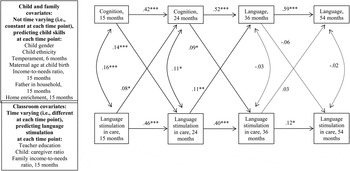
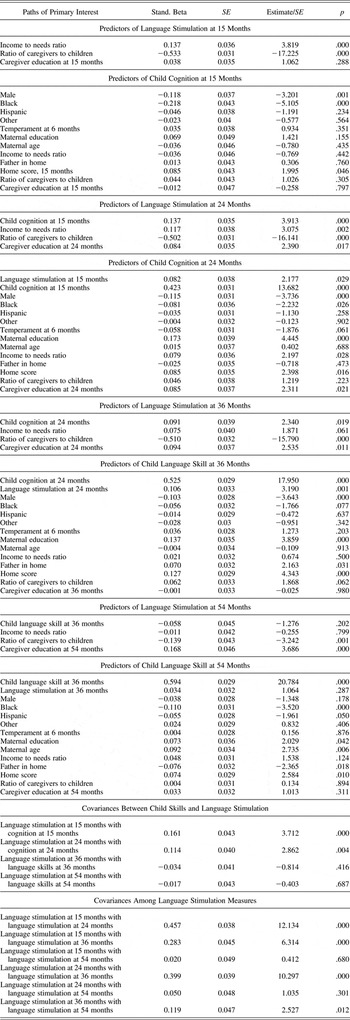
Key results are noted below, with full results included in Table 2. In this model, significant covariances between child skills and caregiver language emerged at 15 months (β = 0.16, p < .001) and 24 months (β = 0.11, p = .004), but not at 36 months (β = –0.03, p = .416) or 54 months (β = –0.02, p = .687; see Figure 1). In addition, transactional evocative effects over time emerged up to 36 months. Specifically, children whose language skills were higher at 15 months received more caregiver input at 24 months (β = 0.14, p < .001), and the same pattern emerged between language skills at 24 months and caregiver input at 36 months (β = 0.09, p = .019). At the same time, complementary evidence of the import of caregiver practices on children was apparent, in that children who received more caregiver input at 15 months demonstrated higher language skills at 24 months (β = 0.08, p = .029), and the same relation emerged between input at 24 months and language at 36 months (β = 0.11, p = .001). Model fit was adequate, χ2 (109) = 257.48, comparative fit index = 0.935, root mean square error of approximation = 0.045, although the Tucker–Lewis index was slightly low (0.888).
Results of the path analysis for caregiver language a child skills. All Language stimulation in care variables were allowed to covary with one another, and all covariates were allowed to correlate with one another. Sample N = 670. All coefficients are standardized. χ2 (109) = 257.48, comparative fit index = 0.935, root mean square error of approximation = 0.046, Tucker–Lewis index = 0.888. *p < .05, **p < .01, ***p < .001.

Path analysis of caregiver language and child skills

Note: All exogenous covariates were allowed to correlate with one another, but these paths are omitted from tables for parsimony. N = 670. χ2 (109) = 257.48, CFI = 0.935, RMSEA = 0.045, TLI = 0.888.
Follow-up descriptive analysis
To more fully explore what the evocative effect on the child care language environment implies for 2-year-old children at various developmental levels, particularly those at developmental risk, we examined the average language environment for children of lower (below the mean) versus higher (above the mean) Bayley scores. While patterns were similar at 15 and 24 months, we focused this descriptive analysis on the 24-month time point because the language stimulation variable was provided in its original metric. The results showed that, out of 120 total segments (each segment 30 s in length) of observation in the child care environment, children in the more developmentally at-risk group were exposed to language in 55.9 segments, while children in the more advanced group were exposed to language in 63.2 segments, a difference that was significant, t (503) = 2.65, p = .008.
Follow up subgroup analysis
In an additional follow-up analysis, we tested the possibility that the contribution of children's skills to the language stimulation they received over time might be stronger for children with higher skills. Specifically, we constructed a group comparison model, estimating the path model described above between two groups: those whose early (15 month) Bayley scores were at or below the sample mean (M = 109) and those whose 15-month Bayley scores were above the mean. In this way, we could examine whether the coefficients representing the transactional evocative effect between child skills at 15 months and language stimulation at 24 months, as well as child skills at 24 months and language stimulation at 36 months, were statistically different between these groups. We also explored group differences in the associations between caregiver talk and later child skills, and between contemporaneous covariances between caregiver talk and child language.
Unconstrained models (in which coefficients were allowed to differ across groups) showed that differences in the pattern of transactional effects emerged only for children with higher initial skills. In particular, child skills at 15 months predicted caregiver stimulation at 24 months for more skilled children (β = 0.12, p = .009) but not for less skilled children (β = 0.05, p = .380); a trend toward the same disparity emerged between child skills at 24 months and caregiver language at 36 months (β = 0.08, p = .164 for more skilled children and β = 0.03, p = .542 for less skilled children). Moreover, child skills and caregiver language covaried at 15 and 24 months only for children with higher initial skills (r = .15, p = .012 and r = .12, p = .027, respectively, for more skilled children, whereas r = .08, p > .175 at both time points for less skilled children). Finally, caregiver language at 15 months predicted child skills at 24 months only for initially more skilled children (β = 0.21, p < .001, as compared to β = 0.01, p = .804 for less skilled children). However, caregiver language was significantly predictive of child skills at 36 months in both groups (β = 0.12, p = .017 for more skilled children and β = 0.14, p = .006 for less skilled children).
Despite these patterns of difference, models in which some or all of these coefficients were constrained to be equal across groups (i.e., lower vs. higher cognitive skills at 15 months) showed no difference in fit from the model in which these coefficients were allowed to differ across groups. Even when all transaction and correlational evocative effects were constrained to be equal across groups, the increase in χ2 for this constrained model fell far short of the criterion for a significant difference, χ2 (6) = 6.97, p > .05. Thus, the patterns of evocative effects at 15 and 24 months depended, although not significantly, on children's initial cognition as measured by the Bayley MDI.
Discussion for Study 1
In light of extensive evidence highlighting “effects” of the richness of the language environment on children's cognitive–linguistic development and related and extensive evidence documenting “effects” of child care quality on children's cognitive–linguistic functioning (e.g., NICHD ECCRN, 2000, 2006), and especially the potential influence of language stimulation (NICHD ECCRN, 2000), the research reported herein was designed to examine a reciprocal, transactional process of influence, namely, the potential “effect” of children's developmental status on the language stimulation they experienced in child care during the infant, toddler, and preschool years. This work was motivated by research and theory highlighting child effects on parenting and parental language stimulation and thus the possibility that child effects might play an important role in understanding the transactional influence of child care on child development. By taking advantage of perhaps the most extensive database available pertaining to children's experience in child care, the existence and magnitude of child effects on language stimulation across four key time points in early development were examined.
Evidence for evocative transactional effects
The results of this inquiry suggest that young children's developmental status, especially in toddlerhood, can influence the quality of care they receive in child care, with quality defined for purposes of this inquiry in terms of language stimulation. At age 24 months, children scoring above average on the Bayley (above 109) were exposed to 13% more language than those children at greatest developmental risk. These disparities, however, were not detected for preschool-aged children (ages 3 and 4.5).
That relations between child skills and caregiver stimulation measured shortly thereafter were greater for younger children, accounting for a host of covariates, suggests that caregivers of the youngest children may be highly attuned to children's developmental status. This result may be due to several possibilities, including the changing nature of child–caregiver language interactions across early childhood development and/or changes in the nature of early childhood caregiving environments for younger versus older children. It may be telling that the strongest child effect was between child skills at 15 months and caregiver stimulation at 24 months of age, because this period is commonly seen as the time of rapid expressive language development for many, but not all children (Bloom, Reference Bloom2000). Caregivers may be responding to increased child vocalizations among the most verbally advanced children.
In addition, changes in the nature of the child care environment might also be cause for the disappearance of the evocative effect at older ages. By ages 3 and 4.5, children are more likely to be in center-based care, with more standardized caregiving environments. Another possibility is that training for preschool-aged teachers in how to verbally interact with preschool-aged children is different than training for caregivers of toddlers. Unfortunately, the measures of language stimulation are unable to identify the content or nature of caregiver language. Future work is clearly needed to determine the nature of these results.
As a final point, beyond the contemporaneous correlations and transactional evocative effects of particular interest in this study, we also found ample evidence that caregivers’ practices early in children's lives (e.g., 15 or 24 months) were predictive of child skills at the following time point. This is fundamentally an encouraging finding because it shows that, net of the effects of a wide range of other factors, caregivers can offer meaningful support for essential early competencies. However, care might be needed to avoid widening disparities between children with initially low versus high skills. As a final point, future research might delve further into the nature of teacher–child interactions using detailed discourse analysis and sequential analysis of caregiver–child interaction to better understand the precise nature of these transactional associations.
Study 2: Child Effects on Amount of Child Care
The effects of amount of time and age of entry into child care on children's psychological/behavioral development has proven to be one of the most contentious topics in the field of child development over the past two decades (Fox & Fein, Reference Fox and Fein1990; Langlois & Liben, Reference Langlois and Liben2003). The NICHD SECC was more or less “born in controversy,” as scholars debated the proposition first advanced by Belsky (Reference Belsky1986) and further refined by him over the years that lots of time spent in the kind of routine nonmaternal care arrangements typically available in American communities beginning early in life was related to somewhat elevated levels of aggression and disobedience between the ages of 3 and 8 (Belsky, Reference Belsky1988, Reference Belsky1990, Reference Belsky1994, 2001).
International work has also found some parallel links between amount of care and child behavior problems; for example, in an Australian context, Claessens and Chen (Reference Claessens and Chen2013) have shown child care multiplicity was related to higher behavioral problems. Although many critics of Belsky (Reference Belsky1986) called attention, appropriately, to the limits of much of the available evidence (e.g., Clarke-Stewart, Reference Clarke-Stewart1989; Phillips, McCartney, Scarr, & Howes, Reference Phillips, McCartney, Scarr and Howes1987), as did Belsky (Reference Belsky1986) himself, one thing that the NICHD SECC indisputably reveals is that low quality of care does not account for the linkage repeatedly detected in the NICHD SECC between lots of time spent in any kind of nonmaternal child care (particularly center-based care) and elevated (but not clinical) levels of externalizing problem behavior (NICHD ECCRN, 1998, 2001, 2006; NICHD & Duncan, Reference Duncan2003). Specifically, the predictive power of time spent in child care (or specifically in child care centers) remains virtually unchanged in this data set even with excellent measurements of quality care controlled. Some international work has identified congruent results (Claessens & Chen, Reference Claessens and Chen2013; De Schipper, Tavecchio, van IJzendoorn, & van Zeijl, Reference De Schipper, Tavecchio, van IJzendoorn and van Zeijl2004). The abundant evidence of this phenomenon, coupled with the general failure of other plausible explanations of the “quantity effect” to account for it led the NICHD ECCRN and Duncan (Reference Duncan2003) to conclude that the mechanism or process responsible for this (still) controversial finding remains a “mystery” in need of further research.
The finding linking lots of time spent in child care, particularly centers, to elevated levels of externalizing problem behavior has not gone unchallenged (e.g., Love et al., Reference Love, Harrison, Sagi-Schwartz, van IJzendoorn, Ross and Ungerer2003; Newcombe, Reference Newcombe2003). These included the need to more closely examine interplay between quantity and quality of care. For example, some international work, such as the Norwegian Mother and Child Cohort Study study, suggests that a very high overall quality of care may attenuate any links between time in care and poor behavior outcomes (Zachrisson et al., Reference Zachrisson, Dearing, Lekhal and Toppelberg2013). These disparate results suggest the need for a more careful analysis of the putative associations between time in care and child behavior.
Other issues include the need to control for nonrandom selection of child care for long hours and the need to distinguish true aggression and disobedience from independence and assertiveness. One concern raised by the NICHD ECCRN and Duncan (Reference Duncan2003, p. 1001) had to do with the fact that certain kinds of children, perhaps at risk of becoming more aggressive and disobedient than others for reasons having nothing to do with child care, were selectively placed in child care for longer hours than were other children:
It remains possible that the detected relations between time in care and problem behavior could reflect effects of children's behavior on use of nonmaternal care. Conceivably, children who are more aggressive and disobedient than others could be placed in child care at younger ages and for longer periods, and children who are shy and nonaggressive may be less likely to be placed in child care.
Nomaguchi (Reference Nomaguchi2006, p. 1356) observed, upon finding that child care use was related to lower levels of mother-reported anxiety in the child in a national sample in Canada, that “mothers may be uncomfortable having their anxious children stay in day care centers.” In view of this not unreasonable possibility, Study 2 of this report was designed to delve into this issue of child effects on amount of time in child care in more detail, following the approach implemented in Study 1, with child characteristics used to predict subsequent time in child care. In this second study, the approach was expanded to permit examination of child effects on time spent in child care across measurement occasions, as well as the timing of entrance into nonparental care.
To our knowledge, there are only a handful of studies that have examined the association between temperament and placement into care, and their findings are inconsistent. In research on the stability of inhibition, in which children identified as being highly likely to develop inhibited behavioral styles were preselected as 4-month-olds for longitudinal follow up, Fox, Henderson, Rubin, Calkins, and Schmidt (Reference Fox, Henderson, Rubin, Calkins and Schmidt2001) observed that, in contrast to children who manifested high levels of positive emotionality and who manifested high levels of reactivity, those identified as highly negative were less likely to be placed in nonparental child care. In contrast, Sylva et al. (Reference Sylva, Stein, Leach, Barnes and Malmberg2007) determined that children whose temperaments had been rated more difficult in infancy were more likely to spend more hours in child care.
To select child attributes that might predict child care use in Study 2, the NICHD SECC data archive was reviewed in order to identify plausible candidate variables. Considered most important were variables pertaining to child behavior and emotional orientation, potentially reflecting more positive and negative aspects of temperament/personality. Moreover, although not examined in prior research, the results of Study 1 suggest that children's developmental abilities might affect their child care experience; hence, we include the same measures of developmental status from Study 1 as predictors of dosage of child care in Study 2.
Method
Data for Study 2 also came from the NICHD SECC. The sample for this study is larger than the sample used in Study 1 because this sample includes all 1,364 children who were assessed at the 1-month interview. This is because the phenomenon examined in Study 2 was exposure to child care, so children who never participated in nonparental care, or who participated in care for only part of the NICHD SECC study, could be included.
Procedures and measurement
Procedures and measures are described in terms of the roles that they play in the statistical analysis: outcome to be predicted (i.e., time in child care and timing of entry out of parental care), primary predictors (i.e., child characteristics), and control variables (i.e., family background factors).
Outcome measure: Time in child care
Time in child care was measured in two different ways: number of hours in (any and all types of) nonmaternal care reported by mother at 5, 14, 23, 35, and 53 months; and move out of parent-only care, indicating that the child moved out of parent-only (mother or father) and into either center or home-based child care between the two points in time.
Primary predictors: Child characteristics
Temperament
Child difficult temperament at 6 months was measured by a 55-item Infant Temperament Questionnaire (Medoff-Cooper et al., Reference Medoff-Cooper, Carey and McDevitt1993) completed by the mother. As described in Study 1, a composite measure of difficult temperament was formed from the subscales for approach, activity, intensity, mood, and adaptability. The Cronbach α was 0.81. Higher scores reflect a more “difficult” temperament.
Child behavior in interaction with mother
Ratings of child behavior were based on 15- to 30-min videotaped interactions between mother and child at 6, 15, 24, and 36 months. Dyadic interaction was videotaped in varied, age-appropriate situations, with full details, including reliability of ratings as reported by the NICHD ECCRN (1998). At 6 months, rated behavior included activity level, negative mood, and positive mood. At 15 months, rated behavior included negative mood, positive mood, and engagement with mother. At 24 months, rated behavior included negative mood, positive mood, engagement with mother, and sustained attention. At 36 months, the measures included enthusiasm, negativity, persistence, and affection directed toward mother.
Child behavior problems
A measure of total behavior problems rated at 24 and 36 months was generated from maternal report of the Child Behavior Checklist (Achenbach, Reference Achenbach1992). The respondent was asked to determine how well each item described the target child (2 = very true or often true, 1 = somewhat or sometimes true, or 0 = not true [as far as you know]). The total behavioral problem score represented the combined score from the separable composites of externalizing and internalizing problems, because these subscale scores proved highly correlated.
Distress in Strange Situation
Distress during three mother-absent episodes at 15 months was rated on a 5-point scale for each episode. This measure of distress has been found to be substantially heritable (Bokhorst et al., Reference Bokhorst, Bakermans-Kranenburg, Fearon, van IJzendoorn, Fonagy and Schuengel2003) in contrast to attachment classifications, considered for purposes of this report to be a “relationship” variable rather than a child attribute. A rating of 1 reflected no overt distress and no attenuation of the child's exploration, whereas a rating of 5 reflected immediate, high distress resulting in termination of the separation. These ratings were summed across episodes to create a total distress score, which could range from 3 to 15. The Cronbach α was 0.84.
Child sleep problems
At 6, 15, 24, and 36 months, mothers were asked about frequency and length of their child's night time wakings, and severe disruption in their child's sleep. According to Zuckerman, Stevenson, and Bailey (Reference Zuckerman, Stevenson and Bailey1987), a child has a sleep problem if the child wakes three or more times per night, or the child is awake for an hour or more on average, or the mother reports “severe” disruption. Using this binary operationalization, 17% of children qualified as having a sleep problem at 6 months, 13% at 15 months, 12% at 24 months, and 9% at 36 months.
Child developmental skills
The five developmental assessments used in Study 1 were used again as measures of children's developmental status.
Control variables: Child and family background factors
Child and family background factors were the same as used in Study 1.
Control variables: Child care type and quality
Features of child care were assessed at each measurement occasion; these included study site, observed child–caregiver ratio, and years of caregiver education.
Missing data
Because this study uses an ordinary least squares regression approach, multiple imputation was used to address missing data (Acock, Reference Acock2005; Little & Rubin, 2002; Schafer & Graham, Reference Schafer and Graham2003). Multiple imputation is highly appropriate when data are missing at random, as t test and χ2 analyses suggested is the case in the current study. The STATA function “mi” was used to impute missing values by using switching regression, an iterative multivariable regression technique; the iteration was run 10 times (Royston, Reference Royston2004). All variables being used in the subsequent analysis were used to impute missing values. Analyses were also run with the nonimputed data set, and the overall pattern of results were similar.
Results
Analyses address one question: are child characteristics related to the amount of time children spend in child care or moves into nonparental care? As a first step in addressing this question, bivariate associations linking children's behavioral characteristics and their hours in care were examined, both within and across time (results not shown). Children with higher Bayley scores at 24 months spent more time in care at 5, 14, and 23 months. A few other child characteristics were related to time in care, but no associations were large and no consistent patterns emerged.
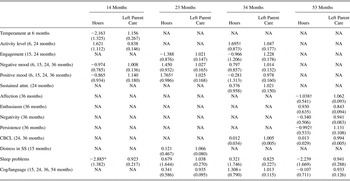
Next, we examined whether children's characteristics predicted child care quantity. In this study, we use the immediately preceding measures of child characteristics to predict moving out of nonparental care. Table 3 presents the results of tests of the evocative effects of children's temperament and behavior on time in child care at four different time points: 14, 23, 34, and 53 months (note that time in child care was measured a month earlier than language stimulation as measured in Study 1). For each time point, two different outcomes were examined: time in child care and child moving out of parental care. We used ordinary least squares regression for the linear outcome and logistic regression for the binary outcome, regressing the outcome variable on the child's behavioral characteristics score at the most recent past time point with a full battery of controls.
Regression of hours of care on child characteristics and logistic regression of leaving parental care on child characteristics

Note: NA, Items not included in regression. N = 1364.
†p < .10. *p < .05.
Our results suggest few associations between children's characteristics and the time they spend in care or their movement out of parental care. We find only one result that is significant at the level of p < .05: having a sleep problem at 6 months is associated with 2.9 fewer hours in child care at 14 months.
We also examined whether the same child characteristics examined above were associated with other child care–exposure outcomes, including changes in time spent in childcare, time spent in center care only, and entering into center care (results not shown). We found fewer associations between child characteristics and these measures of quantity of child care than would be expected by chance and no systematic pattern to those very few that did emerge.
Discussion for Study 2
In light of evidence highlighting seemingly adverse effects of time in child care on child aggression and disobedience (NICHD ECCRN & Duncan, Reference Duncan2003; for a review, see Belsky, Reference Belsky2001), and particularly center-based care on children's externalizing behavior through the elementary school years (Belsky et al., Reference Belsky, Vandell, Burchinal, Clarke-Stewart, McCartney and Owen2007), the research reported herein was designed to examine a reciprocal process of influence, namely, the potential “effect” of children's behavior and temperament at 6, 15, 24, and 36 months, as well as their developmental abilities, on the quantity of child care experienced during the infant, toddler, and preschool years. Very little evidence emerged to indicate that children's characteristics predicted time spent in child care or movement out of parental care. For all the reasons parents decide to use nonmaternal child care, the child's behavioral, temperament, and developmental competency appears to play no role in their decision making, at least insofar as this investigation could determine.
In other words, the not unreasonable concern raised by the NICHD ECCRN and Duncan (Reference Duncan2003, p. 1001) that some children, perhaps at risk of becoming more aggressive and disobedient for reasons having nothing to do with child care, were selectively placed in child care for longer hours proved unfounded. Thus, the somewhat higher rates of aggression among children in care that have been detected in the NICHD ECCRN and Duncan (Reference Duncan2003) and NICHD ECCRN (2001, 2006) studies, especially for those placed in centers (Belsky et al., Reference Belsky, Vandell, Burchinal, Clarke-Stewart, McCartney and Owen2007), are probably not related to underlying differences in children's temperament or behavior correlated with entrance into or time in child care.
General Discussion
The primary purpose of this report was to examine whether child effects on child care exist in the NICHD SECC. We find evidence that both contemporaneous and longitudinal child effects of developmental status on quality of care (specifically, language stimulation) are present for younger children, but not for older children, and are not present at all for time in care. This result suggests that some reported child care quality effects may be inflated due to unaddressed and unacknowledged child effects between the quality of the language environment and young children's developmental outcomes (particularly if only described using correlational approaches), although it is important to note that the size of the effects were small. In the main, quality-of-care effects do not appear to be principally or even largely a function of (routinely unevaluated) evocative child effects. Similarly, the findings of Study 2 indicate that child effects do not contribute to quantity-of-care effects on externalizing problem behavior.
The results of the two studies also have important implications for practice and research in the field of developmental psychopathology. First, the finding that toddlers of lower cognitive ability (as measured by the Bayley MDI) were exposed to less language stimulation in child care settings has important implications for understanding the nature and effects of at-risk children's developmental contexts. In contrast, we failed to find evidence that children with more advanced language development evoked more stimulating language environments at 36 or 54 months. We also did not find evidence for the effects of child characteristics such as behavior problems, difficult temperament, or cognitive or language development on the quantity of child care; this means that children with higher risk for developmental psychopathology are not more or less likely to be spending greater time in child care settings.
Overall, beyond the contemporaneous child-to-caregiver effect of particular interest in this study, we found evidence of complex, transactional patterns of child–caregiver interconnection that unfolded over time, as is suggested by developmental psychopathology theory and empirical work (see this volume). Caregivers’ practices early in children's lives (i.e., 15 or 24 months) were predictive of child skills at the following time point, and conversely, children's skills were predictive of the input they received at the following time point. This finding supports the emphasis within this volume, and the developmental psychopathology literature in general, on the important role children play in shaping their own experiences and warrants additional research with data that allow for careful, sequential analysis of caregiver–child interaction. Our findings suggest that researchers in the field of developmental psychopathology and beyond may benefit from considering potential evocative effects of children on their own caregiving environment.
One of the most important affordances the NICHD SECC for these research questions, particularly in Study 1, is that the data set measured the individual experience of children. Rather than assessing overall classroom quality, child care observations in this research project focused upon the immediate “psychological nutrients” provided by caregiver(s) to each target child. What was important was not whether a caregiver was generally stimulating, but whether the particular child enrolled in the study experienced a linguistically rich care environment. Recall in this regard that the predicted outcome in Study 1 was not an index of language stimulation at the level of the classroom or group, but of that experienced by the individual child. Such an approach to measurement seems most appropriate for evaluating and detecting child effects.
Although the present effort extends research on child effects and on the determinants of the quality of child care, especially for children at risk for poor developmental outcomes, it is not without limitations. Perhaps most important, Study 1 dealt only with assessed cognition or linguistic ability and language stimulation as measured by amount of language. Future work should examine whether other components of language beyond quantity of words spoken are related to child characteristics. It should thus not be presumed that conclusions drawn from this work, either about child effects on caregiver behavior or of the extent to which detected child care effects may actually reflect child effects, generalize to other child characteristics (e.g., behavior problems) and other features of child care (e.g., discipline). In addition, many other factors will influence the adult–child interactions. For example, Girolametto et al. (Reference Girolametto, Hoaken, Weitzman and van Lieshout2000) note that the nature of the activity in the child care setting exerted a greater consistent effect on the nature of the adult–child interaction than the presence of a child with language disabilities.
Moreover, the limits of nonexperimental work must be acknowledged when it comes to drawing strong causal inferences pertaining to child or child care effects. An evocative response based on children's characteristics might be best measured in a setting under controlled conditions, particularly conditions in which child behavior (or perceived child behavior) could be experimentally manipulated.
In addition, it must be noted that the design of this research did not necessarily capture the optimal timing between a child's characteristic and its evocative consequence. Especially in the case of Study 1 and the effect of cognition or linguistic skill on language stimulation, it seems likely that caregivers respond to children's cognitive skill on a short time horizon, perhaps responding to the propensities a child reveals on a particular day in addition to a general notion of how skilled a child is or has been over recent weeks and/or months. Because the NICHD SECC did not adopt a procedure for coding caregiver–child interaction that afforded detailed analyses of sequences of the kind that can be done when interactions are videotaped and microcoded, the current inquiry was limited to the data available.
Relatedly, it is possible that we were unable to detect child effects with respect to exposure to child care due to the timing or nature of the measures available. The processes involved in the parental planning around child care might be somewhat short term, in response to more nuanced children's characteristics, or family circumstances, than were able to be captured with this study. To the extent this is the case, this will contribute to measurement error and a likely understatement of an evocative effect. Further research on evocative effects is necessary to determine whether this is the case.
Finally, it seems possible that evocative effects may be stronger in some child care settings than others. For example, interactions between aspects of the child care setting (e.g., teacher characteristics, curriculum, or other aspects of classroom quality) and other child characteristics are important. These questions could be examined in experimental designs.
Future directions for translating research on the influential child into preventive interventions
The evocative response at 15 and 24 months provides one potential pathway by which the Matthew effect (Merton, Reference Merton1968; “To all those who have, more will be given; but from those who have nothing, even what they have will be taken away”) may function. That is, children who are more advanced in overall cognition are spoken to more often, which in turn may further accelerate their language development, and perhaps even other aspects of cognitive development closely linked to language. The association between lower Bayley scores and less language stimulation for the younger children in this study is particularly concerning, because results reported by the NICHD ECCRN (2000) suggest that language input at 24 months is particularly important for subsequent language development. To the extent that caretakers are speaking less to children with less developed cognitive skills, this can influence children's language growth trajectories and may widen earlier inequalities.
In much of the “child effects” literature, there is a large interest in gene–environment interactions, or the extent to which children's innate propensities may be exacerbated or attenuated by the environments into which they select. It is beyond the scope of the NICHD SECC to afford tests of gene–environment correlations, and although the current study does try to control for multiple child and family characteristics, we are unable to determine to what extent the child's developmental status at ages 15 and 24 months is the result of nurture, nature, or the combination therein. Our results help extend the field's understanding of what child-specific skills and environmental supports look like in an early childhood education setting and for children at risk for delayed cognitive development.
These results carry important implications for the design of early childhood education, care, and intervention settings, and for the training of early childhood educators and workers. Professional development, preservice training, and quality rating or accreditation agencies should emphasize the need for high-quality language environments for all children, especially for those most at risk. These high-quality language environments must include numerous opportunities for responsive, linguistically rich language interactions between educators and their young children. Caretakers can be encouraged to talk with all children, wherever they are in their developmental trajectory, and increase their awareness of the language environments they are providing to their most at-risk youngsters. It is critical that teachers and caretakers be aware of the need to stimulate all young children's vocabulary learning, at all levels of development. Exposure to high-quality language is especially critical for at-risk children from high-poverty homes where language and vocabulary can be limited (Hart & Risley, Reference Hart and Risley1995; Weisleder & Fernald, Reference Weisleder and Fernald2013). All children, but especially those most at risk, benefit from frequent, contextually relevant, and rich exchanges between child and caregiver to reach their full potential (Bloom, Reference Bloom2000; Hoff, Reference Hoff2003; Huttenlocher et al., Reference Huttenlocher, Haight, Bryk, Seltzer and Lyons1991).