Introduction
‘I want to make art—why do I need the library?’ This is a common question among first-year MFA students. While all artists engage in research, the connection between academic libraries and studio practice is not always obvious to art students. At Yale University, this dynamic has shifted significantly over time. Historically, the relationship between the library and the School of Art experienced periods of low engagement. As Hannah Bennett notes in the article, ‘Bringing the Studio into the Library: Addressing the Research Needs of Studio Art and Architecture Students,’Reference Bennett1 studio art and architecture groups at Yale have traditionally been difficult to reach through library outreach. However, over the past seven years, a series of strategic outreach initiatives have transformed this relationship, making the library an invaluable and integrated part of the academic and creative experience for students and faculty.
The author began their role at Yale’s Robert B. Haas Family Arts Library (‘Arts Library’) in 2018 as the arts librarian for research services, serving as a liaison to both the School of Art and the School of Architecture. A key focus of this position was to strengthen engagement between the library and the School of Art. Yale includes 12 distinctive libraries, each with specialized collections and research communities. The Arts Library supports student and faculty research in art, art history, architecture, design, drama and theatre studies. Located in the Paul Rudolph-designed Art & Architecture building (now Rudolph Hall) and the adjoining Loria Center, the Arts Library shares its space with the Department of the History of Art and the School of Architecture, fostering natural connections. However, the School of Art occupies two buildings about a block away from the Arts Library, and this physical separation remains a barrier to engaging studio art students with library resources.
Each year, the Arts Library hosts the Samuel H. Kress Foundation Fellowship in Art Librarianship, a program designed for new professionals entering the field. Shared between the Arts Library and the Yale Center for British Art, the fellowship encourages early career librarians to pursue independent projects and develop professional expertise. In 2019–2020, fellow Allison Comrie brought valuable experience from her role at the Banff Centre artist residency, where she had supported artists. At Yale, she applied this background to launch a studio visit pilot program with the School of Art, documenting her process and recommendations in Art Documentation.Reference Comrie2 Her initiative provided a foundation for sustained engagement with the School of Art, positioning the subject librarian as a more visible and essential resource.
Over the past seven years, what began as a pilot has evolved into a dynamic, embedded model of librarianship. Through targeted outreach initiatives, the Arts Library has deepened connections with students and faculty, expanded its support for studio practice and research, and strengthened collaboration across the arts community at Yale. This article outlines the development of this embedded approach, highlights key initiatives, and reflects on the outcomes and lessons learned from this evolving partnership.
Literature Review
The concept of embedded librarianship has evolved significantly over time, and its definition continues to shift depending on context. Over the past two decades, numerous volumes and articles have examined its scope and applications. Barbara Dewey is often credited with introducing the concept in the 2004 article ’The Embedded Librarian: Strategic Campus Collaborations,’ where she emphasizes the importance of proximity: ‘Embedding librarians bring the learning process in closer proximity to the scholarship on which the disciplines are based and to those that service it—librarians.’Reference Dewey3 The term embedded librarianship is applied broadly, encompassing course-integrated instruction, liaison-based outreach, and physically locating librarians within the communities they serve. Moniz and Eshelman highlight that embedded librarians provide support ‘at the point of need with students and faculty,’ framing the role as both outreach and evidence of the evolving value of ‘the library as place.’Reference Moniz, Eshleman and Henry4 Munshi identifies five core competencies for embedded practice—communication, teaching, research, collaboration, and technological expertise aimed at aligning with the strategic objectives of academic institutions.Reference Munshi, Koner and Barsha5 Scholarship on embedded librarianship relevant to art librarianship falls into two major categories: the information-seeking behaviours of creative populations and case study models of embedded practice. Research into artists’ information-seeking behaviour shows how their processes differ from those of other disciplines. Cowen, for example, described artistic research as nonlinear, noting that ‘information-seeking is a creative process that begins and ends outside of the walls of any library.’Reference Cowan6 Hemming provides a comprehensive overview of this literature, underscoring the diversity and complexity of studio-based research needs.Reference Hemmig7 Salisbury et al explore how studio instructors present artistic research to their students.Reference Salisbury, Robinson, Norton, Jennings, Hunt, Evans and Carter8 The second body of work consists of case studies illustrating different applications of embedded librarianship. Haines describes a ‘field librarianship’ model, in which working physically within departments provided new opportunities to address interdisciplinary needs.Reference Haines9 Jacobs reports on hosting research office hours at California State University, which increased student demand for research consultations and course-integrated instruction.Reference Jacobs10 Keogh presents a digital humanities–based approach, embedding research and digital literacy skills within the arts curriculum.Reference Keogh and Patton11 Other examples include Sherman ’s embedded instruction in an interior design course and Garcia’s introduction of librarians into studio critiques to deepen student engagement with information literacy.12
Within the visual arts context, case studies on studio visits stand out as particularly relevant. Leousis outlines outreach to MFA students at Washington University in St. Louis, including studio visits, programmatic support, and participation on thesis committees. Leousis observes that art students ‘employ multiple strategies for gathering and interpreting information as it complicates, inspires, and moves their artistic practice in different directions.’Reference Leousis13 Similarly, Salisbury describes the School of the Art Institute of Chicago’s studio visit program, highlighting that such encounters ‘serve as an introduction not only to library resources, but also librarians as a resource.’Reference Salisbury14 These initiatives underscore how meeting students in their creative spaces enables librarians to offer support at the point of need and fosters meaningful, trust-based relationships.
The embedded model is also well-documented in the Yale context. Hannah Bennett describes efforts to attract art and architecture students to the library by creatively tailoring services to studio needs, an approach framed as essential for transforming the library from a physical space into ‘an indispensable resource’ for student projects.Reference Bennett15 More recently, Allison Comrie compared studio visit programs at the Banff Centre and Yale, contributing a critical reflection on how librarians can adapt outreach strategies to diverse creative contexts.Reference Comrie16
This article is situated within that existing body of work. While the case study presented here is not unprecedented in art librarianship, it adds to the growing conversation about how librarians can support the distinctive information-seeking behaviours of artists and studio-based students. Building on contributions from Bennett, Comrie, and others, it emphasizes the ongoing need for creative, relational, and context-specific outreach strategies that recognize the unique role of the librarian in supporting artistic research.
Case study: Haas Arts Library & Yale School of Art
Studio Research Visits
In Fall 2019, Allison Comrie proposed a studio visit pilot program for students at the Yale School of Art. Modelled after traditional studio visits with artists, curators, or collectors, these sessions offered students the chance to meet with a librarian to discuss their work, research interests, and possible connections to library resources. Comrie introduced the program during an optional library workshop at the start of the semester and invited students to schedule one-on-one visits. Although the program was interrupted by the COVID-19 pandemic, she published her findings and emphasized the importance of sustaining these connections through multiple outreach strategies: ‘Ideally the librarian is in a permanent position to sustain the collaborative research relationship with these students over the course of their whole degree and can build momentum by developing the research relationship with students using various outreach strategies, in addition to the studio visits.’Reference Comrie17 This recommendation proved essential in meeting the unique needs of art students (see Fig. 1).
After the pilot, it was clear there was demand for research consultations, though promotion at the annual orientation did not generate significant engagement. This gap led to new outreach initiatives.
‘Pop-up’ Art Library
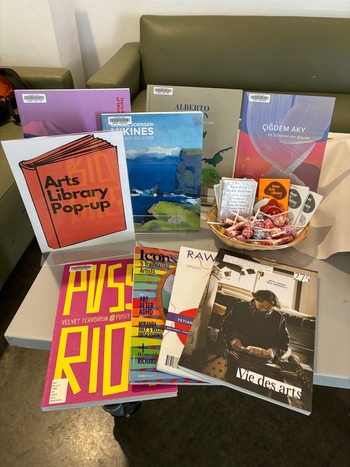
During the post-pandemic return to campus, students needed more support than ever. To address this, the librarian launched an ‘Arts Library Pop-up,’ bringing materials and resources directly into studio spaces once a month. A table was set up in the lobby of both studio locations, sometimes making do with whatever space was available (see Fig. 2). This program was pitched to the incoming art students during the fall 2023 library orientations. Notably, a new drama librarian had started at the Arts Library and was offering a similar program to students at the School of Drama and Department of Theatre and Performance Studies that same term.
During that first year, all interactions with students during the ‘pop-up events’ were recorded and a few key takeaways emerged: One important note was that the name ‘pop-up library’ is not always clear to students. There were many questions like ‘what is this?’ and in one case a student thought the librarian was a vendor selling artist books to students. This prompted renaming the program to ‘office hours with an art librarian’ so that the program goals were clearer to students.
The timing of the ‘pop-up events’ was also key to the success. The lobby of the painting and printmaking studios has considerably more foot traffic than the sculpture and photo studios, so zeroing in on a time for that building proved to be critical. Also, even with reminders, the department administrators did not always know when the librarian was going to be there, so an email list was developed for relevant groups. After two years of the program, admins in both studio spaces now contact the librarian in advance to schedule these events for their students, and create calendar invites for students and faculty so everyone is on the same page. During these events, students stop by to say hello, ask a research question, pick up swag, or follow up later to schedule a studio visit or research consultation. The visibility of the librarian in studio spaces was the program’s greatest strength, leading to spontaneous research questions, new connections, and momentum for additional initiatives.
Though students continued to reach out individually to arrange studio research visits, engagement was still relatively low for that initiative. However, due to the visibility of the librarian at the pop-up events, one of the admins at the School of Art suggested that they become part of the formal studio visits program at the school. Students can add their name to a lottery system for a variety of studio visits happening during the month. Participation in the studio visits program has had the most significant impact on the librarian’s work with students. Once added to the schedule, the ‘studio research visits’ became increasingly popular with every time slot getting filled up immediately.
Similar to Comrie’s model during the pilot period, the studio research visits are arranged in 45-minute time blocks where the librarian visits the student in their studio space. The student discusses their work, possible research or themes they are exploring, and has a dialogue with the librarian about potential library resources or services that might connect with their practice. The librarian takes detailed notes during these visits and follows up with a targeted list of suggested resources based on the conversation. This formalized program led to meaningful research interactions with students in their studios and many repeat visits during their two-year program. In one example, a student in the sculpture program who met with the librarian during their first week of classes continued to set up visits throughout their two-year program to discuss evolving research areas and themes engaged in their work. The librarian was invited to studio critiques and final reviews, highlighting the impact of the research interactions and the librarian-student relationship.
While most students have a general idea of themes or topics to discuss, that is not always the case. One memorable visit started with a painting student asking, ‘Wait, what is this visit about?’ That led to a conversation about research for artists and how that can take many different forms. After a few minutes, the student realized that they did have research topics, but they had not previously considered them research until they discussed it with a librarian.
Research Panel
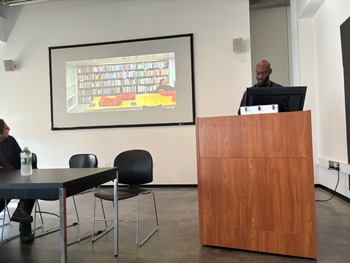
Increased visibility opened opportunities for other collaborative programs. Together with a faculty member from the Painting and Printmaking Department, the librarian co-developed Demystifying Research for Artists, a panel where second-year students shared how research informs their practice across disciplines (see Fig. 3). Students presented their work and research, representing the four areas at the school: graphic design, photo, painting/printmaking, and sculpture. The event took place during interdepartmental days at the school where students from each program are encouraged to come together for shared programming. This event was a success in several ways–it showed students how research is part of all artists’ work in some way. It also allowed first-year students to learn directly from their peers how research informs their work and practice, and how research can vary depending on the artist.
Classroom Engagement
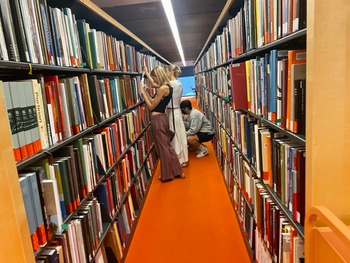
There have been notable shifts in classroom engagement since 2021. This is similar to Keough’s case study example, who noted, ‘The increased visibility of the librarian within a department often leads to collaborative course design, service on departmental committees, increased awareness of faculty and student needs, and a close working relationship that makes faculty and students more willing to ask for research and project assistance.’Reference Keogh and Patton18 Graphic design faculty requested research sessions during the first week of all studio classes for incoming students. There have been exciting opportunities to work with faculty in designing engaging classroom assignments. One recent example is a painting class who visited the library for a session on research and creative inspiration (see Fig. 4). The librarian collaborated with the faculty member to develop a session that included an activity for students to explore the library stacks based on visual interest. Many of the instructional opportunities would not have occurred had the previous initiatives not happened. These opportunities reflect how embedded librarianship naturally leads to deeper collaboration with faculty.
Impact
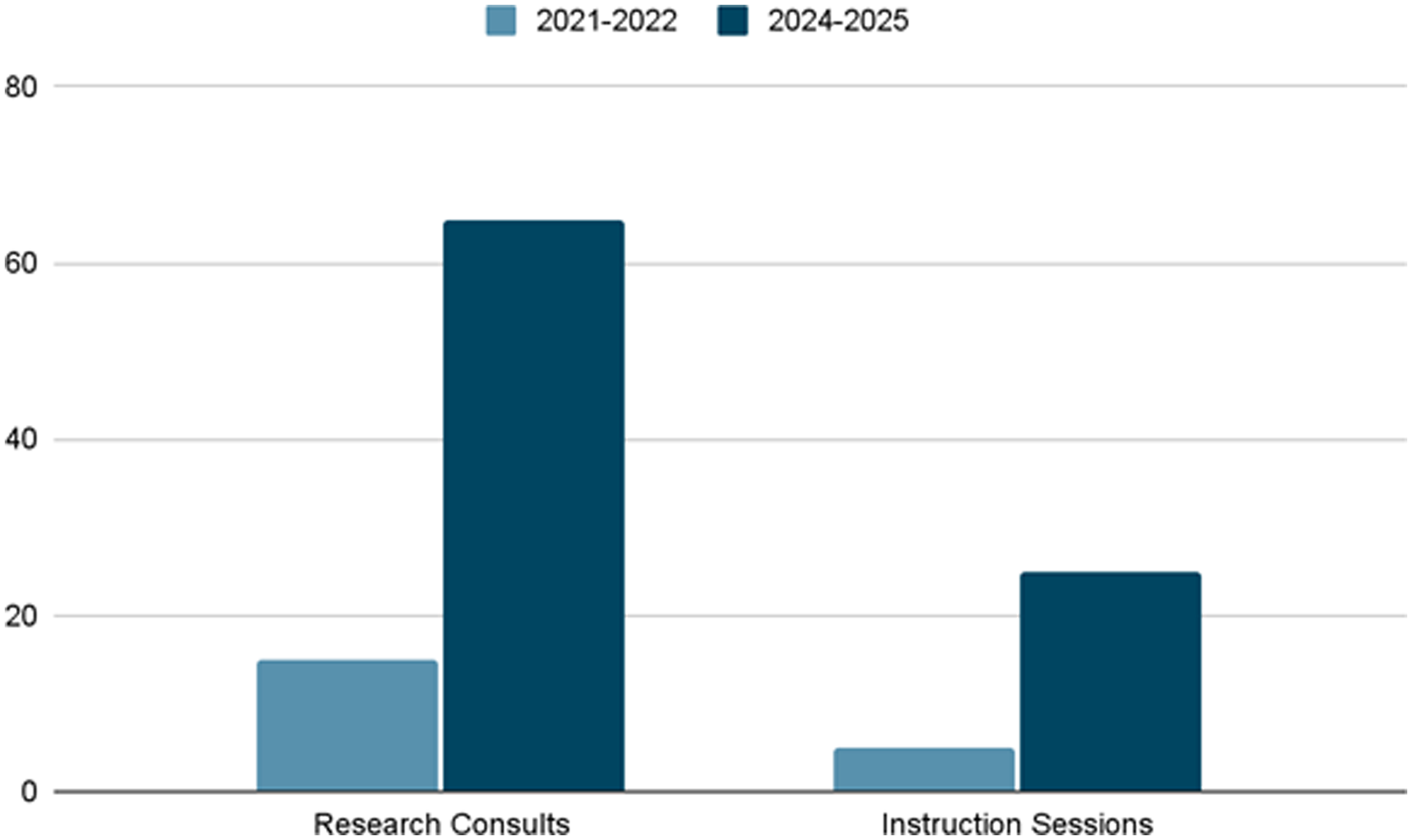
Many anecdotal examples highlight the impact of the embedded relationship between the Arts Library and the School of Art. A few recent examples occurred during the fall 2025 orientations. One incoming graphic design student expressed eagerness to connect with the librarian during the first week of class, stating that their friend who graduated from the program emphasized how important it is to connect with the librarian the right way because of how beneficial they are to successfully navigating the program. Another example was from a first-year student in sculpture who said, ‘I can tell you’re a powerhouse at this school—your name comes up in many different situations at the school.’ While anecdotal evidence is important for assessing the success of these programs, data is also an important indicator. As noted in the chart (Fig. 5), there has been a significant increase in research consults and instruction requests from the School of Art, more than doubling in a four-year time period. The instruction and research consultation statistics are pulled from LibInsight after being recorded by the librarian.
A studio research visit with a student in the painting/printmaking department (left) and the author (right). Photo courtesy of Roza Bozhkov.

An example set-up for the ‘Arts Library Pop-up’ events at the school of art studios.

A graphic design MFA student presents their work and research during the ‘Demystifying Research for Artists’ panel event in February 2025.

A library workshop session that included students exploring the stacks based on visual interest.

Chart comparing the recorded statistics for research consultations and instruction sessions with the School of Art from 2021-2022 academic year and 2024-2025 academic year.

Takeaways
Several lessons have shaped this evolving model of embedded librarianship.
The multi-faceted approach to outreach with the School of Art led to meaningful relationship-building and research engagement with students and faculty. Relationship-building takes time, regardless of the audience, so patience and consistency are key. While statistics are important metrics for evaluating success, they are not always the most useful for evaluating the success of the outreach initiatives, nor do they tell the full story. For example, even when research conversations were minimal during the early days of the pop-up series, being visible to students led to engagement down the line. Students felt comfortable reaching out to the librarian and were also referred from other students and faculty. Reflecting back, it is significant to acknowledge the impact of small initiatives and how they built momentum over time.
Given that many of these programs happened outside of the library, support from the library administration was critical to maintaining and continuing these programs. Allowing the librarian to dedicate time to the school showed the commitment that the library has to supporting all research groups, and empowering librarians to use their expertise and knowledge to provide the best possible support to their liaison areas. Support from the School of Art was also critical. Engagement notably increased when administrators explicitly shared these programs with their students, or encouraged the librarian to participate in the broader school programs, like the studio visit program. During the fall 2025 semester, the admin for the sculpture/photo program amplified the office hours for the fall semester to all students, and personally noted the importance of students taking advantage of the library as a resource.
Lastly, being flexible and open to the needs of students and faculty is extremely important to develop and grow relationships with the library and School of Art. What you think students and faculty need might not be what they need, so listening and being flexible is important to providing support to these groups.
Conclusion
Reflecting on Comrie’s pilot program and recommendations for future development, one sentiment, in particular, rings true for the evolving relationship between the library and School of Art: ‘Students learn to recognize that scholarly conversations happen beyond the bounds of academia’s traditional spaces (libraries), and most importantly that the librarian is willing to engage in these conversations on the participants’ grounds and in their communities.’Reference Comrie19 Meeting students at their point of need, and physically in their space, breaks down the barrier of accessing the library. In addition to seeing the librarian as approachable and available to them, students are also encouraged to see themselves as researchers in many different forms. While not every art student may see library services and collections as essential to their studies, the embedded art librarian can continue to make connections clear through personal relationships and evolving initiatives. Even if only some artists depend on the library’s collections or services, they know who to contact when the need arises—and that feeling of access alone can be transformative.
Acknowledgements
Thank you to Allison Comrie for leading this effort back in 2019 and to all the art librarian colleagues who experimented with an embedded model over the years. Special thanks to Lindsay King and Alex O’Keefe for reviewing early drafts of this article.