Within the Maya lowlands, the Preclassic period of cultural development is known well in some geographical areas and poorly known in others (Figure 1). Where archaeologists have explored deeply beneath Classic and/or Postclassic-period (ca. a.d. 600–1520) overburden, they generally have encountered Preclassic-period (ca. 1000 b.c. to a.d. 400) cultural deposits. Not surprisingly, geographical variation in archaeological knowledge of the Preclassic period is largely a product of regional variation in the overall scale and intensity of field research. In those lowland regions where archaeologists have conducted substantial excavations at many sites, the Preclassic data sample is large and diverse and so knowledge of the period is well developed. Archaeologists working in these regions now can reconstruct Preclassic political, economic, and ideological processes that transpired at spatial scales larger than the individual site (e.g. Adams 1977; Clark and Cheetham 2003; Clark and Hansen 2001; Clark et al. 2000; Freidel and Schele 1988; Hansen 1998, 2001; Hansen et al. 2002; Matheny 1987; Schele and Freidel 1990:96–129). Conversely, in those regions where few excavations have been conducted, archaeology of the Maya Preclassic period has yet to advance much beyond the exploration and discovery stage. Figure 1 illustrates current regional variation in archaeological knowledge of the Preclassic period: evidence of significant Preclassic occupations is abundant (a) in the northern and central sectors but not the southern and eastern sectors of the northern Maya lowlands and (b) in the northern half but not the southern half (defined as the area south of Lake Petén-Itzá) of the southern Maya lowlands.

Map showing lowland Maya sites where evidence of significant Preclassic period occupation has been found. Prepared by J. Burks.
One of many components of Preclassic Maya society that archaeologists would like to more fully understand is political geography. By “political geography” I mean the disposition across landscapes of polities, their capitals, and the subordinate centers and rural population clusters that those capitals ruled. By “polity” I mean a well (although not necessarily thoroughly) integrated, territorially discrete political entity that elites ruled from a central location (and that may or may not correspond to the entity described elsewhere [e.g. Fried 1967:227–242; Service 1975:266–324; Webster 2002:65–70] as the “state.”) A simple but effective way to investigate Maya political geography is to locate the capitals that once ruled polities. Where the capital is present so was the polity. Capitals are “centers” (called “regal-ritual centers” by Sanders and Webster [1988]), or settlements distinguished by the massive scale and architectural elaboration of their ceremonial and residential facilities. Their architectural mass generally is two to ten times that of the next largest settlement within the polity (Ashmore 1981:55–56; Martin 2001; Sanders 1981:358–360; Webster 2001, 2002:154). Whether a center constituted a capital is determined by whether it presents evidence (usually in the form of buildings, burials, and artifacts) of concentrated wealth and power and of large-scale labor mobilization. Generally speaking, capitals are architecturally much more massive and elaborate than any of the other components of the local settlement system to which they belong (Turner et al. 1981). Classic-period polity capitals can be identified by the presence of hieroglyphic inscriptions, some of which name specific settlements as the residence places of kings (Martin and Grube 2000:17–18; Mathews 1991:26; Mathews and Willey 1991:52–53). Unfortunately, few such monumental hieroglyphic inscriptions date to the Preclassic period.
From the spatial distribution of capitals, archaeologists can deduce the approximate locations, and thus the approximate density and size, of Maya polities (Marcus 1973, 1976; Mathews 1991). Yet archaeologists can produce accurate and reliable maps of political geography—maps that correctly reflect the number and location of polities and variance in their size and density—only if they have at their disposal reasonably complete samples of the capitals that existed during the periods under study. Although archaeologists rarely possess complete samples of any properties of an ancient population, the quest for complete (or largely complete) samples is not unrealistic in the case of Maya capitals, which are architecturally massive and distinctive, easily recognized, and, within any particular region, few in number. In regions that they thoroughly explore, archaeologists can expect to discover most ancient capitals and many of the settlements subordinate to them.
Although in some regions archaeologists are well on their way to discovering most Late Classic period (ca. a.d. 550–850) capitals (Mathews 1991; Martin and Grube 2000), in the case of the Preclassic, identifying capital centers can be challenging because at many sites the architecture that reveals them is deeply buried. Thus, with few exceptions (e.g., the Mirador Basin, where many Preclassic sites are exposed on the surface [Hansen 2001; Matheny 1980, 1986]), archaeologists can discover Preclassic capitals (as well as other components of the settlement systems that they ruled) only through extensive reconnaissance, intensive survey, and substantial excavation. In regions where information about the Preclassic period is abundant, archaeologists have carried out these procedures at numerous sites. In contrast, in the southern sectors of the northern and southern Maya lowlands, and in other poorly known regions, the number of sites at which these procedures have been carried out is small, and so archaeologists know relatively little about the Preclassic histories of these regions. Because discovering Preclassic deposits is logistically challenging, archaeological knowledge of the period has grown slowly in all areas of the Maya lowlands, and it will continue to do so in the future. Consequently, each discovery of a major, previously undetected Preclassic settlement advances archaeological knowledge of the period, and nowhere is the impact of these advancements greater than in those regions where knowledge of local Preclassic cultural dynamics remains poorly developed.
This article documents initial evidence of a substantial Preclassic occupation, including the presence of an important Preclassic capital, atop the Itzan escarpment, located in the lower Río de la Pasión drainage system of Petén, Guatemala. The escarpment, the uplifted block of a horst and graben formation, supports two important Maya sites: Itzan, after which the escarpment is named, and Chaak Ak'al. The Pasión drainage lies within the southwestern Maya lowlands, defined here as the vast area that lies south and west of Lake Petén-Itzá. Within this area archaeologists have conducted substantial excavations at several sites, most of which are located in the lower Río de la Pasión drainage system, or the area that lies west and downstream of Seibal (Figure 1). These include Altar de Sacrificios (Smith 1972; Willey 1973) and Seibal (Tourtellot 1988; Willey 1990; Willey et al. 1975), investigated during the 1950s and 1960s; the Petexbatun sites of Dos Pilas, Arroyo de Piedra, Tamarandito, and Punto de Chimino, investigated during the late 1980s (Brady et al. 1997; Demarest 1997; Demarest et al. 1997; Escobedo 1997; Foias 1996; Houston 1992; Valdés 1997); and Aguateca, investigated through the 1990s (Inomata 1995, 1997, 2001, 2003). Excavations at Cancuen, located in the upper Pasión drainage, are underway (Demarest 2004; Demarest and Barrientos 2001). Excavation data (summarized below) suggest that Maya settled the Petexbatun region primarily after the Preclassic period. Although archaeologists have yet to explore much of the Río de la Pasión drainage system (suggesting that many of its Preclassic and perhaps some of its Classic period capitals have yet to be discovered), the region's Late Classic political geography and history are well known from its rich hieroglyphic corpus (Houston 1992; Johnston 1985; Martin and Grube 2000; Mathews and Willey 1991).
During the Middle Preclassic, the Late Preclassic, and the Protoclassic periods Maya populations constructed substantial elite ceremonial and residential facilities atop the Itzan escarpment. Three sets of data provide information relevant to investigations of Preclassic Maya cultural (including political) development: the detection at Itzan of elite facilities that date primarily to the Middle Preclassic and Late Preclassic periods (the latter include a carved stone panel fragment); the discovery of a large, previously undetected capital, named Chaak Ak'al, whose occupation dates primarily to the Late Preclassic and Protoclassic 1 periods; and evidence of a Preclassic-to-Classic shift in capital locations, suggesting a shift in settlement, environmental, and economic orientations. From the initial data collected at Itzan and Chaak Ak'al, as well as at Seibal, Altar de Sacrificios, and sites of the Petexbatun region, a picture of the Preclassic political geography of the lower Río de la Pasión drainage system is emerging.
PREVIOUS EXCAVATIONS IN THE LOWER RÍO DE LA PASIÓN DRAINAGE
I begin by summarizing what archaeologists have learned elsewhere within the lower Río de la Pasión about Preclassic cultural (including political) developments in the region. The earliest known Maya colonization of the Pasión drainage is marked by the Xe ceramic complex, which previously has been found only at Altar de Sacrificios and Seibal, where it dates to the early Middle Preclassic period, ca. 900–600 b.c. (Willey 1970, 1975:40). Xe settlement is evidenced by pottery (unslipped and monochrome tecomates, plates, dishes, and bowls with simple ornamentation), postholes and possible floor remnants, and, at Seibal, a single La Venta-style cache (Andrews 1990:3; Smith 1972:142–145). Archaeologists know little about Xe-phase occupation because evidence of it is deeply buried.
More widespread within the drainage is evidence of late Middle Preclassic occupation, which is marked by Mamom ceramics and at Seibal dates from 600 to 300 b.c. (Willey 1990:239). At Altar de Sacrificios and Anonal, a Seibal outlier, modest (>5 m high) pyramid-shaped ceremonial or civic buildings were constructed for the first time (Willey 1973:27; 1990:240). Although these buildings reveal the presence of an emerging elite, whether they indicate the existence of capitals has yet to be determined. Seibal remained a village of pole-and-thatch huts (Willey 1990:240). Within the Petexbatun area, which surrounds and continues to the west of the Laguna Petexbatun, Mamom ceramics have been found in small quantities at Bayak, a village site 2 km north of the lagoon, and Punta de Chimino, indicating that only small, non-stratified populations occupied these sites (Foias 1996:207–208).
The Late Preclassic period, marked by Chicanel ceramics and dated at Seibal from 300 b.c. to a.d. 0 (Willey 1990:241), is well represented at most of the Pasión sites where excavations have been conducted. Seibal's population increased tenfold to approximately 10,000 people, equivalent to its Late Classic peak (Tourtellot 1990:Table 4.2), and architectural activity, including the construction of public buildings, increased commensurately (Willey 1990:241). Population size also increased at Altar de Sacrificios, where the construction of pyramidal structures, some now 9 meters high, continued (Willey 1973:31–34). Evidently both sites were now capitals (Mathews and Willey 1991:53–54, Table 3.1).
For the first time, Maya farmers densely settled the western shores of the Laguna Petexbatún. At Aguateca, which, like Seibal and Altar de Sacrificios, was an important Late Preclassic ceremonial and administrative center (and possibly a polity capital), several large pyramids were constructed (Inomata 1995:818). Sizeable communities thrived at Punto de Chimino (Foias 1996:263) and Bayak (Foias 1996:207). The intensity with which the Maya colonized the lagoon's shores is evident in core samples removed from the Laguna Petexbatún. During the Preclassic, large quantities of clay accumulated on the lake bottom, and Moraceae pollen (indicative of deciduous forests) decreased in prevalence, presumably because surrounding slopes were being deforested for agriculture (Dunning et al. 1997). In the hills west of the lagoon—at Dos Pilas (Foias 1996:262), Tamarandito (Foias 1996:262), Arroyo de Piedra (Escobedo 1997:311), and in caves near Dos Pilas (James Brady, personal communication 1991)—archaeologists have detected only small quantities of Chicanel ceramics, indicating the presence of widely scattered, low-density farming populations. In sum, during the Late Preclassic period, polities were centered at Seibal, Altar de Sacrificios, and possibly Aguateca (too little information about Late Preclassic Aguateca public architecture has been published to determine its size or probable function), but evidently there were none elsewhere within the Petexbatun region.
Archaeologically more enigmatic is the subsequent Protoclassic period, which Brady et al. (1998:28–34) divide into Protoclassic 1 (ca. 75 b.c. to a.d. 150) and Protoclassic 2 (ca. a.d. 150–420) phases. The former is distinguished by “pseudo-Usulatan” ceramics, characterized by positive-painted wavy-line decorations, the latter by red-on-orange dichrome and polychrome vessels with large “mammiform” tetrapod feet. Most ceramic types produced during the Late Preclassic period, including most components of the Sierra, Flor, and Polvero ceramic groups, remained in use through the Protoclassic 1 phase (Adams 1971:110; Sabloff 1975:77–100).
At Altar de Sacrificios, the widespread distribution of Protoclassic 1 ceramics and their association with large terraced pyramids suggests a substantial population increase and the development of hierarchical social, political, and economic relationships (Willey 1973:31–34). At Seibal, in contrast, the distribution of Protoclassic 1 markers is restricted to a few high-status contexts (e.g., plastered temple platforms) concentrated in one small part of the site (Tourtellot 1988:383–386; Willey 1990:241–245). Tourtellot (1988:387) proposes that either Seibal's population suffered a significant crash, after which its remnants withdrew to a centralized, largely impregnable location, or the site witnessed the emergence of a small, spatially concentrated elite group, who were differentiated by distinct ceramics. Tourtellot (1990:88–89) and Willey (1990:241), who favor the second interpretation, propose that from approximately a.d. 0 to 300, Chicanel ceramics were utilitarian wares available to households of all social and economic ranks, while pseudo-Usulatan wares were an elite functional subcomplex restricted in distribution to a small, highly privileged segment of society. In the Petexbatun region, archaeologists have recovered extremely small quantities (1 to 15 sherds per site) of Protoclassic 1 ceramics at Aguateca, Punto de Chimino, Arroyo de Piedra (Foias 1996:325, 328, 332), and a cave near Dos Pilas (Brady et al. 1998:56–57), indicating that these sites either had (a) very small populations or (b) substantial populations that included few elite persons.
During the subsequent Early Classic period (dated within the Pasión drainage from a.d. 350 to 600 [Foias 1996:357]), most Pasión sites underwent a substantial population decline (Smith 1972:112; Willey et al. 1975:41), if not semi-abandonment (although epigraphic evidence indicates that at Tamarandito and its subordinate Arroyo de Piedra elites and supporting populations were thriving [Escobedo 1997:309; Foias 1996:307, 358; Houston 1992; Inomata 1995:358, 819; Valdés 1997]). This trend was reversed dramatically during the seventh century, when a cadet branch of the Tikal dynasty founded a bellicose polity at Dos Pilas and Aguateca (Martin and Grube 2000:56–57), whereupon the region became a center of intense political and military activity (Demarest 1997; Demarest et al. 1997; Houston 1992; Inomata 1997; Johnston 1985; Mathews and Willey 1991).
In summary, Altar de Sacrificios and Seibal were first settled during the early Middle Preclassic period, and they became capitals during the Late Preclassic period (Mathews and Willey 1991:53). The occupation of both sites continued without significant interruption through the Terminal Classic period (ca. a.d. 800–950). Within the Petexbatun region, only Punto de Chimino and Bayak display evidence of substantial late Middle Preclassic occupation, although during this period and thereafter they remained small, non-capital settlements. Aguateca was not settled until the Late Preclassic period, when it may have been a polity capital. Tamarandito was an Early Classic capital, and Dos Pilas was a Late Classic capital (Houston 1992).
I now describe evidence of Preclassic occupations detected in and around the sites of Itzan, a small Classic-period capital, and Chaak Ak'al, an important Preclassic-period capital.
ITZAN
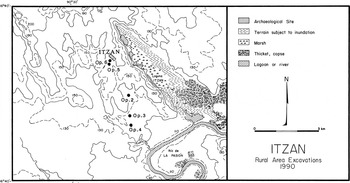
Located approximately 5 km north of the Río de la Pasión, 13 km east of Altar de Sacrificios, and 47 km west of Seibal, Itzan's ceremonial center—a concentration of public buildings, plazas, and carved stone monuments—sits atop a broad, 7-km-long escarpment (the Itzan escarpment) that parallels and overlooks the Laguna Itzan. The lagoon consists of three deep, narrow, and submerged cenotes linked by shallow, seasonally flooded marshlands, which drain through the Arroyo Itzan to the Rio de la Pasión. Like most horst and graben features in the lower Río de la Pasión drainage system (Dunning et al. 1997), the Itzán escarpment has a NW–SE strike, and its crest is marked by hillocks, many of which overlook low-lying, poorly drained terrain. Ridges and arroyos, some deep and steep-sided, run toward the lagoon at oblique angles from the escarpment (Figure 2).

Map showing the location of archaeological excavations atop the Itzan escarpment.
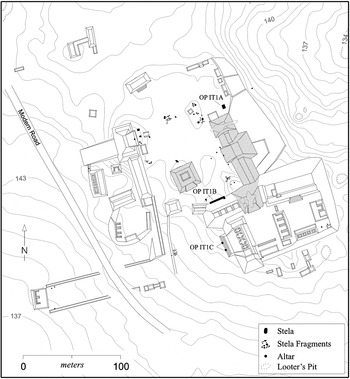
Ancient Maya flattened and broadened the hill beneath the ceremonial center by constructing massive terraces and platforms (Figure 3). The center's most prominent architectural feature is its acropolis, an elite residential (and presumably administrative) complex raised atop a 5-m-high rectangular basal platform 100 × 80 m in size. The acropolis's final construction phase dates to the Late Classic period. West and north of the Acropolis are three plazas, within which Late Classic Maya erected 21 sculpted and inscribed stelae, 2 hieroglyphic stairways, 2 panels, and 9 altars.

Map of the Itzan ceremonial center, with the location of the E Group complex indicated. Prepared by J. Burks.
Archaeologists first visited Itzan in 1968, when a Harvard University reconnaissance team (Tourtellot et al. 1978), composed of Seibal Project personnel, spent five hours at the site. From 1988 to 1998, I directed investigations of Late Classic and Terminal Classic “invisible” (minimally mounded buried) residential settlement at Itzan (Johnston 1994, 1996, 2002, 2004; Johnston and Gonlin 1998; Johnston and Martinez 1999; Johnston and Roman 1992; Johnston et al. 1992). While most of these investigations were conducted in the site's rural sector, during the 1990 season they included several operations in the ceremonial center. These operations, requested by the Guatemalan government, were undertaken to locate, register, and protect previously undetected sculpted stone monuments after an oil company constructed a road close to the center's three plazas (Figure 3). During investigations of Late Classic and Terminal Classic settlement in Itzan's ceremonial center and its rural zone, archaeologists unexpectedly encountered evidence of a significant Preclassic and Protoclassic occupation.
Investigations in Itzan Ceremonial Center
Our three 1990 operations in the site's ceremonial center were designated IT1A, IT1B, and IT1C (Figure 3). Operation IT1A, carried out in the North Plaza, attempted to locate missing fragments of Stela 20, a Late Classic monument, the center section of which I had discovered two years earlier. Operation IT1B investigated in the Central Plaza what was initially thought to be a previously undiscovered Late Classic hieroglyphic stairway. In Operation IT1C, archaeologists searched for the South Plaza's Hieroglyphic Stairway, hoping to determine whether looters, who had ravaged the site some years earlier, had stolen all of its risers.
Operation IT1A.
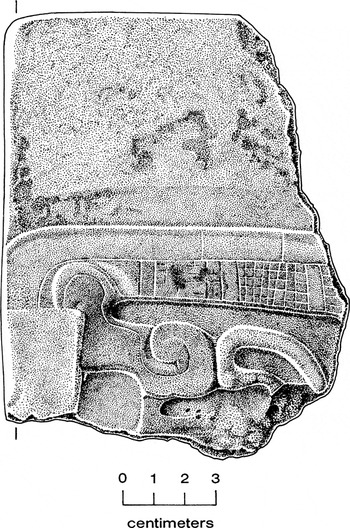
In an attempt to locate the missing fragments of Stela 20, archaeologists cleared around it and down to the uppermost level of the Late Classic plaza surface an area of 28 m2. No additional stela fragments were found. Excavations reveal that following the Late Classic abandonment of the Itzan ceremonial center, the Stela 20 fragment was dragged to the North Plaza and placed in front of two probable sculptural offerings: a red sandstone monkey head (Johnston 1994:Figures 10 and 11) and a finely carved Preclassic panel fragment (Figure 4). Dr. Sam Bonis (personal communication, 1991), a geologist with extensive field experience in the Petén and the Guatemalan highlands (Bonis et al. 1970), identifies the panel material as pyroxene andesite, available in Guatemala's mountainous highlands. The fragment, 14 cm long, 12 cm wide, and 4 cm thick, is the upper left corner of a once larger panel. Richard Hansen (personal communications, 1999 and 2005) identifies the panel as a Late Preclassic creation, noting that its small size and eyebrow scroll are typical of the period (Hansen 2001:63). The raised quadrangle behind (to the left of) the eyebrow scroll may indicate that the sculpture once included a hieroglyphic inscription. Because the panel fragment was placed atop a Late Classic plaza surface by Terminal Classic peoples, the possibility that it was transported to Itzan from a highland location during the Terminal Classic period cannot be eliminated. However, because archaeological data (discussed below) indicate that Preclassic peoples extensively occupied the Itzan escarpment, we believe that the panel fragment reveals local cultural developments during the Preclassic era, including the presence in or near the Itzán ceremonial center of elite residences and ceremonial facilities.

Fragment of a Late Preclassic panel, found in Operation IT1A. Drawing by E. Ortega.
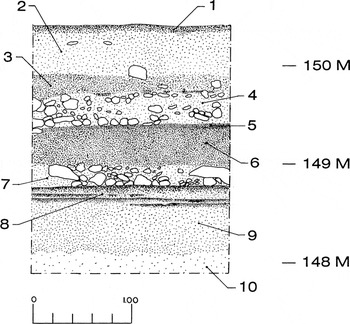
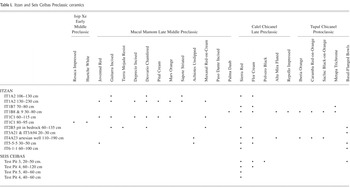
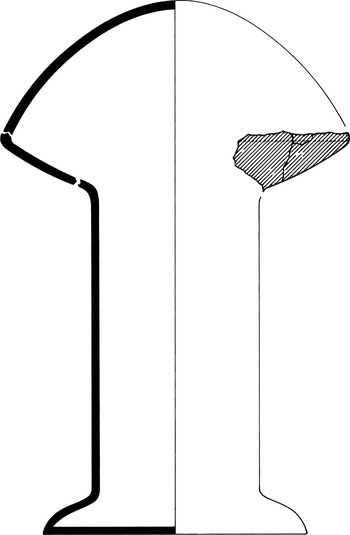
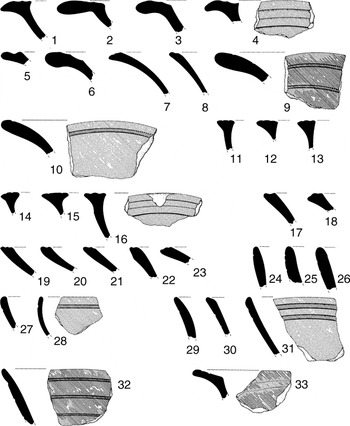
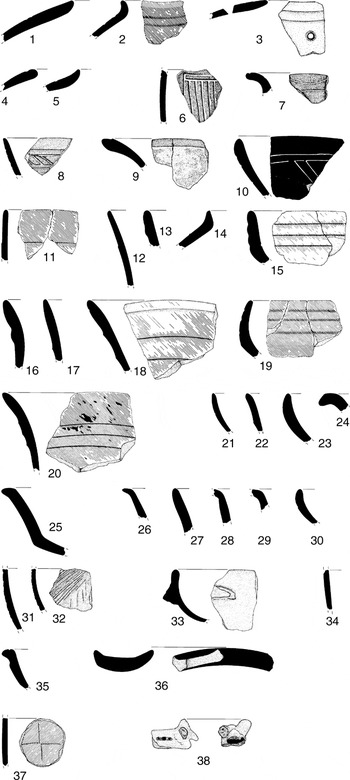
Intrigued by the discovery of the panel fragment, and hoping to find more pieces of it, we excavated one unit (IT1A2) down to the sterile clay that overlies bedrock (Layer 10 [Figure 5]). Beneath Late Classic-period material (Layers 1, 2, and 3), including a plaza surface and its rubble foundation (Layer 4), archaeologists encountered two layers (Layers 5 and 6) of Late Preclassic and Protoclassic debris (Table 1: IT1A2), and beneath them, and continuing to sterile clay, Middle Preclassic remains (Table 1: IT1A2). The latter included, beneath construction rubble (Layer 7), four superimposed plaster floors (Layer 8) ranging in thickness from 1 to 5 cm, which overlay a paleosol (Layer 9) rich in Middle Preclassic ceramics (Figure 6; Figure 7: 1–5, 21–25, 31–32). Wedged between the four plaster floors were fragments (Figure 6) of a Joventud Red mushroom stand vessel (identified by Donald Forsyth, personal communication 1990) and Mars Orange tecomate rims (Figure 8)—both diagnostic Middle Preclassic ceramics types.

Stratigraphic profile of the north face of excavation unit IT1A2, a deep sounding in Itzan's North Plaza. Beneath Late Classic material (Layers 1–3, 0–70 cm), including a plaza surface and its foundation (Layer 4), lie two levels (Layers 5–6, 106–30 cm) of Late Preclassic and Protoclassic debris that overlie Middle Preclassic materials (Layers 7–9, 130–230 cm). Drawing by L. F. Luin.
Itzan and Seis Ceibas Preclassic ceramics


Reconstruction of a Joventud Red (Mucul Mamon Complex) “mushroom stand,” showing the position of fragments recovered during excavations. Drawing by L. F. Luin.

Guitarra Incised (Mucul Mamom Complex) ceramics recovered in Operations IT1A, IT1B, and IT1C. Drawing by L. F. Luin.

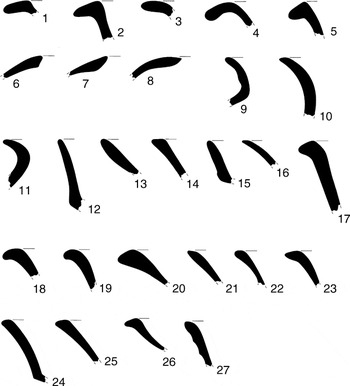
Itzan ceramics of the Mucul Mamom Complex: Guitarra Incised (1–5); Deprecio Incised (6–10); Desvario Chamfered (11–20); Pital Cream (21–25); Mars Orange (26–30); Sapote Striated (31–32); Unnamed Appliqued (33); and Unnamed Incised (34). Drawing by L. F. Luin.
The uppermost plaster floor has two distinct surfaces: an area of smooth, flat plaster that in places is fire-reddened and covered with charcoal; and abutting it, an area of rough plaster marl. Where the two surfaces abut, the former turns upward at right angles to its horizontal surface in a lip several centimeters high, suggesting that the plaster once covered a wall-like vertical plane. We interpret the smooth surface as a floor or plaza surface and the abutting plaster marl as the remains of a plaster-covered structure that was razed before being buried beneath construction debris. The razed structure may present evidence of Middle Preclassic elite residential or ceremonial activity at Itzan.
To summarize, the North Plaza that Operation IT1A penetrated rests on a hillside that slopes gently to the north and east. To produce a level plaza surface, laborers piled tons of soil, rock, and marl on the slope. As Operation IT1A reveals, construction of the North Plaza was initiated during the Middle Preclassic period. Indeed, more than half of the total construction debris at the Operation IT1A location was amassed during the Middle and Late Preclassic periods. During the late phase of the Middle Preclassic, dated by Willey (1990:195) to ca. 600–300 b.c., laborers at Itzan constructed a substantial plaza, plastered it, and built atop it plaster-faced buildings.
Operation IT1C.
When the Harvard team reconnoitered Itzan in 1968, they discovered in its South Plaza, at the base of the Acropolis's south face, four inscribed risers built into a monumental stairway (Figure 3). In 1990, none of the risers of that South Hieroglyphic Stairway were visible, and so excavations were undertaken to determine whether the risers remained in place. Excavations confirmed that three of the inscribed risers had been looted.
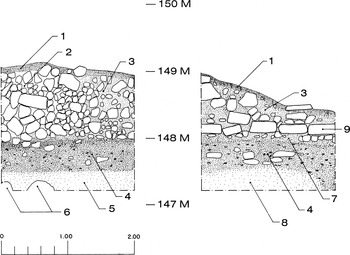
Figure 9 illustrates the north and east profile of one of two units excavated to bedrock. The Late Classic stairway (Layers 1 and 2) overlies a foundation of tabular limestone blocks dating to the same period (Layer 9). A pocket of loose rubble (Layer 2) may be the product of modern looting. Directly beneath the Late Classic construction debris, overlying sterile clay (Layer 5) and bedrock (Layer 6), and only 40 cm beneath the modern surface, are two layers (4 and 7) of dark clay, which in places yielded abundant quantities of Middle Preclassic sherds. Most are components of the Mamom ceramic complex (Figure 7: 6–20, 26–30; Figure 10: 1–26). The presence in these layers of abundant charcoal and ash, chert tools, obsidian blades, snail shell (Pomocea flagellata), river clams, burned bone fragments, and ceramics suggests that they are midden remnants. Test pits reveal that the midden deposit is at least 16 m long, several meters wide, and in places more than a meter deep. The midden's size suggests that substantial Middle Preclassic residential remains are present nearby.

Stratigraphic profiles of the north and east faces of excavation unit IT1C1, which penetrated the east end of the South Hieroglyphic Stairway, in Itzan's South Plaza. A Late Classic stairway and its foundation (Layers 1, 2, and 9) overlie Middle Preclassic midden (Layers 4 and 7), sterile clay (Layer 7), and bedrock (Layer 6). Levels 5 and 6 are sterile clay and bedrock, respectively. Drawing by L. F. Luin.

Joventud Red Ceramics (Mucul Mamom Complex) recovered in Operations IT1A, IT1B, and IT1C. Drawing by L. F. Luin.
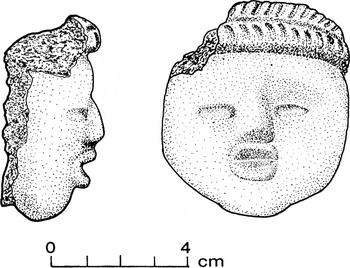
Although most of the midden's content dates to the late phase of the Middle Preclassic period (ca. 600–300 b.c.), between 80 and 95 cm, archaeologists recovered small quantities of Huetche White and Resaca Impressed sherds (Figure 11; Table 1: IT1C1, 80–94 cm). These are components of the Xe ceramic complex, the oldest known complex in the southwestern Maya lowlands, which dates to the early phase of the Middle Preclassic, ca. 900–600 b.c. (Hansen 1998:55). The Itzan Isep Xe phase is assumed to date to roughly the same period. Other materials recovered from the Middle Preclassic midden include quartzite, conglomerate, and siliceous sandstone metate fragments (Dr. Sam Bonis personal communication, 1991), a figurine head (Figure 12), and a limestone stalactite fragment probably used for ceremonial activities (Brady et al. 1997).

Two types of Isep Xe ceramics recovered from the base of level 4 in excavation unit IT1C1: Resaca Impressed (1) and Huetche White (2). Drawing by L. F. Luin.

A figurine head recovered from the Mucul Mamom phase midden exposed in Operation IT1C. Drawing by E. Ortega.
Operation IT1B.
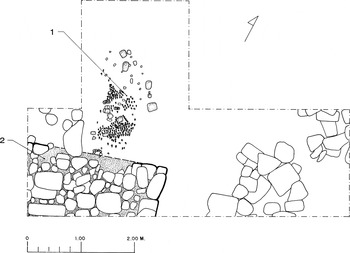
Operation IT1B investigated a Late Classic stairway that mounts the northwest side of the Acropolis and faces the Central Plaza (Figure 3). At this location we discovered a carved limestone block (Johnston 1994:Figure 9) whose shape, size, and placement suggested the presence of a buried, previously undetected, and possibly sculpted stairway. We exposed 32 m2 of the stairway, including three of its steps, but found no sculpted risers. Instead, immediately beneath the Late Classic stairway we uncovered a Protoclassic 1 building and plaza remains (Figure 13).

Operation IT1B exposed a trash deposit (1) that lies in front of a partially exposed building foundation (2). These materials date to the Late Preclassic and Protoclassic 1 periods. Drawing by L. F. Luin.
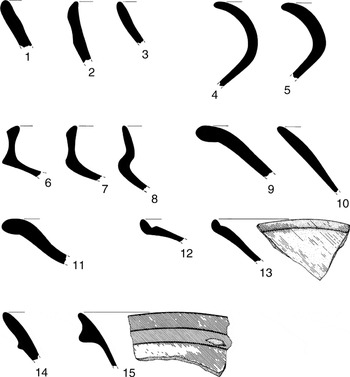
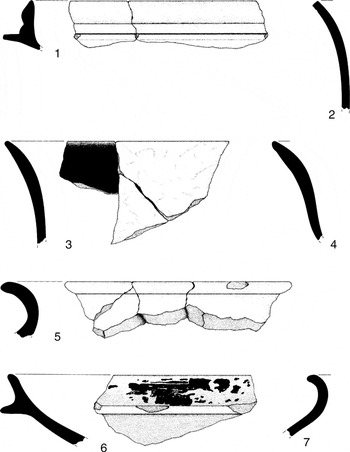
The stairway rests on a foundation of limestone slabs that overlies a thin layer of marl and rocks, which at this location is all that remains of the Late Classic plaza surface. While trying to locate that surface we dug through it and exposed below it the corner of a building, a plaza surface, and, adjacent to the building, a trash deposit. The trash deposit's concentrated form and mounded shape suggests that it is the product of a single dumping episode. The deposit (Table 1: IT1B8 and IT1B9, 30–80 cm) contains a mixture of ceramics that date to the Late Preclassic and the Protoclassic 1 periods, including Sierra Red (Figure 14), Flor Cream (Figure 15: 1–5), and Polvero Black (Figure 15: 6–7), diagnostic of the Late Preclassic, and Metapa Trichrome (Figure 16: 14–16), diagnostic of the Protoclassic 1 period. The deposit also contains approximately 260 unworked, uniformly sized shells of the freshwater snail Pomocea flagellata, available in the Laguna Itzan, as well as burned clay, abundant charcoal, fragments of polished plaster, and chert flakes. Analysis by Kitty Emery (1991) reveals that the deposits' faunal contents include the burned and unburned bones of agouti (Dasyprocta punctata), white-tailed deer (Odocoileus virginianus), and dog (Canis familiarus). Scattered around the deposit atop the surrounding plaza surface, which we date to the Protoclassic 1 period (ca. 75 b.c to a.d. 150 [Brady et al. 1998]), is a mixture of other Protoclassic 1 (Figure 16) and Late Preclassic ceramics (Table 1: IT1B7, 70–80 cm). Beneath the plaza surface, and above sterile clay, the soil contained Middle Preclassic (Mamom complex) materials.

Sierra Red ceramics (Calel Chicanel Complex) recovered in Operations IT1A, IT1B, and IT1C. Drawing by L. F. Luin.

Flor Cream (1–5) and Polvero Black (6–7) ceramics (Calel Chicanel Complex) recovered in Operations IT1A, IT1B, and IT1C. Note that where it is burned the Flor Cream vessel (3) is indistinguishable from Polvero Black. Drawing by L. F. Luin.

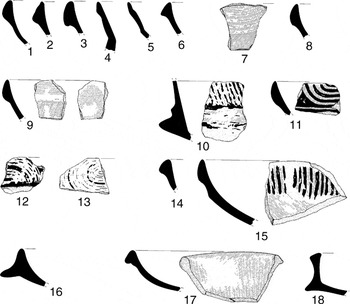
Protoclassic 1 ceramics recovered in Operation IT1B: Iberia Orange (1–5), Caramba Red-on-Orange (7–9, 18), Sacluc Black-on-Orange (10–13, 17), and Metapa Trichrome (14–16). Drawing by L. F. Luin.
Summary.
Excavations undertaken in the North, Central, and South Plazas of the Itzan ceremonial center, along the east and north sides of its Acropolis, reveal that during the Middle Preclassic period, the site was the focus of elite residential activity—indicated by the presence of plastered buildings and multiple plastered plaza surfaces. Clearly during the Middle Preclassic period Itzan served as an important locus of elite activity within the lower Río de la Pasión drainage system. Whether it simultaneously constituted a capital is yet to be determined (although I strongly suspect that it did not).
Materials dating to the Mucul Mamom phase of the Middle Preclassic, ca. 600–300 b.c. (Willey 1990:195), were recovered in Operations IT1A, IT1B, and IT1C. These included in the South Plaza an extensive midden, which in places yielded as many as 2800 Mamom-phase sherds per m2. Within the midden's lower levels are materials dating to Itzan's Isep Xe ceramic phase, ca., 900–600 b.c.. Based on this evidence, Itzan can be added to the list of lowland Maya sites, which includes Seibal (Sabloff 1975), Altar de Sacrificios (Adams 1971), Nakbe (Hansen 1998), Cuello (Hammond 1991; Kosakowsky 1987), Colha (Potter et al. 1984), and Barton Ramie (Willey et al. 1965), among others, which have produced evidence of occupation during this early phase.
We also encountered evidence of substantial Late Preclassic (Calel Chicanel phase) and Protoclassic 1 (Tupul Chicanel phase) occupations in all three operations. At nearby Seibal (Willey 1990:241) and Dos Pilas (Foias 1996:262–269), the Late Preclassic and Protoclassic 1 have been dated to the periods 300 b.c. to a.d. 0 and 300–50 b.c., respectively. Marking Itzan's Protoclassic 1 period are pseudo-Usulatan ceramics, including Metapa Trichrome, Sacluc Black-on-Orange, and Caramba Red-on-Orange, distinguished by positive-painted wavy-line decorations (Figure 16: 7–18). Also ubiquitous in Itzan's Protoclassic deposits are sherds of Iberia Orange vessels with grooved-hooked lips (Figure 16: 1–5). All are Protoclassic 1 types. In Operation IT1B, Protoclassic architectural remains include a building and a plaza or patio surface.
In the IT1B sealed trash deposit, which appears to represent a single depositional episode, Late Preclassic and Protoclassic 1 ceramics are mixed together. This reveals that during the first centuries before and after Christ, ceramics of both complexes were in use at the same time. Similar mixtures in sealed deposits have been uncovered at Seibal (Willey 1990:228) and Altar de Sacrificios (Adams 1971:92–93). As previously noted, Willey (Willey 1990:241–243) and Tourtellot (1990:88–89) propose that during the Protoclassic 1 period (their Late Cantutse Chicanel Phase), pseudo-Usulatan ceramics were elite wares restricted in distribution to elite residences and ceremonial facilities. Chicanel ceramics (dating to both the early and the late, or Protoclassic, phases of the Late Preclassic period), they propose, were utilitarian wares employed in both elite and non-elite domestic contexts. The Itzan data are consistent with their hypothesis.
That Itzan's Preclassic inhabitants practiced a mixed subsistence strategy is indicated by the presence in midden deposits of abundant lagoon snails and river clams, indicative of lacustrine and riparian food collection activities, terrestrial game remains, chert agricultural tools, and metates used for plant material and grain processing. How substantial was Preclassic settlement within the area now buried beneath the Late Classic ceremonial center? The distribution of detected Preclassic deposits along three sides of the Acropolis raises the possibility that the center's Late Classic structures may cover a substantial concentration of smaller Preclassic buildings. This brings to mind the proposal by Hammond (1984:120) and Foias (1996:263) that at Seibal and Punta de Chimino, respectively, Late and Terminal Classic remains may bury substantial Late Preclassic buildings.
That the Preclassic Maya constructed large ceremonial buildings at Itzan is indicated by the presence in its ceremonial center of an E Group complex (Figure 3). As Hansen (1998:Table 2) observes, the Itzan example is one of only a few found outside the Central Maya lowlands, to which the Maya E Group complex is otherwise geographically restricted (Chase and Chase 1995). Chase and Chase (1995:Figure 56) distinguish between a Uaxactun and a Cenote variant of the E Group. In the Uaxactun E Group, a western pyramid faces to its east a broad, rectangular basal platform that supports three mounds, all of which have widths smaller than the basal platform. In the Cenote variant, the three eastern mounds stand alone rather than atop a basal platform, they are connected by low range structures that are narrower than the mounds, and the central mound is considerably larger than the other two. The Cenote E Group variant dates to the early Middle Preclassic period (850–600 b.c.) outside the Maya lowlands (Clark and Hansen 2001:3–14) and to the later Middle Preclassic and Late Preclassic periods (600 b.c. to a.d. 100) within the Maya lowlands (Chase and Chase 1995; Clark and Hansen 2001:15–30). The Uaxactun E Group variant, in contrast, dates to “the transition from the Late Preclassic to the Early Classic Periods” (1995:92), or the Protoclassic period. The Itzan E Group, with its three eastern mounds linked by low range structures and its large central mound, exemplifies the Cenote, or the Middle and Late Preclassic, variant. During the Late Classic period, the southernmost, and now the tallest, of the three eastern pyramids was incorporated into the Acropolis elite residential complex, and the central mound was modified to accommodate, in the Central Plaza, the North Hieroglyphic Stairway.
Investigations in Itzan's Rural Sector.
In 1988 a prospecting company preparing to drill for oil several kilometers south of Itzan constructed a road that cuts through the center of ancient settlement along the escarpment crest. Engineers prepared the road by bulldozing it down to bedrock. For archaeologists the road constitutes a great trench through the rainforest.
While the road was being constructed, I walked its length south of the Itzan ceremonial center, searching soil profiles for buried archaeological materials. At several locations I observed what appeared to be buried, minimally mounded floors covered and surrounded by Late Classic artifacts. All were several kilometers south of the Itzan ceremonial center in what would have been the site's rural periphery. None were associated with mounded architectural remains or left visible surface traces.
In 1990, we excavated several of these roadside “invisible” remains, which turned out to be Late and Terminal Classic house foundations (Johnston 2002, 2004), in Operations IT3 and IT4 (see Figure 2). For comparative purposes, in Operation IT2 (Figure 2) we excavated a mounded Late Classic patio group (Johnston 1994). Then in 1998, in Operations IT5 and IT6 (Figure 2), we excavated several other “invisible” houses found during surveys of recently deforested and burned fields (Johnston 2002, 2004). In each of these operations, archaeologists found evidence of Middle Preclassic, Late Preclassic, and Protoclassic 1 occupations in what during these periods would have been rural zones.
Operation IT2, the mounded patio group, is approximately 3 km south of the Itzan ceremonial center. Operation IT4A, the excavation of an “invisible” residential patio group, is 4.117 km southeast of the ceremonial center. Operation IT3, the excavation of two Late Classic “invisible” houses, is 400 m north of IT4. Operations IT5 and IT6 are 400 and 200–300 m, respectively, south of the ceremonial center.
Beneath the Operation IT2 mounded Late Classic patio group, trenching operations uncovered a pit excavated into bedrock. The pit contained Middle Preclassic, Late Preclassic, and Protoclassic 1 ceramics (Table 1: IT2B5 60–135 cm). In Operation IT3, archaeologists recovered small quantities of Protoclassic 1 basal flanged bowl fragments (Table 1: IT3A21 and IT3A94, 20–30 cm).
In Operation IT4, at the southern edge of the Late Classic “invisible” patio group, excavations revealed a buried artesian well, the upper, slab-lined chamber of which contained Late Classic material. Between 110 and 190 cm, a lower sediment-filled chamber contained Late Preclassic and Protoclassic 1 ceramics (Table 1: IT4A23, 110–190 cm). In Operation IT5, in a test pit placed next to an isolated Late Classic mound, archaeologists recovered Middle Preclassic, Late Preclassic, and Protoclassic 1 ceramics (Table 1: IT5-5-5, 30–50 cm). In Operation IT6, a test pit excavated in the patio of a small Late Classic residential group, yielded, in its lower level (60–80 cm), ceramics dating to the Late Preclassic and Protoclassic 1 periods (Table 1: IT6-1-1, 60–110 cm).
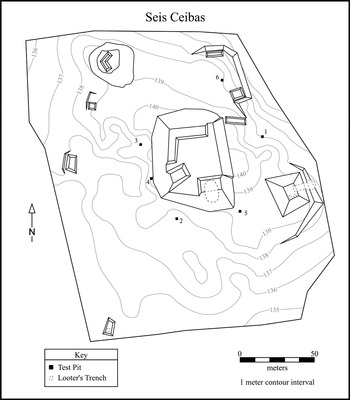
Preclassic materials also were found at Seis Ceibas, a predominantly Late Classic rural palace located on a ridge that overlooks the Arroyo Itzan and the Río de la Pasión, approximately 2.5 km south of the Itzan ceremonial center (Figure 17). Around the perimeter of the residential compound that occupies the site's center, archaeologists excavated six test pits (Figure 18), four of which yielded ceramics dating to Late Preclassic and Protoclassic 1 periods (Table 1).

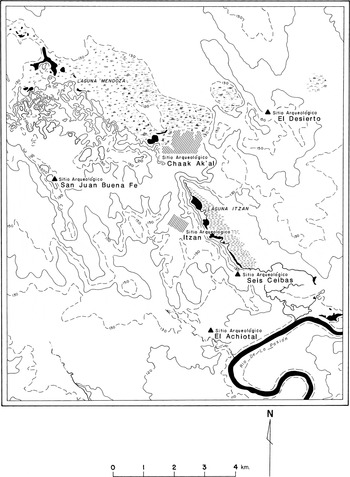
Map of the Itzan escarpment and surrounding regions, showing the locations of Itzan, Seis Ceibas, Chaak Ak'al, El Desierto, and other sites.

Map of Seis Ceibas, whose architectural surface is a Late Classic rural elite residential complex. Prepared by J. Burks.
In summary, at six rural locations, all of which were selected for excavation on the grounds of judgmental rather than probabilistic criteria, soils below Late Classic settlement yielded Preclassic ceramics. At two locations (IT2 and IT5) Middle Preclassic ceramics were present, whereas at one location (IT3) archaeologists found only Protoclassic sherds. In Operations IT4 and IT6 and at Seis Ceibas, archaeologists recovered Chicanel phase and Protoclassic ceramics. Considering that in the IT1B sealed trash deposit this combination dates to the Protoclassic 1 period, it is possible that in these three contexts the Chicanel ceramics reveal only a Protoclassic and not also a preceding Late Preclassic occupation. In any case, long before the Late Classic occupation of the Itzan escarpment's hillocks and ridges, many rural locations had been extensively settled by Preclassic peoples, whose presence now is marked largely by buried ceramic scatters.
CHAAK AK'AL
Approximately three kilometers north of the Itzan ceremonial center, the landscape is marked by another horst upland and graben trough (Figure 17). The trough contains the Laguna Mendoza, an area of marshes and deep water approximately 6 km long (E–W) and 1-to 3-km wide (N–S). The horst, a steep-sided escarpment, the crest of which has been transformed through weathering into tall, conical hills and deep depressions, falls sharply to the lagoon's southern border. At its eastern terminus the escarpment protrudes, peninsula-like, into the lagoon's southeast corner. Atop the latter lies Chaak Ak'al, a large Preclassic ceremonial center (Figure 19).

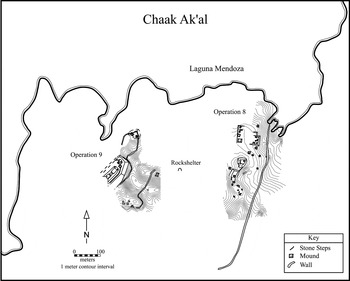
Map of the two surveyed sections of Chaak Ak'al, Petén, Guatemala. Prepared by J. Burks.
Chaak Ak'al (meaning “great lagoon”) sits at the juncture of several distinctive environmental zones. The lagoon, immediately to its north, is a rich source of fish, shellfish, turtles, alligators, wild plant foods, and other lacustrine resources. South of the lagoon lies a broad band of karstic hills blanketed with black calcareous lithosols appropriate for maize agriculture that runs to the Río de la Pasión. North of the lagoon, the landscape flattens, and the dominant soil is a red (possibly lateritic) clay that, according to local informants, is not appropriate for maize agriculture. For the Maya the environmental transition was significant. South of Chaak Ak'al, in the zone of karstic hills, ancient Maya settlement is dense. In contrast, archaeologists contracted in 1998 by Grant Geophysical Co. have determined that north of Chaak Ak'al, vast areas of the flat landscape are devoid of mounded Maya settlement.
For its occupants, Chaak Ak'al's location was strategically advantageous. On the one hand, they enjoyed commanding views of and direct access to the resources of four major environmental zones: (1) the flat savanna-like terrain to the north; (2) the karstic hills to the south; (3) the lagoon that separates them; and (4) the escarpment's steep northern face. On the other hand, they had direct water access to the two great river systems of the southwestern Maya lowlands. Fed by springs, the Laguna Mendoza drains west through the Arroyo El Chorro to the upper Río Usumacinta. The Laguna Itzan, whose northernmost point lies less than 2 km to the south of Chaak Ak'al, drains south through the Arroyo Itzan to the Río de la Pasión. Chaak Ak'al, in other words, is a marsh-fronted site with ready access to the southwestern Petén's two major river systems.
Itzan Project archaeologists discovered Chaak Ak'al in 1998 toward the end of a field season dedicated to the investigation of a Late Classic “invisible” (buried and minimally mounded) residential settlement (Johnston 2002, 2004; Johnston and Martinez 1999). Large areas of the site were clearly visible on land recently deforested and burned for agriculture. In two operations (Figure 19) conducted over the course of two weeks, the Itzan Project carried out a brief reconnaissance, mapped two large tracts of settlement remains, excavated test pits in and around architectural remains, and in the two mapped sectors, collected ceramics from the many looter's pits that penetrate mounds.
Because several individuals own the land on which the site lies, and only one gave permission to conduct operations on his property, we were able to explore and map only parts of Chaak Ak'al. Based on our GPS-aided reconnaissance, we conservatively estimate that the site is more than 1 km long (E–W) and 0.5 km wide (N–S). We reconnoitered but did not receive permission to map settlement remains and several wall-like constructions approximately 300 m west of Operation 9, and landowner tells us that dense settlement continues beyond that to the west. The exact size of Chaak Ak'al has not been determined.
Principal architectural features.
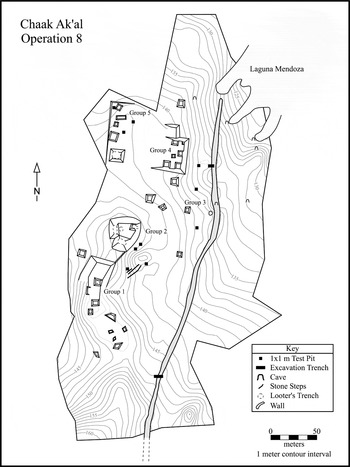
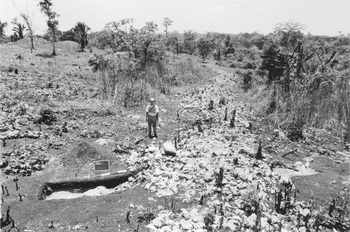
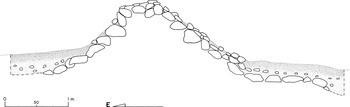
Several architectural features distinguish Chaak Ak'al, including, in Operation 8 (Figure 20), a wall-like architectural feature over 600 m long that runs from the shores of the Laguna Mendoza into the hills that mark the site's southern margin (Figure 21). This feature, constructed of crude, irregularly shaped limestone rocks, varies in width from 2 to 6 m, with an average width of about 3 m. Built along the eastern face of a sharp slope, it trapped sediment. Thus, on its uphill side it has an average height of about 0.5 m, while on its downhill side its height varies between 0.5 and 2.5 m, with an average height of about 1.25 m. The feature's function is not known. There are no major architectural groups near its northern or southern terminus points, suggesting that it was not a sacbe, or roadway. Moreover, it could not have served as an agricultural terrace because for much of its length it runs down slopes rather than along them. The fact that east of the feature the terrain is low-lying, poorly drained, and has few visible settlement remains may indicate that the feature served as a wall or defensive emplacement marking the site's eastern boundary.

Map of Chaak Ak'al Operation 8. Prepared by J. Burks.

Part of the 600-m-long wall-like construction that passes through Chaak Ak'al Operation 8.
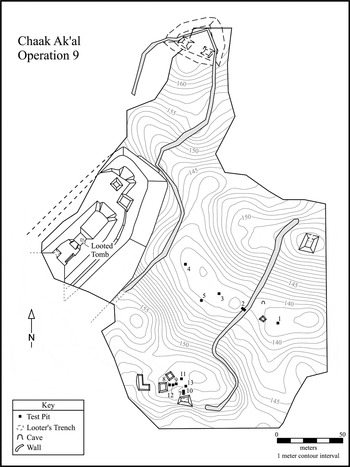
Chaak Ak'al's largest construction is a 60-m-high conical karstic hill that the Maya carved into the shape of a great stepped pyramid (Figure 22). That the pyramid was sculpted from limestone bedrock—which is unique in the southern lowlands—is evident on its eastern face, where portions of its three massive terraces are well preserved. A small mound and plaza complex tops its summit. The pyramid's basal dimensions are approximately 160 m × 120 m. A probable wall of unknown function winds around the pyramid's base and encloses to the north a patio group bordered by a steep slope that falls toward the lagoon (Figure 22). East of the pyramid, a second wall-like construction crosses a narrow basin and partially surrounds mound groups built atop hills to the north and south (Figure 23).

Map of Chaak Ak'al Operation 9. Prepared by J. Burks.

Profile of the easternmost of the two wall-like constructions mapped in Chaak Ak'al Operation 9. Drawing by Gustavo Martinez.
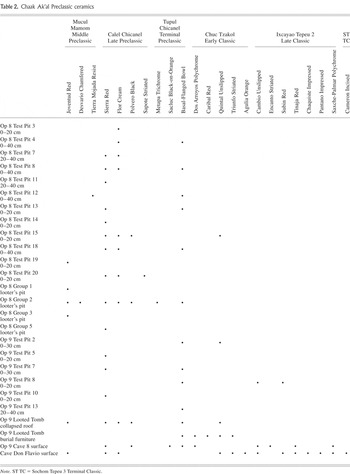
Caves are abundant at Chaak Ak'al, and we briefly explored eight of them. All contain abundant lithic material as well as Preclassic, Classic, and Terminal Classic ceramics (Table 2), and on some cave surfaces we observed human remains. None of the caves were mapped or excavated.
Chaak Ak'al Preclassic ceramics

We mapped topography and architecture and excavated test pits in two sectors, designated Operations 8 and 9 (Figures 20 and 22). Test pits were dug down to the dense, sterile clays that overlie bedrock. Project personnel excavated 21 test pits in Operation 8 and 13 in Operation 9. In these operations we systematically collected sherds and ceramic vessel fragments from the looter's pits and trenches that penetrate the site's many modest-sized (>5 m high) mounds.
Test-pit excavations and ceramic analyses.
To the north and east of the sloping terrain of Operation 8 the landscape is low-lying, swampy, and largely unexplored (Figure 20). In Operations 8 and 9 we mapped only terrain recently cleared of vegetation for agriculture. Dense but unmapped settlement lies west of Operation 8.
Four of the five patio groups in Operation 8—Groups 1, 2, 3, and 5—are damaged by looter's pits, and around their edges and in their backdirt piles, archaeologists recovered ceramics that reveal when the patio groups were constructed. Recovered from Groups 2 and 3 were large quantities of ceramics dating to the Middle Preclassic, Late Preclassic, and Protoclassic 1 periods (Table 2). Late Preclassic sherds also were abundant in and around the looter's trenches of Groups 1 and 5.
In the 21 test pits excavated in Operation 8, identifiable ceramics date almost exclusively to the Late Preclassic and Protoclassic 1 periods. In a few test pits, modest quantities of Late Classic ceramics (mostly domestic wares, including Cambio Unslipped, Encanto Striated, Subin Red, Chaquiste Impressed, Carmelita Incised, and Tinaja Red) were found in the topmost 10 cm of soil. Throughout Operation 8 and in adjacent and outlying unmapped areas, Late Preclassic, Protoclassic 1, and to a lesser degree Middle Preclassic ceramics carpet the surface.
In Operation 9 we excavated thirteen test pits: five at the bottom of a steep-sided depression and eight in the central patio of a hilltop mound group (Figure 22). The former yielded Late Preclassic (primarily Sierra Red and Flor Cream) sherds only (Table 2); the latter, Late Classic materials overlying shallow Late Preclassic deposits. It was built during what appears to have been a modestly sized and widely scattered Late Classic occupation of the site.
Scattered over the surface of the large pyramid that marks the western boundary of Operation 9 are Middle Preclassic, Late Preclassic, and Protoclassic 1 ceramics. Few ceramics observed on the mound's surface or elsewhere at the site date to the Late Classic period. As noted previously, the pyramid consists of a sculpted hill atop which a patio and mound complex was built. That mound encloses a slab-lined tomb chamber 3 m long, 0.7 m wide, and 0.9 m high, recently sacked by looters. Project archeologists recorded the tomb, removed its artifactual contents, and sealed and buried its chamber.
Osteological materials remaining in the tomb include the partial cranium and several leg bone fragments of an adult (sex not determined). Recovered in the sediments at the chamber's base were numerous Sierra Red, Flor Cream, and Polvero Black sherds, all dating to the Late Preclassic period. Two intact ceramics vessels—almost certainly part of the tomb's burial furniture—remained in the chamber. These vessels, an orange glossware polychrome bowl with mammiform tetrapod feet and an orange glossware potstand, date to the Protoclassic 2 period, ca. a.d. 150–400 (Brady et al. 1998:29–34). Assuming that the mound containing the tomb was built after the hill beneath it was transformed into a pyramid, the tomb's ceramic contents reveal that construction of the pyramid was completed prior to the Protoclassic 2 period.
Site Chronology.
Ceramics recovered in Operations 8 and 9 from test pits and looter's trenches indicate that the primary occupation of Chaak Ak'al occurred during the Late Preclassic and Protoclassic 1 periods, ca. 300 b.c. to a.d. 150. On the basis of the size of the site's settlement and the massiveness of its public architecture relative to that of other known lower Pasión Preclassic sites, I conclude that Chaak Ak'al almost certainly served as a polity capital. Neither Seibal nor Altar de Sacrificios had comparably sized pyramids at this time. The territory ruled by Chaak Ak'al almost certainly included Itzan, located a mere 2 km to the south, which during this period had substantial but considerably smaller public buildings.
As revealed by Mamom ceramics, initial occupation began during the Middle Preclassic period or perhaps earlier. Occupation continued through both phases of the Protoclassic period. That is, pseudo-Usulatan ceramic types, including Sacluc Red-on-Orange, Caramba Red-on-Orange, and Metapa Trichrome, found in both operations, date to the Protoclassic 1, ca. 75 b.c to a.d. 150 (Brady et al. 1998), while the looted tomb—revealing an ongoing elite presence—is a Protoclassic 2 construction. Evidently the site had only a modest-sized Late Classic population. In the site's many caves, where archaeologists observed ceramics dating to the Late Preclassic, Early Classic, and Late Classic periods, Terminal Classic (ca. a.d. 800–950) pottery is especially abundant, indicating that, centuries after abandoning Chaak Ak'al's ceremonial center, Maya populations continued to carry out ritual activities in these natural features.
EL DESIERTO
Approximately 1.5 km east of the easternmost shores of the Laguna Mendoza is a small triadic pyramid arrangement supported by a basal platform that, like similarly configured triadic arrangements (Hansen 1998, 2001), almost certainly dates to the Late Preclassic period (Figure 17). Unfortunately, the pyramid group, called El Desierto by locals, has been severely disfigured by looting, and for this reason we did not map it. All ceramics observed in and around the looter's trenches date to the Late Preclassic period. El Desierto appears to be a Late Preclassic ceremonial outlier of Chaak Ak'al.
CONCLUSIONS
The principal chronological and cultural developmental implications of the Itzan escarpment data can be summarized as follows. Within the lower Río de la Pasión drainage system, the earliest known phase of colonization, the Xe phase, which dates to the early Middle Preclassic period, has been detected at Itzan, Seibal, and Altar de Sacrificios. During this period settlement consisted of small, widely dispersed villages. By the late Middle Preclassic period, emergent elites had constructed substantial public buildings at Itzan as well as Altar de Sacrificios and Anonal. These settlements were elite residential and ceremonial centers but probably not polity capitals. No evidence of Middle Preclassic elite architectural facilities has yet been found at Chaak Ak'al (although this may change when archaeologists test the site more extensively).
By the Late Preclassic period, several polities, ruled from Chaak Ak'al, Seibal, Altar de Sacrificios, and possibly Aguateca, were in place and fully developed. There can be little doubt that this list of Late Preclassic polities and capitals within the lower Río de la Pasión drainage system is incomplete; others—dating to this and later time periods—almost certainly remain to be discovered. Chaak Ak'al, with its 60-m-high central pyramid, probably was one of the region's largest and most powerful Late Preclassic capitals. It remained an important capital through the Protoclassic 1 and probably the Protoclassic 2 periods, during which time Altar de Sacrificios and possibly Seibal, but not Aguateca, also were capitals. During the Early Classic period (ca. a.d. 420–600), Seibal (Willey 1990:264), Aguateca (Foias 1996:357), and apparently Chaak Ak'al suffered significant political and demographic declines. At the same time, elite groups remained politically active at Altar de Sacrificios, Tres Islas (Demarest 2004:218–221; Willey 1990:262–264), Tamarandito, and Arroyo de Piedra (Foias 1996:358; Houston 1992). Polity density increased during the Late Classic period, when capitals within the lower Río de la Pasión drainage system emerged or re-emerged at Altar de Sacrificios, La Amelia, El Chorro, Dos Pilas, Aguateca, Seibal, Itzan, and Comixtun (north of contemporary Sayaxche [Chocón 2003]).
The relationship during the Middle Preclassic, Late Preclassic, and Protoclassic periods between Chaak Ak'al and Itzan—which are only 2 km apart—is not well understood. Ceramic and architectural data indicate that during all three periods elites engaged in residential and ceremonial activities at both sites. At Itzan, the scale of these activities was substantial: elites directed the construction of plaster-covered plazas and plaster-faced buildings during the Middle Preclassic period, while during the Late Preclassic period they built an E Group complex and erected at least one sculpted (and possibly inscribed) stone monument. Chaak Ak'al appears to have had a smaller, less ceremonially active Middle Preclassic population (at least in the sectors of the site that have been investigated to date). Yet its Late Preclassic and Protoclassic architecture dwarfs that of Itzan, and its population during these periods seems to have been much larger than that of its neighbor to the south. These data suggest that during the Late Preclassic and Protoclassic periods Chaak Ak'al was a capital. What was the function of Itzan at this time? Two possible explanations come to mind. First, Itzan was a secondary center or rural palace within a polity ruled by Chaak Ak'al and was politically subordinate to it. Second, Chaak Ak'al and Itzan were twin capitals of a single polity—a pattern repeated during the Late Classic period within the Pasión region at Dos Pilas and Aguateca (Houston 1992:116). I strongly favor the first explanation but currently cannot conclusively eliminate the second.
Between the end of the Protoclassic period and the beginning of the Late Classic period (ca. a.d. 400–600), the locus of political power atop the escarpment shifted from Chaak Ak'al (which thereafter was largely abandoned) to Itzan. This settlement shift (which followed an Early Classic “hiatus” [see Willey 1990:264]) presumably prompted (or was prompted by) a shift in political and economic orientations. That is, when the polity capital relocated from Chaak Ak'al (which had limited access to a river) to Itzan (with direct access to a river), residents undoubtedly shifted from a predominantly lacustrine to a mixed lacustrine and riverine pattern of natural resources exploitation. The relocation—which transpired as competing capitals were emerging all along the river's length—might have been prompted by an ambition among elites to gain more direct access to and/or control movement (including commercial movement) along part of the Río de la Pasión. The relocation might have been necessitated in part by political developments at El Chorro, which was the capital of a neighboring and presumably hostile polity. During the Late Classic period, El Chorro almost certainly controlled all movement along the Arroyo El Chorro between the Laguna Mendoza, which it drains, and the Río Usumacinta, into which it flows.
Because of El Chorro's control of the arroyo's middle section, Chaak Ak'al by the end of the Protoclassic period may no longer have enjoyed direct, unimpeded, and unregulated canoe access to the Río Usumacinta. The political relationship between Chaak Ak'al and Itzan will be more fully understood only when more research is conducted at these sites.
The research conducted at Itzan and Chaak Ak'al contributes to the development of a greater archaeological understanding of the regional political geography within the lower Río de la Pasión drainage system during the Protoclassic period. Within the southern sector of the southern Maya lowlands, the Late Classic cultural chronology and political geography of this region are still only partially known. With each discovery of Preclassic elite ceremonial and residential facilities, archaeological knowledge of cultural, including political, developments during this time grows.
RESUMEN
Durante los períodos preclásico y protoclásico las élites y los plebeyos maya ocuparon intensivamente el acantilado de Itzan, localizado en la parte inferior del sistema de desagüe del Río de la Pasión en Petén, Guatemala. Itzan fue colonizado durante la fase de Xe del medio período preclásico, y su tenencia intensificó durante la última mitad del período preclásico cuando fueron montadas las facilidades residenciales y ceremoniales de las élites. Durante los períodos tardíos preclásico y protoclásico, el acantilado fue dominado por Chaak Ak'al, un sitio enorme distinguido por pirámides masivas y construcciones largas parecidas a murallas, que servía sin duda como la capital del orden civil. Tras el período protoclásico, el lugar de actividades del acantilado mudó de nuevo a Itzan que sirvió como centro del orden civil a lo largo del período clásico tardío. De los datos recopilados en Itzan, Chak Ak'al, y otros sitios de la parte inferior del sistema de desagüe del Río de la Pasión, una imagen de la política geográfica regional de los maya preclásico se está revelando.
ACKNOWLEDGMENTS
The research described in this article was completed with the assistance of many colleagues. My valued colleague, Lic. Gustavo Martinez, co-directed the Itzan Project during the 1998 season. Other archaeologists who contributed to the fieldwork included Jarrod Burks, Daniel Molina, Fernando Moscoso, Otto Ramon de Leon, and Tori Saneda. Kitty Emery expertly analyzed the faunal materials recovered during the 1990 season; Lori Wright and Nora Lopez analyzed the human remains. Don Forsyth, Richard Hansen, James Brady, and the late Ed Shook generously assisted with the identification of ceramics. Arthur Demarest, James Brady, and Richard Hansen provided access to laboratory space. Jarrod Burks (maps), Fernando Luin (ceramics), and Edgar Ortega (lithics) drafted the illustrations. Richard Hansen and Traci Ardren read drafts of the manuscript. I am grateful to all of these individuals.
Special thanks are extended to the comité, including its president and vice president, as well as the people of the Cooperativa La Palma, where Itzan and Chaak Ak'al are located. Over the years, the people of La Palma have been very supportive of our field research. Eladio Ixcayao Ramírez, Felipe Ramírez Hernández, Pedro Mendoza, Flavio Pirir, and Jose Marroquin provided valued assistance in the field.
Funding for fieldwork at Itzan, Guatemala, was provided in 1990 by the National Science Foundation (grant number 8911052), a Fulbright fellowship, the JFM Foundation, Sigma Xi, the Explorers Club, and Yale University, and in 1998 by the Ohio State University and the JFM Foundation. Field investigations were made possible with permits graciously awarded by the Instituto de Antropología e Historia de Guatemala (IDAEH); Lic. Leopoldo Colom Molina was the Director of IDAEH in 1990 and Dr. Juan Antonio Valdéz in 1998. Several Jefes of the Departamento de Monumentos Prehispanicos, IDAEH, generously provided additional assistance: Lic. Erick Ponciano, Lica. Elizabeth Lemus Toledo, and Lic. Rene Urgarte. Without the support of these individuals, the Itzan research would not have been possible.
Any omissions and errors in fact and interpretation are the author's responsibility.