




No CrossRef data available.
Article contents
Does ethnicity matter? Bereavement outcomes in two ethnic groups living in the United Kingdom
Published online by Cambridge University Press: 03 March 2006
Abstract
Background: Sociologists, anthropologists, and psychologists agree that grief is a universal phenomenon. Reactions to it are, however, socially constructed and patterned.
Objective: To compare the outcomes of bereavement among family or close friends of deceased first-generation black Caribbean and white native-born patients living in the United Kingdom.
Design: Comparative cross-sectional questionnaire survey in three inner London health authorities administered 10 months after the patient's death.
Participants: Family and close friends of 50 deceased first-generation black Caribbean and 50 native-born white patients with advanced disease.
Main outcome measures: 28-item General Health Questionnaire (GHQ-28), Core Bereavement Items scale, a 17-item measure of grief.
Results: The intensity of grief, measured using the Core Bereavement Items was similar between the two groups. Seventy-two respondents had visited their family doctor subsequent to bereavement, and of these, black Caribbean respondents reported more psychological problems. Depression and anxiety measured by the GHQ-28 were significantly higher among black Caribbean respondents (28.00 vs. 21.2) (t-test = −2.28, p = 0.025). Multiple regression analysis revealed this difference was best accounted for by bereavement concerns such as legal and housing problems.
Conclusions: This study has observed higher psychological morbidity among the bereaved Caribbean individuals. Family doctors are a source of support for three-quarters of respondents, and they may need to focus on the needs of black and minority ethnic minorities.
Information
- Type
- Research Article
- Information
- Copyright
- © 2005 Cambridge University Press
INTRODUCTION
Bereavement is a complex, multidimensional process, influenced by physical, psychological, social, and cultural factors (Kissane et al., 1997). It has been studied extensively by a variety of disciplines and often using combinations of factors. From a psychological point of view, bereavement is the reaction to the loss by death of a loved one, and is viewed by society as the most stressful life event. Bereavement can lead to physical and psychological morbidity (Lundin, 1984; Lund et al., 1989; Thompson et al., 1991) and even a significant increase in the risk of mortality among surviving family members (Parkes et al., 1969; Schulz & Scott, 1999). However, our understanding of bereavement is based largely on studies of white, often Christian populations (Cowles, 1996; Parkes, 2001; Firth, 2004). This has resulted in a very Western-centric view of “normal” grief and what reactions to it involve.
To date, no studies have reported the experience and outcomes of bereavement among the black Caribbean community. Understanding their experience is important. First, as the numbers of older members within the community increases, so will those with advanced disease (Lowdell et al., 2000). Further, for many patients and families from different cultures, rituals and traditions become more important in illness and at death (Koffman, 2001). Addressing these cultural needs may influence postbereavement outcomes of family members (Brennan & Moynihan, 2004). This can significantly impact on the workload of family doctors (Main, 2000; Wiles et al., 2002). Therefore we conducted a survey to describe and compare the last year of life of first-generation black Caribbeans and white native-born patients with advanced disease. This article reports the bereavement outcomes of black Caribbean and white family or friends most closely associated with the care of deceased dependents in both ethnic groups. A subsidiary aim was to determine whether any differences between the two ethnic groups could be explained by confounders that included demographic and health-related variables, in addition to measures of social disadvantage.
METHODS
Research Design
Our survey, which builds on the methods used by Cartwright et al. (1973) and Addington-Hall and McCarthy (1995), is reported in detail elsewhere (Higginson & Koffman, 2003). A letter was sent to the person (the “informant”) who registered that death of the decedent approximately 10 months after the patient's death. Interviewers then contacted this person in order to identify the individual best qualified to recount the deceased's last 12 months of life and how the experience impacted on his or her life.
Setting and Participants
The survey took place in three materially and socially deprived London local authorities with a total population of 736,000 people, where the black Caribbean community represents 10.4% of the total population, one of the highest concentrations of this ethnic group in the United Kingdom (Lambeth, Southwark and Lewisham Health Authority, 1999).
Data on all 5,130 deaths recorded during the period December 1997 to November 1998 were collected from Health Authority death registrations. These data record place of birth, rather than ethnicity. Therefore, although not ideal (Senior & Bhopal, 1994), we selected first-generation black Caribbeans from the place of birth/country of origin variable recorded within the death registration data. The survey was therefore limited to first-generation black Caribbeans, that is, those originating from Barbados, Jamaica, Tobago, Trinidad, and St. Lucia. Ethnicity group was, however, validated at interview, which took place approximately 10 months after a patient's death.
Cases were selected if the patient had a disease that was known to have a progressive and/or terminal period (Doyle et al., 1998) based on information from the ICD-10 code and the five cause of death descriptors. The comparison group was a matched random sample of native-born white patients selected from the same database. Matching was for age, sex, marital status, diagnosis, and electoral district.
Respondents completed three measures during face-to-face interviews: (i) a structured interview, using a questionnaire adapted from previous retrospective surveys to explore the deceased's last 12 months of life and how this experience affected informal caregivers' lives (Cartwright et al., 1973; Addington-Hall & McCarthy, 1995); (ii) the General Health Questionnaire (GHQ-28), a widely used screening questionnaire for detecting verifiable psychiatric morbidity (Goldberg, 1986; Goldberg & Williams, 1991) that has also been used in cross-cultural studies (Jacob et al., 1997; Shaw et al., 1999); and (iii) the Core Bereavement Items (CBI) scale, a 17-item scale that measures the intensity of grief (Burnett et al., 1997).
Researchers received special training for sensitive data collection among bereaved family members and conducted interviews in the respondent's own home. Local Research Ethics Committee approval was granted prior to the study commencing.
Analysis
We analyzed the data using the statistics software package SPSS (version 10.1 for Windows) in three stages. First, characteristics of deceased dependents and the family or close friends who participated in the interviews were compared by ethnic group using Pearson's χ2 test. Where 20% or more cells in the table had an expected count of less than five, Fisher's exact test was used (Mehta & Patel, 2003). Second, the total GHQ-28 and the CBI scores were compared by ethnic group using an independent-samples t test. Third, multiple regression analysis was then used to determine whether any differences between groups in terms of GHQ-28 scores could be explained by potential confounders or explanatory variables. These were grouped into five models: (i) the demographic characteristics of patients and respondents, (ii) the clinical symptoms deceased patients experienced, (iii) service-related factors, (iv) postbereavement health, and (v) postbereavement concerns. A second analysis, using stepwise multiple regression aimed to describe the best-fit model to explain GHQ-28 scores.
RESULTS
Response Rates
During the study period 106 informants of black Caribbean and 110 white patients were contacted, to produce a sample of 50 cases per ethnic group, a response rate of 47% and 45%, respectively. Gender, age, and underlying cause of death were not significantly different between participants and nonparticipants.
Characteristics of Deceased Patients and Family or Close Friends
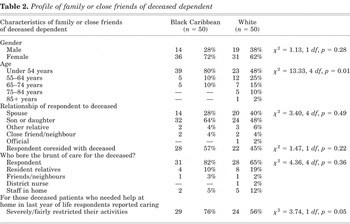
Tables 1 and 2 summarize the main sociodemographic, clinical characteristics, and dependency needs of the two patient samples. The underlying cause of death for more than two-thirds of patients in both ethnic groups was cancer. Black Caribbean patients were more likely have died in a hospital, with fewer deaths in hospices. More than three out of four patients in both groups were reported to have needed help with personal care during their last year of life.
Main sociodemographic characteristics and dependency needs of all deceased dependents

Profile of family or close friends of deceased dependent

The Bereavement Experience
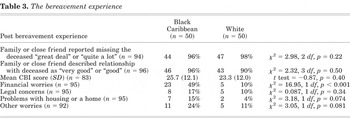
After the death almost all respondents reported they missed their deceased dependents a “great deal” or “quite a lot.” This was supported by the large number of respondents in both groups who described their relationship with the deceased as being “very good or good.” Forty-two (84%) family members or friends of deceased black Caribbean and 41 (82%) family members or close friends of deceased white patients completed the CBI. The reported mean intensity of grief for those representing deceased dependents were similar—25.7 (SD = 12.1) for black Caribbean and 23.3 (SD = 12.0) for white (t test = −0.87, p = 0.4). However, 23 black Caribbean versus 5 white family members or close friends of deceased patients reported they had financial worries (Table 3).
The bereavement experience

The Physical and Emotional Distress Associated Postbereavement
Overall, 31 (65%) black Caribbean and 36 (75%) white respondents described their health for their age at the time of the interview as being “excellent” or “good.” A total of 72 (75%) of all respondents reported they had visited their family doctor since their dependent had died. Of these, more black Caribbean than white respondents reported they had experienced both depression and anxiety or other health-related problems. The 28-item GHQ-28 was completed by 43 (86%) black Caribbean and 42 (84%) white respondents. A higher (more severe) mean score was observed among black Caribbean than white respondents (Table 4).
Postbereavement physical and emotional status

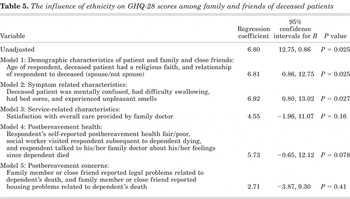
This association between ethnicity and the GHQ-28 score was explored further. We sought to determine whether controlling for additional variables influenced the association using multiple regression. Variables were grouped in five categories (see Table 5). Table 5 shows that the mean difference in GHQ-28 scores between black Caribbean and white respondents was not diminished by sociodemographic differences or symptoms in the deceased. There was a moderate reduction in the difference when postbereavement health variables and satisfaction were entered into the model. However, the variables that appeared to account more for the difference in scores were those in model five. This included legal and housing problems and entering these variables greatly diminished the difference in the GHQ-28 scores between the black Caribbean and white respondents.
The influence of ethnicity on GHQ-28 scores among family and friends of deceased patients

Factors Independently Associated with Postbereavement Emotional Distress
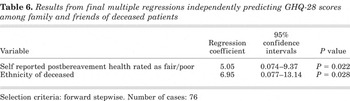
Table 6 shows the final results of the forward stepwise multiple regression model predicting high levels of depression and anxiety among the family and close friends of deceased patients. In four out of five domains, the ethnicity of the deceased patient predicted psychological distress among responders. In the final model, ethnicity and self-reported postbereavement health remained significantly associated with a high GHQ-28 score.
Results from final multiple regressions independently predicting GHQ-28 scores among family and friends of deceased patients

DISCUSSION
We sought to explore whether ethnicity influenced the outcomes of bereavement among the family or close friends of black Caribbean and white deceased patients with advanced disease. Our findings have three main limitations.
First, our response rates were just under 50%. We found no significant variations in the decision to participate in the survey with regard to sex, age, and underlying cause of death of the deceased patients. This response rate was higher than another local postbereavement survey (Addington-Hall et al., 1999); high levels of residential mobility may account for a number of the nonresponders. Further, although great sensitivity was required in approaching participants, it was inevitable that a proportion would refuse to participate. It may be that some did not respond because of unresolved bereavement issues. Thus our findings may underestimate the true levels of psychological morbidity. However, the response rate was similar for each ethnic group, reducing the likelihood of a systematic error in our comparison. This highlights the difficulty of choosing a method for approaching bereaved people that addresses concerns and distress while ensuring a sufficient response rate.
Second, the method of data collection may affect responses, particularly in sensitive areas. Here “racialized differences” between the research participant and the interviewer can potentially affect the “genuiness” and “accuracy” of what the participants say (Gunaratnam, 2003). To counter this, Ahmad (1993) suggests interviewers should be from the same ethnic group as those involved in the research. However, this addresses only one possible marker of identity, others being age, gender, and social class (Phoenix, 1995). In this survey we used two interviewers from the local black Caribbean community and three white interviewers. We observed no obvious differences in the type or depth of data collected by the black Caribbean interviewers. A related issue is concern regarding the assumptions that the underlying features of common mental disorders, such as depression and anxiety, are similar across cultures and that no important culturally specific symptoms or presentations are going to be missed (Rait, 1999). The charges of ethnocentricity can be reduced by assessing the instrument, and in this case, the performance and acceptability of the GHQ-28 within a new population. Although the GHQ-28 has been extensively validated in other cultures, it has not specifically been explored within the black Caribbean population in the United Kingdom. Therefore complimentary approaches might be required to explore the outcomes of bereavement more fully.
Third, this survey was cross-sectional. It therefore does not shed light on the emotional status of respondents prior to their bereavement and during the last year of life of their loved ones or dependents. Further, although controlling for postbereavement health and satisfaction with care provided by family doctors reduced the effect of ethnicity on the GHQ-28 score, it may be that depression has a direct impact on satisfaction and perceived postbereavement health. Controlling for these variables may therefore be inappropriate. Longitudinal studies would be needed to tell us about other significant life events, circumstances, and emotional states that may explain in full, or contribute in part, to respondents' emotional fragility.
Outcomes of Bereavement
Missing the Deceased
Almost all respondents stated they missed their relative or dependent a “great deal” or “quite a lot.” This crude measure of grief is subject to social desirability bias. However, when a more sophisticated method for assessing the intensity of grief was used, similar results were observed among the two groups of respondents and these compared favorably to outcomes of bereavement published elsewhere (Walsh et al., 2002).
Social and Practical Concerns
Financial hardship exacerbates the challenges family members face because they have to bear the extra costs of providing care. Although there were few overall differences in the level of financial support both groups of dependents received, there was greater perception among black Caribbean than white respondents that they could have benefited from additional financial help. Financial and material deprivation has been shown to reduce the ability to provide home care (Higginson et al., 1999; Koffman & Higginson, 2004). As a consequence, we suggest this concern may have translated into a tendency for black Caribbean respondents to worry or feel more anxious about financial issues.
The Physical and Psychological Legacy
We found that both groups of respondents' self-reports of overall postbereavement health were similar. This supports other research that although the health problems in black and minority ethnic groups may be different from those in the ethnic majority, with different causes and different solutions, there areas of similarity (Acheson, 1998). However, for the 71% of black Caribbean respondents who stated they had consulted their family doctor subsequent to the death of their relative or dependent, a contradictory picture emerged. Stress-related symptoms, for example, “nerves” and “depression” and “other health problems,” were more pronounced among black Caribbean respondents. Although the mean levels of psychological distress measured using the GHQ-28 were both within the morbid range for respondents from both ethnic groups, there was a significant difference between the two groups. This remained so even after other important patient, family, service, and other bereavement-related variables were taken into account.
CONCLUSIONS
We observed that anxiety-related disorders following bereavement are an area of concern for both groups of respondents, although they are more pronounced among black Caribbeans. Here alternative explanations other than bereavement may be present (Nazroo, 1997; Shaw et al., 1999).
We recommend that:
- Family doctors, viewed as a principal source of support for many bereaved individuals, should routinely screen for depression and anxiety, with a particular emphasis on the needs of black and ethnic minorities.
- Bereavement support that is sensitive to the needs of diverse communities should be provided.
- Ethnicity should be coded in death registration data, as it is clearly an important factor affecting outcomes.
ACKNOWLEDGMENTS
Funding was provided by the NHS Executive, London Regional Office Research and Development Funding Programme. The following local research ethics committees approved this survey: King's Health Care NHS Trust, St. Thomas' Hospital, and Guy's Hospital.
References
REFERENCES
Acheson, D.
(1998).
Independent Inquiry into Inequalities in Health Report.
London:
The Stationery Office.
Addington-Hall, J. &
McCarthy, M.
(1995).
Regional study of the care of the dying: Methods and sample
characteristics.
Palliative Medicine,
9,
27–35.Google Scholar
Addington-Hall, J.,
West, P.,
Karlsen, S.,
et al.
(1999).
Care in the Last Year of Life in Lambeth, Southwark and Lewisham:
Final Report.
London:
Department of Palliative Care & Policy, King's College
London.
Ahmad, W.
(1993).
Making black people sick: Race, ideology and health
research. In
'Race' and Health in Contemporary Britain,
Ahmad, W. (ed.), pp.
11–34.
Buckingham:
Open University Press.
Brennan, J. &
Moynihan, C.
(2004).
Cancer in Context.
Oxford:
Oxford University Press.
Burnett, P.,
Middleton, W.,
Raphael, B.,
et al.
(1997).
Measuring core bereavement phenomena.
Psychological Medicine,
27,
49–57.Google Scholar
Cartwright, A.,
Hockey, L., &
Anderson, J.L.
(1973).
Life before Death.
London.
Cowles, K.V.
(1996).
Cultural perspectives of grief: An expanded concept model.
Journal of Advanced Nursing,
23,
287–294.Google Scholar
Doyle, D.,
Hanks, G., &
MacDonald, N.
(1998).
Introduction. In
Oxford Textbook of Palliative Medicine,
2nd ed.,
Doyle, D.,
Hanks, G. &
MacDonald, N. (eds.), pp.
4–8.
Oxford:
Oxford University Press.
Firth, S.
(2004).
Cultural perspectives on loss and bereavement. In
Loss, Change and Bereavement in Palliative Care,
Luff, G.,
Oliviere, D. &
Firth, P. (eds.),
Buckingham:
Open University Press.
Goldberg, D.P.
(1986).
Use of the General Health Questionnaire in Clinical Work.
British Medical Journal,
293,
1188–1189.Google Scholar
Goldberg, D. &
Williams, P.
(1991).
A User's Guide to the General Health Questionnaire.
Windsor:
NFER- Nelson.
Gunaratnam, Y.
(2003).
Researching ‘Race’ and Ethnicity: Methods, Knowledge and
Power.
London:
Sage.
Higginson, I.J.,
Jarman, B.,
Astin, P.,
et al.
(1999).
Do social factors affect where patients die: An analysis of 10 years
of cancer deaths in England.
Journal of Public Health Medicine,
21,
22–28.Google Scholar
Higginson, I.J. &
Koffman, J.
(2003).
Attitudes to timeliness of death and euthanasia among first
generation black Caribbean and white patients and their families living in
the United Kingdom.
Journal of Palliative Medicine,
6,
245–249.Google Scholar
Jacob, K.S.,
Bhugra, D., &
Mann, A.H.
(1997).
The validation of the 12-item General Health Questionnaire among
ethnic Indian women living in the United Kingdom.
Psychological Medicine,
27,
1215–1217.Google Scholar
Kissane, D.W.,
Bloch, S., &
McKenzie, D.P.
(1997).
Family coping and bereavement outcome.
Palliative Medicine,
11,
191–201.Google Scholar
Koffman, J.
(2001).
Rituals surrounding death and dying within the black Caribbean
community.
Palliative Care Today,
10,
7.Google Scholar
Koffman, J. &
Higginson, I.J.
(2004).
Dying to be home? A comparison of preferred place of death of first
generation black Caribbean and native-born white patients in the United
Kingdom.
Journal of Palliative Medicine,
7,
628–636.Google Scholar
Lambeth, Southwark and Lewisham Health Authority.
(1999). 1997–1998 Annual Public
Health Report,
Lambeth, Southwark and Lewisham Health Authority.
Lowdell, C.,
Evandrou, M.,
Bardsley, M.,
et al.
(2000).
Health of Ethnic Minority Elders in London: Respecting
Diversity.
London:
The Health of Londoners Project.
Lund, D.A.,
Caserta, M.S., &
Dimond, M.F.
(1989).
Impact of spousal bereavement on the subjective well-being of older
adults. In
Older Bereaved Spouses: Research with Practical Applications.
Series in Death Education, Ageing and Health Care,
Lund, D.A. (ed.), pp.
3–15.
New York:
Hemisphere Publishing Corp.
Lundin, T.
(1984).
Morbidity following sudden and unexpected bereavement.
British Journal of Psychiatry,
144,
84–88.Google Scholar
Main, J.
(2000).
Improving management of bereavement in general practice based on a
survey of recently bereaved subjects in a single general practice.
British Journal of General Practice,
50,
863–866.Google Scholar
Mehta, C.R. &
Patel, N.R.
(2003).
A network algorithm for performing Fisher's exact test in r
× c contingency tables.
Journal of the American Statistical Association,
78,
427–434.Google Scholar
Nazroo, J.Y.
(1997).
Ethnicity and Mental Health.
London:
Policy Studies Institute.
Parkes, C.M.
(2001).
A historical overview of the scientific study of
bereavement. In
Handbook of Bereavement Research: Consequences, Coping and
Care,
Stroebe, M.S.,
Strobe, W. &
Hansson, R.O. (eds.), pp.
25–47.
Washington, DC:
American Psychological Association.
Parkes, C.M.,
Benjamin, B., &
Fitzgerald, R.G.
(1969).
Broken heart: A statistical study of increased mortality among
widowers.
British Medical Journal,
1,
740–743.Google Scholar
Phoenix, A.
(1995).
Practising feminist research: The intersection of gender and race
in the research process? In
Research Women's Lives from a Feminist Perspective,
Maynard, M. &
Purvis, J. (eds.), pp.
49–71.
London:
Taylor.
Rait, G.
(1999).
Commentary: Counting heads may mask cultural and social
factors.
British Medical Journal,
318,
305–306.Google Scholar
Schulz, R. &
Scott, R.
(1999).
Caregiving as a risk for mortality.
JAMA,
282,
2215–2219.Google Scholar
Senior, A. &
Bhopal, R.
(1994).
Ethnicity as a variable in epidemiological research.
British Medical Journal,
309,
327–330.Google Scholar
Shaw, C.M.,
Creed, F.,
Tomenson, B.,
et al.
(1999).
Prevalence of anxiety and depressive illness and help seeking
behaviour in African Caribbeans and white Europeans: Two phase general
population survey.
British Medical Journal,
318,
302–306.Google Scholar
Thompson, L.W.,
Gallagher-Thompson, D.,
Futterman, A.,
et al.
(1991).
The effects of late-life spousal bereavement over a 30-month
interval.
Psychology and Aging,
6,
434–441.Google Scholar
Walsh, K.,
King, M.,
Jones, L.,
et al.
(2002).
Spiritual beliefs may affect bereavement: Prospective study.
British Medical Journal,
324,
1551–1554.Google Scholar
Wiles, R.,
Jarrett, N.,
Payne, S.,
et al.
(2002).
Referrals for bereavement counselling in primary care: A qualitative
study.
Patient Education & Counselling,
48, 1,
79–85.Google Scholar

Main sociodemographic characteristics and dependency needs of all deceased dependents
Profile of family or close friends of deceased dependent
The bereavement experience

Postbereavement physical and emotional status
The influence of ethnicity on GHQ-28 scores among family and friends of deceased patients
Results from final multiple regressions independently predicting GHQ-28 scores among family and friends of deceased patients
 You have
Access
- 24
- Cited by