The first hallmark of a prince should be to survive …
—Frederick the GreatFootnote 1The assumption that ‘states' primary goal is survival’ lies at the heart of the neorealist paradigm.Footnote 2 The so-called ‘survival assumption’, according to neorealism, is all we need to know about state preferences in order to construct a parsimonious theory of international politics.Footnote 3 A careful examination of the assumption, however, reveals that neorealists, while referring to the survival assumption, implicitly draw upon a number of distinct interpretations; there is not a single survival assumption, but an archipelago of distinct interpretations that are then treated as if they are the same.
The burden of this article is to unpack the survival assumption, highlight some of the problems that surround it as well as their consequences, and then to propose a refined interpretation that is consistent with most, but most definitely not all, readings of the assumption. I suggest that survival assumption can be best conceptualised not by trying to establish a universally applicable (or universally acceptable) definition of what ‘state survival’ really is, but by focusing on two questions that, in fact, specify the role and function of the assumption in the neorealist logic: (i) what do states have to lose if they fail to adopt self-help strategies?; and (ii) how does concern for relevant losses motivate state behaviour and affect international outcomes? In order to address these questions, I first propose a two-dimensional framework that highlights ‘autonomy of domestic political order’ and ‘territory’, and then emphasise a specific interpretation of the assumption that focuses on governing elites' sensitivity towards (i) regime stability; and (ii) territorial integrity of the state.
This refinement of the assumption has four implications. First, by elaborating on their impacts on the determinants of regime stability and state-territory relationship, this article explicitly puts the French Revolution and the subsequent rise of nationalism in world politics as a dominant political force into historical context vis-à-vis the neorealist paradigm. Second, in relation, the framework offered in this article directly engages the debates among defensive and offensive neorealists over the relative predictive power of these two approaches. Third, the two-dimensional framework allows neorealist logic to ask new questions about cases that lie outside the Westphalian ideal of the modern territorial state. Fourth, the refined interpretation of the survival assumption not only does position neorealism vis-à-vis the emerging literatures on political survival and forceful regime change,Footnote 4 but it also bridges the gap between neorealist theories – which are essentially system-level – and neorealist policy advice in the post-Cold War era, which tend to include domestic dynamics that usually revolve around regime survival.Footnote 5
The remainder of this article is organised into four parts. First, I elaborate on the place of the survival assumption in neorealist tradition and point towards the in-built ambiguities that surround it. Second, I introduce a conceptual framework that is then utilised to offer a refined interpretation of the assumption. The third section offers a discussion of what is gained with the refinement. The final section concludes.
Survival and neorealism
Since Kenneth Waltz's Theory of International Politics (TIP, hereafter) was published in 1979, neorealism has been the dominant paradigm in International Relations (IR) literature. Neorealism's success, its adherents would argue, emanates from its theoretical rigour and transhistorical scope. Building on a few simple assumptions, the argument goes, the theory can account for much of international politics, or ‘patterns [that] recur and events [that] repeat themselves endlessly’ in international life, ‘through the millennia’.Footnote 6 Waltz claims that we need only two assumptions in order to explain the general trends in international politics: that the international system is anarchic and that states seek to ensure their survival, or that their primary goal is survival.Footnote 7 Despite many refinements and modifications to Waltz's original formulation,Footnote 8 these two starting assumptions still remain as the building blocks of the neorealist tradition.
‘Concern for survival’, an important component of numerous studies,Footnote 9 plays a crucial role in neorealist theory by serving at least two major functions. First, the assumption is one of the key elements that separate neorealism from Hans Morgenthau's classical realism.Footnote 10 Classical realism's pessimistic portrayal of world politics follows directly from the premise that humans – and states – are driven by an insatiable desire for more power. According to neorealism, by contrast, the competition and discord among states is a ‘tragedy’ that emanates from the nature of the anarchical international system; the system literally traps the states – that are concerned primarily with survival and not with more power for its own sake – in a struggle for power. Focus on survival and not power, in turn, not only does allow neorealists to suggest that some optimism is possible in an anarchic environmentFootnote 11 (which would not be the case if all states wanted power all the time), but it also makes it possible for neorealism to claim relative parsimony over its classical precedent, for neorealists take pride in explaining the perpetuity of discord in the international system by starting from a weaker assumption than power maximisation.
Second, and more importantly, the assumption plays a crucial role in the neorealist logic: according to Waltz, it is all we need to know about state preferences: ‘survival is a prerequisite to achieving any goals that states may have, other than the goal of promoting their own disappearance as political entities’.Footnote 12 According to Waltz's followers who claim to have refined Waltz's starting assumptions, survival is states' ‘most important objective’.Footnote 13 Concern for survival animates state behaviour, and in turn, sets the dynamics of interstate relations. For example, survival assumption is directly related with ‘balancing’, a key component of the realist project. According to the realist logic, states balance against another state when their survival is in danger;Footnote 14 therefore how survival is interpreted determines the conditions under which the theory would predict balancing behaviour to take place. Put differently, the assumption tells us not only what states have to lose if they fail to purse self-help strategies but also why concern for relevant losses stimulates much of international politics.
The assumption, however, does not lend itself to a self-evident interpretation. While the concept of survival attracted some attention in the literature, criticisms of the assumption have yet to add up to a refinement. In the face of this conceptual ambiguity, neorealists draw upon a number of distinct interpretations, which are then treated as if they are identical. The result is the perpetuation of a conceptual underspecification that clouds the logical and empirical consistency of neorealist approaches to interstate politics.
An assumption without an obvious interpretation
Notwithstanding its centrality for neorealism, TIP does not elaborate on the survival assumption. This is problematic since what survival can mean for a state and how concern for survival can motivate states are not self-evident. Survival and death are two sides of the same coin; one can be defined as the ‘cessation of all life processes’ and the other as ‘remaining alive’. Both of these concepts are defined with reference to ‘life’, which is an attribute of biological organisms. Non-organic organisational entities such as firms, governments, or states, by definition, do not live or die. It follows that, short of treating states as if they are organisms, say people, what state survival means and how concern for state survival motivates international politics cannot be deemed self-explanatory.
To be fair, attributing human qualities to states, at least for rhetorical purposes, is commonplace in IR scholarship.Footnote 15 Echoing Thomas Hobbes's Leviathan, once we define state death as loss of sovereignty and think of states as if they are humans, it becomes possible to construct a potential interpretation: in an anarchic system where states with power to hurt each other cannot trust each other, state behaviour would be shaped largely by states' fear of violent and sudden death.Footnote 16 However, state-as-a-person approach to survival assumption has little resonance in the realist tradition. Even Thomas Hobbes does underline that relations among states do not resemble relations among individuals.Footnote 17 In addition, neorealists dismiss human nature-based, or first image, explanations by fiat.Footnote 18 The fact that Waltz does not even cite Hobbes in TIP also suggests that neorealism's vision of state and state survival does not entail attributing human characteristics to states.
A close reading of TIP reveals that Waltz draws significant parallels between states and firms.Footnote 19 Establishing an unmistakable analogy between markets and international systems, Waltz holds that all neoclassical economic theory needs to assume about firms to predict as well as explain market outcomes is that they seek to maximise profits; similarly, it would be sufficient to assume that states seek to ensure their survival, or that their primary goal is survival, to predict and explain much of international politics.Footnote 20
However, as Robert Powell recognised, the survival assumption ‘cannot play a role parallel to that of the assumption of profit maximization’.Footnote 21 Neoclassical economics does not predict market outcomes by assuming that ‘firms' primary goal is to avoid bankruptcy’. While avoiding bankruptcy may appear as an ‘implicit’ assumption in microeconomics (for firms need to stay afloat if they want to maximise profits), such thinking is rejected by none other than Waltz himself, who, in a passing note, recognises that an assumption that posits that firms' primary goal is to avoid bankruptcy ‘has no place in economic theory, for it is apparent that such a rule would conflict with the assumption that men and firms are profit maximizers’.Footnote 22 In sum, while Waltz argues that survival for a state is like profit-maximisation for a firm, these two are not necessarily comparable, rendering firm-state analogy a poor means for making sense of the survival assumption.
Critics of the survival assumption
The underspecification of the survival assumption has received attention from a handful of scholars such as Stephen Brooks and Robert Powell.Footnote 23 In particular, three studies deserve special attention. In a Review of International Studies article dated 1999, Darel Paul takes issue with treatment of state survival in the mainstream IR theories, including Alexander Wendt-inspired constructivism. Criticising the ‘anthropomorphic conceptualization of the state’, where state is treated as if it is ‘a living corporal entity’,Footnote 24 Paul argues that survival is – ‘sloppily’Footnote 25 – equated with sovereignty in much of the relevant literature. While the former concept is about existence, Paul maintains, the latter term refers to the ‘terms of this existence’.Footnote 26 Equating survival with sovereignty traps IR theory in a ‘Westphalian blind alley’, for this conceptualisation ‘rejects from the outset an on ontology of overlapping political authorities in a single territory but at distinct scales’.Footnote 27 Such rejection, in turn, distorts the analytical lenses of ‘statist’ (state-centric) IR theories, blinding them with respect to the analysis of states that have existed without being completely sovereign such as the nineteenth-century Egypt or the members of the European Union (EU). While very provocative and insightful, Paul's essay does not intend to refine the assumption or offer a viable alternative, but plays more like an ontological and wholesale critique of neorealism as well as other state-centric approaches in IR literature.
Affirming a ‘Westphalian ontology’, Dustin Howes argues that state survival, which he takes as ‘autonomy in foreign affairs’,Footnote 28 is not sufficient to explain cases where states willingly limit their autonomy by conceding some of their freedoms to international institutions. Accordingly, Howes suggests that IR scholarship should replace ‘survival’ with the concept of ‘national interest’, which would consist of ‘the desire to physically survive, ensure economic well-being, and promote collective self-esteem’ in addition to preserving autonomy in foreign policy.Footnote 29 Howes does in fact offer an alternative interpretation of state preferences; yet, his ‘solution’ to the apparent inconsistencies embedded in the survival assumption is also destined to lead to conceptual ambiguities, for the concept of ‘national interest’ remains a hollow phrase interpretation of which necessarily depends on who is defining the nation and its interest, and under which circumstances.
Beyond the critical readings of TIP's treatment of survival, the single most important study that is of relevance is Tanisha Fazal's groundbreaking book on state death.Footnote 30 By focusing on the membership of a state in the interstate legal network, Fazal defines state death as ‘the formal loss of control over foreign policy to another state’ or ‘exit from the interstate system’.Footnote 31 Carrying out an extensive empirical analysis, Fazal maintains that since 1816, over a quarter of states in the interstate system (66 of 207) have died and that ‘geography’, puts ‘buffer states’ – states with the highest death rate – at a particular disadvantage.
While it constitutes an important contribution to the literature, Fazal's study remains of limited utility for making sense of the survival assumption in the context of neorealism. The main reason is that this approach, by building exclusively on the ‘legal membership’ of a polity in the interstate system, leaves out dynamics such as regime change, partial loss of autonomy in foreign affairs, territorial loss, or state collapse and instead emphasises not only ‘violent’ but also ‘formal’ forms of state death that occurs as a result of occupation and conquest. This has two implications. First, Fazal's interpretation presents a very restrictive picture about what states can lose. For example, this approach assumes that political entities such as Russia (1917) or the Ottoman Empire (1923) did not ‘die’ since their legal heritages were claimed by the Soviet Union and Turkey, leading to the conclusion that these states actually ‘survived’ World War I and its aftermath, which is a little far-fetched of a claim when the historical context is taken into consideration.
Second, in relation, such interpretation makes it difficult for the neorealist causal train to leave the station in the first place, for it focuses more on the notion and empirics of state survival/death and much less on how concern for death motivates states. While partial loss of domestic authority or of some territory – and even regime change and state collapse – is not a distant probability for most states, much different from humans in the state of nature described in Hobbes's Leviathan, great powers, the stuff of neorealist theories, do not usually face an imminent threat of violent state death as it is defined by Fazal. Put differently, Fazal's definition of state death, if accepted by neorealists, would render ‘concern for survival’ an extremely remote motive, since the risk of death for great powers at any given time is almost nonexistent. In fact, Fazal's interpretation, which can be traced to 2004, has yet to be endorsed by neorealists, suggesting that it is not clear if neorealists do or would subscribe to her interpretation of state death/survival.Footnote 32
State of play: one assumption, many interpretations
In sum, the survival assumption, for it to serve the functions that neorealists claim it does, requires further elaboration, which seems to be lacking so far.Footnote 33 Under such circumstances, the common practice among the neorealists has entailed a ‘conceptual sleight of hand’; instead of specifying what they mean by the assumption, neorealists tend to draw upon a pool of alternative interpretations and use them interchangeably as if they are the same. Among all this body of work, John Mearsheimer's The Tragedy of Great Power Politics deserves special attention for Tragedy is arguably the most systematic and extensive revisiting of the neorealist theory since Waltz's seminal work. Mearsheimer's treatment of the assumption is brief and confined in a short paragraph:
The [fourth] assumption is that survival is the primary goal of great powers. Specifically, states seek to maintain their territorial integrity and the autonomy of their domestic political order. Survival motivates other motives because, once a state is conquered, it is unlikely to be in a position to pursue other aims. Soviet leader Joseph Stalin put the point well during a war scare in 1927: ‘We can and must build socialism in the [Soviet Union]. But in order to do so we first of all have to exist.’ States can do and pursue other goals, of course, but security is their most important objective.Footnote 34
Mearsheimer starts with Waltz's original statement, which simply mentions survival without defining the term. Unwilling or unable to define what survival is, he then equates survival with territorial integrity and sovereignty, or, ‘the autonomy of domestic political order’. While such equation provides some flesh to the meaning of the assumption, it does not explain why territorial integrity should be equated with survival or whether states ‘die’ when they lose territory. Mearsheimer's quote from Stalin complicates things even further since what Stalin refers as ‘we’ can also be taken as the ‘communist leadership’, which would imply that Stalin was concerned primarily with the political survival of the communist party and not with the territorial integrity of the state. Regardless, Mearsheimer broadens the scope of the assumption by introducing the term security, without telling us what he means by it. In the end, Mearsheimer presents an unbeatable equation – survival=territorial integrity=sovereignty=security – that contains four different, if related, concepts, none of which is clearly defined or elaborated. Consequently, Mearsheimer, by way of presenting a cyclical and slippery definition of what survival is, creates an impenetrable layer of ambiguity around the assumption.
In particular, Mearsheimer is neither alone nor solely responsible for this conceptual ambiguity. Waltz, for one, argues that ‘survival motive’ can be accepted as ‘the ground of action in a world where the security of states is not assured’.Footnote 35 While it is possible to suggest that Waltz is not directly equating survival with security, facing the ambiguities surrounding the survival assumption, almost all realists have occasionally fallen back to the concept of ‘security’ and substituted it for survival.Footnote 36 Charles Glaser, for example, in his recent neorealist treatise Rational Theory of International Politics, first suggests (in a footnote) that ‘Waltz appears to use the terms “survival” and “security” interchangeably’ [emphasis added] and then maintains that his own work uses the term ‘security’ and not survival, but with the intention of referring to what is being implied by both concepts.Footnote 37 In other words, for most neorealists the assumption also reads ‘states' primary goal is security’ or that states are ‘security seekers’.Footnote 38
On the one hand, security is a less limiting concept than survival and allows for more conceptual leeway; while the concept of survival limits the potential interpretations of state preferences, this is not the case for security. On the other hand, as Richard Betts puts it, security is a ‘hopelessly slippery’ concept.Footnote 39 For the concept of security is even much more malleable than survival, it can be employed to imply a number of different things for a number of different actors. Unless put into context, the concept of security is not useful for theoretical analysis and stays as a normatively loaded and subjective term meaning of which is necessarily in the eye of the beholder.Footnote 40
As mentioned above, another strategy for salvaging the survival assumption involves equating state survival with ‘territorial integrity’.Footnote 41 Monica Duffy Toft, for example, suggests that ‘states are defined by their borders and therefore tend to view challenges to those borders as threats to their very existence’ and ‘for states, control of territory is directly linked to physical survival’.Footnote 42 In fact, substituting survival and security with territorial integrity has a number of advantages. First, territorial integrity is a more tangible concept: it refers to a situation where the borders controlled by the state remain unchanged. Second, it is a sound assumption for analysing the current dynamics of the international politics as well as the recent past; territory is a main source of interstate disputes and conflicts in the modern state system, which suggests that states value territory dearly.Footnote 43 Third, loss of territory is not necessarily a distant possibility; states may be difficult to kill (regardless of how death is defined), but it takes much less lose or gain pieces of land.
However, without further specification, the statement that ‘states' primary goal is to preserve their territorial integrity’ cannot escape from serious problems. Above all, territorial integrity per se has not been a dominant theme in many historical periods and regions. As John Agnew reminds us, the fusion of sovereign political authority and clearly demarcated territories as containers of people, a feature of the nation-states, has been the exception and not the norm in world history.Footnote 44 The complex quasi-hierarchical political system that dominated Europe before the Peace of Westphalia (1648) ruled out the possibility that the territorial integrity of a polity could be a main concern for the governing elites.Footnote 45 Even for the Westphalian ‘territorial state’Footnote 46 of the seventeenth and eighteenth centuries, territorial integrity of the state per se, while important, did not constitute a ‘primary goal’ especially when compared with the nation-statesFootnote 47 of the twentieth century; besides the fact that states continued to exist and function after large-scale territorial losses, they could also swap pieces of territory as dowries following royal marriages or buy and sell them like any other commodity.Footnote 48
Furthermore, there is neither an obvious reason for why territorial integrity per se would be equal to survival nor a natural explanation for why it should be a primary concern for decision-makers.Footnote 49 For example, if we assume that a state dies when the capitol is captured by another state, it becomes obvious that a government's primary goal would be to ensure the survival of the capitol, not to preserve the territorial integrity of the state for its own sake. Rational governments, in other words, would be willing to sacrifice territory to avoid the risk of losing the capital.Footnote 50
In short, neither the original survival assumption nor its substitutes offer much help for understanding how state preferences are treated in the neorealist framework. It is obvious that Poland ‘died’ when it was wiped off the map by the late eighteenth century, or that the US could have died a similar ‘absolute’ death in case of an all-out nuclear war with the Soviet Union, but it is less clear whether the Iranian state died in 1979, Somalia in 1991, Iraq in 2003, Hungary in 1956, Prussia in 1871, Russia in 1917, or Germany in 1918 or 1945.
When the French territorial integrity was violated with the loss Alsace Lorraine as of 1871, for example, it was obvious, as epitomised with Leon Gambetta's dictum ‘never speak of [it], never forget [it]’, that the French state suffered an important loss. While the Franco-Prussian war led to a regime change in France, losing the war or Alsace Lorraine neither triggered nor signalled the dissolution of the French state, suggesting that it is also difficult to claim that France ‘died’ as a result of this loss. The case of Alsace Lorraine can further be contrasted with the occupation of France between 1940 and 1944. It goes without saying that France literally ceased to exist as a ‘sovereign’ state during the occupation. While the French state lost its political autonomy even over Paris, however, it did not physically lose Paris as a piece of territory at least in the same fashion Alsace Lorraine had been lost some seventy years earlier. While there was most clearly a foreign-imposed regime change in France, it is also difficult to suggest that France died in the same fashion that Carthage did after the Punic Wars or Poland during the course of the late-eighteenth century. The elasticity of the term survival can also be observed when scrutinising the more peaceful processes of the present day politics: has France been committing ‘suicide’ in the last half a century by gradually surrendering some its ‘sovereignty’ over to a supranational entity?
Note that the conceptual mist surrounding the assumption is not only a matter of answering the question ‘when does a state die?’; survival assumption is about state preferences defined in terms of what states can lose if they fail to successfully pursue self-help strategies and how these losses can motivate state behaviour. Since the above examples show that what states can lose under the banner of survival may in fact differ in kind and degree, it becomes common sense to suggest that states' sensitivities towards different kinds and degrees of losses will also differ. Needless to say, a state reacting to a concern for loss of political autonomy in some issue areas may behave differently from a state reacting to a concern for partial territorial loss, as it is highly likely that a state concerned with physical destruction in Carthaginian proportions will act much differently than a state that does not face similar threats.
That neorealism is unclear about what survival is and how it motivates states can in turn lead to a number of confusions over the proper ‘neorealist’ interpretation of the historical record as well as recent developments. With all the wars he fought during the course of his reign, was Louis XIV trying to ensure the survival of the French state (however defined), or was he just an unappeasable expansionist hardwired for aggrandising more and more power? Are the members of the EU actually ‘transcending’ the logic of anarchy by forsaking their survival (defined in terms of sovereignty), or is it possible to think of the origins of the entire EU project as a by-product of the founding members' concern for survival, defined in terms of regime survival and territorial integrity, which was considerably amplified in the face of the impending Soviet ideological and military threat during the course of the Cold War?Footnote 51 It is not possible to give definitive answers to these questions unless the survival assumption is scrutinised.
In other words, the ambiguity surrounding the assumption makes it possible to derive different – and even contradictory – theoretical conclusions or policy analyses. Iran's recent attempts to acquire nuclear capabilities, for example, constitute a significant concern for the international community. If one is to interpret state death as the ‘physical destruction’Footnote 52 of the state through conquest in the lines of Carthage after the Third Punic War or Poland during the late-eighteenth century, it follows that – since the US and its allies may not be harbouring such excessive intentions – Iran's attempts at developing nuclear capabilities do not follow from a concern for survival, but could be a function of malign intentions or irrationality. However, if we employ the ‘regime survival’ interpretation of the assumption, it becomes quite possible to suggest that the Iranian leadership perceives a threat to the stability of the present regime – especially from the US – and is merely trying to reassure its regime survival by building deterrent capabilities. The policy advice that would follow from these two interpretations, in turn, would also be very different: the first interpretation calls for measures as harsh as preventive war, while the second calls for containment and deterrence. While neorealists usually call for containment and deterrence in the relevant cases,Footnote 53 it is still possible to claim that such advice is not the only one that follows from their theories.
Ambiguity over the survival assumption can also fuel theoretical disagreements among neorealists. Defensive realists, for example, suggest that states do not want more power than is required to ensure survival and aspire to ‘satisfice’, not maximise power.Footnote 54 Offensive realists, in turn, argue that states aspire to maximise power since their survival is more fragile than is suggested by defensive realists. In his analysis of ‘dueling realisms’, Brooks argues that the main disagreement over the issue of ‘how much power is enough’, derives from the fact that defensive realists focus on the ‘probability’ of losses, while offensive realists emphasise the ‘possibility’ of security losses.Footnote 55 The analysis provided above suggests a complementary explanation for the ‘one logic, many conclusions’ problématique among realists:Footnote 56 perhaps, offensive and defensive realists disagree on, or more likely, are confused about, what the primary security losses are made of. It is quite possible that offensive realists adhere to a more comprehensive interpretation of survival (which would help rationalise the emphasis on fear over relevant losses) while defensive realists stick to a more limited interpretation (which would explain that fear at most times is unnecessary, since destruction of a state in Carthaginian proportions is an extremely rare event). Without specifying what states fear losing, however, it is not possible to even consider the relative merit of these two approaches.
The underlying cause of these ambiguities is the conceptual underspecification inherent within the neorealist programme. This is a problem for neorealism precisely because its adherents claim it to be a deductive enterprise. Deductive reasoning requires that inferences of the theory follow from its starting assumptions. Assumptions, in turn, are comprised of interrelated concepts. If there are ambiguities over the concepts, the assumptions that are built on these concepts will suffer from inconsistencies, which, in turn, would lead to confusions and indeterminacies over inferences. Such tendency may then render sound empirical analysis problematic.Footnote 57
So, if there is a conceptual ambiguity surrounding the survival assumption, what can be done to provide further specification? In the next section, I offer a refined interpretation of the survival assumption.
Making sense of survival
As a first cut, I drop the term ‘security’ out of a potential refinement of the assumption, for it may create unnecessary confusion. The concept of ‘survival’, as argued in the previous sections, also suffers from inherent definitional problems. Accordingly, while the term has most certainly acquired considerable semantic value in the literature, there is much to be gained from not dwelling over a universally acceptable definition of state survival but instead focusing on two important questions that directly relate to the function that the assumption plays in the neorealist logic. First, what do states have to lose when they fail to pursue self-help strategies? Second, how do relevant losses motivate much of international outcomes, or to paraphrase Waltz, how can concern for such losses serve as the ‘ground of action’ in world politics?Footnote 58
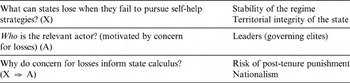
Table 1 summarises my answers to these questions, with the first row addressing the first question and the second and third rows, collectively, addressing the second question. I propose that the assumption should read that nation-states act as if their primary concern is regime stability and territorial integrity of the state. In the next two subsections, I elaborate on this particular specification.
Reconstruction of the survival assumption

What do states lose when they fail to pursue self-help strategies?
With respect to the question of what states can lose, there are more than a few candidates including concepts such as honour,Footnote 59 prestige/status,Footnote 60 reputation/credibility,Footnote 61 or economic wealth.Footnote 62 While these are also reasonable concepts to refer to, I focus on two dimensions that are specifically highlighted by neorealists: ‘autonomy of domestic political order’Footnote 63 and territory.Footnote 64 These two dimensions can be utilised to answer to the first question (what can states lose if they fail to pursue self-help strategies?).
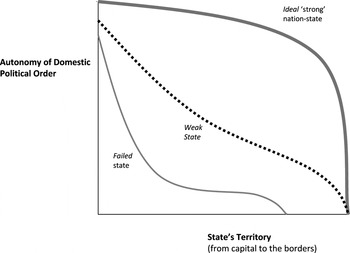
Figure 1 outlines the relationship between these two dimensions. For the sake of simplicity, both ‘autonomy’ and ‘territory’ are represented uni-dimensionally. From a territorial perspective, the starting point is the ‘capital’ and the ending point refers to the external borders of the state. Autonomy, in this context, refers to the ‘internal sovereignty’ of a state, the degree to which the central government can be accepted as the ultimate arbitrator of authority in the relevant issue domains (which can range from taxation to conscription, or from monopoly of education to the regulation of economic activity). The bold frontier in Figure 1 refers to a ‘strong’Footnote 65 nation-state that enjoys near-absolute autonomy over all relevant issue domains across the territorial belongings of the state.Footnote 66
Mapping out autonomy and territory

Such specification begs questions about how losses in different dimensions would interact. As Quincy Wright observed, for a state to do anything in the international sphere, its government ‘must think first of retaining [domestic] power’.Footnote 67 If states are compelled to choose between regime stability and territorial integrity, they would prefer losing territory to risking the survival of the regime to the point where territorial losses themselves start posing immediate threats to regime's stability. Even though territorial integrity is a major concern and most states will act as if threats to territorial integrity are in fact threats to regime's survival, when a difficult choice needs to be made, states will most likely choose regime survival over territorial integrity.
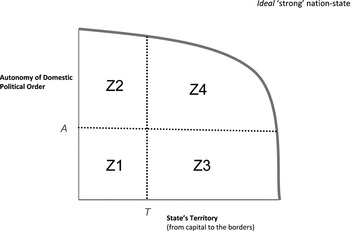
Losses in this two dimensional space in an ‘ideal type’ nation-state, as depicted in Figure 2, can be categorised into four. As Stephen Krasner argued, the political authority of a state within its borders is never absolute and is in fact a variable.Footnote 68 Most states may be willing to concede some of their autonomy due to outside pressures (for example, Finland during the Cold War) and side-benefits (such as support from an ally or membership in a supranational organisation), or they can simply lack the capacity to exert absolute control due to domestic obstacles or the effects of globalisation. Yet, there would be a threshold of losses in political authority where the state can no longer tolerate further losses without putting the regime survival at substantial and immediate risk. In Figure 2, this threshold is represented with A. While a state will cease to exist if it loses the capitol (or its substitute), there would also exist a territorial threshold where further territorial losses would put the regime's stability at substantial and immediate risk. In Figure 2, this point is referenced as T.
Categorisation of potential losses

Such delineation creates four different zones over what states can lose if they fail to pursue self-help strategies. Three of these areas, from Zone 1 (Z1) to Z3, represent ‘danger zones’: without commanding a degree of state authority and controlling sufficient territory to sustain the state, the survival of the regime will be under immediate threat. While the ideal situation for a state may be to make no compromises in any one of these zones, states can, and do, ‘survive’ by making concessions from Z4, both on the side of autonomy and territory.
The case of Saddam Hussein's Iraq after the Gulf War, for example, suggests that Saddam's regime was willing to sacrifice territorial control over the northern Kurdish-populated section of the country in order to ensure regime stability in the rest. Similarly, facing an increasing threat from the Free Syrian Army (FSA) as well as pressure from states such as the US and Turkey, Esad regime partially withdrew its forces from the northern provinces of Syria during the course of Summer 2012, indirectly empowering the Kurdish groups in the region. The logic of regime survival for Esad, one can argue, convinced the Syrian leader to sacrifice control over some territory that was not of immediate concern for the stability of the regime; given that the Kurdish groups in the northern provinces, different from FSA, did not necessarily intend to topple the regime, Esad found it expedient to limit his territorial base in order to divert valuable resources to other areas that are of crucial importance for regime survival such as Aleppo.
Alternatively, as noted above, there would also be a ‘territorial threshold’ that would sensitise states to territorial losses to a larger extent than losses in political autonomy. After being defeated by Russia in 1878 and facing the risk of substantial territorial losses that would put Istanbul under direct Russian military threat, for example, the Ottoman Empire conceded to British and French demands that considerably limited Ottomans' domestic autonomy over non-Muslim inhabitants of the Empire in exchange for avoiding the aforementioned territorial losses that would have put the entire regime at risk.
How do relevant losses motivate states?
Specifying what states can lose makes it necessary to elaborate on how and why relevant losses would shape states' calculi over self-help strategies. A necessary step to address this question, as depicted in Table 1 in the previous subsection, involves the ‘agent’ whose concern for primary losses would motivate state behaviour. Establishing ‘state’ as a political organisation that enjoys monopoly over the use of large-scale violence within a bounded territory and is situated in the nexus of the domestic realm and the interstate system,Footnote 69 I maintain that the agent whose incentives are relevant for understanding state behaviour is the leader, or the governing elites, of the state. It is the state that acts as if it is a unitary actor in the international system,Footnote 70 but the leader is the agent who decides what the action will be.Footnote 71
Even though neorealists reify state as the main agent of concern in their theories, especially when they test their theories against historical record – or when they are offering policy advice – they implicitly or explicitly focus on the ruler as the main unit of analysis. It is the Fredrick the Great, Napoleon, Bethmann-Holweg, Stalin, Roosevelt, or Saddam Hussein, and not some abstract conception about ‘states’, that neorealists emphasise in their empirical analyses.Footnote 72 In this reading, focusing explicitly on the governing elites does not entail the task of ‘bringing the leaders back in’Footnote 73 simply because they never really left the neorealist practice in the first place.Footnote 74
Having established governing elites as the relevant decision makers of concern, the next step would be to provide a working explanation for why the concern for state survival (X) drives much of the relevant agent's (A) decisions and actions. If we accept the conventional neorealist definition of theory, which, according to Waltz, is ‘a depiction of the organization of a domain and of the connections among its parts’,Footnote 75 then we can conclude that microfoundations Footnote 76 – or causal maps between agents, preferences, and outcomes – help establish such ‘connections’.Footnote 77 So, why would leaders be concerned with regime stability and the preservation of territorial integrity of the state?
The causal link between governing elites and regime survival is straightforward. Especially a forceful regime change entails not only loss of power on the part of the governing elites, but also an amplified risk of punishment after losing power. Chiozza and Goemans' empirical analysis of leaders' post-tenure fates, for example, show that ‘leaders who lose office in a violent or forcible manner such as a coup or revolution … almost always suffer [punishment] in the form of exile, imprisonment, or death’.Footnote 78 A direct implication is that governing elites are extremely sensitive towards the internal and external challenges to the stability of the regime. Note that concern for foreign imposed regime changed became a significant concern for the rulers of the modern state system especially after the French RevolutionFootnote 79 and remains as such for numerous governments in present day world politics.
The notion of ‘territorial integrity’ as a concern for the rulers of the modern state system is even more historically contingent. From a historical point of view, governing elites' sensitivities towards state territory have been amplified as a result of the rise of nationalism – defined here as a ‘political principle which holds that the political unit and the national unit should be congruent’Footnote 80 – as a dominant political ideology in world politics during the course of the nineteenth century.Footnote 81 Before nationalism rendered territory more of an indivisible good for states, territorial losses that emanated either from wars or non-violent means such as marriages, swaps, and sales, were tolerable, if not always desirable. Externally [or internally] imposed limitations to the autonomy of domestic political order, similarly, as long as concessions did not pose immediate threats to the regime, have also been tolerated by states.
What is specific to the age of nation-states is the amplified symbolic or political value of territory. Even though loss of some territory would not necessarily ‘kill’ a regime in a nation-state, most states would still act as if their territorial belongings are in fact ‘indivisible’. Even members of the EU, despite having made considerable concessions over their political autonomy, show no signs of becoming comfortable with the notion of ‘dividing up’ their territorial belongings. Two mechanisms that accompany nationalism prompt governing elites to consider preservation of the territorial integrity of the state as a primary motive. First, the rise of nationalism shifted the identity of the sovereign from the person of the monarch to the people.Footnote 82 Accordingly, leaders were compelled to consider ‘audience costs’ with regard to the decisions they make about how the state will act.Footnote 83 Second, despite all the variation in the ingredients of particular nationalisms – some nations are defined by ethnicity, others by culture or a particular creed – a common feature of nationalistic discourses is an emphasis on the indivisibility of the homeland. This renders the territorial integrity of the state an extremely salient issue for the inhabitants of a state regardless of regime type.Footnote 84 When these two mechanisms are simultaneously present, governing elites become particularly sensitive to the defense of state's territory, or, in other words, to the preservation of the indivisibility of the homeland.
Such specification necessarily limits the transhistorical scope of the theories that will be built on this interpretation. It follows that in polities where nationalism is not a robust determinant of domestic politics, territorial integrity per se will be less of a concern for the rulers. This limitation, however, is not a loss but a gain on the part of neorealism. As Stephen Walt suggests, ‘a refinement that limits the domain of a theory… [is] an improvement over the prior but incorrect claim that the theory possessed a broader explanatory range’.Footnote 85 Furthermore, with a few notable exceptions,Footnote 86 much of the empirical focus of neorealists has been on the modern state-system from the French Revolution onwards.
So what? Theoretical and empirical implications
The refinement I propose has at least four implications. First, it historicises the French Revolution and the subsequent rise of nationalism with respect to the shifting nature of threats that states posed to each other.Footnote 87 As John Owen recently showed, the risk of foreign imposed regime change, while almost non-existent between 1648 and 1789, was amplified following the French Revolution and became closely associated with interstate conflict afterwards.Footnote 88 Put simply, forceful regime change became a fact of interstate politics after the Revolution, magnifying the threats that governing elites faced.Footnote 89 Furthermore, it is also possible to suggest that as a result of the gradual rise of nationalism in the aftermath of the French Revolution, loss of territory started to carry a much more substantial price tag for governing elites vis-à-vis political risks and costs. It follows that while war has become an increasingly rare event after the Napoleonic wars,Footnote 90 the risk of forceful regime change and the (negative) domestic political consequences of territorial loss that would be associated with wars have skyrocketed, leading to substantially more ‘fear’ and even ‘paranoia’ among state leaders despite the considerably lower likelihood of war.
The fear itself is also associated with the changing trends in the ‘severity’ of war among states after the French Revolution. As highlighted by von Clausewitz and confirmed by a recent study by Lars Erik Cederman et al.,Footnote 91 the Revolution turned the rather ‘limited’ wars of the past into ‘absolute’ wars, dramatically driving up the severity of war from late-eighteenth century onwards. The refined interpretation of survival assumption can also address this transformation. Before the Revolution, states were relatively safe, that is, the risk of forceful regime change and the political consequences of territorial loss were relatively low, providing governing elites with little incentive to escalate the severity of wars and perhaps making the decision to go to war all too easy (and therefore frequent) since what states can lose as a result of wars did not pose an immediate threat to leaders' domestic authority. In the post-Revolutionary era, the fact that governing elites faced greater challenges with respect to ‘survival’ compelled states to escalate the severity of wars once they erupted, but also made them more reluctant to go to war since losses and risks that might accompany wars became all too threatening for leaders. Overall, these propositions lead to a counterintuitive conclusion: while the ‘safer’ environment that states co-created between 1648–1789 prompted frequent but limited wars, when threats to ‘survival’ intensified following the French Revolution, they started to fight fewer yet deadlier wars.
Second, in relation, the refinement has direct implications for the empirical performance – or empirical fit – of ‘dueling realisms’. Both defensive and offensive realists claim that their respective visions of international politics are universally applicable regardless of time and space. Yet, a commonly shared opinion about the relative purchase of these approaches is that while offensive realism is more appropriate for accounting for the war-ridden environment of the seventeenth- and eighteenth-centuries' European state system than the modern era, defensive realism may perform better at explaining the trends in world politics in the last two centuries.Footnote 92 The framework I propose, however, points towards a counterintuitive insight: it is in fact defensive realism that would be more applicable to the seventeenth – eighteenth-centuries' European state system where threats to ‘survival’, despite frequent wars, were not necessarily robust, while the ‘tragic’ picture that offensive realism draws about interstate politics is more representative of the post-Revolutionary era, where the likelihood of ‘death’ (especially losing territory) at any given time is significantly lower, but the consequences of relevant losses are much more worrisome for the decision makers. This interpretation also presents an empirical puzzle for the duelling neorealist perspectives: how can we explain the relationship between what states have to lose (survival) and patterns of war? This is a challenging question for the neorealist enterprise, for the framework I offer reveals that relatively mild fear for survival can be associated with frequent wars, while an environment governed by amplified fear for survival can be associated with a lower likelihood of interstate wars.
A third implication that follows from the refinement of survival assumption involves the cases that go beyond or stay outside of the Westphalian norm. The framework offered in this article suggests that how ‘survival’ and threats to survival are construed by states, not to mention how states will react to relevant threats, will show great variation across different species of states (for example, city-states, nation-states, empires) as well as across states with different structural capacities (for example, strong states versus weak states). This conceptual move, in turn, allows for making sense of cases that remain outside (usually the non-Western cases) as well as those venture beyond the Westphalian ideal (for example, EU) by positioning them with respect to the two dimensions highlighted in the refinement of the survival assumption.
The case of the Ottoman Empire (1299–1923), a direct competitor and a threat to European states throughout the course of early-modern and modern eras constitutes such an example: despite the robustness of its interaction with Europe in military, economic, and political spheres, Ottoman Empire's positions over matters of war and peace diverged significantly from those of the European states. While a conventional explanation for such divergence builds on the role of (Islamic) ‘culture’,Footnote 93 the Ottoman behaviour in the interstate sphere can also be analysed through neorealist lenses by contextualising what ‘survival’ meant for the Ottoman governing elites with respect to the dynamics of regime stability and territoriality. Scrutinising the complex relationship between the Ottoman dynasty and the territories it controlled, for example, can provide us with insights about the nature of threats and opportunities to which the Ottoman state responded in the interstate arena.Footnote 94
The fourth implication that is associated with the refinement of the assumption entails situating the notion of ‘regime survival’ – which can be threatened not only by external but also by domestic actors – within the neorealist enterprise. It goes without saying that, in their policy advice, neorealists openly make use of the notion of leaders' concern for regime survival. For example, in a controversial piece written right before the invasion of Iraq in 2003, John Mearsheimer and Stephen Walt made the case that going to war in Iraq was ‘unnecessary’, for Saddam Hussein was neither irrational nor suicidal and therefore could be contained through appropriate strategies even if he ended up acquiring nuclear weapons.Footnote 95 When analysing Saddam's rationality as well as his instincts for and skills at ‘survival’, Mearsheimer and Walt provide evidence from his past behaviour vis-à-vis his penchant for keeping his regime alive, even implicitly suggesting that Iran-Iraq tensions were partially fuelled by the threats that the Revolutionary Iran posed to regime stability in Iraq through the empowerment of Shiite groups that opposed Saddam's authority.
Explicitly embracing the importance of regime stability for a state's foreign policy calculus has two benefits. First, it helps neorealist scholars avoid the ‘third-image in theory, second-image in policy advice’ criticism by getting rid of the contradiction. Second, much more importantly, it allows neorealist programme to touch base with the emerging trends and literature with respect to forceful regime change, which explicitly entail the notion of indirect threats a state can pose to another through the empowerment of dissident groups inside the target state. Such engagement is not only desirable but also necessary. The ‘historically common state practice’Footnote 96 of foreign imposed regime changes, or FIRCs,Footnote 97 is becoming more and more prevalent, especially in the context of the ‘democracy promotion’ rhetoric. In the face of these trends – some new, others that have remained, in Owen's words, ‘surprisingly under-studied’Footnote 98 – the challenge for neorealism is to find new ways to directly speak to the relevant puzzles. Even though some neorealists imply that great powers often do try to destabilise regimes for power politics reasons,Footnote 99 neorealist scholars have traditionally proven unwilling to openly engage the question of why great powers sometimes choose to impose regimes on other states.Footnote 100
While further research is necessary, a potential argument can be extracted from the two-dimensional framework offered above: powerful states will prefer to opt for forcible regime change in a target state when the costs and risks that come with territorial forms of domination are significantly higher. The fact that territorial conquest has become a less feasible option for domination (or acquiring more power) over the course of the twentieth century, then, may be responsible for powerful states' increasing inclination to extend their influence not through territorial control but through a strategy that aims to replace an uncooperative regime with a potentially more ‘cooperative’ one, or to keep a cooperative regime ‘alive’, regardless of the desirability of the regime(s) in question from a normative perspective.Footnote 101
Conceptualising the survival assumption explicitly with respect to political stability and territorial control, in this context, makes it possible for neorealism to directly speak to a number of puzzles that involve regime change without having to turn to ad hoc modifications. Refining an assumption, of course, does not automatically render neorealism the perfect analytical tool for theoretically analysing the dynamics of foreign-imposed regime change. Yet, it allows for the systematic exploration of the relevant cases through neorealist lenses, explanatory power of which then can be compared with other competing frameworks and theoretical approaches.
Conclusion
Critics of neorealism suggest that it is a theoretically flawed, empirically indeterminate, and even immoral enterprise. Most defenders of the programme, in turn, address criticisms by incorporating new concepts into neorealism or by diluting the extant ones.Footnote 102 This article takes a different perspective by problematising a core assumption and then offering a framework that will help us clarify its meaning as well as merit and motivate new questions about the scope of neorealist logic of self-help not by introducing new concepts but by clarifying the extant ones. From such a perspective, while this article is a critique of neorealism, it does not declare it defunct or degenerative;Footnote 103 while it aims to improve upon the neorealist programme, it favours refinement instead of concept-stretching or concept-invention.Footnote 104 In broad terms, this article is an attempt from within the realist school of thought that ‘takes preferences seriously’Footnote 105 and pushes forward a simple claim: anarchy may be a truly system-level characteristic that does not need specific content, but ‘survival’ – or what units can lose or how such losses can motivate state behaviour and international outcomes – as it would depend on the historical and/or regional context, requires systematic conceptualisation and specification.
While concluding this article, two questions remain to be addressed: how many neorealist studies will be proven misleading as a result of this analysis and how many realists would claim that what they meant by survival was in fact something else? Hopefully, not many. The motivation behind this article is neither to deliver a blow to the enterprise nor to suggest that all neorealist research conducted so far needs to be rewritten; it is to stimulate new questions, not only about the relative empirical purchase and precise scope conditions of the extant neorealist approaches and studies, but also about new topics and issue areas where neorealist logic have yet to engage directly such as the historical evolution of the modern state with respect to ‘political autonomy’ and ‘territory’ as well as the interaction between these two dimensions in different polities, regions, and time periods. Put differently, this article does not aim to refute TIP. It merely aims to refine it, not by proposing further layers of conceptual complexity, but by imposing conceptual order on one of the core components of neorealist theory.