Introduction
At present there are around 5.4 billion mobile phone users in 224 countries worldwide, representing a market growth rate of 146 per cent over the past 5 years.Reference Davis, Miller and Philips1 The highest market growth has occurred in developing countries, including Iran. The ease of access to pre-paid and subscriber identity module (‘SIM’) cards are the most important factors of such growth, and even children now sometimes use mobile phones.
A study by Hardell et al. showed a strong relationship between mobile phone use and brain tumour.Reference Hardell, Carlberg, Söderqvist, Mild and Morgan2 Their findings indicated that the long-term use of mobile phones (more than 10 years) increased the risk of brain tumour, especially in children. Other studies showed that the incidence of gliomas and meningiomas, which are among the most dangerous brain tumours, was much higher in mobile phone users than in the general population.Reference Ahlbom, Feychting, Cardis and Elliott3, Reference Sage and Carpenter4 Researchers at Lund University in Sweden evaluated the effect of radiation from mobile phones on the brains of mobile phone users. They reported leakage of albumin from the brain into the bloodstream.Reference Sage and Carpenter4, Reference Salford, Brun, Eberhardt, Malmgren and Persson5 However, studies by Hardell et al., Luria et al., Salford et al. and Schoemaker et al. have yielded contrary results, reporting no relationship between brain tumour and mobile phone use.Reference Hardell, Mild and Kundi6–Reference Schoemaker, Swerdlow, Ahlbom, Auvinen, Blaasaas and Cardis9
In addition to the risk of tumour, some mobile phone users have reported indistinct feelings during and after the use of mobile phones, including a burning sensation, tingling of the skin on the head and extremities, fatigue, sleeping disorders, vertigo, mental distraction, increased reaction time, diminished memory, headaches, weakness, palpitations, and digestive system disturbances.Reference Schüz, Böhler, Berg, Schlehofer, Hettinger and Schlaefer10
Mobile phones are used at close proximity to the parotid gland. The parotid gland, which is the largest salivary gland, is located in front of the ears on the mandibular ramus, close to facial skin.Reference Goldwein and Aframian11 Some previous studies have shown that mobile phones increase the risk of cancer; frequent users of mobile phones are at a 50 per cent higher risk of developing parotid gland tumour compared with those who do not use mobile phones.Reference Johansen, Boice and McLaughlin12–Reference Auvinen, Hietanen, Luukkonen and Koskela16 In addition, various studies have shown that the use of hands-free devices were associated with a 25–75 per cent decrease in the incidence of salivary gland tumour.Reference Hardell, Hallquist, Hansson Mild, Carlberg, Gertzén and Schildt15, Reference Auvinen, Hietanen, Luukkonen and Koskela16
Goldwein and Aframian investigated the effect of mobile phone use on parotid gland secretions in 50 individuals.Reference Goldwein and Aframian11 They compared secretions on the left and right sides, and reported that the mean stimulated parotid gland salivary flow rate was 1.5 times higher on the right side than the left in those that predominantly held mobile phones against the right side of the head. In all cases, there was a 2.54-fold increase in salivary flow rate on the dominant (right) side compared with the non-dominant (left) side, and a significant correlation between the two sides and the number of years of mobile phone use (p = 0.002, r = −0.45). Furthermore, the mean total protein concentration was higher on the dominant right side compared with the non-dominant (left) side.
The risk and extent of harmful effects associated with mobile phone radiation, both on the human body in general and on the physiological functions of the adjacent parotid gland in particular, remain unclear. To date, no study has investigated the effect of mobile phone use on the specific concentrations of salivary proteins and immunoglobulin A (IgA).
Lactoferrin and lysozyme are components of the body's immune system (predominately present within mucosal surfaces); they have antimicrobial activity (acting as a bactericide or fungicide), and are part of the innate defence.Reference Bard, Laibe, Clair, Biichlé, Millon and Drobacheff17, Reference Laibe, Bard, Biichlé, Vielle, Millon and Drobacheff18 The human salivary peroxidase system is one of the non-immunoglobulin defence factors that regulate the quantity and species distribution of oral micro-organisms. The peroxidase system also prevents toxic accumulations of hydrogen peroxide, and inactivates many carcinogenic and mutagenic compounds.Reference Nishioka, Maki, Kimura and Takahama19
Amylase is present in human saliva, where it begins the chemical digestion process. This enzyme breaks down food so that it can easily be digested, and it releases all the nutrients from the food which in turn are absorbed into the body. Another function of amylase is to break down starch (a polysaccharide) into maltose in the mouth and duodenum. Maltose is then converted into glucose in the duodenum and oral cavity. Hence, amylase is thought to have played a key role in human evolution in terms of providing humans with an alternative to fruits and proteins. The salivary amylase levels found in humans are six to eight times higher than those in chimpanzees; the latter are mostly fruit eaters and ingest little starch relative to humans.Reference Ramasubbu, Paloth, Luo, Brayer and Levine20
Studies have shown that in humans saliva has a potent lipolytic activity, hydrolysing long-chain triglycerides of milk, corn oil and chylomicrons into partial glycerides and free fatty acids at pH values of 4.5–5.5. This lipolytic activity involves the oral lipase pregastric esterase (a digestive enzyme), which helps with the digestion of fats in the stomach and intestine.Reference Sadurska and Skalska-Hilgier21
C-reactive protein (CRP), an acute phase serum protein that is widely used as a measure of inflammation, is also present in saliva. Therefore, salivary CRP may be an acceptable alternative to serum CRP measurements for health assessments. Salivary CRP levels have been found to be higher in children with allergic asthma and respiratory viral infections. Salivary CRP may largely reflect local inflammation in the oral cavity. Ongoing research is investigating the possibility that salivary CRP can be used to monitor inflammation in other parts of the body.Reference Krasteva, Perenovska and Ivanova22
Immunoglobulin A is an antibody that plays a critical role in mucosal immunity. It is the main immunoglobulin found in mucous secretions, including tears, saliva and colostrum, and in secretions from the genitourinary tract, gastrointestinal tract, prostate and respiratory epithelium. The secretory component of secretory IgA protects the immunoglobulin from being degraded by proteolytic enzymes. Secretory IgA can therefore survive in the harsh gastrointestinal tract environment, and provide protection against microbes that multiply in body secretions, acting as a first line of defence against microbial invasion.Reference Gleeson, Hall, McDonald, Flanagan and Clancy23
The present study was undertaken to evaluate salivary parotid gland concentrations of amylase, lipase, lysozyme, lactoferrin, peroxidase, CRP and IgA, and compare concentrations between dominant and non-dominant mobile phone use sides.
Materials and methods
Sample
This cross-sectional, descriptive-analytical study comprised 86 healthy volunteers. The sample size was determined via statistical consultation, and the study design was based on the only similar study available, utilising two pre-conditions.Reference Goldwein and Aframian11 The conditions specified that the use of mobile phones should affect 80 per cent of the subjects, with a difference between the dominant and non-dominant (control) mobile phone use sides in at least 20 per cent of the subjects (considered as an effect size of 20 per cent). Based on an α level of 5 per cent and a study power of 95 per cent, it was calculated that the sample should consist of 80 subjects (as determined by the sampling formulations for the comparison of the 2 sides). The sample size was increased to 86 individuals to allow for dropouts.
The exclusion criteria included the following: use of any medications that may influence the salivary glands or any medications that could decrease the salivary flow rate (including antihypertensive drugs, antidepressants, or medications with an effect on the digestive system or those inducing xerostomia); long-term and/or excessive use of alcohol or cigarettes; chronic systemic conditions that can influence the salivary glands, including connective tissue conditions such as Sjögren's syndrome; rheumatoid arthritis; a history of trauma to the head and neck region; pregnancy; anaemia; the lack of a dominant mobile phone use side; and a complaint of xerostomia (determined using the Fox questionnaireReference Fox, Busch and Baum24). The inclusion criteria (all of which related to the preceding 6 months) were: the use of a Samsung mobile phone, communication with at least one contact per day, communication lasting at least 2 minutes per day (with a minimum time per call of 45 seconds), at least 15 minutes of communication per week and at least 5 days of communication per week.
Intervention
Informed consent was obtained from each subject following an explanation of the study's aim and completion of the demographic data sheet. All subjects were assured that the data they provided would be confidential and would only be used for statistical analysis. The study was approved by the ethics committee of Kerman University of Medical Sciences, Iran.
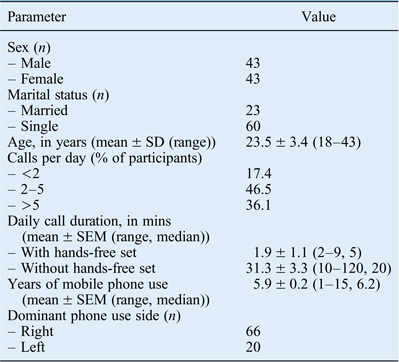
For each subject, samples of saliva from the dominant phone use side (i.e. the (left or right) side on which the subject most used their mobile phone) and the other, non-dominant side (considered the control side) were collected and compared. The subjects had 1–8 calls daily and spent 2–120 minutes on the phone daily (Table I).
Demographic data

SD = standard deviation; mins = minutes; SEM = standard error of the mean
Samsung mobile phone sets were used by all those who took part in the study. In biological systems, the extent of radiofrequency field exposure depends on the amount of energy deposited in tissues. This is measured in terms of the specific absorption rate, defined as the amount of energy absorbed per mass of tissue, and is expressed in W/kg. The specific absorption rate of this study was calculated as 0.49 ± 0.01 W/kg (range of 0.38–0.54 W/kg).
No relationship was observed between the number of years of mobile phone use and protein concentration (r = 0.000), or between the daily duration of mobile phone use and protein concentration (r = 0.04).
Measurements
The subjects were asked not to eat, drink or brush their teeth in the hour before the saliva sample was collected. The sample collection procedure was carried out from 9.00 am to 11.00 am in a dental chair, in a relaxed atmosphere under proper lighting conditions.
After completing the questionnaire on mobile phone use, the salivary flow rate of both parotid glands was simultaneously measured using the Carlson–Crittenden cup parotid fluid collection device (designed, manufactured and patented by the authors of the study; patent number 74068) (Figure 1). After positioning the cup, the buccal mucosa was dried with a piece of gauze and the Stensen's duct was mildly squeezed to locate the orifice of the duct. The salivary flow was stimulated with 2 per cent citric acid, which was placed bilaterally on the tongue and the mucous portion of the lower lip using a swab, at 30-second intervals for 2 minutes. Saliva was collected for another 3 minutes (a total collection time of 5 minutes). Salivary samples were kept on ice during and after sample collection.Reference Goldwein and Aframian11 The samples were then transferred to the pathobiology laboratory and kept in a frozen state at −18°C, until samples from all subjects had been collected.
(a) Carlson–Crittenden parotid gland fluid collector, and (b) demonstration of the device attached to the parotid gland orifice.
In order to determine the activity of salivary amylase, homocysteine and lipase, and the total protein concentration, the frozen samples were placed in an ambient temperature for 30 minutes, before being centrifuged at 3500 revolutions per minute for 20 minutes. The supernatant clear fluid was then transferred into an Eppendorf microtube (Sigma-Aldrich, St. Louis, Missouri, USA) using appropriate samplers. The particulars of each sample were inscribed on each microtube.
Total protein concentration was determined using the Lowry method,Reference Lowry, Rosebrough, Farr and Randall25 and compared with a bovine serum albumin standard. The amount of secretory IgA was determined using an RA1000 measuring device (Nippon Avionics, Tokyo, Japan). The CRP concentration was measured using a CRP kit (Diastat kit; Axis-Shield Diagnostics, Dundee, Scotland, UK), with spectrophotometry at a wavelength of 340 nm. Amylase concentration was determined via calorimetry using a Pars Azmoon Amylase Kit (Pars Azmoon, Tehran, Iran). Lipase concentration was measured automatically with a Randox Kit (Randox Laboratories, Crumlin, Northern Ireland, UK) using the RA1000 device. Relative concentrations of each protein parameter were compared with absolute concentrations of that sample to provide an index for each stage.
Lactoferrin and lysozyme were quantified using a avidin-biotin enzyme-linked immunosorbent assay technique, as described by Rudney et al.Reference Rudney, Krig, Neuvar, Soberay and Iverson26 Total peroxidase activity was assayed using methods described by Mansson-Rahemtulla et al., adapted to 96-well microplates.Reference Mansson-Rahemtulla, Baldone, Pruitt and Rahemtulla27
Analysis
Data were analysed using one-way analyses of variance and t-tests conducted with the Statistical Package for the Social Sciences software, version 18 (SPSS; Chicago, Illinois, USA). Statistical significance was defined as p < 0.05.
Results
This study comprised 86 healthy volunteers (43 males and 43 females), with a mean age of 23.5 ± 3.4 years (range of 18–43 years). The mean ages of the male and female subjects were 23.5 ± 4.2 years (range of 22–43 years) and 23.4 ± 2.3 years (range of 18–32 years) respectively. Only 10 subjects (11.6 per cent) occasionally used hands-free devices. The subjects’ demographic data are presented in Table I, which also shows subjects’ average daily contact with mobile phones.
Sixty-six subjects (76.7 per cent) used their mobile phones predominantly on the right side (33 males and 33 females), and 20 subjects (23.3 per cent) used them predominantly on the left side (10 males and 10 females). No relationship was observed between age or gender and side of mobile phone use (p = 0.84, p = 0.41). The mean number of years of mobile phone use was 5.9 ± 0.2, ranging from 1 to 15 years.
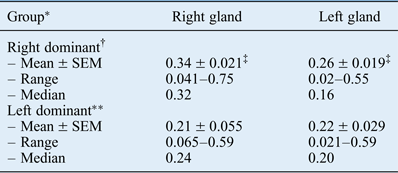
In cases in which the right side was dominant, the mean stimulated parotid saliva flow rate in the right parotid gland was 1.3 times greater than that on the left side (p ≤ 0.001) (Table II). For those subjects in whom the left side was dominant, the mean stimulated parotid salivary flow rate in the left parotid gland was almost the same as that on the right side. The overall salivary flow was 0.1–11.4 ml over a 5-minute period (mean ± standard error of the mean = 3.14 ± 2.32). There was a significant relationship between the number of years of mobile phone use, on the dominant and non-dominant sides, and the salivary flow rate (p = 0.002, r = −0.35). However, there was no relationship between the daily duration of mobile phone use and the salivary flow rate (r = −0.20).
Salivary secretion rates
Data represent ml per 5 minutes. Salivary secretion ratio (i.e. dominant side − non-dominant side) mean ± standard error of the mean = 3.14 ± 2.32 ml per 5 minutes, range = 0.1–11.4 ml per 5 minutes. *Total n = 86. †Number of participants = 66. ‡Significant difference between the right and left parotid gland mean secretion rates (p ≤ 0.001). **Number of participants = 20. SEM = standard error of the mean
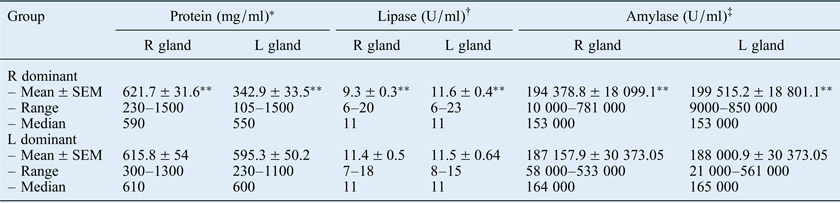
In cases in which the right side was dominant, a significantly higher protein concentration was observed in the right parotid gland (p ≤ 0.001) (Table III). No relationship was observed between the number of years of mobile phone use and protein concentration (r = 0.000), or between the daily duration of mobile phone use and protein concentration (r = 0.04).
Protein, lipase and amylase salivary concentrations
*Total n = 86; salivary secretion ratio (i.e. dominant side − non-dominant side) mean ± standard error of the mean (SEM) = 1.18 ± 0.091 mg/ml, range = 0.28–7.62 mg/ml. †Total n = 86; salivary secretion ratio mean ± SEM = 1.05 ± 0.03 U/ml, range = 0.35–2 U/ml. ‡Total n = 86; salivary secretion ratio mean ± SEM = 1.64 ± 0.33 U/ml, range = 0.03–25.9 U/ml. **Significant difference between the right and left parotid gland mean concentrations (p ≤ 0.001). R = right; L = left
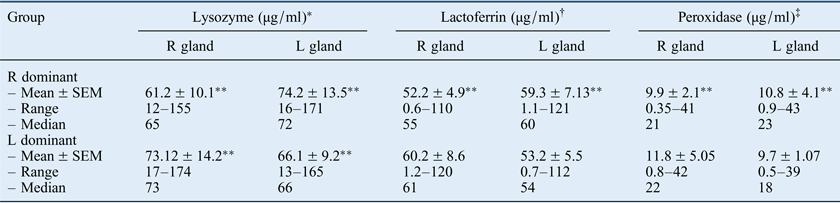
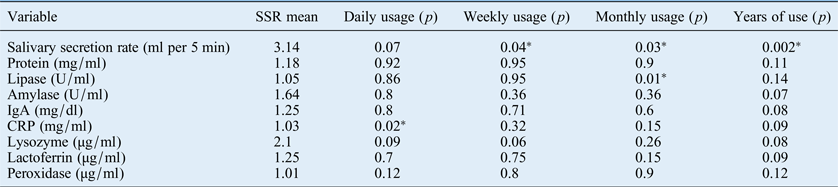
In subjects with right-sided phone use dominance, the t-test results revealed significantly lower salivary concentrations of lipase, amylase, lysozyme, lactoferrin and peroxidase on the right side compared with the left side. However, with the exception of lysozyme, no significant differences were observed between the left and right sides in subjects with left-sided dominance (Tables III–V). There were no significant relationships between salivary concentrations of lipase, amylase, lysozyme, lactoferrin, peroxidase, IgA or CRP, and the number of years of mobile phone use. In other words, although the long-term use of mobile phones (in right-dominant users) was associated with a decrease in salivary concentrations of IgA, lipase, amylase, lysozyme, lactoferrin and peroxidase, and an increase in protein and CRP in the right side (compared with the left side), the relationships were not significant (Table VI).
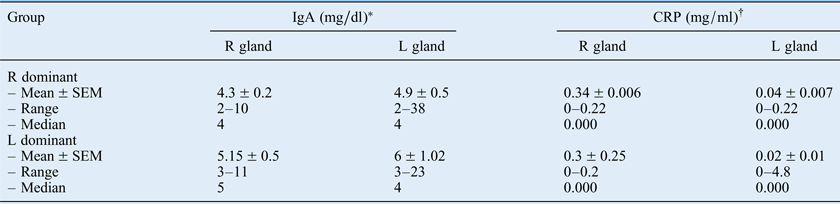
Immunoglobulin a and c-reactive protein salivary concentrations
No differences were found between the right and left parotid gland mean concentrations for either immunoglobulin A (IgA) (p = 0.518) or C-reactive protein (CRP) (p = 0.247). *Total n = 86; salivary secretion ratio (i.e. dominant side − non-dominant side) mean ± standard error of the mean (SEM) = 1.25 ± 0.15 mg/dl, range = 0.3–12.67 mg/dl. †Total n = 86; salivary secretion ratio mean ± SEM = 1.03 ± 0.03 mg/ml, range = 0–2.1 mg/ml. R = right; L = left
Lysozyme, lactoferrin and peroxidase salivary concentrations
*Total n = 86; salivary secretion ratio (i.e. dominant side − non-dominant side) mean ± standard error of the mean (SEM) = 2.1 ± 0.1 µg/ml, range = 0.3–6.3 µg/ml. †Total n = 86; salivary secretion ratio mean ± SEM = 1.25 ± 0.05 µg/ml, range = 0.5–2.2 µg/ml. ‡Total n = 86; salivary secretion ratio mean ± SEM = 1.01 ± 0.21 µg/ml, range = 0.03–2.3 µg/ml. **Significant difference between the right and left parotid gland mean concentrations (p ≤ 0.001). R = right; L = left
Relationships between saliva variables and phone usage
*Significant association. SSR = salivary secretion ratio (i.e. dominant side − non-dominant side). Min = minutes; IgA = immunoglobulin A; CRP = C-reactive protein
No relationship was observed between the specific absorption rate, based on units of time (calculated as 0.49 ± 0.01 W/kg; range of 0.38–0.54 W/kg), and salivary flow (p = 0.041), or between specific absorption rate and the composition of saliva (p = 0.021).
Discussion
The introduction and popularity of any new technology often raises concerns about potential adverse effects on human health. There are now approximately five billion mobile phone connections worldwide, and many mobile phone users are regular users of these devices. It is therefore not surprising that researchers have been evaluating the adverse effects of their use for some time. Twenty years after the advent of mobile phones, many researchers believe that their use poses no health risk; however, other researchers believe that the use of mobile phones is associated with cancer development, and there are still many ambiguities regarding their use by children.Reference Soderqvist, Carlberg, Hansson Mild and Hardell28 The World Health Organization has warned that the continuous and long-term use of mobile phones may be associated with adverse effects on human health, and some believe that the long-term use of mobile phones increases the risk of brain tumour.Reference Soderqvist, Carlberg, Hansson Mild and Hardell28
According to research conducted in Scandinavia, regular use of mobile phones, even the newer generations of mobile phones, increases the odds of brain tumour by up to 40–270 per cent. The researchers compared 1521 mobile phone users suffering from glioma (brain tumour) with 3301 healthy users. They reported that the odds of cancer increased by up to 270 per cent in those who used mobile phones for almost 2000 hours in their lives. In addition, the risk of developing this brain tumour was higher in users under 20 years of age than in older age groups.Reference Deltour, Johansen, Auvinen, Feychting, Klaeboe and Schüz29
A review of studies carried out from 2001 to 2003, on 402 individuals aged over 18 years, indicates an increased risk of parotid gland tumour in continuous users of mobile phones. Specifically, those individuals who use mobile phones for more than 22 hours per month, especially those who always hold their mobile phones on the same side of the head (left or right) without using hands-free devices, have a greater risk of developing parotid gland tumour.Reference Moussa30
Sadetzki et al. carried out a case–control study and reported no increased risk of parotid gland tumour in regular mobile phone users in any of the groups studied.Reference Sadetzki, Chetrit, Jarus-Hakak, Cardis, Deutch and Duvdevani31 However, their results suggested an association between mobile phone use and parotid gland tumour. Lönn et al. conducted a study on the risk of parotid gland tumour associated with mobile phone use and reported no relationship between tumour risk and mobile phone use.Reference Lönn, Ahlbom, Christensen, Johansen, Schüz and Edström32
The present study attempted to evaluate the effect of mobile phones on the concentrations of some salivary constituents. In this study, each subject acted as their own control. We initially considered using a control group comprising individuals who did not use mobile phones. However, salivary secretions can be affected by many factors; hence, this idea was abandoned, in order to avoid confounding variables. In the current study, the side of the face that had more contact with the phone was considered the dominant, experimental side, and the other side was the non-dominant, control side. A literature search, conducted using Pubmed, Science Direct, Blackwell and Scopus, revealed only one similar published report. In that study, by Goldwein and Aframian, only salivary flow rate and total protein concentration were evaluated;Reference Goldwein and Aframian11 no studies to date have evaluated salivary composition in relation to mobile phone use. The work by Goldwein and Aframian was verified in a paper by Agha-Hosseini and Somayeh, but this did not involve any new research.Reference Agha-Hosseini and Somayeh33
The present study showed that only 10 of the 86 subjects occasionally used hands-free devices. This is a much lower proportion than that reported in the above-mentioned study, in which more than half the subjects used hands-free devices.Reference Goldwein and Aframian11 It is unlikely that the (occasional) use of such devices had a considerable influence on the analysis. The difference in the proportion of subjects using a hands-free device might be the result of cultural and social differences; the findings of the current study indicate that relatively few Iranians are interested in using such a device.
The present study revealed a 2.21-fold increase in the salivary flow rate on the dominant mobile phone use side compared with the non-dominant side, which is consistent with the results of the study by Goldwein and Aframian, in which a 2.54-fold increase was reported.Reference Goldwein and Aframian11 It is possible that this increase relates to the fact that individuals who place their mobile phones on the right side of their head are right-handed. They might chew their food more on the right side with an increased masticatory force in the craniofacial complex on that side; the parotid salivary flow rate might therefore be higher as a result of the masticatory-salivary secretion reflex. However, Burlage et al. reported no significant differences in mean stimulated salivary flow rate between the right and left sides in healthy individuals.Reference Burlage, Pijpe, Coppes, Hemels, Meertens and Canrinus34 The secretion of saliva is regulated by the sympathetic and parasympathetic autonomic nervous systems. The parasympathetic pathway is involved in the secretion of thin salivary flow and the sympathetic pathway has a role in the secretion of proteins.Reference Goldwein and Aframian11
In the present study, in subjects who predominantly used their mobile phone on the right side, the mean stimulated parotid gland salivary flow rate was 1.3 times higher in the right parotid gland than in the left gland. For those whom the left side was dominant, the mean stimulated parotid gland salivary flow rate in the left gland was almost equal to that in the right gland. The overall salivary flow was 0.1–11.4 ml over the course of 5 minutes. In the study by Goldwein and Aframian, the parotid salivary flow rate on the right-dominant side was approximately 1.5 times that on the left side; in cases in which the left side was dominant, the stimulated parotid gland salivary flow rate was almost equal to that on the right side. These findings are consistent with the results of the present study.Reference Goldwein and Aframian11 This increase in salivary flow on the dominant side (in subjects with right-sided phone use dominance) might be the result of thermal effects associated with an enlarged secretary parenchymal tissue. It has previously been shown that thermal effects lasting for more than 28 days result in changes in salivary gland weight-to-size proportions.Reference David, Shai, Aframian and Palmon35, Reference Horowitz and Soskolne36
In the present study, adequate correlation strength was observed for the relationship between the number of years of mobile phone use and the salivary flow rate. However, the relationship between daily duration of mobile phone use and salivary flow rate was not significant.
In cases in which the right side was dominant, a significantly higher concentration of protein was observed in the parotid saliva on the right side (compared with the left side), consistent with the results reported by Goldwein and Aframian.Reference Goldwein and Aframian11 It is interesting that despite a higher salivary flow rate on the dominant side, an increased protein concentration was measured on the right-dominant side in comparison with the non-dominant left side. This might reflect the different effects of mobile phone use on the sympathetic and parasympathetic pathways. Andrzejak et al.Reference Andrzejak, Poreba, Poreba, Derkacz, Skalik and Gac37 investigated the effects of mobile phone use on variable parameters of heart rate in healthy individuals. They reported parasympathetic rhythm increases and sympathetic rhythm decreases during mobile phone use. The authors suggested that the electromagnetic range produced by mobile phones might influence the autonomic nervous system by modifying the function of the circulatory system.Reference Andrzejak, Poreba, Poreba, Derkacz, Skalik and Gac37
The results of the present study showed that, in right-dominant subjects, the salivary concentrations of lipase and amylase were significantly lower in the right parotid gland compared with the left gland. However, in left-dominant subjects, no significant differences were observed between the right and left sides. In addition, there were no significant associations between the number of years of mobile phone use and the concentrations of protein, lipase, amylase, lysozyme, lactoferrin, peroxidase, IgA and CRP.
The most abundant biochemical ingredients of saliva in terms of weight are proteins, which are predominantly in the form of glycoproteins. The total proteins of saliva comprise approximately 3 per cent of the total serum proteins. The major proteins secreted by the parotid gland are amylase, lipase and proline-rich glycoproteins. Some of the antibacterial salivary proteins secreted include lysozyme, lactoferrin, peroxidase and IgA. The bulk of these proteins are secreted by the parotid glands and, to a lesser degree, by the submandibular glands; the concentrations secreted by the sublingual glands are not of significance. Amylase and lipase are the most important protein enzymes contributing to food digestion; these have a significant effect on digestion and the absorption of food. Amylase has played a key role in human evolution, enabling humans to eat alternatives to fruits and proteins. Amylase is also used to convert complex sugars, such as starch (found in flour), into simple sugars.Reference Ramasubbu, Paloth, Luo, Brayer and Levine20 Salivary lipase has a protective function; it helps to prevent bacterial build-up on teeth and washes away adherent food particles.Reference Humphrey and Williamson38 Deficiency of these enzymes might disturb the digestion and absorption processes of many foods.
Immunoglobulin A is the most important salivary protein. A deficiency of IgA can lead to oral ulcers and a decreased resistance to infectious bacteria in the oral mucosa. In addition, IgA can neutralise viruses, bacteria and harmful enzymes. It serves as an antibody for bacterial antigens and is able to aggregate bacteria, inhibiting their adhesion to oral tissues.Reference Rudney, Hickey and Ji39
C-reactive protein is another important protein. It is used as an inflammatory marker; it is non-specific and can therefore be traced in the bloodstream in the majority of inflammatory diseases and reactions, such as myocardial infarction, diabetes and connective tissue diseases. This protein can also be traced in the inflammatory reactions of salivary glands.Reference Dillon, Opris, Kopanczyk, Lickliter, Cornwell and Bridges40
Lysozyme, lactoferrin and peroxidase are components of the body's immune system. They have antimicrobial activity (acting as a bactericide or fungicide) and are part of the innate defence (they are found predominantly within mucosal surfaces). The oral cavity immune system is a part of the systemic immune system. In the oral cavity, there are interactions between non-specific elements of the immune system (lysozyme, lactoferrin and peroxidase) and specific elements (immunoglobulins A, G and M), which facilitate, create and maintain the homeostasis. Unlike the specific factors, the non-specific ones act without previous exposure to antigens. These latter proteins work in co-operation with other components of saliva and can have an immediate effect on oral bacteria, interfering with their ability to multiply or killing them directly. Non-specific proteins are the most important non-immunological defence factors of saliva.Reference Bard, Laibe, Clair, Biichlé, Millon and Drobacheff17, Reference Laibe, Bard, Biichlé, Vielle, Millon and Drobacheff18, Reference Zalewska, Waszkiewicz, Szajda and Waszkiel41
This study showed that the long-term use of mobile phones decreased right-sided concentrations of lipase, lysozyme, lactoferrin, peroxidase and amylase, and increased concentrations of protein, in those who held mobile phones predominantly on the right side. However, the relationship between mobile phone use and salivary composition was not significant.
• This study investigated the effect of mobile phone use on parotid gland saliva components
• In subjects with right-sided phone use dominance, right-sided concentrations of amylase, lipase, lysozyme, lactoferrin and peroxidase were lower, and protein and flow rate were higher
• There were no significant associations between saliva components and years of mobile phone use
The limitations of this study include the fact that most of the subjects were relatively young in age. It is recommended that the effect of mobile phone use is evaluated in different age groups. Furthermore, in the present study, only one type and model of mobile phone was used by the participants. It is therefore suggested that other types of mobile phones are examined and their effects compared. It is also suggested that a study be carried out in which users of hands-free sets are compared with those who use a handheld mobile. The effects of mobile phones on parotid gland saliva should be evaluated in a long-term study. Finally, a larger sample size should be evaluated to attain more accurate results.
Conclusion
In the present study, the use of mobile phones resulted in a decrease in concentrations of amylase, lipase, lysozyme, lactoferrin and peroxidase on the right side compared with the left side in those who held mobile phones predominantly on the right side. In addition, protein concentration and salivary flow rate were higher on the right side. Although mobile phone use influenced salivary composition, the relationships were not significant. Further studies are required to evaluate the effect of long-term mobile phone use on the normal functioning of the parotid glands.
Acknowledgement
This study was supported by Kerman University of Medical Sciences, Iran. The authors would like to thank the research deputy, for financial support.