1. Introduction
Despite recent advancements in energy technologies around the developed world, traditional solid energy such as fuelwood, crop waste, and coal is still the most widely used fuel for daily life in developing countries (IEA, 2017). Traditional solid energy consumption poses severe challenges to the natural environment and the welfare of residents. Ecologically, the incomplete burning of solid fuels releases a large amount of suspended particulates, and is thus a main source of air pollution (Lelieveld et al., Reference Lelieveld, Evans, Fnais, Giannadaki and Pozzwe2015). In poor, rural areas, the use of wood as a main fuel contributes to forest resource degradation and soil erosion (Miah et al., Reference Miah, Alrashid and Shin2009; Araujo et al., Reference Araujo, Combes and Féres2019). Additionally, the indoor environmental pollution caused by the burning of solid fuels endangers human health (Liu et al., Reference Liu, Li, Rommel and Feng2020; Pratiti et al., Reference Pratiti, Vadala, Kalynych and Sud2020; Hou et al., Reference Hou, Wu, Mi, Ma, Shi and Liao2022; Li et al., Reference Li, Li, Zheng and Zhou2024), and traps and keeps low-income groups in ‘energy poverty’, that is, a vicious cycle of poor health and poor economic conditions.
Given these concerns, a large and growing literature has studied fuel transition in developing countries, from traditional solid fuels to clean non-solid energy. The ‘energy ladder’ theory describes a trajectory wherein household fuel choice gradually shifts from solid fuels (e.g., firewood or coal) to clean fuels (e.g., gas and electricity) as income increases. According to the energy ladder theory, income is the most important factor affecting household energy transition. Empirical studies have tested the relationship between income levels and fuel choice, and show that households with higher income prefer clean energy (Zhang and Hassen, Reference Zhang and Hassen2017; Song et al., Reference Song, Bilsborrow, Jagger, Zhang, Chen and Huang2018; Wassie et al., Reference Wassie, Rannestad and Adaramola2021; Yang and Wang, Reference Yang and Wang2023). At the same time, the energy ladder theory has been challenged by the empirical fact that households may not completely abandon traditional fuels and instead use multiple fuels simultaneously as income increases (Alem et al., Reference Alem, Beyene, Köhlin and Mekonnen2016; Han et al., Reference Han, Wu and Zang2018); this theory is known as the ‘fuel stacking theory’. Income structure is also an important factor affecting household energy consumption, and an increase in non-farm income reduces solid energy consumption (Ma et al., Reference Ma, Zhou and Renwick2019; Zou and Luo, Reference Zou and Luo2019; Yang et al., Reference Yang, Li, Xu and Yi2020). Some empirical studies consider fuel prices: Muller and Yan (Reference Muller and Yan2018), for example, measure income and price elasticities of fuel consumption and fuel choice for different fuels. Besides that, household energy choice is also determined by factors such as resources (Murphy et al., Reference Murphy, Berazneva and Lee2018), cooking habits and cultural traditions (Heltberg, Reference Heltberg2005; Baiyegunhi and Hassan, Reference Baiyegunhi and Hassan2014; Yadav et al., Reference Yadav, Davies and Asumadu-Sarkodie2021), one's understanding of energy policies (Guo et al., Reference Guo, Xu, Qu, Wang and Wu2023), and demographic characteristics (Chen et al., Reference Chen, Yang, Liu and Zhang2016; Dendup and Arimura, Reference Dendup and Arimura2019).
However, research has paid less attention to the influence of peer-decision making on household fuel choice decisions. It is a generally accepted fact that individuals are influenced by the beliefs and decisions of their peers. Recent studies have found peer effects in the contexts of household consumption, technology diffusion, and agricultural production (Sampson and Perry, Reference Sampson and Perry2018; Roychowdhury, Reference Roychowdhury2019; De Giorgi et al., Reference De Giorgi, Frederiksen and Pistaferri2020; Fang et al., Reference Fang, Chen, Delgado and He2023), and in areas of sustainability, such as the diffusion of organic fertilizers, the adoption of solar panels, water conservation, and waste classification (Busic-Sontic and Fuerst, Reference Busic-Sontic and Fuerst2018; Wuepper et al., Reference Wuepper, Sauer and Kleemann2018; Bryan et al., Reference Bryan, Burkhardt and Gillingham2020; Zheng et al., Reference Zheng, Qiu, Wang, Zhang, Wang and Cheng2023). Specifically, these papers provide empirical evidence that individual decision-making is affected by the behavior or decisions of one's neighbors. These types of interactions, often called peer effects or social interactions, may be particularly pertinent in the developing country context in which a change in technology (such as household fuel) may be particularly costly or risky.Footnote 1 Thus, while an individual's decision to adopt a cleaner fuel is based in part on their own private utility and budget constraint, we expect that information and experience sharing is also an important factor not to be overlooked. Therefore, we study household fuel choice in developing countries through the lens of social interactions.
To give a formal definition, ‘social interaction’ refers to interdependencies among individuals in which the preferences, beliefs, and constraints faced by one individual are directly influenced by the choices and characteristics of others in the reference group (Durlauf and Ioannides, Reference Durlauf and Ioannides2010). The literature has classified two types of social interactions. An ‘endogenous social effect’ (which is frequently called a ‘peer effect’) refers to a situation in which the choices/decisions of others influence the individual's choice/decision, while ‘exogenous social interaction’ (also called a ‘contextual effect’) refers to the situation in which the characteristics of others influence the individual's choice/decision. It is important to understand that social interactions – particularly the endogenous social effect – bear great implications for public policy. A positive endogenous social effect magnifies the overall impact of a public policy intervention to the group via a social multiplier; the social multiplier, in turn, increases the effectiveness of public policies (Becker and Murphy, Reference Becker and Murphy2000). From these definitions, we posit that a household's fuel choice depends not only on one's individual characteristics and the characteristics of the village, but also on the choices and characteristics of others in the village. Understanding these social interaction effects is important for understanding household fuel adoption decisions, and measuring the endogenous effect is critical for designing efficient policies aimed at nurturing or speeding up energy transition.
Theoretical research shows that an endogenous social effect can lead to complex situations of multiple equilibria (Brock and Durlauf, Reference Brock and Durlauf2001); in our context, an endogenous social effect could lead to an environmentally unsustainable low-level equilibrium with little adoption of clean fuels, or a high-level equilibrium of broader adoption of cleaner fuels. As will be made clear, household utility consists of both a private component and a public component, and the trade-off between these components leads to this possibility of multiple equilibria. If multiple equilibria exist in the context of household fuel choice, then a critical goal of public policy must be to structure incentives so as to avoid falling into the low-level equilibrium.
We use a discrete choice model of social interactions to model the interdependence of household fuel choices and to frame our empirical model. The model is a structural, utility-based model in which individuals subject to a budget constraint maximize their utility by choosing between solid fuels and non-solid fuels. Following the traditional assumption, we assume that the marginal utility of clean non-solid fuels is higher than that of solid fuels. Individual private utility depends on fuel choice, individual characteristics, and unobservable random utility. This model departs from the conventional model by including a social component that depends on the choices of others. Specifically, fuel choices among individuals are strategic complements. The decision to abandon traditional energy and shift to modern clean fuels means that a household faces a lifestyle change and with uncertainty about the potential health benefits. A rational individual learns from his/her neighbors, such that the more people that an individual expects will choose non-solid fuels, the greater the marginal benefits of transition for the individual.Footnote 2 Therefore, there is an endogenous social effect in household fuel choice. The equilibrium of the above non-cooperative game may not be unique. Multiple equilibria may emerge if the private incentives underlying fuel choice are small relative to the social incentive. In this case, when the public incentive favors fuel transition, the village will converge to a high-level equilibrium characterized by broad transition to clean fuels, regardless of one's private incentives. However, if the public incentive is negative, the village will converge to a low-level equilibrium characterized by little to no energy transition.
Based on the theoretical model, we develop a corresponding econometric model and use data from rural China to test our hypothesis that social interactions play an important role in household fuel choice decisions. The data we use comes from the China Family Panel Studies from 2010 to 2020. We find a statistically significant and robust endogenous social effect that drives, in part, household fuel choice. The probability that a household chooses non-solid clean energy (e.g., gas or electricity) as cooking fuel increases with the average adoption rate of the village, holding other factors such as household characteristics, the contextual effect, and village-level fixed effects, constant.
We further explore the policy implications of these social interaction effects through post-estimation simulations, and we investigate heterogeneity. Since our econometric model is structural, we use our parameter estimates to calibrate the theoretical equations to conduct simulations that allow us to explore the equilibrium effects of exogenous shocks from public policy changes on fuel adoption to understand the role of the social multiplier. Because of the endogenous social effect, a small change in individual preferences for clean non-solid fuel can lead to a relatively large increase in the average village adoption rate, thereby amplifying the public policy. Our investigation into patterns of heterogeneity indicate that intervention policies, such as introducing straw processing technology or demonstrations of new energy kitchenware, which specifically target more highly educated households will be more effective in stimulating demand for clean energy in groups that are lower in non-farm income than had the policy randomly targeted a subset of households.
We acknowledge that others also focus on ‘peer effects’ related to household fuel choice decisions: for instance, peer effects and liquefied petroleum gas (Srinivasan and Carattini, Reference Srinivasan and Carattini2020), biogas (Qing et al., Reference Qing, He, Guo, Zhou, Deng and Xu2022), cooking fuels (Wen et al., Reference Wen, Wang and Nie2021; Gu, Reference Gu2022), and energy consumption structures (Zhu et al., Reference Zhu, Huang and Wei2022). Our work contributes to the literature in the following respects. First, we provide a formal theoretical structure. As described, we construct a non-cooperative game model in which the complementarity of behavioral benefits leads to interdependence in decision-making, thereby driving the endogenous social effects. Our theoretical framework has two advantages: the theoretically optimal equation can be directly transformed into an empirical model, which establishes a direct link between theory and empirics, and the theoretical structure clarifies the nature of the policy implications of the social interaction effects by characterizing the equilibrium structure and social multiplier. Second, our work deepens this literature on the empirical front. In addition to identifying and estimating the endogenous social effect (the ‘peer effect’ in these other studies), we also identify and estimate the contextual effect; together, separating these two effects gives a complete characterization of the nature of the social interactions present in rural household fuel choice. Our identification strategy is buttressed via control for group fixed effects to account for any correlation effects (i.e., observed convergence of fuel choice among households in the same village caused by common environmental factors). While other studies deploy a county-level fixed effect strategy, we deploy a village-level fixed effects strategy to account for unobservable village-level characteristics that might otherwise confound our estimates.
2. Theoretical framework
We propose a discrete choice model with interactions to understand the extent to which household fuel choice is interdependent, and as a context for developing the empirical model. This model is a non-cooperative game model in which a household decides whether to shift to clean non-solid energy. We set the reference group for each household as the village in which the household resides; this reference group structure is motivated through sociological research that classifies rural China as an acquaintance society wherein individuals within a village are familiar with each other and influence each other's behavior and psychology (Fei, Reference Fei1993; Yang, Reference Yang2004). Surveys from economics also show that rural Chinese residents prefer to draw social comparisons from local residents, relatives, and friends (Knight et al., Reference Knight, Song and Gunatilaka2009; Chen and Chi, Reference Chen and Chi2014).
2.1 The environment
We consider a village consisting of N households in which each household is described by an observable characteristic, ${x_i}$ , and they must make a discrete choice about fuel use represented by ${Y_i} = \{{ - 1,1} \}$
 such that ${Y_i} = 1$
 means that a household chooses modern non-solid fuels and ${Y_i} ={-} 1$
 is the choice to use traditional solid energy. The possible set of choices for the village is $Y = ({{Y_1}, \ldots ,{Y_N}} )$
 . We use the subscript $- i$
 to code the choices of all households in the village other than household i, or ${Y_{ - i}} = ({{Y_1}, \ldots ,{Y_{i - 1}},{Y_{i + 1}}, \ldots ,{Y_N}} )$
 .
A household chooses fuel type to maximize utility, U. In the absence of social interactions, the standard discrete choice model assumes that the level of utility depends on the household's own fuel action ${Y_i}$ , individual characteristic ${x_i}$
 , and a random component of utility defined as $\varepsilon ({{Y_i}} )$
 . As we further consider the dependence of fuel choice among households, the utility function not only includes a private component, but also a social component:

where $u({{Y_i}} )$ is private utility directly related to the household's own fuel choice, $S({{Y_i},\mu_i^e({{Y_{ - i}}} )} )$
 is the social component of utility associated with the fuel choices of others, and $\varepsilon ({{Y_i}} )$
 is a random utility term which is assumed to be independent across individuals. $\mu _i^e({{Y_{ - i}}} )$
 represents a household's subjective expectations of others' fuel choices at the time of making its own fuel choice decision, and is specified as $\mu _i^e({{Y_{ - i}}} )= \bar{Y}_i^e = {({N - 1} )^{ - 1}}\sum\nolimits_{i \ne j} {Y_{ij}^e} \;$
 where $Y_{ij}^e$
 denotes the subjective expectation of household i on household $j$
 's choice for any household $j \ne i$
 . It is easy to see that $\bar{Y}_i^e$
 is an expected average choice for the village from the view of household $i.$

Specifically, we consider the social utility as a form of strategy complementarity (see Blume et al., Reference Blume, Brock, Durlauf and Jayaraman2015), which consists of a parameter and an interaction term between the household's choice and the expected average village choice, $S({{Y_i},\; \bar{Y}_i^e} )= \lambda {Y_i}\bar{Y}_i^e$ . This utility function setting indicates that the household's fuel choice and the average expected choice of the village determine the level of utility together, and the marginal utility of the household's choice changes with a change in the average expected village choice. The parameter $\lambda$
 measures the degree of interdependence of fuel choices among households. It is necessary and convenient here to assume that parameter $\lambda$
 is positive, ${\partial ^2}S({{Y_i},\bar{Y}_i^e} )/\partial {Y_i}\partial \bar{Y}_i^e = \lambda > 0$
 , which implies that the more people in the village that a household expects to abandon traditional fuels, the greater the marginal benefit of transition for the household. Yet, the increase in private utility brought on by fuel transition is limited.Footnote 3
Finally, we set the private utility to be an interaction between the individual characteristic and the household discrete choice,$u({{Y_i}} )= {x_i}{Y_i}$ , which means that the marginal private utility of fuel choice is linear in the household's own characteristics. Thus, the complete utility function is $U({{Y_i}} )= {x_i}{Y_i} + \lambda {Y_i}\bar{Y}_i^e + \varepsilon ({{Y_i}} )$
 .
2.2 Equilibrium
Following Brock and Durlauf (Reference Brock and Durlauf2001), we specify the random term $\varepsilon ({{Y_i}} )$ as $i.i.d.$
 extreme-value, which leads the difference between the positive and negative choice on the random term to be logistically distributed. When $\lambda > 0$
 , household fuel choice is no longer independent and the social interactions effect is just the effect of the average village choice (captured by $\lambda$
 ).Footnote 4 Under a rational expectations assumption, all households from the same village have the same overall average expectation about village fuel transition. However, the solution – here, the optimal choice in transitioning to clean fuel or not – need not be unique, meaning that there is a possibility of multiple equilibria. This response function provides a means of visually understanding the potential for multiple equilibria. Detailed derivations are provided in the online appendix.
The intuition is that the equilibrium is determined by two parameters: ${x_i}$ , which reflects marginal private utility, and $\lambda$
 , which reflects marginal social utility. In particular, the curvature of the response function is determined by the size of $\lambda$
 such that a larger $\lambda$
 corresponds to more curvature, and multiple equilibria may emerge when the social interactions effect is relatively larger than the private incentive.
As described in the introduction, the case of multiple equilibria has rich economic significance. In the online appendix, we show that in a situation of three equilibria, one is positive, one is negative, and one is not stable. The negative equilibrium means that most households in the village will choose traditional solid fuels; this equilibrium is the environmentally inefficient case. In contrast, the positive equilibrium is one in which a large number of households choose clean non-solid fuels, previously referred to as the high-level equilibrium. Brock and Durlauf (Reference Brock and Durlauf2001) show that both the low-level and high-level equilibria are locally stable, such that small deviations will not dislodge the equilibrium. In other words, if stuck at the low-level equilibrium, it may be very difficult for any household or village to escape the energy trap without a substantial outside force (substantial policy intervention).
3. Empirical analysis
3.1 Data
The data we use is from the China Family Panel Studies (CFPS). CFPS is a national-level, comprehensive continuous survey that documents changes in China's society, economy, population, education, and health, providing data for academic research and policy analysis. In 2010, CFPS implemented its baseline survey that covered 14,960 households. The CFPS baseline sample covers 25 provinces/cities/autonomous regions across the country, representing 95 per cent of China's population (Xie, Reference Xie2012). After the baseline survey, there were 5 subsequent waves of follow-up surveys implemented in 2012, 2014, 2016, 2018 and 2020. In total, we use all six waves of the survey to build a panel dataset.
We focus only on households in rural areas, and drop samples from urban areas according to the rural-urban division standard defined by the National Bureau of Statistics. Rural areas remain relatively underdeveloped with relatively poor infrastructure and household-based agricultural production, making rural residents more likely to use traditional solid fuels as cooking fuel. This setting provides us with an opportunity to study household fuel transition. Further, population mobility in rural areas is relatively small: most of the residents who come from the same village belong to several clans, which means that they are familiar with each other and their decisions affect each other's decisions. Therefore, we regard the household as the basic unit of analysis with the village as the reference group unit. We set the minimum group size to be six to allow every household to have at least five other households in the same village as its reference, and to avoid issues with highly isolated household clusters. After cleaning the data, we are left with a six wave, unbalanced panel dataset containing more than 38,000 total observations. The average group size (number of households per village) is 21.15.
3.2 Empirical methodology
Identifying the social interaction effects for household fuel choice requires that we manage the following two obstacles. The first is the reflection problem (Manski, Reference Manski1993), which is a confounding of the endogenous social effect and the contextual effect. This issue is particularly pernicious for the linear-in-means model. Fortunately, nonlinear models, like the logit model, are not plagued by the reflection problem because the binary choice framework imposes a non-linear relationship between individual behavior and group means (Brock and Durlauf, Reference Brock and Durlauf2001). The discrete choice interaction model described above, under the i.i.d. extreme-value random utility assumption, leads to a logistic regression model; therefore, by virtue of this nonlinear framework, the reflection problem is not a concern here. Another problem is how to separate the endogenous social effect from the correlated effect (Moffitt, Reference Moffitt, Durlauf and Young2001). The concern is that an observed convergence of fuel choice among households in the same village may stem from common environmental factors, such as village energy accessibility and availability, rather than the endogenous social effect. We follow standard empirical strategy and address this omitted variable problem via group-level fixed effects, which in our case is village-level.
The probability of individual fuel choice under the logit regression structure is:

where $F:\mathrm{\mathbb{R}} \to [{0,1} ]$ is a standard logistic distribution function, ${Y_i}$
 is the fuel choice for household $i = 1, \ldots ,\; N$
 , ${X_i}$
 is a $1 \times k\; $
 vector of individual $i$
 's characteristics such that the corresponding $k$
 -dimensioned coefficient $\beta$
 captures the effect of private characteristics on fuel choice, ${\bar{Y}_{ - i}}$
 is the leave-$i$
 -out mean of the fuel choices of the other $N - 1$
 households in the village, and the coefficient $\rho$
 is the endogenous social effect that captures the extent to which the probability that a household chooses non-solid clean fuel varies with the choices of its neighbors. Additionally, we investigate the extent to which the characteristics of household $i$
 's neighbors, ${\bar{X}_{ - i}}$
 , influence household fuel choice via parameter $\theta$
 (Manski, Reference Manski1993). The term ${\alpha _v}$
 is the village-level fixed effect that captures the common shock to all households in the same village, and ${\alpha _t}$
 is the time fixed effect.
3.3 Variables
3.3.1 Dependent variable
Cooking has been the most overlooked area of the sustainable energy agenda (ESMAP, 2018); we use the primary cooking fuel to measure household fuel choice.Footnote 5 Cooking is nearly always a daily occurrence in a rural household, and thus, it provides an indicator for measuring the rural household energy transition process across a broad, national sample.Footnote 6 The primary cooking fuel measure also avoids the possibility of irregular use of clean cooking fuels, which is important given research and policy interest on regular use rather than simply adoption (Wen et al., Reference Wen, Wang and Nie2021).
The CFPS team surveyed the primary cooking fuel for each household, with fuel options including crop residue, firewood, coal, solar, biogas, liquefied petroleum gas, electricity, natural gas, and an ‘other’ category. Considering that the burning of solid fuels brings serious environmental pollution and thus a threat to physical health, following Liu et al. (Reference Liu, Li, Rommel and Feng2020), the binary choice variable equals one if the household chooses clean non-solid fuel (solar, biogas, liquefied petroleum gas, electricity, and natural gas), and zero if the household chooses a solid fuel (crop residue, firewood, and coal). The data shows a significant energy transition, with the proportion of clean non-solid fuels used for cooking increasing from 29.61 per cent in 2010 to 60.79 per cent in 2020.
3.3.2 Control variables
According to the energy ladder theory, the most important factor supporting household transition from solid fuels to clean non-solid fuels is income. We choose household annual net income to measure income, and take the natural logarithm of income to reduce the influence of relatively large values. Some studies find that the consumption of firewood or biomass is closely related to the farm size (Démurger and Fournier, Reference Démurger and Fournier2011; Pandey and Chaubal, Reference Pandey and Chaubal2011; Yang et al., Reference Yang, Li, Xu and Yi2020). Intuitively, agricultural activities directly provide households with biomass byproducts. Considering the heterogeneity of crops and land in our sample, we use the agricultural output value to measure the scale of household agricultural operations. Another economic factor is non-farm business: a household that owns a non-farm business has a higher opportunity cost of time, which we expect motivates the household to choose a relatively efficient energy type. We use a binary indicator to measure whether or not the household is predominantly engaged in non-farm business.
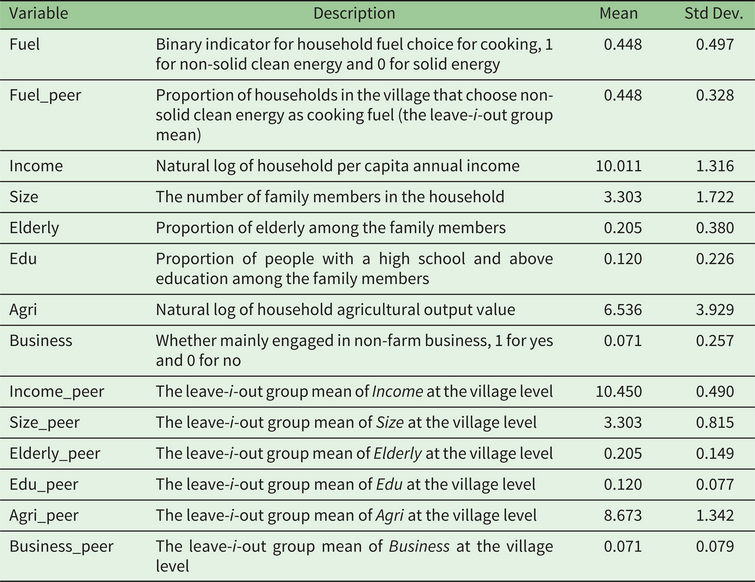
We also control for household demographic characteristics, including family size, age, and education. Family size refers to the number of permanent residents in the household, excluding those who work or study outside. The proportion of elderly people aged 60 and above, and the proportion of family members with a high school education or above, measure the age structure and education level of the household, respectively. Table 1 shows the variables, variable definitions, and provides descriptive statistics.
Definitions and descriptive statistics for variables

Notes: Family members do not include those who work or live outside the village.
3.3.3 Social interactions variables
As described, we use the mean model to identify the social interactions effects for household fuel choice. Therefore, the variables corresponding to the social interactions in the model are the leave-i-out group means of the explained and control variables. The group mean of the explained variable – the average adoption rate for the village – identifies the endogenous social effect, and the group mean of the control variables captures the contextual effects.
3.4 Results
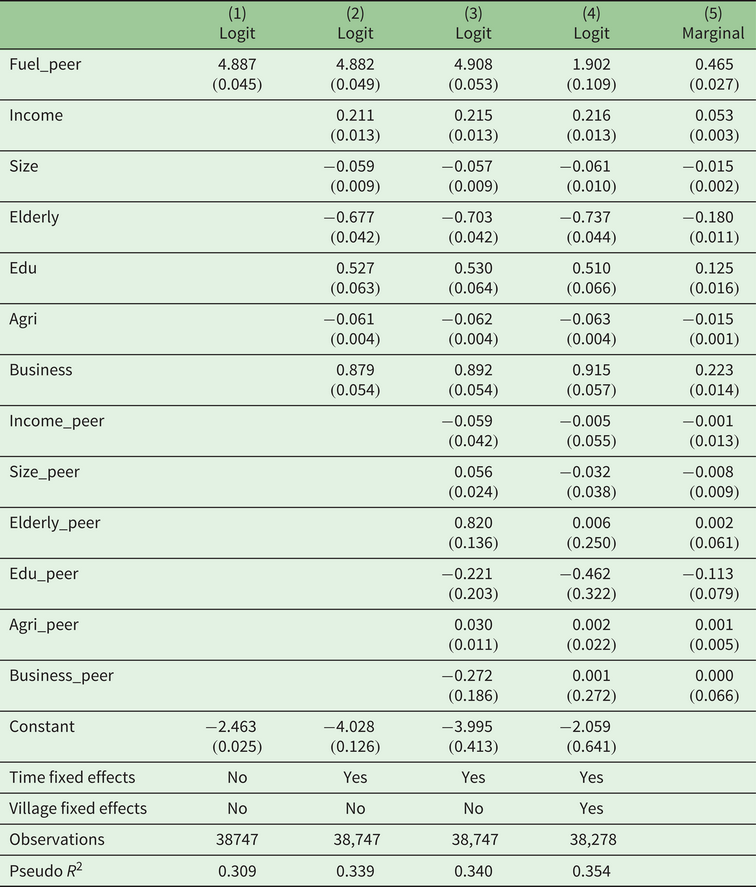
Here, we present the estimated social interaction effects.Footnote 7 We report the logit model results in table 2. In column (1), we report baseline estimates of the regression of household fuel choice on the average adoption rate in the village and a constant term; in column (2), we add the economic and demographic characteristics variables; and in column (3), we add the group means of household characteristics to capture the contextual effects, as well as the time fixed effects. Finally, in column (4), we control for village-level fixed effects to account for correlated effects. Column (4) reflects the main model, and so in column (5) we show the implied marginal effects from the model shown in column (4). Without any control variables, the average village adoption rate is significant at the 1 per cent significance level. After controlling for the individual's characteristics, contextual effects, and correlated effects, the average village adoption rate is still significant at the 1 per cent significance level. Specifically, if the average village adoption rate goes up by 1 per cent, the probability of a household adopting clean energy goes up by 0.465 per cent. This estimate indicates that there is an endogenous social effect in household fuel choice: all else equal, the probability that a household will choose non-solid clean energy as cooking fuel is influenced by the fuel choice of others in the same village. This estimate indicates that household fuel choice is not independent; rather, whether a household shifts from firewood or coal to clean non-solid fuel not only depends on the household's own characteristics or private incentives, but also on the choices of their neighbors.Footnote 8
The social interactions effects of fuel choice: logit model

Notes: Robust standard errors in parentheses. Column (5) is the marginal effects for the logit model shown in column (4).
The coefficient estimates for the control variables are generally consistent with estimates from previous studies. A household with a higher income level is more likely to choose non-solid fuels, which is consistent with previous research findings (Song et al., Reference Song, Bilsborrow, Jagger, Zhang, Chen and Huang2018; Wassie et al., Reference Wassie, Rannestad and Adaramola2021; Yang and Wang, Reference Yang and Wang2023). Among other household economic factors, there is a negative impact of agricultural output value on the probability that a household uses clean non-solid energy, which means that the larger the scale of agricultural production, the lower the probability of using clean non-solid fuels. A possible reason is that agricultural production activities directly provide crop residue and firewood to the household. Compared to a household not predominantly engaged in non-farm business, a household with a non-farm business prefers clean non-solid fuels; this finding is also consistent with Yang et al. (Reference Yang, Li, Xu and Yi2020) who find that off-farm income has a negative effect on the quantity of fuelwood consumed. Among other household demographic characteristics, the larger the household size, the lower the probability of using non-solid fuel. The fraction of elderly people in the household plays an important role in determining energy choice behavior, with a household with more elderly people preferring traditional solid energy. The proportion of well-educated family members increases the probability of using clean non-solid fuel. These findings are consistent with Chen et al. (Reference Chen, Yang, Liu and Zhang2016). As to the contextual effects, neighbor characteristics do not have a significant effect on household fuel choice.
3.5 Robustness checks
To ensure that our results are robust, we undertake four separate robustness checks. First, we set a minimum group (village) size to ensure that the peer reference group is adequate for all villages in the sample. Second, we use household-level fixed effects to account for any correlation effects that are not accounted for by our village-level fixed effects. Third, we conduct a series of placebo trials to ensure that the village reference groups we use are not generating spurious results. Fourth, we deploy an instrumental variables regression to ensure that our model does not suffer from reverse causality. In all cases, the results are consistent with our main reported results. Detailed results from these robustness checks are reported in the online appendix.
4. Social interactions and public policy
Our empirical research shows that there is a significant endogenous social effect driving, in part, rural household fuel choice. We have described how, theoretically, the existence of the endogenous social effect may lead to multiple equilibria. In our context, does the estimated endogenous social effect for fuel choice indicate multiple equilibria? What are the subsequent implications for relevant public policy?
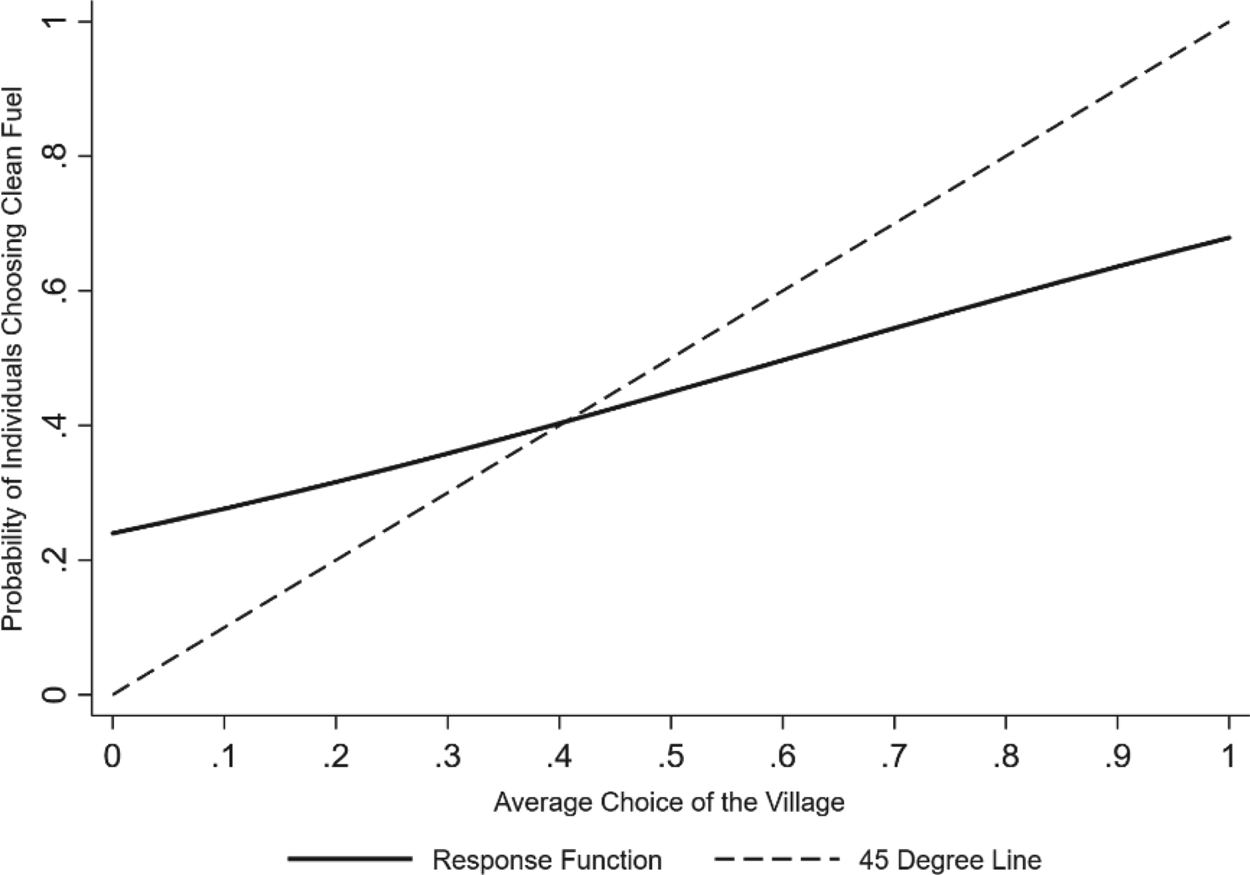
We use the estimates from column (4) of table 2 to simulate the household fuel choice equilibrium. In figure 1, the horizontal axis represents the proportion of households who choose non-solid clean fuels in the village, and the vertical axis represents the probability that the household chooses clean energy. As before, the response function represented by the solid black line refers to the response of the household's probability to a change in the average village adoption rate, when the other explanatory variables are averaged. The 45-degree line represents the state in which household choice is consistent with the group's choice, whereby the intersection of the two lines is the equilibrium point. Here, we have only one intersection point between the estimated household response curve and the 45-degree line, meaning the equilibrium based on our estimated parameters is unique. Thus, in this case, the situation of multiple equilibria does not appear. It is still worth noting that the average clean fuel adoption rate at the intersection is less than 50 per cent, so this is a relatively low-level equilibrium. From an environmental policy vantage, this equilibrium does not appear to be ecologically sustainable. The equilibrium is stable (Brock and Durlauf, Reference Brock and Durlauf2001), which means that any deviation from the equilibrium will not generate a lasting change. That is to say, beyond convergence to this equilibrium, it will be difficult to achieve broad adoption of clean non-solid fuel. In this situation, carefully designed policy interventions become even more important if the policy goal is to transition households to clean energy.
Simulation of the household fuel choice equilibrium.

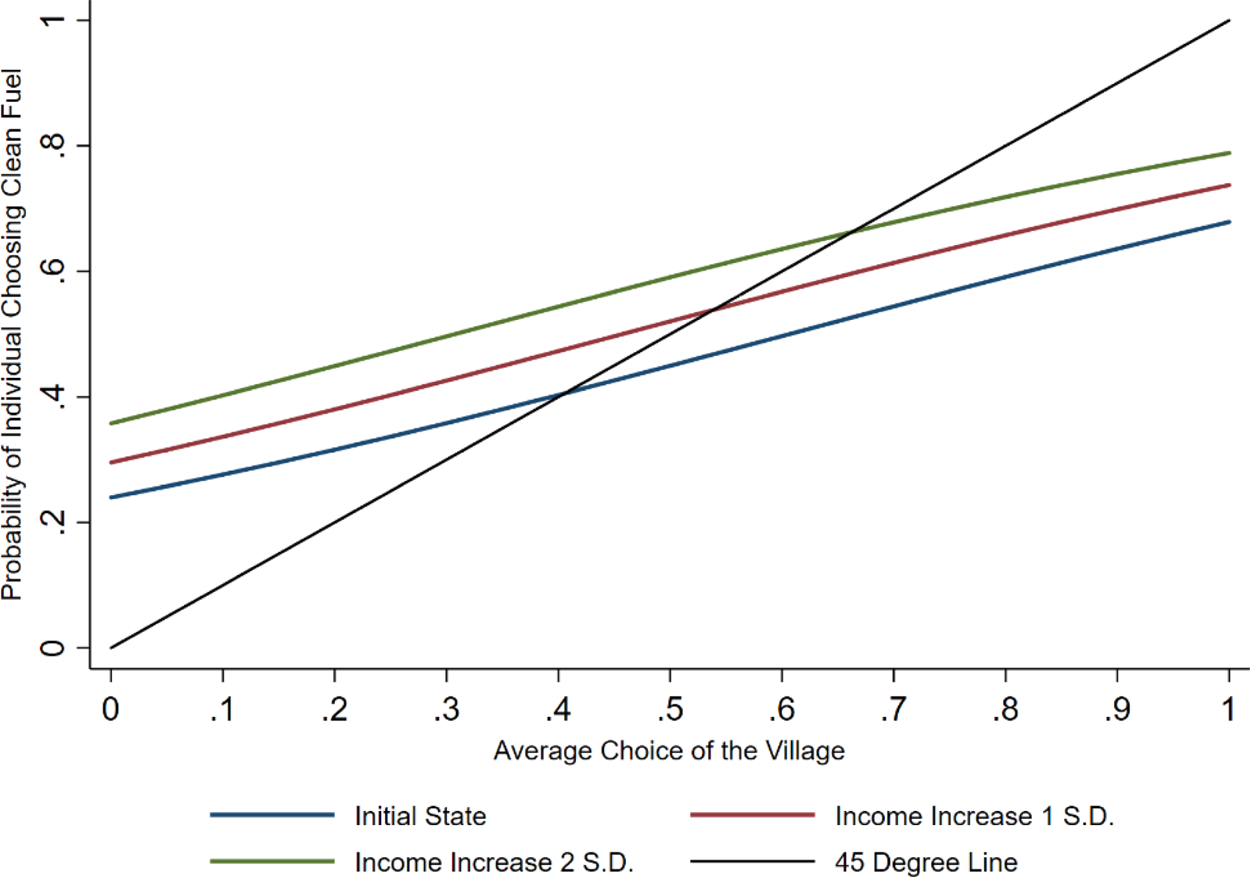
Considering that income was identified in previous theoretical and empirical work to be the most important factor affecting household energy transition, we first focus on the effectiveness of income-related policies. Assume that the government's subsidy policy affects rural residents' fuel choices by increasing household income. The increase in income changes the intercept term of the response function, which is shown as a vertical movement of the curve. Figure 2 shows a simulation of the effect of a positive income shock of 1 and 2 standard deviations. The figure shows that this policy shifts the response function up such that it intersects with the 45-degree line at a higher equilibrium level, and the proportion of households choosing clean non-solid fuel corresponding to the equilibrium point increases substantially. More importantly, the improvement in the rate of non-solid energy adoption in the village brought by income growth is greater than the increase in the household's individual probability of adoption.Footnote 9 In other words, the impact of the policy on the average choice at the village level is greater than the effect on the household's individual decision. This means that there is a social multiplier brought on by the endogenous social effect, such that a small change in individual preferences for clean non-solid fuel can lead to a relatively larger increase in the average village adoption rate. Social interaction amplifies the effectiveness of the public policy.
Simulation of an income-related policy.

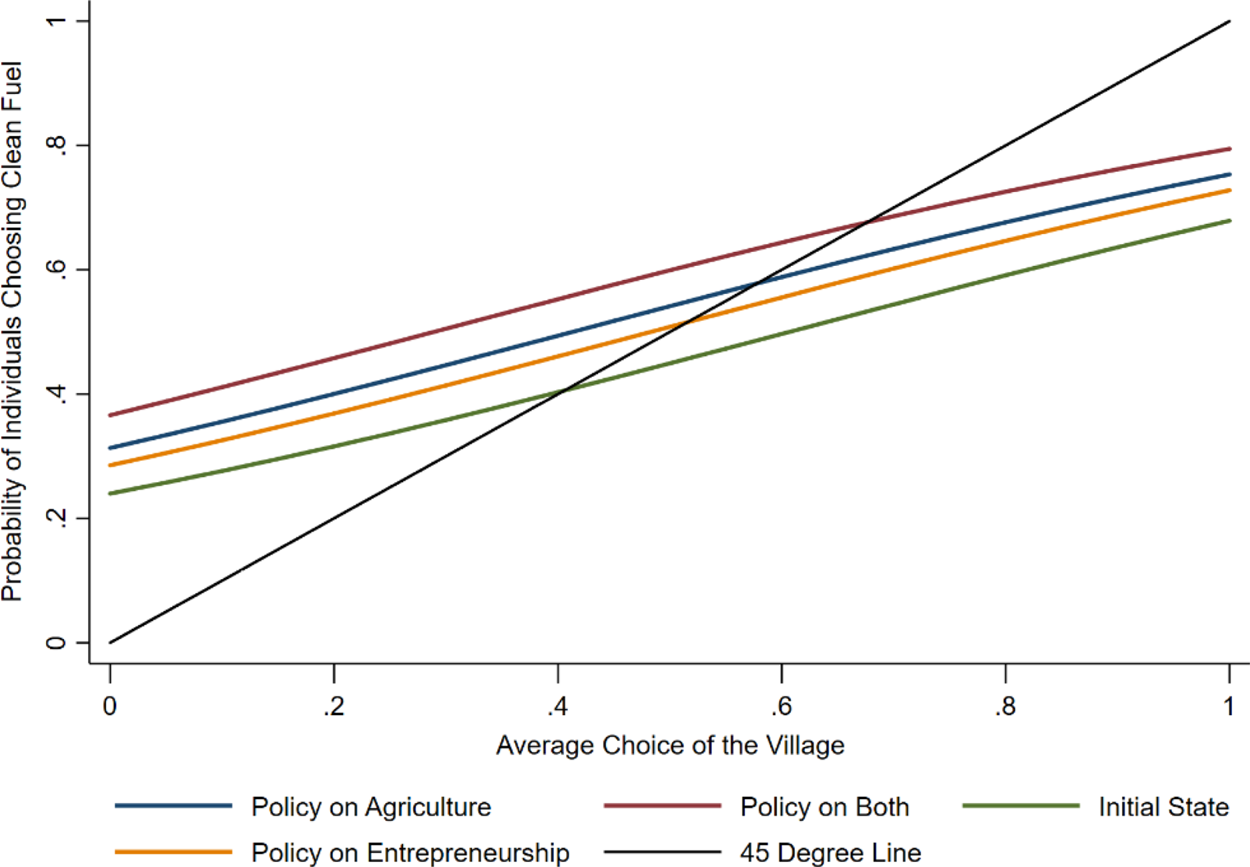
In addition to the income policy, we also simulate the impact of public policies related to agriculture and entrepreneurship. Agricultural production activities directly provide households with biomass byproducts, and entrepreneurial behavior affects household non-farm income; thus, these factors have bearing on energy transition (Démurger and Fournier, Reference Démurger and Fournier2011; Pandey and Chaubal, Reference Pandey and Chaubal2011; Ma et al., Reference Ma, Zhou and Renwick2019; Zou and Luo, Reference Zou and Luo2019; Yang et al., Reference Yang, Li, Xu and Yi2020). Public policies that encourage non-agricultural transfers of labor, promote the transfer of land management rights, or promote rural households to operate non-farm businesses, can reduce farming activities and increase household preferences for clean non-solid energy.Footnote 10 For the simulation, we assume that relevant agricultural policies reduce the scale of household agricultural productivity (measured in output value) by 1 standard deviation, and policies relevant to entrepreneurship make the proportion of households engaged in non-farm businesses increase by 1 standard deviation. Figure 3 shows the simulation for these interventions. It is clear that these policies increase the equilibrium level. At the same time, the improvement in the average village adoption rate is greater than the change in household behavior, indicating that policies become more effective because of the endogenous social effect of fuel choice.
Simulation of agricultural and entrepreneurship policies.

5. Investigating heterogeneity
In this section, we further explore heterogeneity in these social interactions, which allows us to develop deeper insights into policy implications. We consider two aspects of heterogeneity based on the following questions. Which households are more likely to be influenced by others? And, whose choice attracts more attention? The first allows us to gain insight into which people are more likely to be influenced by others, and the second provides insight into the kinds of people that are more likely to influence others. Analyzing these differences allows us to understand which groups are more or less likely to be affected by public policy.
5.1 Which households are more likely to be influenced by others?
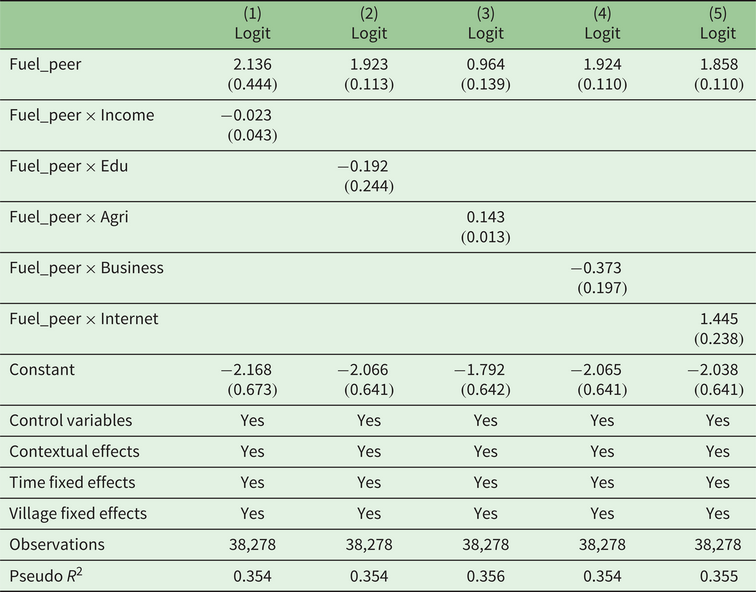
We are interested in heterogeneity in the magnitude of the endogenous social effect among different households because policies that leverage peer influence to accelerate rural energy transition will have a more immediate impact on those households that are more easily influenced by others. We select four household characteristics that are easily influenced by government policies to investigate this heterogeneity: income, education, agricultural production, and non-farm business. We add interaction terms between these variables and the average adoption rate of the village into the model in equation (2). Columns (1)–(4) of table 3 report the results: the interaction term for agricultural production is significantly positive, and the interaction term of non-farm business is significantly negative. These results indicate that the endogenous social effect has a greater impact on a household with a larger scale of agricultural production and/or that is not engaged in non-farm business. Therefore, we can conclude that intervention policies aimed at promoting household energy transition, because of the endogenous social effects underlying fuel choice, are more effective in groups with lower non-farm income households.
Heterogeneity analysis: which households are more likely to be influenced by others?

Notes: Robust standard error in parentheses.
Additionally, people now communicate in more ways than in previous times. The Internet has changed both communication between, and information sources of, rural residents, both of which may affect the social interaction effects. On the one hand, the Internet greatly facilitates daily communication among rural residents, and a higher frequency of information exchange strengthens the complementarity of others' choices in the same village, thereby enhancing the endogenous social effect. On the other hand, the Internet may provide rural residents with more information regarding cooking fuels and health, thereby weakening the peer influence, and reducing the social interaction effects. We investigate these issues by adding an interaction term between Internet use (measured as the proportion of family members using the Internet) and the endogenous social effect variable to the model. The estimated results are reported in column (5) of table 3, and we find that Internet use significantly increases the endogenous social effect. That is to say, the positive impact of the Internet on social interactions is greater than any negative impact.
5.2 Whose choice attracts more attention?
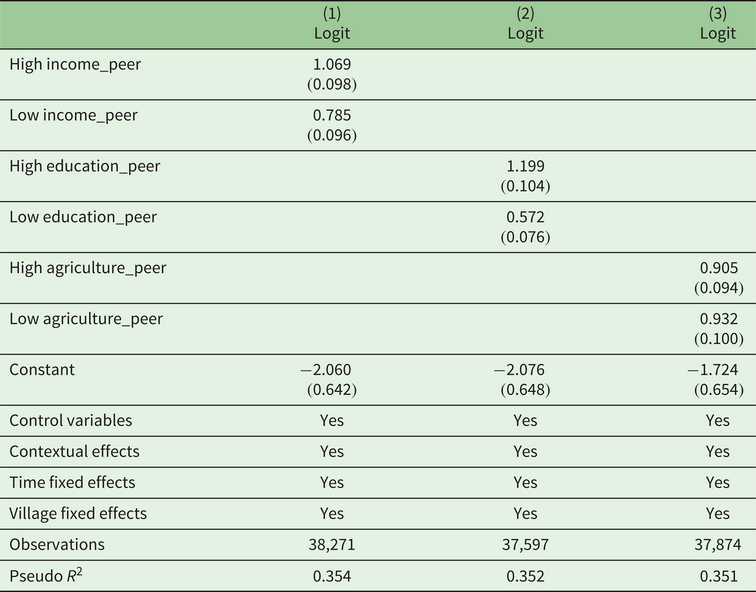
Our primary analysis assumes that when a household looks to its peers in determining its fuel choice it looks to all potential peers equally. However, it is possible that a household holds the decisions of particular neighbors in higher regard than others. For example, a household might look to more highly educated neighbors when considering adoption of a new technology in the anticipation that more highly educated neighbors might have a better understanding of the pros/cons of clean fuel. To test this hypothesis, we replace the average choice of neighbors in the village in the model with the average choice of neighbors with a higher education and with the average choice of neighbors with lower education. We also create similar groupings for income and agricultural production.Footnote 11
Table 4 reports the results. In column (1), we can see that both the average choice of high-income neighbors and low-income neighbors has a significantly positive impact on household fuel choice. We test for a significant difference between the two coefficients, and we reject the null hypothesis that the two coefficients are equal at the 5 per cent significance level. The same situation holds in the model of high-education and low-education neighbors shown in column (2) of table 4, but not in the model of large-scale and small-scale agricultural production neighbors shown in column (3) of table 4. This implies that the fuel choices of households with a higher education and higher income have a greater spillover effect. If public policies such as straw processing technology and demonstrations of new energy kitchenware prioritize interventions targeting more highly educated and higher income households, then the effects on the fuel consumption structure of the entire village may change more readily towards clean fuel.
Heterogeneity analysis: whose choice attracts more attention?

Notes: Robust standard errors in parentheses. ‘High Income_peer’ and ‘Low Income_peer’ represent the average adoption rate of high- and low-income neighbors, respectively. ‘High Education_peer’ and ‘Low Education_peer’ represent the average adoption rate of high- and low-education neighbors, respectively. ‘High Agriculture_peer’ and ‘Low Agriculture_peer’ represent the average adoption rate of large- and small-scale agricultural production neighbors, respectively.
6. Conclusion
In developing countries, energy consumption relies heavily on traditional solid fuels, and this poses severe challenges to eco-friendly sustainable development. Promoting energy transition, especially in rural areas, is essential for alleviating growing environmental problems and poverty issues. We analyze household fuel choice through the lens of social interactions, by using a non-cooperative game model in which the complementarity of behavioral benefits leads to the non-independence of fuel choice decision-making. We use panel data from rural China and multiple strategies to test our theoretical hypothesis, and generate the following main findings. First, an endogenous social effect exists in household fuel choice. Taking Chinese rural residents as an example, our empirical research finds that whether a household chooses non-solid clean fuel for cooking is directly affected by the choice of its neighbors in the village, after controlling for household characteristics, contextual effects, and village-level fixed effects. That means that household fuel choice is not independent, but rather is driven, in part, socially. Second, this peer influence is heterogeneous across household characteristics. Households with lower non-farm income are more sensitive to the choices of others, and the fuel choices of households with a higher education and higher income attract more attention from others. Third, modern communication technologies, such as the Internet, facilitate information exchange among rural residents, thereby strengthening the endogenous social effect by enhancing the complementarity of benefits of choosing to use clean fuel.
These findings provide important implications for policies on energy transition in developing countries. First, public policies aimed at incentivizing rural residents to use clean fuel can enhance policy effectiveness through social interactions among households. Families with high education and high income have a greater spillover effect, analogous to opinion leaders in the villages. Therefore, when public resources (such as promotion of and education regarding clean energy, straw processing technology, and demonstrations of new energy kitchenware) are limited and scarce, treating households with higher education as priority intervention targets can maximize the social multiplier effect and better promote rural energy transition. Second, facilitating energy-related information exchange among people is an effective way to strengthen endogenous social effects and social multipliers, which is also conducive to accelerating energy transition in rural areas, like other policies aimed at addressing the last-mile accessibility of clean energy. Therefore, promoting the flow of information about the benefits of clean fuel via modern communication technologies in rural areas should be an important part of policies to better stimulate a positive social influence. Third, while emphasizing social interactions, policymakers should also pay attention to private incentives households face. Especially for low-income families, poverty alleviation policies should help them switch fuels when social influence prompts them to do so. Recent governmental efforts have focused on expanding digital capacities of rural areas; since we show how Internet usage is an important factor driving social interactions, such policies should carefully consider the ways in which digital expansions in rural areas might affect rural residents' welfare.
Supplementary material
The supplementary material for this article can be found at https://doi.org/10.1017/S1355770X24000287.
Acknowledgements
This work was supported by the Social Science Foundation of Anhui (Grant No. AHSKQ2022D033).
Competing interest
The authors declare no competing interests.