

Introduction
When looking at political strategies, the role of Europe is gaining significance in certain fields, such as the economic and financial ones, and it is also becoming crucial for the development of the European public sphere. The leadership of Europe is also becoming pivotal in asserting the role of the Union within the world and toward the Member States. According to recent studies, all the above indicate that a Europeanization process is underway (Börzel and Risse, Reference Börzel and Risse2000; Della Porta and Caiani, Reference De Vreese, Banducci, Semetko and Boomgaarden2006).
Focusing on the 2014 European elections and media coverage in a comparative perspective, the aim of this article is to assess the extent to which this is true. According to the literature, this electoral competition is considered less important than the national elections (Reif, Reference Poguntke and Webb1984; Van der Eijk and Franklin, Reference Taggart1996); this confirms, therefore, the well-known definition of European elections as second-order elections. Nevertheless, as media and political studies have shown, these EP elections are becoming increasingly important for both the European institutions and the Member States (de Vreese, Reference Viola2001; Viola, Reference Thurman2015).
This research operates within such framework and analyses newspaper coverage in Italy, Spain, France, Germany, and the United Kingdom during the 2014 European campaign,Footnote 1 and it analyses a selection amongst these countries’ main ‘quality’ newspapers, defined by Habermas (Reference Graziano and Vink2011) as the backbone of the public sphere, namely: The Guardian, Le Monde, El Pais, La Stampa, and Süddeutche Zeitung (online editions).
During the 8 weeks of campaigning, a research group that studies Political Communication at the University of Turin downloaded all the articles about the European election and analyzed them, using a content analysis method. The main goal of this research has been to verify the, presumably increasing, attention that these important European newspapers would pay to the forthcoming European elections. Domestic orientation was expected to be predominant; nevertheless, a hypothesis was that European themes could gain increased weight compared with past European elections. The second overarching goal of the study has been to test the extent to which Euroscepticism and Eurosceptic leaders were mentioned in the electoral newspaper coverage. The analysis revealed that Eurosceptical voices were predominant, which paradoxically, has been found to have reinforced the presence of ‘Europe’ in the public debate. Lastly, this research has also focused on gender balance in the electoral debate and found that the gender gap is proving particularly resilient to change.
The article will be structured as follows: in the first part, it will show how European elections are generally considered second-order elections. In the second chapter, changes introduced after the Lisbon Treaty will be presented, and in the last part, data about media coverage will be discussed.
European elections in the electoral cycle
The process of European integration has been characterized by instability and fickleness. The challenges and opportunities implicit in such process can be observed in various contexts. The electoral arena can offer a useful viewpoint to capture some of the contemporary dynamics. For this reason, it is useful to put European elections in the context of a greater electoral cycle (Legnante, Reference Krippendorf2004).
There is consensus in the literature that European elections have so far played only a secondary role in Member States’ electoral cycles (Bellucci and Sanders, Reference Bellucci and Sanders2011; Viola, Reference Thurman2015).
According to the well-known definition by Reif and Schmitt (Reference Piattoni1980), European elections have long been considered second-order elections. In a nation-state’s electoral cycle, there are first-level elections (i.e. general elections), where the stake is higher because the impact for political order is more relevant and both organizational and cognitive resources are actively mobilized. Second-level elections (i.e. generally local or European elections as well as referendums), on the other hand, are subordinated to the former. From a national point of view second-order elections are less important, as the stake is lower and resources, as a result, are not fully mobilized. Another aspect to take into account is that, although some supranational political groupings do exist, the European party system has never been truly integrated and remains dependent on national political logics.
In this framework, European elections have thus been seen as ‘weaker’, both within the political arena and vis-à-vis the public opinion. In general, national political parties tend to perceive European elections as less relevant compared with domestic general elections, and they dedicate fewer resources to the European vote (Hix, Reference Hix2005; De Vreese et al., Reference De Marte2006). In addition, political communication strategies are less dynamic, and this attitude results in a lower visibility and few electoral events for the electoral campaign. Regarding the electorate and public opinion, the cognitive mobilization effects are inferior, and consequently the abstention rate is higher (Franklin et al., Reference Fossum and Schlesinger1996). Furthermore, the factors outlined above often generate a more ideological and protest vote, which tends to punish governing parties and reward political minority parties with alternative manifestos (Hix and Lord, Reference Hallin and Mancini1997; Bromley, Reference Bromley2001; Lord and Harris, Reference Ladrech2006).
The mid-term election is another analytical (normative) model, which presents the European vote as a test for incumbent governments, and for new political strategies (Reif, Reference Poguntke and Webb1984; Van der Eijk and Franklin, Reference Taggart1996). This approach, mostly used in the US electoral cycle, is based on a ‘permanent electoral campaign’ where political mobilization is continuous (Roncarolo, Reference Reif and Schmitt1995) and the party system uses mid-term elections to send signs of consent/dissent to the current administration.
However, the adaptation of this model to the European context is perhaps not fully appropriate, because not all European electoral cycles are synchronized and the so-called ‘second-order’ elections do not always take place half way through the term of ruling governments. Much depends upon the different national electoral systems in use in European countries, where electoral norms vary, as well as the place of European elections within the national electoral cycles. When second-order elections follow national ones, the chance of a good result for the winning national party is high (Bellucci et al., Reference Bellucci, Garcia and Maseda2010). On the contrary, if the second-order election is due just shortly before the political vote, the result will be less predictable.
However, political and electoral instability have become a common trait in European democracies. This makes it difficult to imagine a stable scenario, as the most recent electoral cycles of the countries analyzed in this article show. In the 2013 Italian national elections, the center-left party Democratic Party, [Partito Democratico (PD)], led by Pierluigi Bersani, won by a hair’s breadth, while the Five Star Movement [Movimento 5 Stelle (M5S)] was in second place; meanwhile the Berlusconi’s party (Forza Italia) lost votes. It is important to remember that the explicit European endorsement toward Mario Monti, despite being unsuccessful, was a clear sign of European influence in national policy (Belluati and Serricchio, Reference Belluati2014). In 2014 European election, the PD, led by Matteo Renzi, obtained 40% of the votes, downsizing the electoral consensus of M5S, led by Beppe Grillo, and restraining the rise of the Northern League [Lega Nord (LN)], led by Matteo Salvini. In the 2015 local elections, the scenario changed again: the PD lost votes, while M5S and LN recovered consensus.
In France, Marine Le Pen’s National Front [Front National (FN)], openly against Europe, placed itself as the leader party in the European elections, but lost the second ballots in the 2015 local elections. Meanwhile, the Union for Popular Movement (l’Union pour un mouvement populaire), led by Nicolas Sarkozy which had lost the 2012 presidential election, caught up with Hollande’s Socialist Party (Partie Socialiste). In the United Kingdom, in spite of gaining 31% of the votes in the European elections, Nigel Farage’s UKIP (United Kingdom Independence Party) did not obtain a good result in the 2015 general elections. This was not because of the loss of consensus, but rather an effect of the different British voting system of national election. Moreover, as stated in the literature about second-order election, turnout at the polls was lower and this tends to favor smaller parties. Another signal of the uncertain political scenario in Great Britain is the result of the Scottish National Party (SNP), which openly stands for Europe. In the last general election, SNP gained a remarkable 56 seats. The fact that a nationalist party won triggered ‘a new interest about the role and place that England should have in the context of an increasingly decentralised UK’ (Giovannini, Reference Franklin, van der Eijk and Oppenhuis2015) and it opens a multilevel political tendency, where Europe becomes an appealing horizon. In Spain, the Popular Party [Partido Popular (PPE)] came first in the European elections, but did not stop the advancement of Podemos, which improved its performance in the 2015 local and general elections.
The only stable situation could be found in Germany, where Angela Merkel’s Christian Democratic Union confirmed the consensus in all the electoral rounds. However, it should be noted that this did not prevent the Eurosceptic party Alternative für Deutschland from obtaining 7% at the ballot, thus gaining seven seats in the European Parliament.
EP 2014 and the attempts to reduce the democratic deficit
Aspects strictly connected to politics (e.g. the crisis of the system of representation and the change in electoral mechanisms) as well as extra-political factors (e.g. the recent economic crisis, political corruption scandals, and international instability) have generated important transformations in the European integration process. Undoubtedly, EU Member States have been increasingly conditioned by European decisions. In the 1993 White Book, Jacques Delors estimated that in the following 20 years EU influence on European national states would increase by 80% (Drake, Reference Down and Wilson1995).Footnote 2 Furthermore, the national bureaucracies are progressively adapting their modus operandi to European standards (Rometsch and Wessels, Reference Reif1996).
European studies define this as the Europeanization of the public sphere (or as a trans-nationalization process). This definition replaces the one of permissive consensusFootnote 3 (Brechon et al., Reference Brechon, Cautres and Denni1995), which explained the favorable attitude toward Europe in terms of idealism, considering the irrelevance of conditioning effects by European institutions on Member States (Fossum and Schlesinger, Reference Ferrara and Weishaupt2007). Permissive consensus is to be found within the pattern of constraining dissensus (Della Porta and Caiani, Reference De Vreese, Banducci, Semetko and Boomgaarden2006; Down and Wilson, Reference de Vreese2008; Hooghe and Marks, Reference Hix and Lord2009) which, by contrast, interprets the increase of Euroscepticism and criticism toward Europe as a form of public and political engagement.
The process of Europeanization of the public sphere can be defined as an increase of political and economic positioning toward a European dimension of the institutions and in the policy-making process. This produces impacts (structural and cognitive) on the political system and on public opinion (Ladrech, Reference Kriesi2010). In addition, factors such as globalization and the economic crisis (Kriesi, Reference Key2012; Statham and Trenz, Reference Schmitt, Hobolt and Popa2015) increasingly show the need for a transition to a multilevel governance system (Piattoni, Reference Michailidou, de Wilde and Trenz2009). Europeanization can be viewed as a form of bureaucratic modernization producing institutional isomorphism, because it facilitates the transition from a political and cultural domestic approach to a more integrated transnational one (Featherstone and Radaelli, Reference Entman2003; Graziano and Vink, Reference Giovannini2007).
There also seems to be changes at electoral level. European institutions have attempted to provide more visibility for their operations through specifically targeted communication policies. From the point of view of national parties, Europe as a specific topic has become both a structural and structuring element for the political electoral discourse (Michailidou et al., Reference Maier, Strömbäck and Kaid2013).Footnote 4
Paradoxically, due to significant grow in the last three elections of Eurosceptic parties in the EU Parliament, the topic of Europe has become highly visible in European public opinion through Euro-critical stances. (Serricchio, Reference Roncarolo2011; Belluati and Serricchio, Reference Belluati2014). Moreover, positions toward Europe have shifted even within traditionally Europeanist parties, especially with the selection of political figures to represent national interests in Brussels (Bressanelli, Reference Bressanelli2012) and the growing engagement required to build common political-institutional strategies for Europe (Belluati, Reference Belluati and Serricchio2015; Caraffini, Reference Caraffini2015). At the same time, a geographical shift has taken place in pro-EU terms, as the new Member States seem to be more pro-Europe than the founders (Standard Eurobarometer, 82, Autumn, 2014).
With regard to electoral campaign analysis, some studies outline that attributing importance to European issues during campaigning benefits the vote: the more media and parties discuss Europe, the more the electorate seems encouraged to vote (Banducci et al., Reference Banducci, Hajo, Semetko and de Vreese2006). Furthermore, for what concerns parties’ electoral performance, a certain correlation has emerged between dealing with Europe during the EU campaign and improving a party’s own electoral performance (Ferrara and Weishaupt, Reference Featherstone and Radaelli2004).
Both political action and vote-mechanisms are important variables in the electoral competition as are the communication strategies that regulate them (Pfetsch et al., Reference Marletti and Mouchon2008; Maier et al., Reference Legnante2011). Until 2009 European elections, the organization of campaigns was a matter dealt with by national parties, which, as already noted, had very little interest in mobilization and leadership selection. For a long time, electoral lists for the European Parliament were formed by second-order political figures and chosen based on parties’ internal dynamics. This came with a scarce electoral engagement by candidates, because the support from their own parties was poor and the districts did not follow the traditional geography of voting patterns, thus making it harder to activate ‘vote-banks’. For the reasons above described and due to internal political dynamics, campaigning resources are often reduced along with the ability to convince people to go to vote. This helps to explain why the DG of European Parliament (Directorate-General for Communication) elaborated a centralized strategy for the 2009 campaign (Belluati, Reference Belluati2010) and fortified the relationship with European parties in 2014. With only non-compulsory recommendations, the official institutional campaign for the 2014 European Election (EU2014) was presented on 13 September 2013 with the slogan ‘This time it’s different’Footnote 5 and was followed with a communication concept spread across the Member States.
Within this frame, it is interesting to consider the reasons that led European institutions to believe that this electoral round would be different from previous ones. The most important factor was that these elections were the first to be held after the ratification of the Lisbon Treaty, which increased the powers of the European Parliament over the European Commission. Moreover, the treaty has introduced new guidelines for the elections, in order to achieve different goals: to promote the electoral participation, which is an important resource for the European public sphere; to contrast the rate of abstentions, as forecasted by polls; and to contain the advancement of Eurosceptic parties.Footnote 6
With regard to vote dynamics, the first noticeable difference is the number of seats assigned to Member States, especially in view of the EU enlargement. For what concerns the electoral system, although proportional, the European directives sought to intervene in the formation of the electoral lists. In the 2014 electoral competition, voters were given the possibility to vote, though indirectly, for a person. This because, for the first time after the approval of the Lisbon Treaty, the European parties were obliged to indicate a coalition leader who, in case of victory, would then become the President of the European Commission. This has introduced an element of political personalization in the electoral competition (Poguntke and Webb, Reference Pfetsch, Silke and Eschner2007). To have a leader of the coalition could enhance the electoral communication strategies, producing, in the of European institutions, positive effects in terms of turnout (Schmitt et al., Reference Roncarolo2015).
Another new element was the explicit recommendations of the European Parliament to respect gender balance within electoral formations, with the aim to offer female candidates greater visibility in their electoral campaign.
In order to have effective institutional communication, a unified campaign center was established (European Parliament Download Centre). They planned communication tools, produced informative materials in different languages, made advertising videos and promotional manifestos, and organized campaigning events. The most important was the face-to-face televised debates between the candidates for the EU Commission Presidency, broadcasted for the first time on Euronews on 28 April and 15 May 2014. The European institutional-communication campaign was preceded by a series of pre-electoral surveys from which some strategic indications emerged. For example, the choice of campaign topics (i.e. labor, finance, sustainability, and Europe’s role in foreign affairs) and the communication platforms to use. The novelty in European electoral communication terms, compared with previous experiences, was indeed the great use of web strategies. This greater investment in communication, which included the web and the social network strategy, is the consequence of the considerable investment that EU is making in this direction (De Marte, Reference Della Porta and Caiani2013).
The research on European election coverage
Drawing on this theoretical framework, and following its premises, in this study the 2014 European elections were analyzed comparatively through the journalistic coverage of five high-profile newspapers: La Stampa, Le Monde, El Pais, The Guardian, and Süddeutche Zeitung. They were chosen because they all take part in the ‘Europa’ project, a joint European journalistic experience which, from 2012 to 2014 once or twice a year, published a special issue translated into all five languages. All these newspapers are overtly of moderate orientation and almost all of them maintain an institutional position. If, on the one hand, this could appear as a limitation for the results of this research, the fact that it puts together the experiences of the different countries makes the selection coherent with the proposed aim of surveying the ongoing Europeanization of the public sphere. Moreover, all these newspapers represent an élite press model, which Habermas (Reference Graziano and Vink2011) considers fundamental for the growth of the European public space. Albeit Habermas’ concept could be seen as slightly dates and the public sphere must be considered in a globalized and multilevel perspective (Volkmer, Reference Van der Eijk and Franklin2014), élite newspapers continue to produce framing effects in the policy-making process and influence the public debate (Bobbio and Roncarolo, Reference Bobbio and Roncarolo2015), especially during elections (Belluati and Serricchio, Reference Belluati2014).
The period analyzed covered 8 weeks, from 31 March to 24 May 2014 (the last voting day), and the study examined the online editions of the abovementioned newspapers, downloaded daily at 2 p.m. For each edition, all 2014 European election-themed articles were selected through textual research. Online editions were chosen because of their effectiveness in terms of readership (Thurman, Reference Szczerbiak and Taggart2007).Footnote 7 Every article was classified with dichotomous indicators of content in order to establish a relation between the trend of some variables and our research questions: Was the traditional domestic nature of second-order electoral competition confirmed? Did the process of Europeanization, as illustrated above, influence the electoral competition?
The domestic nature of the electoral competition was verified through the following indicators:
-
a. The degree of visibility: the number of articles from the different newspapers was compared following the models of journalism defined by Hallin and Mancini (Reference Habermas2004). Although this is not an electoral model in strictu sensu, it still offers a valid perspective to analyze the relationships between politics, culture, and media in Europe.
-
b. The domestic frame vs. the European frame: in each article, the prevalence of an electoral discourse slant (Entman, Reference Drake1993) was classified in domestic or European terms.
-
c. A comparison between the visibility of European leaders vs. national leaders: national leaders’ visibility focused on the incumbent governing leaders, prime ministers, or president depending to the structure of national executive. The European leaders were the main five competitors.
The degree of Europeanization considered as public discourse integration was verified through the following variables:
-
a. Euroscepticism as a campaign topic: while being a conflicting category of discourse, literature leads one to believe that the critique of Europe represents, paradoxically, the strongest current sign of Europeanization in public discourse (Della Porta and Caiani, Reference De Vreese, Banducci, Semetko and Boomgaarden2006). This aspect was measured in two ways: (i( by explicitly seeking the presence of Eurosceptic argumentation in the articles (whether promoted or reported by the newspaper); and (ii) by emphasizing the presence of Eurosceptic stakeholders, movements, parties, and leaders that use Eurosceptic arguments in their political speeches.
-
b. Gender balance: on this issue, the European position was explicit in terms of policies and recommendations.Footnote 8 The analysis used the thematization of gender politics and the visibility of female candidates in the election campaign coverage as indicator of Europeanization in a comparative perspective.
Before explaining the results, some remarks on the methodology are necessary. The corpus of the analysis is composed of all articles refer to European elections, select with web search engines of the online editions. The collection data were built of all articles where the word ‘European election’ was mentioned and the article itself was mainly focused on electoral issue. All articles were read and coded with simple descriptive variables determined in advance as the topic; the subjects of the article; the main general frame of discourse (i.e. positive vs. negative; domestic frame vs. European frame), and the specific one (i.e. Eurosceptic or gendered argumentations). This study used a descriptive approach and dichotomous variables to measure the presence/absence of the content dimensions investigated in the articles. For this reason, inferential analysis within this data set only was not deemed as significant.Footnote 9
European elections yet again a second-order elections
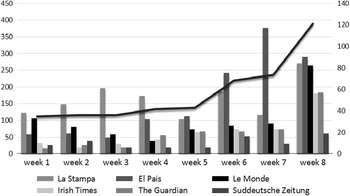
In the first place, the research compared the number of articles about the European elections in the different newspapers. In Italy and Spain, the level of attention registered was quite high, whereas in Germany it seemed to be low (Table 1).
Number of articles

The general degree of attention remains somewhat constrained and slowly grows until the final weeks preceding the vote (Figure 1). This proves that, in an overloaded context, electoral campaigns focus primarily on salient, key moments; the presentation of the candidates, the electoral deadline, and controversial/contested issues. Media and political logics usually converge during the electoral time and this contributes to create cognitive mobilization (Altheide, Reference Altheide2004). With no data to compare, but wishing to avoid inaccurate analysis, the interpretative framework followed the general view of the model suggested by Hallin and Mancini (Reference Habermas2004). The research confirms several features of this model. Spain and Italy represent the ‘Mediterranean model’, where the presence of political information is structurally more relevant. A form of parallelism coexists between journalism and political system as well as a faint openness toward European issues. Furthermore, the system of information is strongly connected to the national institutions, and the professionalization of journalism is less developed when compared with other countries. This explains the strong emphasis on domestic matters.
The visibility of the electoral campaign in selected European newspapers over the 8-week period (amount of articles online edition).

The British case confirms the features of Hallin and Mancini’s (Reference Habermas2004) ‘liberal model’, characterized by a journalistic system where the distance between media and politics is rather clear, institutional control is limited, and commercial tradition is relatively developed. The British case is also characterized, especially with regard to The Guardian, by a political analysis in form of political news commentary. Moreover, UK history and its insular and colonialist cultural matrix – which we use to understand its lukewarm support toward Europe – explain the strong presence of Nigel Farage’s UKIP, a British xenophobic nationalist and anti-European party, which drew a significant number of votes in the European elections.
The German case fits into the ‘corporative democratic model’ (Hallin and Mancini, Reference Habermas2004), where the media are viewed as real institutions and as an expression of parties and organized social groups. Hence, the media are highly integrated in the political system, in the context of a well-developed communication industry. The German information system is also characterized by a very strong regional tradition that maintains its own information structures limiting the importance of nationwide press (Barberio and Macchitella, Reference Barberio and Macchitella1992). This feature lowers the interest in European elections. In addition, the editions of Süddeutche Zeitung are rather small and this fact could explain the low number of published articles on the topic. Another aspect was the widespread perception that Germany played a decisive role in European governance. This may be the reason why the electoral campaign was undervalued and mainly considered as a domestic matter.
The French press, in Hallin and Mancini’s (Reference Habermas2004) categorization, was positioned in the middle, as a ‘hybrid model’, and does not show specific peculiarities, as almost all the distinctive features of European journalistic systems have been developed: a degree of political parallelism, a rather developed private media system, State control, and a good journalistic tradition. Le Monde, taken as the example for the French case, revealed a moderate interest in terms of news publication, although it was qualitatively more attentive to the political analysis of the votes. From the newspaper’s comments, a certain degree of preoccupation regarding the advancement of the FN could be evinced.
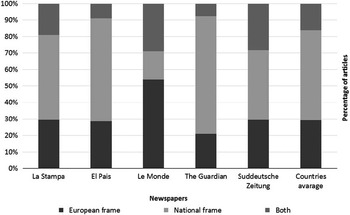
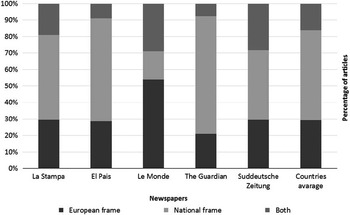
The general frame of each article – considered as the general argumentative slant that oriented the broad interpretation (Iyengar, Reference Hooghe and Marks1987; Entman, Reference Drake1993) – put the electoral frame oriented toward the domestic context face to face with a European public frame (Figure 2). The articles favored the national frame, though less than expected, because during the electoral campaign Eurosceptic parties enjoyed more visibility. Although strongly critical, this position placed the European dimension at the core of public discourse. This can be considered as a sign of the European public sphere growing.
Domestic frame vs. European frame.
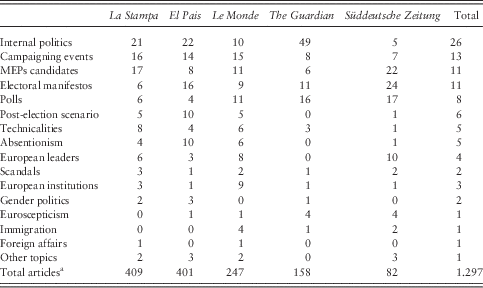
Observing the topics of the campaign (Table 2, each article was classified based on the prevalent issue reported), reference to domestic matters was predominant. However, the data revealed significant differences that, once again, confirm the diverse journalistic approaches within each country. First, the candidates for the European Parliament were discussed more in Italy, once electoral lists had been presented, and in Germany, where Süddeutche Zeitung dedicated a specific column to candidates, entitled ‘Europawahl’ (European election). Another interesting point concerns European leaders: German media coverage, gave more space to Martin Schulz (probably because he is German) and Jean-Claude Juncker (strongly endorsed by Angela Merkel). Alexis Tsipras enjoyed a certain visibility in Italy, where the left-wing party Sinistra Ecologia Libertà entitled its electoral list ‘L’Altra Europa con Tsipras’ (the other Europe with Tsipras), and in Spain too, due to the close relation with Podemos. All the other European competitors were practically absent.
European election topics in newspapers (percentages)

a Total articles are absolute numbers.
Another topic that gained visibility in the electoral campaign were the polls, to which British and French newspapers paid major attention, because of the uncertainty about the electoral results of UKIP and the FN. The coverage of themes such as abstentions and gender balance, which the European campaign amply invested in, was somewhat scant. Euroscepticism was the other crucial topic of the election, and it was anticipated that broader attention to this phenomenon would be found in the newspapers. In general, this theme was covered during the electoral campaign, but it was dealt with through the campaign narration of Eurosceptic parties and their leaders (classified in terms of candidates’ actions and campaign events) as well as journalistic commentary. Overall, the five journalistic editorial lines reconfirm their specificities, but also converge in the selection of news. This suggests that the journalistic agenda is gradually becoming more Europeanized (Marletti and Mouchon, Reference Lord and Harris2005; Roncarolo, Reference Rometsch and Wessels2015).
To explore the question of second-order elections, the analysis compared the presence of national leaders (i.e. heads of government) in relation to European ones (Table 3). The results confirm the preponderance in all countries of national leadership over European leadership. Within this frame, two contexts deserve further discussion. The first is Italy, where the result is almost balanced (Table 3). This could be due to the fact that Martin Schultz had visited the country at least three times throughout the electoral campaign. Furthermore, Alexis Tzipras garnered significant electoral support. On the opposite side, the German case shows that Angela Merkel was heavily quoted in the articles analyzed in all the countries – confirming her position as a European leader.
Degree of Euroleadership

Euroscepticism and gender: a proof of Europeanization
The second aim of this study was to verify the presence of signs of Europeanization in the electoral debate. At the time of the European elections, a Eurosceptic ‘mood’ was growing everywhere, and Eurosceptic parties were becoming increasingly popular. The first Eurosceptic organized party formations – UKIP, FN, and LN – had long been present in the political arenas of their respective countries and had occupied seats in the European Parliament for consecutive legislative terms. Thus, Euroscepticism was considered as a topical issue in the political and academic debate.Footnote 10 In the 2014 elections, however, Euroscepticism started to gain ground in the public opinion. In this way, it became a key element in the public debate on European integration. During the electoral campaign, some parties and political movements widely showed their hostility toward Europe using the media and adding new critical political stances. This was the case of the Italian M5S, the Spanish Podemos, and the German AdF.
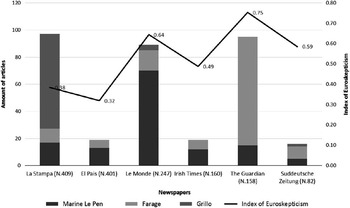
As already explained in the previous chapter, Euroscepticism could be seen as a sign for Europeanization (Down and Wilson, Reference de Vreese2008; Hooghe and Marks, Reference Hix and Lord2009) following this cognitive ability all the articles were classified using three different indicators of Eurosceptical argumentation in semantic perspective. The first detected the presence of journalistic analyses that focused on Euroscepticism. As shown in Table 2, such articles were rare (<1% of the coverage, and non-existent in some countries). The second indicator detected clear references to Euroscepticism (whether pro or anti) either by journalists or by attribution to leaders and political parties. The third one focused on the presence of ‘No Euro’ leaders and parties. In order to obtain numerical significance, the study concentrated only on three Eurosceptic actors that featured in all the articles analyzed: Marine Le Pen and the FN; Nigel Farage and UKIP; Beppe Grillo and the M5S. In Italy, Eurosceptic stances were also expressed by the LN (in coalition with the French FN); however, the LN was mentioned as a Eurosceptic party only four times in the Italian articles and was therefore excluded from the general analysis. Another interesting case was Beppe Grillo, who overtly adopted a strong anti-European stance but only in the last weeks of the electoral campaign, after he established an alliance with UKIP.
The comparison between articles containing Eurosceptic stances facilitated an evaluation of the general degree of explicit Euroscepticism. As Figure 3 demonstrates, this index was particularly high in France and the United Kingdom, where the largest anti-EU parties originate (i.e. FN and UKIP). Furthermore, this was linked to the diffuse concerns that their success could influence the two countries’ domestic political balances. In Germany, the frequent reference to Euroscepticism and its promoters mostly concerned the fear that the growing anti-European sentiment could jeopardize German leadership. In Italy, journalists attributed Eurosceptic stances mainly to Grillo’s sphere of influence. Finally in Spain references to Euroscepticism were noticeably low and linked to the Catalan independence parties, which were hoping, in this way, to distinguish themselves from the national pro-EU parties.
Reference in articles to Euroscepticism and Eurosceptic leaders.

Considering the visibility of Eurosceptic leaders and parties in the electoral campaign, Marine Le Pen and Nigel Farage held the true scepter of anti-Europeanism, though in different ways. The leader of UKIP launched an electoral campaign focusing on the British withdrawal from the European Union and from its immigration policies. The newspapers provided good visibility, especially as Farage’s personality attracted attention. Even if all the newspapers covered the alliance between M5S and UKIP, only the Italian press recognized Beppe Grillo as a Eurosceptical leader. The anti-European position of FN, though well rooted in French nationalism, endorsed the thesis of defending Europe’s national identities and is the only anti-European movement that attempted to build a transnational network of alliances prior to the European vote: first with the Italian LN, then with the Dutch anti-European party headed by Geert Wilders (Party of Freedom). In some instances, regarding immigration matters, Nigel Farage and Marine Le Pen even became involved in a dispute. Farage sought to restrictively tighten the control over immigration by suggesting a change in the existing laws on work permits. Differently, the French leader supported a defense of Europe’s ‘national people’ based on their historic, cultural, and religious traditions. This suggests that, in spite of a common label, the anti-Euro front is a magmatic and often incoherent discourse.
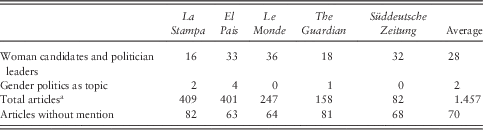
Another indicator selected to verify the Europeanization of public space was the topic of gender politics (Jamieson, Reference Iyengar1995; Campus, Reference Campus2013), a crucial priority for European policies that the EU institutions insisted on throughout the electoral campaign. Among the recommendations given to national parties, as described above, one called for the equitable selection of candidates and the enhancement of the female presence of women in the electoral lists. This study verified the visibility of this issue within the articles (Table 4). To measure gender reference, we used two different indicators. First, all the articles, though only few (a total of 2% as reported in Table 2), were classified and analyzed for their reference to gender politics. Attention was paid to articles that talked about the policy of gender and the role of women in politics. Second, the study verified the presence of women candidates and politicians in the coverage of the electoral campaign. This space was almost entirely occupied by Angela Merkel, a truly prominent European politician woman, and by Christine Lagarde, the Managing Director of the International Monetary Fund.
Gender references (percentages)

a Total articles are absolute numbers.
The result of the analysis was that Europe’s influence on gender issues was not effective enough. On average only 30% of the classified articles contained at least one indicator related to gender, and the worst performance was in Italy and in the United Kingdom. In addition, within each national context the issue of gender was dismissed in its own way. The only country that overtly declared its commitment to follow the European directives was Italy, where the PD selected women as ‘head of lists’ in all five electoral districts. Despite the important choices made, the journalistic balance was not positive. Indeed, once the initial phase was over, all five candidates practically disappeared from the campaign coverage.
In Spain, the results regarding gender coverage were connected to a political gaffe made by Miguel Arias Cañete (PPE head of list and now EU Commissioner for Energy and Climate Action) involving Elena Valenciano, a militant feminist and former MEP (Member of European Parliament) and PSOE (Spanish Socialist Workers’ Party) head of list. During the TV show Espejo Público, on Antena 3, Cañete made a politically incorrect slip of the tongue – which generated long-lasting controversies – by saying: ‘talking with a woman is complicated, but if you say so, you are accused of machismo’.
In France and Germany, the visibility of women in the electoral campaign had an impact for different reasons. In France, the presence of Marine Le Pen made the headlines constantly, while in Germany Angela Merkel earned considerable visibility. In both cases, as well as in all five countries, these two political figures were covered with no specific gender connotation. In the British press, during the electoral campaign, the visibility of female candidates and gender politics were less present than in other countries.
Conclusions
In conclusion, the coverage analysis of the 2014 European election of five newspapers from major European countries validated some of our questions while refuting others. First, it should be emphasized that the feared collapse of votes did not occur, as the percentage of voters reconfirmed the 43% of the previous elections. In addition, the weight of Euroscepticism in the new European Parliament, despite the undeniable electoral performances of UKIP and FN, did not destabilize the European institutional balance. Despite the good electoral results, Eurosceptical parties, after the vote, have had many difficulties to form a common group, thus showing deep differences in their anti-European political stance.
With regard to the initial questions, the answer as to whether we find ourselves in front of second-order elections is affirmative, even if to a lesser degree than expected. At a general level, there is no doubt from the selection of topics, the frames of discourse and leaders’ visibility that these elections were highly domestically oriented. Nonetheless, there were also signs confirming the growth of a European public space where arguments, agenda, and issues had been integrated. The different political cultural traditions and the model of journalism confirm, once again, their structural characteristics to a great extent, even if, in the issue of European elections, a certain convergence occurred in the selection of topics and in the narration of the campaign. With respect to the selection of news and the visibility of the European vote, there was a greater transnational journalistic attention than in the past.
Paradoxically, Euroscepticism presented the strongest element of Europeanization in the electoral public debate. Although less able to organize political action than expected, given the initial concerns, Eurosceptic movements remain pivotal in EU criticism. Finally, ‘gender politics’ confirms and refutes the convergent dynamics. In general, the presence of a gender gap remains a cultural matter. Political institutions are not actively contrasting such trend and, despite the good intentions, the influence of Europe is also quite feeble. Nevertheless, the European institutional context presents women in politics with extraordinary opportunities in terms of visibility and confrontation and it offers, at any rate, models of comparison. Against this compound background, Europe carries on – enduring fatigue, and with many contradictions
Funding
This research has been funded by the Italian national research program (2010-2011-protocol 2010943X4L -- DM 1152/ric/27 December 2011) ‘How political representation changes in Italy. Voting decisions over the 2013–2015 electoral cycle’. General coordinator Paolo Segatti, local coordinator Unit of Turin Franca Roncarolo.