The historian Charles Payne has described Brown v. Board of Education as “a milestone in search of something to signify.”Footnote 1 Widely hailed as a symbol of Jim Crow's demise, the case is popularly understood to represent America at its best. For many, Brown symbolizes the end of segregation, a national condemnation of racism, a renewed commitment to the ideal of color-blind justice, or some combination of all of these, but Brown is equally affirmed in less celebratory narratives, in which it is seen to articulate a constitutional aspiration against which the injustice of current racial practices can be measured. Unlike the celebratory Brown, which indulges a fantasy of completion or accomplishment, this aspirational Brown marks “an appeal to law to make good on its promises” of equal citizenship and racial democracy, even if that promise remains as yet largely unfulfilled.Footnote 2
In both versions of Brown, the cultural significance of the case is largely redemptive. According to the legal historian J. Harvie Wilkinson III, “Everyone understands that Brown v. Board of Education helped deliver the Negro from over three centuries of legal bondage. But Brown acted to emancipate the white South and the Supreme Court as well.”Footnote 3 Continuing the redemptive language of emancipation and deliverance, Wilkinson's celebratory account chronicles how “Brown lifted from the Court the burden of history.”Footnote 4 In contrast, Jack Balkin presents the aspirational view of Brown as an ideal against which current racial inequalities may be judged. Among legal practitioners, he notes, one does not argue “for” or “against” Brown; rather, equal protection disputes tend to involve rival interpretations of the case's underlying principle, with all sides claiming to be Brown's rightful heir.Footnote 5 That Brown figures so centrally in such irreconcilable historical narratives testifies to the case's iconic status. This much is implicit in Payne's quip about Brown as milestone: setting aside questions of the Court's ability to produce social change, the case is asked to carry a cultural load it could not possibly sustain.Footnote 6 We are invited to reflect, then, upon what social, political and ideological needs are revealed by this state of affairs.
If Brown is “a milestone looking for something to signify,” it is not because the case is less important than it is typically thought to be. Rather, it is because the case's significance lies more in its contribution to hegemonic understandings of race and racism (and their relationship to American democracy) than in the creation of enforceable law. To use Omi and Winant's terminology, Brown is a powerful producer of “racial common sense.”Footnote 7 And on Payne's view, that necessarily implies a “mystification of race” that reduces “the systemic character of white supremacy to something called ‘segregation.’”Footnote 8 It is a double reduction, actually, first in taking segregation for the entirety of white supremacist practices, and again in reducing the meaning of “segregation” to little more than social custom and interpersonal contact rather than “political disenfranchisement, economic exploitation, racial terrorism, and personal degradation.”Footnote 9 This view has both gained national ascendency and helped to define a liberal consensus on race, according to which, overt acts of discrimination, prejudice and “insensitivity” are roundly condemned, whereas the structural causes of inequality are steadfastly ignored.
If Payne is right that Brown's influence is felt most of all in how Americans think about race, then it is not surprising that the case is asked to do a kind of cultural work that pulls in different and often contradictory directions. It is within this context that I argue for the centrality of civil rights memory to contemporary racial formation; and against particular memorializations of the struggle to desegregate schools that would “contain” moral and legal responsibility for systemic racial injustice. In so doing, I want to suggest that a proper understanding of what Brown did (or did not do) requires more careful attention to what the case means, and what it meant to the people who fought to implement (or prevent implementation of) desegregation of public schools. By taking this approach I hope to accomplish several related goals.
First, this article contributes to our understanding of how contemporary popular, political, and legal discourses about race make use of the past. One reason for Brown's success as a contemporary producer of racial common sense, I argue, is the potential for slippage between its symbolization of constitutional equality at the highest level of abstraction and its more proximate condemnation of state-sponsored racial segregation as practiced by the school boards in the consolidated cases. Precisely because of its iconic status, Brown's rejection of a specific form of white supremacist social organization (Jim Crow) has been taken to define the meaning of constitutional equality in itself. Today's racial common sense is defined largely by reaction against Jim Crow, and, therefore, also by a corresponding blindness to other, more contemporary techniques of racial subordination.
Second, my reading of massive resistance to school desegregation both draws on and challenges a rich historical literature emphasizing the role of Southern moderates in the struggle over civil rights. Mathew Lassiter has been especially successful in displacing traditional narratives of defiantly racist Southerners brought grudgingly into conformity with racially egalitarian national norms.Footnote 10 Instead, Lassiter describes a shift in Southern politics and the emergence of a distinctly suburban, Sun Belt political agenda defined by discourses of meritocracy and “color-blind” individualism. Similarly, legal historian Anders Walker has shown how, in response to Brown, Southern moderates articulated a “strategic constitutionalism” that avoided open defiance of federal authority and, therefore, through evasion, succeeded in preserving racial inequality where massive resistance had failed.Footnote 11
While building on the work of Lassiter, Walker, and other critics of “Southern Exceptionalism,” this article also revises their conclusions by raising significant questions about how we are to understand the success of Southern moderates in relationship to racial violence, as well as the failure of massive resistance in relationship to current racial practices and constitutional law. For Lassiter—and even more so for Walker—Southern moderates were motivated principally by their opposition to racial violence, which they viewed as a threat to Southern economic development, and which they countered with a renewed commitment to law and order. In contrast, I argue against this sharp conceptual distinction between law and violence, which does render the South and segregation less exceptional, but only by rendering massive resistance itself all the more exceptional. Drawing from Robert Cover's pioneering work on violence and the creation of constitutional meaning, I rearticulate the shift from massive resistance to “strategic constitutionalism” as an intensification of racial violence through the state rather than a shift from violence to law.
Third, my reading of massive resistance to school desegregation poses difficult questions for recent scholarship on the Constitution outside the courts.Footnote 12 By rejecting the sharp distinction between law and violence, my analysis is able to recognize the claims of massive resistance not only, as they are typically regarded, as a refusal of law—perhaps even as a celebration of lawlessness—but instead, as a particularly noxious species of popular constitutionalism. This view revises our understanding of massive resistance, but it also challenges two widely held assumptions about popular constitutionalism: that extrajudicial constitutional claims are naturally more progressive than those emanating from within legal institutions, and that such claims function deliberatively (by expanding the range of ideas under consideration) rather than through force (by constraining the range of meanings that might practically take hold). Seen this way, the influence of massive resistance on current law and policy may be far greater than is generally believed.
Massive Resistance in Civil Rights Memory
In popular memory, and in the view of at least five members of the current Supreme Court, Brown's meaning is largely contained within a narrative of racial progress, and represents an approximate boundary between past prejudice and current color-blind justice. The memory of massive resistance to school desegregation, in contrast, threatens to disrupt this narrative and, therefore, must be elided or otherwise contained. Typically, the story goes somewhat as follows. Long ago, this nation was stained by the sin of slavery, and later by segregation. The laws did not treat individuals with equal dignity and respect, but instead made arbitrary distinctions that treated people differently based solely on their race or color. After great struggle and much sacrifice the nation confronted this sin and, spurred on by the example of great men such as Martin Luther King, Jr., sought to effect his noble dream by abolishing all racial distinctions in the law. Finally, all citizens would be treated the same, without regard to their race, color, or ethnicity. It is in this sense that Wilkinson reads Brown to redeem the Court and the Constitution, just as King and the Southern Christian Leadership Conference sought to “redeem the soul of America.”Footnote 13 and it is against this color-blind vision that race-based affirmative action is figured as a departure from the civil rights movement's ideals, and, therefore, as a fall from grace and a return to the sin of prejudice.
The narrative of “fall” in color-blind advocacy thus accomplishes what cannot be achieved through argument alone: the appropriation of civil rights discourse, even when the individuals being quoted explicitly endorsed positions impossible to reconcile with color-blind conservatism.Footnote 14 In the span of only three pages, William Reynolds (assistant attorney general for civil rights under President Ronald Reagan) manages to quote Thurgood Marshall, Earl Warren, Edmund Muskie, Hubert Humphrey, Roy Wilkins, Jack Greenberg, Martin Luther King, Jr., and the first Justice Harlan.Footnote 15 There is little room for nuance in such uses of the past. Reynolds cites King's “dream” speech at the Washington Monument, but ignores King's implicit demand for reparations and affirmative action. He quotes Thurgood Marshall's appeal to the Court in Brown, but ignores Marshall's explicit defense of affirmative action as a member of that Court.Footnote 16
Of the current members of the Supreme Court, Justice Thomas has been the most candid and most enthusiastic defender of color-blind constitutionalism (although he is by no means alone in this vision of constitutional equality), which he is quick to authorize as the authentic meaning of Brown and the civil rights movement, both of which are reduced in meaning to a single celebrated line from Justice Harlan's Plessy v. Ferguson dissent. For example, in the 2006 case Parents Involved in Community Schools, Thomas explained the unconstitutionality of voluntarily adopted race-conscious integration programs in Louisville and Seattle by offering a string of uncontextualized quotations drawn from Brown and leaders of the civil rights movement:
I am quite comfortable in the company I keep. My view of the Constitution is Justice Harlan's view in Plessy: “Our Constitution is color-blind, and neither knows nor tolerates classes among citizens.” And my view was the rallying cry for the lawyers who litigated Brown. (“That the Constitution is color blind is our dedicated belief”), (“The Fourteenth Amendment precludes a state from imposing distinctions or classifications based upon race and color alone”), (“Marshall had a ‘Bible’ to which he turned during his most depressed moments. The ‘Bible’ would be known in the legal community as the first Mr. Justice Harlan's dissent in Plessy v. Ferguson. I do not know of any opinion which buoyed Marshall more in his pre-Brown days…”).Footnote 17
Not only does Thomas claim for himself the moral authority of Brown, he also characterizes the Court's defenders of these voluntary integration plans as—curiously enough—segregationists: “The segregationists in Brown embraced the arguments the Court endorsed in Plessy. Though Brown decisively rejected those arguments, today's dissent replicates them to a distressing extent… This approach is just as wrong today as it was a half-century ago.”Footnote 18 Dismissing the distinction between racial inclusion and racial exclusion as a “faddish social theory,” Thomas concludes: “What was wrong in 1954 cannot be right today.”Footnote 19
Notably absent from this civil rights progress narrative is any reference to massive resistance. Memory of resistance to school desegregation must be suppressed (or otherwise contained) if the narrative is to achieve its desired political effect. In part, this reflects a simple prioritization of progressive elements in the narration of American history, but it is also necessitated by the logic of racial redemption, which Sumi Cho has described as comprising three basic elements: repudiation of white supremacy's old regime, burial of historical memories of racial subordination, and transformation of white supremacy into a viable contemporary regime.Footnote 20 The appropriation of civil rights discourse by contemporary color-blind conservatives accomplishes the dual goals of burial and transformation by squarely rejecting the constitutional legitimacy of Jim Crow, and by transforming the meaning of civil rights struggle into a generic rejection of racial classification rather than a substantive demand for racial democracy.Footnote 21
The logic of “burial” would seem to be at cross-purposes with those of “repudiation” and “transformation,” if only because the former suppresses historical memory of events that must be summoned to consciousness for the latter to function. However, perhaps ironically, racial progress narratives are as well served by repressing popular memory of massive resistance as they are by spectacular memorializations of massive resistance that fix the contemporary cultural meanings of “equality” and “justice” to their discontinuity from overt acts of racial violence. One version of this narrative concentrates responsibility for past racism in working-class prejudice, whereas another version blames Southern demagogues. Both narratives, however, contain responsibility for racial inequality within the broader exculpatory historical framework that Jacquelyn Dowd Hall has termed “the short civil rights movement.” Despite the best efforts of nearly a decade of civil rights historiography, popular memory of the movement remains predictably limited in ways that contain the location of (and culpability for) white supremacy within each gesture of condemnation: “By confining the civil rights struggle to the South, to bowdlerized heroes, to a single halcyon decade, and to limited, noneconomic objectives, the master narrative simultaneously elevates and diminishes the movement. It ensures the status of the classical phase as a triumphal moment in a larger American progress narrative, yet it undermines its gravitas. It prevents one of the most remarkable mass movements in American history from speaking effectively to the challenges of our time.”Footnote 22
White racism, that is, was spectacularly illegal and unjust; so much so as to render it unrecognizable in the post-civil rights America of today. The wrongness of white supremacy is thus safely contained in the past, in the South, in crude racialist prejudice and overt acts of Jim Crow, and with the violent extremism of an uneducated working class and the political demagogues who manipulated them.Footnote 23 Perhaps nowhere is the pairing of condemnation and exoneration more effective than within popular memory of massive resistance to school desegregation.
The move to concentrate responsibility for racial violence in the hands of mobs and demagogues is equally noteworthy in the rhetoric of political actors during the school desegregation crisis as it is in more recent historians' accounts. In an editorial entitled “Mississippi Citizens' Councils Are Protecting Both Races,” Thomas Waring (editor of the aggressively segregationist Charleston News and Courier) places responsibility for potential violence on the National Association for the Advancement of Colored People (NAACP), while insisting that Citizens' Councils are also “dedicated to protect the rank and file of Negroes from the wrath of ruffian white people who may resort to violence.”Footnote 24 Writing the next year in Harper's Magazine, Waring cautions, “the thin tolerance of the ruffian and lower elements of the white people could erupt into animosity and brutality if race pressure became unbearable.”Footnote 25 In his Harper's essay, Waring writes specifically as a Southerner presenting to a Northern audience. Part warning and part threat, he invokes the possibility of racial violence while, at the same time, containing responsibility for it with white working-class “ruffians” and outside agitators from the North.
Legal historians have categorically rejected this segregationist view of the Citizens' Councils as benign defenders of Southern blacks against “outside agitation” by the NAACP. Nonetheless, top-down explanations that attribute massive resistance to the actions of a few opportunistic racial entrepreneurs are still widely accepted, albeit with antithetical normative commitments. For example, all the basic elements of Southern exceptionalism can be found in the opening paragraph of Numan Bartley's classic history of massive resistance: “By any rational standard of measurement, mid-twentieth century America seemed an alien habitation for an extensive system of racially segregated public schools. The foundations for institutionalized white supremacy belonged to the past. Jim Crow seemed as anachronistic as slavery had been a century before.”Footnote 26
Not only is racism safely contained in the South, its exceptional character renders it irrational and “anachronistic”—tied to “the past”—and thoroughly “alien” to properly American egalitarian ideals. For Bartley, the real America is implicitly Northern and fully committed to the “tendency toward acceptance of human equality” that had “penetrated American thought deeply by the post-World War II era.”Footnote 27 The North—which Bartley describes as having “resumed its role as protector of the nation's black minority”—is figured as an agent of redemption rather than a participant in racial subordination, in need of redemption for itself.Footnote 28
Bartley's top-down explanation both invokes and contains responsibility for massive resistance, and for American racial injustice more broadly, which massive resistance may be taken to exemplify. With some modification, Bartley's account continues to be accepted by most historians of the period. Adam Fairclough, for example, adapts the “Woodward-Bartley model” to read massive resistance in Louisiana chiefly as an internal conflict between white elites, in which populist racial animosity is deployed in the service of voter purges of political foes.Footnote 29 Tony Badger agrees: “as Numan V. Bartley demonstrated over thirty years ago, it was a top-down policy shaped by black-belt elites and conservative economic leaders.”Footnote 30 And Clive Webb flatly declares that, “responsibility for these disturbances rests with the racist demagogues who stirred whites into open revolt.”Footnote 31 The language of demagoguery is particularly suggestive in regard to the question of responsibility. Classically, a demagogue's power stems from control over the demos rather than speaking in its interest or on its behalf. Demagoguery is what we call it when we want to say that the actions of the masses are not authentically their own, but rather the voice of a charismatic leader by whom they are all too easily manipulated. As such, we blame the leader more than the masses. The crime here is a departure from their true wishes, even when committed by them and in their name.
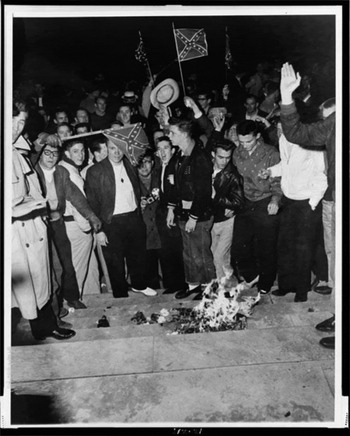
The condemnation of racist demagogues, at least in this sense, may carry within it an implicit gesture of exoneration. Not only do top-down accounts minimize the responsibility of “ordinary Southerners,” they also figure massive resistance in terms that suture white racism to a familiar iconography of extravagant racist display. A photograph (also used as the cover of Webb's edited volume, Massive Resistance: Southern Opposition to the Second Reconstruction) perfectly captures the visual logic by which condemnation and exoneration are twinned. It is night, and a crowd has gathered, all of them white men, evidently in a heightened emotional state. Several of the men wave Confederate battle flags as they form a ring around a small fire burning on the stairs where they have assembled. Some of the younger men wear jackets, jeans, and slicked-back hair. Some men are yelling. One holds a camera. There are clenched fists, laughter, smirks, and defiant glares. The atmosphere is both violent and festive, reminiscent of crowds that gathered for spectacle lynchings in the 1920s and 1930s.Footnote 32 The photograph was taken in 1956 and this crowd—or mob—turns out mostly to be students at the University of Alabama who have gathered to burn desegregationist literature in protest of Autherine Lucy's enrollment.
It is difficult to imagine anyone viewing this image today—and this is especially so, given the book's likely readership—feeling sympathy for the protesters. The image is meant to disturb. It is a visual representation of the kind of racism that current readers can be counted upon to abhor. It positions the subject of the essays contained in the book as a terrible episode in America's racial past that must be examined, explained, and confronted. In so doing, the image also positions the source of racial trauma in familiar yet distant terms: racism is figured as violent, overt, distinctively Southern, and a holdover from the past. In short, the people in this photograph look very little like “us,” whoever “we” are as readers of such a book.
Remembering Southern Moderates
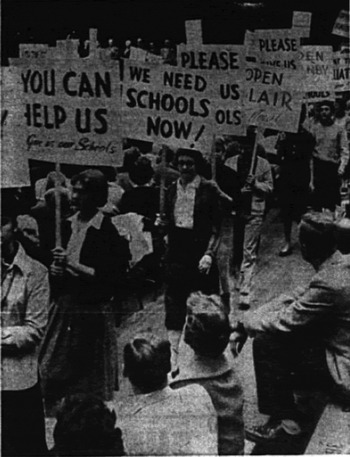
A quite different visualization of the desegregation crisis is found in a photograph of open schools protests that appeared in the Norfolk Virginian-Pilot newspaper in October of 1958. In this grainy image, we see picketers marching in an orderly line; most are white women, primly dressed in skirts and cardigans over white collar-shirts. They are carrying signs, one of which says “We need schools now!” Another reads: “You can help us.” At least two of the signs, partly obscured in the photograph, start with the word “PLEASE.” The atmosphere is one of middle-class respectability and responsible civic engagement. Some readers will recognize the photograph from the cover of another edited volume, The Moderate's Dilemma: Massive Resistance to School Desegregation in Virginia.Footnote 33 This image well represents the organizing premise of the essays within the book, that “the majority of white southerners are somewhere between the few liberals who openly embraced the principle of racial integration and the vocal, organized segregationists and political demagogues who pledged to resist any and all encroachments upon the right to maintain segregated schools.”Footnote 34 White Southern moderates, they argue, are less studied but more important than their hypervisible extremist counterparts.
Massive Resistance Demonstration, University of Alabama, 1956.
Exhibited in National Gallery, “With an Even Hand: Brown v. Board at 50.” Accessible at: http://www.loc.gov/exhibits/brown/images/br0121As.jpg
Library of Congress catalog record at: http://www.loc.gov/pictures/item/98506860/

Open schools demonstration, Norfolk, VA, 1958 The Virginian-Pilot and Portsmouth Star, October 19, 1958, 3D.

The significance of white moderates in the South extends beyond the historical fact of their numbers. Moderates were also crucial politically, and the story of their conversion from passive accepters of extremism into active challengers of massive resistance is centrally important to current understandings of race, regarding both the timing of change and what kind of changes ultimately would occur. In part, this is because their (belated) rejection of massive resistance set the terms for an emergent national racial compromise reducible neither to the egalitarian demands of the civil rights movement, nor to the preservation of Jim Crow-era racial caste. In both timing and tactics, Southern moderates contributed to a new racial common sense that permitted token desegregation along class lines and in accordance with a repurposed and rearticulated ideology of color-blind individualism. Unlike the pro-segregation protestors photographed at the University of Alabama (but very much like the open-schools protestors in the second image), this emergent racial understanding is easily recognized in today's political, legal, and cultural orientations regarding race.
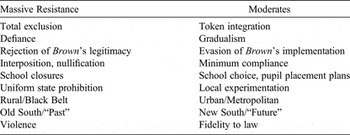
In some regards, the line between moderates and massive resistance was clearly drawn. A general outline of these differences, as commonly understood, is represented in Table 1. Moderates overwhelmingly disagreed with the Brown decision, yet accepted its status as law, and therefore conceived themselves as duty bound to bring local school policies gradually into conformity with the United States Constitution. Where the forces of massive resistance refused to recognize Brown's legitimacy, moderates sought ways to minimally comply with its ruling while still preserving as much racial separation as possible: an approach rendered all the more reasonable by Brown's separation of right from remedy and Brown II's intentionally vague criteria for implementing its decree. Where theories of “interposition” and “nullification” justified massive resistance to school desegregation, moderates sought to minimize conflict through strategies of minimum compliance, gradualism, and delay.
Moderates vs. Massive Resistance

As a popular movement, massive resistance produced spectacular scenes of open defiance and mob violence for which it is best remembered, but it also contained legal and policy dimensions that ought not to be overlooked. The theory of interposition, for example, was foremost a claim about legality (that sovereign states retained the right to interpose their authority against an over-reaching federal judiciary) even while functioning foremost as political rhetoric.Footnote 35 Massive resistance also contained a range of policy initiatives advanced at both state and local levels. In response to Brown, state legislatures enacted legislation prohibiting the use of state funds for desegregated schools and making it a criminal offense for public officials to assign white and black students to the same school.Footnote 36 A number of states repealed compulsory attendance laws and held referendums amending state constitutions to remove language that required state provision of public education, thereby setting the stage for public school closings as an alternative to desegregation.
In comparison to the champions of massive resistance (Citizens' Councils, Black Belt political monopolies such as Harry Byrd's in Virginia, the conservative Southern press), Southern moderates were late to organize. When they did, it was not to defend school desegregation, but to oppose the excesses of massive resistance, which they correctly identified as a threat to economic development, both in the image of violence and unreconstructed racialism it projected to potential sources of capital investment, and in the threat to public education upon which the New South economy would depend.Footnote 37 As long as the debate was framed as a choice between segregated or integrated schools, the clear preference of nearly all white Southerners was for segregation. However, under pressure from civil rights activists and federal courts, it became increasingly likely that school closures would be needed to prevent their desegregation. The prospect of school closures dramatically increased the costs of massive resistance to a level that many whites were unwilling to pay. It also allowed moderates to reframe the debate as a choice not between segregated or desegregated schools, but between open schools operating with token desegregation or no schools at all.Footnote 38 In regard to racial preferences, there was little or no difference between moderates and massive resistance; in regard to public education, there was a tremendous difference.Footnote 39 The success of racial moderates therefore depended largely upon their ability to prioritize the demand for public schools over citizens' views on “the race question.”
As Lassiter and Lewis point out: “the absence of an effectively organized opposition to massive resistance between 1956 and 1958” should not be taken as “active support for inflexible, hard-line segregationist policies,”Footnote 40 but neither should the eventual presence of such an opposition be mistaken as support for Brown's desegregation mandate. It was no secret that token desegregation proposals from Southern moderates were intended to avoid integration—and succeeded remarkably well in doing so—without running afoul of federal courts. When Armistead Boothe (Virginia's outspoken racial moderate and leader of the Young Turk revolt against “the Organization” of Senator Byrd) proposed local option legislation with a pupil placement plan, he boasted that schools would be kept “99 percent segregated” and that segregation could more readily be defended through tokenism than by outright defiance.Footnote 41 In 1959, he campaigned “as a Virginian and a segregationist” on the platform of “public schools segregated to the limit allowed by law.”Footnote 42 Moreover, Boothe's proposal was considered slightly more moderate than that of the commission headed by Garland Gray (the Gray Report), which similarly endorsed locally administered pupil assignments, but which also endorsed tuition grants to facilitate the transfer of students to segregated private schools – but which nonetheless was denounced by Byrd and other advocates of Virginia's massive resistance. Both proposals for the token integration of Virginia's schools were modeled, in part, on the success of North Carolina's Pearsall Plan, which self-consciously avoided the confrontational rhetoric of massive resistance, allowed for the highly visible integration of a handful of black students, but nonetheless managed to preserve segregation for more than 98% of the state's non-white students, an arrangement referred to by North Carolina Governor Hodges as “voluntary segregation.”Footnote 43
Numan Bartley explains the bureaucratized and formally de-racialized logic by which local pupil placement laws claimed to adhere to Brown's desegregation mandate while failing to bring about any substantial degree of integration: “Various criteria were listed to guide local agencies in assigning students, and the words ‘race’ and ‘Negro’ found no place on the list. Instead, administrative problems, physical facilities, sociological and psychological factors, and academic background were among the considerations that school boards were required to take into account. Resulting segregation rested not upon an illegal racial classification but nominally upon weighty and responsible concern for individual students.”Footnote 44
Pupil placement laws thus supplied the ostensibly non-racial basis upon which conventionally segregated outcomes in school assignments might be preserved. Additionally, most placement laws specified administrative remedies for parents of students dissatisfied with the school board's initial decision. The grievance procedures further insulated discriminatory treatment from constitutional scrutiny for two reasons. First, drawing out the lengthy appeals process meant that it could take years to exhaust local administrative remedies as required to gain a hearing in federal courts. Second, making the process sufficiently daunting discouraged parents from challenging their school assignments. As Michael Klarman explains: “the patent motive behind pupil placement was to frustrate desegregation by inviting surreptitious consideration of race by school boards and then confounding blacks who were dissatisfied with their placements in a maze of administrative appeals.”Footnote 45
In this regard, at least, the line between massive resistance and minimum compliance is not as clear as at first it may have seemed. If moderates shared with massive resisters a common antipathy to desegregation—and if moderate strategies proved equally or more successful in frustrating the implementation of Brown—why insist upon the distinction? Why not adopt a definition of massive resistance that includes “the full range of southern strategies of defiance,” as does George Lewis:
The devices that they chose to employ ranged from race-free appeals to the sanctity of states' rights to playing upon latent fears of miscegenation that were saturated in brutally racist rhetoric; legislative and legal rejoinders that varied from subtle and effective stalling tactics to poorly thought-through obstructions that reeked of short-term expediency; attempts to undermine southern segregationists' opponents as ‘outsiders’, which could be taken to mean either those outside the South or those outside the democratic, capitalist traditions of the United States; legislative committees and subcommittees that hid their racist agendas under the banner of ‘state sovereignty’ or ‘security’ issues; threats of economic and violent reprisal; and, of course, sporadic descents into mob rule that brought ephemeral threats of violence into the sharp focus of reality.Footnote 46
In the next section, I will urge a degree of caution regarding recent efforts to sharply distinguish the racist violence of massive resistance from the respectably bureaucratized evasions of the moderates. Nonetheless, it is important to keep in mind a number ways in which the distinction sheds light on the practices of white supremacy, present as well as past.
First, and most obviously, in the political contest between massive resisters and Southern moderates, massive resisters lost and the moderates won. Racial moderates became “the primary architects of racial and social policy” in Virginia, and in the nation as well.Footnote 47 This simple fact suggests some explanation for why a comparatively greater amount of attention has been paid to extreme segregationists and to the civil rights movement with whom they principally were at war. By focusing on the racism of extremists, popular historical narratives invite us to take pleasure in their demise while discouraging identification with the more familiar racism of Southern moderates. In emphasizing the central role of moderates, and in contrast to the collapse of massive resistance, we are called upon to recognize techniques of white supremacy that persist to this day. At stake in the distinction, then, is our ability to see how greatly the defeat of massive resistance differs from a victory for civil rights, and to inquire more carefully about what kind of victory the moderates achieved.
Second, the victory of Southern moderates over massive resistance is crucially linked to the rise of color-blindness as a central rhetoric of American racial common sense. As such, the distinction between moderates and massive resistance reveals color-blind constitutionalism's rise to hegemonic status as a technique of resistance to the civil rights movement rather than its embodiment. In this sense, the emergence of color-blindness may be understood to signify a demand that Southern racial practices be brought into conformity with those of the nation, exactly counter to the suggestion of Southern exceptionalism, which cannot account for national convergence around white supremacist racial norms. More precisely, this national convergence facilitates the rejection of white supremacist ideology while preserving the underlying material conditions of white supremacist rule. As Lassiter explains, the consensus is premised upon (and would be inconceivable without) ostensibly race-neutral mechanisms by which to preserve similar racial outcomes: “The ascendance of color-blind ideology in the metropolitan South, as in the rest of the nation, depended upon the establishment of structural mechanisms of exclusion that did not require individual racism by suburban beneficiaries in order to sustain white class privilege and maintain barriers of disadvantage facing urban minority communities.”Footnote 48
With this view, we may accept that Jim Crow segregation was powerfully transformed, while recognizing as well that it was not replaced by racial democracy and inclusion, but rather by dispersed systems of exclusion “embedded in the built environment” of suburban development patterns and residential segregation.Footnote 49 Defenders of massive resistance were, therefore, wrong in thinking that token desegregation would quickly lead to the destruction of white supremacy and a radical reordering of society. As evidenced by the experiences of Northern civil rights struggle, racial hierarchy and exclusion find support in an array of formally race-neutral policies, even in the absence of formal segregation. Against the familiar progress narrative of Southern conversion to an egalitarian national creed (the American dilemma), the fall of Jim Crow may in fact represent the South's adoption of more suitably Northern methods for reproducing the material conditions of racial exclusion.
Third, and in evidence of just how extensive was the moderate's victory—a victory as much over civil rights and racial democracy as over massive resistance and Jim Crow—key elements of the legal argument for token desegregation now govern the Supreme Court's current equal protection doctrine. The basic structure of the argument, which reads into Brown a sharp distinction between desegregation and integration, originates in the explicit efforts of Southern moderates to protect racial segregation by avoiding intervention by federal courts. Judge John Parker's opinion for the Fourth Circuit in Briggs v. Elliot (1955) is perhaps the earliest and best-known formulation of this position.Footnote 50 Noting that Brown had reversed his initial ruling, Parker resigned himself to the decision, noting “it is our duty now to accept the law as declared by the Supreme Court.” This much set him apart from the interposition and nullification theories of massive resistance, but Parker's interpretation of Brown drastically narrowed its scope, drawing a blueprint for judicial evasion that would be adopted by federal courts across the South. The opinion itself is a little over a page long, and is largely concerned with explaining what the Brown decision had not required: “It has not decided that the states must mix persons of different races in the schools or must require them to attend schools or must deprive them of the right of choosing the schools they attend. What it has decided, and all that it has decided, is that a state may not deny to any person on account of race the right to attend any school that it maintains. […] The Constitution does not require integration. It merely forbids discrimination.”Footnote 51
On Parker's interpretation of Brown, the constitutional prohibition against segregated schools is satisfied by a transition to facially neutral placement criteria or “freedom of choice” plans, even when doing so results in school attendance patterns indistinguishable from those under Jim Crow. Racial separation itself need not change, only the stated justification for segregation and the techniques by which it is accomplished.
More than a decade after Brown, the Court eventually rejected school choice and pupil placement plans as thinly veiled efforts to avoid implementation of the desegregation mandate.Footnote 52 Parker's underlying distinction between desegregation and integration, however, has proven to be far more resilient. Arguably, the well-worn judicial distinction between de jure and de facto segregation is but a variation on Parker's theme.Footnote 53 The connection is especially clear in Justice Rehnquist's dissent in Keyes v. School District No. 1, Denver Colorado (1973), one of the first cases to end what had been a line of unanimous desegregation decisions: “To require a genuinely ‘dual’ system to be disestablished, in the sense that the assignment of a child to a particular school is not made to depend on his race, is one thing. To require that school boards affirmatively undertake to achieve racial mixing in schools is quite obviously something else.”Footnote 54
The distinction is also central to the Court's rejection of inter-district relief in Miliken v. Bradley and to the re-segregation cases of the 1990s, which limited judicial scrutiny to specific discriminatory acts by school officials while refusing to see state action in the creation and maintenance of racially segregated housing patterns. The predictable result was an overwhelming failure to integrate public schools that was nonetheless insulated from constitutional concern, as even the most dramatic “racial imbalance” in schools can be said to result from residential patterns that remain mysterious—Justice Stewart called them “unknown and unknowable”—and beyond the control of local officials.Footnote 55
Judge Parker's aim was to thwart constitutional obligations to desegregate public schools, but his distinction more recently has been used to prohibit even voluntary efforts by local school boards to integrate them. Justice Thomas implicitly adopts Parker's formulation to counter the suggestion that race-conscious integration policies could be justified on remedial grounds or by existing racial concentration in schools: “Racial imbalance is not segregation. Although presently observed racial imbalance might result from past de jure segregation, racial imbalance can also result from any number of innocent private decisions, including voluntary housing choices.”Footnote 56 Just as Judge Parker had hoped, the constitutional prohibition against segregation had been stripped of any corresponding obligation to integrate schools. PICS simply extended Parker's antidiscrimination logic a step further: not only is mandatory integration not required, voluntary integration is constitutionally suspect and may even be prohibited.Footnote 57
Massive Resistance as a Constitutional Claim
The victory of Southern moderates over massive resistance may be understood as a rejection of Jim Crow racialism in favor of less anachronistic techniques for preserving white racial privilege. That these techniques reveal striking continuities with the present serves to undermine popular memorializations of massive resistance that would leverage sincere condemnation of Jim Crow racism in order to exonerate contemporary racial inequalities. In emphasizing the role of Southern moderates, therefore, civil rights historians provide a powerful counterbalance to popular but misleading narratives of Southern exceptionalism that contain responsibility for segregation, both geographically and temporally.
It is, nonetheless, possible to overstate the differences between moderates and massive resisters. Whereas attention to racial moderates successfully renders segregation (and the South) less exceptional, it may do so only at the cost of rendering massive resistance itself all the more exceptional, and, therefore, even less recognizable in terms of contemporary racial common sense. That the foregrounding of Southern moderates would be needed to establish continuities with the present suggests a fundamental discontinuity between massive resistance and contemporary racial practices. But what if, despite the triumph of Southern moderates, massive resistance is not as exceptional as we might like to believe? What if, as I want to suggest, massive resistance retains a greater influence upon current racial practices and ideology than is generally acknowledged?
That historians are generally dismissive of the legacy of massive resistance is understandable. The movement evidently failed to preserve total, caste-based segregation in public schools, just as it failed to persuade Southern voters that school closings were preferable to token integration. Even the language and symbolism of massive resistance has, for the most part, been purged from mainstream political discourse, where it appears chiefly as a source of scandal or opportunity for self-congratulatory condemnation. Thus the historical consensus: moderates supplied a framework for legal evasion of Brown, which succeeded where violent defiance of federal law failed or backfired.Footnote 58 Racial equality was not achieved, but white supremacist violence was at least discredited, replaced by a nominally “color-blind” rule of law.
It may be true that moderate evasion schemes proved more effective than open defiance of federal law, and yet, this observation need not commit us to the sharp distinction between law and violence that underwrites narrations of moderate victories over massive resistance. Rather, by challenging this intuitive pairing (massive resistance with violence, moderates with law), we may come to better understand historical actors and events that crossed easily between both sides of the law/violence dichotomy. In so doing, I hope to recast massive resistance as a popular (albeit violent) effort to create constitutional meaning. Conversely, I argue that the moderates' commitment to law and order should not be seen as a rejection of violence per se, but more precisely as a (successful) effort to suppress politically costly and disruptive street violence with less visible but more efficient forms of violence conducted by the state. In opening up this critique, I hope to suggest a possible stance in relation to massive resistance that is neither self-servingly condemnatory nor self-servingly naïve. Both, it turns out, minimize our own self-criticism, because both reduce the meaning of white supremacist violence to something disruptive of the legal order rather than constitutive of it.
The Citizens' Councils provide one example of historical actors that blurs the line between moderates and massive resistance. Whereas massive resistance is correctly associated with mob violence and the re-emergence of the Ku Klux Klan, it was also a product of a highly organized Citizens' Councils movement that was, at the time, understood to be as respectable as it was extreme.Footnote 59 In remembering massive resistance, we may think of the Citizens' Councils as quite different from the Klan, and, therefore, less fully responsible for racial violence. Or, we may think of Citizens' Councils as little more than the “Uptown Klan,” which emphasizes their culpability for racial violence, but only by making that violence seem exotic and strange, a tragic relic of racism past. In either case, our historical judgment is derived from the Councils' relationship to extralegal violence. In some ways, this should not be surprising, given the centrality of law in distinguishing moderates from the violence of massive resistance. And yet, it is unclear why we must hold the two as definitionally incompatible: why not legalistic and violent? Viewed this way, the law/violence dichotomy emerges both as a defining element of contemporary distinctions between moderates and resisters, and as a misleading claim about the role of law in facilitating racial violence.
In raising these concerns I do not simply mean that law and violence were at times practiced by the same people: by a Sheriff, for example, who by day publicly vowed to uphold the law while attending Klan rallies or lynchings by night. We want to say about such people that they were not acting as agents of law in those moments of criminal violence. That they happened to be wearing badges when the crime was committed did not for that reason render them any less criminal. Nor did their actions put into question what the law is or what it should be. In contrast, the violence associated with massive resistance explicitly sought to influence constitutional law. That Southern moderates invoked “law and order” as a way of countering these claims by no means implies a turn away from violence. Rather, moderates turned to the state for a more efficient instrument of white supremacist violence. They articulated a racial order premised upon violence through law, rather than violence defining law's limit.
That violence is transmitted through law and not only by law's failure is a deceptively simple concept. When Robert Cover argued something like this in his essay “Violence and the Word,” he characterized it as “obvious,” and yet, a state of affairs that legal commentary “blithely ignores.”Footnote 60 According to Cover, “neither legal interpretation nor the violence it occasions may be properly understood apart from one another.”Footnote 61 The relationship is importantly bidirectional, and Cover wants us to see not only the violence law enacts but also how engagements with violence might come to create new law. This creation of new law—which he terms jurisgenesis—is the central topic of “Nomos and Narrative,” which calls for the recognition of social movements, civil disobedients, and other non-state actors as creators of law and legal meaning.
Jurisgenesis “takes place always through an essentially cultural medium,” although never outside of the specific material conditions and relationships of power in which cultural productions necessarily are embedded.Footnote 62 One reason for Cover's enthusiasm about “groups dedicated to radical transformations of constitutional meaning”Footnote 63 and their ability to “generate their own constitutional law”Footnote 64 is that he thought the constitutional vision of social movements was quite often far superior to that of the state. His examples of law-generating insular interpretive communities included constitutional abolitionists in the nineteenth century, and the civil rights movement in the twentieth. Therefore, it was an optimistic rather than an apocalyptic vision that led him to conclude the essay with a declaration that “the statist impasse in constitutional creation must soon come to an end.” He continues:
When the end comes, it is unlikely to arrive via the Justices, accustomed as they are to casting their cautious eyes about, ferreting out jurisdictional excuses to avoid disrupting the orderly deployment of state power and privilege. It will likely come in some unruly moment—some undisciplined jurisgenerative impulse, some movement prepared to hold a vision in the face of the indifference or opposition of the state… The stories the resisters tell, the lives they live, the law they make in such a movement may force the judges, too, to face the commitments entailed in their judicial office and their law.Footnote 65
It is almost irresistible, this image of brave and committed social activists pushing the justices to confront their own complicity in structures of power and privilege. For Cover, the “disrupting” potential of this “undisciplined” impulse must not be dismissed as lawless destruction but recognized as a creative force, as the creation of new law. It is not violence only, but “a vision” that is “held in the face” of the indifferent judges with their cautious eyes, even if violent conflicts are the necessary occasions by which to “force the judges” to confront their own commitments as agents of official law.
If Cover is right about the processes that lead to jurisgenesis, he may have been wrong in supposing that civil rights protestors and virtuous “resisters” to unjust legal regimes would be the primary architects of the new law. Rather, at least after 1954, we see the emergence of a different kind of social movement, for whom it is politically and morally imperative to displace Brown as the dominant and authoritative interpretation of constitutional equality. Viewed through the lens of Cover's understanding of jurisgenesis, massive resistance may be seen as just such an attempt to make new law, and not only as a rejection of law for violence.
This reading of massive resistance ought to seem strange, given common understandings of the role of violence in pro-segregation social movements. Their different relationships to violence are often understood as constitutive of the very boundary between moderate and massive resistance organizations (see Table 1). For example, writing in 1961, Jack Peltason observed that Southerners understood the term “segregationist” to be synonymous with massive resistance: it “refers to those who oppose integration no matter how limited or how gradual, no matter whether ordered by a judge or not.”Footnote 66 In part, this reflects an agreement between moderates and resisters regarding the desirability of segregation, a point emphasized by Armistead Boothe when he campaigned (successfully) in 1959 as “a Virginian and a segregationist.”Footnote 67 That many Virginians nonetheless doubted the moderate Boothe's segregationist credentials underscores the extent to which disagreements between moderates and massive resistance turned not on one's commitment to segregation but on the intensity of that commitment, and on disputes over how segregation might best be preserved. On both counts, attitudes about violence typically served as a line of demarcation. According to Peltason, “A good test to distinguish a segregationist from a moderate is to ask: ‘Do you think the schools in this town can be integrated without trouble?’ If the answer is: ‘There will be blood in the streets,’ then you are probably talking to a segregationist.”Footnote 68 In the end, violence is seen as the key element that sets the two groups apart.
And yet, this prediction of “blood in the streets” leaves open key questions of who will enact, who suffer, and who be held responsible for the violence that was expected to (and did) accompany desegregation efforts. In popular memory, the association of massive resistance with street violence is secured by iconic images of white racist mobs attacking well-dressed black children on their way to school. Massive resistance to school desegregation is thus remembered simply as massive resistance to just laws. But this is surely not how participants in massive resistance would have understood their own actions. The actual language used by proponents of massive resistance almost invariably laid claim to the Constitution, and to the law more broadly, as justification for their actions. In dismissing massive resistance as nothing more than lawless street violence, we fail to see the jurisgenerative potential of that violence, as well as the real violence contained in more legalistic techniques of racial exclusion.
The choice of names that massive resistance organizations took for themselves is instructive in this regard. Whereas all of the groups emphasized racial purity, fears of miscegenation, or the science of biological racism, only some of them recorded this commitment in the organization's name (e.g., Arkansas's White Citizens' Council and White America Inc., Tennessee's Society to Maintain Segregation). More often, they took on names that emphasized patriotism, constitutional values, and the rule of law: Florida's Federation for Constitutional Government, Alabama's American State's Rights Association, the Virginia Defenders of State Sovereignty and Individual Liberties, the Patriots of North Carolina, Inc., the Tennessee Federation for Constitutional Government. Those organizations bearing legally themed names do not appear to have been restrained from using the most openly racialist language in their literature and public presentations. That they did not otherwise feel the need to conceal their white supremacist beliefs beneath legal euphemism suggests that their repeated invocation of law records something other than simple deceit. This is not to deny that racial views supplied the primary motivation for resistance to Brown. Rather, it suggests a sincere belief on the part of Citizens' Councils and other massive resistance groups that the Constitution was on the side of violent defenses of white supremacy, not on the side of Brown.
That segregationists held a firmer claim upon the Constitution than did Brown (or the Supreme Court) was one of the single most pervasive themes in massive resistance literature. Virginia's Senator Harry Byrd—who is credited with first uttering the phrase “massive resistance”—described interposition as “a perfectly legal means of appeal from the Supreme Court order.”Footnote 69 Characterizing Brown as an amendment rather than an interpretation of the Constitution, interposition resolutions passed in Virginia and every state in the Deep South. Alabama's resolution is typical in this regard, when it declares “the decisions and orders of the Supreme Court of the United States relating to separation of races in the public schools are, as a matter of right, null, void, and of no effect.”Footnote 70 Similarly, the Southern Manifesto—signed by nineteen United States Senators and seventy-seven members of the House—denied the legitimacy of Brown and suggested that Southern defiance was lawful, whereas the Court's decision was little more than force dressed-up as law: “The unwarranted decision of the Supreme Court in the public school cases is now bearing the fruit always produced when men substitute naked power for established law… The Supreme Court of the United States, with no legal basis for such action, undertook to exercise their naked judicial power and substituted their personal political and social ideas for the established law of the land.”Footnote 71 The states were thus justified “to resist forced integration by any lawful means.”Footnote 72
Given the almost uniform insistence by advocates of massive resistance that Brown's interpretation of equal protection was not constitutionally legitimate (but that massive resistance was), it is remarkable how easily this claim is dismissed in modern commentary as frivolous, disingenuous, or worse. Viewed in the context of competing racial narratives, it is understandable why: massive resistance represents the worst kind of violent racial extremism, against which dominant historical narratives define post-civil rights America, and against which Lassiter, Klarman, and others define Southern moderates. Carrying this symbolic load tends to displace consideration of any jurisgenerative potential in massive resistance. Consequently, the language of constitutionalism comes to be seen as nothing more than a pretext for white supremacist violence.
Numan Bartley captures this widespread attitude of dismissal when he characterizes interposition as “constitutional mumbo-jumbo.”Footnote 73 Interposition was not even a failed legal theory, he suggests, but a raw political gesture of illegality, in the end wholly reducible to violence. If segregationists spoke of resistance by legal means, he points out, “‘legal’ opposition was merely a denial of the constitutional validity of the Brown decision,” and, therefore, by definition “meant violation of the law through properly constituted authority.”Footnote 74 Anders Walker similarly dismisses interposition as “a formal way of dressing groundless constitutional rebellion in legal language, useful mainly as a rhetorical tool for extremists to gain uninformed votes.”Footnote 75 Taking constitutional meaning to coincide entirely with the actions of courts, Bartley presents interposition as “a pretext for further bombardment of the statute books with all manner of resistance legislation… virtually all of it offensive to the American Constitution and the spirit of Anglo-Saxon jurisprudence.”Footnote 76 With each example of segregationist appeals to law, Bartley assures the reader they are not really law but violence, both symbolically (a bombardment) and materially in their future effects.
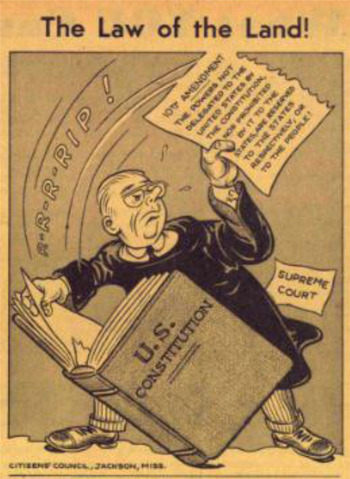
To treat massive resistance as a constitutional claim is not to legitimize its substantive views. However, our ability to understand what the movement meant and what results it was able to achieve may depend upon recognizing the extent to which its supporters viewed themselves not as law-breakers, but as defenders of the Constitution. Writing in Harper's Magazine, Thomas Waring denounced the Supreme Court's “flouting of the Constitution for political reasons.”Footnote 77 In the American Bar Association Journal, Georgia's attorney general warned: “the Court has thus dealt a vital blow to the very heart and framework of our constitutional republic,” that “the Constitution is whittled away without a vote of the people or consent of the states,” signaling “death to liberty in America.”Footnote 78 In an essay first appearing in US News but widely circulated by Southern newspapers and Citizens' Council publications, former Supreme Court Justice James F. Byrnes explained to Northerners why “the trend of the Court is disturbing to millions of Americans who respect the Constitution” (see Fig. 3).Footnote 79 Appealing to extrajudical sources of law (in Cover's sense of jurisgenesis), Byrnes allows that Brown “must be accepted by the courts of the United States and the states, but not necessarily by the court of public opinion. The people are not the creatures of the Court. The Court is the creature of the people.”Footnote 80 Byrnes would not have understood this charge as a call for lawlessness. That public opinion could serve as a court, in judgment of Brown, was more than a metaphor, it was an appeal to a higher constitutional authority.
Citizens' Council cartoon, 1956 The Citizens' Council (Jackson, MS), Vol. 2, No. 2, November, 1956, 2.

Because the actions of courts and the meaning of law are so thoroughly fused in most accounts, it is easy to miss the constitutional claim that necessarily backs Southern rejections of Brown's legitimacy. And yet, the challenge to Brown's validity as law necessarily implies an underlying principle of constitutional fidelity, which the case is said to have violated.Footnote 81 In this regard, it is critically important to recognize that segregationists attacked the Court, not the Constitution. In so doing, they insisted upon extrajudicial sources of constitutional lawmaking, and, therefore, may be understood as a less benign example of what recent scholars have called “popular constitutionalism.” In The People Themselves, for example, Larry Kramer portrays a particularly stark choice between popular constitutionalism and judicial supremacy.Footnote 82 The courts may have final authority over constitutional law, he argues, but the Constitution belongs to the people, represents their fundamental values and beliefs, and ought not be surrendered to “aristocratic” and antidemocratic legal institutions. Kramer's is a normative argument against judicial supremacy, which he understands as a threat to popular constitutionalism, just as “constitutional law” threatens “the Constitution” in his terms. Given its explicit embrace of white supremacy, massive resistance would, therefore, seem to present the limiting case for positive normative judgments about popular constitutionalism as such.Footnote 83
Aside from the normative question of popular constitutionalism's desirability, reading massive resistance as a constitutional claim also sheds light on the role that political mobilization plays in creating constitutional meaning. It is perhaps a truism that political contestation substantially influences legal decision making, but the history of massive resistance speaks more precisely to the role that social movements play in that process. As Balkin and Siegel have noted, social movements can be effective “disruptors” of received understandings of what the law is, or how it should be extended to new historical circumstances.Footnote 84 Consequently, social movements often can “change the social meaning of constitutional principles and the practices they regulate.”Footnote 85 However, the manner in which massive resistance influenced constitutional law is also important, as it directs our attention away from legal advocacy—the traditional object of study in this regard—and toward the deployment of racial violence in pursuit of a particular constitutional vision. The next section looks more closely at how extralegal violence and threats of violence associated with massive resistance to school desegregation were absorbed into law.
Massive Resistance, Violence and the Law
The successful defense of segregation at the University of Alabama in 1956 would appear to be a clear-cut case of violence triumphing over law: in keeping with her qualifications, Judge Grooms of the District Court ordered that Autherine Lucy be admitted to the graduate school; with the tacit encouragement of state and local authorities, violent mobs turned her away (see Fig. 1). The lesson seemed plain enough: “Federal Court orders could be forcibly nullified—provided that sufficient elements of the white power structure countenanced or encouraged it.”Footnote 86 This much is unquestionably true, but it would be a mistake to think that the violence that ensured Ms. Lucy's exclusion was contained solely in the actions of the mob outside, and not in the legal dealings within the courts and university administration. Without denying that violence nullified desegregation in this case, we might still inquire to what extent that violence was enacted through law, not only against it. Seen this way, the case serves to undermine rather than reinforce common assumptions about law's relationship to violence and massive resistance's relationship to law.
First, in the most literal sense, violent protests alone did not prevent Ms. Lucy from entering the school. Rather, the mob was sufficiently disruptive, and their threat sufficiently credible, as to compel state officials to escort her from campus under armed guard. Soon after, the university suspended her, ostensibly “for her own safety.” The incident thus fits a general pattern of intimidation in which Citizens' Councils and other massive resistance groups would actively circulate rumors of violence in order later to denounce integration as impracticable for reasons of public safety.Footnote 87 Segregationist warnings, that is, often turned out to be threats. And yet, it is significant that Autherine Lucy's encounter with this violence was located as much in the decision making of school officials as in the street: violence appeared in the form of legal action, as an integral part of the administrative and legal proceedings governing the suspension.
Peltason's description of these proceedings is revealing. Characterizing the University of Alabama Board of Trustees as “caught between the orders of Judge Grooms and the pressure of the segregationists,” Peltason poses the question: “Whom would they obey?”Footnote 88 Clearly, Peltason does not regard both sets of commands as legitimate. One is backed by law, the other backed by the mob. But at the same time, Peltason's language of competing commands betrays a certain anxiety that the question of whose violence will be counted as law is not an entirely settled matter. The deliberate pairing of the two sets of commands—one judicial and one popular—thus twins the appeals to law even while placing them in opposition. It is because both commands claim rightfully to speak on behalf of the law that the Board is put to the question: Whom would they obey?
The Board of Trustees was evidently divided on this question and decided not to take action, effectively shifting responsibility for the decision back onto Judge Grooms, who was urged by Ms. Lucy's attorneys to cite the Board for contempt for conspiring with the rioters, and for her suspension. Contempt thus became the legal instrument relating the actions of university officials to the actions of the mob gathered in protest outside their windows. While continuing to insist that segregation was illegal, Judge Grooms nonetheless declined to issue the contempt order, and so implicitly gave credence to the university's position that their actions were intended to maintain order, not to defy his initial desegregation order. When the university expelled Lucy (in retaliation for seeking the contempt order against the trustees), Judge Grooms allowed the expulsion on the grounds that it was “for disciplinary and not racial reasons.”Footnote 89 In this sense, Judge Grooms effectively obeyed the orders of the protesters, whose violence was thereby transformed into a properly legal justification for delay.
In sharp contrast to the racist violence of the mob outside, public safety and disciplinary rationales could at least claim to be race neutral. In this way, the legal process served to translate overtly racist violence into facially race-neutral law while nonetheless leaving the underlying social conditions virtually unchanged. Desegregation may have been nullified by violence, but that violence was as much a part of the legal process as it was in the street. What kept Autherine Lucy out of the University of Alabama was not the mob itself, but the threat of violence incorporated into the legal process.
This was emphatically not the view taken by the United States Supreme Court when it finally intervened, decisively, to reject the argument that violent opposition to school desegregation could serve as a legal justification for delaying Brown's implementation. The occasion for this intervention was Little Rock, which is remembered almost exclusively within the narrative frame of “violence vs. law,” but which also presents a more complex relationship between the two. This point was not lost on white Southerners whose experience of “law” in the Little Rock crisis took the form of tanks and armed federal troops more than judicial robes and desegregation decrees. Many segregationists viewed Eisenhower's use of military force as symbolic of the absence of constitutional legitimacy behind “forced integration,” and turned this symbolism to great political effect. Images of the soldiers circulated widely in a “Remember Little Rock” campaign that recalled Yankee occupation after the Civil War and at times suggested that troops had bayoneted or raped white girls at Central High.Footnote 90 For some, the use of military power against United States citizens seemed to buttress conservative accusations that the civil rights movement was part of a communist conspiracy. In 1954, Judge Tom Brady's extravagantly paranoid and considerably popular “Black Monday” pamphlet repackaged the old Birth of a Nation mythology in the form of a Communist plot, warning that “a black empire was to be established in the Southern States of this nation, ruled by negroes […] on behalf of Communist Russia.”Footnote 91 After Little Rock, R. Carter Pittman's “Federal Invasion of Arkansas In Light of the Constitution” ran in local newspapers and state bar journals before being entered into the Congressional Record.Footnote 92 By 1963, in the wake of violent conflicts surrounding James Meredith's enrollment at Ole Miss, hard right anti-Communists remembered “Operation Little Rock” as “a trial balloon” for plans “to invade the South by the brutal use of armed federal force,” and presented “the invasion of Mississippi” as “nothing less than the opening scenes of the police state which is being rapidly established in the United States.”Footnote 93
One need not embrace the extreme views of the segregationists to recognize what was at stake in the conflict. The hypervisibility of law's violence, in Cover's sense of the term, opened a rhetorical space in which it became possible for segregationists to contest assumptions about whose actions represented law and whose represented violence. Beneath the narrative frame of “law vs. violence” lurks a more disturbing version of Cover's question about the role of violence in determining whose law will triumph.
In sharp contrast to the Autherine Lucy case, and no doubt motivated by the need to remove incentives for Alabama-style mob nullification, the Supreme Court called a special session in August of 1958 for the sole purpose of rejecting a petition by the Little Rock School Board that sought to postpone its gradual desegregation plan. Despite having established itself as an agent of racial moderation, and despite its Court-recognized “good faith” effort to comply with Brown,Footnote 94 the school board's argument was virtually identical to that made earlier by the University of Alabama: “because of extreme public hostility… a sound educational program at Central High School, with the Negro students in attendance, would be impossible.”Footnote 95 The Court's sense of urgency to reject this claim stemmed from the recognition that failure to do so would amount to an incorporation of segregationist violence into the legal apparatus. Mob violence would prevail, and it would do so precisely by virtue of being channeled through law.
The Court's rejection of this claim was, therefore, understandably fierce, and came in the form of a unanimous and scathing opinion in Cooper v. Aaron.Footnote 96 The opinion seethed with righteous anger on behalf of the Constitution, which it presented as a potential victim of the violent mob: “No state legislator or executive or judicial officer can war against the Constitution without violating his understanding to support it.”Footnote 97 Justice Frankfurter hammered this point home in a separate concurring opinion, warning that such a claim would “enthrone official lawlessness” which, “if not checked is the precursor to anarchy,” and vowing not to allow “that law should bow to force.”Footnote 98 Stripped of even the possibility of a conflict between competing formulations of law, all that remains is the stark choice between law and chaos. On one side right, violence entirely on the other.
And yet, dismissing the school board's claim turned out to be somewhat more difficult than this Manichean distinction would suggest. In part, this was because Brown II explicitly allowed federal courts to consider the practical difficulties of implementation, which the Little Rock crisis might be taken to represent. It did so by making a critical distinction: “Courts of equity may properly take into account the public interest in the elimination of such obstacles in a systematic and effective manner. But it should go without saying that the vitality of these constitutional principles cannot be allowed to yield simply because of disagreement with them.”Footnote 99
Clearly, the violence of massive resistance calls into question the distinction between “public interest,” which may include such factors as public safety and effective education, and “simple disagreement,” which suggests ideological differences rather than legitimate practical concerns. This disturbing possibility was underscored by the concession, in Cooper, that Brown II permitted lower courts, after consideration of all “relevant factors,” to conclude that justification existed “for not requiring the present nonsegregated admission of all qualified Negro children.”Footnote 100 Strictly speaking, the school board did not seek to be released from Brown's mandate; rather, it claimed that the refusal to implement its desegregation plan was actually in compliance with Brown, as it was motivated by concern for public safety rather than racial animosity. The Court therefore faced a difficult problem. How could it reject the school board's petition (which obviously had to be done), without contradicting its recognition of “public interest” as a legitimate basis for consideration? How could it keep violence on one side and law on the other?
Framed narratively as a defense of judicial supremacy against “official lawlessness,” Cooper's solution was to insist that interposition and street violence were inextricably linked. Mob violence was the predictable result of intransigent actions taken by state officials for reasons of simple disagreement with the decision. The school board had acted in good faith, but the governor and legislature clearly had not, and their actions in turn had provoked the mob. The conditions rendering integration unworkable were, therefore, “directly traceable to the actions of legislators and executive officials of the State of Arkansas,” reflected “their own determination to resist this Court's decision in the Brown case,” and had “brought about violent resistance to that decision.”Footnote 101 As evidence of this direct link, the Court counted the following: formation of a state sovereignty commission; passage of a constitutional amendment requiring the Arkansas General Assembly to oppose “in every Constitutional manner the Un-constitutional desegregation decisions of May 17, 1954 and May 31, 1955;” repeal of compulsory school attendance laws; the making of statements “vilifying federal law and federal troops;”Footnote 102 and, eventually, Governor Faubus's deployment of the Arkansas National Guard to prevent integration of Central High.Footnote 103Cooper thus rejected Little Rock's petition to delay desegregation for public safety reasons, but it did so without denying either that exceptions could be justified under certain conditions, or that such conditions existed in Little Rock.
It is in this context that we must understand the broad pronouncements, in dicta, for which the case is best remembered: “The constitutional rights of respondents are not to be sacrificed or yielded to the violence and disorder which have followed upon the actions of the Governor and Legislature… the Brown case cannot be nullified openly and directly by state legislators or state executives or judicial officers, nor nullified indirectly by them through evasive schemes for segregation whether attempted ‘ingeniously or ingenuously.’”Footnote 104
The Court knew that it must attribute mob violence to the words and actions of state officials because it was this move that would suture the question of street violence and public safety (an admittedly legitimate basis for evading Brown) onto even the most legalistic of “evasive schemes.” The Court's narrative therefore sought to restore law's innocence by refusing to recognize the legality of segregationist legal appeals, treating them as just so much violence dressed-up as law, responsible for, and nearly indistinguishable from, violence in the streets.
The Court's rebuke to massive resistance betrayed a fierce insistence upon judicial supremacy that was notably distinct from its concern for the rights and welfare of the African-Americans who advanced constitutional challenges to Jim Crow segregation. Just as Eisenhower had insisted that his order was neither for nor against segregation, but intended only “to maintain or restore order and… prevent violence,” the Court's ire was directed at a perceived “war on the Constitution” rather than a war on African-Americans or African-American civic participation.Footnote 105 In the Court's response to massive resistance, the law itself came to replace Black bodies as the ultimate victim of white supremacist violence.
That moderate strategies of evasion were more successful at preserving racial segregation than was open defiance is sometimes taken as evidence that massive resistance inadvertently contributed to the advance of civil rights rather than preventing it. Anders Walker argues that white extremists “actually helped the movement rouse national support and muster federal action in favor of the civil rights struggle by projecting a particularly negative image of the South.”Footnote 106 Similarly, Klarman notes, “massive resistance may have come back to haunt white southerners,” as “the justices eventually grew tired of the endless evasion and bad faith, and they adjusted constitutional and other doctrine in response.”Footnote 107 It is undoubtedly true that extremist violence provoked federal intervention in the South in ways that legalistic evasion strategies did not. And Walker is definitely right to emphasize the rise of Southern moderates as a key factor in the decline of the civil rights movement and retreat from Brown's constitutional vision.Footnote 108 Nonetheless, by recognizing the permeability of the boundary between law and violence, we may come to see these findings in a somewhat different light.
First, whereas the overt racism and violence of massive resistance did provoke a federal backlash, it was nonetheless a concerted effort to influence constitutional law, and was not entirely unsuccessful in this regard. By raising the costs of federal intervention and creating “facts on the ground” that could not be ignored, segregationist violence generated strong incentives for the Court to accept moderate alternatives that it might otherwise have rejected. In the aftermath of Little Rock, Cooper's tough language not withstanding, the Court would prove to be far more accepting of “indirect nullification”—ingenious and ingenuous—than it was with massive resistance. Ironically, it was just this sort of political calculation that constrained the scope of remedies in Brown II, and led the Court to embrace gradualism over immediate compliance: “the justices feared that immediate desegregation would cause violence and school closures. White southerners campaigned to convince them of this.”Footnote 109 After Little Rock, the Court was especially careful not to undercut the position of Southern moderates, to whom Justice Frankfurter openly appealed in his Cooper opinion. In a per curium decision just months after Cooper, the Court upheld a pupil placement law that had been passed as part of Alabama's massive resistance package for the express purpose of circumventing Brown.Footnote 110 Shortly thereafter, it upheld Nashville's grade-a-year plan, in part because, as Circuit Judge J. Skelly Wright put it, “another Little Rock must be avoided.”Footnote 111 The Court may not have recognized massive resistance as a constitutional claim; it was, nonetheless, influenced by it.
Second, although federal authorities and Southern moderates clearly shared an aversion to unseemly (and politically costly) street violence, the regime of “strategic constitutionalism” that replaced Jim Crow was perhaps even more violent than its predecessor, even if this violence tended to be concealed beneath discourses of crime and public safety, economic development, or individual rights. Viewed in this way, we can fill out Anders Walker's account of Brown's role in expanding and modernizing state power. Walker convincingly showed how moderate governors such as J. P. Coleman, Luther Hodges, and LeRoy Collins mobilized the rhetoric of “law and order” (often in direct opposition to interposition resolutions) to discredit massive resistance candidates as sources of lawlessness and racial unrest. Institutionally, this included reform programs in the areas of policing and criminal justice, centralizing and expanding state police powers to counter the power of white vigilantes, the Ku Klux Klan, and local police who either refused to prosecute or actively participated in extralegal violence. However, the centralization of police power also supplied a potent weapon against civil rights activists who were subject to unprecedented levels of surveillance by the state, including infiltration of civil rights groups by paid informants.Footnote 112
And it was not just activists who found themselves increasingly the targets of expanded police power. As Naomi Murakawa has shown, the rapid post-civil rights expansion of the prison system (massive new prison construction, mandatory minimum sentence requirements, the death penalty) “developed in tandem with the struggle for black civil rights in the postwar period,” as political leaders “explicitly and routinely addressed black civil rights in terms of crime.”Footnote 113 In this regard, Southern moderates were not far removed from hard-right segregationists such as George Wallace, whose ascendency to national politics demonstrated the viability of rearticulating Jim Crow racism into the “coded” racism of New Right conservatism, and whose hallmark “tough on crime” agenda has since been accepted in large part by both major political parties.Footnote 114
The link between race and the rise of conservative populism in American politics is typically debated in terms of attacks on “big government” business regulation, welfare, and the like. And yet, anti-statist conservatives overwhelmingly aligned with, not against, the unprecedented expansion of prisons and prison populations in the post-civil rights era. In a process of “hyper-incarceration” that Loïc Waquant links genealogically with slavery, the total population of state and federal prisons swelled from only 380,000 in 1975 to roughly 2,000,000 by century's end, and now stands just over 2,400,000.Footnote 115 In 2009, more than 7,200,000 people (approximately 1 in every 32 adults) were on probation, in jail or prison, or on parole at year end.Footnote 116 This unprecedented expansion of state violence has principally targeted African-Americans (or more precisely, poor African-American men). Since the end of World War II, the ethnoracial makeup of convicts flipped from 70% white in the 1940s to “70 percent African American and Latino versus 30 percent white by century's end.”Footnote 117
The heightened levels of incarceration and police surveillance authorized by “law and order” politics reveals disturbing continuities between violence and law, which undermine the assertion that moderates intended to “rein in violence,”Footnote 118 or that they acted from “aspiration… rather than repression.”Footnote 119 If Walker is right that Southern moderates were “motivated by hope”—whereas massive resistance was “motivated by hate”Footnote 120—the racial vision they hoped for nonetheless included an intensification of state repression that concentrated violence within legal institutions rather than reducing or eliminating it. The result was an unprecedented shift to mass incarceration as a form of racial control, which Michelle Alexander has aptly named “the new Jim Crow.”
Ironically, by turning to discourses of “law and order” as a way to discredit massive resistance, Southern moderates joined civil rights leaders in their refusal to recognize the jurisgenerative potential in massive resistance's violence. Moderate segregationists and civil rights activists both regarded open defiance of Brown as a rejection of law and not as an effort to generate constitutional meaning. However, in turning the rhetoric of “law and order” against civil rights, massive resistance leaders joined Southern moderates in linking discourses of crime and criminality to black demands for social and economic equality. Politically, the effect was to relocate anti-black violence inside the state, as “justice” rather than “mob rule.” For white Southerners, the strategy had obvious benefits, not the least of which was to project an image of the New South that more easily conformed to racial common sense at a national level, thereby removing a key obstacle to economic development and attracting Northern capital investment. For African-Americans, however, in the North as well as the South, the turn to “law and order” and the expansion of police power that it authorized, had more ominous results, helping to lay the groundwork for the mass incarceration that we see today.
Conclusion
Cooper v. Aaron may be understood as the judicial beginning of the end for massive resistance. The decision sent a message to Southern extremists, both that open defiance of Brown carried a heavy price—a price imposed by the executive branch in the form of military force—and that the Court would not back down in the face of violent confrontation. The decision thus forced a choice between token integration and wholesale school closings, against which moderates were able successfully to mobilize and take power. In Cooper, then, the Court put down a rebellion: a “war against the Constitution.” But what was the nature of the rebellion they quashed?
As it is typically remembered, massive resistance represented a violent, illegal, and ultimately futile effort to prevent the modernization of Southern race relations. In popular memory, this progress narrative serves to confirm our own racial innocence, and occludes the institutional mechanisms through which racial privilege is maintained in the post-civil rights era. Recent interest by historians in the role of Southern moderates reminds us that Jim Crow segregation laws and overt acts of discrimination were not, in the end, necessary to preserve racial stratification. It is tempting, therefore, to read massive resistance as an antiquated and violent rejection of core constitutional principles. This view represents the self-understanding of the Court in Cooper, as well as that of most legal scholars. Nonetheless, it is a view that relies heavily upon the sharp distinction between law and violence, which in turn distorts a proper understanding of the massive resistance era, as well as our own. The Court meant to rescue the Constitution from the threat of mob rule and extralegal violence. What they put down was a violent defense of a law they (rightfully) refused to recognize. In its place they left a suitably legalistic system of racial subordination, which is no less violent for that fact.