INTRODUCTION
The world is filled with a variety of causal events. Animate beings like little boys intentionally throw balls and accidentally topple towers. Inanimate entities like the sun can heat a lake, while tools like baseball bats can clobber balls out of the park. Preverbal infants seem to perceive aspects of motion events similarly across cultures (Bowerman & Choi, Reference Bowerman, Choi, Gentner and Goldin-Meadow2003; Choi & Bowerman, Reference Choi and Bowerman1991; Göksun, Hirsh-Pasek & Golinkoff, Reference Göksun, Hirsh-Pasek and Golinkoff2010; Göksun, Hirsh-Pasek, Golinkoff, Imai, Konishi & Okada, Reference Göksun, Hirsh-Pasek, Golinkoff, Imai, Konishi and Okada2011; Hespos & Spelke, Reference Hespos and Spelke2004, Reference Hespos, Spelke, Aurnague, Hickman and Vieu2007; Maguire et al., Reference Maguire, Hirsh-Pasek, Golinkoff, Imai, Haryu, Vanegas and Sanchez-Davis2010; Mandler, Reference Mandler2004; McDonough, Choi & Mandler, Reference McDonough, Choi and Mandler2003). As children begin to learn language, however, they must communicate these events in ways that are specific to their native tongue. When children learn mappings between the world and their grammar and how this learning occurs over development are central questions in the study of language development.
Languages differ greatly in how they encode events (Clark, Reference Clark2003). For example, at 14 months of age, both English- and Japanese-reared infants are sensitive to a categorical distinction among the grounds upon which an agent moves. This ground distinction is realized in the Japanese verb system but not in the English verb system. Japanese has separate verbs for going across a bounded space, such as a railroad track, and for going across an unbounded space, such as a grassy field (wataru and tooru, respectively). In contrast, both instances are denoted by the same expression go across in English. By 19 months of age, English- and Japanese-reared infants diverge in how they encode these events, as only Japanese-reared infants maintain the sensitivity to different types of grounds (Göksun et al., Reference Göksun, Hirsh-Pasek, Golinkoff, Imai, Konishi and Okada2011). Shifts from universal to language-specific ways of carving up events can also be found in expressions of PATH (the trajectory of the motion) and MANNER of motion (how an action is performed; Maguire et al., Reference Maguire, Hirsh-Pasek, Golinkoff, Imai, Haryu, Vanegas and Sanchez-Davis2010). Another example of this shifting pattern is the spatial distinction between TIGHT- and LOOSE-FIT in containment (when something is in a container) and support (when something is on a surface), relations that are realized in the verb system of Korean but not of English (Bowerman & Choi, Reference Bowerman, Choi, Gentner and Goldin-Meadow2003; Choi, Reference Choi2006; Choi & Bowerman, Reference Choi and Bowerman1991; McDonough et al., Reference McDonough, Choi and Mandler2003). Whereas both English- and Korean-reared five-month-olds can form tight- and loose-fit categories when they view non-linguistic events, only Korean-reared children maintain these distinctions later on. This paper focuses on another underexplored area wherein languages carve events differently: how children learn which aspects of events can serve as the subject in a lexical causative sentence that describes a causative situation.
According to Talmy (Reference Talmy2000), “the basic causative situation consists of three main components: a simple event (that is, one that would otherwise be considered autonomous), something that immediately causes the event, and the causal relation between the two” (p. 480). For example, when Peter breaks a branch, there is a causal relation between the simple event (i.e. the branch breaking) and the event that immediately caused it (i.e. Peter's action; George, Reference George2014). To describe causative situations, speakers of English may use lexical causatives (e.g. Peter broke the branch), periphrastic causatives (e.g. Peter caused the branch to break), causal conjunctions (e.g. because), prepositions (e.g. because of), and resultatives (e.g. Peter sanded the stick smooth; Wolff, Reference Wolff2003).
One of the simplest ways to describe causative situations is by using lexical causative sentences, single-clause sentences involving transitive verbs that encode both the cause and the effect in their meanings (e.g. Peter broke the branch; Muentener & Lakusta, Reference Muentener and Lakusta2011; Wolff, Reference Wolff2003). Even though the lexical causative construction is found across languages and offers a very simple way to describe causal relations, languages differ greatly in what can serve as the subject of a lexical causative (Fausey, Long, Inamori & Boroditsky, Reference Fausey, Long, Inamori and Boroditsky2010; Kuno, Reference Kuno1973; Wolff, Jeon, Klettke & Li, Reference Wolff, Jeon, Klettke, Li, Malt and Wolff2010; Wolff et al., Reference Wolff, Jeon and Li2009), or what Wolff et al. (Reference Wolff, Jeon, Klettke, Li, Malt and Wolff2010) referred to as the CAUSER.
In this paper, we use the term ‘causer’ to refer to the subject of a lexical causative sentence. We recognize, however, that the term ‘causer’ can be somewhat confusing because there has been disagreement about its definition. For example, according to Alexiadou and Schäfer (Reference Alexiadou, Schäfer, Baumer, Montero and Scanlon2006), a CAUSER refers to an inanimate entity that can cause an event on its own (e.g. storm in The storm broke the branch). When a person causes an event, in contrast, the thematic role of a lexical causative would be an AGENT (e.g. Peter in Peter broke the branch; Alexiadou & Schäfer, Reference Alexiadou, Schäfer, Baumer, Montero and Scanlon2006). Whereas some theorists maintain a strict distinction between Agents and Causers (Alexiadou & Schäfer, Reference Alexiadou, Schäfer, Baumer, Montero and Scanlon2006; Kallulli, Reference Kallulli, Hole, Meinunger and Abraham2006), others claim that, as Agents and Causers can both appear in the subject position of sentences, there is no significant difference between the linguistic behaviors of the two (Chomsky, Reference Chomsky1995, Reference Chomsky and Kenstovicz2001; Kratzer, Reference Kratzer, Rooryck and Zaring1996; Schlesinger, Reference Schlesinger1989; Van Valin & Wilkins, Reference Van Valin, Wilkins, Shibatani and Thompson1996). Despite this disagreement, however, there must be overlap between the two thematic roles because an Agent is often causing a change (Reinhart, Reference Reinhart2002). Even an INSTRUMENT (e.g. hammer in The hammer broke the branch), although not autonomous, can cause an event and appears in the subject position when it determines the outcome and works as the ultimate cause of the event (Croft, Reference Croft and Tomasello1998). We chose to use the term ‘causer’ as it can encompass different entities whether they are animates or inanimates (Reinhart, Reference Reinhart2002).
In some languages like Japanese, the causer is generally animate and intentional. Other languages, like English, use various causers in the subject position. These causers range from animate beings like little boys, to inanimate objects like baseball bats. Cross-linguistic differences in causal language are also apparent in the use of causal verbs such as ‘make’ or ‘let’ among English, Russian, and German speakers (Klettke & Wolff, Reference Klettke, Wolff, Alterman and Kirsh2003; Wolff & Ventura, Reference Wolff and Ventura2009). Languages also differ in their mapping of syntactical structure to causal events. When asked to rate the acceptability of descriptions for object-mediated causal events (e.g. a girl accidentally bounces a ball off her foot, the ball hits a vase, and the vase breaks), English and Chinese speakers rate bi-clausal causative sentences (e.g. The girl caused the ball to break the vase) as highly acceptable, whereas Korean speakers do not (Wolff, Jeon & Yeh, Reference Wolff, Jeon and Yeh2006). Research on causers is particularly interesting among a variety of topics in the research of causal language because multiple dimensions such as animacy, intentionality, and the level of energy generation seem to jointly influence which participant in causal chains will be marked as the causer.
What determines causers?
ANIMACY, or the distinction between living and non-living beings, may be a universal determinant of what is considered to be a ‘good’ subject in these sentences, as all languages seem to prefer animate causers to inanimate causers. Whereas animate beings are capable of initiating actions and causing events without any external force acting upon them, inanimate entities cannot make things happen without the help of gravity or another animate agent (Golinkoff, Harding, Carlson-Luden & Sexton, Reference Golinkoff, Harding, Carlson-Luden, Sexton and Lipsitt1984). Animacy is manifested in a number of linguistic phenomena (Becker, Reference Becker2014; Comrie, Reference Comrie1989; Dahl & Fraurud, Reference Dahl, Fraurud, Fretheim and Gundel1996; de Swart, Lamers & Lestrade, Reference de Swart, Lamers and Lestrade2008; Yamamoto, Reference Yamamoto1999), which has led several linguists to develop the idea of the animacy hierarchy, ranging from the most to the least animate (Human > Animal > Inanimate; e.g. Comrie, Reference Comrie1989; Croft, Reference Croft2003; Dixon, Reference Dixon1979; Silverstein, Reference Silverstein and Dixon1976). Nouns that are higher in the hierarchy (e.g. human) are more likely to be the subjects of sentences. Researchers who study agency also suggest that animate agents are generally encoded in the subject position (Baker, Reference Baker1989; Belletti & Rizzi, Reference Belletti and Rizzi1988; Fillmore, Reference Fillmore, Bach and Harms1968; Givón, Reference Givón1984; Grimshaw, Reference Grimshaw1990; Jackendoff, Reference Jackendoff1972, Reference Jackendoff1990; Van Valin, Reference Van Valin1990). In sum, research suggests that animate beings are accepted as better causers than inanimate entities.
Although humans distinguish animate beings from inanimate entities across cultures, some languages emphasize animacy more than others. Kuno (Reference Kuno1973), for example, reported that in Japanese, transitive sentences, “with few exceptions, require higher animals as their subjects” (p. 31; see also Palmer, Reference Palmer1986; but see Pardeshi & Yoshinari, Reference Pardeshi and Yoshinari2012). By way of example, Kuno suggests that a lexical causative sentence in (1a) is ungrammatical in Japanese even though the same sentence structure is fully acceptable in English. Japanese speakers may instead use a non-causative verb as in (1b) and (1c).Footnote 1 It must be noted that there is some, though rare, use of inanimate causers in Japanese. Tsunoda (Reference Tsunoda1991), for example, used the sentence ‘Oomizu ga kaoku o osinagasita (flood NOM houses ACC swept-away)’, which roughly means ‘a flood swept away houses’, as an example of grammatical transitive sentences with inanimate subjects. We agree with Kuno, however, that there is a general trend whereby Japanese is more likely to require an animate subject than other languages like English.
-
(1)
-
a. *Taihuu ga mado o kowasita.
typhoon nom window acc broke (transitive verb)
‘The typhoon broke the window.’
-
b. Taihuu de mado ga kowareta.
typhoon by window nom broke (intransitive verb)
‘The window broke because of the typhoon.’
-
c. Mado ga kowareta.
window nom broke (intransitive verb)
‘The window broke.’
-
While some researchers suggest that causers generally rely on animacy (e.g. Kuno, Reference Kuno1973; Palmer, Reference Palmer1986), others claim that INTENTIONALITY is the key feature that predicts what can serve as the subject of a lexical causative sentence (Comrie, Reference Comrie1989; DeLancey, Reference DeLancey1983; Huddleston, Reference Huddleston1970; Kiparsky, Reference Kiparsky, Alsina, Bresnan and Sells1997; Schlesinger, Reference Schlesinger1989). Perhaps animacy only appears as an essential element in causal language because animate beings are more likely to be intentional. In fact, psycholinguistic research has demonstrated that intended and unintended events are described differently in many languages. For example, Wolff (Reference Wolff2003) found that English-speaking adults preferred to use lexical causative sentences (e.g. The girl broke the vase) over periphrastic causative sentences (e.g. The girl made the vase break) only when a person intentionally caused events. The same pattern of linguistic encoding was also found in a production task (Song & Wolff, Reference Song, Wolff, Achard and Kemmer2005).
Intentionality of causers is also differentially realized across languages. Fausey, Long, Inamori, and Boroditsky (Reference Fausey, Long, Inamori and Boroditsky2010) asked English- and Japanese-speaking adults to describe various causal events. Reflecting the universal sensitivity to intentionality, both English and Japanese speakers mentioned intentional causers more often than accidental causers. When speakers of the two languages were compared, however, the study found that English speakers paid relatively less attention to intentionality than Japanese speakers did. English speakers sometimes used the same sentence, He popped the balloon, to talk about a person who accidentally popped a balloon and to talk about a person who intentionally pierced a balloon with a tack. Japanese speakers, in contrast, avoided using causal descriptions when the actor popped the balloon accidentally and preferred to use an intransitive form of the sentence (e.g. Huusen ga wareta ‘The balloon popped’; see also Fausey & Boroditsky, Reference Fausey and Boroditsky2011, for similar results with English and Spanish speakers).
Importantly, while both animacy and intentionality seem to play a role in determining the causers, neither can fully account for what can serve as the subject in a lexical causative sentence. Animate beings in sentences with English verbs such as break or lose often lack intention, but can nonetheless serve as causers (DeLancey, Reference DeLancey1984). Inanimate beings without intention, such as natural forces (e.g. ‘wind’), also serve as causers in many languages. Wolff and colleagues thus introduced a third dimension, the level of a causer's ENERGY GENERATION, to describe how inanimate causers are conceptualized (Wolff et al., Reference Wolff, Jeon and Li2009; Wolff et al., Reference Wolff, Jeon, Klettke, Li, Malt and Wolff2010). According to Wolff et al., the level of energy or force an object can generate determines whether the object can serve as a good causer.
Wolff et al. (Reference Wolff, Jeon and Li2009) asked English-, Chinese-, and Korean-speaking adults to rate the acceptability of various lexical causative sentences and found that speakers of these languages are sensitive to the level of energy generation. For example, a machine like a microwave can often serve as a causer, but a tool like a knife with low or no energy generation is rarely used as a causer. Although speakers of all three languages showed sensitivity to the energy generation level of causers, there was some marked variability in their ratings. Korean speakers gave relatively lower ratings (about 65 out of 100 on average), even to sentences with high-energy-generating causers (e.g. ‘The air conditioner cooled the room’) whereas English speakers regarded them as highly acceptable (over 80 out of 100).
In accord with this result, Kanero, Hirsh-Pasek, and Golinkoff (Reference Kanero, Hirsh-Pasek and Golinkoff2014) found that, when describing events in their own words, English-speaking adults used high-energy-generating causers more often than low-energy-generating causers, whereas Japanese speakers rarely used either type. English- and Japanese-speaking adults were presented with fifty-six pairs of pictures depicting the initial and end states of various causal events. They were then asked to describe the events in a sentence using their own words. A regression analysis revealed that energy generation levels of objects predicted the frequency with which English speakers, but not Japanese speakers, used the objects as the subjects of sentences.
It appears then that no single factor determines what can serve as the subject of a lexical causative sentence. Instead, various dimensions, such as animacy, intentionality, and the level of energy generation, acting in concert, must be considered when mapping aspects of the world onto the semantics of language.Footnote 2 These patterns are evident in adult cross-linguistic use of causal language. But how do children acquire the patterns of expression that are used in their language? As Bowerman and Levinson stated: “The central problem is how do children, from an initially equivalent base, end up controlling often very differently structured languages?” (Reference Bowerman and Levinson2001, p. 10).
Muentener and Lakusta (Reference Muentener and Lakusta2011) were the first to explore this question with regard to causal language. In their study, preschoolers (3;6 to 4;0) watched videos of a person intentionally causing events, a person accidentally causing events, and an object causing events. Two puppets explained the events using causal descriptions and non-causal descriptions, and children were prompted to decide which was a ‘better story’. For example, in one of the video clips, a girl moved a pen to pop a balloon, and the balloon popped. One puppet described the event as the girl made the balloon pop (causal description) whereas the other puppet said the girl moved the pen (non-causal description). Children preferred causal descriptions for intentionally caused events but not for accidentally or object-caused events. Muentener and Lakusta concluded that there is an ‘intention-to-CAUSE bias’ in young children.
Muentener and Lakusta (Reference Muentener and Lakusta2011) solely focused on English-speaking children's early biases; therefore, several important issues were left unexplored. First, English-speaking adults allow animate beings as well as inanimate beings to be causers. Thus, children must, at some point, broaden the class of causers to include inanimate causers. That is, English-reared children learn that sentences such as The microwave heated up the coffee are acceptable. When and how do they learn to do this? Second, Muentener and Lakusta present general claims about linguistic encoding of causers while focusing only on English speakers. Given the variability of the encoding patterns across languages, a cross-linguistic approach is imperative to answer this question. Finally, seven out of eight object-caused events used by Muentener and Lakusta were unusual ones in which a ball was thrown into a scene by an off-camera person not seen in the video. A ball in such events is a projectile that often appears as the subject of a lexical causative sentence even in languages with many restrictions on what qualifies as a causer (e.g. Japanese; Wolff et al., Reference Wolff, Jeon and Li2009; see also Fillmore, Reference Fillmore, Bach and Harms1968; Jackendoff, Reference Jackendoff1990). Perhaps preschoolers’ sensitivity to different types of inanimate causers was not fully demonstrated in Muentener and Lakusta's study due to their limited choice of stimuli.
Present study
The present study extends the work by Muentener and Lakusta (Reference Muentener and Lakusta2011) to ask when children exposed to very different languages learn which entities can function as the subject of a simple lexical causative sentence and how the shift occurs over development. We targeted three- and four-year-olds, following Muentener and Lakusta, as our study was designed based on their work. We tested two age groups, as our interest was in exploring developmental changes. Two primary questions guided this research: (1) Which dimension(s) – animacy, intentionality, or the level of energy generation – do children favor when determining how to describe causal events? and (2) When and how do English and Japanese speakers diverge with respect to the kinds of objects that can serve as causers? We hypothesize that, in accord with previous literature (e.g. Choi & Bowerman, Reference Choi and Bowerman1991; Göksun et al., Reference Göksun, Hirsh-Pasek, Golinkoff, Imai, Konishi and Okada2011; Maguire et al., Reference Maguire, Hirsh-Pasek, Golinkoff, Imai, Haryu, Vanegas and Sanchez-Davis2010), there will be a universal-to-specific shift in the domain of causal language. We expect that, at age three, both English- and Japanese-speaking children exclusively use intention of animate beings to determine causers; however, by age four, English speakers, but not Japanese speakers, begin attending to the level of energy generation and accept non-intentional inanimate causers that can generate their own energy.
METHOD
Participants
Thirty-three English-speaking children from a suburban area of a large US city participated in the study. All were monolingual English speakers and most were from middle- to upper-middle-class families. Following Muentener and Lakusta (Reference Muentener and Lakusta2011), children were chosen from two age groups: 17 three-year-olds (8 females and 9 males), ranging from 3;6 (years; months) to 3;11 (M = 3;9), and 16 four-year-olds (6 females and 10 males), ranging from 4;2 to 4;10 (M = 4;6). An additional two children were tested in each age group but were excluded from data analysis because they failed to correctly answer practice questions (described below; n = 4).
Japanese-speaking participants consisted of 32 preschoolers living in suburban areas of a large Japanese city. All were monolingual Japanese speakers and most were from middle- to upper-middle-class families. The sample comprised 16 three-year-olds (8 females and 8 males), ranging from 3;3 to 3;11 (M = 3;7), and 16 four-year-olds (8 females and 8 males), ranging from 4;1 to 4;11 (M = 4;7). One three-year-old and one four-year-old were also tested, but excluded from data analysis because they did not complete the task.
Stimuli
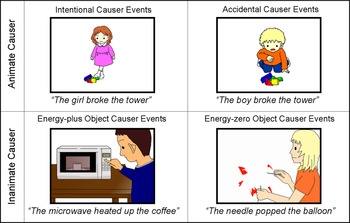
Figure 1 depicts examples of the stimuli. Twenty-four animation clips portrayed a person performing an action that led to a state change in the recipient of the action (e.g. the tower breaks, the coffee warms up). The clips were prepared to allow a separate test of each of the three dimensions thought to influence the choice of sentential subjects: animacy, intentionality, and the level of energy generation. All sentences were lexical causative sentences that consist of a causer, a transitive verb, and a direct object (e.g. The girl broke the tower, The microwave heated up the coffee). To examine the effects of animacy, half of the clips (12 clips) involved animate causers, and the other half involved inanimate causers. In the animate causer clips, a person caused events without using any tools or machines (e.g. a girl kicks a toy tower, and the tower falls down). In the inanimate causer clips, on the other hand, a person used a tool or a machine (i.e. an inanimate causer) to cause state changes (e.g. a boy starts a microwave, and the microwave heats up a cup of coffee). The inanimate causer clips depicted not only the inanimate causers (e.g. microwave), or intermediaries, but also the human agents who were using these objects (note, this design feature in our clips avoids the projectile problem raised above). Each of the animate and inanimate causer clips were further divided into two groups. To examine the effects of intentionality, half of the animate causer clips (6 clips) portrayed a person who intentionally caused an event; the other half portrayed a person who accidentally caused an event. Similarly, within the inanimate set, clips were divided into the ENERGY-PLUS and ENERGY-ZERO clips (6 clips each), offering a direct test of the role of energy generation level in subject use. In the energy-plus clips, a human performed an action with an object that can generate a high level of energy (e.g. microwave). The energy-zero clips involved objects that do not have any internal causal properties (e.g. knife). In sum, there were six intentional causer clips, six accidental causer clips, six energy-plus causer clips, and six energy-zero clips. All animation clips were in color and lasted for 10 seconds.
The four types of events used in the study. The pictures indicate the last frames of animation clips. In the intentional causer event (upper left), the girl kicked the brick tower to break the tower. In contrast, in the accidental causer event (upper right), the tower breaks apart when the boy tries to put a block at the top of the tower. In the energy-plus object causer event (lower left), the boy presses a start button on the microwave, and the coffee starts rotating inside. In the energy-zero object causer events (lower right), the girl pierces a balloon with a needle, which causes the balloon to pop. Sentences below each picture were contrasted with non-causer sentences (e.g. The tower was broken) in the explicit causer vs. non-causer trials and human causer sentences (e.g. The boy heated up the coffee) in the inanimate vs. human trials (the inanimate vs. human trials used the inanimate causer clips only).

Design
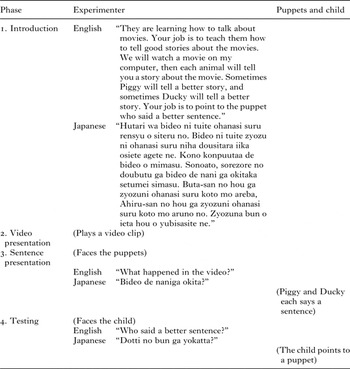
As in Muentener and Lakusta (Reference Muentener and Lakusta2011), children were introduced to two puppets, Piggy and Ducky (Buta-san and Ahiru-san, respectively, for Japanese-speaking children), and asked to teach them how to talk (Table 1). In each trial, children watched an animation clip and heard two different sentences, one from each puppet, describing what happened in the animation they had just seen. Children were asked to point to the puppet who “said a better sentence”, or who more accurately described what they had seen.
Sequence of the experimental procedure

note: An experimenter interacted with the children and asked questions, and a puppeteer played Piggy/Buta-san and Ducky/Ahiru-san. Phases 2, 3, and 4 of the experimental procedure were repeated with different animation clips and sentences.
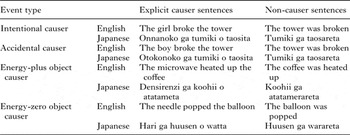
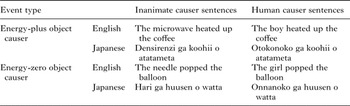
Two separate research questions were assessed using two corresponding types of trials. The EXPLICIT CAUSER vs. NON-CAUSER trials assessed which dimension(s) - animacy, intentionality, or the level of energy generation - children use to determine how causal events should be described. To do so, these trials probed whether children prefer event descriptions that include the explicit mention of the causer or whether they are agnostic as to whether the causer is mentioned, as in sentences where they only hear the outcome but learn nothing about the causer (Table 2). All twenty-four animations (intentional, accidental, energy-zero, energy-plus) were used in these trials, and sentences presented here varied on three dimensions: animacy, intentionality, and energy level. The INANIMATE vs. HUMAN trials assessed whether children learning different languages would accept some inanimate causers of events (Table 3). Japanese-speaking adults do not usually use inanimate causers whereas English-speaking adults use inanimate causers that can generate their own energy (Kanero et al., Reference Kanero, Hirsh-Pasek and Golinkoff2014). We examined when English-speaking children begin to mirror adults’ encoding practices. Twelve inanimate causer clips (energy-plus and energy-zero) were used in the inanimate vs. human trials.
Examples of sentences designed to assess which dimension(s) – animacy, intentionality, or the level of energy generation – children use when determining causers (research question 1)

Examples of sentences designed to examine how English- and Japanese-speaking children differ in their acceptance of inanimate causers (research question 2)

The study employed a within-subject design to minimize the effects of individual differences, and the explicit causer vs. non-causer trials and the inanimate vs. human trials were presented intermixed and in random order. Thus, each child participated in 24 explicit causer vs. non-causer trials and 12 inanimate vs. human trials, resulting in 36 total trials. Each of the 12 inanimate causer clips appeared twice in the experiment, as they were used in both the explicit causer vs. non-causer trials and the inanimate vs. human trials.
Research question 1: Which dimension(s) – animacy, intentionality, or the level of energy generation – do children favor when determining how causal events should be described? Two types of sentences (in counterbalanced order across children) were contrasted in the explicit causer vs. non-causer trials to assess the first research question: sentences that mentioned causers (hereafter referred to as EXPLICIT CAUSER sentences) and sentences that did not mention causers (hereafter referred to as NON-CAUSER sentences). The former type of sentence was always an active declarative sentence (e.g. The boy broke the tower in English and Otokonoko ga tumiki o taosita in Japanese), while the latter type was the truncated passive (e.g. The tower was broken in English and Tumiki ga taosareta in Japanese). Truncated passive sentences were used because they allow omission of the causer, and previous studies demonstrated that adults use passive voice to avoid mentioning causers in subject position (Bock, Reference Bock1986; Bock & Loebell, Reference Bock and Loebell1990; Bock, Loebell & Morey, Reference Bock, Loebell and Morey1992). The subjects of explicit causer sentences were humans (e.g. boy, girl) for the trials with the intentional and accidental causer clips and objects (e.g. microwave, knife) for the trials using the energy-plus or energy-zero clips.
Research question 2: When and how do English and Japanese speakers diverge with respect to the kinds of objects that can serve as causers? This second research question was investigated in the inanimate vs. human trials using the energy-plus and energy-zero clips in which human agents operated with object causers (e.g. microwave, knife). These trials probed when children preferred human vs. inanimate causers. We will refer to the sentences used in these trials as INANIMATE CAUSER and HUMAN CAUSER sentences. For example, for an energy-plus clip showing coffee being warmed up in a microwave after a boy presses the microwave button, the human causer sentence offered was The boy heated up the coffee (Otokonoko ga koohii o atatameta in Japanese), while the parallel inanimate causer sentence was The microwave heated up the coffee (Densirenzi ga koohii o atatameta in Japanese).
Procedure
In the US, children came to a laboratory with a parent, whereas in Japan children were tested at their own preschools. At both sites, children met individually with the experimenter in a small room, without the parent or teacher. All participants went through four practice trials during which children were shown animation clips that were similar to the test trial clips. These practice trials were described with true statements and obviously incorrect sentences. For example, a video of a boy eating an apple was presented, and children were asked to choose between A man ate the apple and A man ate the orange. The practice trials were conducted to ensure that children understood the task. If a child did not give the right answer to a practice question, the experimenter corrected the child by providing hints (e.g. “Are you sure? What is this person eating?”), and re-asked the question. Any child who did not correctly answer at least three of the four practice trials without feedback was excluded from the final analysis (n = 4; M = 4;3).
All responses were coded on-line, but sessions were also videotaped. While it was obvious which puppet the child pointed to, we took the additional precaution of having 20% of the tapes recoded by a blind observer. Reliability with live coding was 100%.
The entire task took 15–25 minutes and only 2 children (M = 3;11) were discarded for lack of attention. All experimental protocols were reviewed and approved by the Temple University Institutional Review Board.
RESULTS
Children's responses were analyzed separately for the first and second research questions. The explicit causer vs. non-causer trials were analyzed to see whether, across the four contrasts (animate – intentional and accidental; inanimate – energy-plus and energy-zero), children preferred explicit causer sentences to non-causer sentences. The analysis for the inanimate vs. human trials dealt with the question of when children chose inanimate object causers (energy-plus and energy-zero) over human causers.
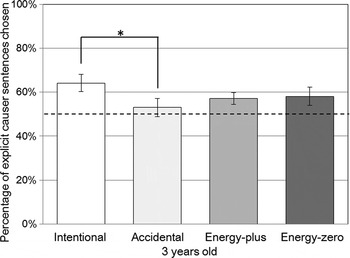
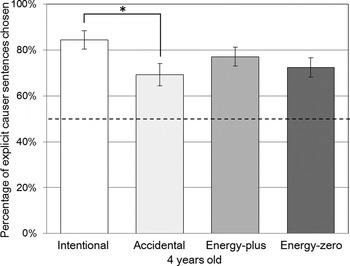
Our first research question was how each dimension (animacy, intentionality, energy level) affects the way children choose between explicit causer sentences and non-causer sentences (e.g. The boy broke the tower vs. The tower was broken). We conducted a three-way ANOVA with causer type (intentional vs. accidental vs. energy-plus vs. energy-zero) as a within-subject factor, and age (age group: 3 vs. 4) and language (English vs. Japanese) as between-subject factors. The omnibus test revealed a main effect of causer type (F(3,183) = 5·73, p = ·001). Three planned contrasts tested the effect of each of the three dimensions. Whereas the effects of intentionality and of the level of energy generation were tested simply by contrasting trial types (intentional vs. accidental and energy-plus vs. energy-zero, respectively), the effects of animacy were examined by contrasting the combined mean of the intentional and accidental trials (animate) and the combined mean of the energy-plus and energy-zero trials (inanimate). Both English- and Japanese-speaking children relied on intentionality (t(61) = 3·73, p < .001), but not on animacy (t(61) = 0·87, p = ·389) or the level of energy generation (t(61) = 0·73, p = ·470). Thus, children had a tendency to choose sentences that mentioned causers (e.g. boy) to describe intentionally caused events rather than accidentally caused events, while animacy or the level of energy generation did not affect their choices. The effect of age was also significant (F(1,61) = 20·17, p < .001), as four-year-olds generally preferred explicit causer sentences over non-causer sentences. No other effects were found to be significant in the model (Figures 2 and 3).
Percentage of three-year-olds choosing explicit causer sentences (e.g. The boy broke the tower) over non-causer sentences (e.g. The tower was broken) across both language groups (English and Japanese). note: The dotted line indicates the chance level preference (50%). The error bars represent ±1 standard error. Means for each language group as follows: for English speakers, Intentional: 65·69%, Accidental: 50·98%, Energy-plus: 59·80%, and Energy-zero: 60·78%; for Japanese speakers, Intentional: 62·50%, Accidental: 55·21%, Energy-plus: 54·17%, and Energy-zero: 55·21%.

Percentage of four-year-olds choosing explicit causer sentences (e.g. The boy broke the tower) over non-causer sentences (e.g. The tower was broken) across both language groups (English and Japanese). note: The dotted line indicates the chance level preference (50%). The error bars represent ±1 standard error. Means for each language group as follows: for English speakers, Intentional: 82·29%, Accidental: 72·92%, Energy-plus: 80·21%, and Energy-zero: 77·08%; for Japanese speakers, Intentional: 86·46%, Accidental: 65·63%, Energy-plus: 73·96%, and Energy-zero: 67·71%.

We also found a general tendency for children to choose explicit causer sentences over non-causer sentences. A series of one-sample t-tests largely confirmed the pattern. Four-year-olds chose explicit causer sentences more often than non-causer sentences across all four trial types (Intentional: t(31) = 8·40; Accidental: t(31) = 3·97; Energy-plus: t(31) = 6·64; Energy-zero: t(31) = 5·32; all ps < .001). For three-year-olds, the preference was significant in the intentional causer (t(32) = 3·55, p < .01) and energy-plus trials (t(32) = 2·60, p = ·01), and was marginally significant in the energy-zero trials (t(32) = 1·94, p = ·06); however, the preference was not significant in the accidental causer trials (t(32) = 0·73, p = ·47).
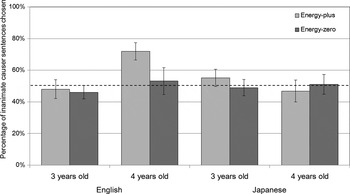
The second question asked when and how English and Japanese speakers diverge with respect to the kinds of objects that can serve as causers. We performed a three-way ANOVA with energy level (energy-plus vs. energy-zero) as a within-subject factor, and age (3 vs. 4) and language (English vs. Japanese) as between-subject factors in order to see whether children preferred inanimate causers over human causers (e.g. The microwave heated up the coffee vs. The boy heated up the coffee). A marginal main effect of energy level (F(1,61) = 3·85, p = ·054), as well as a three-way interaction among energy level, language, and age were found (F(1,61) = 5·22, p = ·026; see Figure 4). Four-year-old English speakers preferred object causers when the object can generate high energy (mean = 72%), whereas no other groups (three-year-old English speakers, three-year-old Japanese speakers, four-year-old Japanese speakers) showed this tendency (Figure 4).
Percentage of trials in which children chose inanimate causer sentences (e.g. The needle popped the balloon, The microwave heated up the coffee) over human causer sentences (e.g. The girl popped the balloon, The boy heated up the coffee). note: The dotted line indicates the chance level preference (50%). The error bars represent ±1 standard error.

One sample t-tests further confirmed the results; four-year-old English speakers’ preference toward encoding energy-plus inanimate causers over human causers was above chance level (t(15) = 4·03, p < .01). In contrast, they did not prefer energy-zero object causers over humans causers (t(15) = 0·37, p = ·718). No preference was found in the choice of sentence by three-year-old English speakers, three-year-old Japanese speakers, or four-year-old Japanese speakers.
DISCUSSION
Languages differ greatly in how they express causal events. While in some languages like Japanese the subject of a lexical causative sentence is generally animate and intentional, other languages like English use various causers that range from animate beings to inanimate objects. To learn a language, children must adjust to the ways their native tongue highlights specific components of events. The present study is the first developmental and cross-linguistic exploration of how English- and Japanese-speaking children choose subjects in lexical causative sentences. We hypothesized that, following Muentener and Lakusta (Reference Muentener and Lakusta2011), all children, regardless of language environment, might initially rely on the intention of animate causers to make judgments, only later modifying their criteria to include the energy generation level of object causers. This shift from a more universal to a language-specific use of causers is in line with findings in other semantic categories (e.g. Göksun et al., Reference Göksun, Hirsh-Pasek, Golinkoff, Imai, Konishi and Okada2011). Intentionality might be a strong starting point for causers in both English and Japanese. As they learn to speak their native tongue, however, English-speaking children learn that causers are not narrowly constrained to a focus on intentionality, but must be examined in concert with the level of energy generation. These conclusions follow from the examination of two research questions and hypotheses.
Our first hypothesis was that children would initially choose causers based on the intention of agents. The results were fairly consistent with this prediction. Children in all age and language groups used the purported intention of human agents as a cue to determine what the subjects of lexical causative sentences should be. In accordance with Muentener and Lakusta (Reference Muentener and Lakusta2011), intentional animate beings were considered the best causers, while unintentional animate agents were not better causers than inanimate objects. Importantly, this study also allowed us to evaluate whether the finding resulted from a focus on animacy as the determinant of cause or on intentionality. Comparing accidental vs. intentional animate causers allowed us to confirm that intent rather than animacy was the driving force behind the result. As even preverbal infants can detect others’ intentions (e.g. Meltzoff, Reference Meltzoff1995), we argue that children use this ‘universal’ sensitivity to intention to initially represent causal events in language. The present study not only replicated the intention-to-CAUSE bias found by Muentener and Lakusta, but offered an important extension of their work by demonstrating that the bias exists in speakers of the two very different languages.
These findings are also tantalizing when viewed in concert with Fausey et al.,'s (Reference Fausey, Long, Inamori and Boroditsky2010) adult data. As briefly discussed in the ‘Introduction’, Fausey et al., used a production task to examine how English- and Japanese-speaking adults describe causal events. In their study, speakers of both languages differentiated the intentional from the accidental causers, though they did so to different degrees. English speakers encoded accidental agents in subject position more often than did Japanese speakers. In contrast, English- and Japanese-speaking children in the present study preferred intentional causers to similar degrees, and thus the research reported here leaves open the question of when children might show more adult patterns in their use of causal language. It is also possible that the difference in acceptance of accidental causers resulted from a difference in task demands between the two studies. Whereas children in our study were asked to choose a good description between two options, adult participants in Fausey et al.,'s study described events in their own words. Perhaps the cross-linguistic difference in the use of accidental causers is amplified in production tasks, which allow participants to freely choose a sentence structure from a larger variety of options (e.g. lexical causatives, periphrastic causatives, resultatives). More research is warranted to better understand the interface between intentionality and causality in assuming the role of causers across languages.
The second question addressed in this research focused on a core difference in English and Japanese with respect to whether inanimate objects (that clearly have no intent) can serve the role of causer. In general, our findings were consistent with, but also extend, past research. The first rather surprising finding was that three-year-olds, whether they spoke English or Japanese, performed at chance levels in our task. It is unclear whether they simply avoided making a choice in a task they deemed too difficult or whether they were actually confused about the role that inanimate objects could or could not play in a lexical causative sentence.
Four-year-olds showed a different pattern of results. The four-year-old English speakers, but not the Japanese speakers, showed a preference for certain inanimate object causers over human causers. They did so selectively for objects that were capable of generating their own energy (i.e. energy-plus objects). These results suggest that, at around age four, English speakers understand that inanimate objects can serve as causers. Yet they restrict the type of inanimate objects that can serve in this role. They seem to distinguish between types of objects and to conclude that the level of energy generation is a relevant dimension when determining the subject of a lexical causative sentence.
Two puzzling findings also emerged with respect to our second question. The first is that Japanese-speaking children did not prefer human causers over inanimate causers at age four. This lack of a preference for animate agents might be due to subject omission, which is grammatically acceptable and happens very often in Japanese. Kanero et al. (Reference Kanero, Hirsh-Pasek and Golinkoff2014) offers some insight that supports this hypothesis. When describing energy-plus events (e.g. a microwave heating up a cup of coffee), adult English speakers used object causers (48·48%) much more frequently than human causers (2·27%), whereas when describing energy-zero events (e.g. a knife cutting a tomato), they used human causers (42·80%) more frequently than object causers (35·98%). In contrast, adult Japanese speakers showed virtually no use of object or human causers: when describing energy-plus events, object and human causers were used in 3·33% and 0·00% of sentences, respectively; when describing energy-zero events, object and human causers were used in 0·42% and 5·83% of sentences, respectively. Instead of using human or energy-plus causers, Japanese speakers simply omitted the subjects in sentences (46·25% of events). If Japanese children do not often hear the subjects of lexical causative sentences, then they might not develop a preference for the type of causer within these sentences.
A second puzzling finding was that, in our study, both three- and four-year-olds showed a general preference for explicit causer sentences, not only in the intentional causer trials, but also in the energy-plus and energy-zero causer trials. In other words, children preferred sentences that described causal events in terms of objects causing state changes (e.g. The microwave heated up the coffee; The needle popped the balloon) over passive sentences that did not mention causers (e.g. The coffee was heated up; The balloon was popped; see Figures 2 and 3). This pattern stands in contrast to Muentener and Lakusta (Reference Muentener and Lakusta2011), who found English-reared preschoolers did not prefer causal descriptions to non-causal descriptions for object-caused events. For example, to describe the scene in which a ball touched a button and made a train move, preschoolers in their study did not prefer The ball made the train move to The ball touched the button. One possibility is that this difference emerged as a consequence of the sentences used in the two studies. Unlike Muentener and Lakusta, we presented truncated passive sentences (e.g. The coffee was heated up) alongside explicit causer sentences (e.g. The microwave heated up the coffee). In other words, we offered an active sentence and a passive sentence as the two options, whereas Muentener and Lakusta presented two active sentences. Though children do understand the passive sentence structure, the use of passive voice is relatively rare among preschool-aged children (e.g. Horgan, Reference Horgan1978). Thus, children in our study may have been predisposed to choose the more familiar option – the active sentences (i.e. explicit causer sentences) – unlike the children in Muentener and Lakusta's study.
Importantly, though participants in our study preferred explicit causer sentences, they did not reject all passive sentences. Rather, their choices varied systematically as a function of the causer type, i.e. they chose explicit causer sentences over passive sentences for the intentional-causer events more often than for the accidental-causer events. Recent research also suggests that, although preschoolers do not use passive voice frequently, they already possess an abstract representation of passive sentences (Bencini & Valian, Reference Bencini and Valian2008; Shimpi, Gámez, Huttenlocher & Vasilyeva, Reference Shimpi, Gamez, Huttenlocher and Vasilyeva2007). Both English- (Messenger, Branigan, McLean & Sorace, Reference Messenger, Branigan, McLean and Sorace2012) and Japanese-speaking children (Okabe, Reference Okabe2002) can match passive sentences to action events with high accuracy. The present study highlights the particular importance of intentionality in determining causers precisely because children were willing to choose an unfamiliar, passive sentence in order to avoid choosing an accidental causer sentence.
The answers to the two research questions allow us to see how the investigation of causers can illuminate our understanding of the mapping between events and language. Our examination of developmental and cross-linguistic variation in expressions of causes demonstrates how children begin as universalists and adapt to the specific ways in which their language encodes causal events. This research echoes Muentener and Lakusta (Reference Muentener and Lakusta2011) in suggesting that all children begin with a reliance on intentionality. With language input in their native tongue, however, children alter the boundaries of inclusion for the types of objects that can serve as causers.
We are still left with a question: Why do English speakers come to prefer energy-plus causers? One possibility is that the universal-to-specific shift requires non-linguistic conceptual development (e.g. understanding of how energy-plus objects differ from energy-zero objects). We, however, doubt this explanation because even three-year-olds seem to have the conceptual understanding of how energy-plus objects, or machines, function (Gottfried & Gelman, Reference Gottfried and Gelman2005). We instead suggest that the universal-to-specific shift occurs because children learn to use their conceptual understanding of objects to describe causal events. This realization cannot be made by simply memorizing what can serve as the subject of a sentence, because even energy-zero objects can appear in subject position in some sentences (e.g. The knife fell off the table, The knife is expensive). Thus, the universal-to-specific shift requires a lot of linguistic input. We hypothesize that the shift starts slowly, but speeds up as children become aware of general rules. For example, English-speaking children may first memorize that an object (e.g. microwave) can be used as the subject of a particular transitive verb (e.g. heat). As children encounter more and more exemplars, however, they would come to realize that all energy-plus objects can serve as the subjects of transitive verbs. This piecemeal acquisition strategy has been suggested by others (Lieven, Behrens, Speares & Tomasello, Reference Lieven, Behrens, Speares and Tomasello2003; Lieven, Pine & Baldwin, Reference Lieven, Pine and Baldwin1997; Pine & Lieven Reference Pine and Lieven1997; Tomasello, Reference Tomasello2000, Reference Tomasello2003), and may explain why the shift in the preference for specific types of causers does not occur until age four; much later as compared to the development of language-specific semantic categories found in other cross-linguistic studies (Choi, Reference Choi2006; Göksun et al., Reference Göksun, Hirsh-Pasek, Golinkoff, Imai, Konishi and Okada2011; Hespos & Spelke, Reference Hespos and Spelke2004; Maguire et al., Reference Maguire, Hirsh-Pasek, Golinkoff, Imai, Haryu, Vanegas and Sanchez-Davis2010; McDonough et al., Reference McDonough, Choi and Mandler2003).
By age four, English speakers are becoming attuned to the fact that inanimate objects can serve as causers and that some inanimate objects are better causers than others. The shift from a more universal stance on causers to one that is more language-specific is analogous to the pattern found in other semantic domains (e.g. Choi & Bowerman, Reference Choi and Bowerman1991; Göksun et al., Reference Göksun, Hirsh-Pasek, Golinkoff, Imai, Konishi and Okada2011; Maguire et al., Reference Maguire, Hirsh-Pasek, Golinkoff, Imai, Haryu, Vanegas and Sanchez-Davis2010), as well as to research in phonology (Werker & Tees, Reference Werker and Tees1984). That is, infants start as universal listeners who can distinguish any phoneme used in the world's languages, and only later become selectively attuned to phonological distinctions relevant in their native tongue. The universal-to-specific shift in causal language requires attention to multiple dimensions within the flux and flow of events – animacy, intentionality, and energy generation. Any one of these dimensions might be relevant to the use of causers in the native language.
CONCLUSION
Building on research by Muentener and Lakusta (Reference Muentener and Lakusta2011), this study examined how children map causal events onto language. Using developmental data from children who speak very different languages, we found that children appear to start with a universal set of semantic constructs such that animate intentional actors are considered the best causers. By age four, English and Japanese speakers have begun to adapt to their native language, with English speakers accepting energy-generating objects as causal subjects. Learning these language-specific ways of encoding events and mapping them onto language is a complex task that requires children to understand various dimensions within fluid events and to weigh some of these dimensions over others. This research suggests that the cross-linguistic study of causers can thus be a window onto how children who start from an ‘initial equivalent base’ (Bowerman & Levinson, Reference Bowerman and Levinson2001) come to appreciate language choices made in their native tongue. It also illuminates the multi-faceted complexity that children face as they learn to speak.
Appendix A
Sentences used to assess which dimension(s) – animacy, intentionality, or the level of energy generation – children use when determining causers (research question 1).

Appendix B
Sentences used to assess how English- and Japanese-speaking children differ in their acceptance of inanimate causers (research question 2).