Editor's Note: For this special edition of “Critical Stages,” Chambers-Letson and Son meditate on the following questions: What are the exigencies that animate your entry into the field of theatre and performance studies? How does a shared project in Asian American performance offer a range of possibilities for thinking through pressing political questions and crises that seem otherwise insurmountable?
JOSHUA T. CHAMBERS-LETSON: My entry into the field of performance studies was really rooted in an obsession with the intersection of the performative and the juridical. Out of that, I became interested in how the lens of performance and an interrogation of performance and performativity might help us account for the construction of political realities (race, nation, history, law, war) that are otherwise limited by the rationalist disciplinary frameworks through which they are too often explored (i.e., law, political science, or history). Performance studies, as an interdisciplinary field, allows for a robust accounting of phenomena such as race, politics, and law because it can explore both the performative nature of these phenomena and their often inherently theatrical nature. In this way, the field allowed me to think through the aesthetic nature of law and politics alongside an interrogation of the legal and political nature of aesthetics. My particular investment in Asian American studies is a desire to account for how Asian American performance can function as a way of working through what Liz described—in our preliminary conversations—as “issues often ignored or silenced in Asian/Asian American communities” and within the dominant culture. But it also provides a context for thinking through the pressing political concerns of the current moment. In other words, Asian American performance studies can help us historicize and give context to the contemporary moment, but it also shows how forms of Asian American performance can help us imagine and enact other possibilities beyond the limits of the present.
ELIZABETH W. SON: My entry into theatre and performance studies emerged from a fascination with the intersection of the political and aesthetic. I was particularly drawn to how subjects use performances to negotiate lived experiences of social and political violence. At the same time, I was interested in how artists balance the aesthetic and ethical demands of rendering traumatic histories onstage. The rich theoretical and methodological frameworks of the field allow me to be attentive to the embodied and affective textures of social practices and the live expressive arts, while thinking through how performance as an episteme pushes against the confines of traditional knowledge production. Further, examining social and cultural processes through a performance lens enables me to map movements of transnationalism and to ground its theoretical elocutions in the materiality of embodied acts and exchanges. Asian American studies helps situate performances within the intersectionalities of race, class, gender, and sexuality while locating these acts in historical particularities to illuminate the high stakes of performing lived experiences.
My investment in Asian and Asian American performance grows from how these works critically engage with often ignored or silenced issues and histories in trans-Pacific communities, allowing subjects, as Josh eloquently puts it, “to imagine and enact other possibilities beyond the limits of the present.” One of the most pressing issues is gender violence, from militarized sexual exploitation and human trafficking to domestic abuse. It is exciting that a growing number of individuals are taking up these issues in community-based theatrical productions and collective political action. They pay close attention to the social and political stakes of artistic representations and the performative and redressive possibilities of political activism.
CHAMBERS-LETSON: I sense many resonances between the animating exigencies that you discuss here and my own investments in the field. It seems to me that our shared convergence around the possibility that performance can serve as an imaginative space for the activation of politics is of critical importance. My favorite exegesis on the political power of aesthetics in general—and performance in particular—comes from Frankfurt School philosopher Ernst Bloch. For Bloch, “art is a laboratory and also a feast of accomplished possibilities plus the experienced alternatives within it while the performance as well as the result take place in the manner of substantiated illusion, i.e., of the worldly completed anticipatory illumination.”Footnote 1 Bloch understands performance as key to a politics of social transformation because it can function as what he elsewhere called “the rehearsal for the example” of a better world.Footnote 2 Performance, with its recourse to the body, allows this rehearsal to draw an imagined or “anticipatory illumination” into material being, such that “it does not play around in an unoccupied potentiality and does not go astray but anticipates a real potentiality in a psychical way.”Footnote 3 That is to say that performance functions as an idea of a better world, an exploration of the range of options for realizing this world, and a rehearsal for its possibility. Brought to life during the period of the performance, it allows us to see seemingly foreclosed potentialities as verifiable realities.
For me, performance—at its most and its best—serves as an affirmative rallying cry. At the 1942 Yenan Forum on Literature and Art, Mao famously described “a cultural army” as a companion to the military that was “absolutely indispensable for uniting our own ranks” in the struggle against Japanese imperialism, feudalism, and capitalism.Footnote 4 Most of the rest of the Yenan speeches are dogmatic, despite Mao's protestations to the contrary. But I fundamentally agree with Mao that aesthetics are central to mobilizing our action in a progressive (dare I say Marxist) struggle toward a horizon of liberation. This is a horizon we have not yet known but must continue to insist upon as both possible and plausible. If, as José Esteban Muñoz argues, “Utopian performativity suggests another modality of doing and being that is in process, unfinished,” performance is the call to action that demands that we take an active role in this process.Footnote 5
But as much as performance can be a means of forwarding a progressive, antiracist, feminist, anti-imperialist, queer politics (a politics that I articulate under the sign of Marx), performance and aesthetics are neutral tools in and of themselves. That is to say that, for a long time, the enemy has mobilized “cultural armies” as an indispensable component of and architectural support for dominant hegemony.Footnote 6 This is one of the reasons why I believe that a performance-studies approach can make important contributions to Asian American studies. It allows us to account for the performative production of Asian American racial difference while also affording us the tools to rise up against these processes. In my forthcoming book, for example, I am interested in how performance lines up with, supports, transmits, and allows for the circulation of political narratives about the racial difference of Asians and Asian Americans. Part of my project thus argues that Asian American racial formation is coauthored by performance aesthetics and legal/political discourse.
Madame Butterfly, for example, has long been a bad object of Asian Americanist theatre and performance scholarship, and for good reason to the extent that it is the paradigmatic rendition of orientalist articulations of Asian female difference. But many critical readings of the text have overlooked the problem of law that runs throughout the piece. The law is a central theme in all three original versions of the text (John Luther Long's 1898 novella, David Belasco's 1900 dramatic adaptation, and Puccini's 1904 opera); a great deal of the plot is organized around the legal status of the Japanese heroine and her mixed-race child. If you look at the three versions of Madame Butterfly and read them in relation to the Asian American jurisprudence of the time when it was written, you will find that there is a neat alignment between the figuration and the foreclosure of Asian racial difference in U.S. courtrooms and theatres.
Most of this nineteenth-century Asian American jurisprudence has long been forgotten, but Madame Butterfly continues to be one of the most popularly produced operas in the United States. Thus, the racial knowledge produced in nineteenth-century courtrooms and theatres continues to circulate in contemporary productions of the opera. In the book, I discuss a series of contemporary Supreme Court cases involving the citizenship of half-Asian children born in different Asian countries (Vietnam and the Philippines) to a U.S. citizen father and a foreign national mother. The justices denied the children citizenship rights, and dissenting justice Ruth Bader Ginsberg later went so far as to suggest that the majority was influenced by the Madame Butterfly narrative. So the lens of performance allows us to account for the making of race across political, legal, and aesthetic media. In other words, performance helps us to see how race comes to have meaning in and on the body in ways that have often been underexplored in rationalist discourses (such as history, law, or political science). Through popular performances such as Madame Butterfly, damaging fictions about race are made into reality as they circulate through the cultural bloodstream and are eventually projected onto and sometimes assumed by the Asian American body. But it is also through performance that these realities can be shattered, reconfigured, imagined otherwise (to gesture toward Kandice Chuh), and made differently in the always “unfinished” process of becoming free.Footnote 7
SON: Your invocation of Bloch and Muñoz beautifully captures the necessity of intervening in social and political crises and the power of performance to do so. Bloch's articulation of performance as a rehearsal for possibilities of a better world brings to mind Jill Dolan's work on utopian performatives. “By focusing on the ‘now’ of performance, on the affect and impact of the present moment,” writes Dolan, “utopian performatives let us embody conditions of which we can otherwise only dream. Perhaps, in fact, performance is an act of public dreaming.”Footnote 8 Performance materializes dreams, stirring people to imagine, believe in, and take concrete steps toward fostering change. In my research, for example, I examine performances that seek redress for those subjected to Japanese military sexual slavery during World War II. The institutionalized system of sexual slavery forever transformed the lives of an estimated two hundred thousand girls and young women forced by the Imperial Japanese Army to service Japanese troops sexually. For almost fifty years, survivors kept their wartime experience a secret, but since the early 1990s activists have begun advocating on their behalf and shedding light on the history of Japanese military sexual slavery. To this day, the Japanese state contests this history, denying survivors an official apology and reparations. From violence and silencing, a vibrant culture of activism and artistic intervention has emerged. A rich array of performances that range from protests, tribunals, theatre, and dance to testimonial acts speaks to the current pressing moment created by the passing away of octogenarian survivors and the urgent need for reparative measures and the transference of “epochal memory,” which Joseph Roach defines as “specially marked by the limits of generational recollection.”Footnote 9 Faced with this critical moment and state apathy, activists, artists, and survivors are taking justice into their own hands.
Situating my work at the intersection of theatre and performance studies and Asian American studies offers a range of methodological approaches. In particular, participant observation allows me to illuminate the workings of transnational justice, a justice that takes place not only in the courtroom but also in public performances. “Proximity, not objectivity,” Dwight Conquergood reminds us, “becomes an epistemological point of departure and return.”Footnote 10 Proximity is not just about being physically present but also about entering into performance spaces with humility, vulnerability, and keen awareness of one's subject position and implication in the collective act of creation.Footnote 11 Conquergood eloquently and aptly describes participant observation as “coperformative witnessing.”Footnote 12 As a researcher/audience/witness, I become part of the dreamworld of performances, yet I need to maintain a “critical generosity” that negotiates a “critical dance” between “honoring the intentions of progressive cultural work and pointing out its limitations or failures.”Footnote 13 I find myself constantly performing this critical dance as I write about Asian and Asian American performances that respond to social and political crises.
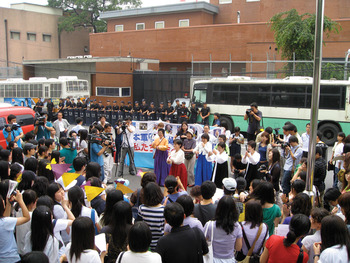
In my research on the Wednesday Demonstrations, participant observation opened my eyes to the limits and possibilities of protest performances as vehicles for social change.Footnote 14 For the past twenty years, activists and a handful of survivors gather each week, rain or shine, across from the Japanese Embassy in Seoul. The Wednesday Demonstrations are not random gatherings; they are productions with a rich repertoire, involving the strategic remarking of public space and bodies through visual, sonic, and physical means. Around noon, when the street becomes busy with lunch traffic, survivors and their protesters congregate on a sidewalk across from the embassy. Supporters ranging from high school and university students and middle-aged locals to foreign tourists stand behind survivors, who are wearing yellow vests and are seated on stools. As the crowd grows, supporters spill onto the street and form a somatic circle around the survivors, displacing the embassy as the target audience. Following a script, the protests move through singing, chanting of demands, calls for solidarity, and usually a cultural performance staged for survivors by a visiting organization.
My favorite metaperformance during the protests was a performance by the Weekly Wednesday Troupe, a group of Japanese citizens from Takarazuka who travel around Japan performing survivor testimonies.Footnote 15 “You are connected to the past as well as to the future,” explained the Japanese woman performing the role of Gil Won-ok, a Korean survivor of military sexual slavery.Footnote 16 Two other Japanese women playing the roles of Korean survivors Lee Yong-soo and Yi Ok-seon joined her on the makeshift stage created in the middle of the street. In colorful hanboks, traditional Korean dresses, the performers wore headshots of the women they were playing on their chests and spoke Korean haltingly. They performed a short skit based on survivor testimonies and a dance routine for the eight elderly survivors and their supporters in attendance at the 823rd Wednesday Demonstration (Fig. 1).Footnote 17 I made my way through the crowd to catch a glimpse of how survivors were responding. The real Gil Won-ok was wiping her neck with a handkerchief and Yi Ok-seon was leaning forward in her seat, while Lee Yong-soo nodded her head as she watched the performance. I noticed that passersby paused to watch and then slowly zigzagged through the crowd, whose bodies disrupted the usually linear movement of passersby in this area. In this way, protesters produced somatic disruptions, a physical disturbance that led unknowing passersby to pause, notice, and possibly engage.
The Weekly Wednesday Troupe at the 823rd Wednesday Demonstration, Seoul, 23 July 2008. Photo by Elizabeth Son.

The participation of the Weekly Wednesday Troupe, whose members frequently visit and attend the protests in Korea, illuminates one layer of the transnational connective tissues of the social movement for redress. It is remarkable that these ordinary citizens take to the streets in Japan to retell the testimonies of women whose experiences touch upon a sensitive chapter of Japanese history. Through their performance at the Wednesday Demonstrations in Seoul, the Weekly Wednesday Troupe poignantly demonstrates their admiration of survivors and support for their cause, offering their act as a small token of redress.
A recurring question about the Wednesday Demonstrations is how to assess their efficacy. On the surface, the repetition of the Wednesday Demonstrations for the past twenty years reinforces the failures of the protests as an arena of official redress. One question I ask survivors about the protests is whether they think the protests are effective. Lee Yong-soo adamantly emphasizes that the protests have been effective in drawing local and global support for the cause and giving people an opportunity to see a “living witness to history.”Footnote 18 However, in positioning survivors as living embodiments of the history of Japanese military sexual slavery, the protests and the social movement risk reifying wartime experience as personhood for these women. Nevertheless, the Wednesday Demonstrations allow survivors to testify through their physical presence and occasionally in brief verbal testimonies. Ultimately, the efficacy of these protests reaches more deeply into the hearts of the survivors and people who find their way to the protests.
The Wednesday Demonstrations may not have resulted in official reparative action, but they have given survivors a profound gift of personal redress. “Sometimes when elementary school children come [to the protests], they go, ‘Halmoni [grandmother in Korean], halmoni, cheer up and have strength! We're here. Cheer up,” Gil Won-ok halmoni explains, “and my heart just suddenly opens up.”Footnote 19 She communicates the sense of connection she feels with students who come to the Wednesday Demonstrations, reinvigorating her with a sense of hope. Gil halmoni's words are all the more poignant because she was unable to bear children as a result of a hysterectomy performed by a Japanese military doctor.Footnote 20 During my interview with her, I was struck by how often Gil halmoni referred to supporters as hoosun-dul, which means “descendants.” “They [the Japanese government] think that all of this will disappear after we die,” says Gil halmoni. “After we die, we have our descendants.”Footnote 21 She locates the arbitration and embodiment of redress in her “descendants,” the young protesters who form a community of memory. Most important, she expresses the social bond she feels with these supporters. Gil halmoni articulates a reconstituted subjectivity that is defined not by wartime sexual violation but by a sociality nurtured during street performances.
As I witnessed during the Wednesday Demonstrations, performance broadens how we imagine and practice redress, expanding the spectrum of what constitutes restitution to its affective horizons. Efficacy emerges from a process of repeated engagement, hence redress (as in continually attending to a wound), in which change accumulates over time. “Repair,” writes Catherine Cole, “is a continuous process, at once practical and immediate.”Footnote 22 Indeed, performance brings to life, as Josh notes, “seemingly foreclosed potentialities as verifiable realities.” We act in order to dream.
CHAMBERS-LETSON: Your description of the Wednesday Demonstrations is profoundly moving. It reminds me of another capacity of performance: performance as a way to build counterpublics for the expression and affirmation of otherwise foreclosed minoritarian ways of being-in-the-world. This conceives of performance as a space where we can experience the political power of belonging and community. I'm thinking here of Christine Bacareza Balance's work on performance as that which allows the rehearsal of intimacy and belonging in Filipino America. As Balance observes, “[a]ffective responses and intimate attachments” that are deeply felt by Filipino America are often impossible within the majoritarian logic of the dominant sphere.Footnote 23 Performance can realize and bring these possibilities together as “part of the world-making process that is belonging[,] . . . [which includes] dynamic processes of identification that move in multiple directions and across a variety of identity categories.”Footnote 24 As you've shown us, the Wednesday Demonstrations open up such a space in the world for the halmoni. The demonstrations become scenes for articulating intergenerational and transnational attachments, these “dynamic processes” that Balance rightly observes as necessary for minoritarian world-making practices.
I once participated in the Wednesday Demonstrations. I felt an extraordinary sense of personal shame at the beginning of the actions when I watched every single bureaucrat in the Japanese Embassy draw down their shades so as to shut out the vision of the grandmothers. But as you have shown, to some degree, the activists are not performing for the Japanese or South Korean governments. From the space of seeming foreclosure, the demonstrations emerge as the type of counterpublic for the experience of belonging that Balance discusses. They are a place for the fostering of a political community, or what Jean-Luc Nancy describes as the “sharing out” of our experiences together. This, for Nancy, is the exigency of community: “one does not produce it, one experiences or one is constituted by it as the experience of finitude.”Footnote 25 Finitude is important here; Nancy reminds us that community is the experience of the singular being as communicating with or relating to other singularities outside ourselves. If community is an experience, performance as a communicative art has the unique capacity to bring us together in order to take part in this experience. For so many of us—people of color, queers of color, transnational subjects, immigrants, and the laboring poor—everyday life can be an experience in constant negation. Performance, then, becomes a way of creating places not only for our singular selves but also for the experience of our being-together and being-in-difference. In this way, it becomes more than a dream; performance is a foundational element for the activation of a better world where all will experience freedom and belonging, if we so choose.