Introduction
A carbuncle is a series of interconnected furuncles in the subcutaneous tissue that usually drain via multiple hair follicles onto the skin surface.Reference Brook 1 Central necrosis with surrounding cellulitis and inflammation is usually present.Reference Tan and Bong 2 The most common pathogen for carbuncles is Staphylococcus aureus. This condition is common among diabetic patients with poor glycaemic control.
This paper reports our experiences in managing three cases with facial carbuncles using a non-conventional method, which brought about aesthetically favourable outcomes.
Case report
Case one
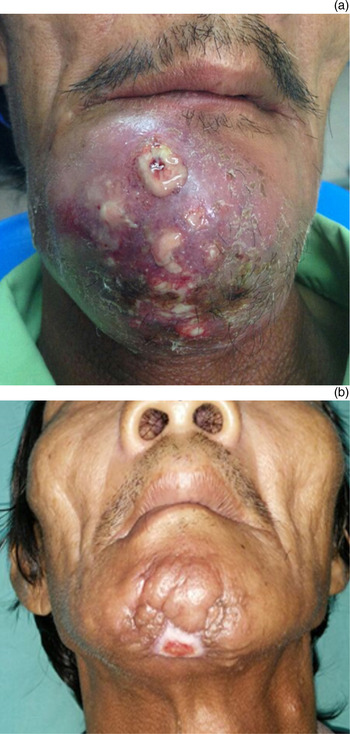
A 52-year-old gentleman presented with a painful carbuncle over his chin, present for 1 week, measuring about 5 × 5 cm (Figure 1a). He was a diabetic, and was non-compliant with oral hypoglycaemic agents. Although afebrile during presentation, blood investigation showed a total white cell count of 21.8 × 10⁹l.
(a) The carbuncle, over the chin, was approximately 5 × 5 cm in size. (b) The wound had contracted and healed after four weeks.

Intravenous cloxacillin 1 g four times a day and intravenous metronidazole 500 mg three times a day were administered for 3 days' duration; this was subsequently converted to oral antibiotics for a total of 2 weeks. In light of poor glycaemic control, subcutaneous insulin was initiated during the patient's hospital stay. This was later converted back to oral hypoglycaemic agents. The wound was managed conservatively with minimal necrotic tissue debridement, pus drainage and copious irrigation with gentamicin solution (80 mg in 500 ml normal saline three times a day) for one week. Intra-oral necrotic tissue on the inner lower lip was debrided, and dressing over the chin wound was continued using povidone iodine (10 per cent) diluted with normal saline daily.
The patient was fit for discharge on day 8 of admission. He was taught how to do the daily dressings at home with diluted povidone iodine solution prior to discharge. The pus culture from the wound grew S aureus, which was sensitive to cloxacillin and gentamicin. The patient was followed up weekly in the out-patient clinic. Repeated pus culture testing at one week post-discharge showed no growth. The wound had contracted and healed after four weeks (Figure 1b).
Case two
A 33-year-old gentleman had a painful carbuncle over the right side of his upper lip and face, present for 1 week, associated with fever. The carbuncle measured about 10 × 8 cm. It extended superiorly to the right infra-orbital region, laterally to the right buccal region, and inferiorly to the right side of the upper lip reaching the midline (Figure 2a). He had no known medical illnesses. Total white cell count was 13.0 × 10⁹l.
(a) The carbuncle measured about 10 × 8 cm. It extended superiorly to the right infra-orbital region, laterally to right buccal region, and inferiorly to the right side of the upper lip reaching the midline. (b) The wound had completely healed by the third week of follow up.

The patient was started on intravenous cloxacillin (500 mg four times a day) and intravenous metronidazole (500 mg three times a day). The carbuncle was minimally debrided and pus was drained. We proceeded with copious irrigation using gentamycin (80 mg in 500 ml normal saline three times a day) for 2 days. Necrotic tissue over the inner upper lip was also debrided.
The patient could be discharged on day 4 of admission with a favourable wound condition. He completed a total of two weeks of oral cloxacillin (500 mg four times a day) and oral metronidazole (400 mg three times a day). Pus culture showed S aureus, which was sensitive to cloxacillin and gentamicin. The wound had completely healed during follow-up review by the third week (Figure 2b).
Case three
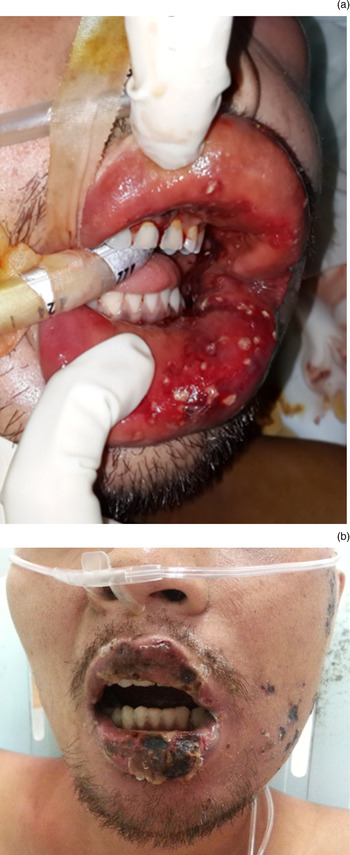
A 26-year-old gentleman was referred to us from a district hospital for septic shock with multi-organ failure secondary to a left-sided facial carbuncle. The carbuncle was 10 × 10 cm in size, and had progressively worsened over one week. He had no known medical illnesses. The lesion had started off as a left-sided facial pimple for 3 days and subsequently extended to involve the entire left side of the face. The upper and lower lips were swollen on the left side, with multiple puncta, with discharging sinuses from the oral cavity (Figure 3a). He developed trismus and shortness of breath 2 days prior to presentation, which required intubation and ventilator support upon arrival to the hospital. He was febrile, with a temperature of 39.2 °C and a total white cell count of 40.1 × 10⁹l.
(a) The upper and lower lips were swollen on the left side, with multiple puncta, with discharging sinuses from the oral cavity. (b) The wound was completely dry on day 5 of admission.

Intravenous ceftriaxone and metronidazole was commenced. Minimal debridement and pus drainage was carried out. Wound irrigation was performed with gentamicin solution (80 mg in 500 ml normal saline three times a day) for 2 days' duration. Intravenous cloxacillin (500 mg four times a day) was commenced in view of the pus culture, which grew S aureus.
The wound was completely dry on day 5 of admission (Figure 3b) and had completely healed upon review 1 week later. The patient had a longer hospital stay of 15 days because of the acute respiratory distress syndrome and a left ankle abscess. Oral cloxacillin was administered for a total of three weeks for his ankle abscess.
Discussion
The mainstay of treatment for carbuncles involves the early administration of antibiotics in combination with surgical intervention. Based on our literature review, the surgical treatment for carbuncles is either saucerisation, which involves extensive excision of the necrotic centre and the surrounding cellulitis, or a less extensive surgery, which comprises simple incision and drainage along with debridement of the necrotic centre. Both surgical techniques result in a large wound, which is then allowed to heal by secondary intention and hence involve a longer duration of wound healing.
Although delayed split-thickness skin grafting can be performed to hasten recovery, secondary surgery is needed with a new wound over the donor site. Lyer et al. introduced a new treatment modality for the excision of carbuncles with primary split-thickness skin grafting, but only 66.66 per cent of patients from the study achieved wound closure with this method, while the remaining patients required a second procedure for wound closure.Reference Lyer, Kadam, Gore and Subramaniyan 3
The three cases reported above were challenging as they all involved facial areas. A typical saucerisation procedure, or incision and drainage, over these regions will create a large wound, which could lead to aesthetic concerns. Free-flap reconstruction or a split-thickness skin graft would enable closure of the wound; however, the cosmetic outcome is unpredictable in terms of colour contrast. Therefore, we advocate conservative management of these facial carbuncles, with minimal surgical intervention, to achieve an aesthetically better outcome. In all three cases, the puncta were ruptured individually with a needle, and pus was drained out. Minimal debridement of necrotic tissue was conducted, with maximal skin conservation.
Intravenous antibiotics were administered during the treatment. In addition, gentamicin solution was used to irrigate the wound. In clinical settings, there are several ways in which antimicrobials can be administered to patients, including topical, inhaled, enteral and parenteral routes.
The irrigation of wounds with an antibiotic-containing solution has been used worldwide for the prevention and treatment of infections, although this method has not been well studied.Reference Falagas and Vergidis 4 The irrigation of infected wounds aims to wash off the debris and blood clots, which often contain bacteria. Irrigation with antibiotic-containing solution has the advantage of eliminating bacterial contamination directly and is superior to saline irrigation.Reference Falagas and Vergidis 4 Moreover, irrigation with antibiotic-containing solution avoids tissue destruction, in contrast with antiseptic solution.Reference Falagas and Vergidis 4
Gentamicin is a bactericidal antibiotic that binds irreversibly to the 30S subunit of the bacterial ribosome, thus interrupting protein synthesis.Reference Wishart, Knox, Guo, Shrivastava, Hassanali and Stothard 5 In our cases, we opted to use gentamicin because it is a broad-spectrum aminoglycoside antibiotic and all of the pus cultures were sensitive to gentamicin.
-
• This paper reports a non-conventional method for the management of three facial carbuncles cases
-
• This method has a better cosmetic outcome and shorter period for wound healing than conventional saucerisation
-
• Conservative surgical management, followed by irrigation with antibiotic-containing solution, should be considered for facial carbuncles
-
• This method yields a good cosmetic outcome and early wound healing, and avoids general anaesthesia risks
In our three cases, the wounds healed completely in about two to four weeks, with no major cosmetic concerns. Tan and Bong reported three carbuncle cases with a post-operative length of hospital stay in the range of 1–6 days following conventional surgical treatment; however, wound healing took between 6 and more than 8 weeks.Reference Tan and Bong 2 Based on the wound alone, our patients could have been discharged on days 4–8 of admission. The length of hospital stay was extended because of poor glycaemic control in case one, while co-existing acute respiratory distress syndrome and ankle abscess contributed to a longer hospital stay in case three.
Conclusion
The conservative surgical management of facial carbuncles using maximal skin conservation followed by irrigation with antibiotic-containing solution was shown to be superior to conventional surgical methods. This new method provides significant benefits in terms of cosmetic outcome and shorter duration of wound healing. In addition, this method allows the procedure to be conducted under regional anaesthesia. This reduces the anaesthetic risks compared to conventional surgical treatment of saucerisation, which normally requires general anaesthesia. This is clinically significant as patients with facial carbuncles usually have multiple co-morbidities, with systemic disease and end organ damage, which predispose them to higher risks associated with general anaesthesia.