INTRODUCTION
Antidepressants are widely prescribed to the general population: in 2009 in England there were 39 million prescriptions for antidepressants (NHS Information Centre, Prescribing Support Unit, 2010). They are also commonly prescribed to psychiatric patients (Paton, Reference Paton2000). They are used principally for the treatment of depression, panic disorder and generalised anxiety disorder, although some are licensed for other indications such as bulimia nervosa and, more controversially, social anxiety disorder. With respect to the treatment of depression, in recent years it has been realised that for most patients, depression is a recurrent illness, with a significant minority of patients (in the region of 12.5–15%) developing chronic depression (Scott, Reference Scott1988). Thus, some patients will require long-term maintenance therapy with antidepressants if they are to remain well, while others will only require treatment for the acute episode (Anderson et al. Reference Anderson, Ferrier, Baldwin, Cowen, Howard, Lewis, Matthews, McAllister-Williams, Peveler, Scott and Tylee2008). In forensic psychiatric populations the predominant psychiatric diagnoses are schizophrenia and personality disorders (Coid et al. Reference Coid, Gault, Kahtan, Cook and Jarman2001). Primary affective disorders are uncommon (Haw, in press). Thus, it might be expected that among forensic rehabilitation patients antidepressant usage would be fairly uncommon.
All drugs have side-effects and antidepressants are no exception (British Medical Association & Royal Pharmaceutical Society, 2010). The selective serotonin reuptake inhibitors (SSRIs) are favoured over tricyclics because of their better tolerability, safety in over-dosage and simple dosing regimes (NICE, 2009a). However, patients taking SSRIs do frequently report side-effects which may be troublesome enough to lead to them discontinuing the medication (Hu et al. Reference Hu, Bull, Hunkeler, Ming, Lee, Fireman and Markson2004). Sexual side-effects are common with SSRIs and also venlafaxine (Williams et al. Reference Williams, Baldwin, Hogue, Fehnel, Hollis and Edin2006; Williams et al. Reference Williams, Edin, Hogue, Fehnel and Baldwin2010) but patients may feel inhibited from discussing these with the prescriber.
We could not find any published reports of antidepressant prescribing to forensic or rehabilitation patients and so decided to carry out a survey of their usage at our own secure hospital. The aims of this study were to survey the use of antidepressants in the treatment of male and female forensic and rehabilitation inpatients including which drugs were used, their frequency of use, dosages and duration of treatment, the indications for their use and the effectiveness of antidepressants in ameliorating symptoms, as reported by the treating clinician. A subsidiary aim was to ask if the prescriber had inquired about side-effects caused by the antidepressant, including sexual side-effects, and if so what side-effects patients had reported.
METHODS
St Andrew's Healthcare, Northampton, is a 700-bed charitable psychiatric hospital providing care and treatment to a wide variety of patients with complex mental health needs from adolescence to old age. Almost all patients are funded by the National Health Service (NHS) and most are detained under the Mental Health Act of England and Wales (1983, amended in 2007). The study was conducted in the adult male and female forensic rehabilitation wards known as the Men's and Women's Services. All patients undergo rehabilitation. Some of them have forensic histories. Patients are admitted to the Men's and Women's Services for a variety of reasons including lack of a secure bed in the NHS, complex needs that cannot be met by local services and a need for slow-stream rehabilitation. Some patients have mild learning disabilities and most have complex mental health needs. The Men's Service consists of two medium and eight low secure wards and has a total of 157 beds. The Women's Service comprises three medium and three low secure wards and an open ward and has 112 beds.
In November 2010, a census of psychotropic medication was completed for all patients in the Men's and Women's Services. Patients prescribed antidepressant drugs, that is those listed in chapter 4.3 of the British National Formulary (BNF) no. 60 (British Medical Association & Royal Pharmaceutical Society, 2010), were identified. Using the case notes and pharmacy records, the duration of antidepressant therapy and whether or not the patient was prescribed the antidepressant at the time of admission were determined. Also in November 2010, demographic, legal and clinical details, including ICD-10 clinical psychiatric diagnoses (these are required to be formally recorded on the front of the electronic patient notes by the consultant psychiatrist and should be comprehensive), were collected from the case notes for all patients in the Men's and Women's Services. Between December 2010 and March 2011, structured interviews were carried out with the consultant psychiatrist or associate specialist for each patient prescribed one or more antidepressants. The interview schedule was developed following a review of the literature on antidepressant prescribing for psychiatric patients. First, they were asked the indication for the antidepressant. Secondly, they were asked to describe the effectiveness of the antidepressant in treating the indication on a six point scale (treatment has resulted in: 1) major improvement 2) minor improvement 3) no change 4) minor deterioration 5) major deterioration 6) not known as drug not started by current treating clinician). Thirdly, the treating clinician was asked about their plan for the antidepressant; to continue with it indefinitely, to phase it out within the next three months or next year etc. Finally, the treating clinician was asked if they had ever asked the patient about side-effects of the antidepressant and what, if any, side-effects attributable to the antidepressant the patient had described. Specific inquiry was made about whether or not they had asked the patient about sexual side-effects.
JS, a retired Head Pharmacist, used the eBNF to determine if each antidepressant was being used for at least one licensed indication or whether its use was off-label.
Data were entered into SPSS version 14.0 (SPSS, 2006) and subject to a descriptive analysis. The Chi-square and Fischer Exact tests were used to test for differences between groups.
RESULTS
Characteristics of the study population
There was a total of 231 patients in the Men's and Women's Services of whom 126 (54.5%) were male. Median age was 34 years (range 18–64 years) and median length of stay was 2.5 years (inter-quartile range 1.2–4.1 years). All but 4 (1.7%) were detained and 103 (44.6%) were on restriction orders. The most common psychiatric diagnoses were schizophrenia and related psychoses (117; 50.6%), emotionally unstable personality disorder (80; 34.6%), mild learning disabilities (58; 25.1%) and drug or alcohol misuse or dependence (38; 16.5%). Most (197; 85.3%) were prescribed regular antipsychotic medication and 129 (55.8%) were prescribed clozapine.
Patients receiving antidepressants
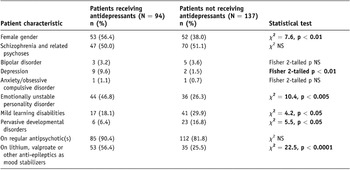
A total of 94 patients (40.7%) were prescribed antidepressants. Patients receiving antidepressants were compared with those who were not (see Table 1). Antidepressant use was associated with female gender, a diagnosis of depression and also of emotionally unstable personality disorder and not having a learning disability or a pervasive developmental disorder. Caution is needed in interpreting the negative findings in Table 1 because of the small numbers involved in some comparisons. Very few patients had a case note diagnosis of depression (n = 11), bipolar disorder (n = 8) or anxiety disorder or obsessive compulsive disorder (n = 2). Antidepressants were not associated with the prescription of regular antipsychotic medication but their use was associated with lithium, valproate and other anti-epileptics prescribed as mood-stabilisers.
Characteristics of patients prescribed antidepressants compared with those who were not

Details of antidepressant prescriptions
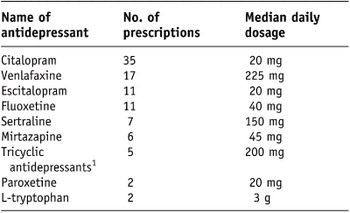
Ninety-two patients were prescribed one antidepressant and two were prescribed two. Details of the different antidepressants prescribed and their median daily dosages are given in Table 2. No dosages exceeded BNF recommended limits, but two tricyclic dosages were sub-therapeutic (defined as less than the equivalent of 100 mg of amitriptyline a day).
Details of antidepressant prescriptions

1Doses of tricyclic antidepressants expressed as amitriptyline equivalents as given in Ali (Reference Ali1998)
Antidepressant indications
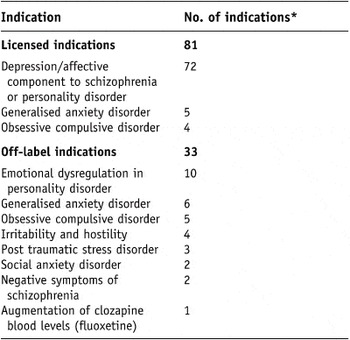
The treating psychiatrist stated the indication(s) for which the patient was receiving the antidepressant (for some patients there was more than one indication). Seventy-five patients (79.8%) were receiving an antidepressant for a licensed indication but six of these carried more than one of these indications bringing the total number of indications to 81. For 17 patients (18.1%) the antidepressant was being used off-label and for two patients (2.1%) the indication for the antidepressant was not known. The indications for antidepressants are given in Table 3. The licensed indications were depression, generalised anxiety disorder and obsessive compulsive disorder. The most common off-label indication was emotional dysregulation, usually associated with emotionally unstable personality disorder. Antidepressants were prescribed for many patients with schizophrenia in order to treat ‘the affective component of their illness’. For the purposes of the study this was interpreted as being a licensed indication for the treatment of depression, however, we recognise that the two terms may not be synonymous. For only two patients was an antidepressant prescribed for negative symptoms of schizophrenia. Similarly, patients with a personality disorder were frequently prescribed antidepressants for ‘an affective component’ and this was interpreted as being for depression. For one patient fluoxetine was being prescribed to deliberately increase plasma clozapine levels, an off-label indication.
Numbers of patients with licensed and off-label indications for antidepressants

* For some patients there was more than one indication for the antidepressant
Duration of antidepressant therapy
Forty-seven patients (50.0%) were already prescribed the antidepressant on admission to our hospital and 15 (16.0%) were being prescribed a different antidepressant at the time of admission (antidepressant status was not known for two patients at the time of admission). The median duration of antidepressant therapy to date at our hospital was 1.9 years (range 0.1–8.1 years). For 63 patients (67.0%), the psychiatrist's plan was to continue with the antidepressant indefinitely. For 20 (21.3%) the plan was to phase the drug out within three months to a year, for three (3.2%) the antidepressant was being stopped and for a further three (3.2%) it was being changed to a different drug, while for five (5.3%) the use of the antidepressant was currently under review.
Effectiveness of the antidepressant
The treating psychiatrist said that for 21 patients (22.3%) the antidepressant had resulted in a marked clinical improvement. For 49 (52.1%) the improvement was modest and for 11 (11.7%) there was no change. No patient was thought to have deteriorated as a result of taking an antidepressant but for 13 patients (13.8%) the treating psychiatrist was unable to comment on treatment response as the antidepressant had not been started by them. Patients receiving antidepressants for off-label indications were no less likely to be rated as markedly improved than those receiving them for licensed indications.
Side-effects of antidepressants
In 78 cases (83.0%), the treating psychiatrist said they had asked the patient about side-effects; in 14 (14.9%) they had not. In one case the patient had spontaneously volunteered they had no side-effects and in another case the psychiatrist could not remember if they had asked about side-effects. However, in only 14 cases (14.9%) did the treating psychiatrist say that they had asked about sexual side-effects. Several psychiatrists commented that they did not think it was clinically appropriate to ask female patients with a history of childhood sexual abuse about sexual side-effects. Only three patients (3.2%) were thought to have any side-effects attributable to the antidepressant. In two cases this was drowsiness and in the third case this was QTc prolongation on the ECG.
DISCUSSION
In this survey conducted at a secure psychiatric hospital, 40.7% of adult forensic and rehabilitation inpatients were prescribed antidepressants, mostly on a long-term basis. Prescription of antidepressants was associated with female gender and a diagnosis of depression and also emotionally unstable personality disorder and the co-prescription of mood stabilising medication. Depression and emotionally unstable personality disorder are known to be more common in females (Kessler, Reference Kessler2003; Lieb et al. Reference Lieb, Zanarini, Schmahl, Linehan and Bohus2004). Patients with learning disabilities and pervasive developmental disorders (mainly autistic spectrum disorders) were less likely than the rest of the patients to be receiving antidepressants. SSRI antidepressants were the most frequent type of antidepressant prescribed. Citalopram was the most common antidepressant prescribed. This is likely to reflect safety and tolerability (Keller, Reference Keller2000), lack of significant interactions with other psychotropics and low cost. By far the commonest licensed indication was depression or an affective component of the primary diagnosis. Yet very few of these patients had a formal diagnosis of an affective disorder. One likely explanation is that depressive co-morbidity was grossly under-reported in the case notes, even though consultant psychiatrists are supposed to document all co-morbid psychiatric disorders. Use of research tools has been found to detect a much higher proportion of psychiatric co-morbidity than reliance on clinical diagnoses (Zimmerman et al. Reference Zimmerman, McGlinchey, Chelminshi and Young2008). Co-morbidity in borderline personality disorder was extremely common in one study of inpatients, with 88% having an anxiety disorder and 83% having depression (Zanarini et al. Reference Zanarini, Frankenburg, Dubo, Sickel, Trikha, Levin and Reynolds1998). Similarly, in patients with schizophrenia co-morbid depression is thought to be fairly common with a reported prevalence of between 11 and 43% (Micallef et al. Reference Micallef, Fakra and Blin2006).
Strikingly few patients were thought by the treating psychiatrist to have side-effects from the antidepressant, despite the fact that most psychiatrists claimed they had inquired of the patient about side-effects. This may reflect lack of awareness of side-effects by the patient, attribution of side-effects to other drugs or other causes, communication difficulties between the patient and staff or a failure of the prescriber to ask about side-effects. In one study of community patients taking SSRIs, 85% reported at least one bothersome side-effect (most commonly sexual dysfunction or drowsiness, 17% each) whereas doctors significantly underestimated the occurrence of side-effects and their impact on patients (Hu et al. Reference Hu, Bull, Hunkeler, Ming, Lee, Fireman and Markson2004). In another study 34% of men and 33% of women were reported as having antidepressant-induced sexual dysfunction (Williams et al. Reference Williams, Baldwin, Hogue, Fehnel, Hollis and Edin2006), while in a study conducted on depressed outpatients the mean number of side-effects reported by patients was twenty times higher than the number recorded by the treating psychiatrists (Zimmerman et al. Reference Zimmerman, Galione, Attiullah, Freidman, Toba, Boerescu and Ragheb2010).
Some antidepressant prescriptions were off-label, principally those for emotional regulation in personality disorder. The NICE guideline on the treatment of borderline personality disorder (NICE, 2009b) does not recommend pharmacotherapy for core symptoms of the disorder and that would include emotional dysregulation. However, antidepressants are routinely prescribed for patients with personality disorder and their utility in these patients has been argued (Tyrer & Bateman, Reference Tyrer and Bateman2004). In only two instances were antidepressants being used to treat negative symptoms of schizophrenia. This could be considered surprising given the nature of the chronically ill patient population and the research finding that these drugs show some effectiveness in improving negative symptoms although the effect is modest (Singh et al. Reference Singh, Singh, Kar and Chan2010). Other off-label prescriptions were ‘near label’, for example, sertraline but not citalopram is licensed for the treatment of obsessive compulsive disorder. Off-label indications were no less likely to result in benefit to the patient as licensed indications – such prescriptions were reported by the treating clinician to be just as likely to result in marked improvement in symptomatology as when an antidepressant was being used for a licensed indication.
The study has a number of limitations. It was conducted at an independent tertiary referral centre with many complex and treatment-resistant cases. The results cannot, therefore, be readily extrapolated to NHS secure units. We relied on psychiatrists’ subjective reports of efficacy of antidepressants for target symptoms in individual patients rather than on examining outcomes using rating scales. Also, the low incidence of side-effects reported by the psychiatrist is likely to be an under-estimate and we relied on their report rather than studying the case notes to see how often side-effects had been documented. It was a cross-sectional survey and for some patients the psychiatrist could not comment upon the indication for the antidepressant or whether or not the antidepressant had improved target symptoms because it was not started by them. It may be that the drug had proved effective but this fact was not known to the current psychiatrist. A further weakness is that the interview schedule employed was not a validated tool. We asked about sexual side effects but not other commonly occurring side effects of antidepressants.
CONCLUSIONS
Use of antidepressants was very common in the secure inpatient population studied, although only a small percentage of the patients studied actually carried a formal diagnosis of an affective or an anxiety disorder. For the majority of patients antidepressant therapy was long-term. Although the majority of antidepressants were prescribed for licensed indications, off-label prescribing was fairly common. When assessing the effectiveness of antidepressant regimes, psychiatrists should regularly ask patients about possible side-effects of the medication, including where appropriate sexual side-effects, since the latter are very common and patients may need reassurance or a change in drug therapy. The need for continuing treatment with antidepressants should also be subject to periodic review. Further research on the use of antidepressants in secure settings is warranted, for example to investigate the reasons for the possible discrepancy between the true rate of side effects and those recorded.