Introduction
The cabbage seedpod weevil, Ceutorhynchus obstrictus (Marsham) (Coleoptera: Curculionidae), is an invasive alien species of European origin. It has established in North America at least twice in the last century (Laffin et al. Reference Laffin, Dosdall and Sperling2005) and is an important pest of canola, Brassica napus L. and B. rapa L. (Brassicaceae), in western and eastern Canada (Dosdall and Mason Reference Dosdall, Mason and Williams2010). It is estimated to cost Canadian canola producers in excess of $300 million in losses annually (Colautti et al. Reference Colautti, Bailey, Overdijk, Amundsen and MacIsaac2006). An attempt in the 1940s to introduce chalcidoid parasitoids (Hymenoptera: Chalcidoidea) for biological control of C. obstrictus in British Columbia, Canada, was unsuccessful except for the establishment of Stenomalina gracilis (Walker) (Pteromalidae) (Gibson et al. Reference Gibson, Baur, Ulmer, Dosdall and Muller2005, Reference Gibson, Gillespie and Dosdall2006b; Gillespie et al. Reference Gillespie, Mason, Dosdall, Bouchard and Gibson2006). Two additional European parasitoids, Trichomalus perfectus (Walker) and Mesopolobus morys (Walker) (Pteromalidae), are currently being reassessed for reintroduction (Kuhlmann et al. Reference Kuhlmann, Dosdall, Mason, Mason and Huber2002; Gillespie et al. Reference Gillespie, Mason, Dosdall, Bouchard and Gibson2006). Earlier studies documented the parasitoid communities in western Canada (Dosdall et al. Reference Dosdall, Ulmer, Gibson and Cárcamo2006b, Reference Dosdall, Gibson, Olfert and Mason2009; Gillespie et al. Reference Gillespie, Mason, Dosdall, Bouchard and Gibson2006) and Georgia, United States of America (Gibson et al. Reference Gillespie, Mason, Dosdall, Bouchard and Gibson2006a), which, except for S. gracilis, consisted of native or putatively Holarctic species such as Necremnus tidius (Walker) (Eulophidae) and Trichomalus lucidus (Walker). No studies have yet documented the parasitoid communities associated with C. obstrictus in the most recently invaded regions of Quebec and Ontario, Canada (Brodeur et al. Reference Brodeur, Leclerc, Fournier and Roy2001; Mason et al. Reference Mason, Baute, Olfert and Roy2004).
The objectives of this study were to (i) determine the parasitoid complexes associated with C. obstrictus infesting canola in Ontario and Quebec and (ii) assess the impact of the parasitoids on this important pest.
Materials and methods
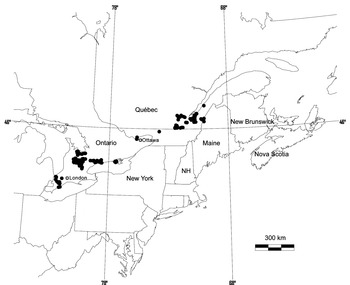
Surveys were conducted in 2003–2009 in canola fields in southern Ontario and southern Quebec where C. obstrictus was present (Mason et al. Reference Mason, Baute, Olfert and Roy2004) or could potentially occur (Fig. 1). Sites were visited when the crop was in the silique stage of development (stages 73–79 of Lancashire et al. Reference Lancashire, Bleiholder, van den Boom, Langelüddeke, Strauss, Weber and Witzenberger1991) — in early July for winter canola and in late July to early August for spring varieties. Densities of adult C. obstrictus were estimated in 2006 and 2007 with a standard sweep net when the canola was flowering (stages 61–65). Samples were taken by sweeping 100 times in a 180° arc while walking from the edge toward the centre of a field. Samples were placed in 70% ethanol and processed in the laboratory. Data were reported as number of adult weevils per sweep to allow comparison with the economic threshold of three or four weevils per sweep, used for insecticidal control (Dosdall et al. Reference Dosdall, Moisey, Cárcamo and Dunn2001; Cárcamo et al. Reference Cárcamo, Dosdall, Johnson and Olfert2005).
Localities surveyed for Ceutorhynchus obstrictus and parasitoids in Ontario and Quebec, Canada, from 2003 to 2009.

To determine parasitism, 50 (2003–2004) or 100–1000 (2006–2009) canola siliques were harvested from racemes on the lower half of randomly selected plants in each field. In 2003, 2004, 2008, and 2009, samples of siliques were collected at only a few locations with a history of C. obstrictus infestation. In 2006 and 2007, larger surveys were conducted to provide semiquantitative data. Because in earlier surveys, C. obstrictus was recovered from wild radish, Raphanus raphanistrum L. (Brassicaceae), in and around canola fields (Mason et al. Reference Mason, Baute, Olfert and Roy2004), siliques were also collected from this non-native host plant. Siliques of another non-native plant, wild mustard, Sinapis arvensis L. (Brassicaceae), were also collected because this species has been implicated as a host of C. obstrictus (Doucett Reference Doucette1947). In 2003 and 2004, samples of 50 siliques were placed in 1 L paper buckets, whereas in each of 2006–2009, samples of approximately 1000 siliques were placed in 30 cm×30 cm×30cm cardboard emergence boxes containing moistened fine vermiculite as a pupation substrate. A 2 cm diameter hole in one side of the bucket or box allowed insects to exit into plastic containers. The emergence buckets/boxes were placed in a lighted room at 22 ± 1 °C. Collection containers were inspected every 1 or 2 days until no insects had emerged from the boxes for 30 consecutive days. Emerged insects were placed in vials containing 70% ethanol, and weevils and parasitoids were sorted and counted. In 2006, percent parasitism was estimated on the basis of numbers of weevil larvae and parasitoid pupae found in the vermiculite substrate and of emerged adult weevils and adult parasitoids. Because of the large numbers of pods collected, it was impractical to dissect each pod to determine whether weevil remains or parasitoid pupae were present. Thus, estimates of parasitism may be slightly lower than actual levels. In 2009, parasitoid data from an ongoing life-table study of C. obstrictus in southwestern Ontario (A.B. Broadbent, G.A.P. Gibson, D.R. Gillespie, and P.G. Mason, unpublished data) were included for comparison with data from the Ottawa area. Parasitoids were critical-point dried and identified by G.A.P. Gibson; weevils were identified by P. Bouchard. Voucher specimens of weevils and parasitoids are deposited in the Canadian National Collection of Insects, Arachnids and Nematodes in Ottawa, Ontario. Specimen labels include site codes.
Means and standard errors were calculated using PROC Means of the SAS statistical software (SAS Institute Inc. 2008).
Results
Ceutorhynchus obstrictus
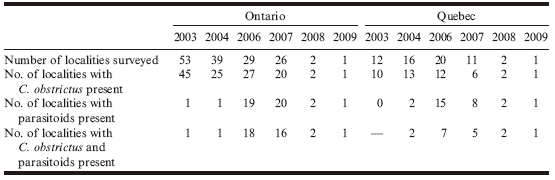
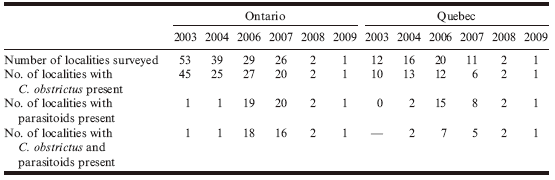
The surveys in 2006 and 2007 demonstrated that C. obstrictus was widespread in canola-growing areas south of Québec City and in southwestern Ontario, although weevils were not present at all sites surveyed (Table 1). Ceutorhynchus obstrictus was found in the Ottawa area for the first time in 2007 in spring canola on the Agriculture and Agri-Food Canada Central Experimental Farm (CEF). Individuals were subsequently reared in 2008 and 2009 from siliques of spring canola at the same location, indicating that a population had established.
Numbers of localities in Ontario and Quebec, Canada, surveyed in 2003 and 2004 and 2006–2009 where Ceutorhynchus obstrictus was present at flowering and parasitoids of C. obstrictus were present in siliques of Brassica napus.
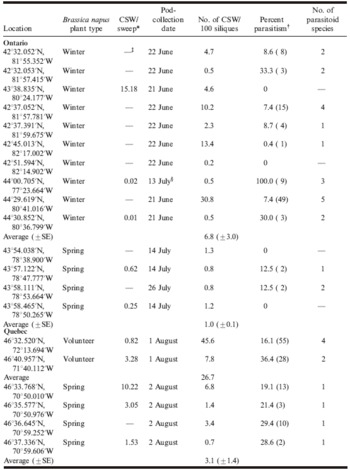
In 2006, numbers of adult C. obstrictus per sweep ranged from <0.1 to 15.2 in winter canola and from <0.1 to 1.2 in spring canola in southwestern Ontario, and from 0.1 to 10.2 in spring canola in Quebec (Table 2). The numbers of weevil larvae per 100 siliques were also highly variable, but high numbers of adults collected at flowering were not indicative of high numbers of larvae in siliques. Mean numbers of C. obstrictus per 100 B. napus siliques were higher in winter canola (6.8 ± 3.0) than in spring canola (1.0 ± 0.1) in southwestern Ontario. In Quebec, mean numbers of C. obstrictus per 100 B. napus siliques in spring canola were similar to those in spring canola in southwestern Ontario crops but lower than in volunteer B. napus (26.7), though only two locations were sampled. Other species of Ceutorhynchinae were collected as adults on flowers during the project, but only C. obstrictus emerged from the siliques of B. napus.
Incidence and parasitism of Ceutorhynchus obstrictus (CSW) during winter and spring and in volunteer Brassica napus plantings in Ontario and Quebec, Canada, in 2006.

*Sweep samples were taken during flowering, approximately 4 weeks before pod collections.
† Numbers in parentheses show the sample size.
‡ Samples were not taken, owing to rain.
§ Pod samples were taken very late (therefore parasitoid numbers were normal but weevil numbers decreased).
Parasitoids associated with C. obstrictus in B. napus
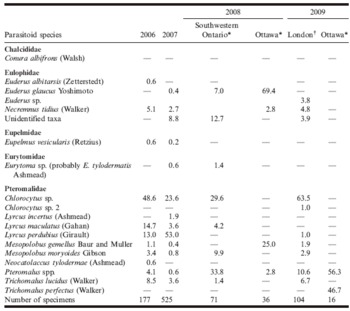
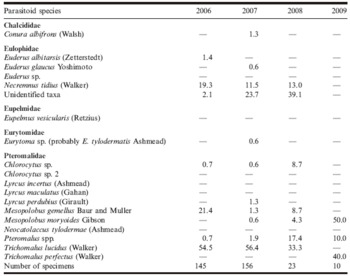
In 2003 and 2004, very few parasitoids were reared from siliques of B. napus. A total of three specimens of Lyrcus perdubius (Girault) (Hymenoptera: Pteromalidae) were reared from siliques in southwestern Ontario. In southern Quebec, one specimen each of Euderus glaucus Yoshimoto (Hymenoptera: Eulophidae) and an unidentified species of Trichomalus Thomson (Hymenoptera: Pteromalidae) were reared. In 2006–2009, at least 18 parasitoid species from five families of Chalcidoidea were reared, including at least 17 species from southwestern Ontario (Table 3) and 13 species from Quebec (Table 4). Parasitoids were not present at all sites, and some sites yielded parasitoids but no C. obstrictus (Table 1). Furthermore, not all parasitoid species were present at all sites surveyed, and because of the mass rearing method it is possible that some of the species recovered in low numbers (e.g., a single specimen of Chlorocytus “sp. 2” in Ontario) were actually associated with other host species contaminating the siliques. Some specimens of other chalcidoid genera and families as well as the superfamilies Ceraphronoidea, Cynipoidea, Ichneumonoidea, and Platygastroidea were reared but are not included in Tables 3 and 4 because known host relationships indicate that they were associated with such contaminants as the diamondback moth, Plutella xylostella L., (Lepidoptera: Plutellidae), aphids (Hemiptera: Aphididae), plant bugs (Hemiptera: Miridae), and miscellaneous plant-mining Diptera, which also emerged from our samples.
Species composition (%) of Chalcidoidea parasitoids reared from collections of approximately 1000 siliques of Brassica napus in 2006–2009 in southern Ontario, Canada, and putatively associated with Ceutorhynchus obstrictus.

*Pod collections are from a single location.
† Pod collections were made weekly from two locations in the London area.
Species composition (%) of Chalcidoidea parasitoids reared from collections of approximately 1000 siliques of Brassica napus in 2006–2009 in southern Quebec, Canada, and putatively associated with Ceutorhynchus obstrictus.

Two parasitoid species, Mesopolobus gemellus Baur and Muller and T. perfectus, previously reared in Europe from Ceutorhynchus typhae (Herbst) (Baur et al. Reference Baur, Muller, Gibson, Mason and Kuhlmann2007; Muller et al. Reference Muller, Dosdall, Mason and Kuhlmann2011) and C. obstrictus (Haye et al. Reference Haye, Mason, Dosdall and Kuhlmann2010), respectively, were reared from siliques of canola and are reported for the first time in North America. Prior to 2009, T. perfectus had not been reared from siliques of canola or wild radish in Canada or elsewhere in North America, even though this name was erroneously used in the literature prior to Gibson et al. (Reference Gibson, Baur, Ulmer, Dosdall and Muller2005).
The parasitoid complex associated with C. obstrictus differed between Ontario and Quebec. In southwestern Ontario, the most abundant species were a species of Chlorocytus Graham (23.6%–48.6%) and L. perdubius (0%–53%), followed by Lyrcus maculatus (Gahan) (2.8%–14.7%) and species of Pteromalus Swederus (0.6%–23.1%) (Pteromalidae). In contrast, the most abundant species in Quebec were T. lucidus (33.3%–56.4%), followed by unidentified species of Eulophidae (2.1%–39.1%), N. tidius (11.5%–19.3%), and M. gemellus (1.3%–21.4%). Among the most abundant species, Chlorocytus sp. in southwestern Ontario and T. lucidus in Quebec constituted a relatively high proportion of the parasitoid community each year during the 2006 and 2007 surveys.
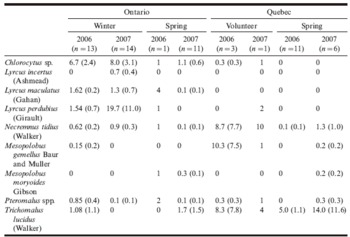
In 2008, parasitoids were recovered for the first time in Ottawa, Ontario, from C. obstrictus in a spring canola field on the CEF. Euderus glaucus and M. gemellus were the most abundant species (69.4% and 25.0%, respectively). In 2009, only Pteromalus spp. (56.3%) and T. perfectus (46.7%) were collected from the CEF. Chlorocytus sp. and L. perdubius, two of the most prevalent parasitoid species in southwestern Ontario, were absent at the CEF location, whereas T. perfectus was present at this site and absent from southwestern Ontario (Table 3). Trichomalus perfectus was also reared from C. obstrictus in Quebec in 2009. In 2006 and 2007, mean numbers of the nine most common parasitoids (Table 5) differed between southwestern Ontario and Quebec and varied among years and between early season (winter or volunteer) and summer (spring) B. napus siliques. These differences appear to be random.
Numbers of the most common parasitoids of Ceutorhynchus obstrictus at all sites in Ontario and Quebec, Canada, in 2006 and 2007 where collections of approximately 1000 siliques were made.

Note: All species belong to the Pteromalidae, except Necremnus tidius, which belongs to the Eulophidae; n is the number of sites from which approximately 1000 siliques were collected and parasitoids emerged. Numbers in parentheses show the mean ± SE.
Parasitoids associated with C. obstrictus in noncrop Brassicaceae
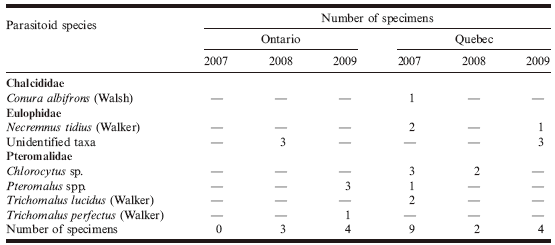
Collections of R. raphanistrum siliques from southern Quebec and the CEF site in 2007–2009 yielded adult C. obstrictus (data not shown) and seven ectoparasitoid species (Table 6). In 2007, one specimen each of Conura albifrons (Walsh) (Chalcididae), N. tidius, and Chlorocytus sp. and two specimens of T. lucidus were reared from a single southern Quebec location (46°03.647′N, 72°03.476′W), whereas a single specimen of Chlorocytus sp. was reared from each of two additional locations (46°13.118′N, 72°25.515′W and 45°56.570′N, 73°04.168′W). In 2008, one specimen of Chlorocytus was reared from each of two locations in southern Quebec (45°58.691′N, 72°48.062′W and 45°57.267′N, 72°27.886′W) and three specimens of Eulophidae were reared from one site in southwestern Ontario (42°59.000′N, 80°22.882′W). In 2009, one specimen of N. tidius and one unidentified eulophid were reared from each of two locations in southern Quebec (46°11.264′N, 72°21.201′W and 45°50.179′N, 73°50.724′W, respectively) and three specimens of Pteromalus sp. and one specimen of T. perfectus were reared from the CEF site (45°23.308′N, 75°42.780′W).
Species composition of Chalcidoidea parasitoids reared from collections of siliques of Raphanus raphanistrum from southern Quebec and southern Ontario, Canada, in 2007–2009 and putatively associated with Ceutorhynchus obstrictus.
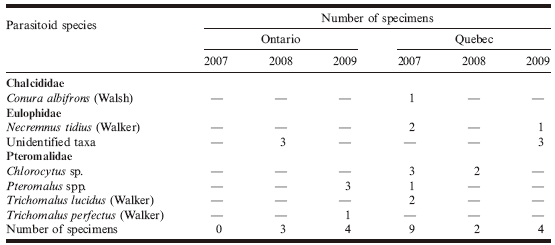
Collections of S. arvensis siliques from 34 sites in 2006–2008 yielded no C. obstrictus. One unidentified eulophid emerged from siliques collected at one site in Ontario (42°48.384′N, 81°52.220′W) in 2007 (n=1) and two sites in Quebec (45°17.299′N, 73°41.200′W and 45°13.874′N 73°48.891′W) in 2007 (n=1 at each site) and one site (45°13.872′N, 73°48.919′W) in 2008 (n=4). The host of these unidentified parasitoids could belong to any one of a number of insect families (see Yu Reference Yu2005).
Discussion
Our survey showed that populations of C. obstrictus have continued to spread in eastern Canada. Densities of weevils varied among locations and years and between early-developing (winter/volunteer) and late-developing (spring) plant types. Early flowering/silique-producing plants supported higher numbers of C. obstrictus and associated parasitoids than plants that flowered and produced siliques later in the season (Table 2). Because C. obstrictus overwinters in the adult stage (Dosdall and Mason Reference Haye, Mason, Dosdall and Kuhlmann2010 and references therein), heavy attacks on siliques of early-developing host plants would enable this pest to maximally exploit available resources. The early-season occurrence of volunteer canola and other weedy Brassicaceae (see below) ensures that populations of C. obstrictus will persist and continue to spread. Attacking early-maturing plants is the basis of pest management using trap crops (Cárcamo et al. Reference Dosdall, Moisey, Kott, Keddie, Good and Rahman2007), together with late seeding of harvestable crops (Dosdall et al. Reference Dosdall, Moisey, Kott, Keddie, Good and Rahman2006a).
Ceutorhynchus obstrictus was found in the Ottawa area for the first time in 2007, and this represents a major range extension because it was absent from earlier surveys in eastern Ontario (Mason et al. Reference Mason, Baute, Olfert and Roy2004). The use of wild radish and wild mustard as host plants by C. obstrictus (Mason et al. Reference Mason, Baute, Olfert and Roy2004) and the widespread occurrence of these plant species in southern Quebec and southern Ontario (Mulligan and Bailey Reference Mulligan and Bailey1975; Warwick et al. Reference Warwick, Beckie, Thomas and MacDonald2000; Warwick and Francis Reference Warwick and Francis2005) may have provided a pathway for dispersal of C. obstrictus.
The reason for lack of parasitoids at some locations sampled may have been that too few siliques were collected (approximately 50 per site in 2003 and 2004) to yield parasitoids at low population levels, samples being collected before parasitism occurred, or a non-uniform distribution of parasitoids. The fact that only parasitoids were found in some locations may indicate that these species were associated with non-weevil hosts known to be present or were locations where healthy weevils had emerged before siliques were sampled (parasitoids emerge from siliques approximately 2–3 weeks after C. obstrictus).
Gibson et al. (Reference Gillespie, Mason, Dosdall, Bouchard and Gibson2006b) verified that T. perfectus was intentionally introduced in British Columbia from Europe in 1949 for biological control of C. obstrictus, but it did not establish (Gillespie et al. (Reference Gillespie, Mason, Dosdall, Bouchard and Gibson2006). The recent occurrence of T. perfectus in Ottawa, Ontario (45°29.121′N, 75°42.311′W), and St-Célestin, Quebec (46°11.264′N, 72°21.201′W), in 2009 suggests that this species is adventive in eastern Canada and has attained a wide regional distribution in a relatively short time. Because C. obstrictus was first reported in Ottawa in 2007, even though surveys have been ongoing since 2000 (Mason et al. Reference Mason, Baute, Olfert and Roy2004), it is likely that C. obstrictus and at least some of its parasitoids moved west to the Ottawa area from Quebec via the Ottawa Valley. Detailed population studies are required to validate this hypothesis because all other parasitoids associated with C. obstrictus at the CEF location in Ottawa were found in both southwestern Ontario and Quebec.
Identification of the complex of parasitoids attacking larvae of C. obstrictus in southwestern Ontario and Quebec is consistent with findings in other regions of North America (Gillespie et al. Reference Gillespie, Mason, Dosdall, Bouchard and Gibson2006; Gibson et al. Reference Gillespie, Mason, Dosdall, Bouchard and Gibson2006b; Dosdall et al. Reference Dosdall, Gibson, Olfert and Mason2009), though different species dominate the complexes in different regions. The occurrence of the European species M. gemellus at all sites in this study and T. perfectus in Quebec and the Ottawa area suggests that these species are adventive, and both may have been introduced at the same time as the Quebec C. obstrictus population. However, because of host association it is more likely that M. gemellus was introduced with C. typhae, an adventive species that is widespread in eastern Canada (Ontario, Quebec, New Brunswick, Nova Scotia, and Newfoundland) (Bousquet Reference Bousquet1991; Bouchard et al. Reference Bouchard, Lesage, Goulet, Bostanian, Vincent, Zmudzinska and Lasnier2005). In Europe, M. gemellus is recorded as the major parasitoid of C. typhae, which feeds in siliques of shepherd's purse, Capsella bursa-pastoris (L.) Medik. (Brassicaceae) (Baur et al. Reference Baur, Muller, Gibson, Mason and Kuhlmann2007; Muller et al. Reference Muller, Dosdall, Mason and Kuhlmann2011), a common invasive weed in canola and other crops in North America (Moss Reference Moss1959; Budd and Best Reference Budd and Best1969). The emergence of M. gemellus from siliques of canola (i.e., from C. obstrictus) represents a curious new host association. Mesopolobus morys Walker (Pteromalidae), which is not known from North America (Gibson et al. Reference Dosdall, Ulmer, Gibson and Cárcamo2006b), is the species of Mesopolobus that parasitizes C. obstrictus in Europe (Williams Reference Williams and Alford2003; Haye et al. Reference Haye, Mason, Dosdall and Kuhlmann2010).
The hypothesis that T. perfectus and M. gemellus were introduced accidentally in eastern Canada is supported by the absence of T. perfectus from southwestern Ontario (this study) as well as from British Columbia, Alberta, and Saskatchewan in Canada and Georgia in the United States of America (Gillespie et al. Reference Gillespie, Mason, Dosdall, Bouchard and Gibson2006; Dosdall et al. Reference Dosdall, Gibson, Olfert and Mason2009; Gibson et al. Reference Gillespie, Mason, Dosdall, Bouchard and Gibson2006b) and the presence of C. typhae in southwestern Ontario, the Ottawa area, and southern Quebec but not in western Canada. Furthermore, the absence of M. gemellus from Georgia also suggests accidental introduction in eastern Canada.
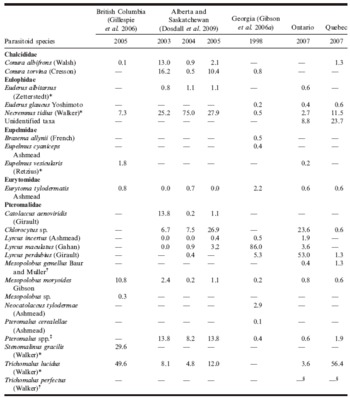
The North American parasitoid communities of C. obstrictus vary among regions from 8 to 17 species (Table 7). In British Columbia, T. lucidus, S. gracilis, and Mesopolobus moryoides Gibson are dominant (Gillespie et al. Reference Gillespie, Mason, Dosdall, Bouchard and Gibson2006), whereas N. tidius dominates in the Canadian prairies (Dosdall et al. Reference Dosdall, Gibson, Olfert and Mason2009), L. maculatus is most abundant in Georgia (Gibson et al. Reference Gillespie, Mason, Dosdall, Bouchard and Gibson2006b), Chlorocytus sp. and L. perdubius dominate in southwestern Ontario (this study), and T. lucidus and unidentified species of Eulophidae are most abundant in Quebec (this study). Three species, N. tidius, Eurytoma tylodermatis Ashmead (Hymenoptera: Eurytomidae), and M. moryoides are present in all regions where C. obstrictus occurs, although E. tylodermatis constitutes a very small proportion of the parasitoid complex (<0.2%, except in Georgia, where it is 2.2%). Among the 24 larval parasitoids reported as associated with C. obstrictus in North America, 8 are also reported from the Palaearctic Region. Of these, S. gracilis was intentionally introduced to North America (Gibson et al. Reference Gillespie, Mason, Dosdall, Bouchard and Gibson2006b), but whether the others are naturally occurring Holarctic species or were accidentally introduced is uncertain. For example, Eupelmus vesicularis (Retzius) (Eupelmidae) is transcontinental in North America, but is thought likely to have been introduced from Europe in straw with early European settlers (Gibson Reference Gibson1990). It is a broad generalist, with over 130 known hosts, as are most of the other known parasitoids of C. obstrictus (Yu Reference Yu2005; Dosdall et al. Reference Gibson, Gillespie and Dosdall2006b), though M. moryoides is as yet associated only with this weevil, and M. gemellus has previously been associated only with C. typhae except for a single female from Ceutorhynchus turbatus Schultze (Baur et al. Reference Baur, Muller, Gibson, Mason and Kuhlmann2007). The incidence of even the dominant parasitoid species varies over time (Tables 3, 4, 5, 7), although sampling protocols likely influence these estimates (i.e., patchiness of hosts and parasitoids; see Dosdall et al. Reference Dosdall, Gibson, Olfert and Mason2009).
Species composition (%) of Chalcidoidea parasitoids reared from collections of siliques of Brassica napus and B. rapa and putatively associated with Ceutorhynchus obstrictus in British Columbia (2005), southern Alberta and Saskatchewan (2003–2005), and Ontario and Quebec (2007) in Canada and Georgia, United States of America (1998).

*Palaearctic Region.
† New record for North America.
‡ At least two undescribed species.
§ Although T. perfectus was not found in 2007, it was found in Ontario (Ottawa) and Quebec in 2009.
In Europe, 32 parasitoids, including 17 chalcidoids, have been associated with C. obstrictus (Ulber et al. Reference Ulber, Williams, Klukowski, Luik, Nilsson and Williams2010). Although the complex varies among regions, three ectoparasitoid species, M. morys, S. gracilis, and T. perfectus, have been reared from C. obstrictus in all areas where it is present. Haye et al. (Reference Haye, Mason, Dosdall and Kuhlmann2010) determined that larval mortality due to parasitism accounted for 45.5%–51.9% of the seasonal mortality of C. obstrictus in Europe, the dominant parasitoid species being M. morys (44%–48%) and T. perfectus (37%–48%). Veromann et al. (Reference Veromann, Williams, Kaasik and Luik2011) found substantial parasitism (up to 96%) in Estonia, a relatively new area for C. obstrictus and its parasitoids. Although parasitoids of the egg and adult stages of C. obstrictus occur in Europe, these species do not cause significant mortality (Williams Reference Williams and Alford2003; Ulber et al. Reference Ulber, Williams, Klukowski, Luik, Nilsson and Williams2010). Microctonus melanopus Ruthe (Hymenoptera: Ichneumonoidea: Braconidae), a parasitoid of adults, has also been reported from North America but has a limited distribution (Idaho, Alberta) and has little impact on C. obstrictus mortality (Dosdall and Mason Reference Haye, Mason, Dosdall and Kuhlmann2010).
The complex of parasitoids associated with C. obstrictus on Brassicaceae other than B. napus is poorly understood. Fewer species appear to be associated with C. obstrictus infesting siliques of wild radish (Table 6), although those that occurred tended to be the major species that attacked C. obstrictus in canola. The eastern Canadian populations of C. obstrictus did not appear to attack wild mustard. Doucette (Reference Doucette1947) concluded that C. obstrictus could complete its development in wild mustard, although this was not a preferred host.
Ceutorhynchus obstrictus continues to expand its range in North America. Parasitoid communities composed of Nearctic, putatively Holarctic, and introduced species have assembled on this host, but these communities vary in composition among the regions that have been surveyed. Although existing communities appear to provide substantial parasitism, the dominant species vary among years. Overall parasitism currently does not reduce C. obstrictus populations sufficiently to eliminate economic loss in eastern Canada, and this is also the case elsewhere in North America (Dosdall et al. Reference Dosdall, Gibson, Olfert and Mason2009). Monitoring of parasitism levels should continue, to assess whether the current assemblages of species will increase and disperse across the entire range of C. obstrictus or there is a need to introduce more host-specific species from Europe that will provide greater mortality of C. obstrictus. The establishment in Canada of T. perfectus, the most effective parasitoid of C. obstrictus in Europe (Williams Reference Williams and Alford2003; Haye et al. Reference Haye, Mason, Dosdall and Kuhlmann2010; Veromann et al. Reference Veromann, Williams, Kaasik and Luik2011), provides an opportunity to track the spread and determine the impact of this important species. Finally, because the community of parasitoids has likely assembled from locally occurring weevil species in the subfamily Ceutorhynchinae, it will be important to determine whether or not the same parasitoid communities, or components thereof, are also associated with native species and (or) species introduced for the biological control of weeds.
Acknowledgements
Erin Adams, Jane Allison, Margaret Aslanian, Ahmed Badiss, Lisa Bartels, Andrea Brauner, Ana Maria Farmakis, Gabriel Gregorich, Lola Gualtieri, Tom Hay, Shashi Juneja, James Knechtel, Kevin Macwan, Kathryn Makela, Christie Martin, Richard Muth, and Michael Wogin provided technical assistance. Tracey Baute and Michèle Roy provided information on sampling locations in Ontario and Quebec, respectively. This project was funded in part by Agriculture and Agri-Food Canada's Pest Management Centre Improving Farming Systems and Practices Initiative Project PRR03-370.