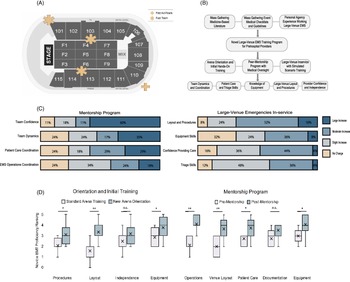
Many musical concerts meet the criteria for a mass gathering event (MGE), which can strain local medical resources and present a challenging work environment for emergency medical service (EMS) providers (see Table S1). Reference Arbon1,Reference Koski, Kouvonen and Sumanen2 Environmental factors like loud music, darkness, and dense crowds make it difficult to locate and treat patients effectively, while dehydration and excessive substance use exacerbate medical emergencies. Reference Jaslow, Yancy and Milsten3–Reference Yancy, Luk, Milsten and Nafziger5 Emergency medical technicians (EMTs) face many of these challenges at Agganis Arena, a 7,200-seat, indoor, large venue located on the Boston University campus (Figure 1A). The arena is staffed by Boston University Emergency Medical Services (BUEMS), a collegiate, basic life support agency based in Boston, Massachusetts, United States.
(A) Agganis Arena Layout and EMS Locations. (B) Program Development and Outcomes. (C) Self-evaluated impact of individual components of peer-mentorship program and large-venue emergencies in-service. Both numerically converted from a 4-point qualitative scale from 0-3 (Unchanged = 0, Large Improvement = 3); n = 25 including Novice Arena EMTs and Non-arena EMTs. (D) Novice EMT proficiency rankings pre- and post- orientation implementation and participation in the mentorship program. Pre-orientation implementation was defined as BUEMS EMTs that received the standard arena training before September 2019. Post-orientation implementation was defined as the Novice EMTs that received the new arena orientation during September 2019. Novice EMTs were evaluated by Experienced EMTs. Scores rated on a 0-5 scale and are represented as median Likert scores IQR; (unpaired two-sample Mann-Whitney/Wilcoxon rank sum tests; n = 12 including arena experienced EMT mentors). During the mentorship program, novice EMTs were evaluated by Experienced EMTs. Scores rated on a 0-5 scale and are represented as median Likert scores IQR; (paired two-sample Wilcoxon signed rank tests; n = 12 including arena experienced EMT mentors). The “X” marker within each boxplot denotes sample mean. *p < 0.05, **p < 0.01; Key: LVEMS = Large-Venue Emergency Medical Services.

Given the potential for environmental delays, most MGE literature focuses on retrospective review and prediction of factors affecting EMS utilization, including weather, attendance, and substance use. Reference Arbon1,Reference Morimura, Mizobata and Sugita4,Reference Lund, Gutman and Turris6 However, the literature does not focus on mass gathering medicine training regarding these events, which presents a gap between proposed event preparation and implementation into clinical practice through comprehensive training. Reference Arbon1,Reference Lund, Gutman and Turris6 Public health preparedness guidelines recommend that on-site EMS providers have training in disaster medicine, but this training is not mandated in the National Standards for EMS Education. Reference Yancy, Luk, Milsten and Nafziger5,Reference Schwartz, Nafziger and Milsten7,Reference Samuels, Bock, Maull and Stoy8
In September of 2019, BUEMS management implemented a comprehensive, concert-specific training program to adequately prepare EMTs to work large-venue emergency medical services (LVEMS) (see Table S2). Course curriculum included core components of LVEMS and highlighted the differences from conventional ambulance operations (Supplementary Text 1).
First, all novice arena emergency medical technicians (NA-EMTs) attended a pre-season orientation and skills training session at Agganis Arena. The goal was to provide NA-EMTs with the basic skills and competency needed for their first large-venue shifts. After this, a peer-mentorship program was established to provide every NA-EMT with tailored training, mentorship, and medical oversight during each patient interaction. For every shift at Agganis Arena, a NA-EMT was always paired with an arena-experienced emergency medical technician (AE-EMT) as a mentor. Last, an all-staff in-service was instructed by AE-EMTs and included a lecture component, hands-on scenario component, and guided tour of Agganis Arena, which highlighted environmental difficulties and medical management of patients (Supplementary Text 2). Small teams of students rotated through simultaneous scenarios that used patient-actors and simulated comprehensive concert-venue emergencies (Supplementary Text 3 and 4).
The primary objective of this study was to describe the mass gathering medicine program schema and characterize its implementation at our institution (see Figure 1B). The secondary objective was to determine the impact of preparing EMTs to manage the difficulties of LVEMS.
Methods
Study Approval and Data Sources
This study was approved by the Boston University Institutional Review Board (IRB) (H-40458) and was conducted in compliance with anonymous survey guidelines. Data were collected from eligible participants through Qualtrics Software electronic questionnaires (Qualtrics, Provo, UT, USA).
Cohort description
The overall cohort included all active status BUEMS EMTs from September 2019 to January 2020 (N = 56). AE-EMTs included those who had worked at least 8 Agganis Arena shifts prior to September 2019 and possessed a thorough familiarity regarding the layout and protocols, as well as strong leadership skills while on duty (n = 13). NA-EMTs included those with little to no experience working at Agganis Arena prior to September 2019 and who completed the arena orientation in September 2019 (n = 12). Non-arena EMTs included those who had not worked at Agganis Arena during the 2019 season and did not complete the arena orientation in September 2019 (n = 31).
Likert scale questionnaires
Questionnaires were constructed from AE-EMT feedback and validated through a pilot study of AE-EMTs and administrative staff with experience in LVEMS. The validation included review from the Boston University IRB for leading, confusing, or double-barreled questions, whereafter content and wording were adjusted as appropriate.
AE-EMTs, NA-EMTs, and non-arena EMTs received separate surveys regarding specific roles within the program. Regarding the orientation, NA-EMTs were assessed by AE-EMTs using 6-point Likert scales (0-5). Pre-orientation implementation was defined as BUEMS EMTs that received the standard arena training before September 2019. Post-orientation implementation was defined as the BUEMS EMTs (now called NA-EMTs) who received the new arena orientation during September 2019. Similarly, AE-EMTs rated NA-EMTs before and after completion of the mentorship program using 6-point scales (0-5). Orientation, mentorship, and in-service assessments also included self-reported 4-point scales (Unchanged = 0; Large Improvement = 3).
Statistical Analysis
All statistical analyses were performed using JMP Pro 15 (SAS Institute, Cary, NC, USA).
Orientation impact was evaluated for significance with unpaired 2-sample Mann-Whitney-Wilcoxon rank-sum tests. Pre-/post-mentorship scores were evaluated for significance with paired 2-sample Wilcoxon signed-rank tests. Self-assessment data were evaluated through 1-sample Wilcoxon signed-rank tests with a null hypothesis of no improvement. Nonparametric tests were chosen for analysis, as they are more robust to unequal variances and skewed distributions often found with small samples. Categorical or dichotomous variables were reported as number and percentage. Medians and interquartile ranges were chosen for continuous data, as the small sample size increases the chance of large variances and standard deviations.
Results
Overall Cohort
The overall cohort included 43 BUEMS EMTs, with a total survey response rate of 76.8%. Only 16 EMTs (37.2%) felt prepared to work MGEs upon hire, and 25 (60.5%) stated that their initial EMT-certification course did not prepare them for large-venue challenges (see Table S3).
Arena Orientation and Initial Training
Compared to new staff before the orientation was implemented, NA-EMTs were associated with increased logistical aspects of LVEMS. NA-EMTs who completed the orientation had increased knowledge of LVEMS procedures (P = 0.0170) and Agganis Arena layout (P = 0.0011) when compared to new hires who did not receive the new arena orientation. NA-EMTs were also better at using Agganis Arena equipment (P = 0.0304) when compared to previous hires (Table 1). All 7 surveyed NA-EMTs (100%) stated that this orientation was beneficial for working at Agganis Arena and 10 AE-EMTs (83.3%) stated that the orientation produced better trained NA-EMTs (see Figure 1D).
Training Program Quantitative Impact

Orientation impact was evaluated for significance with unpaired two-sample Mann-Whitney/Wilcoxon rank sum tests and presented as a comparison of median scores. Pre/post mentorship scores were evaluated for significance with paired two-sample Wilcoxon signed rank tests and presented as a comparison of median scores. Peer-Mentorship evaluation included both AE-EMTs and NA-EMTs. Inservice self-assessment data were evaluated through one-sample Wilcoxon signed rank tests with a null hypothesis of no improvement and presented as median score. Inservice evaluation included both NA-EMTs and Non-Arena EMTs. Scores rated on a 0-5 scale. Key: LVEMS = Large-Venue EMS; AE-EMTs = Arena Experienced EMTs; NA-EMTs = Novice Arena EMTs.
Peer-Mentorship Program
Additional training and mentoring by AE-EMTs during arena shifts were significantly associated with increased NA-EMT knowledge and competency within the venue. NA-EMTs showed increased equipment skills (P = 0.0248) and venue layout navigation (P = 0.0048) at the end of the program when compared to the beginning (see Table 1). Additionally, NA-EMTs had increased patient care skills (P = 0.0438) and greater ability to follow EMS operations (P = 0.0025) (see Figure 1D).
The mentorship program was also significantly associated with increased EMS dynamics within the venue. At the commencement of the program, 5 NA-EMT (100%) and 10 AE-EMT (83.3%) respondents reported that the mentorship was beneficial to BUEMS and Agganis Arena. NA-EMTs and AE-EMTs both self-reported that the pairing and mentoring significantly increased their confidence with working events (P = 0.0002) and teamwork within the venue (P = 0.0002). EMTs also self-reported increased coordination when working in these designated pairs, including increased coordination of patient care (P = 0.0002) and abilities performing coordinated EMS operations (P = 0.0001; see Figure 1C).
Large-Venue In-Service
Simulated training was significantly associated with increased knowledge of LVEMS procedures and skills, as well as individual confidence. Through self-evaluation, 6 NA-EMT (100%) and 18 non-arena EMT (94.7%) respondents found the in-service to be beneficial to their understanding of large-venue specific logistics and patient care. Together, 22 (88.0%) respondents reported an increase in triage skills (P = 0.0001), 17 (68.0%) reported better knowledge of equipment (P = 0.0001), and 21 (84.0%) reported increased confidence providing care (P = 0.0001). Most notably, 17 (68.0%) respondents stated that the large-venue guided tour moderately or largely increased their knowledge of arena layout and LVEMS procedures (P = 0.0001; see Figure 1C).
Discussion
Mass gathering medicine is performed in a unique and demanding environment, and the majority of BUEMS EMTs initially felt uncomfortable providing care at Agganis Arena (see Table S1). Reference Jaslow, Yancy and Milsten3 Since mass gathering medicine education is not mandatory during initial EMT coursework to obtain certification, the majority of BUEMS EMTs reported little or no formal training in LVEMS before working at the arena (see Table S3). Reference Schwartz, Nafziger and Milsten7
Agganis Arena has the capacity to host thousands of guests located between multi-level stadium-style seating and standing-room floors, so EMTs must understand how to efficiently and safely extricate patients (see Figure 1A). After the orientation, NA-EMTs had twice the knowledge of arena layout and increased equipment skills for difficult extrications (see Table 1).
Additional training regarding typical large-venue emergencies and protocols covered care and management of individual patients. This training significantly increased NA-EMT knowledge of LVEMS procedures, including managing the high volume of altered mental status and intoxicated patients (see Table 1). These skills are vital for MGE EMTs, as substance use is linked to nearly 96% of the people transported to the hospital from a large venue, with 50% using more than 1 illicit substance. Reference Ruest, Stephan, Masiakos, Biddinger, Camargo and Kharasch9
Representative of many MGE logistics, BUEMS EMTs must care for multiple simultaneous patients and decide which patients require transport for further care. Reference Lund, Gutman and Turris6 Many of these are medically complex patients, with up to 48% requiring care beyond prehospital capabilities. Reference Lund, Gutman and Turris6,Reference Martin-Gill, Brady and Barlotta10 Through the peer-mentorship program, NA-EMTs always had more experienced providers to guide their treatment decisions and thus teams reported increased confidence that each call would go smoothly (see Table 1).
The mentorship program was created to benefit NA-EMTs, but the results also showed an increase in overall EMS team dynamics (see Figure 1C). Team dynamics is especially important during MGEs, as the chaotic and loud environment can often make communication between providers extremely difficult. Reference Jaslow, Yancy and Milsten3 One-on-one team pairing increased coordination of both patient care and EMS operations, which may have improved patient management decisions (see Figure 1C).
During the large-venue in-service, AE-EMTs who proctored the scenarios were able to use their own large-venue experiences to guide students through the skills (Supplementary Text 4A-C). Each scenario was simulated as a full, comprehensive patient encounter, including dispatch, initial contact, treatment, extrication, and transport. The curriculum covered MGE skills that are excluded from the National Standards for EMS Education, including the treatment of intoxicated minors, noncompliant refusals, and treat-and-release, which occur often in the large-venue environment. Reference Yancy, Luk, Milsten and Nafziger5,Reference Samuels, Bock, Maull and Stoy8
After the in-service, students reported increased confidence in triaging, providing appropriate care, and using equipment, all of which are regularly performed in the large-venue setting (see Figure 1C). Reference Morimura, Mizobata and Sugita4,Reference Lund, Gutman and Turris6 BUEMS EMTs were also taught how to adapt communication skills to the large-venue setting, which is essential for coordinated emergency care (Supplementary Text 2). Reference Jaslow, Yancy and Milsten3,Reference Yancy, Luk, Milsten and Nafziger5,Reference Lund, Gutman and Turris6 As a result, EMTs reported increased confidence regarding care decisions and increased teamwork (see Figure 1C).
Additionally, MGE providers are not given an exact address in a large venue but rather a generalized location of the patient, often within a dense crowd. Reference Jaslow, Yancy and Milsten3 During the guided tour, EMTs were taught how to traverse this multi-level environment and reported a large benefit in navigating the layout (see Figure 1C).
This preliminary evaluation did yield many potential program benefits, but further research should also explore the program’s impact on specific aspects of patient care, including response times, correct and thorough treatment initiation, and adherence to large-venue protocols. A future study should also test the program efficacy with a new cohort of EMTs and during mass gathering events at another institution.
Limitations
This study was limited by a relatively small sample size. Over the 5-month period after program implementation, only 56 EMTs were employed and available to survey. Since evaluation was particular for this program, inclusion criteria were limited to only EMTs employed by BUEMS. Additionally, long-term follow-up could not be performed, as only 1 concert was held after initial evaluation before the arena was closed in March 2020 due to COVID-19. The arena has remained closed due to government-issued restrictions on mass gatherings.
The questionnaires were subject to potential response bias. Portions of this survey involved EMTs rating their own improvements in knowledge and skills, which are subjective measurements. To attenuate the potential effects of this limitation, EMTs were advised that the surveys were anonymous and that they would not face any retribution or reimbursement for their survey responses.
Finally, there is a statistical limitation in the use of nonparametric tests as opposed to multivariate analysis, which could handle covariates and potential confounders within the study. However, due to the population of collegiate EMS, study subjects did have similar demographics regarding year of EMT certification, date hired by BUEMS, and prior work experience, so potential confounding may have been limited (see Table S3).
Conclusions
Large-venue events continue to pose a challenge to EMS organizations, including the Boston University collegiate service. Reference Jaslow, Yancy and Milsten3 Upon hire, novice Boston University EMTs did not feel prepared to work mass gathering events, which stemmed from an absence of mass gathering medicine training during their traditional EMT class education. Results suggest that this training program improved select large-venue emergency skills for EMTs and may fill a gap in the EMS education system regarding mass gathering events.
Supplementary material
To view supplementary material for this article, please visit https://doi.org/10.1017/dmp.2021.318
Acknowledgments
The authors would like to thank EMS Supervisors Eugene Chong and Lorenzo Kinnicutt, EMS Managers Ronald Estanislao and Danny Guerrios, and Training Coordinator Jessica Deitsch, for implementing portions of this program. Success of this program would not be possible without the knowledgeable and dedicated AE-EMTs. This training program was funded by Boston University Emergency Medical Services, a subdivision of the Boston University Fitness and Recreation Center.
Author contributions
Conceptualization, EGP, KMR, EFE, SKG; Data curation, EGP; Formal analysis, EGP, BLP; Methodology, EGP, KMR, EFE, BLP; Project administration, EGP, KMR; Visualization, EGP; Writing—original draft preparation, EGP, EFE, SKG, BLP; Writing—review and editing, EGP, EFE, SKG, BLP, RAL, KMR; and Investigation, EGP, KMR. All authors read and agreed to the published version of the manuscript.
Funding statement
The authors declare that they did not receive funding to conduct the research and/or writing associated with this work. This training program was funded by Boston University Emergency Medical Services, a subdivision of the Boston University Fitness and Recreation Center.
Conflicts of interest
The authors declare no conflict of interest. BUEMS management personnel who designed this training program did not participate in data collection, curation, analysis, or study administration. Enzo G. Plaitano (BA, EMT-B–NREMT) and Elana F. Everett (BS, EMT-B–NREMT-I/C) are EMS instructors at Boston University EMS. Sarah K. Golden (BS, EMT-B–NREMT) is an EMT at Boston University EMS and medical student at Boston University School of Medicine. Bianca L. Pate (EMT-B–NREMT) is a large concert-venue EMT for the UPMC Prehospital Care Program. Raymond A. Levy (MPH, EMT-B–NREMT-I/C) is an EMS instructor for Boston University EMS and Senior Associate Director of Programs for Boston University Fitness and Recreation Center. Kevin M. Ryan (MD, FACEP, FAEMS) is Medical Director of Boston University EMS and Assistant Professor of Emergency Medicine at Boston University School of Medicine. Portions of this program were accepted for presentation at the Society of Academic Emergency Medicine (SAEM) Conferences on April 7 and May 14, 2021.