Significant outcomes
• Gender differences, with early-onset schizophrenia, can be attractive subpopulation for genetic studies.
• Clinical, familial and biological characteristics suggest that age at onset is a valid indicator of onset of symptoms in genetic studies on schizophrenia.
Limitations
• Smaller size of patient-control group.
• More than two polymorphic regions and haplotytpe study may reveal more statistically significant results.
Introduction
The heterogeneity of schizophrenia mainly results from variations in clinical expressions of the disease, such as age at onset, gender differences in onset of illness, symptoms and response to antipsychotic treatment and may be associated with biochemical variability, which would depend on genetic background of affected individuals (Reference Wei, Hai-Min, Ramchand and Hemmings1,Reference Gourion, Goldberger and Leroy2). Early neurodevelopmental abnormalities of the prefrontal dopaminergic (DA) system may lead to enhanced sensitisation of dopamine pathways in males, who are having consistently an earlier onset, poorer premorbid functioning and different premorbid behavioural predictors (Reference Leung and Chue3,Reference Lee, Ahn and Joo4). These observations suggest that neurotrophic and neuromodulatrory factors in the mesolimbic DA system might be implicated as disease modifiers for schizophrenia in males (Reference Lee, Ahn and Joo4).
The biochemical variability may arise from mutations or polymorphisms of the genes encoding the DA receptors and the principal enzymes for biosynthesis and metabolism of catecholamines (Reference Arrufat, Dilevelsaz and Queralt5).
Dopamine beta hydroxylase (DβH), one of the principal enzymes for the biosynthesis of catecholamines, is present in plasma and cerebrospinal fluid (CSF) (Reference Arrufat, Dilevelsaz and Queralt5,Reference Jonsson, Jamra and Schumacher6). The activity of DβH both in serum and CSF has been shown to be highly correlated with the level of DβH protein, which is encoded by DBH, a structural locus located on chromosome 9q34 (Reference Jonsson, Jamra and Schumacher6–Reference Yamamoto, Cubells and Gelernter9). It has been suggested that mutations or polymorphisms at DBH gene accompanied by low plasma DBH levels are associated with differences in vulnerability to positive psychotic symptoms and with differences in severity and clinical outcome of schizophrenia, including the prognosis and treatment response, or with idiopathic and psychostimulant-induced psychoses (Reference Crow10,Reference Park, Kim and Lee11). Several studies have shown that serum DBH activity is lower in schizophrenia patients than in control subjects, although results have been inconsistent (Reference Jonsson, Jamra and Schumacher6,Reference Williams, Bray and Murphy8,Reference DeLisi, Wise and Potkin12–Reference Cho, Park and Kim15). Other studies, while finding no differences in DBH activity between schizophrenia patients and controls, have found low serum DBH activity to be associated with the paranoid subtype of schizophrenia (Reference Meltzer, Nasr and Tong13,Reference Arató, Bagdy and Blümel16), with better response to antipsychotic medications (Reference Sternberg, van Kammen and Lerner17), or with differences in measures of psychosocial functioning (Reference Cubells, van Kammen and Kelley7,Reference Van Kammen, Kelley and Gilbertson18). Furthermore, in schizophrenia patients, low DBH levels appear to define a subset of patients with psychotic symptoms that have a better response to treatment with antipsychotic medication than high DBH levels (Reference Wood, Joyce and Miller19).
Recently, two polymorphisms (DBH5′-ins/del and DBH-444g/a) of the DBH gene were isolated and significant linkage disequilibrium (LD) was established in their DBH enzymatic activity; the ‘del' and ‘a' alleles being both associated with low plasma D activity (Reference Yamamoto, Cubells and Gelernter9,Reference Cubells, Kranzler and McCance-Katz20,Reference Köhnke, Kolb and Köhnke21). These two alleles show significant LD in European-Americans, and the haplotype (del-a) was found to be more frequent in cocaine abusers who develop paranoid symptoms, suggesting that the brain norepinephrine pathway may be involved in the emergence of psychotic symptoms (Reference Yamamoto, Cubells and Gelernter9,Reference Cho, Park and Kim15,Reference Cubells, Kranzler and McCance-Katz20).
Schizophrenia appears in both males and females but occurs at a significantly earlier age in males than females (Reference Thompson, Pogue-Geile and Grace22). The critical roles of DA receptors, brain-derived neurotrophic factor, epidermal growth factor, catechol-o-methyltransferase and N-methyl-d-aspartate receptors in normal brain maturational processes have led researchers to hypothesise that any disruption of this pathway may be related to the age of onset of schizophrenia (Reference Gourion, Goldberger and Leroy2,Reference Lee, Ahn and Joo4,Reference Williams, Bray and Murphy8,Reference de Chalde'e, Laurent and Thibaut23–Reference Hanninen, Katila and Anttila27). But DBH polymorphism has not been studied in association with gender and age at onset in recent times.
This study tested the association between these two polymorphisms and phenotypic variability of schizophrenia with respect to antipsychotic therapeutic response and symptom profile. The DBH gene is likely to play a role in schizophrenia or in its phenotypic variability with respect to symptom profile, antipsychotic response and/or severity of the disorder and gender difference. To test this hypothesis, we performed a case-control association study between the DBH5′-ins/del and DBH-444g/a polymorphisms of the DBH gene and schizophrenia. The quality of long-term therapeutic response to typical antipsychotic medication was used as the primary criterion to categorise schizophrenic patients into very good responders (R) and non-responders (NR). On an exploratory basis, we also compared the level of psychotic symptoms between patients with different DBH genotypes/haplotypes.
Materials and method
Subject recruitment
The study was conducted with 87 schizophrenia patients diagnosed according to the Diagnostic and Statistical Manual of Mental Disorders (DSM-IV) criteria and received 16-week clozapine treatment in Gulhane Military Medical Academy, Haydarpasa, and Ankara Hospitals' Psychiatry Departments in Turkey. Patients were excluded if they had clinically significant organic or neurological disorders, mental retardation, epilepsy, psychiatric disorders other than schizophrenia, a history of alcohol and drug abuse in the previous 12 months. Pregnant or lactating women and those in the reproductive age without adequate contraception were also excluded. Subjects were treatment resistant according to the National Institute of Clinical Excellence Criteria (2002), as evidenced by lack of a satisfactory clinical improvement despite the sequential use of the recommended doses for 6–8 weeks of at least two antipsychotic drugs, at least one of which should be a second-generation antipsychotic. A total of 87 (72 males and 15 females; mean age: 30.5 ± 10.6 years) schizophrenic subjects with a mean illness duration of 7.2 ± 6.4 years were involved in the trial. One hundred healthy subjects were chosen for the control group. The age of onset was defined by the family and relative interviews and hospital records. The study was approved by the Local Ethics Committee. All patients or their caregivers were informed, and their consents to take part in the study were obtained.
Psychiatric assessment
Clinical efficacy of the treatment was evaluated by the Brief Psychiatric Rating Scale (BPRS) (Reference Overall and Gorham28), Scale for the Assessment for Positive Symptoms (SAPS) (Reference Andreasen29) and Scale for the Assessment for Negative Symptoms (SANS) (Reference Andreasen30) before and after 16 week of the treatment. Treatment response was accepted as as a minimum of 30% decrease in BPRS, SAPS and SANS scores at the endpoint (Reference Kumra, Kranzler and Gerbino-Rosen31). Only clozapine patients as antipsychotic users were included in the study, and the doses were adjusted as naturalistically. An average dose of 308.2 ± 92.2 mg clozapine (minimum 200 mg, maximum 600 mg) was used.
Molecular analysis
DNA extraction and analysis. With written informed consent, a blood sample was drawn from each individual. Venous blood samples were collected in ethylenediaminetetraacetic acid-containing tubes. DNA was extracted from whole blood by salting out procedure (Reference Miller, Dykes and Polesky32).
Genotypic analysis of the DBH gene 5′-ins/del polymorphism. Polymerase chain reaction (PCR) assays were used to determine DBH5′-ins/del polymorphism. The oligonucleotide primers used to determine the DBH5′-ins/del polymorphism were described previously (Reference Yamamoto, Cubells and Gelernter9,Reference Cubells, Kranzler and McCance-Katz20). The primers, forward 5′-GCAAAAGTCAGGCACATGCACC-3′; reverse 5′-CAATAATTTGGCCTCAATCTTGG-3′, were used to amplify the DβH gene. PCR was performed in a 25 μl volume with 100 ng DNA, 100 μm deoxyribonucleotide triphosphates (dNTPs), 20 pmol of each primer, 1.5 mM MgCl2, 1× PCR buffer with (NH4)2SO4 (MBI Fermentas, Vilnius, Lithuania) and 1U Taq DNA polymerase (MBI Fermentas). Amplification was performed on an automated thermal cycler (Techne Flexigene, Cambridge, United Kingdom). PCR conditions were 2 min for initial denaturation at 95 °C, 35 cycles at 95 °C for 45 s for denaturation, 45 s at 55 °C for annealing and 90 s at 72 °C for extension, followed by 7 min at 72 °C for final extension. After amplification, the genotyping of the DβH gene was determined by fragment separation at 120 V for 30–40 min on a 2% agarose gel containing 0.5 μg/ml ethidium bromide. The gel was visualised under ultraviolet (UV) light using a gel electrophoresis visualising system (Vilber Lourmat, Marne-la-Vallée Cedex, France). PCR products of the DBH gene: allel I, 163 bp (insertion) and allel D, 144 bp (deletion).
Genotypic analysis of the DBH gene 444g/a polymorphism. PCR-restriction fragment length polymorphism assay were used to determine DβH gene polymorphism. The oligonucleotide primers used to determine the 444 g/a polymorphism of the DBH gene were described previously (Reference Cubells, van Kammen and Kelley7,Reference Yamamoto, Cubells and Gelernter9). The primers, forward 5′-CCTGGAGCCCAGTGCTT GTC-3′; reverse 5′-ACGCCCTCCTGGGTACTC GC-3′, were used to amplify the DBH gene. PCR was performed in a 25 μl volume with 100 ng DNA, 100 μm dNTPs, 20 pmol of each primer, 1.5 mM MgCl2, 1× PCR buffer with (NH4)2SO4 (MBI Fermentas) and 1U Taq DNA polymerase (MBI Fermentas). Amplification was performed on an automated thermal cycler (Techne Flexigene). PCR conditions were 2 min for initial denaturation at 95 °C, 35 cycles at 95 °C for 45 s for denaturation, 1 min at 58 °C for annealing and 90 s at 72 °C for extension, followed by 7 min at 72 °C for final extension. After amplification, PCR products were digested by restriction endonucleas 10 U Xag I (Eco NI, MBI Fermentas) for 14 h at 37 °C; the genotyping of the DβH gene was determined by fragment separation at 120 V for 30–40 min on a 2% agarose gel containing 0.5 μg/ml ethidium bromide. The gel was visualised under UV light using a gel electrophoresis visualising system (Vilber Lourmat). The restricted products of DβH 444, allele g and allele a, genotypes had band sizes of 169/38 and 207 bp, respectively. A 100 bp marker (100 bp DNA Ladder, MBI Fermentas) was used as a standard size for each gel lane. All procedures were conducted in a manner blind to the case status and other characteristics of the participants. Scoring of gels and data entry was conducted independently by two persons.
Results
Statistical analysis
Descriptive values of variables were computed as mean ± SD or count and percent. In statistical analyses, the t test was used for determination of differences between case and control groups, and one-way ANOVA was used for comparison among the genotypes with regard to continuous variables with normal distribution (such as age, duration of disease and age at onset of disease). Significant differences was determined by using post hoc Tukey test. The differences of allele frequencies, genotype frequencies and homozygosity of DBH444 and DBH5′-g/a polymorphism between schizophrenic patients and controls were examined using the chi-squared test. In addition, Hardy-Weinberg equilibrium (HWE) for gene polymorphisms was controlled in each group using the chi-squared test. LD analysis was applied, and haplotype frequencies were computed. Statistical analysis were done using SPSS for Windows (ver. 11.5), and LD analysis and haplotype frequencies were performed by PyPop (Python for Population Genomics) software. Type I error was accepted as 0.05. Statistica 6.0 program was used to power analysis.
Allele and genotype frequencies
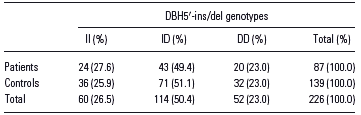
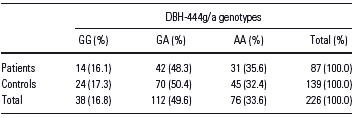
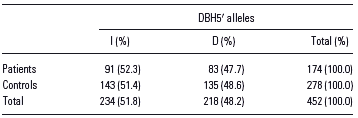
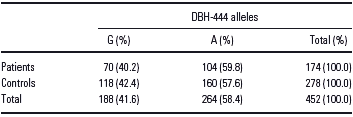
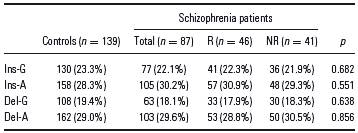
There were no significant differences between genotype and allele frequencies at either DBH5′-ins/del or DBH-444g/a in the healthy group as compared with the schizophrenia patients (p > 0.05 in all cases) (Table 1–Table 4). The population was in HWE for all the polymorphisms. For DBH-444g/a polymorphism, the frequency of individuals carrying the AA genotype was elevated in patients compared to healthy individuals but not significantly different.
Genotype frequencies of DBH5′-ins/del polymorphism
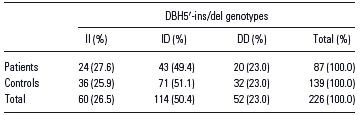
p = 0.958.
Genotype frequencies of DBH-444g/a polymorphism
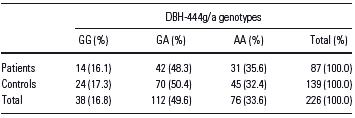
p = 0.878.
Allele frequencies of DBH5′-ins/del polymorphism
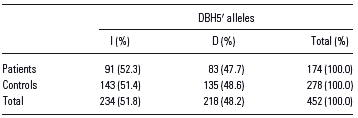
p = 0.859.
Allele frequencies of DBH-444g/a polymorphism
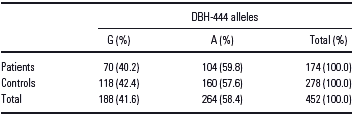
p = 0.642.
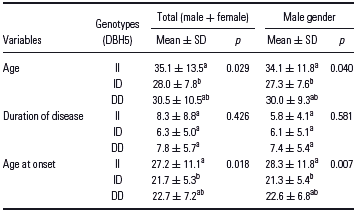
The allelic and genotypic distributions were compared in groups of schizophrenic patients divided with regard to gender, age at first hospitalisation/first contact with psychiatric treatment and response to clozapine treatment (R and NR). When compared R patients with NR patients, no significant differences were obtained in total BPRS, SAPS and SANS. No significant difference was observed between both polymorphisms and BPRS (p = 0.957 for DBH5′-ins/del and p = 0.067 for DBH-444g/a). When the age is considered in patient group, a significant difference was observed between patients with ID genotype and with II genotype (p = 0.018). Patients with ID genotype have been diagnosed as schizophrenics in early ages when compared to II genotype carriers (21.8 ± 5.3 and 27.3 ± 11.1, respectively). Stratifying into gender, this significant differences were not observed in females but had a higher score in males (p = 0.007; Table 5).
Distribution of DBH5′-ins/del genotypes
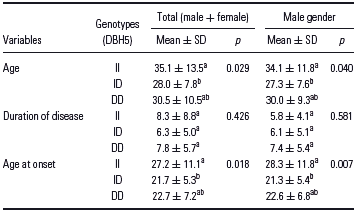
Different letter on genotypes was shown significantly different genotypes from each other.
There was no significant difference between age, duration of illness and age at onset at DBH-444g/a locus (p = 0.401, 0.409 and 0.438, respectively).
When the gender had taken into account, in male gender, there was significant difference between II and ID genotype (p = 0.007). The ID genotype carriers had an early onset to schizophrenia. But when the gender had not been taken into account between II and DD genotypes, p value was 0.133, and it was 0.096 when only males were considered.
There was significant difference between II and ID genotype in male patients (p = 0.007), and the power of this statistical comparison was 0.9073 according to the power analysis for independent two means.
There was no significant difference between age, duration of illness and age at onset when female gender is considered (p = 0.724, 0.293 and 0.938, respectively). The only difference observed was in male gender.
No statistically significant difference was observed in DBH-444g/a polymorphism, between males and females. Allelic frequencies are also showed no difference (p = 0.859 and 0.642). With adjustment for age among patients, we observed underrepresentation of ID genotype. There were no significant differences between R and NR in terms of age, sex, number of hospitalisations, subtype of schizophrenia, mean clozapine dosage or weight gain during the treatment period.
Haplotype frequencies
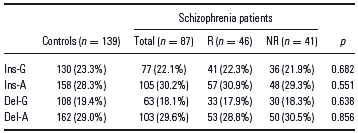
The distributions of the estimated haplotype counts for both DBH-444g/a and DBH5′-ins/del polymorphisms did not show significant differences between patient and control groups (p = 0.9). The frequency of del-a haplotype in R schizophrenia patients was similar to that in NR patients (Table 6). As haplotype-based results did not provide additional information, LD analyses are not presented.
The distributions of the estimated haplotype frequencies for both DBH-444g/a and DBH5′-ins/del polymorphisms of controls and schizophrenia patients (BPRS)
Discussion
On the basis of the observations that DBH activity tends to be lower in patients with schizophrenia (Reference Cubells, van Kammen and Kelley7,Reference Arató, Bagdy and Blümel16,Reference Sternberg, van Kammen and Lerner17,Reference Van Kammen, Mann and Sternberg33,Reference Wei, Ramchand and Hemmings34), we hypothesised that clinical outcome of the illness and treatment response are associated with molecular variation at 444g/a and 5′-ins/del polymorphisms at DBH locus and compared the relationships of these polymorphic sites and a possible LD between the polymorphisms in Turkish schizophrenia patients. In this study, the genotype distributions and allele frequencies of the two polymorphisms did not differ significantly between the schizophrenia patients and healthy controls, and the haplotype analysis did not reveal any significant difference between the groups. Consistent with the results of this study, Yamamoto et al. (Reference Yamamoto, Cubells and Gelernter9) and Park et al. (Reference Park, Kim and Lee11) found no allelic or genotype differences in the distribution of the two polymorphisms observed. Yamamoto et al. (Reference Yamamoto, Cubells and Gelernter9) also examined the relationship of the same haplotypes with treatment outcomes in schizophrenic patients, classifying them according to their responses to treatment into NR and R. They found ‘del' and ‘a' alleles at positive LD but no difference in the frequency of del-a haplotypes between patients and control subjects. However, they observed that low activity-associated del-a haplotype was significantly more common in NR patients, and the mean BPRS score was significantly higher in the group of patients with the del-a compared to those without the del-a haplotype. In this study, we did not find any difference in response to clozapine between R and NR patients. The haplotype analysis revealed no significant difference between schizophrenic patients and the controls, consistent with the results of a study by Park et al. (Reference Park, Kim and Lee11) but conflicting with the results of Cubells et al. (Reference Cubells, Kranzler and McCance-Katz20). In fact, they did not find any significant differences in allele, genotype or haplotype frequencies at either DBH-444g/a or DBH5′-ins/del between the controls and the cocaine-dependent group, but they showed an association between the del-a haplotype and cocaine-induced paranoia.
This study did not reveal any association between del-a haplotype, which lowers DBH activity and did not support the evidence that lower DBH activity is an independent risk factor for development of psychosis and for interpersonal sensitivity to psychosis and failed to show that schizophrenic patients with high DBH activity have a better response to treatment with antipsychotic medication than schizophrenic patients with low DBH levels (Reference Yamamoto, Cubells and Gelernter9,Reference Arató, Bagdy and Blümel16–Reference Cubells, Kranzler and McCance-Katz20,Reference Sapru, Rao and Channabasavanna35–Reference Kalayasiri, Sughondhabirom and Gueorguieva38). In other words, we could not obtain evidence for the role of low DBH activity in psychosis, sensitivity to psychosis and response to treatment.
These results suggest that the DBH-444g/a and/or DBH5′-ins/del polymorphisms do not play a causative role in schizophrenia and treatment response, which are consistent with prior studies indicating no major involvement of the DBH gene in schizophrenia. These two polymorphisms may not be effective enough to alter DBH function themselves but may be effective in LD with another functional polymorphisms in the same gene.
The discrepancy between the studies may be explained by the heterogeneity of the clinical syndrome of schizophrenia itself. Since schizophrenia represents a variety of disorders, each having different genetic expressions appears to involve functional polymorphisms at DBH locus and may occur on different haplotype backgrounds in different populations. This suggests a relation between these polymorphisms and clinical response to treatment with antipsychotics in schizophrenic patients, which requires further investigation in larger samples. The sample size of this study was not large enough to detect statistically significant differences in allele/genotype frequency or haplotype association. Another genetic explanation for this inconsistency could be locus heterogeneity; the low activity of DBH in schizophrenia patients is likely to result from as-yet-undiscovered diagnosis-associated non-synonymous variants at DBH. That is, that variation at a locus other than DBH explains the biochemical findings. Thus, lack of an association between only two polymorphisms from this region may not be sufficient to exclude a possible association or LD located elsewhere in the same gene.
Increasing evidence during the last few years suggests that there are gender-specific differences in schizophrenia, especially in males, influencing the age of onset and leading to poorer premorbid functioning and treatment outcome and different premorbid behavioural predictors such as cognitive deficits (Reference Leung and Chue3,Reference Lee, Ahn and Joo4,Reference Yue, Liu and Kang26,Reference Hanninen, Katila and Anttila27). In addition, early neurodevelopmental abnormalities or physical anomalies of the DA-related system can result in enhanced sensitisation of dopamine pathways in the early onset of schizophrenia, involved in the therapeutic response to antipsychotic drugs and gender differences (Reference Gourion, Goldberger and Leroy2,Reference Szymanski, Lieberman and Alvir39).
The genetic loading of participants' vulnerability to schizophrenia might be affected by phenotypic heterogeneities including gender, age at onset and other clinical markers. Stratification by age of onset and gender may serve to identify a more homogeneous patient group, less confounded by potential secondary effects of illness and with a more salient genetic risk. Many factors may account for this sex difference. Besides the sex steroid hormones, genetic factors might also be implicated (Reference Salem and Kring40,Reference Rao and Kölsch41). But it is crucial to define the age of onset at the time of the first hospitalisation. It was considered the age at onset of schizophrenia with the first occurrence of positive psychotic symptoms. The controversial results could also be due to differences in the patient population, and the age of onset was markedly lower in the present study.
Clinical, familial and biological characteristics suggest that age at onset is a valid indicator of onset of symptoms in genetic studies on schizophrenia but that the best way to determine the actual ‘onset' of schizophrenia is still unclear.
As males with early-onset schizophrenia are an attractive subpopulation for genetic studies, we have to recruit more patients to examine the potentially candidate genes.
Although this study did not show any significant difference between DBH5′-ins/del and DBH-444g/a polymorphisms and schizophrenia, it revealed an interesting and so far unreported association between the DBH5′-ins/del polymorphism and age of onset of the illness. We observed that the patients with ID genotype developed schizophrenia earlier than those with II genotype and may have a predictive value of onset in men. Furthermore, this association was more significant in male schizophrenia patients than females. Thus, this finding may constitute a novel biological support for the prior finding that onset of schizophrenia varies with gender. The results also showed that critical genetic vulnerability may be associated with the presence or absence of the ID genotype of DBH5′-ins/del.