INTRODUCTION
Sweetcorn (Zea mays L. var. saccharata) has some limitations from a maize breeding perspective. First, the narrow genetic base of sweetcorn limits its improvement (Haber Reference Haber1954; Tracy Reference Tracy1990b). Additionally, heterotic groups are not well-defined in sweetcorn (Revilla & Tracy Reference Revilla and Tracy1997; Revilla et al. Reference Revilla, Rodríguez, Malvar, Butrón and Ordás2006b). Field maize genotypes (Zea mays L.) (Su1Su1) have been frequently used for broadening the sweetcorn genetic base and for improving its agronomic performance, particularly the fitness-limiting traits emergence and early vigour (Haber Reference Haber1954; Tracy Reference Tracy1990b; Cartea et al. Reference Cartea, Malvar, Revilla and Ordás1996a, Reference Cartea, Malvar, Revilla and Ordásb; Malvar et al. Reference Malvar, Cartea, Revilla and Ordás1997a, Reference Malvar, Revilla, Cartea and Ordásb). However, practical results can be disappointing because undesirable genetic factors could be incorporated into new sweetcorn genotypes (Tracy Reference Tracy1990a; Revilla et al. Reference Revilla, Malvar, Abuín, Ordás, Soengas and Ordás2000, Reference Revilla, Malvar, Rodríguez, Butrón, Ordás and Ordás2006a, Reference Revilla, Malvar, Ordás, Rodríguez and Ordás2010). The importance of the field maize background effect on su1 fitness is due to the lethality or near lethality when it is introgressed into the germplasm of some wild form field maize genotypes, with no mutations (Tracy Reference Tracy1990a). Revilla et al. (Reference Revilla, Malvar, Abuín, Ordás, Soengas and Ordás2000, Reference Revilla, Malvar, Rodríguez, Butrón, Ordás and Ordás2006a, Reference Revilla, Malvar, Ordás, Rodríguez and Ordás2010) also reported that the viability of su1 depends on specific sweetcorn × field maize genotype interactions, and genetic background plays a major role in the viability of this mutant. However, little is known about the genetics causes of the differences in the fitness of su1 when different field maize genotypes are used as recurrent parents in breeding programmes. Djemel et al. (Reference Djemel, Ordás, Khelifi, Ordás and Revilla2011, Reference Djemel, Romay, Revilla, Khelifi, Ordás and Ordás2012) reported that fitness of su1 is under genetic control and depends on many genes with small effects on a variety of viability-related traits throughout the genome.
In areas with cool and humid springs and relatively short summers such as the North Atlantic areas of Europe and America, the cultivation of sweetcorn is limited by its reduced emergence and poor seedling vigour (Cartea et al. Reference Cartea, Malvar, Revilla and Ordás1996a, Reference Cartea, Malvar, Revilla and Ordásb; Malvar et al. Reference Malvar, Cartea, Revilla and Ordás1997a, Reference Malvar, Revilla, Cartea and Ordásb). When the recessive mutant su1 segregates in a maize breeding population, the selection against the mutant acts first through viability (germination, early vigour) (Ordás et al. Reference Ordás, Rodríguez, Romay, Malvar, Ordás and Revilla2010) and then through fertility (mating ability and grain formation) (Cisneros-López et al. Reference Cisneros-López, Mendoza-Onofre, Zavaleta-Mancera, González-Hernández, Mora-Aguilera, Córdova-Téllez and Hernández-Mártinez2010; Zhang et al. Reference Zhang, Li and Lian2011). The viability of su1 plants has been investigated mainly at the first stages of plant growth. Germination is the first limiting factor and the next important factor is early vigour (Martins & Da Silva Reference Martins and Da Silva1998; Revilla et al. Reference Revilla, Malvar, Abuín, Ordás, Soengas and Ordás2000; Yousef & Juvik Reference Yousef and Juvik2002; Juvik et al. Reference Juvik, Yousef, Tae-Ho, Tadmor, Azanza, Tracy, Barzur and Rocheford2003; Revilla et al. Reference Revilla, Malvar, Rodríguez, Butrón, Ordás and Ordás2006a). Revilla et al. (Reference Revilla, Malvar, Ordás, Rodríguez and Ordás2010) compared the performance of plants carrying su1 in different maize genetic backgrounds in order to choose the most appropriate field maize varieties for improving the agronomic performance of sweetcorn and found that early vigour was the most limiting factor for su1 plant development. However, little is known about the genetic effect of su1 in the genetic regulation of both germination and early vigour when introgressed in field maize. Tracy (Reference Tracy and Hallauer2001) also reported that these two characters are affected by genetic factors in sweetcorn, both at planting and during seed production.
All of the previous studies mentioned above suggest that su1 viability is not solely a function of the mutant su1 but it is probably under genetic regulation and both germination and early vigour were of great importance in conditioning the su1 fitness. The aims of the present research were: (1) to investigate the effect of the introgression of su1 in the genetic regulation of these fitness-limiting factors and (2) to determine the relative effects of germination and early vigour on su1 fitness.
MATERIALS AND METHODS
Plant materials
Two separate designs of mean generation analyses were developed to analyse genetic effects (Mather & Jinks Reference Mather and Jinks1982) to investigate the effect of the su1 introgression on the genetic regulation of fitness-limiting factors (emergence and early plant development). One of the designs involved two unrelated field maize (Su1Su1) inbreds, A661 (Corn Belt) and EP42 (European Flint), while the second design involved two inbreds from the same genetic background (Corn Belt): A619 and A632. Crosses between each pair of inbred lines started in 2001. Crosses were self-pollinated and backcrossed, obtaining six generations per design: two parents P 1 and P 2, F 1, F 2, BC1, and BC2. The 12 generations of both designs were crossed with the sweetcorn (su1su1) inbred P39 as donor of the su1 allele. After that, all crosses to the P39 inbred line were selfed: c. 100 plants from each cross were self-pollinated by hand, harvested and conserved in bulk. No artificial selection was made during the self-pollination. From each bulk, a sample of 150 seeds (maintaining the observed proportion of the su1 allele in the absence of selection) was sown in blocks 3 m long, spaced 0·8 m apart; plants within the row were 0·20 m apart. The self-pollination of all 12 generations was conducted for 5 successive years (2006, 2007, 2008, 2009 and 2010) in Pontevedra (42°24′N, 8°38′W, altitude 20 m a.s.l.), a location in the northwest of Spain where annual rainfall is in the range of 1600–1700 mm. Thirty different populations were obtained for each design, corresponding to the different combinations of generation (P 1 and P 2, F 1, F 2, BC1 and BC2) and the five self-pollination cycles.
Emergence and early vigour are the two major limiting factors on sweetcorn production in the areas with cool and humid springs, such as the North Atlantic areas of Europe and America. In order to determine the genetic regulation of both traits, all of the materials produced above were evaluated in controlled growth chambers under cold and standard conditions. In addition, field evaluations were made in order to confirm the results from the growth chamber.
Growth chamber trial
For each self-pollination year and generation, the kernels were sampled randomly, and su1 and Su1 kernels were separated for further evaluation in the growth chamber. Therefore, 60 genotypes were produced for each design, consisting of 30 su1su1 genotypes and 30 Su1 genotypes. The 120 entries, plus the parents’ inbred lines involved in the two designs (EP42, A661, A619 and A632), were evaluated in plastic multi-cell seed trays (each seed tray consists of 104 alveoli or 8 × 13 mm) in 2011 at Pontevedra (Spain). The experimental design for each of the two experiments (standard and cold treatments) consisted of 15 multi-cell seed trays in a randomized complete block with three replications (five multi-cells on each replication). In the growth chamber, the evaluations were carried out for a period of 30 days. Each experimental plot consisted of four kernels per row and one kernel per alveolus. Sowing depth was c. 2 cm. All trays were given 12 litres of water every week. The two designs (EP42 × A661 and A619 × A632) were evaluated in a growth chamber under standard conditions and a posterior evaluation was made in the same growth chamber but applying cold temperature as follows: the conditions were set at 14 h with light (provided by seven very high-output (VHO) fluorescent lamps with a photosynthetic photon flux (PPF) of 228 μmol/m2/s) at 14 °C and 10 h without light at 8 °C for cold treatment. However, under standard conditions, the temperatures were 25 and 18 °C in light and dark, respectively. The following data were recorded: % of emergence, and three vigour-related traits: early vigour (taken at the five-leaf stage with a visual scale from 1 = weak plant to 9 = strong plant); leaf chlorophyll content (CCM) measured at the three-leaf stage using a hand-held Chlorophyll Content Meter (CCM-200, Opti-Sciences, Tyngsboro, Massachusetts, USA), and finally, plant weight (total dry shoot area after drying the stalks for 5 days at 80 °C) was taken at the end of each experiment.
Combined analyses of variance of the dataset were conducted using the General Linear Model (GLM) procedure of SAS (SAS Institute 2005). The sources of variation were divided into effects due to the environment (E), treatment (years of selfing (S), generation (G), gene (su1 v. Su1) and the respective interactions) and the environment × treatment interactions. The sums of squares for each partition of the environment × treatment interactions were initially tested with the sum of squares of the pooled error, if the F-test was significant, all of the sums of squares of the treatments were tested with their corresponding environment × treatment interaction; if not, the sums of squares of the treatments were tested with the sum of squares of the pooled error (Cochran & Cox Reference Cochran and Cox1992).
Field trial
For each self-pollination of generations (except those produced in 2010), the kernels were sampled randomly, and 50 su1 and 50 Su1 kernels were separated according to phenotype. Finally 96 genotypes (48 su1su1 and 48 Su1) were produced for each design. The 96 genotypes plus the parental inbred lines involved in the two designs were evaluated in 10 × 10 triple lattice designs with three replications. The field trials were sown on 21 April 2010 and 18 April 2011 at Pontevedra in north-western Spain (42°24′N, 8°38′W, altitude 20 m a.s.l.), where annual rainfall is 1600–1700 mm; and 20 March 2010 at Algiers (36°47′N, 2°03′E, altitude 32 m a.s.l.), located in the sub-humid North of Algeria with 900 mm of annual rainfall. Each experimental plot consisted of two rows with 25 kernels per row and one kernel per hill. The rows were spaced 0·80 m apart, and the hills were spaced 0·12 m apart. Appropriate techniques for cultivation were carried out according to local practices. Harvesting was manual in both locations. The following data were recorded: proportion of emergence and three vigour-related traits: early vigour (taken on the five-leaf stage on a visual scale from 1 = weak plant to 9 = strong plant) was taken on each plot at Pontevedra and Algiers; CCM measured at vegetative stage using a hand-held Chlorophyll Content Meter (CCM-200, Opti-Sciences, Tyngsboro, Massachusetts, USA), and plant weight (g) at the five-leaf stage were taken only at Pontevedra.
Combined analyses of variance were made using the adjusted means obtained from the lattice analysis (Proc lattice procedure) of each environment, when the efficiency of the lattice design was above 105%, otherwise, the traits were analysed as randomized complete block designs. The sources of variation were divided into effect due the environment (E), treatment (year of selfing (S), generation (G), gene (su1 v. Su1) and the respective interactions) and the environment × treatment interactions as mentioned above (see growth chamber trial).
Generation mean analysis
For both growth chamber and field trials, generation mean for each trait, showing significant differences among generations in the analysis of variance, was calculated from each year of selfing individually. Each design was considered a separate experiment. The genetic parameters estimated were m = mean value, a = additive effects, d = dominance effects, aa = additive × additive epistatic effects and ad = additive × dominance effects (Mather & Jinks Reference Mather and Jinks1982). The equations for the generation means’ analysis of the various generations employed in the present study are:
 $${P_{\rm 1}} = m + a + {\rm aa},$$
 $${P_{\rm 2}} = m - a + {\rm aa},$$
 $${F_{\rm 1}} = m + {(\raise.5ex\hbox{$\scriptstyle 1$}\kern-.1em/ \kern-.15em\lower.25ex\hbox{$\scriptstyle 2$} )^n}d,$$
 $${F_{\rm 2}} = m + \raise.5ex\hbox{$\scriptstyle 1$}\kern-.1em/ \kern-.15em\lower.25ex\hbox{$\scriptstyle 2$} {(\raise.5ex\hbox{$\scriptstyle 1$}\kern-.1em/ \kern-.15em\lower.25ex\hbox{$\scriptstyle 2$} )^n}d,$$
 $${\rm B}{{\rm C}_{\rm 1}} = m + \raise.5ex\hbox{$\scriptstyle 1$}\kern-.1em/ \kern-.15em\lower.25ex\hbox{$\scriptstyle 2$} \,\,a + \raise.5ex\hbox{$\scriptstyle 1$}\kern-.1em/ \kern-.15em\lower.25ex\hbox{$\scriptstyle 2$} {(\raise.5ex\hbox{$\scriptstyle 1$}\kern-.1em/ \kern-.15em\lower.25ex\hbox{$\scriptstyle 2$} )^n}d + (\raise.5ex\hbox{$\scriptstyle 1$}\kern-.1em/ \kern-.15em\lower.25ex\hbox{$\scriptstyle 4$} )\,\,{\rm aa} + \raise.5ex\hbox{$\scriptstyle 1$}\kern-.1em/ \kern-.15em\lower.25ex\hbox{$\scriptstyle 4$} {(\raise.5ex\hbox{$\scriptstyle 1$}\kern-.1em/ \kern-.15em\lower.25ex\hbox{$\scriptstyle 2$} )^n}{\rm ad},$$
 $${\rm B}{{\rm C}_{\rm 2}} = m - \raise.5ex\hbox{$\scriptstyle 1$}\kern-.1em/ \kern-.15em\lower.25ex\hbox{$\scriptstyle 2$} \,\,a + \raise.5ex\hbox{$\scriptstyle 1$}\kern-.1em/ \kern-.15em\lower.25ex\hbox{$\scriptstyle 2$} {(\raise.5ex\hbox{$\scriptstyle 1$}\kern-.1em/ \kern-.15em\lower.25ex\hbox{$\scriptstyle 2$} )^n}d + (\raise.5ex\hbox{$\scriptstyle 1$}\kern-.1em/ \kern-.15em\lower.25ex\hbox{$\scriptstyle 4$} )\,\,{\rm aa} - \raise.5ex\hbox{$\scriptstyle 1$}\kern-.1em/ \kern-.15em\lower.25ex\hbox{$\scriptstyle 4$} {\rm (}\raise.5ex\hbox{$\scriptstyle 1$}\kern-.1em/ \kern-.15em\lower.25ex\hbox{$\scriptstyle 2$} {{\rm )}^n}{\rm ad}$$
where n = the number of year of selfing.
For the six basic generations (P 1, P 2, F 1, F 2, BC1 and BC2) the estimation of each genetic parameter was obtained in the form of a matrix using the PROC IML process in SAS (SAS Institute 2005) as follows:
 $$X = {(C^{\prime} \times C)^{ - {\rm 1}}} \times (C^{\prime} \times Y)$$
where Y = 6 × 1 vector of generation means, C = the matrix (6 × z), when z depends on the genetic model, C′ is the transpose of C matrix and −1 represents the inverse of a matrix. The standard error (s.e.) associated with each estimate of a genetic effect was obtained as the diagonal items in the variance–covariance matrix (C′ × C)−1. The significance of each genetic effect estimate was evaluated as described by Kearsey & Pooni (Reference Kearsey and Pooni1996), utilizing a t-test; if the chi-squared (χ 2) of the model was not significant the t-test = |estimate of a genetic effect|/(their corresponding s.e.). The s.e. was multiplied by the square of the χ 2/(degrees of freedom) if the χ 2 of the model was significant.
The adjustment of the generation means to a genetic model was tested with a χ 2 test. The test was applied to the simplest model and, if the χ 2 revealed lack of fit, the next model was tried (Mather & Jinks Reference Mather and Jinks1982; Kearsey & Pooni Reference Kearsey and Pooni1996).
RESULTS
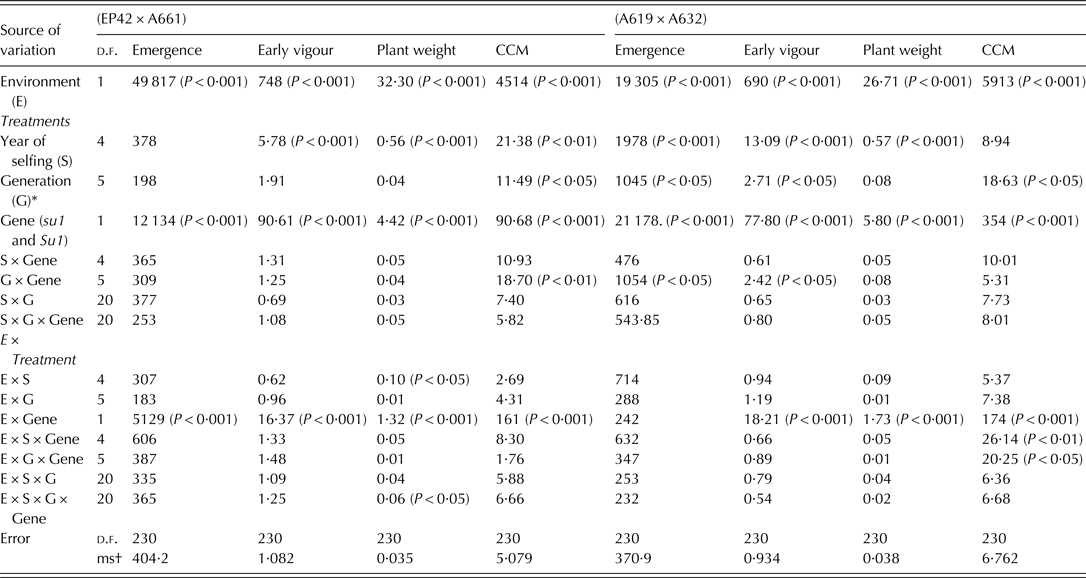
In the growth chamber, and for both designs (EP42 × A661 and A619 × A632) (Table 1), differences between environment (standard v. cold treatment) were highly significant for all traits (P < 0·001). There were no significant differences between generations except for CCM in the first design (EP42 × A661) (Table 1). However, all traits except plant weight showed significant differences between generations in the second design (A619 × A632) (Table 1). The differences between genes (su1 v. Su1) were highly significant for all traits in both designs (P < 0·001). The differences between years of selfing (S) were significant for all traits (P < 0·001) except for emergence in the first design involving the two unrelated inbred lines (EP42 and A661) and CCM in the second design involving the two related inbred lines (A619 and A632). The Generation (G) × Gene interaction was significant for CCM (P < 0·01) in the first design and for emergence and early vigour in the second design (P < 0·05). The environment × treatment interactions were seldom significant except for environment × gene (P < 0·001). The interactions were more important in the first design (EP42 × A661) than in the second design (A619 × A632). The environment × treatment interactions were often of rank rather than of magnitude (data not shown).
Mean squares from the combined analysis of variance for two generation mean designs (produced from EP42 × A661 and A619 × A632, respectively) evaluated under cold and standard conditions in a growth chamber

CCM, chlorophyll content.
* The six basic generations: P 1, P 2F 1, F 2, BC1 and BC2.
† Mean squares.
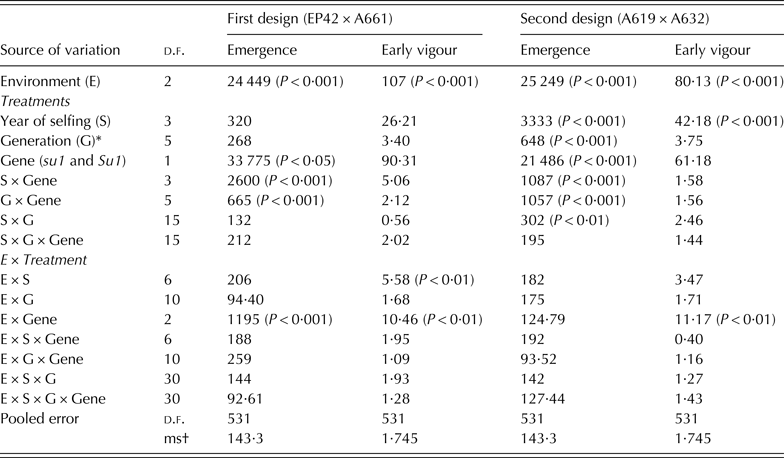
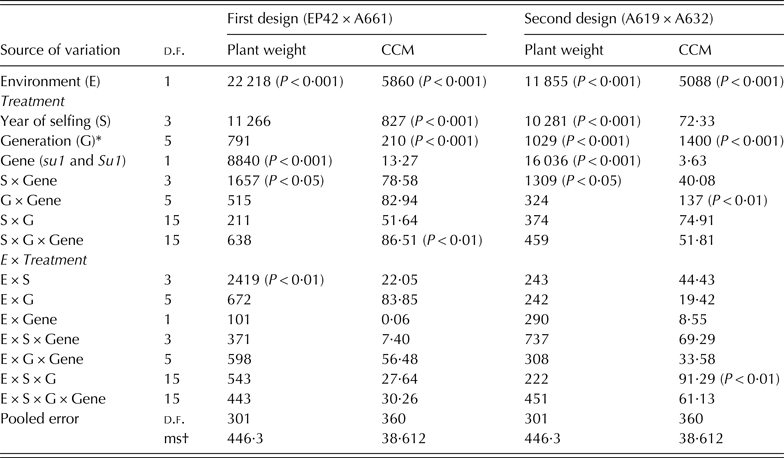
In the field trials, the environment × treatment interactions were seldom significant in either design. In general, both designs behaved diversely in the combined analyses of variance (Tables 2 and 3). The differences between years of selfing (S) were only significant for CCM in the first design (P < 0·001) and for all traits except CCM in the second design (P < 0·001) (Tables 2 and 3). Indeed, only early vigour was not significant for the second design (A619 × A632) (Table 2), while only CCM was significant between generations for the first mean generation design (EP42 × A661) (Table 3). In contrast, genes (Su1 v. su1) differed significantly for emergence (Table 2) (P < 0·05 in the first design and P < 0·001 in the second one), and plant weight (Table 3) in both designs (P < 0·001). The generation × gene interaction was significant in at least one of the designs for emergence (P < 0·0001) and CCM (P < 0·01), and not significant in any design for early vigour and plant weight.
Mean squares from the combined analysis of variance for two generation mean designs (produced from EP42 × A661 and A619 × A632, respectively) evaluated in two locations (Pontevedra, Spain, and Alger, Algeria)
* The six basic generations: P 1, P 2, F 1, F 2, BC1 and BC2.
† Mean squares.
Mean squares from the combined analysis of variance for generation mean designs (produced from EP42 × A661 and A619 × A632, respectively) evaluated 2 years in Pontevedra, Spain
CCM, chlorophyll content.
* The six basic generations: P 1, P 2, F 1, F 2, BC1 and BC2.
† Mean squares.
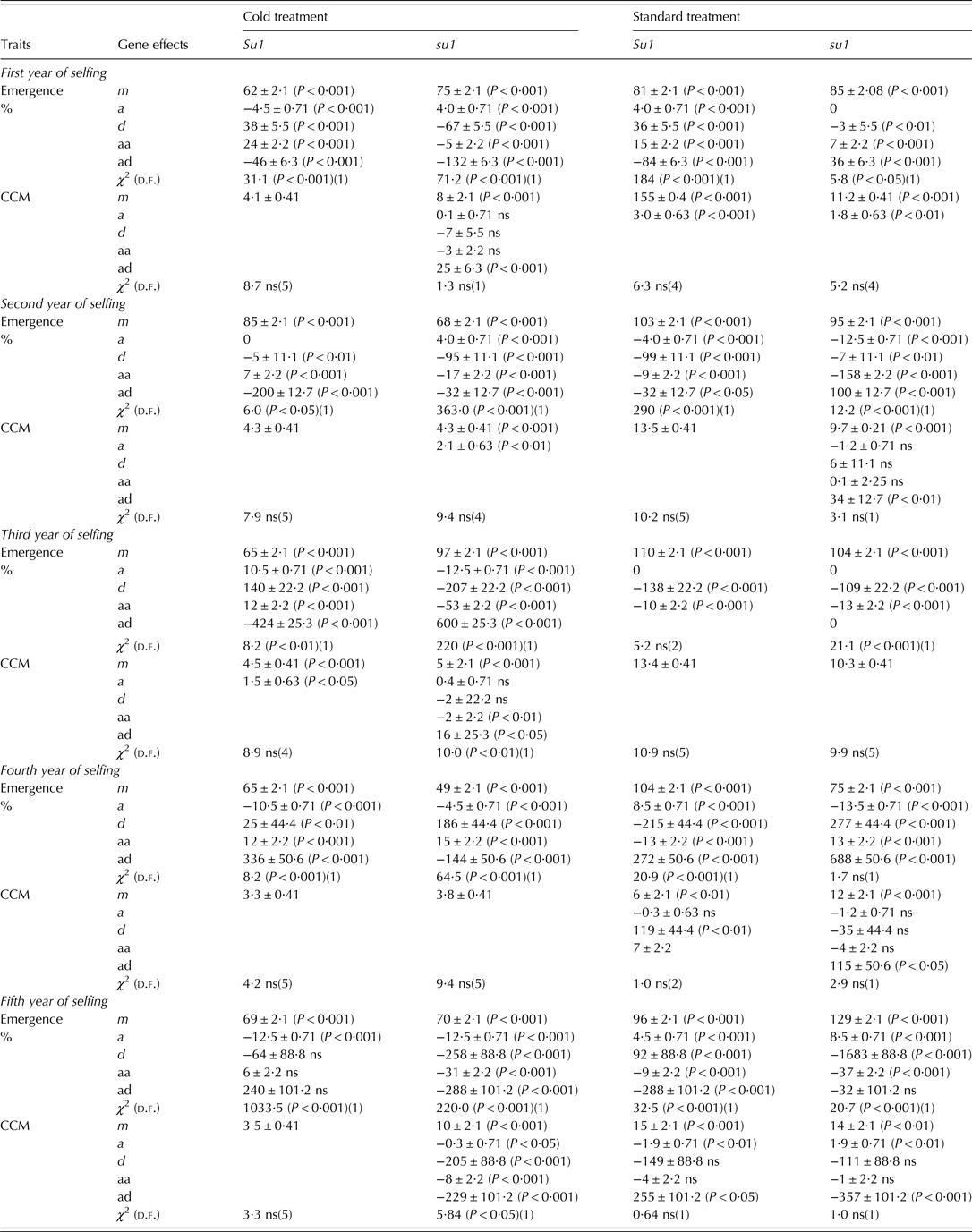
Estimates of genetic effects from generation mean analysis according to a five genetics parameters model and the χ 2 values are presented separately for each environment and year of selfing. Only the means of traits showing significant differences between generations or environment × generation interaction were used. In addition, differences in the environment × gene interactions were found in both designs, and for those reasons environments were analysed separately.
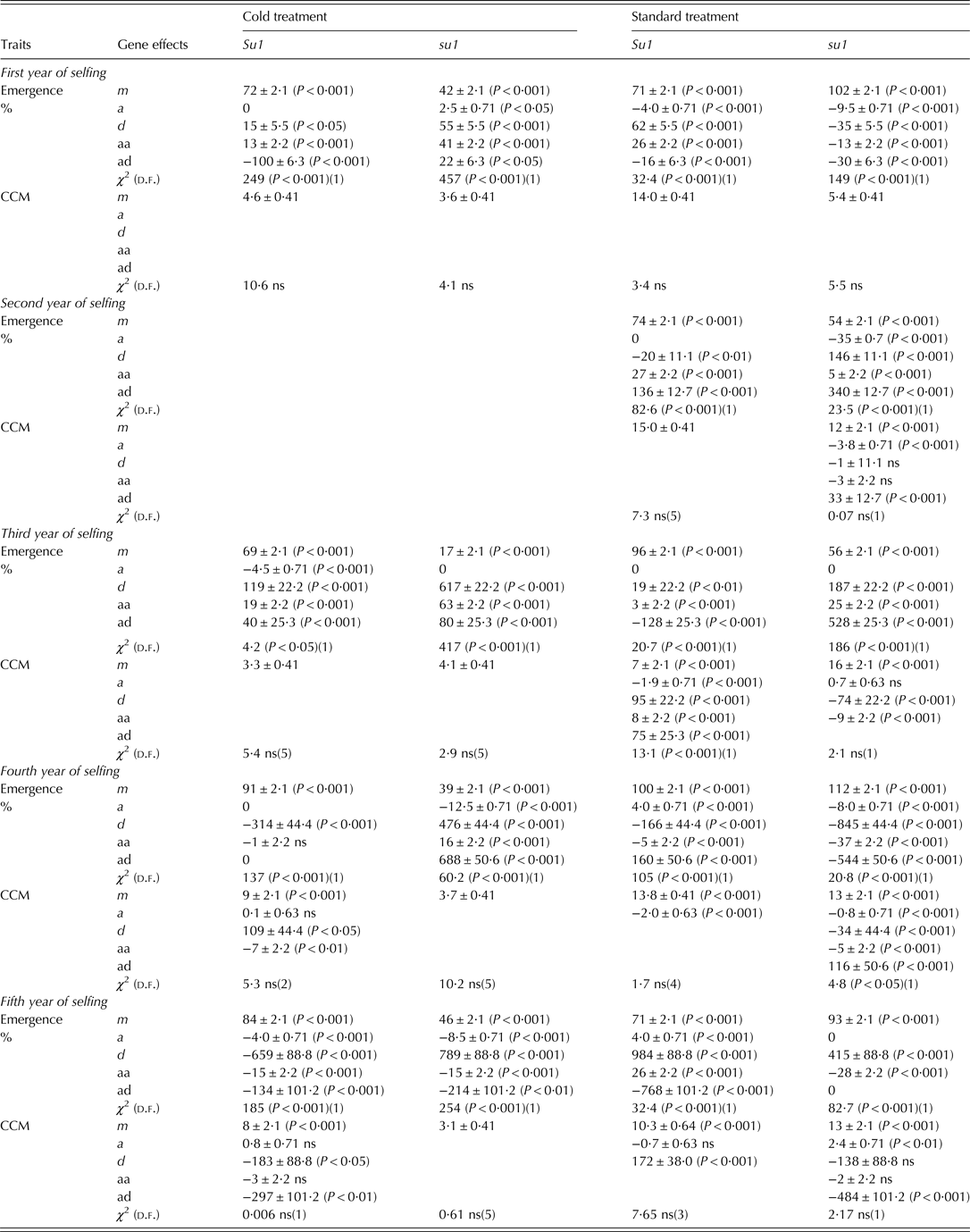
The observed χ 2 values and the estimates of genetic parameters for both designs evaluated in the growth chamber are given in Tables 4 and 5. The χ 2 values for early vigour and plant weight were not significant and the means-only model fitted the data adequately in all environments (data not shown). Almost all emergence data fit the additive–dominance model with both epistatic interactions. However, the estimates of genetic parameters and their significance were strongly affected by gene (su1 v. Su1), year of selfing and environment for CCM. All models (m, m + a, m + a + d, m + a + d + aa and m + a + d + aa + ad) were detected in both designs. In general, the absolute values of dominance (d) effects were much higher than the additive (a) effects. Moreover, the absolute values of the epistatic ‘ad’ gene effects were larger than the ‘aa’ epistatic effect. Compared to emergence, CCM exhibited a higher number of significant genetic effects and this variation was strongly affected by genes (Su1 v. su1). In the first design (EP42 × A661) (Table 4), data were adjusted to the additive × dominance model with both epistatic interactions in the plants carrying the su1 allele, compared to the data of plants carrying the wild type Su1 allele that were adjusted to the means-only model or to the additive model (in the first, third and fifth year of selfing in the cold treatment, and, in the second year of selfing in the case of standard treatment). Moreover, in the second design (A619 × A632) (Table 5), the same behaviour of CCM traits was found in the second and third year of selfing under standard treatment. However, the data of plants carrying the wild type Su1 allele were adjusted to the additive × dominance model with epistatic interactions and the data of the plants carrying the su1 allele fitted the means-only model in the third and fifth year of selfing in the cold treatment.
Estimates ± s.e. of mean (m), additive (a), dominance (d), and epistasis (aa and ad) gene effects of Su1 and su1 plants, and χ 2 test from generation mean analysis derived from 5 years of selfing of the first design (produced from EP42 × A661) evaluated under cold and standard conditions in a growth chamber
CCM, chlorophyll content; ns, not significant.
Estimates ± s.e. of mean (m), additive (a), dominance (d), and epistasis (aa and ad) gene effects of Su1 and su1 plants, and χ 2 test from generation mean analysis derived from 5 years of selfing of the second design (produced from A619 × A632) evaluated under cold and standard conditions in a growth chamber
CCM, chlorophyll content; ns, not significant.
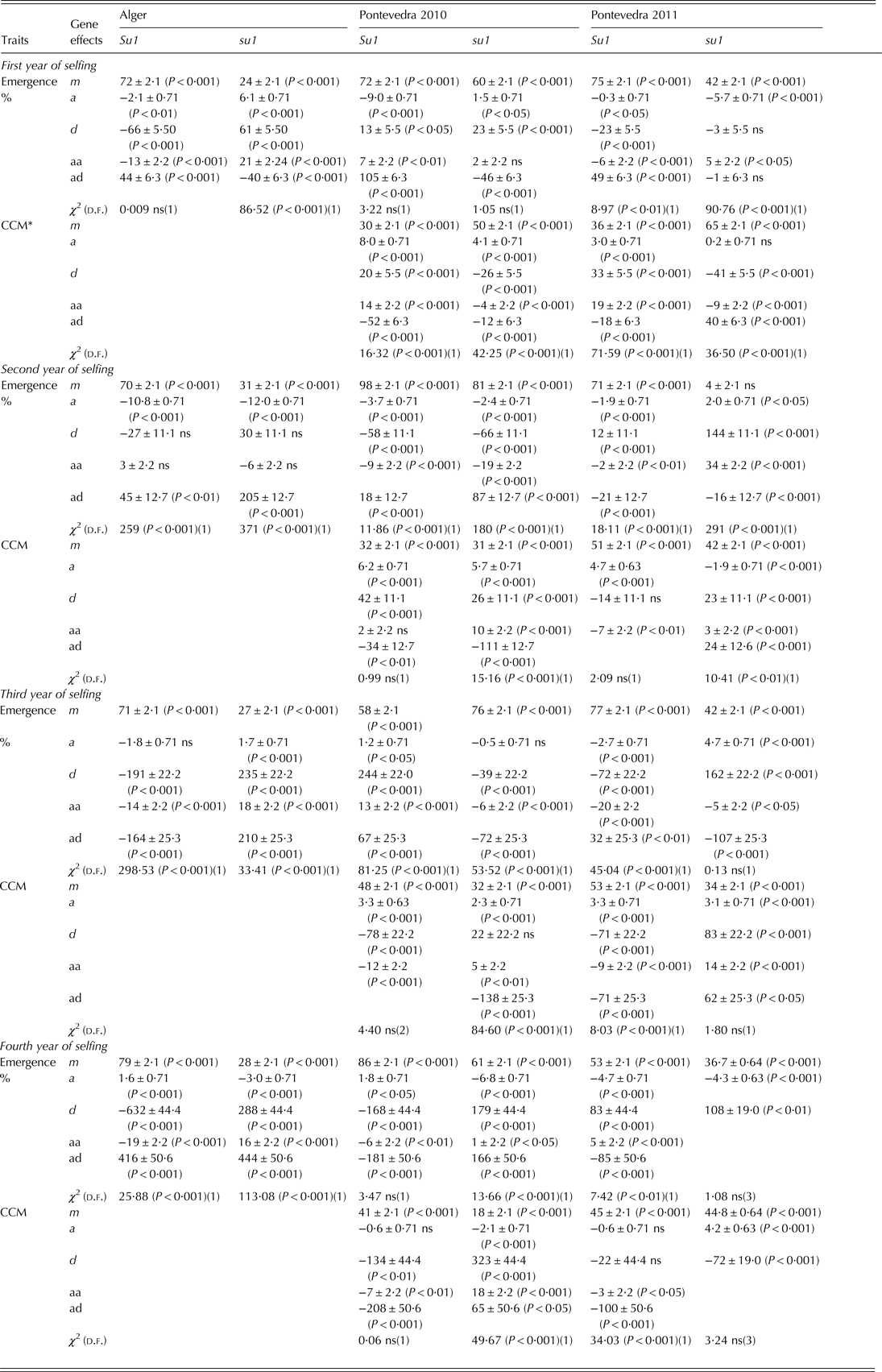
The observed χ 2 values and the estimates of genetic parameters for the first design (EP42 × A661) in the field are given in Table 6. For all years of selfing; the χ 2 values for early vigour and plant weight were not significant and the means-only model fitted the given data in all environments adequately, as in the growth chamber (data not shown). Besides additive and dominance effects, both digenic epistatic interactions are presented for emergence and CCM. Moreover, the significance or otherwise of χ 2 values depended on genes (Su1 v. su1) and environment. All data were adjusted to the additive or additive × dominance model with both epistatic interactions except in the fourth year of selfing (Pontevedra 2011), and for plants carrying the su1 allele, the data from which fit the additive-dominance model interactions.
Estimates ± s.e. of mean (m), additive (a), dominance (d), and epistasis (aa and ad) gene effects of Su1 and su1 plants, and χ 2 test from generation mean analysis derived from 4 year of selfing of the first design (produced from EP42 × A661) evaluated in two locations (Pontevedra, Spain, and Alger, Algeria)
CCM, chlorophyll content; ns, not significant.
* CCM was not recorded in Alger.
The relative magnitudes of dominance (d) gene effects were in general much higher than those of additive (a) gene effects. The absolute and the relative magnitudes of the additive × dominance epistatic interaction were variable depending on the traits and larger than the additive × additive epistatic interaction. However, the magnitude of the total epistatic effects was more important than the additive or dominance effects. Moreover, the negative or positive effects of a, d and aa were highly dependent on gene (Su1 v. su1) and environment.
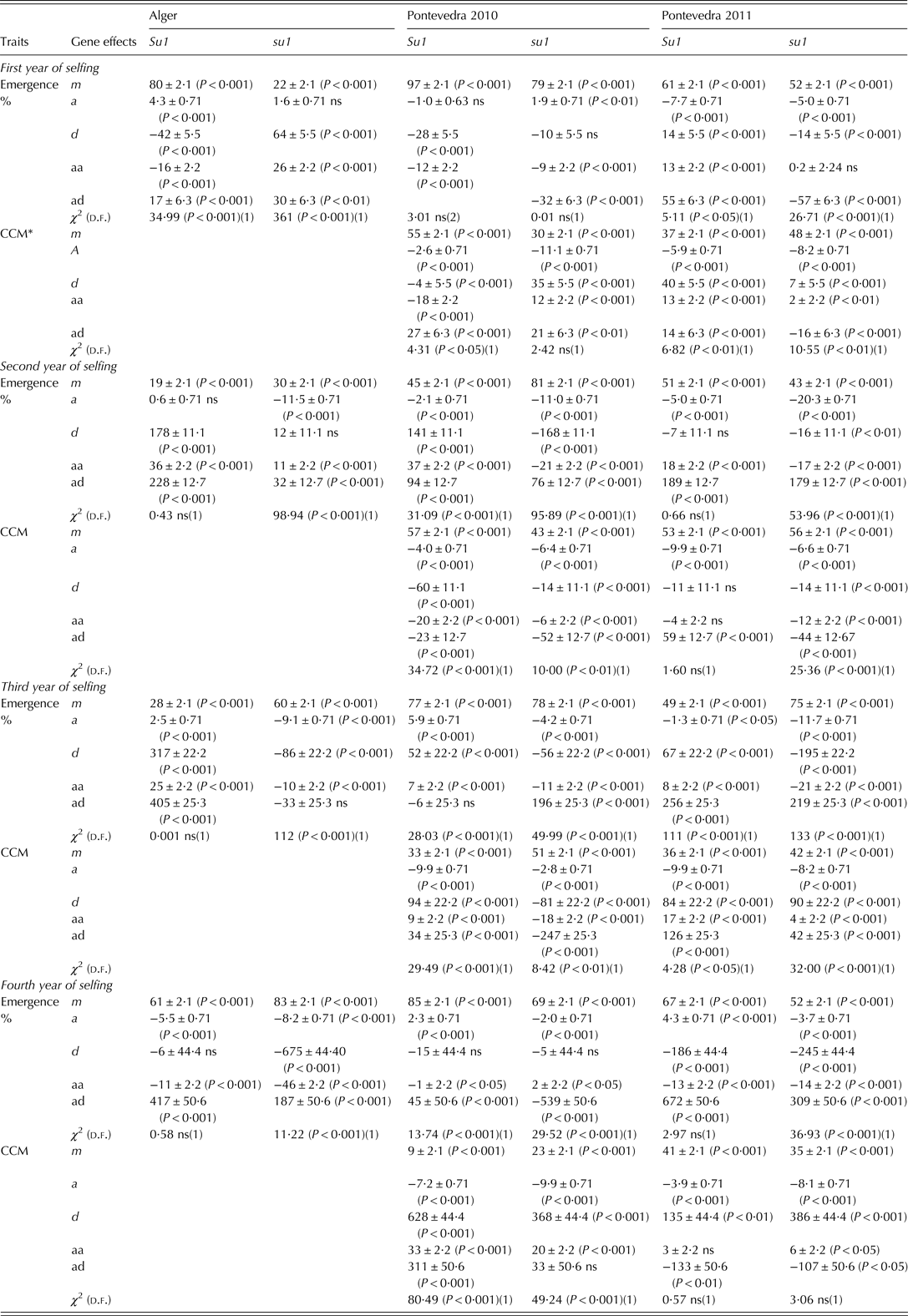
The observed values of χ 2 and the estimates of genetic effects for the second design (A619 × A632) are given in Table 7. As expected in the first design, early vigour and plant weight data were adjusted to the model with only the mean (data not shown). The remaining traits (emergence and CCM) data fit the additive-dominance model with both epistatic interactions. The additive and dominance effects were significant in all cases (P value between 0·05 and 0·001 depending on the traits measured, see Table 7). However, the positive or negative signs of the effects and their significance were strongly affected by gene (su1 v. Su1), year of selfing and environment. Both epistatic interactions were detected in almost all environments and genes (su1 v. Su1) and were significant in almost all cases (P value between 0·05 and 0·001 depending on the traits measured, see Table 7). The absolute and relative magnitudes of the dominance effects were more important than the absolute and relative magnitudes of the additive effects, respectively.
Estimates ± s.e. of mean (m), additive (a), dominance (d) and epistasis (aa and ad) gene effects of Su1 and su1 plants, and χ 2 test from generation mean analysis derived from 4 years of selfing of the second design (produced from A619 × A632) evaluated in two locations (Pontevedra, Spain, and Alger, Algeria)
CCM, chlorophyll content; ns, not significant.
* CCM was not recorded in Alger.
DISCUSSION
The performance of su1 plants differed from that of Su1 plants mainly in the first stages of development (Martins & Da Silva Reference Martins and Da Silva1998). Both emergence and seedling vigour are very limiting agronomic traits and affect su1 plant viability (Martins & Da Silva Reference Martins and Da Silva1998; Revilla et al. Reference Revilla, Malvar, Abuín, Ordás, Soengas and Ordás2000, Reference Revilla, Malvar, Rodríguez, Butrón, Ordás and Ordás2006a). Tracy (Reference Tracy and Hallauer2001) also reported that these traits are affected by genetic factors, both at planting and during seed production. The su1 fitness is under both genetic and environmental control; therefore, understanding the genetic and environmental factors that affect variation in the fitness of the su1 mutation and of mutations at large is of major interest for breeding programmes and evolutionary biology.
The mean performance of su1 plants was lower than that of the Su1 plants for all traits evaluated in both designs and across environments (data not shown). The significant differences between su1 and the wild-type allele Su1 for all traits confirms that emergence and all vigour traits (early vigour score, plant weight and chlorophyll content) were of great importance in determining su1 fitness. These results agree with previous reports showing that su1 is less viable than the wild type (Martins & Da Silva Reference Martins and Da Silva1998; Revilla et al. Reference Revilla, Malvar, Abuín, Ordás, Soengas and Ordás2000). The lack of significant differences between generations and between genes (su1 v. Su1) for early vigour in the field can be attributed to the large environmental effect.
Environmental interactions, especially with genes (su1 and Su1), were important and this is the second reason why environments were analysed individually. Although variations depended on the design, environment and traits, in most cases the variation in the generation means did not fit an epistatic model (additive-dominance with both epistatic interactions model), which indicated that the genetics underlying these traits was complex and others genetic parameters were involved. This was true for all environments and for both genes (Su1 v. su1). Furthermore, these traits are of great importance on su1 fitness and viability. Both early vigour and plant weight fit the model with only the mean in both designs and for both genes su1 v. Su1; these results suggests that both traits did not explain su1 fitness in the present study. However, Revilla et al. (Reference Revilla, Malvar, Abuín, Ordás, Soengas and Ordás2000, Reference Revilla, Malvar, Ordás, Rodríguez and Ordás2010) concluded that early vigour is one of the fitness-related traits in the crosses between field maize and sweetcorn.
Both epistatic effects (additive × additive and additive × dominance) were also important in the basic genetic regulation of these fitness-related traits. For other types of maize, Alonso Ferro et al. (Reference Alonso Ferro, Malvar, Revilla, Ordás, Castro and Moreno-Gonzalez2008) reported that the epistatic effects are not important for agronomic and quality traits. However, in the present study, the magnitude and significance of the estimates for ‘additive × additive’ and ‘additive × dominance’ epistatic interactions were affected strongly by environment and gene (Su1 v. su1).
The effects of su1 v. Su1 on genetic effects estimated were influenced strongly by environment. The estimated effects of emergence fit the epistatic model in both controlled environments, i.e., growth chamber and field. However, the estimated genetic parameters of CCM were stable across environments in the field trials. These results suggest that the genetic control of emergence is more complex than that of CCM and uniformity of environmental conditions is of great importance in order to estimate the genetic effect of su1 introgression on agronomic traits.
Variation in su1 gene frequency has been reported by Djemel et al. (Reference Djemel, Ordás, Khelifi, Ordás and Revilla2011), who concluded that the fitness of su1 was under genetic control with significant additive effects probably due to minor contributions of multiple genes and was strongly dependent on specific sweetcorn × field maize interactions. Some changes were shown in the genetic control of fitness-related traits when su1 was incorporated into field maize. Only the genetic control of CCM was strongly altered in both designs and in both growth chamber treatments (cold and standard). Differences between Su1 v. su1 for genetic control suggest that CCM has consistently significant effects on su1 fitness. These results have not been previously reported.
The variation of the significance and magnitude of the genetic parameters estimated for all traits across years of selfing depended on environment and gene (Su1 v. su1). The influence of the Su1 and su1 genes on the estimation of the genetic parameters was similar for emergence both in the growth chamber and in the field, and for CCM in the field. However, the estimation of genetic parameters for CCM in the growth chamber was affected by the genes in both designs. Moreover, in order to release sweetcorn genotypes with high agronomic performance at early stages of development, breeders should choose combinations of sweetcorn and field maize genotypes as donors and receptors, respectively, to produce the highest su1 performance particularly at earlier stages of growth. The current results suggest that, independently on specific sweetcorn × field maize interactions, seedling vigour and, particularly, chlorophyll content are critical traits for su1 plant viability. However, the complexity of the genetic control of emergence and the great heterogeneity of environmental conditions in the field evaluation prevent the estimation of genetic parameters on su1 fitness. Based on these results, sweetcorn breeders and other breeders dealing with defective mutants should design a comprehensive breeding approach including seedling vigour and chlorophyll content, as well as other agronomic and quality traits, in their breeding programmes in order to release improved genotypes with high fitness.
These conclusions could perhaps be generalized for other defective mutants that have important roles in plant breeding and evolution at large. Therefore, donor × receptor interactions are crucial for mutant fitness and the mechanism of fitness-limiting traits should be sought among those biological processes affected by the defective mutant.
Research was supported by the Spanish Plan for Research and Development (project code AGL2007-64218/AGR and AGL2010-22254) and the Excma. Diputación Provincial de Pontevedra. A Djemel acknowledges his fellowship from the Spanish Council for Scientific Research (CSIC).