Hurricane Katrina arrived on the shores of the Gulf Coast states on August 29, 2005, with devastating consequences, including the loss of more than 1000 lives, the displacement of hundreds of thousands of residents, and the destruction of billions of dollars in property. That devastation was felt broadly and deeply, but not evenly. As the Congressional Research Service recently concluded, “the 700,000 people acutely affected by Katrina were more likely than Americans overall to be poor; minority (most often African-American); less likely to be connected to the workforce; and more likely to be educationally disadvantaged” (Gabe et al., 2005, p. 13). While the statistics on the differential impact are clear, one needed only to watch any news station in the days after the hurricane to see the reality of differential devastation captured in the images of large crowds of poor Black residents of New Orleans abandoned at the Super Dome and the Convention Center. Certainly many residents of the Gulf Coast lost property, but most had the means to escape the storm and ride out its effects from a safe distance.
While the natural disaster of howling winds, torrential rains, and flooding hit hard, the deep and devastating consequences of the storm were arguably best understood as a social disaster. The hurricane could not have wreaked such damage if it were not for the years of neglect and abandonment of the poor and disenfranchised in this nation. In New Orleans itself, roughly one in five residents in flood-damaged areas had no vehicle available in the household with which to escape from the impending storm (Saenz 2005). This situation and its likely effects were catalogued publicly three years before the storm in a newspaper series, “Washing Away,” which reported that 100,000 of the city's residents without private transportation were likely to be stranded in a big storm (New Orleans Times Picayune 2002). Aside from the lack of attention to published reports from government agencies about the insufficiency of the city's levee system, the problems of population growth, the erosion of natural barriers, and the general lack of preparation for a category four or five hurricane, virtually nothing was done to prepare for evacuating these residents in the case of such an emergency.
Understanding the level of death and personal destruction in the wake of Hurricane Katrina requires, however, attention not only to the well-documented poor planning on the part of federal, state, and local governments to buttress levees, properly plan for hurricanes, or to immediately respond to the developing disaster, but also the long-term abandonment of large segments of the U.S. population. This idea was expressed by Illinois Senator Barack Obama on the Senate floor in the wake of the storm: “I hope we realize that the people of New Orleans weren't just abandoned during the hurricane. They were abandoned long ago—to murder and mayhem in the streets, to substandard schools, to dilapidated housing, to inadequate health care, to a pervasive sense of hopelessness” (Alter 2005). But it would be a mistake to localize the neglect to New Orleans. Every metropolitan area has a Lower Ninth Ward populated by the abandoned, forgotten, and avoided (Saenz 2005). These places have not sprung overnight out of the soil but are the product of centuries of systemic racial and ethnic inequality visited on particular parts of the U.S. populace (Almaguer 1994; Feagin 2001; Fredrickson 2002; Takaki 1993). Well over 30 million Americans live below the federal poverty line (U.S. Bureau of the Census 2006), and while a majority of the poor are White, African Americans and Latinos constitute approximately twice the proportion of the country's poor as they do of the population overall. In addition, these Black and Brown poor are much more likely to live in segregated areas of concentrated poverty (Kingsley and Pettit, 2003; Massey and Denton, 1994). They are overrepresented not only demographically, but also in the social imaginary, holding a special place for most Americans as the face of the undeserving poor (Katz 1990; Kelley 1998).
We argue that to understand contemporary racial dynamics that led to the post-Katrina social disaster, including the broader context which leads to the existence and perpetuation of isolated Black and Brown low-income communities like the Lower Ninth Ward across the United States, we need to turn our attention to Whites' racial attitudes and understandings. Drawing on a concept developed by Forman (2004), we argue that racial apathy is an increasingly central dimension in Whites' racial attitudes and plays a key role in the reproduction of ethnoracial inequality. Forman defines racial apathy as “indifference toward societal racial and ethnic inequality and lack of engagement with race-related social issues” (Forman 2004, p. 44). In the current historical moment, racial apathy may be more important to the reproduction of racial inequality than are traditional forms of Jim Crow prejudice. In fact, we argue that racial apathy is a particular kind of racial antipathy that enables those who deploy it to not only explain away what racial inequality they know of, but largely avoid knowing much about it in the first place. As captured in the quote by Senator Obama above, this kind of ignorance and indifference was vital in creating the conditions for disaster before the hurricane actually hit.
In this article, we empirically examine the parameters and expressions of racial apathy today. Based on our analysis, we point out that racial apathy includes not only lack of care about racial inequality and unwillingness to address it, but also the strategic avoidance of contact with ethnoracial minority groups (e.g., Blacks and Latinos) and knowledge about racial and ethnic disparities and the racialized realities that go along with them. Using survey data, we demonstrate empirically that racial apathy is on the rise, is a new form of prejudice, and has important political consequences. We then draw on in-depth interview data to demonstrate just what racial apathy looks like in Whites' contemporary racial common sense. Racial apathy and White ignorance, we argue, is only the newest in a long line of mechanisms that facilitate the perpetuation of the unequal racialized social system and that lead to the kind of deep chasms in access to even the most basic material and social resources that left some stranded in the middle of a hurricane and flood while others observed, or not, from a safe distance.
BACKGROUND
A number of scholars over the last decade have argued that, since the cultural, political, and social struggles of the 1950s, '60s, and '70s, the racial landscape in the United States today has shifted significantly (Bonilla-Silva 2001, 2003; Bobo et al., 1997; Forman 2004; Goldberg 2006b; Omi and Winant, 1994). Not only was the expansive structure of legalized segregation dismantled, but the culture that went with it, rife with long-held assumptions about innate biological inferiority, was also challenged. However, the end of Jim Crow and the successes of the civil rights era did not result in a new racial democracy. Rather than eradicating ethnoracial inequality, these authors argue, a new racial common sense emerged which continues to reproduce broad-scale racial and ethnic disparities, as well as to protect White privilege, albeit using a new language and new strategies (Bonilla-Silva et al., 2003).
While this new post-civil rights racial ideology has been variously labeled by different scholars, we prefer to label it color-blind racism2
We define racism as an organized social system of racial domination that results in the subjugation of some human population group(s) relative to other(s). Central to the development of such a system is an ideology of inferiority (e.g., biological, cultural) which rationalizes the ranking/ordering of some racial groups relative to others. This definition differentiates between racism as a structure and racism as an ideology. In the first instance, the focus is on the ways in which a system of racial domination emerges and functions. When considering racism as an ideology, we focus on how a system of racial domination is maintained through an interrelated set of ideas and symbols which rationalize a set of structures (Chesler 1976; Mills 1997, 2000).
For instance, while schools are no longer legally segregated, a range of mechanisms (e.g., housing segregation and school funding structures) produce a public school system today that remains highly segregated and unequal (Kozol 1991; Lewis 2003; Orfield and Gordon, 2001; Orfield and Yun, 1999). These separate and unequal schools are no longer defined in explicit racial terms, and the outcomes they produce are no longer seen as the result of the biological inferiority of minority groups. Instead, schools are defined geographically, believed to belong to discrete local (often segregated) municipalities, and unequal school outcomes are believed to result from the differential investment in education that various families and communities make, that is, cultural inferiority: some groups are driven to succeed, while others are not. Thus, in the place of Jim Crow practices and ideologies of the past, new racial structures have emerged. Our collective awareness of the continuing role of race in fundamentally shaping life opportunities diminishes, and the reality of, as Bobo et al. (1997, p. 40) describe it, “substantial and widening racial economic inequalities, high levels of racial residential segregation, and persistent discrimination experienced across class lines in the Black community” becomes invisible.
An additional shift in the contemporary racial landscape involves changes in how racial antipathy is expressed. As Herbert Blumer and Thomas Pettigrew have argued, dominant groups' expression of prejudice toward outgroups shifts over time in response to changes in societal norms about socially appropriate ways to express dislike and maintain privileged access to resources (Blumer 1958; Pettigrew and Meertens, 1995). Today Whites are more likely to express their prejudices toward ethnoracial minorities in ways that are covert and enable plausible deniability (Bonilla-Silva and Forman, 2000; Bobo et al., 1997; Dovidio 2001; Forman 2001, 2004; Myers and Williamson, 2001; Sears and Henry, 2003). For instance, using laboratory experiments, John Dovidio and his colleagues have shown that White college students are more likely to express distaste for or to discriminate against Blacks when conditions enable them to do so without having to directly acknowledge or confront their racist attitudes or behavior—for example, when their views can be masked by some other motive (Dovidio and Gaertner, 2000; Hodson et al., 2002).
Traditional conceptualizations of prejudice do not allow us to fully capture this new development in the racial landscape. Although the traditional conceptualization of prejudice has advantages (e.g., its focus on the negative and hostile nature of prejudice), it also has important limitations (e.g., its focus on the irrationality or unreasonableness of prejudice) (Brown 1995). By focusing on the irrationality of prejudice and ignoring social structural dynamics, the traditional conceptualization of prejudice is ill equipped to account for some of the subtler and more covert manifestations of contemporary race prejudice. This is, in part, because the traditional conceptualization treats the articulation of racial prejudice as an irrational anomaly rather than a normal (possibly rational) human action rooted in an individual's defense of his or her group position in a racialized social system (Blumer 1958; Bobo 1999; Bobo and Tuan, 2006). For these reasons, we here outline an alternative conceptualization of prejudice, one which eschews the notion of prejudice as either irrational or a mental disorder. Instead we posit a view that is broad enough to encompass both the irrationality and rationality in prejudice. This view includes as key dimensions of prejudice the violation of the norms of human-heartedness and justice (Harding et al., 1969; Pettigrew 1980) and, in doing so, provides important leverage for the study of changing expressions of racial prejudice in U.S. society.
Informed by a functional approach (Katz 1960; Myrdal 1944), our conceptualization of prejudice locates the study of prejudice in both individual motivations and social institutional factors. This approach takes seriously the view that the individual expression of prejudice “neither begins nor ends with the subject who speaks” (Butler 1997, p. 13), but rather develops in concert with a social and material reality (Blumer 1958). It also allows us to understand the deep and dynamic connection between microlevel psychological processes and meso- and macrolevel social structural dynamics. Racial prejudice, we are suggesting, not only involves negative attitudes held by one individual against another, but it also reflects the social structural relations between groups in a racialized society (see also Bobo 1999; Bobo and Tuan, 2006; Dollard 1937; Lippman 1922).
Racial apathy is a form of prejudice that serves functions similar to those of the overt forms of prejudice of the past in that it supports and sustains the racial status quo in society. It reflects “seeing but not believing; believing but believing at once it is not my problem, our problem; seeing and believing but frozen from action, too distracted or busy or unconcerned to do anything about it” (Goldberg 2006a, pp. 337–338). Many Whites today claim not only that they do not “see” race but also that they do not know or care about racial issues or racial inequality (Forman 2001, 2004). It is a mistake to view these kinds of expressions of lack of care for or disinterest in the social circumstances of ethnoracial minorities as benign, because prejudice is increasingly “expressed in a failure to help rather than in a conscious desire to hurt” (Sue 2005, p. 108). In this way, racial apathy is a kind of prejudice, one that is pernicious not because of the direct harm it inflicts on individual ethnoracial minorities, but rather because of its indirect influence on ethnoracial minorities' life chances through its creation of a societal climate that prevents many Whites and some ethnoracial minorities from recognizing or taking actions to redress persistent racial inequality. In short, racial apathy reflects callousness to the plight of racial and ethnic minorities (e.g., “I don't care. It's their problem, not mine”).
A number of scholars recently have begun to show the increasing prevalence of racial apathy. Forman (2004) has drawn an explicit connection between the rise in expressions of racial apathy and the rise in “don't know,” “no interest,” and/or “neutral” responses in race-related survey items. He found, for instance, that the proportion of White adults saying they had “no interest” in the issue of fair treatment for Blacks in employment rose from approximately 13% in 1964 to 34% in 2000 (Forman 2004). Consistent with his contention is research by Adam Berinsky which revealed that Whites harboring prejudice attitudes hide behind “don't know” survey responses (Berinsky 1999, 2002). Similarly, Jaak Billiet et al. (2006), in a study of response bias in Germany, Great Britain, Switzerland, and the Netherlands, found that the expression of prejudice in these nations was more pronounced among reluctant respondents as opposed to cooperative respondents. In all, this pattern of results speaks to the growing centrality of expressions of racial apathy. We believe there are at least two reasons why individuals express racial apathy.
First, individuals express indifference to racial inequality because they view ethnoracial minorities who experience difficulty as lesser beings than themselves and therefore as deserving of inferior treatment. As a result, these individuals feel that they have little reason to care about the social circumstances of ethnoracial minorities. According to Blumer, “feeling[s] of superiority” is an essential element of dominant racial groups' expression of prejudice (Blumer 1958, p. 4). In essence, dominant racial groups deny the humanity of the disadvantaged by separating themselves and viewing the disadvantaged as “intrinsically different and alien” (Blumer 1958, p. 4). Daniel Bar-Tal (1990) has labeled this phenomenon delegitimization, which refers to the categorization of certain groups into negative social categories so as to exclude them from social acceptability.
The second reason for the expression of racial apathy is ignorance about the persistent nature of racial and ethnic inequality. For instance, Lawrence Bobo conducted a recent nationwide survey and found that 34% of Whites believed that we had already achieved racial equality, in contrast to 6% of Blacks (Bobo 2004). These data reveal not only a racial divide in perceptions of racial and ethnic equality but also the profound lack of knowledge that many Whites have about racial and ethnic inequality in the United States. We argue that, rather than being a thoughtful response to social realities, such a lack of thought or knowledge about racial matters represents, in some ways, a strategic evasion of responsibility, what philosopher Sandra Bartky (2002) has labeled culpable ignorance, what philosopher Charles Mills (2006) has termed White ignorance. As Bartky describes it, the difference between ordinary ignorance and culpable ignorance is that the latter represents
the willful not-knowing of what is staring them in the face, the bad faith of pretending not to know, what they indeed do know and the retreat under the two-pillared shelter (the disadvantaged are personally responsible; the disadvantaged are biologically unfit) for whites endangered by the possibility of guilt (Bartky 2002, p. 147).
Bartky and Mills speak to the fact that White people today often know little about the realities of life for many racial minorities, and what they do know is often full of inaccurate information and mistaken assumptions. This not knowing is not, however, innocent. Mills contextualizes White ignorance, arguing that it has structural origins as one of the consequences of White supremacy. As Mills illustrates, within a racialized social system, we are all racialized cognizers whose perceptions of the world and knowledge about it are shaped by the larger context. Either way,
racialized causality can give rise to what I am calling white ignorance, straightforwardly for a racist cognizer, but also indirectly for a non-racist cognizer who may form mistaken beliefs (e.g., that after the abolition of slavery in the United States, blacks generally had opportunities equal to whites) because of the social suppression of the pertinent knowledge (Mills 2006, p. 11).
It is thus quite possible to claim to be a person of good faith, not adhere to traditional racist beliefs, and still participate in what Glenn Loury3
According to Glenn Loury, biased social cognition refers to the “politically consequential cognitive distortion to ascribe the disadvantage to be observed among a group of people to qualities thought to be intrinsic to that group when, in fact, that disadvantage is the product of a system of social interactions” (Loury 2002, p. 26). This concept is similar to Thomas Pettigrew's “ultimate attribution error,” which posits that dominant groups provide dispositional attributions for the perceived negative behavior of an outgroup, but also invoke situational attributions to explain away perceived positive behavior of an outgroup (Pettigrew 1979).
It is, we argue, within this theoretical and analytic frame that we can begin to examine the collective surprise that resulted when, in the light of the national media spotlight, Americans came to discover that the consequences of natural disaster are not equally shared, and that, low and behold, large numbers of Black people are not doing so well. Thus, the research questions that motivate the present study include the following: 1) what are the parameters of White racial apathy today?; 2) is racial apathy on the rise?; 3) is racial apathy a form of prejudice; and 4) what are its social and political consequences?
DATA AND METHODS
Survey Data
The quantitative data for this article come from two sample surveys: the 1976–2003 Monitoring the Future (MTF) Surveys and the 2005 Chicago Area Survey (CAS). We chose these surveys because each contains a measure of racial apathy. Although differences between the MTF Surveys and the CAS in the years conducted and populations sampled prevent direct comparison, the availability of these two unique data sets provides an important opportunity to understand Whites' contemporary sense making about race.
The MTF is a repeated cross-sectional survey of high school seniors that has been conducted annually since 1976. In the spring of each year, high school seniors complete a questionnaire focused largely on drug use, which also includes a wide range of items concerning the student's racial attitudes, interracial contact, and perceptions of race relations. The design and methods of the study are summarized briefly below; a more detailed description is available elsewhere (Bachman et al., 1996). Each year, a three-stage national probability sample4
The complex sampling design employed in this study means that the actual sampling variance may be larger than the variance expected from a simple random sample. Frequently this also means that standard errors reported from conventional statistical packages (e.g., SPSS and SAS) will underestimate the true sampling variability. Given the complex sampling design of the present study (i.e., clustering, stratification, and differential weighting of cases), we used standard errors adjusted utilizing the Taylor series linearization method contained within the STATA statistical package (for an excellent discussion of design effects, see Lehtonen and Pahkinen (1995)). Although the MTF surveys have roughly equal sample sizes, the 1989–2003 MTF surveys are approximately three-quarters the size of the 1976–1988 surveys (in 1989 the MTF project switched from administering five questionnaires to six). Therefore, pooling the twenty-eight year surveys results in the 1989–2003 MTF surveys being “undersampled.” For this reason, in this study we weighted the 1989–2003 data by a factor of 1.25.
Students complete self-administered, machine-readable questionnaires during a normal class period. Overall questionnaire response rates average about 84%.5
It should be kept in mind that, although the present design is effective in sampling high school seniors, it obviously does not capture those who have dropped out of high school. This omission might have important implications for the external validity of the trend analyses reported here if, for example, dropout rates have dramatically changed over the span of the study. However, a review of available census data between 1972 and 2003 reveals that dropout rates have been virtually flat (or, if anything, only slightly declining) during this period. That is, the proportion of young people who fail to complete high school has been consistently estimated to be approximately 15% over this interval. Given that there is little evidence of an appreciable change in the dropout rate, there should be virtually no effect on cross-time trend estimates. That is, the biases (i.e., an underestimate of negative racial attitudes) that exist as a result of omitting dropouts are likely to be fairly consistent from one year to the next and should not appreciably influence the social trends reported in this study. Another possible reason why trend data from seniors would deviate from trends for the entire class cohort (including dropouts) would be if the constant proportion who have been dropping out showed trends contrary to those observed among seniors; and even then, because of their small numbers, they would have to show dramatically different trends to alter the trend story very much for the age group as a whole. Thus, short of having good trend data gathered directly from dropouts, we cannot close the case definitively.
The 2005 CAS is a stratified, multistage area probability sample representative of the population twenty-one years of age and older who reside in Cook County, including the city of Chicago. The fieldwork was completed between July 2004 and August 2005 by professional interviewers from the Survey Research Laboratory (SRL) at the University of Illinois at Chicago. Face-to-face interviews were completed with 789 adult respondents. Relying on the American Association for Public Opinion Research's (AAPOR's) Standard Definitions, our survey had an overall cooperation rate of 70% (ratio of completed interviews to completed interviews plus refusals) and a conservatively estimated response rate (AAPOR's Response Rate 4) of 45% (ratio of completed interviews to all possible eligible households, including noncontacts) (AAPOR 2004). Blacks and Latinos were oversampled, as well as residents of racially mixed neighborhoods. To capture the views and opinions of the Latino population in Cook County, a Spanish language translation of the questionnaire was developed. Monolingual Spanish speakers and those preferring to conduct the interview in Spanish were interviewed in Spanish. The final sample included 279 Whites, 237 Blacks, 235 Latinos, and 38 Other. All of the analyses reported in this article use only the White sample (n = 279). (See Appendix for detailed information on the measures used in our study.)
Interview Data
In this article we also draw on recent research in Oak Valley, a mid-sized midwestern city. The larger project involved surveys and interviews of White and African American graduates from an integrated high school during the years 1955–1957 and 1968. In order to select respondents, a list of names and addresses was obtained from a school alumni organization. While the survey was sent to all alumni, for the interviews we drew a random sample of both Black and White graduates, concentrating on those still living in the Oak Valley area. The final sample from the class of 1968 included equal numbers of Whites and African Americans, all of whom were interviewed at their home or at a location of their choosing.6
Among Whites, approximately 77% consented to be interviewed (out of the twenty-six White 1968 graduates contacted, four refused to be interviewed and two others were no longer at their known address and were never located).
In 1968, Midwest High was about half White and half Black. Not integrated through busing, but drawing students from two neighborhoods near the school in the central city of Oak Valley, Midwest was noteworthy for its long-term integration: a school in a northern city which, by virtue of how school boundaries had been drawn, included significant numbers of both Black and White students, even at the time of the passage of Brown v. Board of Education (1954). One of the reasons why this group is theoretically interesting for our purposes is that they are individuals who had significant interracial experiences during adolescence during a period of heightened awareness of racial issues. Moreover, unlike those attending desegregated schools in subsequent years, their school was not integrated in a context of forced busing plans and did not involve animated local conflicts between White and Black residents. High school was for them a time when their Whiteness was a conscious part of White students' identities. They belonged to a clearly marked group that operated in close relationship (sometimes in friendship, sometimes as teammates or fellow band members, sometimes in tense contact or conflict) to a distinct racial group: Blacks. While the respondents reported various levels of social contact with Blacks outside of school, all reported substantial interaction in class. As one respondent put it, being seated alphabetically in all of their classes, they were regularly intermixed. In fact, with only a few exceptions, the respondents described the climate in Midwest as friendly, involving mutual respect and without tension.
One of the challenges today of analyzing Whites' racial understandings and behaviors is the context of widespread color-blind ideology through which many claim not to have racial identities, much less to belong to a social group called “Whites” (Kenny 2000; Lewis 2001; McKinney 2004; Perry 2002). In a recent paper Lewis (2004) entertained the question of how we go about studying Whites when many “Whites” do not claim a group identity. She argues that in fact no racial groups have coherent and collectively consistent self-conscious group identities. Rather, they belong to a passive social collective or series, in which members share a similar location within the racial structure—a location that has material implications. Drawing upon Sartre's notion of seriality, Lewis argues that a series is a passive collectivity united by their shared relations to a larger set of social structures and institutions as opposed to a self-conscious, mutually acknowledging collectivity or group. In many ways, Whites today are best understood as a series, as their lives continue to be shaped by race but not in ways they necessarily are conscious about or actively engaged in. For Whites, how they experience existing racial structures varies (and how they internalize those experiences in the form of a social identity varies), but all still experience them. Though all-White groups, organizations, or neighborhoods may not be explicitly racial in their composition, their racial composition is not an accident but a result of Whites' status as members of a social collectivity whose lives are at least in part shaped by the racialized social system in which they live and operate (Lewis 2004).
For Midwest graduates, high school was the moment for them that their previously serialized experience of race, in which their immediate neighborhood, social networks, elementary and middle school had all been White, was interrupted and their group identity became highlighted in a sustained way. So these are people who, for at least part of their lives, and at a time when they were developing their sense of self and their relationship to the world, were aware of and conscious about their social location, at least at that time, as members of a social group: White people. What we are most interested in analyzing here is not the accuracy of their memories about their high school experiences, but the way they talk about those experiences and particularly how they think about race today.
ANALYSIS AND RESULTS
Survey Results
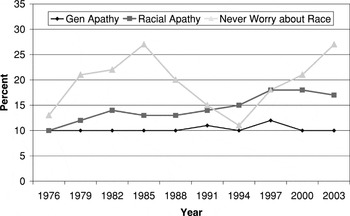
In order to assess the extent, if any, to which Whites' expression of racial apathy has changed, we draw on survey data spanning twenty-eight years. Figure 1 reports trend data for our measures of racial apathy, concern for race relations, and generalized apathy. Two patterns bear highlighting from these trend data. First, the expression of racial apathy is clearly on the rise. Almost twice as many young Whites in 2003 (17%) as in 1976 (10%) agreed with the statement that minority groups may receive unfair treatment but that this is not their concern. Further, the trend data shown in Figure 1 indicate that the proportion of young Whites who report never being concerned with race relations has not been uniform between 1976 and 2003. Specifically, the rise in young Whites reporting no concern for race relations that occurred during the 1970s and early '80s did not persist into the 1990s. At its peak in the mid-1980s, the proportion of young Whites who reported never being concerned with race relations was approximately 27%; by 1994 it had sharply declined to 11%. From 1994 until 2003, however, the percentage of young Whites who said that they are never concerned with race relations increased substantially from one in ten to almost three in ten (from 11% to its high of 27%).

Trends in Young Whites' Expression of Racial Apathy and Generalized Apathy, 1976–2003
Although it is true that young people have historically demonstrated a high degree of apathy, our results indicate that young Whites express more racial apathy than generalized apathy. For instance, approximately one in ten young Whites agreed in 2003 with the statement that it is not their problem if others need help; the same percentage of young Whites expressed apathy in 1976 (10%). This stability in results over almost three decades reveals that, at least with respect to young Whites, the expression of racial apathy is distinct from the expression of generalized apathy often attributed to young people. Further, it appears that the rise in young Whites' apathy is specific to a racialized notion of apathy. Taken together, these data reveal that young Whites are increasingly becoming comfortable with racial and ethnic inequality.
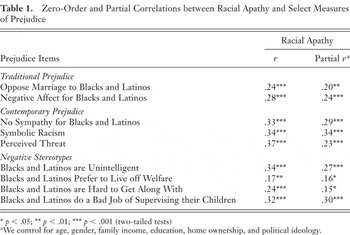
We next turn to an analysis of the relation between Whites' expression of racial apathy and several indicators of racial prejudice. We draw on survey data from the 2005 Chicago Area Survey (CAS) to explore this issue because it included a lengthy battery of questions measuring prejudice. Table 1 presents evidence on the degree of association between racial apathy and three major types of prejudice (i.e., traditional prejudice, contemporary prejudice, and negative racial stereotypes). Specifically, the first column of Table 1 reports zero-order correlations between racial apathy and several forms of prejudice. Based on our notion that racial apathy is a new form of racial prejudice, we expected that it would correlate positively with the three types of prejudice. All correlations between racial apathy and the various indicators of prejudice are statistically significant, and in the predicted direction. For instance, racial apathy is positively associated with opposing marriage to Blacks and Latinos (r = .24, p < .001). Racially apathetic Whites tend to express no sympathy for Blacks and Latinos (r = .33, p < .001) and believe that Blacks should work their way up without any special favors (r = .34, p < .001). Further, Whites who express racial apathy tend to perceive Blacks and Latinos as economic and political threats (r = .37, p < .001). The bivariate correlations, with one exception, also show a moderate size association between racial apathy and negative racial stereotypes (mean r is .27). Whites who believe that Blacks and Latinos (1) are less intelligent than Whites, (2) are more difficult to get along with than Whites, and (3) do a worse job supervising their children relative to Whites, are more racially apathetic. The results, shown in column 2 of Table 1, reveal that partial correlations (controlling for several social background characteristics: age, gender, family income, education, home ownership, and political conservatism) between racial apathy and each indicator of prejudice remained statistically significant and only slightly reduced. Thus, demographic differences alone are not responsible for the correlations between racial apathy and the various indicators of prejudice. These results provide useful information on the convergent validity of racial apathy. In all, racial apathy appears to be a new form of racial prejudice that is related to other forms of prejudice, yet distinct in important ways. (Recall that the Pearson correlation coefficients displayed in Table 1 are moderate in size, ranging from .17 to .37, and averaging .29.)
Zero-Order and Partial Correlations between Racial Apathy and Select Measures of Prejudice

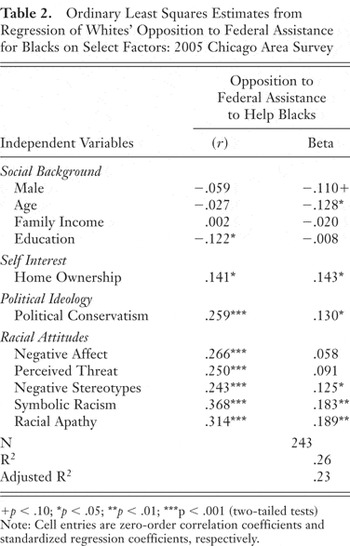
Based on our analysis thus far, we have shown that racial apathy is on the rise in the United States and is moderately related to other forms of prejudice. However, is racial apathy politically consequential? That is, is there a link between Whites' expressions of racial apathy and their opposition to race-targeted social policies? Table 2 presents our ordinary least squares regression results. In our analysis, we also take into account, in addition to racial apathy, the effects due to social background characteristics, self-interest, political ideology, and several measures of prejudice that previous research has highlighted as relevant (Sears and Henry, 2003). Four patterns stand out from our results. First, our indicators of racial prejudice have consistent and large effects on opposition to federal assistance to help Blacks. An examination of the zero-order coefficients in column 1 of Table 2, for example, reveals that the racial prejudice items are generally two to three times as large as social background and self-interest measures. These patterns suggest that racial prejudice is a highly relevant factor in understanding Whites' opposition to race-targeted social policies.
Ordinary Least Squares Estimates from Regression of Whites' Opposition to Federal Assistance for Blacks on Select Factors: 2005 Chicago Area Survey

Second, our multivariate analyses reveal that racial apathy has the strongest influence in determining Whites' opposition to federal assistance to help Blacks. Further, the effects of Whites' expression of racial apathy (B = .189) and symbolic racism (B = .183) are roughly equivalent. That is, Whites who believe that Blacks should help themselves without special favors, or who express racial apathy tend to oppose federal assistance to help Blacks.
After racial apathy and symbolic racism, homeownership, political conservatism, and negative racial stereotypes are the next most important variables shaping Whites' opposition to federal assistance to help Blacks. For example, compared to individuals who rent, Whites who own their homes are more likely to oppose government efforts to help Blacks. Politically conservative Whites are more likely than are their liberal counterparts to oppose federal intervention to assist Blacks. Whites who hold greater negative stereotypes of Blacks and Latinos relative to Whites also tend to oppose federal assistance for Blacks. Finally, several of the social background characteristics (e.g., gender, family income, and education), anti-Black/anti-Latino affect, as well as perceived threat, are not related to Whites' opposition to federal assistance to help Blacks.
Overall, racial apathy plays as large a role in how Whites react to race-targeted social policies as does symbolic racism, but somewhat more than do homeownership, political orientation, and negative racial stereotypes. Further, these results reveal that Whites' commitment to a stance of passive resistance, collective indifference, or ignorance has important implications for the future of racial politics. In short, racial apathy, which we interpret as a new form of racial prejudice, is a politically consequential factor in U.S. society.
As powerful and suggestive as these survey results are, they do not provide the texture for understanding Whites' racial common sense making that we believe is driving the rise in racial apathy, or its influence in shaping social policy attitudes. Thus, we turn our focus to an examination of in-depth interviews with Whites who at one point in their lives had a significant interracial experience.
Interview Results
Despite their interracial high school experience, most of those in the Midwest High School class of '68 with whom we spoke have retreated back into a serialized experience of race. Three and one-half decades after high school graduation, most have moved out to the overwhelmingly White suburbs surrounding Oak Valley and have little or no contact with racial minorities today. Some talked explicitly about getting out of Oak Valley and away from the “inner city” while others talked about being lured out to the suburbs several decades ago by the availability of affordable new housing. Either way, the majority now experience a mostly White world interrupted only occasionally by brief contact with racial and ethnic minorities.
Interestingly, they also mostly talk about themselves as more racially liberal than other Whites as a result of their experience at Midwest High. Even for those who did not enjoy high school, they represented themselves as more “open” than their friends, as more “sympathetic” to the plight of racial minorities, and as color-blind people who see everyone as equals. Yet their conversations were filled with contradictory claims and a deep ambivalence about race and particularly about Black people and the “inner city.” Throughout the interviews we found the echoes of both old-fashioned and more subtle forms of prejudice. For example, when Janet, a retired UPS driver and Midwest graduate, was asked about race relations today, she claimed to be color-blind and to believe in equality: “bottom line, we're all human beings first off. The fact that your nationality comes from a different region, that your skin is a different color doesn't matter. You got two arms, two legs, the same organs inside, what is the problem?” Or, as she also put it, she learned that there are “assholes in every group.” However, shortly thereafter Janet expressed a common narrative about Black cultural dysfunction when discussing her disgust for “slackers”:
more Blacks seem to have less values. I'm not saying all, but those [Blacks at Midwest who] had values were kind of shunned by the Blacks because they weren't the norm. They wanted to go on with their education and had an aspiration of a vocation. And my only thought with that is that this stemmed from their home front. You know, like the old saying, “welfare breeds welfare.” And you do see that, you see generation after generation. It's not just Blacks on welfare, I'm not trying to imply that, but if they can get by, then that's good enough [for them].
Along these same lines, several other respondents stated that they were color-blind, and then went on to express quite color-conscious sentiments. In discussing her experience at Midwest, Mary said it taught her to be more open: “You have to know someone, you can't just look at their skin. We should all be color-blind. Really.” In the same conversation, Mary explained that she was vehemently opposed to interracial unions, because “the children would suffer,” that it would be too hard for the offspring of such unions to not know “where they belong.” Similarly, Susan described herself as racially “open” and said that she did not really think about or notice race. Yet, when asked about the role of race in her life, she restated her position with a qualification: “I guess I must think about it some because I wouldn't want my kids to marry, you know, a Black person.” When prodded about whether there are other situations in which she thinks about her race or racial identity, she said, “You know I just never really think, I don't think about [my race] that much … (pause) You know unless I see a big Black guy coming at me with a tire iron or something. Then I might be afraid.” Though she did clarify that she would also be afraid if she saw a big White guy coming at her with a tire iron, this statement was so completely out of place, given the rest of the interview, that it seemed particularly revealing. It represented her digging around to imagine when race might be relevant—in this case, an imagined attack by an anonymous Black assailant. The only other context she could imagine thinking about race was thus deeply inflected with a kind of racial paranoia.
While the expressions of traditional and color-blind prejudice were similar to those chronicled elsewhere (Bonilla-Silva 2003; Lewis 2001), we also found numerous examples of respondents drawing on various aspects of new racial logic, and, in particular, of racial apathy and White ignorance. We found racial apathy expressed in multiple ways: as indifference to or avoidance of racial issues generally, as awareness of racial inequality coupled with lack of interest in addressing such inequalities, and as ignorance about racial issues.
A Culture of Avoidance
When asked about race relations today, or about their racial identities, many respondents said that they did not have much to say and offered the following kinds of statements:
“I'm not a real political person.” (Hillary)
“I live in my own little world.” (Nancy)
“I don't like to be around the general public.” (Henry)
“I'm not in the middle of it … I'm not there.” (Catherine)
With the exception of Henry, none of these respondents expressed active or explicit racial animosity. Some even expressed a kind of distant sympathy for the abstract plight of others. But that plight was one they were, for the most part, not engaged with. Their relationship to racial issues is one of casual or deliberate avoidance. Bill Burton provides a good extended example of these sentiments.
Bill Burton, a 1968 Midwest graduate, is now in the used-car repair and sales business. He lives in a tidy cul-de-sac in a planned development to the south of Oak Valley. Bill recalled a good experience in high school with lots of friends, participation on the basketball team and in other curricular activities. He reported that in high school there was a lot of interracial interaction among jocks like him. A self-described “gearhead” and bad student in high school, he went to college solely to beat the draft.7
A “gearhead” was someone who was into muscle cars.
During his interview, Bill reported himself to be focused solely on his family and his job. Remembering the years after he graduated as having had a contentious racial climate, Bill described those who opposed busing in Oak Valley in the early 1970s as “dead, aim prejudice[d]” because they did not want Blacks to “come across the river.” But Bill's recollections about the past are quite different from his orientation to the present. In response to a question about how he felt about changes in the world and in Oak Valley since high school, Bill responded, “You know, I don't pay much attention to that. I'm just kind of in my own little world, I do what I do, I don't, you know, I hate politics, I hate all this racial stuff. You know, I just, I don't pay attention to it, I don't care about it.” In fact, he became practically incoherent when asked about race relations today and about his own racial identity (I = Interviewer; R = Respondent):

For Bill, it is true that the “old westsiders” were and might well still be prejudiced: “that's life.” But those are issues for others to worry about. Bill also said that he worked actively to keep his kids away from Oak Valley, “didn't want my kids going to the inner city,” and moved to a town where the large local public high school, as he described it, has “maybe a dozen Black kids total.” But otherwise he does not think or care about racial issues. And his race, “being White,” doesn't matter. And it is true—his Whiteness matters not nearly as much to him as the Blackness of others. He has structured his life so as to have minimal contact with racial others; he has in some ways de-raced his life.
Bill's statements, along with those of other respondents, echo the findings of Lorraine Kenny's (2000) study of children growing up in a White suburb on Long Island. Kenny describes a “culture of silence and avoidance” in the suburbs but argues that, though the community imagines itself to be without race, such “avoidance of race … is a smoke screen” because of course it is not really possible (Kenny 2000, p. 17). In fact, the community is a place “where people fled to escape the other,” a place like many other suburbs founded “as the antidote to the Other (read: non-White, poor) America built on social processes of exclusion, histories, and current day practices that in turn must be erased from the collective suburban memory in order to constitute suburbia as a place without race or difference, a place of Whiteness” (Kenny 2000, p. 6).
In fact, Bill, Hillary, Henry, Nancy, Catherine, and many of the other 1968 Midwest graduates live in these kinds of suburbs. Though some described moving to the suburbs as a way to get away from the city, most thought of their neighborhoods as racially neutral places, even in the face of evidence to the contrary. For example, Carla described her locale as a nice place to raise kids, a place she had moved to for the nice housing and good schools. She also expressed her complete and utter surprise when she found out that her Black co-workers would not come out to where she lived:
This girl I work with, she's my age and when we have retreats, she'll say, “I don't go there.” I said, “you don't go there?” She said, “no,” we were talking about a lake up in [northern suburb where Carla lives] she says, “No. I have had too many experiences where I stand out as a Black and I don't go to those places. I'm not going to put myself through that.” I am going, “really?” I mean it is, I mean she is adamant that there are places that she won't go. She says, “I won't come to your house in [northern suburb] in the woods. I wouldn't go there… I wouldn't drive to [northern suburb] and know that I am getting off at that exit.”
The racial diversity of Oak Valley suburbs varies, but most are 90% or more White, and several are over 96% White. Like many metropolitan areas, the city and surrounding suburbs are highly segregated. But this fact is one that most residents explain as being a result of every group's desire to be comfortable, as a result of differences in family resources, or as just a result of happenstance.
Racial Apathy and Culpable Ignorance
Some respondents were more consciously aware of racial issues and expressed a different kind of racial apathy. Aware of and even sometimes articulate about the hardships for racial minorities and the benefits of being White, they viewed such disparities as distant issues that were other people's problems. For example, Tim and Jill Spellhouse, high school sweethearts who married after Tim returned from Vietnam, talked about some of the challenges for African Americans. Jill said:
I think that they are definitely, that they have to work much harder. That's unfair, you know, and I don't. I wasn't really raised with a racial tendency to be one way or the other, and for me it's … If the person is working towards the same kind of goals and respect as a person and respect for their children and the desires for them, I don't care really what color they are.
However, this couple also explicitly explained that they had moved to their northern suburb to get away from the city schools. When asked what was wrong with the city schools, Tim and Jill talked about busing and the fact that there was “so much emphasis” on making sure that “Blacks and Whites were equal” that it seemed to them like “the educational part of it got lost.” In fact, the suburban school their children attended had only “one or two Blacks,” and the Spellhouses did acknowledge that their kids might have been missing out on something by attending a White school:
Well they're spoiled, yeah. They're isolated from a lot of that reality, but then I think that they're well-rounded enough when they move into it in a work place or a school situation. We weren't ever derogatory. I mean I don't think ever in our family have we said, you know, anything racially derogatory.
For them, “reality” was something to protect their children from, and while they realized that it was perhaps isolating not to have interracial contact, they did not want the distraction. They were comfortable with their lives and did not want to deal with (or have their children involved with) racial issues, much less make any sacrifices to ensure that “Black and Whites were equal.” Here they realized and acknowledged that they had made strategic choices to provide advantage for their kids, and while they knew that the world is not equal, that wasn't their focus. They avoided using “racially derogatory” language, but they also avoided racial and ethnic minorities generally, or as they put it, “reality.” In some ways these respondents represent examples of what Bartky (2002) calls the culpably ignorant.
When Bartky asked, “What does (or does not) go on in the minds of ‘nice’ White people which allows them to ignore the terrible effects of racism and, to the extent that these effects are recognized at all, to deny that they bear any responsibility for their perpetuation?” (Bartky 2002, p. 151), it was perhaps the Spellhouses that she had in mind. How do we understand the lives and choices of nice White folks like the Spellhouses who choose to build their lives around a culture of avoidance? Midwest graduate Mary Sternhoven provides another good example to explore. Mary lives with her husband in a partially developed part of the suburbs outside of Oak Valley. Though she was not involved in many activities, she described her years at Midwest as good ones, while wishing that she'd been encouraged more as a kid to pursue her talents. She is one of many of the women of the class of '68 who reported much more academic encouragement directed towards their brothers, who were expected to have to become breadwinners and thus to need the education more. All of her friends at Midwest were from the White feeder school and had the “same type of upbringing.” As she put it, it was a “nice time to grow up.” There was very little social mixing along racial lines in high school, but neither were there problems. Students were intermixed in class and got along well. Interracial dating would've been a problem for her parents, though having a Black friend would have been okay. She continues to be totally against interracial marriage. Her focus these days is on family, friends, being a good person, a good wife, a good friend, having good family values, following the golden rule, being a good neighbor, and, as she put it, “you know, don't be judgmental.” She currently has no interracial contact. When asked how she thinks race relations are today, she responded that she really couldn't say much about race relations because “I'm not really involved … I stay in my own little world.” Race is not important for her life.
Mary meant it when she said that we should all be equal: “We should all be color-blind. Really.” She was sincere when she said that her focus was on being a good person, a good wife, a good neighbor. But what does it mean when these things are operationalized in narrow terms? Whom are we responsible to and for? How can people describe their goals to be a “good wife, good neighbor, good person” and structure their lives in this way? In some ways the answer should be apparent enough: easily. While Bartky labels this type of “White denial” as characteristic of “the culpably ignorant,” these people are perhaps best understood as the “deliberately clueless.” These are the people who could and should know better, who moved their families to the suburbs because they know the schools are better, and who also vote against policies to change these unequal funding structures because they know that such policies would shift resources. Some may embrace theories about Black poverty that explain it in ways that do not involve them (e.g., as the result of bad culture, lack of effort and work ethic), but others do not think about it at all.
As Charles Mills suggests, this kind of “not-knowing” is driven by White supremacy and all its consequences. While indifference and ignorance can take the form of disengagement or avoidance of information, there are also several other important forms that include both misinformation and errors in thinking.
Ignorance and the Management of Memory
Examples of these latter two forms of ignorance are expressed as types of historical amnesia that run throughout dominant narratives about race today. In many ways, a central part of racial apathy and White ignorance is our collective, tenuous relationship with even recent U.S. history. The construction of stories about our history that leave out much of the population are not accidental or inadvertent (Loewen 1996; Shenkman 1992). Color-blind ideology generally negates any need for a systematic response to persistent racial inequality. As Mills explains,
White normativity manifests itself in a white refusal to recognize the long history of structural discrimination that has left them with the differential resources they have today, and all its consequent advantages in negotiating opportunity. If whiteness was race, now it is racelessness, and equal status and common history in which all have shared, with white privilege being conceptually erased (Mills 2006, p. 18).
This kind of refusal takes several forms. One of these is a very fragmented sense of history in which time is imagined to begin at an arbitrary moment. For example, when Mildred discussed the neighborhood she grew up in, and in which her parents still reside, the history of this physical space began with her occupation of it:
Well, [my parents] know that [the neighborhood is] bad, but they're in denial about it. It's their home, and it's paid for and they live very reasonably there and that's what's most important to them. So, even though I have property up north and I've offered that to them, and you know they won't do it. And I believe God brought me back to my mother and dad's house. I've been there for two years now, and just oversee things…. But, the neighborhood is, it can be scary. But, the only thing I think that, um, gives me peace of mind there is that it was mine first. You know, you've taken ownership because it was mine first. You know, actually, “you are intruding, I'm not.” You know, even though I'm White and there are a lot of Black[s], and you know. I don't know, like people will say to me, “aren't you a little bit leery, you know, because there's so much purse snatching and all these things going on,” and I think that, what gives me the boldness was that it was mine first, I lived here first.
Mildred has moved back to the neighborhood she grew up in and makes peace with the racial transformations there by reminding herself and others that it is her space: “it was mine first.” The sense of ownership she expressed over the space is not unlike that described by many other scholars studying neighborhoods in transition (Fine and Weis, 1998; Rieder 1985; Sugrue 1996), but it depends on a truncated vision of historical events and the complete erasure of the original occupants of the land. In fact, the area around the Great Lakes was occupied for hundreds of years by Native American tribes that were killed off or driven off the land by European settlers. Mildred's version of the history of the area lasts only several decades and asserts a “first” occupation of it by her people, thus making her sense of ownership complete and unproblematic. These kinds of feelings of proprietary claim to rights and privileges are what Blumer (1958) talks about in his famous essay “Race Prejudice as a Sense of Group Position.” They represent one part of a larger set of understandings which explain White dominance as deserved and, therefore, in need of protection rather than challenge.
Another version of refusal embedded in racial apathy and White ignorance is one that denies the role of the past in the present. A good example of this came from Janet Croft, a UPS driver for twenty-five years before her recent retirement. When Janet talks about race relations today she claims to be color-blind and believe in equality, but
one thing that does enrage me, whether it be Blacks or Hispanic or whatever, that because of slavery a hundred years ago, I owe you. No I don't. That's crap. Don't hold me accountable for something how many generations ago did to you. And that's free loading, gold bricking, you're just looking for a free ride then…. you earn it. And that's the way I feel about anybody. Don't expect a free ride just because you think I owe you.
This readily available narrative of color-blind ideology, “I did not own slaves,” divorces present-day reality from the past (Bonilla-Silva et al., 2004), suggesting that history begins today. This story renders Black or Latino claims illegitimate and suggests that they are falsely dependent on the idea that Whites somehow unfairly profited from the past labors of racial minorities in some way that might still be relevant today. Of course, there is ample evidence that past and present private practices and public policies advantage Whites (Katznelson 2005). However, the strategy deployed by Janet here, of reducing claims of Black disadvantage or White accountability to whether one directly and personally participated in slavery (which ended over one hundred years ago), renders them absurd.
Racial apathy and White ignorance, in all their forms, are at some level facilitated, culpable, deliberate, and they have effects. As Charles Payne states in a discussion of our sociological explanations of inequality, “every way of seeing is a way of not seeing” (Payne 1984, p. 14). Or, to put it differently here: every way of “not seeing” is a way of seeing. The stakes involved aren't merely ones of description, but also of solution: how we define a problem shapes what we do about it. To quote Payne again, “when the overwhelming insight produced by three-quarters of a century of theory is that no one has much complicity in human suffering except the sufferers and those closest to them, we are justified in being more than normally skeptical” (Payne 1984, p. 14).
Against Racial Apathy
There were respondents among the Midwest class of 1968 who worked actively against racial apathy. What seemed to unite all of them was their consistent and meaningful contact with racial minorities in the years since having graduated from Midwest. While several had married interracially, another had significant interactions in a multiracial church setting that had led to long-term friendships with a diverse group of fellow church members. Two of these respondents, whose lives were decidedly different from those of their peers, described and critiqued the racial apathy that they had experienced in interactions with other White friends and neighbors. For example, in drawing parallels between the events of the 1960s and those of today, Elaine Manning likened Vietnam to 9/11 in that, despite the great attention to a major national event, most people remained unaffected and thus unconcerned about it on a daily basis: “it's happening, but yet it's not affecting how we're living … we can still walk across the street … go to beach.” Similarly, during his interview, Charlie Woods expressed great frustration while talking about trying to raise his own kids to care about people:
because most people are apathetic … I think most people are happy with the status quo … [I] would like to clear up some injustices but honestly don't think most people care. For example, [I] was talking to a woman recently about a war in Africa [in which hundreds of thousands were being ethnically cleansed], and her response was “what's that got do to with me?”
These respondents witnessed such patterns of apathy with concern and disdain, knowing that nothing will change for the lives of racial minorities (including, in some of these cases, their partners, children, grandchildren, godchildren, and community members) so long as Whites remain racially indifferent.
DISCUSSION AND CONCLUSION
In this article, we have argued that the expression of racial apathy is one mechanism by which racial and ethnic inequality endures. By being indifferent, or ignoring the social reality of race in a racialized social system, Whites and others sustain a system of inequality that restricts opportunities for many ethnoracial minorities. President Lyndon B. Johnson understood the danger of racial apathy when, speaking before a joint session of the Senate and House of Representatives in March of 1965, he emphatically proclaimed, “their cause must be our cause, too. Because it is not just Negroes, but really it is all of us, who must overcome the crippling legacy of bigotry and injustice” (Katznelson 2005, p. 4). While the “legacy of bigotry and injustice” persists into the present and results in large swaths of our citizenry still struggling to get by, it is a legacy that many have erased from their memories altogether or relegated to the dustbin of history as old news.
In support of this perspective, our survey results indicate that the sentiment of racial apathy is on the upswing among young Whites in the United States. Further, we found that racial apathy is modestly related to various forms of overt and subtle prejudice. For example, Whites who express racial apathy also tend to oppose interracial marriage, lack sympathy for ethnoracial minorities, endorse negative stereotypes of ethnoracial minorities, and perceive ethnoracial minorities as both political and economic threats. We also found that Whites who express racial apathy tend to oppose federal assistance to help Blacks. These survey results highlight the peril of racial apathy for modern society: it effectively paralyzes many individuals who do not personally suffer from racial injustice, preventing them from caring very much about people who do.
Building on the evidence from our survey findings, we examined interview data to explore how Whites talk about and make sense of race. We were interested in answering the following question: What does racial apathy look like in the daily life of Whites? The graduates of the class of the Midwest class of '68 are people who describe themselves as better than their friends. More open. Good Whites. They aren't mean. They know that some Black people are smart and funny and nice. In fact, most described their past high school experience as positive in part because of the racial diversity at the school. And yet, almost four decades later, they mostly structure their lives so as to have no interracial contact. The trouble in the “inner city” that they avoid, the bad schools, high levels of poverty, and deteriorated housing, are not their issues. They want no part of any of it. Avoiding racial issues, structuring their lives so that they can remain ignorant about them, or just having very little interest in addressing inequalities they know about, these nice, hard-working White people exhibited multiple forms of racial apathy. As Bill put it, “If it don't happen in my driveway, I don't care.” And most are very careful to control what happens in their driveways—literally and metaphorically.
In many ways Midwest respondents are like the White and well-off residents of and visitors to New Orleans: they know that the Lower Ninth Ward is there. They avoid going there; they avoid interacting with the people who reside there; and they remain at best abstractly sympathetic, perhaps apathetic or collectively indifferent. They view their lives as separate from those who live in these other places. They cannot be held responsible for the cumulative effects of past injustices, nor for the persistent consequences of ethnoracial inequality today, because they do not “know” anything about them. In all of its forms, racial apathy involves personal behavior, manifest, for example, in the evidence of how Whites personally structure their lives to maintain literal and figurative distance from ethnoracial minorities, but racial apathy is also driven by the larger structure and organization of the racialized social system which facilitates “the social suppression of the pertinent knowledge” (Mills 2006, p. 11). It is a form of prejudice that reflects the structure of group relations, the racial status quo, but also facilitates its perpetuation.
Although our survey and in-depth interview results warrant replication, a practical implication of our findings is that racial apathy is a powerful force in shaping opportunities for ethnoracial minorities in the post-civil rights era. And to see the nature of this force we need only think back to the fall of 2005 and the devastation wrought on the lives of hundreds of thousands of Americans living in the Gulf region. The crisis that followed Hurricane Katrina was an amplified example of the pernicious consequences of rising indifference to the plight of Black and Latino poor people in our nation. Not only did the largely White and better-off residents of the Gulf Coast ride out the storm from a literal safe distance, but also the metaphorical posture of maintaining a safe distance is one that many White Americans adopt toward racial issues more generally today. As Mayor Milton D. Tutwiler of Winstonville, Mississippi, opined in the weeks after the storm, “No one would have checked on a lot of the Black people in these parishes while the sun shined, so am I surprised that no one has come to help us now? No” (Gonzalez 2005). This literal and figurative safe distance facilitates a lack of engagement between haves and have-nots in this country.
More than four decades ago, the Reverend Martin Luther King, Jr., remarked in his famous “Letter from a Birmingham Jail” that “we will have to repent in this generation not merely for the hateful words and actions of the bad people, but for the appalling silence of the good people” (King 1963, p. 86). Theoretically and substantively it is essential to shift our attention to the perniciousness of racial apathy, color blindness, and White ignorance. No longer taking the form of explicit racial animosity, racial prejudice is instead increasingly expressed more subtly and indirectly (Bobo et al., 1997; Dovidio 2001; Forman 2001, 2004; Pettigrew and Meertens, 1995). As a result, the continued focus on traditional, overt anti-Black or anti-Latino prejudice as the main form that racial antipathy takes limits our understanding of a key factor in the perpetuation of racial and ethnic inequalities.
If, in the face of entrenched, systemic, and institutionalized racial inequality, most Whites say that they have no negative feelings toward racial minorities but feel no responsibility to do anything about enduring racial and ethnic inequalities and in fact object to any programmatic solutions to addressing those inequalities, is that progress, or is it rather a new form of prejudice in its passive support for an unequal racial status quo? It is, in our view, the latter rather than the former. The expression of racial apathy in the post-civil rights era represents an action that is racist at least in its effect, if not in its intent. This was exactly Illinois Senator Barack Obama's point when he declared on the Senate floor that the poor response to Katrina was not “evidence of active malice,” but the result of “a continuation of passive indifference” (Obama 2005, p. 2). In this article we have characterized this lack of engagement as racial apathy. This new form of prejudice, if not rooted out or stopped in its proverbial tracks, will remain the silent toxin in the maintenance of racial and ethnic inequality during the twenty-first century. Furthermore, until we pay much closer attention to its manifestation as an important and destructive force, we will continue to have social disasters such as that which followed in the aftermath of Hurricane Katrina.
APPENDIX
Question Wording for the 1976–2003 Monitoring the Future (MTF) Surveys
Racial Apathy.
Respondents were asked to rate on a five-point, Likert-type scale the following statement: “Maybe some minority groups do get unfair treatment, but that's no business of mine.” Possible responses ranged from disagree (1) to agree (5). High scores represent greater racial apathy.
Generalized Apathy.
Respondents were asked to rate on a five-point, Likert-type scale the following statement: “It's not really my problem if others are in trouble and need help.” Possible responses ranged from disagree (1) to agree (5). High scores represent greater apathy.
Concern about Race Relations.
Respondents were asked to answer the following question on a four-point, Likert-type scale: “Of all the problems facing the nation today, how often do you worry about race relations?” Possible responses ranged from never (1) to often (4).
Question Wording for the 2005 Chicago Area Survey (CAS)
Racial Apathy.
Respondents were asked to rate on a four-point, Likert-type scale the following statement: “How much do you agree or disagree with the following statements. First, it's not really my problem if racial minority groups experience unfair treatment and need help.” Possible responses ranged from strongly disagree (1) to strongly agree (4). High scores represent greater racial apathy.
No Sympathy for Blacks and Latino.
This was measured with two Likert-type items (r = .71, p < .001): “How often have you felt sympathy for Blacks and their families?” and “How often have you felt sympathy for Hispanics and their families?” Possible responses ranged from very often (1) to never (4). High scores represent greater lack of sympathy.
Oppose Marriage to Blacks and Latinos.
This was measured with two Likert-type items (r = .74, p < .001): “How would you feel about having a close relative or family member marry a Black person?” and “How would you feel about having a close relative or family member marry a Hispanic person?” Possible responses ranged from very much in favor (1) to very much opposed (5). High scores represent greater prejudice.
Negative Affect.
Negative Affect was measured using the feeling thermometer scale. Respondents were asked to rate their feelings of warmth (coldness) toward several groups (e.g., Blacks, Latinos, and Whites) on a scale that ranged from 0 to 100 degrees: 0 degrees represents extremely cold feelings, 50 degrees represents neutral feelings, and 100 degrees represents extremely warm feelings. In order to reduce possible response-bias effects we used a difference score in which we subtracted the respondent's rating of each outgroup (e.g., Blacks and Latinos) from his or her ingroup rating (e.g., Whites). Because affect for Latinos and affect for Blacks were highly correlated, we combined them into a scale (r = .88, p < .001). High scores indicate greater affect for Whites (ingroup) than for Blacks and Latinos (outgroup).
Symbolic Racism.
Symbolic racism was measured with a single item: “Many people say Irish, Italian, Jewish, and many other ethnic groups overcame prejudice and worked their way up. Minorities today should do the same without any special favors.” Possible responses ranged from strongly disagree (1) to strongly agree (4). High scores represent greater symbolic prejudice.
Perceived Threat.
Perceived threat was measured with four Likert-type items (α = .88): “More good jobs for Blacks means fewer good jobs for Whites”; “More good jobs for Hispanics means fewer good jobs for Whites”; “The more influence Blacks have in local politics the less influence Whites will have in local politics”; and “The more influence Hispanics have in local politics the less influence Whites will have in local politics.” Possible responses ranged from strongly disagree (1) to strongly agree (4). High scores represent greater perceived threat.
Negative Racial Stereotypes.
Negative racial stereotypes were measured with four bipolar trait-rating questions (α = .75). Respondents were asked to rate on a seven-point scale members of their own racial group, Blacks, and Latinos. The end points of the scales were defined in terms of the four key pairs of traits: 1) intelligent or unintelligent; 2) prefer to be self-supporting or prefer to live off welfare; 3) easy to get along with or hard to get along with; and 4) good job of supervising their children or bad job of supervising their children. In order to reduce possible response-bias effects, we created a difference score in which we subtracted the respondent's rating of his or her ingroup (e.g., Whites) from their rating of each outgroup (e.g., Blacks and Latinos). A score of zero on this measure represents Whites who believe that outgroups are equally as intelligent, self-supporting, and so forth as Whites. A positive score on this measure represents those Whites who believe that proportionately more outgroup members (i.e., Blacks and Latinos) than Whites possess undesirable traits (e.g., are unintelligent and prefer to live off welfare). A negative score represents Whites who believe that their racial group is less intelligent and hard working than outgroups. Because there were strong correlations between Whites' assessments of Blacks and Latinos on these four traits, they were combined: intelligent or unintelligent (r = .81); prefer to be self-supporting or prefer to live off welfare (r = .74); easy to get along with or hard to get along with (r = .70); and good job of supervising their children or bad job of supervising their children (r = .74).
Federal Assistance to Help Blacks.
We measured federal assistance to help Blacks using the following question: “Some people feel that the government in Washington should make every possible effort to improve the social and economic position of Blacks. Others feel that the government should not make any special effort to help Blacks because they should help themselves. Where would you place yourself on this seven-point scale (1 = government should help Blacks and 7 = Blacks should help themselves), or haven't you thought much about this?”
Political Conservatism.
Political conservatism was measured with a single item: “We hear a lot of talk these days about liberals and conservatives. On a seven-point scale in which the political views that people might hold are arranged from extremely liberal to extremely conservative, where would you place yourself?” Possible responses ranged from extremely liberal (1) to extremely conservative (7). High scores represent greater conservatism.