INTRODUCTION
During the last few decades there has been a clear change in the role of agriculture in The Netherlands. Agriculture itself has changed: mainstream agriculture is now characterized by the use of large amounts of external inputs, minimal labour efforts per hectare and high outputs (Reinhard & Thijssen Reference Reinhard and Thijssen2000; Ten Berge et al. Reference Ten Berge, Van Ittersum, Rossing, Van de Ven, Schans and Van De Sanden2000).
In addition to significant alterations in the structure of agriculture itself, Dutch society has also changed (Roseboom & Rutten Reference Roseboom and Rutten1998). Citizens have become cosmopolitan (Bos Reference Bos2008). Due to world trade liberalization, products from The Netherlands are transported to other continents, while at the same time products from elsewhere are imported. Consumers only have to go to the supermarket to buy these. The European Union (EU) has made it possible to travel throughout Europe without passport controls. Multinational corporations are contributing to globalization (Archibugi & Iammarino Reference Archibugi and Iammarino1999). The national government has receded (Renting & Van der Ploeg Reference Renting and Van der Ploeg2001), leaving decision-making increasingly to, on the one hand, local and regional authorities and, on the other, to the supranational EU-level.
However, problems do occur. Because of population growth, the landscape in The Netherlands is changing rapidly and some former agricultural areas are now urbanized (Van Dam et al. Reference Van Dam, Heins and Elbersen2002). Environmental pollution, originating from industrial and agricultural activities, has become problematic (Oenema et al. Reference Oenema, Boers, Van Eerdt, Fraters, Van der Meer, Roest, Schröder and Willems1998; Huijser et al. Reference Huijser, Meerburg and Holshof2004). New challenges lie ahead: as The Netherlands is low lying, climate change will lead to specific problems in the field of water management. There are concerns about the availability of energy, the environment, animal welfare and the vitality of the rural areas. Consumers tend to project their private views on agricultural systems (Bos & Grin Reference Bos and Grin2008).
The connection between the agricultural sector and consumers has gradually been lost: some children now even think that milk comes from a factory, not from cows (Vileisis Reference Vileisis2008). Because of the limited availability of land, tensions emerge around its allocation to different functions of the rural area, e.g. agriculture, housing, recreation, nature development, infrastructure, etc. (Frouws Reference Frouws1998; Goossen & Langers Reference Goossen and Langers2000; Renting & Van der Ploeg Reference Renting and Van der Ploeg2001; De Nijs et al. Reference De Nijs, De Niet and Crommentuijn2004).
Due to all these changes, both within and outside the agricultural sector, agricultural researchers face new challenges. Clearly, there is a need for agricultural production systems that meet the demands of society on the one hand, and that are profitable for farmers on the other. The current paper will focus on these challenges and illustrate ways in which agricultural research responds.
Dynamics of Dutch agriculture
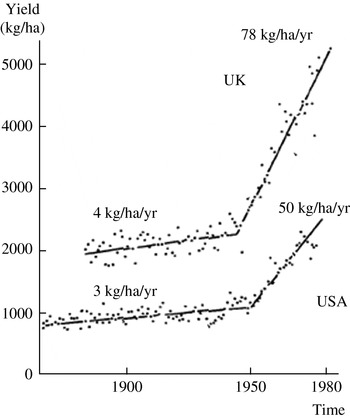
The post-World War II (WW II) reconstruction of the Dutch economy under the influence of the Marshall Plan was a success. Due to lack of fertilizers (factories had been converted for war production), large-scale slaughter of animals (to feed the hungry population) and lack of labour (mobilization of the male population), agriculture was generally in a depressed state (Dornbusch et al. Reference Dornbusch, Nölling and Layard1993). From 1948 onwards, external support provided under the Marshall Plan was an important factor in this respect, mitigating the lack of production capital (machinery, buildings, livestock and land quality). The Dutch government also invested heavily in agricultural research to increase food security and prevent future food shortages for the Dutch population. Farm productivity and efficiency had to increase. Moreover, the government wanted to maintain low food prices through cost-effective agriculture and restricting salaries to stimulate industrial production and export. Soon after WW II, agricultural production volume exceeded that of the pre-war years (De Widt Reference De Widt1954). Figure 1 illustrates the rapid yield increases per hectare directly after WW II for Europe (UK) and America (USA). This persistent yield increase may be attributed to the synergistic effect of soil amelioration, fertilizer use and control of diseases, as well as introduction of plant varieties that were able to make good use of the input increase (De Wit Reference De Wit, van Keulen and Wolf1986).
Average wheat yields in the United Kingdom and the United States between 1880 and 1980 (De Wit Reference De Wit, van Keulen and Wolf1986). Production in the UK is comparable to that of the Netherlands in the same era.

In Dutch agriculture, land productivity growth was especially high from 1950 to the mid-1970s, while during this period the labour input in agriculture declined from almost 600 000 to less than 300 000 man-years. This was achieved through large-scale intensification and mechanization. The outflow of labour from the agricultural sector was easily absorbed in the emerging industrial sector, where the demand for labour was high, as also illustrated by the arrival of the first wave of migrant workers, mainly from southern European countries (e.g. Italy, Spain and Greece).
An important stimulus for the excellent production results was the Onderzoek, Voorlichting Onderwijs (OVO) model or ‘triad’ (research, extension and education) that, because of its success, remained the leading principle in Dutch agriculture for decades (Van Dijk & Van Boekel Reference Van Dijk and Van Boekel2001). Due to the crucial role of farmers in guaranteeing food security, their position in the rural areas was unassailable in this era.
After the mid-1970s, food security was no longer perceived as a problem, while concurrently environmental organizations such as the World Wildlife Fund (established in 1961) and Greenpeace (established in 1971) brought the importance of negative environmental impacts, such as loss of biodiversity, to the attention of the general public. The book Silent Spring by Rachel Carson (Carson Reference Carson1962) triggered widespread public concerns about pesticides and pollution of the environment, which eventually led to the ban of the pesticide DDT in the United States in 1972.
Politically, the Report for the Club of Rome The Limits to Growth (Meadows et al. Reference Meadows, Meadows, Randers and Behrens1972) provided a strong signal to governments and citizens to take environmental issues seriously. As a consequence, societal concerns started to emerge in Western Europe about the environmental impacts of the intensification of agriculture, such as soil and water pollution and loss of biodiversity, in addition to ‘overproduction’.
Although the first signals about overproduction dated from the end of the 1960s, most of these signals were initially neglected by the Dutch government. The same happened with environmental problems, although there were already warnings about pollution through excessive manure use in the 1960s (Henkens Reference Henkens1961).
From the end of the 1970s, environmental problems became increasingly evident in The Netherlands (Bloemendaal Reference Bloemendaal1995; Dijkstra et al. Reference Dijkstra, Coeterier, Van Der Haar, Koomen and Salden1997): pollution of drinking water with nitrate, saturation of soils with phosphate, loss of biodiversity and radical changes in traditional anthropogenic Dutch landscapes. In response, the Dutch government introduced a strategy in 1975 for the protection of rural areas through the creation of new entities, National Parks (Anon 1975a) and National Landscapes (Anon 1975b), and a system of Management Agreements between farmers and the government to protect nature and landscape on farmland (Anon 1975c). However, it was not until the mid-1980s that strict regulations were introduced to reduce expansion of intensive animal husbandry (Van Boheemen Reference Van Boheemen, Meer, Unwin, van Dijk and Ennik1987). At about the same time, the European Community introduced the milk quota system to halt the increase in milk production, although the ‘milk lake’ had already been present since the 1970s.
Sustainability in general, and also in agriculture, increasingly dominated the policy agenda, stimulated by the Brundtland report, Our Common Future (Brundtland Reference Brundtland1987), which addressed ‘the accelerating deterioration of the human environment and natural resources and the consequences of that deterioration for economic and social development’. In the report, sustainable development was defined as development that ‘meets the needs and aspirations of the present generation without compromising the ability to meet those of the future’.
From the end of the 1970s further expansion of the public sector was considered undesirable and unfeasible, because of rapidly growing government deficits and debts. Neo-liberalism was seen as an alternative (Müller & Wright Reference Müller and Wright1994; Roseboom & Rutten Reference Roseboom and Rutten1998). Institutionally, neo-liberalism implies privatization, deregulation, including deregulated (preferably free) international trade and reduced government interference. In The Netherlands, this period was marked by cutbacks in public spending and far-reaching deregulation and privatization (Roseboom & Rutten Reference Roseboom and Rutten1998; Grin et al. Reference Grin, Felix, Bos and Spoelstra2004). This trend would continue into the 1990s and agricultural research institutes and extension services were also privatized. In the process, government funding for agricultural research and development gradually declined (Grin et al. Reference Grin, Felix, Bos and Spoelstra2004).
In the period 1980–2000, the agricultural labour force continued to decrease due to ongoing mechanization and rationalization (Bieleman Reference Bieleman, Schot, Lintsen, Rip and De la Bruhèze2000). Concurrently, traditional societal patterns in rural areas changed drastically (Frouws Reference Frouws1998). Traditionally, farmers formed the backbone of society in rural areas: they dominated municipal councils, church boards, management of cooperative banks, etc. As their numbers decreased, these traditional societal patterns changed. Farmers' children left the agricultural sector, because of better employment opportunities or income and moved to economically more favourable regions, such as the highly urbanized Randstad (Amsterdam, Rotterdam, The Hague, Utrecht and a number of smaller towns). In some parts of the country (e.g. in the northern provinces Friesland and Groningen) this has led to a declining population in rural areas (Mak Reference Mak1996). In other regions, closer to the Randstad, ‘urbanites’ bought homes in rural areas, thus creating more diversity among the original rural population, which sometimes also led to problems, most of which were sociocultural in nature (Brunt Reference Brunt1974; Renting & Van der Ploeg Reference Renting and Van der Ploeg2001; Van Dam et al. Reference Van Dam, Heins and Elbersen2002; Heins Reference Heins2004).
As the number of farmers declined, links between agriculture and society weakened with fewer people having roots in rural areas. As a consequence, societal knowledge about modern agricultural production methods strongly declined. Moreover, as food prices remained low, intensive large-scale farming systems were needed to generate an acceptable farm income. Societal acceptance of these large-scale production systems gradually decreased (Groot Koerkamp et al. Reference Groot Koerkamp, Van Hierden, Meerburg, Struik and Wienk2006). Widely publicized and disruptive outbreaks of contagious animal diseases and food safety scandals in the 1990s further reduced societal acceptance of the prevailing farming practices (Bos Reference Bos2008; Bos & Grin Reference Bos and Grin2008). The traditional institutional arrangements and the close relationship (sometimes also called ‘iron triangle’) between the Ministry of Agriculture, agricultural specialists in parliament and agricultural branch organizations were disrupted as a result of continuous pressure of citizens and their representatives in parliament (Wisserhof Reference Wisserhof, Van Tatenhove, Arts and Leroy2002). These ‘outside’ actors now have a vote in agricultural decision making (Groot Koerkamp & Bos Reference Groot Koerkamp and Bos2008). Although a large part of the Dutch Gross National Product is still earned through production and trade of agricultural products, the political clout of farmers has declined significantly.
Historically, national and supranational (EU) policies had a strong and direct influence on agricultural practices in The Netherlands. In the pre-1990 period, the Common Agricultural Policy (CAP) was based on the objective of guaranteeing self-sufficiency in basic foodstuffs, in response to post-war food shortages. However, the first quotas (milk, sugar) were already introduced in the mid-1980s. In the 1990s, these production limits helped to reduce surpluses and the emphasis shifted to environmentally sound farming. Top-down manure directives were formulated to reduce environmental pollution, such as the Nitrate Directive (1991), specifying a maximum permitted level of 50 mg nitrate (NO3)/l groundwater to ensure the safety of drinking water.
According to EU regulations, farmers have to respond more strongly to the world market and to the public's changing priorities. Driving forces for this reform are international trade agreements (World Trade Organization (WTO)). The MacSharry reform of the CAP in 1992 involved a shift in policy instruments with respect to arable cropping regimes. Guaranteed prices were reduced and a substantial share of agricultural support was paid in direct income support to farmers (Anon 1991a, b). In 2000, the CAP underwent another reform named Agenda 2000 (Anon 1999), whose main goal was to strengthen its environmental provisions and to integrate these in a more systematic way into a broader policy for rural development (also triggered by the enlargement of the EU). This resulted in two main areas (so-called ‘Pillars’) of agricultural expenditure: the market and income support measures (Pillar 1) and rural development measures (Pillar 2) (Anon 2008). In recent years (2003 – present), the EU is focusing even stronger on market-oriented and environmentally friendly farming systems.
However, priorities of the EU vary between locations, as the point of departure in various member states is different. The developments that were described earlier and its time frame are valid for North-Western Europe (Netherlands, United Kingdom, Germany, Denmark), but they differ from the situation in Central and Eastern Europe (e.g. Hungary) or Southern Europe (e.g. Spain). For example, in the new EU-countries in Central and Eastern Europe, growth in agricultural production and food safety awareness are still supported by the European Commission.
Since the reform of the CAP, the (supra-) national governments also support rural areas in meeting economic, social and environmental challenges of the 21st century. However, this top-down policy is not always effective, because often it does not match the local situation (Dietz et al. Reference Dietz, Ostrom and Stern2003). Hence, there is increasing interest in initiatives developed bottom-up by local stakeholders, often in collaboration with municipalities, water boards and/or provinces in interactive decision-making processes (Hendriks & Tops Reference Hendriks and Tops1999). These activities have definite advantages as such processes mobilize efforts, involvement and expertise of local stakeholders (Hendriks & Tops Reference Hendriks and Tops1999; Kersting & Vetter Reference Kersting and Vetter2003). However, they may also lead to emergence of conflicts and tensions. As the actual design of processes of co-production is complicated, substantial demands are made on civil servants, political representatives and citizens (Hendriks & Tops Reference Hendriks and Tops1999; Kersting & Vetter Reference Kersting and Vetter2003). The linkage of such initiatives to (supra-) national regulations is often perceived as particularly difficult (Hendriks & Tops Reference Hendriks and Tops1999; Kersting & Vetter Reference Kersting and Vetter2003).
Different times, different functions
The landscape of The Netherlands is strongly urbanizing and land use functions compete for the available space (Opdam et al. Reference Opdam, Foppen and Vos2001). This struggle also has an enormous impact on the possibilities for farmers to continue farming. In areas with strong conflicts of interest (e.g. nature conservation v. farming, or urbanization v. farming), it will be very hard for farmers to continue their farming activities conventionally. This will be especially the case if these farmers need to expand their farm in order to reach their optimal size from the viewpoint of economies of scale. However, alternative opportunities present themselves.
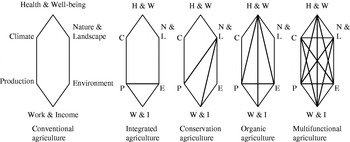
In addition to food production, farms can serve a number of other functions (Vereijken Reference Vereijken2003) that link farming (although perhaps not in the traditional way) to society. Vereijken (Reference Vereijken2003) schematically presented this societal-driven transition in agricultural visions (Fig. 2).
Transitions of agricultural visions and derived systems to combine multiple rural functions (Vereijken Reference Vereijken2003).

The different focus of farmers is the result of a combination of personal interests/skills or ‘management style’ (Van der Ploeg Reference Van der Ploeg2000), the type of the farm they own and current agricultural and societal trends. The most important agricultural trends in the period 1945 to mid-1970s were: production increase, mechanization, intensification and specialization. The leading societal trends were a decreasing focus on food security, government involvement, a strong belief in the malleability of society (Bijker Reference Bijker2002) and the dominant position of agriculture in the rural areas. From 1975 onwards, new societal trends emerged that can be partially explained by Maslow's hierarchy of needs (Maslow Reference Maslow1962). In his terms, sustainability of production methods and food quality only become important if food security and food safety are guaranteed. In the current paper, food safety is defined as the absence of chemical or microbiological hazards in food products, whereas food quality is the combination of their appearance, texture and flavour.
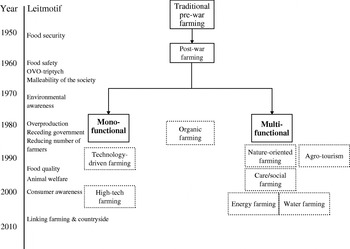
Concurrently, government funding for agricultural research declined, driven by the opinion that product-oriented research should no longer be funded by public money. Public attitude towards agriculture had changed. Another breaking point was the oil crisis of 1973, which created awareness about the limits to availability of natural resources, combined with growing concern about environmental problems and possible consequences of agricultural overproduction (Fig. 3).
Agricultural trends in the Netherlands from 1945 to present.

From the mid-1970s onwards, farm incomes did not keep pace with those in other economic sectors. Farmers with smaller farms, in particular, were looking for methods to increase their farm income.
In response to the autonomous societal trends (such as population growth or changes in income) and the ongoing urbanization (Buijs et al. Reference Buijs, Pedroli and Luginbühl2006), the agricultural sector was forced to adapt. For many farms, generation of additional income became important, which was possible through new types of products with a higher added value or through application of new cost-saving production methods or processes. As an alternative, farmers could combine various rural area functions (Vereijken Reference Vereijken2003) and become multifunctional (Fig. 1). This led to a strong diversification in multifunctional farming systems, as diversification can form a useful strategy to cope with income problems of farm households (Meert et al. Reference Meert, Van Huylenbroeck, Vernimmen, Bourgeois and Van Hecke2005).
Multifunctional farmers link farming, the rural area and its visitors through initiation of recreational activities such as camping at the farm and Bed & Breakfast or maintenance of nature and landscape, in addition to their agricultural activities. Others organize social care, company events, children's birthday parties or by selling farm products, etc. Part-time farming has become a possibility, as high levels of mechanization no longer require farmers to be continuously present at their farm. All these developments have led to new forms of entrepreneurship. Sometimes this entrepreneurship originates from farmers that appreciate social contact, which is difficult to find in a mere technological environment such as modern agriculture, sometimes it originates from purely economic motives (Van den Ham & Ypma Reference Van Den Ham and Ypma2000). However, in addition to these motives, pride of a farmer in the commodity produced (whether it is a conventional product or a new ‘multifunctional’ one) is essential (Dessein & Nevens Reference Dessein and Nevens2007).
Whatever the reason, multifunctional activities of farmers have contributed to integration of urban and rural areas. According to some, rural life has even become urban life in a green setting (Tjallingii Reference Tjallingii2000). This has led to a number of problems, as traditionally Dutch spatial policy has typically been characterized by striving for developing town and countryside as separate spatial entities (Hidding & Teunissen Reference Hidding and Teunissen2002).
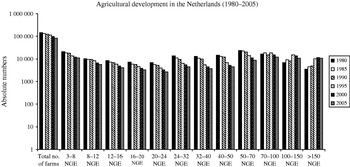
In addition to farmers that respond to opportunities of the integration of rural and urban lifestyles, the majority of farmers still prefer further specialization (Peerlings & Polman Reference Peerlings and Polman2004). Further specialization is also known as ‘monofunctional’: agriculture solely dominated by the production of crop and/or animal products. Efficient production is the main goal of monofunctional farmers. To earn a satisfactory income, farm expansion is an absolute requirement, a process that has been in progress during the last few decades (Fig. 4).
Farm development in the Netherlands between 1980 and 2005 on logarithmic scale (source: CBS, http://www.cbs.nl). NGE means Nederlandse Grootte-Eenheid (Dutch Size Unit) and is an economic standard that is used to describe farm size. NGE is based on the balance per animal or per hectare of crops. In 2005, 1 NGE equals a gross margin of €1400.

As land is a finite resource, farmers that strive for a monofunctional farming style face heavy competition, not only from other farmers, but also from other actors, such as nature conservationists, rural residents and tourists, who compete for the same space (Heide et al. Reference Heide, Overmars, Jongeneel, Mander, Wiggering and Helming2007). In the past, the focus on efficient agri-production systems has led to a uniform countryside with many problems: intensification, fragmentation and loss of natural features and biodiversity (Jongman Reference Jongman2002; Huijser et al. Reference Huijser, Meerburg and Holshof2004; Korevaar & Geerts Reference Korevaar, Geerts and Hopkins2007; Schröder & Bos Reference Schröder and Bos2008). In order to prevent these problems in the future, monofunctional farmers should (more than in the past) realize that they act in a tightly constrained and regulated environment. Their production is controlled by strict regulations as derived from societal concerns, often supported by national or supranational legislation (production quota, regulations on animal welfare, environment-friendly production methods, etc.). This requires a shift in thinking when designing new production systems: the interpretation of sustainability of a production system and participation of various stakeholders are important preconditions (Groot Koerkamp & Bos Reference Groot Koerkamp and Bos2008).
Currently, there is a debate about whether farmers should specialize or whether they should combine different functions in order to earn the highest income. In fact, there is no single solution. Each farmer has to decide for him/herself, depending on his/her own management style and his/her local and social embedding (e.g. family structure). These strategic choices are frequently made, as was shown by a multivariate probit model that demonstrated that farm size and life cycle are important variables explaining the probability of farmers having plans to rebuild or expand their farms (Oude Lansink et al. Reference Oude Lansink, Van Den Berg and Huirne2003).
Development of new farming concepts
The societal changes dealt with above also required a paradigm shift among researchers. They face the challenge of supporting the development of farming systems that function according to societal demands and that are at the same time capable of responding to market forces. They have to develop sustainable farming systems, both for farmers that select large-scale monofunctional production and for those that select the pathway of multifunctional agriculture. An important precondition before research can start is an interest of society in the expected results: consumers of research results are no longer seen as passive recipients, but as active clients (Roseboom & Rutten Reference Roseboom and Rutten1998). Research institutes are no longer solely dependent on government money, but have to acquire funding from the market as well (Roseboom & Rutten Reference Roseboom and Rutten1998). Thus, researchers try to optimize between the different landscape functions in the rural areas, of which agriculture is one. Fine-tuning of these systems often takes place with various stakeholder groups (Groot Koerkamp & Bos Reference Groot Koerkamp and Bos2008), as these systems should be in line with current societal demands in order to be acceptable. The current paper presents four examples of concepts that are currently developed at the Wageningen University & Research Centre, illustrating the diversity of new multifunctional farming systems and the way they are linked with society.
Case 1: Constructed wetlands for water sanitation and green energy
The combination of different functions to counter emerging problems can sometimes result in the start of a new innovative concept that may offer opportunities for the agricultural sector in The Netherlands. This certainly applies to the Lankheet Estate, in the eastern part of the country. In Western Europe, a number of environmental problems such as eutrophication, flooding and desiccation of nature reserves are posed. The capacity to absorb heavy rainfall in catchment areas has diminished and waterways swell more quickly during storms. The result is an increased risk of flooding downstream that poses a threat, especially in densely populated and low-lying areas such as The Netherlands. Global climate change will probably aggravate these problems.
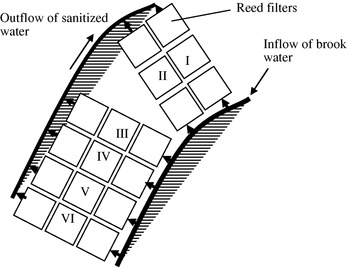
At the Lankheet Estate, tests are currently performed with constructed wetlands with reed (Phragmites australis) (Meerburg & Van der Werf Reference Meerburg and Van Der Werf2008a, Reference Meerburg and Van der Werfb): see Fig. 5. Water from a brook enters the wetlands that serve as surface sanitation units as they absorb nutrients, whereas at the same time offering opportunities to serve as water storage and production areas for ‘green’ energy. The optimal residence time of water in the wetlands is tested in relation to their cleaning capacity. Test results are promising (B. G. Meerburg & A. Van der Werf, personal communication): the amount of nitrogen is, depending on residence time, reduced by 32–47%, while phosphorus concentration is reduced by 27–45%. A number of these wetlands will contribute to the success of the European Water Framework Directive, which aims to ensure the quality of surface- and groundwater by 2015. However, to achieve this, farmers have to be interested in implementing these man-made wetlands with reed on their premises. This will only happen if it becomes possible to convert the reed into green energy and they get a good price for this product, combined with a reward for their contribution to surface water sanitation which is a communal benefit.
Schematic display of the constructed wetlands at the Lankheet Estate.

Case 2: Multifunctional land use and green-blue services
Multifunctional land use is an option for increasing economic and environmental sustainability and making a region more attractive for local inhabitants and visitors. Between 2002 and 2004 a group of 14 farms was studied in the Winterswijk region (in the eastern part of The Netherlands), a small-scale landscape with high nature value, consisting of a mosaic of grasslands, arable fields, hedgerows and woodlots, on sandy soils. The study sites consisted of five dairy farms, two beef, one young stock rearing, one pig, two arable, one mixed farm and two small estates. Four of these farms were organic farms. The farms also differed in their level of function combinations. The impact of multifunctional land use at field level, farm level and rural community level was analysed (Korevaar & Geerts Reference Korevaar, Geerts and Hopkins2007). The results indicate that a combination of agronomic, ecological and environmental goals is possible and that it is possible to combine high biodiversity with a rather high production level. In most cases, this multifunctionality is not profitable for the individual farmer. However, for the region as a whole, it provides good opportunities to generate extra income. The most important potential for extra income is an increase in recreation and tourism. A mechanism is necessary to reallocate this extra income. At the request of the same group of farmers, a follow-up project is now in progress to develop a rewarding system for this region for ‘green-blue services’, which consist of activities on water, nature and landscape (including cultural heritage) that contribute to the quality of the rural area.
Case 3: Sole production in a polder
In the western part of the country, new water-farming concepts are currently being developed. An example is the ‘Zeeland sole’ project, aimed at developing a new multifunctional system, respecting the original Dutch Polder design. In this project, the government, private companies and researchers collaborate in order to develop a new economic sector (Ketelaars Reference Ketelaars2006, Reference Ketelaars2007). The main idea is inland production of sole (Solea solea), a fish that is in high demand with a market value of €10–15 per kg. Currently, the species is on the EU quota list and due to this limit, the income of many fishermen is under pressure, as they are no longer allowed to catch large numbers of sole in the North Sea.
With the development of an inland production system, new economic support is created in this part of the country, where high-tech arable production, the main agricultural activity, was also under pressure. If production of sole is combined with that of other aquatic products, such as mussels, cockles, clam worms and Salicornia plants, the chances of earning a good income increase even more. Moreover, as the waste that is produced in one part of the system is used as input (feed) in the other part, the sustainability of the system is assured (Rood et al. Reference Rood, Nagelhout, Ros and Wilting2006). Another aspect of the Zeeland sole project is the search for ways to integrate these water-farming concepts within the traditional Dutch landscape, for example by striving to combine economic activity with nature development. Thus, these systems will acquire more societal acceptance.
Case 4: Green care farming
Another trend in The Netherlands is the development of social or green care farming. The creation of care farms to promote physical and mental health is an interesting method to link societal needs to opportunities for farmers to increase their income. Many farmers have seen the possibilities of this linkage, as between 1998 and 2005 the number of care farms in The Netherlands increased from 75 to 591 (Elings & Hassink Reference Elings, Hassink, Hassink and van Dijk2006), and their number is now increasing rapidly towards 800 (Haubenhofer et al. Reference Haubenhofer, Hassink, Elings and Dessein2008). However, as farmers become involved in a new sector (care), specific questions emerge (Hassink et al. Reference Hassink, Van Almenkerke and Ketelaars2002, Reference Hassink, Zwartbol, Agricola, Elings and Thissen2007; Haubenhofer et al. Reference Haubenhofer, Hassink, Elings and Dessein2008). Farmers are interested to learn how their care farm differs from traditional institutions that are providing care to people and whether their activities indeed result in an improvement of physical, mental and social well-being of clients. On the other hand, many other stakeholders (e.g. the Ministries of Health and Agriculture, traditional care institutions and insurance companies) are interested in the contribution of green-care farms to the health sector (Hassink & Van Dijk Reference Hassink and Van Dijk2006). Because various actors are interested, research on this topic has to be multidisciplinary and participatory in order to ensure maximum benefit for society (Van de Fliert & Braun Reference Van de Fliert and Braun2002).
DISCUSSION
European farmers are far from becoming redundant. They can provide services such as water sanitation, production of green energy and providing green care. By providing these services, even farmers with limited production capital (in terms of land, stock or money) are able to remain active and to contribute to the vitality of rural regions of Europe. Other farmers retain a focus on conventional agricultural (food) production, but they have also to adapt their farming system to meet societal demands.
The concepts that were described in the case studies are, not considered as ‘pure’ agricultural systems by many people. However, the main similarity between these systems and systems that were developed in the years after WWII is that they were both developed according to the societal demands of their era. After the war, there was a strong demand for food, and farmers produced that in order to feed the human population. With plenty of food available (although locally in Western Europe), other functions become more important. These functions develop as the demands of society change over time.
For agricultural scientists, changing demands are always a challenge. Scientists have to acquire new knowledge (i.e. of systems previously unknown to them), to cooperate with scientists from different disciplines and use all their creativity in order to contribute to the development of systems that satisfy the continuously changing requirements of society (e.g. on the topic of sustainability). A close relation with citizens and stakeholder groups is beneficial for scientists to keep up with the continuously changing societal requirements.
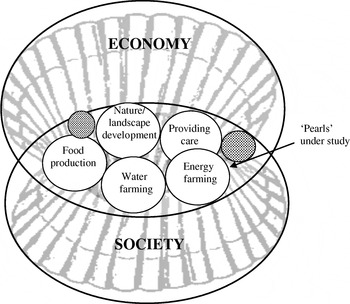
As a precondition, agricultural research should focus on the cutting edge of economy and society (Fig. 6). Food production is always a key element in farming systems, but other functions can be added. Agricultural scientists have to be aware that the farming systems they work on should meet current societal demands and at the same time offer farmers and other land owners the opportunity to continue farming in socially acceptable and economically viable ways. Sometimes scientists will work on optimization of farming systems that have already been present for some time. Sometimes, they will develop new systems. As in any innovation process, the development of such new systems is a challenge: it is difficult to predict which systems will become mainstream and which will not. Many of the new systems that are being developed will not become mainstream, but some ‘pearls’ have the capacity to evolve and result in a good future for a group of farmers. Thus, agriculture is becoming more diverse. For the farmer, the search is for the ‘true pearl’, the farming system that provides him with a good income that matches societal demands and gives him pride.
The Pearl concept: agricultural research should remain focused on the cutting edge of economy and society. Attention for the environment is considered a societal precondition.