Introduction
Recurrent respiratory papillomatosis is the commonest benign neoplasm of the larynx, and affects approximately 4.3 per 100 000 children in the USA.Reference Derkay and Darrow1 It is caused by human papilloma virus (HPV), most commonly types six and 11; types 16 and 18 are less frequently implicated but are associated with a higher risk of malignant transformation. Recurrent respiratory papillomatosis is a disease that tends to run an unpredictable and recurrent course, frequently proving resistant to treatment.Reference Bishai, Kashima and Shah2
Numerous medical and surgical modalities have been used to treat recurrent respiratory papillomatosis, but evidence-based studies comparing treatments are lacking.Reference Derkay and Darrow1 In many centres, carbon dioxide laser remains the treatment of choice for the management of laryngeal papillomata, although recently the laryngeal microdebrider has gained popularity as a quicker method possibly less likely to produce scarring.Reference Schraff, Derkay, Burke and Lawso3
Laser causes thermal vaporisation of water, resulting in explosive disruption of cells. Human papilloma virus DNA has been detected in the CO2 laser plume,Reference Kashima, Kessis, Mounts and Shah4 and this has been hypothesised to cause distal seeding of lesions into the tracheobronchial tree. In a recent survey, distal seeding was found in 13 per cent of patients.Reference Schraff, Derkay, Burke and Lawso3 Once the trachea is involved, surgical management becomes increasingly problematic, testing the skills of both the otolaryngologist and the anaesthetist. The laser bronchoscope traditionally required to treat these distal lesions produces a beam that is tangential to lesions, and this may potentially increase the risk of collateral damage and further distal seeding.
The laryngeal microdebrider offers rapid local control of recurrent respiratory papillomatosis. However, it has been shown to often require more surgical sessions,Reference El-Bitar and Zalzal5 and has been noted to produce more intra-operative bleeding than the CO2 laser.Reference Patel and MacKenzie6 Whilst microdebrider-induced bleeding can be controlled with topical adrenaline in limited laryngeal disease,Reference Pasquale, Wiatrak, Woolley and Lewis7 bleeding can be a major problem in gross tracheal disease, thus limiting the amount of disease treatable in a single procedure.
Radiofrequency cold ablation (coblation) is increasingly being used in otolaryngological practice.Reference Arya, Donne and Nigam8–Reference Bortnick10 Its precise, non-thermally disruptive properties make it an attractive alternative therapy for recurrent respiratory papillomatosis in the tracheobronchial tree. In 2003, our department published the first report of its use in the resection of tracheal recurrent respiratory papillomatosis.Reference Psaltis and Carney11
This study examines the time interval between procedures in a cohort of patients with laryngotracheal recurrent respiratory papillomatosis who were treated firstly with CO2 laser and then subsequently with radiofrequency coblation.
Patients and method
We obtained approval from the local ethics and research committee to review the case records of the patients studied. The case records of six adult patients with laryngotracheal recurrent respiratory papillomatosis were reviewed. All patients had been treated with CO2 laser for a minimum of two years, and were then subsequently treated with radiofrequency coblation for a further two years. The length of time between surgical interventions required for symptomatic control was determined and compared using the Student paired t-test.
Coblation operative technique
All patients were treated under general anaesthesia using jet ventilation. A 0° Hopkins rod endoscope and camera were used with a Storz C laryngoscope (Storz, Tuttlingen, Germany) to visualise the tracheobronchial lesions. A modified, three-electrode, bipolar radiofrequency device (Coblator I; Arthrocare, Sunnyvale, California, USA) was used to ablate papillomata (Figure 1). Before each insertion into the airway, the wand tip was placed in saline gel to create an adequate environment for the coblation plasma field. The power level was set to provide 800–1200 J of energy. Papillomata were ablated by placing the tip of the wand over the lesions at a 90° angle where possible to minimise surrounding thermal damage.
The Coblation I probe.

Post-operatively, patients were observed overnight and discharged home the following morning.
Results
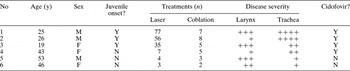
Three men and three women with a median age of 34 years (range 19–53 years) were studied. These six patients exhibited marked differences in the severity of their recurrent respiratory papillomatosis, from advanced laryngeal disease with only solitary tracheal lesions, to almost complete circumferential papillomata involving most of the trachea with minimal laryngeal disease. Three patients had developed juvenile onset disease which progressed in adult life. Data on the onset and severity of these patients' disease are outlined in Table I.
Patient data

No = number; y = years; M = male; F = female; Y = yes; N = no
A single surgeon performed or supervised all coblation procedures. Laser resections had been performed by one of four consultant surgeons from the unit. Four patients had been treated previously with intralesional cidofovir (<3 ml of 5 mg/ml solution) after laser resection but were regarded as non-responders, although intralesional treatment was continued in these four cases after coblation also.
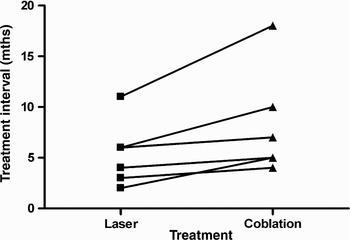
In three patients, there was a modest increase (<25 per cent) in the time interval between procedures required to maintain disease control, but in the remaining three cases there was a significant increase (>50 per cent) (p = 0.0342) (Figure 2).
Mean interval between treatments: laser versus coblation.

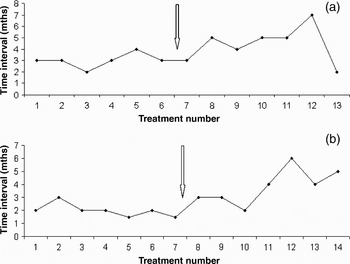
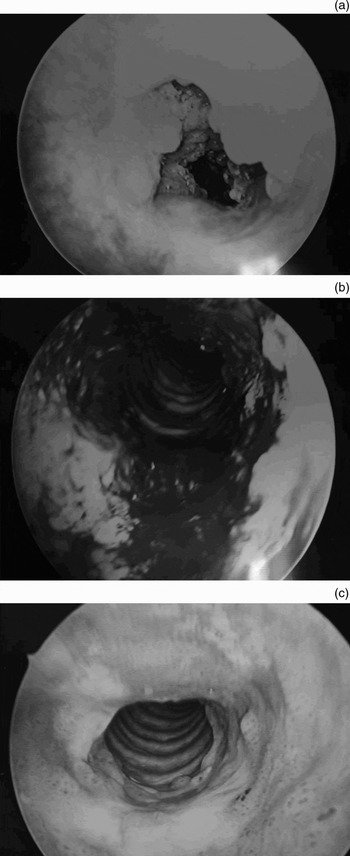
Figure 3 shows more detailed individual operative data on the two patients with the most severe disease. This demonstrates a trend towards increased time between coblation procedures required to control disease, compared with laser procedures. Figures 4(a) and 4(b) show pre- and post-operative endoscopic views for one of these patients, who presented with severe tracheal papillomata. Figure 4(c) shows an endoscopic view taken prior to the patient's fifth coblation resection.
Time interval between treatments for (a) patient one and (b) patient two, both with advanced disease. The vertical arrow indicates the change from laser to coblation treatment. Mths = months

Endoscopic views of patient with advanced tracheal papillomatosis: (a) pre-operatively; (b) post-operatively; (c) prior to fifth coblation procedure (note that papillomata have become less exophytic).

Discussion
There are numerous treatment modalities for recurrent respiratory papillomatosis, both medical and surgical.Reference Derkay and Darrow1 Despite initially promising results for intralesional antiviral agents,Reference Akst, Lee, Discolo, Knott, Younes and Koltai12, Reference Milczuk13 variable success rates have been reported, and concern regarding potential malignant transformation may limit their use.Reference Derkay and Darrow1 Whilst four patients in this series were non-responders to cidofovir, this may be as a result of more severe disease burden than that reported in other series. As a result of the unpredictable efficacy of antiviral and other medical therapies, it remains likely that, at least for the foreseeable future, there will continue to be a need for a surgical method to physically debulk obstructing lesions in the larynx and trachea. All current surgical treatment modalities have potential disadvantages, and a survey of surgeons treating recurrent respiratory papillomatosis showed a wide variation in current practice.Reference Schraff, Derkay, Burke and Lawso3
Following the first coblation tonsillectomy in the late 1990s, radiofrequency coblation has increasingly been used throughout otolaryngology practice. It has been shown to provide impressive benefits as a tonsillectomy technique, reducing post-operative painReference Polites, Joniau, Wabnitz, Fassina, Smyth and Varley14 and allowing an earlier return to normal diet.Reference Parsons, Cordes and Comer15 Coblation has also been shown to be effective in reducing obstructive lesions in the tongue base, with minimal morbidity,Reference Robinson, Ettema, Brusky and Woodson16 whilst pain and other complications following palatal surgery also seem less compared with laser uvulopalatopharyngoplasty.Reference Belloso, Morar, Tahery, Saravanan, Nigam and Timms17 In 2007, Timms et al. Reference Timms, Bruce and Patel18 reported two patients with laryngeal papillomata treated previously with cold steel and laser techniques, who subsequently underwent coblation. These authors found good control of disease, with minimal scarring and preservation of the mucosal wave at six months. They also reported that coblation afforded the advantage of a bloodless field with minimal surrounding tissue damage.
Radiofrequency coblation offers many advantages that make it a suitable technique for the treatment of recurrent respiratory papillomatosis. The electrode arrangement and flexible wand configuration enable precise papilloma removal with minimal, or no, damage to surrounding tissues, and the technique is easy to learn and extremely efficient.Reference Psaltis and Carney11 As the probe is able to both ablate and coagulate, no instrument change is required, and this minimises bleeding and enables all obstructing lesions to be removed during a single procedure, an achievement not always possible with the microdebrider due to problems with haemorrhage control.Reference Patel and MacKenzie6, Reference Pasquale, Wiatrak, Woolley and Lewis7 Additionally, whilst surgical time in our series was not formally analysed, it was our impression that operative times were less compared with CO2 laser, a feature previously reported with microdebrider-assisted papillomata resection.Reference Patel, Rowe and Tunkel19
As the temperature generated by coblation is relatively low (approximately 40–70°C), the risk of an airway fire is significantly reduced.Reference Psaltis and Carney11 As the coblation plasma field causes direct molecular dissociation, this should denature viral proteins without causing a plume, as the only breakdown products are elementary molecules and low molecular weight gases. This should remove the potential for distal seeding,Reference Kashima, Kessis, Mounts and Shah4 a problem which must always be considered when using laser. As seen in Figure 4, after a number of coblation resections one patient's papillomata became less exophytic, tending to a more sessile appearance, a finding not previously reported for laser procedures. This finding was also observed in our other cases after multiple coblation procedures, although the aetiology is unclear. This may represent some modification of the disease process or wound healing as a result of the coblation, and further work should be conducted to establish the relevance of this change in the disease course.
At the time of our study, one major disadvantage of coblation for the resection of tracheal papillomata was the lack of a suitable probe for tracheal work. The Coblation I wand was designed for orthopaedic arthroscopic procedures and had only a single port for suction. The saline gel required to produce the plasma field was laborious to apply, and, additionally, the probe was only long enough to reach lesions up to 4 cm below the vocal folds. Timms et al. Reference Timms, Bruce and Patel18 used the Evac 70 (a wand conventionally used for tonsillectomy) to ablate laryngeal papillomata, which enabled simultaneous suction and irrigation for the plasma field. With the assistance of the senior author, Arthrocare developed a dedicated laryngeal wand device with both suction and irrigation channels, which allows access to adult laryngeal and proximal tracheal lesions. Prototype probes that would address distal adult tracheal and bronchial disease have also been developed but are not currently commercially available.
Due to the limited number of cases in this study, it is prudent not to over-interpret the data. Whilst it would appear that the time intervals between coblation procedures increased in comparison to those between laser treatments, we recognise that the natural history of the disease may also be responsible for the apparent improvement. However, many of our patients had severe disease which had resisted treatment for many years and showed no sign of resolution.
We are currently undertaking a series of other trials utilising coblation technology in other areas of laryngology and head and neck surgery, and will report on these in future publications.
• Recurrent respiratory papillomatosis is the commonest benign neoplasm of the larynx
• Numerous medical and surgical modalities have been used to treat this condition, often requiring frequent, repeated treatments
• Coblation of laryngotracheal papillomata results in increased time between procedures, compared with CO2 laser vaporisation
• Coblation provides an alternative option in the surgeon's armamentarium for the treatment of recurrent respiratory papillomatosis
Conclusion
Radiofrequency coblation is a useful adjunct to the surgeon's armamentarium when dealing with patients suffering from laryngotracheal recurrent respiratory papillomatosis, In our series, this treatment enabled increased intervals between treatments. In time, coblation may prove to be as effective as, or even superior to, other surgical techniques in controlling this notoriously unpredictable disease, with potentially fewer adverse effects and subsequent improved quality of life for patients.