Assessment of children with autism spectrum disorders (ASD) is a common referral for psychologists, guidance officers and other school and counselling professionals, with at least 1 in 200 Australian children having an ASD diagnosis (Australian Bureau of Statistics [ABS], 2014). International estimates suggest rates may be as high as 1:68 (Centers for Disease Control and Prevention [CDC], 2014). For children with ASD attending school in Australia, ABS data (2014) suggest that the majority experience some form of educational restriction (e.g., attending a special class or school) and/or challenge (e.g., social) with their school experience. Further, students with ASD have been shown to exhibit greater difficulties with performing academically and regulating their emotions and behaviours at school relative to their typically developing peers (e.g., Ashburner, Ziviani, & Rodger, Reference Ashburner, Ziviani and Rodger2010). Assessment may be indicated for children with ASD for a range of purposes, including verification of diagnosis, assessment for intellectual or developmental delays, to identify language or behaviour problems and potential contributing factors, to monitor progress and intervention outcomes, and/or to better understand children's strengths and needs (Akshoomoff, Reference Akshoomoff2006; Brassard & Boehm, Reference Brassard and Boehm2007). The purpose of this article is to provide an overview of key information to understand and complete standardised assessments with school-aged children with ASD.
ASD Overview
ASD is characterised by a spectrum of severity of impairments in social communication and social interaction skills, and restricted, repetitive behaviours, interests, or activities (American Psychiatric Association, 2013). Challenges with sensory processing, including both hypo- and hyper-sensitivity (e.g., to sound) are common (Ben-Sasson et al., Reference Ben-Sasson, Hen, Fluss, Cermak, Engel-Yeger and Gal2009), and were recently added to the DSM-5 diagnostic criteria as a potential symptom (APA, 2013). ASD is typified by heterogeneity of presentation, with individual children varying in terms of severity of impairments, as well as the presence or absence of comorbidities and associated challenges.
Presentation with one or more comorbidities tends to be the rule, rather than the exception, for children with ASD. Comorbidities include developmental, psychiatric and mood disorders, medical, and genetic conditions. Intellectual disability is observed in approximately 30% of children with ASD (CDC, 2014). Psychiatric and/or mood disorders have been observed in as many as 70–95% of children and adolescents with ASD, with the most common being anxiety disorders (e.g., social), attention deficit hyperactivity disorder (ADHD), oppositional defiant disorder, and major depressive disorder (Joshi et al., Reference Joshi, Petty, Wozniak, Henin, Fried, Galdo and Biederman2010; Simonoff et al., Reference Simonoff, Pickles, Charman, Chandler, Loucas and Baird2008). Common medical conditions include epilepsy/seizures, gastrointestinal problems, severe headaches or migraines, and asthma (Mannion & Leader, Reference Mannion and Leader2014; Schieve et al., Reference Schieve, Gonzalez, Boulet, Visser, Rice, Braun and Boyle2012). Genetic conditions such as fragile X and tuberous sclerosis complex co-occur in approximately 10% of children with ASD (Muhle, Trentacoste, & Rapin, Reference Muhle, Trentacoste and Rapin2004).
Additional challenges associated with ASD include behaviour, executive functioning, bias towards local processing, and theory of mind/social understanding. Challenging behaviours such as aggression towards others, non-compliance and difficulties with emotional regulation occur more often in children with ASD than those who are typically developing or have other conditions such as Down syndrome (e.g., Eisenhower, Baker, & Blacher, Reference Eisenhower, Baker and Blacher2005). Self-injurious behaviours may also be observed, particularly in children with higher levels of impairments in cognition or adaptive behaviour skills (Richards, Oliver, Nelson, & Moss, Reference Richards, Oliver, Nelson and Moss2012). Executive functioning difficulties, including difficulties with suppressing responses, shifting set, and keeping and using information, have been consistently observed in children with ASD (Geurts, Vries, & Bergh, Reference Geurts, Vries, Bergh, Goldstein and Naglieri2014). A tendency towards processing details (i.e., local processing) over the ‘big picture’ (i.e., global processing) also appears to characterise individuals with ASD and can be both a strength (e.g., in completing visual-spatial tests such as the embedded figures test) and a weakness (e.g., when completing a task where context assists comprehension — for example, of sentences; see Happé & Frith, Reference Happé and Frith2006, for a review). Difficulties with understanding and predicting others’ behaviour (i.e., theory of mind) have also been well documented (e.g., for a review, see Baron-Cohen, Reference Baron-Cohen and Glidden2001). Core and associated features of ASD can raise unique challenges for conducting a valid assessment with a child with ASD.
Assessment of Children With ASD
The validity of using standardised assessments with children with ASD is commonly queried in school contexts; however, standardised assessments can be administered validly with children with ASD (Reisinger, Steiman, Ferencz, & Sattler, Reference Sattler2014). Understanding the symptoms, common challenges and comorbidities associated with ASD can assist professionals in choosing appropriate assessment tools, as well as in preparing for, and conducting, an assessment in a manner that gives the best opportunity for a valid assessment. A typical assessment would include interviews with parents/caregivers, teachers, and the child (as appropriate to developmental level), observation, standardised assessment, and referral for medical/genetic/audiological examinations as indicated by observations or interview information (Reisinger et al., Reference Reisinger, Steiman, Ferencz, Sattler and Sattler2014). However, due to space limitations, the focus from hereon will be on choosing and conducting the standardised assessment/s with a school-aged child with ASD.
Choosing an Appropriate Assessment
A number of factors must be considered when choosing the most appropriate standardised assessment for a child with ASD. These factors include the referral question, child characteristics (e.g., chronological and mental age, verbal-ability, test-taking skills) and test characteristics (e.g., age range, norms, time, cost, training). In addition, consideration of one's own training, opportunities for training and supervision, and expertise are also important and ethical considerations and are discussed in the preparation section.
The referral question will inform the type of assessment required (e.g., intellectual, achievement, neuropsychological), whether assessments will be required to be repeated (e.g., to evaluate progress), and will also assist in informing whether a brief or full battery of assessments is required. Child factors to consider along with the referral question may include their behaviour, attention span, and age, which may help in narrowing the choice of assessment tools. For example, where the assessment is to be used for evaluation purposes, and may need to be repeated over time to identify changes or developments, the age range across the study or intervention/monitoring period may need to be considered. For example, where a child is to be assessed between 5 and 8 years of age, the Stanford-Binet may be used at both time points, whereas using Wechsler scales with this age range may necessitate using the Weschler Preschool and Primary Scale and then later the Weschler Intelligence Scale for Children.
In terms of child factors, key considerations for clinicians include the child's chronological and mental age, verbal/communication ability and understanding, and test-taking skills. Given many children with ASD function significantly below their chronological age (due to known or suspected developmental or intellectual impairments), consideration of both chronological and (hypothesised) mental age can help to narrow the choice of assessments. Finding an appropriate measure that covers both can at times be difficult or impossible, and clinicians are recommended to then consider using an assessment that provides age equivalents rather than using standard scores. This is because although a child who shows a significant delay may receive the lowest possible standard score (e.g., 50 on an intellectual assessment), this does not provide information on whether a child's ability is in the moderate, severe or profound range of impairment (Goldstein, Naglieri, & Ozonoff, Reference Goldstein, Naglieri and Ozonoff2009). In subsequent assessments they may still score at this basal and it may not be sensitive to changes over time. In contrast, if age equivalents were available and used, these may be more useful in obtaining an estimate of children's ability level and may be more sensitive to changes over time or in response to intervention, although requiring careful interpretation (as suggested by Akshoomoff, Reference Akshoomoff2006).
Given communication impairments are part of the diagnostic criteria for ASD (APA, 2013), verbal requirements of assessments are important to consider when selecting an assessment. It is important to note that this also applies to non-verbal scales of assessments where poorer verbal ability is also linked to poorer outcomes (e.g., on the Stanford-Binet 5; Lennen, Lamb, Dunagan, & Hall, Reference Lennen, Lamb, Dunagan and Hall2010). This is because although a scale may be ‘non-verbal’, it may still contain verbal instructions, and if a child does not comprehend task requirements, this may affect their ability to complete tasks. For a child with limited understanding of verbal communication, the use of a completely non-verbal scale (e.g., Leiter International Performance Scale) may provide a more accurate indication of the extent of a child's abilities (although this is dependent on the referral question). Consistent with this, previous research has suggested children with ASD show better performance on intellectual assessments that have lower verbal demands (e.g., Leiter International Performance Scale; Raven's Matrices) than more verbally-based assessment (e.g., Weschler Intelligence Scales for Children; Stanford-Binet; Dawson, Soulieres, Gernsbacher, & Mottron, Reference Dawson, Soulieres, Gernsbacher and Mottron2007; Grondhuis & Mulick, Reference Grondhuis and Mulick2013). However, whether this reflects areas of strength (e.g., local processing) versus true weakness (e.g., verbal ability) is under some debate (e.g., see Dawson et al., Reference Dawson, Soulieres, Gernsbacher and Mottron2007, for a discussion).
In addition to consideration of children's verbal ability and understanding, screening of a child's test-taking skills is also recommended to inform test selection. Test-taking skills are the basic skills required to complete an assessment, such as the ability to sit and attend for an extended period, and respond to verbal instructions, requests and questions, such as ‘Point to_____’, ‘Give me_____’, and ‘Show me_____’ (Brassard & Boehm, Reference Brassard and Boehm2007). Such skills may be observed in the classroom prior to selecting an assessment, or alternatively may be assessed more formally (e.g., through using the Boehm Test of Basic Concepts).
The skills a child displays may limit which assessments are useful with a given child, or whether standardised assessment should be deferred (where possible) until a child has been taught the required skills (e.g., pointing, imitation) to complete the test. In some cases, it may be impossible to avoid or defer assessments that require skills (e.g., pointing, personal pronouns, imitation of clinician's actions) that are difficult for a given child with ASD; the clinician nonetheless should be aware of potential tasks likely to be especially challenging for the child and consider this both during administration and when interpreting assessment findings and their validity.
Thus, in summary, test characteristics to consider include availability of appropriate norms, including both chronological and mental age, verbal ability and comprehension, and test-taking requirements. In addition, consideration of whether there is flexibility of item administration, timed/non-timed, availability of clinically relevant norms (e.g., are ASD or clinical norms available), and the test time, cost, and training required should be considered. Overviews of these factors may be found in recent textbooks on assessments (e.g., Sattler, Reference Sattler2014) and on publishers’ websites.
Preparation for Assessment
Following test selection, preparation should include revising or learning the assessment, identifying reinforcers, selecting an appropriate location, and preparing the child and relevant stakeholders (e.g., parents, teachers) and materials for the assessment. Preparation should first include revising or gaining skills and knowledge in administration of that specific test, in line with ethical mandates (Australian Psychological Society, 2012). As assessment of a child with ASD can be more challenging, practice with a typically developing child can be useful prior to assessing a child with ASD (Reisinger et al., Reference Reisinger, Steiman, Ferencz, Sattler and Sattler2014). In addition, review of any suggestions or guidelines for assessing a child with ASD in the test manual where available prior to that specific assessment is recommended.
Children with ASD may not be reinforced by the same things as children without ASD; for example, being keen to please assessors (Akshoomoff, Reference Akshoomoff2006; Brassard & Boehm, Reference Brassard and Boehm2007). Thus, identification and preparation of other reinforcers is valuable to support engagement during the assessment. Reinforcers may include, for example, children's preferred activities and interests, tangible items (e.g., favourite foods or snacks), ‘high fives’, or short-periods of play. Reinforcers may be identified informally through discussions with parents and/or teachers, or through the use of more formal checklists (e.g., Atkinson et al., Reference Atkinson, Jenson, Rovner, Cameron, Van Wagenen and Petersen1984) or preference assessments (e.g., see Virués-Ortega et al., Reference Virués-Ortega, Pritchard, Grant, North, Hurtado-Parrado, Lee and Yu2014 for a review and clinical decision-making framework). It is recommended to carefully consider use of ‘special interests’ or particularly highly motivating items (e.g., tablet computers in our experience) as reinforcers, as these may be difficult to remove to continue with assessment items. The use of items that children find reinforcing but that they are willing to return or let go of, or that are self-limiting (e.g., with younger children the use of bubbles can be useful as they disappear) is thus recommended. In conjunction with reinforcers, the use of a visual work schedule of tasks, including these preferred activities or items, may also help some children with ASD. This would ideally need preparing in advance, using photographs, pictures, or words to describe test items or activities and reinforcers matched to the child's comprehension level (for further discussion see Klinger, O’Kelley, & Museey, Reference Klinger, O’Kelley, Museey, Goldstein, Naglieri and Ozonoff2009).
Where possible, the test location and time should be selected to fit with the child, school, and family's needs. For example, some children may be sensitive to light (e.g., fluorescent lighting) or noise (e.g., garden maintenance), and selecting a room away from such sensitivities may reduce distractions and enhance attention. Young children in particular may respond better if a parent or familiar caregiver (e.g., teacher's aide) is present. Children's usual timetable should be considered; for example, morning tea and lunch breaks, special classes (e.g., music lessons, physical education), and preferred subjects, to schedule a time to maximise motivation and minimally disrupt school routines. It can also be helpful to discuss the best time with both teachers and parents, and anything children need to bring (e.g., preferred items for reinforcers, communication devices), and confirm these in writing with all relevant parties. If sending written confirmation, this may also be an ideal time to send a social story or narrative (for more information see Collet-Klingenberg & Franzone, Reference Collet-Klingenberg and Franzone2008). This may be used to explain the social situation of the test to reduce anxiety and increase predictability for a child who prefers routine and may have difficulty with the unfamiliar test situation.
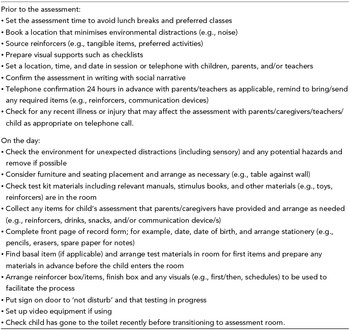
During conversations to confirm the assessment time and location, clinicians may also gather information about children's test-taking skills (discussed above), challenging behaviours (including response to change or environment), sensory sensitivities, use of visual or communication devices, and preferred activities or interests, if this information has not already been gathered via interviews. Knowledge of the assessment time and place also gives parents and teachers an opportunity to inform you, as the clinician, of any changes to the child's health, sleep, medication, or other factors that may affect the assessment on the day. Parents should also be informed or reminded about the purpose of the assessment, any costs, and when to expect results and/or feedback. A checklist to assist with preparation on the day, based on our clinical experience and the above recommendations, can be seen in Table 1.
Assessment Preparation Checklist (Adapted from Paynter & Fothergill, Reference Paynter and Fothergill2014)

During the Assessment
Children with ASD may not be socially motivated, and may also have difficulties with understanding the social requirements of an assessment and/or what is being asked of them, and may be more easily frustrated and harder to engage than children who are typically developing (Akshoomoff, Reference Akshoomoff2006; Brassard & Boehm, Reference Brassard and Boehm2007). Maintaining children's engagement and reducing off-task and challenging behaviours may thus be particularly important when assessing children with ASD, where attention, motivation, and challenging behaviour have been shown to considerably affect their test performance (e.g., Akshoomoff, Reference Akshoomoff2006; Koegel, Koegel, & Smith, Reference Koegel, Koegel and Smith1997). A valid assessment requires standardised administration in terms of object placement, verbal/non-verbal instructions, and use of specific materials. However, standardised administration can be maintained while also incorporating behaviour management techniques to maximise children's attention and motivation, thus gaining a more accurate (and valid) indication of a child's ability. In contrast, rigid adherence to a particular assessment style that does not accommodate an individual child's strengths, interests and attention may lead to a challenging assessment. For example, a child may spend the entire session in off-task behaviour such as throwing test materials, screaming or running around the room; results are then highly unlikely to show the child's true ability, regardless of how standardised the administration may be (Klinger et al., Reference Klinger, O’Kelley, Museey, Goldstein, Naglieri and Ozonoff2009).
Strategies to enhance children's motivation and engagement during the assessment session may include adapting the physical environment, visual supports, reinforcement, management of challenging behaviour, and/or allowing parents or support workers to attend (Akshoomoff, Reference Akshoomoff2006; Koegel et al., Reference Koegel, Koegel and Smith1997; Reisinger et al., Reference Reisinger, Steiman, Ferencz, Sattler and Sattler2014). In regards to the physical environment, this may include reducing or removing distractions, arranging furniture to suit the child's needs (e.g., for an assistant to sit beside), and/or positioning the side of the table against a wall (Lincoln, Hansel, & Quirmbach, Reference Lincoln, Hansel, Quirmbach, Smith and Handler2007). In addition, this may also include using visual supports such as ‘to do’ lists or visual schedules (see Hume, Reference Hume2008 for an overview of visual supports) that may help children with ASD to attend (Reisinger et al., Reference Reisinger, Steiman, Ferencz, Sattler and Sattler2014).
During the assessment, standard methods of encouraging participation, such as smiling and verbal praise (for effort rather than success/accuracy) may be used, although these may be less effective with children with ASD than for children without ASD (Reisinger et al., Reference Reisinger, Steiman, Ferencz, Sattler and Sattler2014). Thus, as discussed above, the use of reinforcers identified in your preparation may be important for encouraging completion of assessment tasks. Giving regular breaks contingent with on-task behaviour before challenging behaviour occurs can also support sustained attention as with all children. In addition, it may be of assistance to prepare task materials in advance to minimise transition time between tasks (and subsequently the length of time a child needs to sustain their attention); alternate desirable/less desirable tasks where flexible administration is allowable by the assessment (e.g., Psychoeducational Profile); ask children to help pack up test items (which gives them a task to do while you are preparing the next item); and/or to place completed tasks/materials into a ‘finished box’. A schedule including these elements may also be displayed in a visual schedule, as discussed earlier.
Where individual children have been identified prior to the assessment as displaying particularly challenging behaviour, if possible it may be of assistance to assess with the support of an assistant (e.g., therapy students can be useful here) or teaching aide. This second person can manage behaviour (e.g., delivering reinforcers) while the clinician focuses on test administration, which can both reduce test-taking time and the amount of time a child needs to sustain their attention (Lincoln et al., Reference Lincoln, Hansel, Quirmbach, Smith and Handler2007). Having a parent or caregiver attend can also be of benefit to some children, particularly younger children. Parents may also be able to support management of challenging behaviour; but it is important, as with any additional people in the room, to ensure they are aware of when they can and cannot prompt/assist the child in responding, so as not to affect standard administration.
Where receptive language is low, it may be particularly important during the assessment to ensure you speak slowly and give enough time to process verbal information, and be concrete in instructions (Reisinger et al., Reference Reisinger, Steiman, Ferencz, Sattler and Sattler2014), while ensuring adherence to standardised instructions and test requirements. At times, children with ASD may not respond to the standardised instructions (e.g., ‘Point to the red crayon’, may not be able to point), but you may have observed or suspect (e.g., based on parent and teacher reports) that the child could display this skill and that challenges may be due to comprehension or identified gaps in test-taking skills. In such cases it may provide useful information to ‘test the limits’ by first administering the item as intended for scoring purposes, and then testing an adaptation (e.g., ‘Give me the red crayon’) for informational purposes (but scoring the item as 0 or failing). In doing so, it is important to be aware of what can and cannot be scored (i.e., allowable modifications), and noting any adaptations in the report and their success. In addition, the use of reinforcers, observation of challenging behaviours and impact on assessment should also be noted and discussed in reports and feedback on the assessment. A sample behavioural observation form is included in the appendix that may be used for this purpose.
Summary and Recommended Reading
To ensure the best chance of a valid assessment with a child with ASD, a clinician should have a good understanding of ASD and the individual child, and use this understanding to inform their test selection, preparation, and test administration. Valid assessment is important for developing children's intervention plans, developing appropriate supports, monitoring progress, evaluating children with ASD's strengths and needs, and informing or verifying diagnosis. As increasing numbers of children are diagnosed with ASD it is likely there will be increased need for assessments of children with ASD in schools, making knowledge of strategies to support a valid assessment vital for clinicians. For further information on assessment of children with ASD, including report writing, interpretation and giving feedback, which were beyond the scope of this article, a list of further reading and reference materials are provided below.
For sharing with parents/caregivers:
• Braaton, E., & Felopulos, G. (2003). Straight Talk about Psychological Testing for Kids. New York: Guilford.
For clinicians:
• Matson, J.L. (Ed.). (2008). Clinical Assessment and Intervention for Autism Spectrum Disorders. Burlington: Elsevier.
• Goldstein, G., Naglieri, J.A., & Ozonoff, S. (Eds.). (2009). Assessment of Autism Spectrum Disorders. New York: Guilford.
• Lichtenberger, E.O., Mather, N., Kaufman, N.L., & Kaufman, A.S. (2004). Essentials of Assessment Report Writing. New Jersey: Wiley.
• Sattler, J.M. (2014). Foundations of Behavioral, Social, and Clinical Assessment of Children (6th ed.). San Diego: Jerome M. Sattler.
Appendix
Sample Clinician Observation Form
Clinician Observations
Child's name: _______________________Date of birth: ________ Date filled out: ________
Instructions for examiner: Please compare this child's behaviour during the assessments to other children their age that you have observed in similar situations. Tick the response that comes closest to your observations.

Child Observations (e.g., communication, eye contact, behaviours observed):
___________________________________________________________________________
___________________________________________________________________________
___________________________________________________________________________
Signed : __________________________________Date :____________________________
Name: _________________________________Position:_________________________