In 2008, Sue-Ellen Case, the director of the UCLA Center for Performance Studies, and Diana Taylor, the director of the Hemispheric Institute, designed a collaborative international event entitled Actions of Transfer: Women's Performance in the Americas, to be held in Los Angeles.Footnote 1 The idea sprang from an event in Chiapas, Mexico, where the Institute, with support from the Ford Foundation, opened a new cultural and performance space with FOMMA – Fortaleza de la Mujer Maya (Fortress of the Mayan Woman). Since 1993, FOMMA has performed in Mayan communities, offered literacy workshops to women and children in their native languages as well as in Spanish, funded scholarships for Mayan women to pursue graduate education and professional training, and helped women who have suffered from abuse and domestic violence. For the Chiapas celebration, women artists from various parts of the Americas, many of them indigenous, were invited to perform in the new space. Local scholars and activists discussed the political, legal and economic conditions facing Native peoples in Chiapas today. The celebration inaugurated the new centre, marked the extraordinary achievements of FOMMA and made visible the networks and communities of hemispheric practice that sustain the ‘local’.
The idea of a sister conference/festival at UCLA was intriguing and challenging. Instead of two discrete events, we were developing an international performance practice that was relational, dialogic and multi-sited (Chiapas/LA) in a way that revealed a shared history of practice throughout the Americas. The pairing became the point. While San Cristóbal, Chiapas and Los Angeles, California seem diametrically opposed, not just in terms of size and economic status (Chiapas is the poorest state in Mexico), the pairing of the two enabled both of us to rethink the politics of space and time outside the transnational sense of the ‘global’ and the seemingly resistant dimension of the local. Los Angeles is a global city – a hub of cultural and economic production hemispherically as well as along an East–West axis (see Daphne Lei's contribution to the performance dossier for a critical treatment of this dynamic in the conference). San Cristóbal remains physically isolated in the Mayan highlands – it has no airport and it is still difficult to get to even after the new highway was built in the early 2000s. Nonetheless, the ‘global’ is visible in the Citibanks, megaplex movie theatres, WalMarts and Staples that circle the town's periphery. But there are other layers of shared history that confound these contrasts. The ethnic complexion of San Cristóbal reflects the coexistence of conquered and conquerors dating back five hundred years, with the Mayan Tzotzil and Tzeltal speakers living alongside the descendants of the Spaniards. Centuries of brutal discrimination have not extinguished the native populations that continue to defend their rights to language and lands. San Cristóbal has become the intellectual and political centre of the indigenous movement in Mexico. The Zapatista uprising on 1 January 1994 – the same day that the North American Free Trade Agreement (NAFTA) was implemented – is only the most visible demonstration of Mayan determination for self-governance in an age of global capital. (See Tamara Underiner in the performance dossier for a fuller treatment of FOMMA and this history.)
Los Angeles was first the home of the Tongva, Mupu and Chumash Native peoples who lived peacefully in the region. Then a violent history of colonial possession by Spain brought deadly attacks against these communities. After decimating much of the local population, a Spanish explorer, a Mexican governor and a Catholic priest brought twelve families from Mexico to settle the region for the king of Spain in 1781, calling the town El Pueblo de la Reyna de los Ángeles. Mexico then took over the land from Spain in 1822, making it a part of the United Republic of Mexico until 1848, when the United States of America annexed it, retaining the Spanish name, Los Angeles. So both San Cristóbal and Los Angeles share the history of Spanish occupation and Mexican governance. Situating Actions of Transfer and Los Angeles in a hemispheric framework revealed the ways in which the ‘local’ has been perforated by histories, economies and cultural practices. The invited performances by women whose work represents indigenous and immigrant communities included the gathering of specific plants for the stage, immersions in water, rituals based on native species of corn as well as critical responses to genetically altered invasions of native crops, histories of violent colonial practices, and issues of immigration (for a full discussion of Native American performance and study see Inés Hernández-Avila in this issue).
The pairing of these two sites helped to reveal that the global, local and ancestral often exist simultaneously not just in traditional towns such as San Cristóbal and the global Los Angeles, but throughout the Americas. The experience of linked sites is a common one among many of the performers who travelled to Los Angeles: from the southern regions of Latin America, where Luisa Calcumil of Patagonia lives in her traditional Mapuche community and in a modern nation state (Argentina), to the northern tip of the land, where Tanya Lukin Linklater, of the Aleutic peoples, lives in her native community and in the state that became known as Alaska.
Yet Los Angeles is also the home of many immigrant communities. It now enjoys the largest Mexican population outside Mexico City, approximately one million people from parts of Asia, long-time African American and Jewish communities, the descendants of the poor whites who came during the Dust Bowl, and so on. The diasporic/exiled, immigrant axis of movement is powerful throughout the Americas. Performers represented the mixed memories produced by those movements as well as the violent juridical and social measures that would censor them. (Sandra Richards's article in this issue reveals the complex sisterhood and isolation that the African diaspora brought up from the Caribbean into Canada.)
While performers and scholars brought the memories of violent forms of repression of peoples and specifically of women, Actions of Transfer brought together women who were active in transforming conditions in which they found themselves – artists, activists and scholars determined to intervene in their social milieu. The mechanics of transfer that we envisioned were ‘performance’ (gestural systems); ‘linguistic systems’; sexual practices; topographies; indigenous, grass-root and activist performance; and virtual systems. But it was clear that the logic of participation and collaboration would change in this very different academic and sociopolitical site, as would the questions, audiences and expectations. Several of the major stumbling blocks to transcultural and national communication had to be faced head-on. There were the perennial issues of language and access – what languages would we speak and who would be left out as a result? And even when we speak the same language, the terms and definitions we use actually complicate, rather than facilitate, communication. What, for example, do we mean by ‘hemispheric’? Does it include the United States and Canada (yes)?Footnote 2 More difficult issues stemmed from definitions and word choices that have long, politically charged meanings: indigenous (the word used by the United Nations but which could refer to any group thought to originate in a particular place)? Native? First People? Indian (preferred by some indigenous groups in the US but a derogatory term in Mexico)? In all cases, the strong preference is for the use of naming the specific groups: Maya, Mapuche, and so on. Other words (such as feminist and queer) conjure up specific enactments and politicizations of gender and sexuality that may not play out the same way across cultures. Other problems have to do with fantasies and desires about the ‘other’. What does it mean to be interested in performances from other cultures? What do we imagine we see there and take from that? What is that desire? What is the assumption that we should be interested in, say, Mapuche culture? All of these issues have long made cross-cultural communication and collaboration a very risky, and often one-sided, affair (see Jacqueline Shea Murphy's discussion of indigenous nationhood in this issue).
Actions of Transfer dealt with these issues by paying attention not just to the actions but to the politics of transfer. A hemispheric perspective makes visible the broader systems and practices of power that shape relations in and among the various communities and nation states. Nonetheless, it is vital to underline that ‘hemispheric’ is not an offshoot of ‘area studies’, an academic model derived from the Cold War. Area studies were conceived and financed by the US government as a way of assuring strategic advantage over the country's many others through regional knowledge and language acquisition. The politics of investigation, from its inception, revealed a by-us–about-them set-up. In fact, however, area studies so transcended its original mandate that in many cases (Latin American studies is one example) the field created networks and bodies of knowledge that promoted regional interests and local scholarship. Still, suspicions about its instantiating politics led to the gradual loss of financial and academic support for area studies. A hemispheric project, such as the one carried out by the Hemispheric Institute, promotes an expansive, on-the-ground network (rather than centre or umbrella) approach to knowledge. Issues such as migration, bilingualism or cultural transmission cannot be thought from any one place. They play out differently at various points along the routes. As Jill Lane reminds us in her article in this issue, the term ‘hemispheric’ is usually understood as a ‘staunchly spatial term, when the logic that lends it coherence as an organizing structure for our thinking is thoroughly and radically temporal: history made geography, and not the other way around’. Our hemispheric project, then, is not a thing, it is a practice – an action of transfer. It relies on collaboration and exchange, on engaging ‘cultural agents’ to think and work together across a broad spectrum of topics.Footnote 3
The LA event also envisioned the rhythms and environments that need to be altered if we want encounters such as these to be meaningful. The conference format, which is academic-centric, needed to change to include spaces for performance, discussion, workshopping, online performance and webcasting. This was a mixed-media event that included scholarly papers as well as embodied performance and digital media. Many of the interactions took place informally around food in the assembly room that was dedicated to people simply eating and talking. People understood that way of sharing and collaborating. A different approach, then, facilitated the exchange of information and ideas.
Language issues were addressed in various ways. Everyone performed and interacted in their native language or, if possible, in the colonial language that served as the lingua franca for their region (Spanish, Portuguese, English). While gestures and props made certain things obvious, there was much that escaped the audience. We provided as much translation as possible, and participants helped each other by explaining things in whispers. But the most important moment of communication came when participants changed their attitude towards language and access. Even if we spoke all the imperial languages that have dominated the Americas for the past five hundred years, we would not understand each other. The good news is that there are so many native languages being spoken in the Americas that we cannot even fantasize about understanding everything. Even imagining total access as an ideal or a right is a colonialist fantasy that many of us participate in without realizing. Clearly, however, that expectation has never been held by those in the so-called underdeveloped or underrepresented countries or communities. Bilingual performances such as the Chicano/a code switching of Butchlalis, a group from East Los Angeles, or the Spanish–Quechua performance of Rosa Cuchillo by Ana Correa, an actor with the internationally acclaimed Grupo Cultural Yuyachkani (Peru) remind us that communication is about negotiation, not open access.Footnote 4 Being closed out of complete access to understanding by, on the one hand, an indigenous language or, on the other, a subcultural set of signs limited to an exclusive group, reminds the viewer that all meaning-making processes are limited negotiations among codes, falling short of a summary understanding. That, in fact, might well be the first step towards some kind of transnational and international understanding.
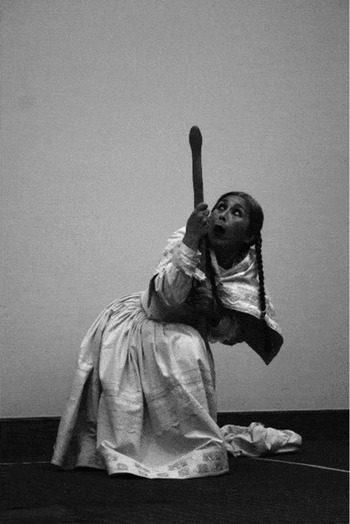
Gestural language is likewise both accessible, in some ways, and exclusive, in others. Dance was the focus of the group showing titled ‘Choreographing Identities’ – four solo dances curated by Susan Leigh Foster around the notion of identity. These soloists used vocabularies of popular, ‘modern’ and contemporary dance traditions familiar in the US to corporealize issues of African American and Jewish American ethnic identities, sexuality and perception (see Sara Wolf's contribution to the performance dossier). Dance was an integral part of other pieces, such as Indonesian dance by Sri Susilowati, and the ghostly dance by Ana Correa as Rosa Cuchillo, searching the afterlife for her dead son. While some of the solo dancers did speak, others created meaning in silent complex choreographies of gesture. Susilowati situated her traditional vocabulary within stories of diasporic loss. Ana Correa dramatically severed storytelling from dance. Spoken language, in Rosa Cuchillo, serves to relate the events and bring charges in the world of the living. Her son has been taken by the armed forces, she says, as she moves through crowds asking if anyone has seen him. She is dressed all in white, from the many-layered skirt to her white hat that hides most of her braided black hair. Even her face is painted white. This piece, which normally begins as Ana makes her way through the open marketplaces in Peru holding a walking stick, invites the accidental audiences to accompany her on her search. The extraordinary whirls of movement, in which the swishing skirts take on a life of their own, transport her through the netherworld populated by the seventy thousand men and women disappeared during the 1980s and 1990s in Peru. While her audience may not understand the specifics of the ‘dirty war’ in Peru, they cannot fail to be moved by the exquisite intensity of her gestures as she makes her way forward on her journey.
Ana Correa as Rosa Cuchillo (photograph courtesy of the UCLA Center for Performance Studies).

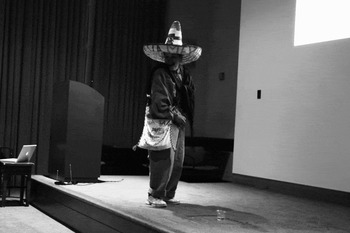
Jesusa Rodríguez's performance of Soldadera Autógena (photograph courtesy of the UCLA Center for Performance Studies).

Musical styles, singing and instrumentalization were also both familiar and a form of intervention, exemplified by the cabaret and political performance artist couple Jesusa Rodríguez and Liliana Felipe. Much of the wit of Jesusa Rodríguez's performance of Soldadera Autógena is a send-up of a well-known revolutionary corrido (a Mexican ballad form) that deconstructs its masculinist ethos. Beginning dressed as a man, she strips, revealing women's clothes beneath, singing of the revolutionary idea of androgyny. Liliana Felipe's witty, satirical, political songs often use Argentinian tropes from the tango that ironize both the emotions and topics generally associated with that form and unmake the sometimes martial tradition of political songs.
The UCLA event also made clear that the performances activated commitments and desires of several different kinds. Luisa Calcumil, for example, sees performance as a means of telling her stories from the Mapuche people in Patagonia (see Marcela Fuentes in the performance dossier). Using Spanish, Mapudungun (the Mapuche language), song, acting, masks, painted signs and other expressive features, she performs an aesthetically beautiful play about the internal migration and assimilation of the Mapuche due to rapacious economic policies that deny communities their lands and livelihood. After the performance, she thanks the group and says she now has more stories to tell her people back home. Trading these stories, for her, functions as a form of transferring knowledge – we all know a little more through this exchange. In a way, Calcumil's position resembles that of anthropologist Victor Turner: ‘We will know one another better by entering one another's performances and learning their grammars and vocabularies.’Footnote 5 But there is a politics of that knowing that differs among groups. Calcumil does not see performance as a window into someone else's culture – she needs people to understand the plight of the Mapuche to help stop the continuing disenfranchisement. She needs to learn other strategies to take home. Her position as a viewing, speaking, performance subject makes her far more than an interesting performer for others. Her project is about reciprocity and communication – not the reigning values of anthropology in the 1960s and 1970s. Other performers were more interested in their own communities than in exchange. While understanding that they may bring back some performance/activist strategies from these actions of transfer, they see their engagement and activism as taking place elsewhere. FOMMA, for example, travel throughout the Mayan highlands to offer free workshops and performances to isolated communities. In Los Angeles, however, they might see themselves as invited artists and award-winning playwrights who perform their work for viewers rather than as participants in a collaborative project that they might not recognize as their own. Their idea of taking something back to their communities might mean selling the embroidered handmade blouses and small items made by their compañeras who desperately need the money.
As previously stated, Calcumil does not view the performances of others as a window into their cultures as anthropologists did in the 1960s and 1970s, but rather regards their performances as a storehouse of strategies to stage the plight of the Mapuche people. Insofar as Calcumil can share strategies with others, she understands performance as engaging in a network of reciprocal relations – a perspective that in turn inspired us to interrogate the very form of a conference/festival. Perhaps this form derives from the anthropological notion of opening windows onto other cultures by bringing representative works together? However, we tried to avoid that presumption by situating performances and scholarly papers in the same room, with an interweaving of performance/interview/panel. One effect of this mixing was that performances could be perceived as social critiques and papers could be viewed as performances. The notion of ‘opening windows’ depends on the functional division between performance as an unmediated and authentic glimpse into a people's culture and the critical interrogation of that performance – particularly when interested critiques such as feminist and queer ones are brought to bear on the event.
Issues of gender and queer sexualities – so often regarded as side or special issues within the critiques of colonial, or national and transnational, processes – also became central to our event. (For a full exploration of these issues, see Leo Cabranes-Grant's article on gender, sexuality and ritual in Cuba.) We wanted to bring the queer critical discourse into the ‘actions of transfer’ to correct this elision, which often leaves in place dominant assumptions of naturalized gender codes, and the codes of heteronormativy. Whereas issues of rape and sexual abuse accompany colonial practices and sexist ones, practices often addressed in performances and papers about colonial and national processes, representing queer sexualities is often perceived as too risky or too marginal for those in the communities to represent. For example, the FOMMA women were ‘accused’ of being lesbians by members of their community, as a way to exorcize their critique. When this issue came up in the context of queer sexualities, it lost some of its power to exclude and even helped to form a potential alliance between these Mayan women and lesbian activists in Los Angeles.
Queer sexualities bring an iconography, linguistic vocabulary, gestural system and ethnographic history that can help to recognize and redefine modes of association within and across social groupings. During the queer round-table discussion at the conference, Jesusa Rodríguez offered a humorous genealogy of the Mexican term for lesbian, una tortillera. Reporting that she and her partner, Liliana Felipe, had performed ‘research’ on this topic, Jesusa ironized the academic component to these studies. Part of their research, she reported, was that they had tried to have sex in the same way that people make tortillas, to see if that was the origin of the word, and here she patted her hands together; she regretted that it had not worked. Adelina Anthony was in the audience, a Chicana from Los Angeles whose show Mastering Sex and Tortillas also plays on this term. Adelina's show, however, along with that of the Butchlalis, was organized by the notions of ‘butch’ and ‘femme’ – a distinction Jesusa found both helpful and perplexing. In contrast to butch and femme dichotomies, Jesusa had performed Soldadera Autógena, suggesting that the radical future would be one of androgynous identification. The difference between gendered role-playing and androgyny led, ultimately, to a lengthy discussion of how lesbians organized their systems of self-presentation in Mexico, in Latina Los Angeles, and among ‘white’ performers, such as Split Britches. More broadly, these issues led to discussions of strategies of queering gender roles in performance and how they are or are not political interventions.
That evening, the wittily named Butchlalis de Panochtitlan (a play on Tenochtitlán, the Aztec capital now known as Mexico City, and panocha, a humorous and vulgar term for female genitalia) performed The Barber of East L.A., directed by the nationally known gay Latino playwright Luis Alfaro. The Barber tells the story of a butch woman in the Latina/o neighborhood who finally is able to open her own small business – a barbershop. Each of the members of the troupe offers a hyperbolic portrait of a Latina butch from the 1940s and 1950s, campily representing the queer iconography of the period, with wigs and costumes.
Overall, the queer perspective added a playful, sex-positive dimension to the representations of sexuality. In other performances, such as Luisa Calcumil's, a woman's sexuality was portrayed as a commodified role taken on by poor indigenous women who came to the city looking for work. FOMMA's performance portrayed a woman whose sexuality was both repressed and abused by the offices of the Catholic Church. However, FOMMA does employ cross-gender roles in which the women always play the male roles, although their non-ironic drag (if drag can ever be non-ironic) critiques men rather than the normative performances of gender and sexuality. One participant, Carla Melo, wandered through several events dressed as Carmen Miranda to reveal the hyper-exotification of a Brazilian actress by the movie industry. In contrast to these performances of sex and gender as repressed or commodified, the deep irony and camp playfulness of queer performances can rejuvenate the sense of pleasure and agency in sexual relations. And, in the context of more repressed communities, the ‘out’ status of these performers and academics can help to create new possibilities of ‘transfer’ in which queer people may work as activists alongside ‘straights’. Finally, the inclusion of queer work in a conference about the Americas keeps the juridical and social status of gender and sexual codes integral to the consideration of colonial and transnational processes.
Much of the energy of the conference was produced by the sense of the ‘live’, facilitating the participation of performers and scholars in the space. Yet we were aware of the powerful function and intervention that new technologies have made in terms of organizing a virtual sense of the hemispheric as well as making drastic incursions into local practices. New technologies are commonly regarded as globalizing and universalizing instruments, highly capitalized in their production and creating a class of the virtual elite in their usage. Nevertheless, members of indigenous and migrant communities throughout Latin America rely on cellphones and video to keep them connected to family members who have moved to urban centres, or even to other countries, in search of jobs. Interestingly, these communities move ubiquitously between embodied and digital forms of transmission bypassing writing altogether. While some of the artists featured in the event make art with the cheapest and fewest elements, technology is now fully incorporated into their daily lives. Activist-based projects, such as some included here, reflect the counterintuitive fact that people from very marginal communities rely utterly on digital technologies.
Key in this regard is the work of Actions of Transfer participant Ricardo Dominguez. An academic and long-time techno activist, Dominguez is the cofounder of the art-cum-activist organization known as the Electronic Disturbance Theater (EDT). In the late 1990s, the EDT set up a participatory website-jamming network called the FloodNet system, which allowed anyone with an Internet connection to bring down the official sites of the US Border Patrol, the White House, the G8, the Mexican embassy, and others by flooding the websites. In 1998, the group developed Virtual-Sit-In technologies in solidarity with the Zapatista communities in Chiapas. Dominguez regards such interventions as performances of the Electronic Disturbance Theater. At the conference, Dominguez gave a presentation/demonstration of his ‘Transborder Immigrant Tool’, a GPS cellphone designed with special software to help migrants more safely find their way across the Mexico–US border. The distribution of free, easy-to-use specially designed cellphones allows immigrants to trace safe routes, and to find shelter, food, water and friendly sympathizers along their way. Dominguez presented a live/tech activist intervention that enhanced the use of locative media by the poor and the undocumented. His work amplified the notion behind the conference of bringing together performances across borders.
The role of technology in allowing performances to cross borders, in ways that human beings currently cannot, offers a major and innovative way to think about hemispheric practice. Digital artists and practitioners are experimenting with all sorts of formats that go beyond the individual use of cellphones to engage entire groups and communities. The Hemispheric Institute's Digital Video Library (HIDVL) has made six hundred hours of streaming video of performance in the Americas freely available online. People around the world can view local performances throughout the Americas on this website, producing a new sense of contact and transfer. For Actions of Transfer, Adriene Jenik and Charley Ten designed Open_borders: Improvisation Across Networks, Distance, Timezones, using new technologies to achieve something that political will has made unimaginable. Jenik, Dean of the School of Art at Arizona State University, has a long history of populist uses of technology, from the early collective Paper Tiger Television to her multiyear project with Lisa Brenneis called Desktop Theatre, which intervened on websites using avatars to represent issues such as ethnic stereotypes, genetically altered crops, womens’ self-representation online, and so on. Open_borders sent out a call on several listservs that invited ‘performers, writers and engaged world citizens’ to participate via web-based video conference tools in a networked performance event. Participants contributed short, live, direct-address performances to a multilingual audience of academics, artists, performers and conference attendees. Live performances were mixed and processed with additional imagery and sound to enhance meaning and intensify aesthetic impact. The final output was then projected and amplified throughout the reception site. The idea was to ‘hack’ into the conference reception/lounge from somewhere ‘else’ entirely. After days of lining up the performers and the specific times, Jenik and Tan brought in performances in real time from such places as Buenos Aires, Tijuana and New York, filling the walls of the room with projections of their performances, and mixing them with performances and improvisations taking place in the room. Some performances were simply done before computer cameras in the individual performers’ bedroom or living room. Moreover, an interface was connected where people in the two sites could directly interact. People at the conference could talk with the other women from FOMMA, and other members of the group Yuyachkani, in Peru, appeared.
Nonetheless, this seeming freeplay was dependent upon software, hardware, sufficiently powered spaces and expert labour. While Jenik and Dominguez are both well known for their years of putting technology to populist uses, the fact remains that the technology itself is still dependent on subvention by highly capitalized institutions, as FOMMA discovered, when the donated lighting and lightboards of their space could not be supported by the electrical input into the building, or even the electrical input to large parts of their town. While most people in the Americas now have access to some forms of technology, this staging made evident how the ‘digital divide’ is playing itself out somewhat differently than expected. The divide is not so much a contrast between the haves and have-nots as it is about the potential for elaborating and maintaining projects of scale.
Considerations of space and support brought us back to the realization that all of this was happening on a campus and, though publicly owned land, it was still an elite space. This consideration led us to take our final performance downtown, where it could be seen by the larger community. Thus we staged Jesusa Rodríguez's Maiz (see Chantal Rodriguez in the performance dossier) at the Los Angeles Theater Center, a multiplex of performance spaces that attracts an audience composed of the diverse communities in Los Angeles. LATC often stages works in Spanish from Mexico and Latin America for the large Spanish-speaking population. Maiz begins with a ritual-like evocation of the important place that corn has occupied in the Mexican social imaginary. It evokes imagery from precolonial Mexican traditions. Part two is an improvised, cabaret-like take on the politics of corn and the transnational, basically US, incursions into the native crops by genetically altered seeds. A great part of the humour of the piece was directed at what Jesusa assumed would be an audience from Gringolandia, who did not understand Spanish. However, her interview on the television station Telemundo, which reaches Spanish-speaking audiences across the US had produced a sold-out house of Spanish-speaking audience members. Jesusa's surprise was part of our hope for the conference. The live and media together produced a performance that became available to immigrants, to diverse people across geographic and linguistic divides that shared common interests that they did not know they had.
This special issue of TRI, we hope, will reflect some of the same inquietudes, or troublings, posed by our sister hemispheric practice. While the Actions of Transfer event was a unique North–South Americas concept, the complex issues we encountered in our collaborative, multisited project probably hold true for all international encounters that aspire to real engagement. Academic traditions and restricted budgets make the monolingual conference format standard practice, regardless of the country in which the conference is held. Local participants are often included as informants to provide updates on the work being done in their community rather than as full partners in a meaning-making process. Our scholarly publications enact the same problem – translations are costly, so many of the essays included are written in English which, by definition, excludes a whole set of interlocutors and topics. Our academic journals rarely circulate beyond these linguistic borders. ‘Sister’ publication series that publish international work in various languages have not yet become the norm.
Many of us who work in international, multilingual settings address these perennial challenges in our own ways. Our ‘sister’ events in Chiapas and Los Angeles provide an example of one paradigm of transnational exchange, calling attention to (rather than minimizing) the stumbling blocks we all faced. Instead of coming together as experts working on our own specific topic, the dialogic and profoundly relational nature of the multi-sited project forced us to change the terms of engagement and the assumptions we brought to it. In short, Actions of Transfer was all about challenging the assumptions of the organizers, the participants and the audiences. But by reformulating our own assumptions we were able to ask different kinds of questions and allow for unexpected responses. The different kinds of questions posed by these encounters are taken up in this special TRI issue, with the hope that this will lead to new possibilities and paradigms for international performance research and practice.