Influenza is a major cause of morbidity and mortality in Canada, accounting for an estimated 12,000 hospitalizations and 3,500 deaths every year. 1 It also disproportionately affects vulnerable populations, with the elderly being affected most severely. 1 A proportion of elderly adults reside in long-term care facilities (LTCFs), which are particularly prone to outbreaks of influenza.
Long-term care facilities are generally defined as institutions that care for residents who are unable to take care of themselves; residents are typically over the age of 65 years.Reference Jefferson, Di Pietrantonj, Al-Ansary, Ferroni, Thorning and Thomas 2 An outbreak is defined as an increased incidence of a disease compared to the background rate.Reference Last 3 Outbreaks contribute to the significant morbidity and mortality attributed to influenza; many of the residents in LTCFs have multiple chronic conditions. 4 – Reference Peters, Gravenstein and Norwood 8 Influenza is also known to exacerbate chronic medical conditions, specifically cardiac or pulmonary disorders, cancer, other immune compromising conditions, kidney disease, anemia or hemoglobinopathy, diabetes or other metabolic conditions, conditions that compromise the management of respiratory secretions, and morbid obesity. 1
In Manitoba, if an influenza outbreak is detected in an LTCF, the standard protocol is that all symptomatic residents receive 5 days of oral oseltamivir at the therapeutic dose and all other residents receive 10 days of oseltamivir chemoprophylaxis at the prophylactic dose. 9 This approach is described in many studies, is used in other countries, and is similar to the recommendations of the Infectious Diseases Society of America (IDSA).Reference Booy, Lindley and Dwyer 5 , Reference Gorisek Miksic, Ursic and Simonovic 7 , 9 – Reference van der Sande, Meijer and Sen-Kerpiclik 12
In the 2014–2015 influenza season, Manitoba administered more than 50,000 doses of oseltamivir for LTCF outbreak chemoprophylaxis 13 at $5·72 per dose.Reference Estevez 14 This one-season total of almost $300,000 does not include associated costs, such as nursing time, nor doses prescribed in the community or hospital settings. However, the use of prophylactic oseltamivir in the setting of LTCF outbreaks may not be warranted because the studies that the IDSA relied upon to make the recommendation for their use,Reference Bowles, Lee and Simor 6 , Reference Peters, Gravenstein and Norwood 8 , Reference Hayden, Belshe and Villanueva 11 , Reference Monto, Rotthoff and Teich 15 – Reference Welliver, Monto and Carewicz 17 and those published since the IDSA recommendation,Reference Booy, Lindley and Dwyer 5 , Reference Gorisek Miksic, Ursic and Simonovic 7 , Reference van der Sande, Meijer and Sen-Kerpiclik 12 , Reference Millership and Cummins 18 , Reference Ye, Jacobs and Khan 19 have significant limitations, with low-quality evidence and mixed results.
To better understand whether there is utility in following the portion of the IDSA guideline relating to oseltamivir use in LTCF outbreaks, we examined the effect of the timing of administration of oseltamivir chemoprophylaxis for the control of influenza A H3N2 outbreaks among residents in LTC facilities in Manitoba, Canada, after controlling for other institutional factors.
Methods
A retrospective cohort design was used with 4 data sources: (1) epidemic curves, (2) hand hygiene audits, (3) lists of private and public LTC facilities in each studied region, and (4) Statistics Canada census data.
In Manitoba, all LTCFs monitor influenza-like illness (ILI). Influenza-like illness is characterized as acute onset of respiratory illness with fever and cough and with 1 or more of the following symptoms: sore throat, arthralgia, myalgia, or prostration that could be due to influenza. 9 An institutional influenza outbreak is defined as “2 or more cases of ILI (including at least 1 laboratory-confirmed case) occurring within a 7-day period in an institution.” 9 If an institutional ILI outbreak is suspected, nasopharyngeal swabs are conducted on a sampling of up to 6 ill residents or staff to identify the causative pathogen.
Staff also keep records of daily case counts and symptoms present during outbreaks to monitor their development and resolution. Once no new cases have occurred for 2 incubation periods of influenza, up to 8 days, 1 the outbreak can be declared over.
Outbreaks were included (1) if they occurred between October 2014 and May 2015, (2) if they occurred in an LTCF in Manitoba, and (3) if influenza type was determined. Only the first influenza A H3N2 outbreak in an institution was included in the analysis because a prior outbreak during the same influenza season with the same virus may significantly alter the immunity of the residents to that strain of influenza and thus alter the attack rate of the virus and, thus, the subsequent likelihood of symptomatic infections.
Outbreaks were excluded if either the dependent variable or main independent variable could not be determined.
The University of Manitoba Human Research Ethics Board approved this study.
The main independent variable was how many days passed between the true start of the outbreak (ie, the date that the second person became ill) and commencement of oseltamivir chemoprophylaxis. The dependent variable was whether each person in the institution developed ILI (yes or no). The following control variables were used:
1. The number of days between declaring an outbreak and the start of oseltamivir chemoprophylaxis
2. The number of days between the first and second cases of ILI
3. The prevalence of symptomatic infection among residents at the start of the outbreak
4. The prevalence of symptomatic infection among staff at the start of the outbreak
5. The number of at-risk residents at the start of the outbreak
6. The percentage of residents vaccinated
7. The percentage of staff vaccinated
8. Rural (yes or no)
9. Publicly operated facility (yes or no)
10. Percent compliance during hand hygiene audit.
Rural was defined as 10,000 people or less. Population size was determined using Canadian Census data from 2011. 20 The hand hygiene audit conducted closest to the study period was used to determine percent hand hygiene compliance.
Data analysis
For each outbreak, the secondary attack rate is calculated with the following equationReference Gregg 21 :
 $$\eqalign {&2^{0} \,attack\,rate \cr & \quad {\equals}{{\left( {Total\,\,\#\,\,cases{\minus}\,\#\, Cases\ on\ or\ before\ day\ of\ 2nd\ case\ of\ illness} \right)} \over {(Total\,\,\#\, \,residents{\minus}\,\#\, Cases\ on\ or\ before\ day\ of\ 2nd\ case\ of\ illness)}}$$
The number of days until oseltamivir prophylaxis was started was calculated by determining the date of chemoprophylaxis and subtracting the date of the second case of ILI.
The data were analyzed at the individual level (level 1) and institutional level (level 2) using a hierarchical (also known as multilevel) logistic regression model with Laplace maximum likelihood approximation. This analysis was conducted using the following stepwise approach.
1. An empty model was used to determine the variation within institutions and between institutions (ie, intraclass correlation or ICC).
2. The 11 independent variables listed above were included in the model as level 2 variables and were individually modeled with the outcome variable.
3. The independent variables were added in a stepwise forward modelling strategy to determine the best multivariable main-effects model, including both statistically and clinically significant variables.
4. The continuous variables were assessed for linearity to determine whether any variable transformations were needed.
5. Model variables were assessed for a collinearity problem.
6. The final main-effects model was extended by adding any significant interactions between the time to oseltamivir prophylaxis and other main-effects model variables.
All analyses were 2-tailed and were conducted at an α of 0·05. The power was >99%.
Results
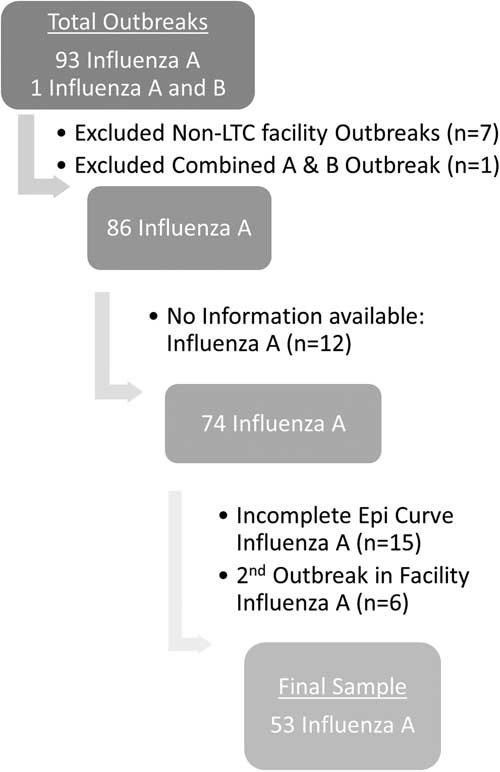
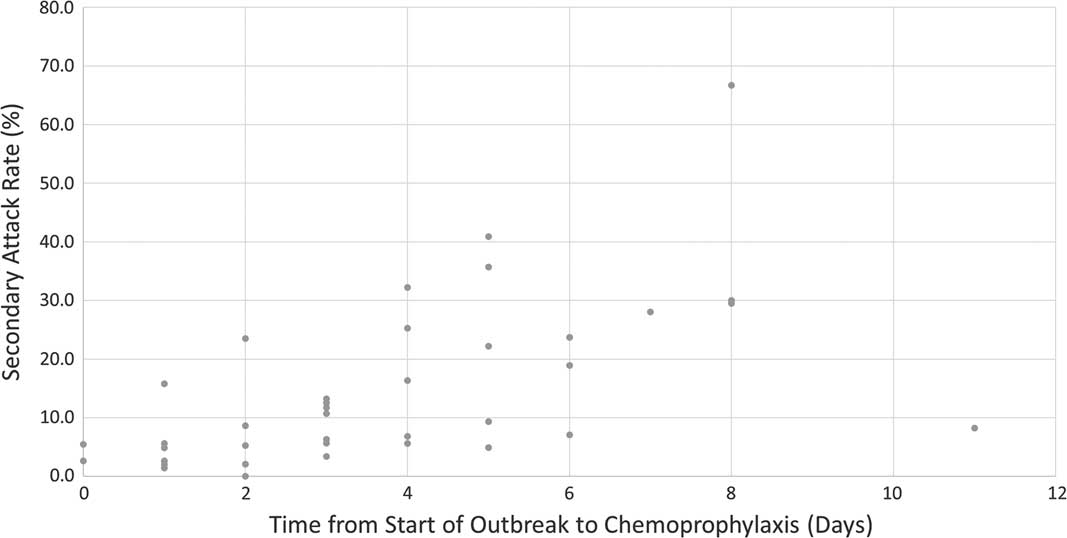
We identified 94 influenza A H3N2 outbreaks in LTC facilities during the 2014–2015 influenza season. After applying the exclusion criteria, 53 influenza outbreaks remained for analysis (Fig. 1). The summary of the characteristics of those 53 influenza outbreaks can be seen in Table 1. In total, there were 5,258 residents in the 53 facilities. A plot of the secondary attack rate versus time from the start of the outbreak to initiation of chemoprophylaxis can be seen in Fig. 2.
Outbreaks included and excluded from analysis.

Outbreak secondary attack rate versus time for influenza A H3N2 outbreaks.

Summary of Influenza A H3N2 Outbreak Characteristics

NOTE. n, number of facilities with available information; ILI, influenza-like illness.
a Primary cases are defined as cases of ILI occurring on or before the day that the second case occurred; and Secondary cases are defined as all cases of ILI occurring after the primary cases.
b ILI is characterized as acute onset of respiratory illness with fever and cough and with 1 or more of the following: sore throat, arthralgia, myalgia, or prostration that could be due to influenza. 9
c At the start of the outbreak.
d Hand hygiene score in the facility during the 2014–2015 influenza season. If >1 audit occurred during this time, scores were averaged.
e Rural=a population less than 10,000 in the 2011 Health Canada Census (1=yes, 0=no).
f Facilities not directly operated by the Regional Health Authority (1=yes, 0=no).
Data analysis
The ICC was calculated by taking an empty model and dividing the between-group variance by the sum of the within-group variance plus the between-group variance. The ICC for these data was 27%. Therefore, the outcomes were significantly correlated with the institutions that the residents resided in and hierarchical logistic regression was needed to analyze these data.
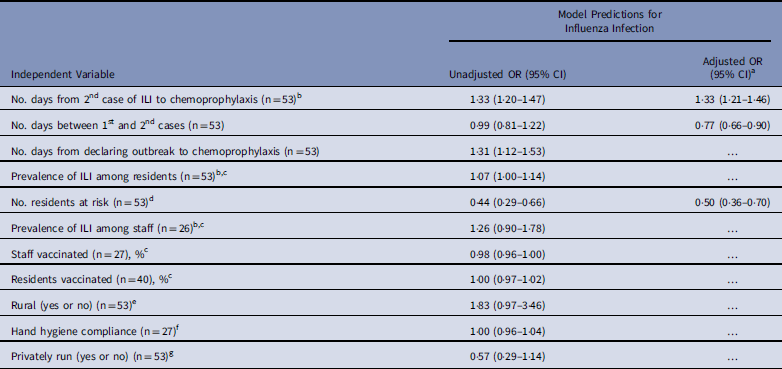
Using a univariate analysis, 5 of the 11 independent variables were statistically significant (Table 2): the number of days from the second case to starting oseltamivir (t=5·41; df=51; P<·0001), the number of days from declaring an outbreak to starting oseltamivir (t=3·48; df=51; P=·001), the prevalence of ILI among residents at the start of the outbreak (t=2·04; df=51; P=·047), the number of residents at risk at the start of the outbreak (t=4·02; df=51; P=·0002), and the staff vaccination rate at the start of the outbreak (t=2·09; df=25; P=·047).
Univariate and Final Model Predictor Odds Ratios for Influenza A H3N2 Infection

NOTE: n, number of facilities with available information; OR, odds ratio; ILI, influenza-like illness; LTCF, long-term care facility. Statistical test: hierarchical logistic regression.
a (…) indicates that this variable was not included in the final model.
b ILI is characterized as acute onset of respiratory illness with fever and cough and with 1 or more of the following: sore throat, arthralgia, myalgia, or prostration that could be due to influenza. 9
c At the start of the outbreak.
d At the start of the outbreak; OR represents change per 100 resident increase in an LTCF.
e Rural=a population less than 10,000 in the 2011 Health Canada census (1=Yes, 0=No).
f Hand hygiene score in the facility during the 2014–2015 influenza season. If >1 audit occurred during this time, scores were averaged.
g Facilities not directly operated by the Regional Health Authority (1=yes, 0=no).
Using a stepwise forward modeling strategy, where initial criteria for being included in the model was having a P value<·15 and removal from the model with a P value>·20, only 3 variables were found to be statistically significant (Table 2): the number of days from the second case to starting oseltamivir (t=6·04; df=49; P<·0001), the number of days from the first case to the second case (t=3·35; df=49; P=·002), and the number of residents at risk at the start of the outbreak (t=4·22; df=49; P=·0001).
The inclusion of the prevalence of ILI in the model did not change the odds ratios (ORs) of the 3 statistically significant independent variables. In addition, no other control variables significantly affected the model because the timing of oseltamivir chemoprophylaxis remained statistically significant (P values ranging from ·002 to <·0001) in all other 4 variable models with an OR ranging from 1·27 to 1·37 in these models. Therefore, the final main effects model includes the 3 statistically significant variables.
The main effects model was assessed for collinearity. The variance inflation factor was well below 10, so there was no concern about collinearity (Table 3).
Assessment of Independent Variable Collinearity

NOTE. Statistical test: linear regression.
The main effects model was checked for any statistically significant interactions among the independent variables and the dependent variable. No statistically significant interactions were detected. Therefore, the final model for the influenza A H3N2 analysis was the same as the main-effects model.
The OR for the number of days from the second case to the start of oseltamivir in the final model was 1·33 (95% confidence interval [CI], 1·21–1·46). Thus, for every day that passes from the second case to the initiation of oseltamivir, the odds of a resident at risk of infection in the facility developing ILI increased by 33%.
Discussion
These data indicate that the sooner oseltamivir chemoprophylaxis is initiated, the lower the odds of secondary infection with influenza in LTCFs during outbreaks caused by influenza A H3N2 in Manitoba. The data also indicate that the number of residents in a facility and the number of days from the first case to the second case are negatively associated with the odds of secondary infection in LTCFs with influenza A H3N2 outbreaks. In the study preceding this one, these associations were not statistically significant in the adjusted model, but we observed a trend toward significance.Reference Singh, Robinson and Hilderman 22 The results of these 2 variables may have become statistically significant because of the increased power of the current study.Reference Singh, Robinson and Hilderman 22 The timing of oseltamivir chemoprophylaxis was statistically significant in both studies.Reference Singh, Robinson and Hilderman 22
This study provides strong evidence supporting the rapid detection of influenza A H3N2 outbreaks and the rapid administration of oseltamivir chemoprophylaxis in a LTC resident population. Delays in this process can occur at many key points, including collection of nasopharyngeal specimens, transport of specimens to the laboratory, identification of viruses present, communication of results, making the decision to administer oseltamivir chemoprophylaxis, and the actual administration of oseltamivir.
Strengths and limitations
This study has several strengths. First, this is the largest study examining the effect of the timing of oseltamivir chemoprophylaxis in influenza A H3N2 outbreaks in LTC facilities to date, and we employed a common provincial approach to oseltamivir prophylaxis. Second, we examined the secondary attack rate, which is a much more accurate approach to examine the impact of oseltamivir chemoprophylaxis than total attack rate. Third, vaccination rates were not a significant confounder for infection in the 2014–2015 influenza season for influenza A H3N2 because of lack of effectiveness of the vaccine for that strain of circulating virus.Reference Gilca, Skowronski and Douville-Fradet 23 Fourth, oseltamivir resistance is likely not a confounder because none of the 73 influenza A H3N2 samples tested in Manitoba for oseltamivir resistance were positive. 13 In addition, only 1 of the 913 influenza A H3N2 samples tested in Canada for oseltamivir resistance was positive. 13 Fifth, some discrepancies between LTCFs are controlled for by including hand hygiene audits, staff vaccination rates, public versus private operation, and time between declaring an outbreak and the start of chemoprophylaxis. After an outbreak is declared, chemoprophylaxis of its residents should occur immediately. When this is not the case, a difference in the operations and preparedness of these facilities may be indicated. Sixth, several other potentially significant variables are included in the analysis. Finally, a hierarchical model was used, accounting for both the number of outbreaks and the size of the facilities involved.
This study also has several limitations. First, not all cases of ILI received a nasopharyngeal swab. Therefore, some cases of ILI that developed during the outbreaks may have been caused by other respiratory viruses. However, this lack of specificity likely affected all institutions equally at random, so only the magnitude of the result should be affected not the presence of an effect. Second, although this study attempts to control for some of the discrepancy between how various facilities operate, some of these differences may not be accounted for by the control variables and may confound the results in an unpredictable way. Third, the analysis does not control for individual factors, such as age, comorbidities, smoking status, or mobility, among the various LTCF residents. Therefore, differences such as the number and types of comorbidities and other demographic differences could theoretically be present and could affect the results. Fourth, this study does not examine hospitalization or mortality. However, these variables are less sensitive measures of effectiveness and the decision to hospitalize a patient can be very subjective. Fifth, many outbreaks were missing data to the extent that they could not be included in the analysis (27 influenza A H3N2 outbreaks of 94 total). If these facilities were significantly different in character from those with sufficient information for analysis, the results may not be as generalizable. However, given the variation in institutional characteristics present in the 53 institutions in the analysis, these results are likely widely applicable to LTCFs.
Generalizability of findings
The findings presented should be applicable across North America and Europe. All of these areas have similar LTC resident populations, infection control precautions, and institutional standards,Reference Smith, Bennett and Bradley 24 , 25 and they all use oseltamivir for chemoprophylaxis in influenza outbreaks.Reference Bowles, Lee and Simor 6 , 9 , Reference Harper, Bradley and Englund 10 , Reference van der Sande, Ruijs, Meijer, Cools and van der Plas 16 , Reference Ye, Jacobs and Khan 19
Future research
Future research regarding the effect of the timing of oseltamivir chemoprophylaxis in LTCFs should be targeted at influenza B and influenza A H1N1, as these have not yet been studied in a rigorous way. Due to the relatively large amount of missing data common to many retrospective cohort studies, a prospective study may be more beneficial. However, the advantages of a prospective study will need to be weighed against the need for increased time and resources. Eventually, separate strategies regarding chemoprophylaxis may be employed based on the circulating type or subtype of influenza in the community. Other outcomes, such as hospitalization and mortality, could also be examined. This would be valuable since these are the outcomes that infection prevention and control programs are ultimately striving to prevent.
Acknowledgments
The authors thank the Regional Health Authority Ethics Review Boards and Infection Prevention and Control Coordinators from the Winnipeg Regional Health Authority (WRHA), Interlake-Eastern Regional Health Authority (IERHA), Northern Regional Health Authority (NRHA), Prairie Mountain Health (PMH), and Southern Health – Santé Sud (SH) for their assistance in accessing the necessary data and for their helpful collaboration. No drug manufacturers had any involvement, direct or indirect, with any portion of the planning or production of this manuscript.
Financial support
No financial support was provided relevant to this article.
Conflicts of interest
All authors report no conflicts of interest relevant to this article.