There is ample evidence endorsing the robust relationship between phonemic awareness and the acquisition of basic reading skills in an alphabetic orthography (for reviews, see Adams, 1990; Byrne, 1996; Goswami & Bryant, 1990; National Reading Panel, 2000; Share, 1995; Stanovich, 1992; Wagner & Torgesen, 1987). Nonetheless, there has recently been growing concern over the convergent validity of phoneme awareness tasks and the nature of the underlying construct that is tested. This endeavor has established the role of several cognitive and linguistic factors in explaining individual variations in phoneme awareness task performance (McBride-Chang, 1995; Schreuder & van Bon, 1989; Stahl & Murray, 1994; Stanovich, Cunningham, & Cramer, 1984; Stuart, 2005; Yopp, 1988). Two factors attracted most of the empirical research in this area: phoneme identity and linguistic context.
The effect of phoneme identity on the accessibility of phonemes in phoneme awareness tasks has been addressed by testing children's awareness for phonemes that varied in their phonological profile. Two phonological features received particular attention: sonority and manner of articulation. It was reasoned that sonorant consonants, which are produced with a relatively open vocal tract, such as glides (e.g., /j/, /w/), liquids (e.g., /l/, /r/), and nasals (e.g., /m/, /n/), would be more accessible to children than nonsonorant consonants, because they are acoustically louder and perceptually more prominent. Similarly, it was predicted that fricatives, like/s/ or /∫/, would be easier for children to operate on, because their articulation is accompanied by noise caused by friction in the oral cavity (Akmajian, Demers, Framer, & Harnish, 1995), and because they can be extended in time and produced in isolation. Psycholinguistic evidence obtained from children and adults has largely supported these predictions and endorsed a concept-based view of phoneme awareness (Byrne & Fielding-Barnsley, 1990; Content, Kolinsky, Morais, & Bertelson, 1986; DeWeirdt, 1988; McBride-Chang, 1995; Reed, 1989; Stahl & Murray, 1994; Tallal, 1980; Treiman & Baron, 1981; Werker & Tees, 1987; Wolters & van den Broek, 2004). According to this view, phoneme awareness is not merely a mechanical operation. Rather, it is concept based and is affected by the identity or the phonological profile of the target phoneme on which candidates are required to operate (Byrne & Fielding-Barnsley, 1989, 1990, 1993; Elbro, 1996, 1998; Goswami, 2000; Swan & Goswami, 1997).
Research on the role of structural factors in phoneme sensitivity has been guided by the rime-cohesion hypothesis. According to this hypothesis, syllables are composed of phonemes structured hierarchically into two constituents: the onset; the initial consonant(s); and the rime, the nucleus vowel with the coda of any following consonant(s) (Fudge, 1969; Goldsmith, 1990). The linguistic cohesiveness of the rime (vowel–consonant [VC]) has acquired distributional evidence in English, with studies showing particularly close statistical dependencies between these units (Booij, 1983; De Cara & Goswami, 2002; Fudge, 1969, 1987; Goswami & De Cara, 2000; Luce & Pisoni, 1998; Treiman & Kessler, 1995; Treiman, Mullennix, Bijeljac-Babic, & Richmond-Welty, 1995). Similarly, psycholinguistic evidence has shown that children and adults have a tendency to break syllables at the boundary between the onset and the rime (Goswami, 1986, 1988, 1992, 1998; Treiman, 1983, 1985, 1988). Finally, English speakers were found to have greater difficulty segmenting rime–coda phonemes than onset phonemes, and cluster phonemes than singleton phonemes (Bruck & Treiman, 1990; Goswami, 1986, 1988, 1991, 1992, 1998; McBride-Chang, 1995; Stahl & Murray, 1994; Treiman, 1983, 1985, 1988; Treiman & Baron, 1981; Treiman & Danis, 1988; Treiman & Kessler, 1995; Treiman et al., 1995; Treiman & Weatherson, 1992; Treiman & Zukowsky, 1991).
Despite extensive endorsement, notably from English, recent evidence has begun to cast doubt on the psychological reality of the onset–rime structure (Booth & Perfetti, 2002; Duncan, Seymour, & Hill, 1997; Geudens & Sandra, 2003; Guedens, Sandra, & den Broeck, 2004; Guedens, Sandra, Martensen, & Nation, 2004; Goswami & East, 2000; Lewkowicz & Low, 1979; Uhry & Ehri, 1999). For example, Geudens and colleagues tested children's explicit and implicit segmentation of two-phoneme syllables in English and Dutch and did not find support for the view that children treated onsets and rimes as cohesive constituents. In light of these findings, it was argued that phonetic factors, such as sonority and acoustic salience, may offer a better explanation of cohesion among phonemes.
LINGUISTIC FACTORS IN THE ACQUISITION OF PHONOLOGICAL AWARENESS IN ARABIC
The most important feature of diglossia, and one that has direct implications for the acquisition of literacy skills, is the establishment of rigid and complementary functional separation of two linguistic codes: the written and the spoken (Ferguson, 1959). According to Hymes (1980), the dominant practical response to linguistic diversity is “to impose a novel unity in the form of the hegemony of one language or standard” (p. 22). The standardization of Arabic, which began in the 8th and 9th centuries AD has produced a set of norms that the early grammarians called fusha /fusha/ (Maamouri, 1998). Over the course of many years, the continued use of this favored set of written linguistic norms led to substantial differences between the dynamic Spoken Arabic Vernaculars (SAV) and the fixed written form, making the two varieties linguistically distant. The term fusha is currently used to refer to Classical Arabic (the language of the Qur'an), as well as to a modern descendant of classical Arabic, Modern Standard Arabic (MSA), which serves as the modern written standard and the language used in formal oral discourse.
Another unique feature of diglossia that has direct ramifications for literacy development in Arabic-speaking children is the process of acquisition (Ferguson, 1959). Although all Arab children naturally acquire the local spoken vernacular of the speech community to which they belong, learning the written standard, MSA, comes about mainly as a result of formal instruction in reading. Thus, fusha is nobody's mother tongue (Coulmas, 1987; Joseph, 1987). The fact that the functional distribution of codes in a diglossic context protects the role of the spoken vernacular as a natively learned variety is what distinguishes diglossia from other interlingual or intralingual situational alternation (Hudson, 2002).
Although all spoken vernaculars are linguistically (mainly phonologically and lexically) different from each other to the extent that they may become mutually unintelligible, all vernaculars are structurally related to MSA. Despite such linguistic relatedness, a comparison between any given spoken vernacular and MSA always reveals aspects of structural distance in all language domains, including phonological, morphosyntactic, and lexical–semantic (for a more detailed discussion, see Saiegh-Haddad, 2004). This linguistic distance implies that a given linguistic structure may be affiliated either with MSA or with SAV. In addition, some linguistic structures may be affiliated with both, although their distribution in the two codes may be different. For instance, although MSA and SAV share a large number of phonemes, no SAV has exactly the same set of phonemes as MSA (Maamouri, 1998); some MSA phonemes may not be available in a particular SAV. Alternatively, some SAVs may contain nonstandard phonemes. All this implies that some MSA phonemes, as well as other phonological, morphosyntactic, and lexical structures, may not be familiar to children upon the inception of reading in the first grade. This makes learning to read in Arabic a dual task in which children are required to acquire a linguistic system and an orthographic system simultaneously.
The effect of the diglossic context on the acquisition of basic literacy processes in Arabic has only recently begun to attract empirical attention. This research has primarily addressed the development of phonologically based literacy skills in Arabic. Saiegh-Haddad (2003) tested children's phonological sensitivity and pseudoword decoding accuracy for stimuli that incorporated SAV versus MSA phonological structures (phonemes and syllabic structures). It was hypothesized that because of enhanced exposure and practice with oral language phonemes, children would find SAV phonemes easier to access than MSA phonemes. Further, phonemes embedded within SAV syllables would be easier to access than those embedded within MSA syllables. Linguistic affiliation with SAV versus MSA was also predicted to affect the pseudoword decoding accuracy of children. Both hypotheses were confirmed. The results showed that, despite proper articulation, MSA phonemes were more difficult for both kindergarten and first-grade children to isolate than SAV phonemes. Moreover, MSA phonemes embedded within MSA syllables posed a further challenge to kindergarten children. The results also showed that despite high rates of pseudoword decoding accuracy, MSA phonemes and syllabic structures accounted for a large number of the decoding errors among children (Saiegh-Haddad, 2003). Awareness for standard phonemes was also found to be indirectly related to pseudoword reading fluency (accuracy and speed) in Arabic (Saiegh-Haddad, 2005).
Saiegh-Haddad (2004) tested the effect of the phonological and lexical distance between MSA and SAV on children's phonological awareness. The study investigated whether the lexical status of the word (SAV, MSA, or pseudo) affected children's ability to access SAV versus MSA phonemes. The results showed that, although MSA phonemes were more difficult to access than SAV phonemes, MSA phonemes embedded within MSA words were more difficult than those embedded within pseudowords. Although they provide clear counterevidence to the predictions of lexical restructuring models (Metsala & Walley, 1998; Walley, 1993; Walley, Metsala, & Garlock, 2003), these results were interpreted in terms of an unstable, fuzzy, and inaccurate phonological representation for MSA phonemes and MSA lexical items that, even in the presence of proper articulation, appears to interfere with phonological analysis. This interference was argued to result from an automatic activation of the dominant spoken representations for these standard structures.
Research on the acquisition of phonological skills in Arabic has also addressed the role of phoneme position (Saiegh-Haddad, 2003, 2004). These studies compared children's isolation of phonemes in initial and final positions in monosyllabic CVCC and disyllabic CVCVC words that differed in linguistic affiliation: MSA and SAV, respectively. Contrary to predictions of the rime–cohesion hypothesis, Arab preliterate kindergarteners and first-grade children were shown to have particular difficulty isolating initial phonemes versus final phonemes from both CVCVC and CVCC words. These results were used to argue that the onset–rime structure may not properly capture the phonological representation of syllables in Semitic Arabic, as they indicate a strong cohesion of the CV unit (Saiegh-Haddad, 2003, 2004). Convergent evidence has recently been reported for Semitic Hebrew as well (Saiegh-Haddad, in press; Share & Blum, 2005).
The available research pertinent to the acquisition of phonological awareness in Arabic has demonstrated the impact of two linguistic factors on children's ability to access phonemes in Arabic: phoneme's linguistic affiliation and phoneme position. Concerning the phoneme's linguistic affiliation, Arab children's phoneme awareness was predicted by the linguistic affiliation of the target phoneme, SAV versus MSA, with SAV phonemes easier to access than MSA phonemes (Saiegh-Haddad, 2003, 2004). However, despite such empirical endorsement, there is a need to replicate the above reported findings in a cross-dialectal research design that would allow an examination of the validity of a competing concept-based hypothesis. Namely, it is the phonological identity of the target phoneme, rather than its linguistic affiliation that is to blame for children's difficulty in isolating MSA phonemes. This phoneme identity-based hypothesis is particularly tenable given the fact that earlier research in this area has been conducted within a single dialect and in which three of the four critical MSA phonemes were phonetically similar and were all interdental fricative phonemes: voiced /ð/, voiceless /θ/, and emphatic /ð/. Because interdental fricatives are marked phonemes in comparison with other more common phonemes, such as stops and other fricatives (Eckman & Iverson, 1993; Major & Faudree, 1996), and because the three critical phonemes targeted shared the primary phonological features of place and manner of articulation, it is possible to argue that the difficulty that children had shown in accessing these phonemes had been the result of the phonological profile of these phonemes rather than their absence from the children's spoken vernacular. This is one of the questions that the present study addresses.
The present study compares the phoneme isolation performance of two groups of children speaking two different regional vernaculars. The first vernacular is the same local SAV that was targeted by previous research—a local form of Northern Palestinian Arabic spoken in the north of Israel (Saiegh-Haddad, 2003, 2004). This dialect will be referred to as the Northern SAV (N-SAV). The second vernacular is a local form of Central Palestinian Arabic spoken in a small village in the Triangle (Central SAV [C-SAV]). This spoken vernacular incorporates 27 out of the 28 MSA consonantal phonemes, including the four critical phonemes that do not occur in the Northern SAV. The performance of children from these two SAV backgrounds was compared. It was reasoned that if children in the two groups differed in their phonological sensitivity toward these four phonemes versus other phonemes, it would be reasonable to conclude that this was because of the availability of the phonemes in the SAV of children. However, if both groups revealed comparable sensitivity toward these phonemes, then the phoneme's identity hypothesis would be supported. Because formal exposure to MSA begins in the first grade, the study tested children in the first, second, and third grades. Within-grade comparisons were expected to help identify the point in the acquisition process when the impact of the phoneme's linguistic affiliation on phoneme awareness was reconciled.
In regard to the effect of phoneme position, earlier studies have demonstrated that final phonemes were more accessible in Arabic than initial phonemes, even when the former are embedded within consonantal cluster codas (Saiegh-Haddad, 2003, 2004). However, these studies compared CVCVC and CVCC words because they were concerned with comparing SAV and MSA syllabic structures. Hence, the two factors of phoneme position and linguistic context were amalgamated. To test the independent contribution of phoneme position (initial vs. final) and linguistic context (singleton vs. cluster), the present study examines children's phoneme isolation for phonemes embedded within simple as well as complex onsets and codas. Further, the current study tests whether there is an interaction between the above structural factors and the phoneme's linguistic affiliation on phoneme isolation performance. The following questions are addressed:
- What is the effect of the linguistic affiliation of the phoneme (MSA vs. SAV) on phoneme isolation?
- What is the effect of the position of the phoneme (initial vs. final) on phoneme isolation?
- What is the effect of the linguistic context in which the phoneme is embedded (singleton vs. cluster) on phoneme isolation?
METHOD
Participants
The initial sample of the study consisted of 211 children (53 first graders, 160 second graders) drawn randomly from three public schools in the northern school district and one public school from the central school district in Israel. A larger number of second graders were tested because first-grade teachers were less cooperative and more reluctant to allow children to participate in individualized sessions. In addition, we were keen on testing a larger number of children in the second grade because, although earlier research established the effect of the linguistic affiliation constraint among first-grade children, this is the first study to address the effect of this factor on the performance of children in the second grade.
The sample consisted of two groups of children speaking two regionally different vernaculars: N-SAV and C-SAV. The N-SAV group consisted of 159 children: 30 in the first grade (mean age = 83.23 months, SD = 3.48 and 129 in the second grade (mean age = 94.29 months, SD=4.83). The C-SAV group consisted of a total of 54 children: 23 in the first grade (mean age = 83.65 months, SD = 5.36) and 31 in the second grade (mean age = 94.25 months, SD = 4.36). More children speaking the N-SAV were tested than those speaking the C-SAV because, whereas the N-SAV dialect is more dominant and geographically more widespread, the C-SAV is a local dialect that is used by residents of a small village in the triangle. Given the prevalence of the N-SAV, we sought to obtain a large enough sample that will be representative of the native-speaking populations and tested children from three different geographical locations, and from three different public schools, one in each geographical location.
Because an initial analysis of the data showed that the effect of the linguistic affiliation factor was reliable in predicting the performance of second graders speaking the N-SAV dialect, an additional sample of 43 third graders speaking this dialect were tested (mean age = 107.65 months, SD = 5.96) to keep track of the effect of this factor at a higher grade level. As a result, the total sample of the study amounted to 256 children (136 males, 120 females).
Tasks and procedure
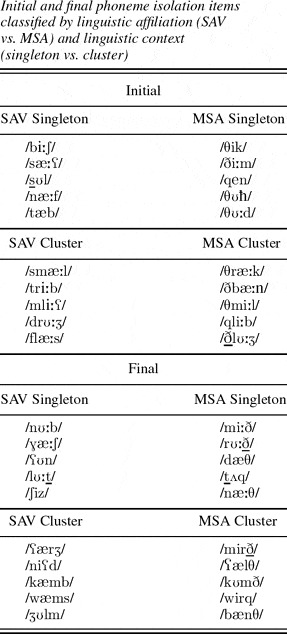
Two phoneme isolation tasks were orally administered to all children: initial phoneme isolation and final phoneme isolation. In both tasks, the stimuli consisted of monosyllabic pseudowords. Items in the initial phoneme isolation task were CVC and CCVC pseudowords. Items in the final phoneme isolation task were CVC and CVCC pseudowords. Two types of phonemes were evenly distributed between the initial and final positions of pseudowords. The first type was phonemes available in both the N-SAV and the C-SAV dialects (SAV phonemes). The second type was phonemes within the C-SAV only, but not within the N-SAV, which I term MSA phonemes). These phonemes consisted of the voiced interdental fricative /ð/, the voiceless interdental fricative /θ/, the emphatic voiced interdental fricative /ð/, and the uvular stop /q/. Target phonemes were either SAV phonemes, evenly distributed in initial and final positions (two stops, two fricatives, and one nasal phoneme), or MSA phonemes (voiced interdental fricative, emphatic voiced interdental fricative, and uvular stop once item each, and voiceless interdental fricative two items). The remaining phonemes in stimulus pseudowords were SAV phonemes. Stimuli were randomly ordered within each position category. The single phoneme that was not within the C-SAV dialect, the voiced emphatic dental stop /d/, was not targeted (see Appendix A).
Data collection took place in May, 1 month before the end of the school year. All tasks were individually administered to children in a quiet room inside their school. The administration of initial and final phoneme isolation tasks was counterbalanced. Children were orally presented with a pseudoword and were required to say the word out loud. This was done to identify children with articulation difficulties, especially when pronouncing MSA phonemes. Because the task required oral production of phonemes, and to avoid the confounding of phoneme awareness with articulation difficulties, two first-grade children who failed to repeat the target pseudowords accurately were excluded from the study. Next, children were required to say “just what the word began, or ended with.” Four trial sessions (two initial and two final) using SAV phonemes only were administered to familiarize children with the task. One score was assigned for successfully isolating the phoneme and a zero score for failing to do so. No partial scores were assigned. Each participant received a total of eight scores. Two scores corresponded to their performance on the initial and on the final phoneme isolation tasks, and six additional subscores within each position category that corresponded to their phoneme isolation scores for MSA versus SAV phonemes and for singleton versus cluster phonemes separately.
RESULTS
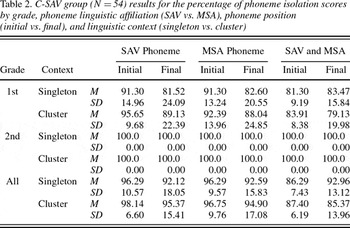
Percent correct phoneme isolation scores as a function of grade, phoneme's linguistic affiliation (MSA vs. SAV), phoneme position (initial vs. final), and linguistic context (singleton vs. cluster) are summarized in Table 1 for the N-SAV group and in Table 2 for the C-SAV group.


Before the cross-dialectal validity of the phoneme's linguistic affiliation constraint was addressed, a set of independent sample t tests were used to compare children's isolation ability for the shared SAV phonemes, which exist in both dialects. This was done to find out whether the two groups, the N-SAV and the C-SAV, differed in overall phonological awareness. (Note that this analysis compared the performance of children in the first and second grades only. This is because the C-SAV sample did not include a third-grade group.) The results unexpectedly showed that there was a significant difference in the overall means of phonological awareness that the two groups achieved, t(211)=3.54, p<.001, with the C-SAV group achieving higher scores. Next, we compared the means for SAV phonemes in the two linguistic contexts (singleton vs. cluster). The results revealed that the two groups achieved significantly different means in both singleton and clustered contexts, again with the C-SAV group outperforming the N-SAV group, t(211)=3.53, p<.001 and t(211)=2.68, p<.001, respectively. Finally, we compared the means of the two groups on SAV phonemes in initial and in final positions, separately. This comparison showed that the two groups achieved different means on initial SAV phoneme isolation, t(211)=5.17, p<.001, with the C-SAV group (mean = 97.35, SD = 6.83) achieving higher scores than the N-SAV group (mean = 87.87, SD = 19.89). In contrast, the means that the two groups achieved on final phoneme isolation were not significantly different, t(211)=1.13, p=.26. The results obtained from the t tests above demonstrate that the two groups were not matched on general level of phonological awareness. We will have to take this unexpected finding into account when interpreting the statistical outcomes of an ANOVA involving all design factors. More particularly, we will have to consider that an interaction involving the factor Group might be because of differences in general phonological awareness skills.
To address the research question targeted by the study we used a split-plot analysis of variance (ANOVA) with repeated measures on the following linguistic factors: Phoneme's Linguistic Affiliation (SAV vs. MSA), Phoneme Position (initial vs. final), and Linguistic Context (singleton vs. cluster). Group (C-SAV vs. N-SAV) and grade (first vs. second) were used as between-subject factors. The results showed that the main effect of the phoneme's linguistic affiliation factor was not significant, F(1, 209)=1.12, p=.29. However, the two-way interaction of phoneme's linguistic affiliation by group was significant, F(1, 209)=16.71, p<.001, with the N-SAV group finding MSA phonemes, which are not within their dialect, significantly more difficult to isolate than SAV phonemes. The results also showed that the three-way interaction of Phoneme's Linguistic Affiliation × Group × Grade was significant, F(1, 209)=7.39, p<.01, with speakers of the N-SAV dialect significantly improving their ability to isolate MSA phonemes as they advanced into the second grade.
The results pertaining to the effect of phoneme position revealed that the main effect of phoneme position was significant, F(1, 209)=15.21, p<.001, with all children finding initial phonemes more difficult to isolate than final phonemes. Further, the interaction of phoneme position by group was significant, F(1, 209)=12.74, p<.001, with the C-SAV group, who had been shown to have higher levels of phoneme awareness, performing significantly more successfully on this seemingly challenging task of isolating initial phonemes. It is noteworthy, however, that the three-way interaction of Group × Phoneme Position × Phoneme's Linguistic Affiliation was not significant, F(1, 209)=0.90, p=.34, indicating that, although they had higher levels of phoneme awareness and hence performed better on the initial isolation task, the C-SAV group did not show an increased facility with MSA phonemes.
The main effect of linguistic context was significant, F(1, 209)=16.33, p<.001, with singleton phonemes more difficult to isolate than cluster phonemes. Further, the two-way interaction of Phoneme Position × Linguistic Context was significant, F(1, 209)=5.52, p>.05, with singleton phonemes in initial position significantly more difficult to isolate than those in final position. Further, the results showed a significant two-way interaction of Grade × Linguistic Context, F(2, 209)=6.10, p<.01, and a trend for a significant three-way interaction of Grade × Linguistic Context × Position, F(1, 209)=2.78, p=.09, with the ability to isolate singleton phonemes and singleton phonemes in initial position improving with grade level.
The results also showed that the main effects of group and grade as between-subject factors were significant: Group: F(1, 209)=34.18, p<.001; Grade: F(2, 209)=23.89, p<.001, with the C-SAV group demonstrating a higher level of phonological sensitivity than the N-SAV group and second-grade children achieving higher scores than first-grade children.
The effect of the linguistic factors targeted in the study on the performance of third-grade children in the N-SAV group was examined using ANOVA with repeated measures on the three factors of phoneme's linguistic affiliation, phoneme position, and linguistic context. The results showed that the main effect of phoneme's linguistic affiliation in the performance of third-grade children fell below satisfactory levels of statistical significance, F(1, 42)=1.85, p=.18. However, the main effect of phoneme position was significant, F(1, 42)=22.70, p<.001, with initial phonemes harder to isolate than final phonemes. The main effect of linguistic context was not significant among third-grade children.
DISCUSSION
The first objective of the current study was to test the cross-dialectal validity of the phoneme's linguistic affiliation constraint on phoneme isolation in diglossic Arabic. It was hypothesized that, regardless of phoneme identity, phonemes not available in the spoken vernacular of children would be more difficult for them to access than phonemes within their dialect. The results of the study lent empirical support to this hypothesis. The results showed that children speaking the N-SAV dialect found the four critical phonemes, which were not within their spoken vernacular, significantly more difficult to isolate than phonemes available in their dialect. This difference was not significant among speakers of the C-SAV dialect, for whom these same phonemes were spoken phonemes.
It is noteworthy that the external validity of the linguistic affiliation hypothesis versus the competing hypothesis of phoneme identity was established in the current study despite the fact that the two groups tested (N-SAV and C-SAV) were not matched on overall level of phoneme awareness. The argument is the following. The two groups of children tested in the study were unexpectedly found to have different levels of phoneme awareness for the shared SAV phonemes, with the C-SAV group achieving higher scores than the N-SAV group. This advantage in phonological awareness was reflected in the C-SAV children's improved ability to isolate initial singleton phonemes. In a CV biased language (a detailed discussion of which will follow), initial phonemes are particularly difficult to isolate, and this requires strong phonological awareness. The C-SAV children's stronger phonological awareness was manifest in their ability to isolate phonemes from this challenging context. If the evident group by phoneme type interaction were a reflection of the N-SAV group's weaker phonological awareness, the interaction that would reflect this weaker awareness should interact with phoneme type and produce a significant interaction of group by phoneme position by phoneme type. In other words, if phoneme identity, rather than the phoneme's linguistic affiliation underlay the difference between the two groups in the ability to isolate MSA phonemes, it should be reasonable to find that MSA phonemes embedded within this challenging initial singleton context should be even more difficult for this phonologically weak group. This three-way interaction was not found to be significant. This finding supports the separation of the two factors in explaining phoneme isolation performance of children, and strengthens the conclusion that the obtained difference between the two groups in isolating MSA phonemes reflects the effect of linguistic affiliation rather than general level of phonological awareness.
In other words, the two groups tested were found to be matched for their performance on final SAV phonemes, but not on initial SAV phonemes (see the results of the t tests) indicating a larger involvement of phonological awareness in the initial isolation task. If the poorer performance of the N-SAV children on the MSA phonemes is because of the extra challenge that these phonemes present to phonological awareness (i.e., the phonological profile of these phonemes), these children should have a particularly hard time in a condition where the demands on phonological awareness are already very high, that is, in initial position. Hence, the difference between initial and final phoneme isolation, which is larger for the N-SAV group than for the C-SAV group when SAV phonemes are considered, would create even bigger differences between the groups when MSA phonemes are considered. This would appear as a third-order interaction of group by phoneme type by phoneme position. This interaction was not found to be significant. This finding is consistent with the view that the effect of phoneme type reflects the linguistic affiliation of the phoneme, rather than group differences in phonological awareness. This evidence constitutes empirical support for the external cross-dialectal validity of the phoneme's linguistic affiliation constraint in explaining phoneme awareness in diglossic Arabic (Saiegh-Haddad, 2003, 2004).
The study tested phoneme isolation performance among children in the first, second, and third grades. The results showed that the effect of the phoneme's linguistic affiliation remained significant in explaining variability in the performance of children in the N-SAV group in the first grade and also in the second grades, 2 years after formal instruction in reading in MSA had begun. This factor, however, ceased to be reliable in explaining the phoneme isolation performance of third-grade children. These findings replicate and extend previously reported results (Saiegh-Haddad, 2003, 2004) and show that MSA phonemes pose a challenge to children's phonological awareness in the early grades and persist beyond the kindergarten level. Note that my earlier research has shown that MSA phonemes are also an important source of decoding inaccuracy among first-grade children (Saiegh-Haddad, 2003). It remains to be seen whether the effect of the linguistic affiliation factor on decoding and reading achievement will persist at more advanced stages, and whether a similar effect will emerge in the development of spelling among children.
The present study underscores a very important aspect of the development of phoneme awareness in diglossic Arabic. It shows that the same phoneme may be associated with variable levels of awareness among Arabic native speaking children in the early grades. This variability is attributed to the presence/absence of the phoneme from the spoken vernacular of children. This evidence is in harmony with recent hypotheses regarding the role of the quality of phonological representation in children's developing awareness of phonemes (Elbro, 1996, 1998; Goswami, 2000, 2002). Because the four critical phonemes addressed in the study are not within the phonological repertoire of children speaking the N-SAV dialect, children might not have had the opportunity to develop proper phonological representation for these phonemes. Such inaccurate, indistinct, and underspecified phonological representation might have disrupted children's ability to access these phonemes, especially because these phonemes have a parallel competing form in the spoken language of children, which is probably automatically invoked in the process of phonological operation, especially when real-word stimuli are used (Saiegh-Haddad, 2004). In contrast with standard phonemes, spoken vernacular phonemes are more likely to have been more accurately represented in the mental lexicon of children. Accurate, stable, and well-specified phonological representations support phonological analysis because they facilitate the phonetic encoding and maintenance of phonological stimuli in working memory during phonological analysis.
With regard to the effect of the structural factors of phoneme position (initial vs. final) and linguistic context (singleton vs. cluster), the results showed that initial phonemes were harder to isolate than final phonemes and singleton phonemes were less accessible than cluster phonemes. Further, initial singleton phonemes were particularly more difficult to isolate than any other phoneme, and especially so for speakers of the N-SAV dialect, the phonologically weaker group. The ability to isolate initial phonemes and initial singleton phonemes was also found to improve with grade level. Whereas these results replicate and consolidate earlier findings among Arabic native-speaking kindergarten and first-grade children (Saiegh-Haddad, 2003, 2004), they are at odds with the predictions of the rime–cohesion hypothesis (Goswami, 1986, 1989; Treiman, 1983, 1985, 1988), according to which syllable onset phonemes should be easier to access than rime–coda phonemes, and singleton phonemes should be easier to access than cluster phonemes. Instead, the current results imply a stronger cohesion of the CV body unit in Arabic than the VC rime, which has acquired strong distributional and psycholinguistic evidence in English (Booij, 1983; Bruck & Treiman, 1990; De Cara & Goswami, 2002; Fudge, 1969, 1987; Goswami, 1986, 1988, 1992, 1998; Goswami & De Cara, 2000; Luce & Pisoni, 1998; Treiman, 1983, 1985, 1988; Treiman & Danis, 1988; Treiman et al., 1995; Treiman & Kessler, 1995; Treiman & Weatherson, 1992; Treiman & Zukowsky, 1991). These results converge with increasing evidence from a number of languages, including Dutch (Geudens & Sandra, 2003), Hebrew (Share & Blum, 2005), and Korean (Yoon, Bolger, Kwon, & Perfetti, 2002), which shows that the CV body is more accessible to children in these languages than the VC rime. This implies that the intrasyllabic division of onset and rime may not be a linguistic universal (Ziegler & Goswami, 2005).
The findings of the present study show that Arab children, and especially those with relatively lower levels of phonological sensitivity, find the CV phonological unit the most difficult to segment. Similarly, although to a somewhat lesser extent, isolating the initial consonant from a CCV unit is more challenging than isolating a final phoneme, singleton, or cluster. This implies a unique cohesion of the CV phonological unit in Arabic.
Although the conceptual basis for the stipulated cohesion of the CV unit in the representation of Arabic syllables remains as yet unclear and open for future research, four features of Arabic phonology and orthography may contribute to the salience of the CV unit in Arabic. The first is the predominance of the CV unit in the morphophonology of Arabic. Arabic is a multisyllabic language with the CV unit, by far the most frequent syllable (Ababneh, 2000). VC syllables are not available in Arabic, because all syllables must begin with the onset. CCVC syllables are not available in MSA, because consonant clusters are not permissible. The complex CVCC syllable is only permissible in an intermediate form of Arabic, Educated Spoken Arabic (Ennaji, 2002), in which inflectional endings are deleted. However, even in this form, CVCC is one of the rarest syllabic structures (Ababneh, 2000). The predominance of the CV unit in Arabic, and in similar Type III syllable structure languages (Clements & Keysers, 1983), such as Hebrew (Cohen-Gross, 2003), should contribute to the phonological cohesion of this unit in children's phonological analysis. Note that a phonologically based interpretation of a stipulated strong cohesion of the CV unit has also been proposed for explaining similar findings in Semitic Hebrew (Saiegh-Haddad, in press; Share & Blum, 2005).
The second feature is the salience of the CV unit in Arabic is further strengthened by the rather weak status of the rime as a competing phonological unit. Monosyllabic CVC words, particularly content words, are relatively rare in Arabic and are almost absent from the children's early lexicon (Saiegh-Haddad, 2007). This, coupled with the relatively small number of vowels in the language, results in a small number of rhyming monosyllabic content words and does not support the prominence of the rime as a salient perceptual unit in children's phonological or lexical acquisition. In contrast, the rime has been shown to play an important role in phonological and lexical development in English, because phonological neighborhood among English words is dominated by rime neighborhood (De Cara & Goswami, 2002; Goswami, 2000; Goswami & De Cara, 2000; Luce & Pisoni, 1998; Metsala, 1997a, 1997b, 1999; Metsala & Walley, 1998; Treiman & Kessler, 1995; Walley, 1993; Walley et al., 2003).
A third factor is the visual representation of phonemes in the voweled Arabic orthography with the CV phonological unit represented as one integral orthographic unit. Although voweled Arabic provides a full representation of the phonemic structure of words, it employs two separate systems of graphemes: a system of letters and a system of diacritics to represent these phonemes. The two systems of letters and diacritics are mutually exclusive in their representation of consonantal and vocalic information; letters represent consonants (and sometimes long vowels), and superscripted diacritics appended to letters represent short vowels. Such an orthographic representation should contribute to greater orthographic cohesiveness of the CV unit especially among beginning readers of voweled Arabic. Note that the unique orthographic representation of the CV unit in Semitic script has been proposed to explain the cohesion of the CV in the processing of syllables by children exposed to pointed Hebrew (Saiegh-Haddad, 2007; Share & Blum, 2005) and by adults skilled in reading unpointed Hebrew (Ben-Dror et al., 1995). It is interesting, however, that the results of the current study show that the ability to unfold the CV unit among Arab children improved with grade level, despite a CV-based orthographic representation. This implies that, although the CV-based orthographic representation of Arabic may encourage a CV-based phonological analysis in the earlier grades, greater exposure to the alphabetic orthography of Arabic results in greater gains in phoneme awareness, and higher rates of success in segmenting the phonologically and orthographically cohesive CV unit. This finding provides unique support for the reciprocal relationship between alphabetic reading and the development of awareness for phonemes. It shows that, despite the orthographic cohesion of the CV unit in Arabic, greater experience with this alphabetic orthography enhances the development of awareness for the internal phonemic components of this orthographically cohesive unit (Bentin & Hammer, & Cahan, 1991; Bentin & Leshem, 1993; Liberman, Shankweiler, Fischer, & Carter, 1974; Morais, Alegria, & Content, 1987; Morais, Bertelson, Cary, & Alegria, 1986; Morais, Cary, Alegria, & Bertelson, 1979). However, this finding may be confined to Arabic, and may be the result of the fact that MSA uses diacritics to represent short vowels only whereas long vowels are represented using letters, one of the three dual-function letters that may map onto a consonant or a long vowel (

). This means that, although the Arabic orthography is mainly CV based, it is not exclusively CV based, and greater experience with this orthography helps readers realize that both phoneme-based and CV-based recoding mechanisms are necessitated by this duality in the orthographic system.
The fourth feature, early reading instructional practices, which use the CV unit (letter plus diacritic) as the minimal building block for word decoding among beginning readers, also contributes to the cohesiveness of the CV unit. These instructional practices are inspired, in addition to the phonological and orthographic features mentioned earlier, by the diacritical system of Arabic. There are mainly three types of diacritics in Arabic. The first represents a short vowel (fatha/a/,damma/u/, and kasra /i/), the second denotes a null vowel (sukun), and the third represents a consonantal geminate (shadda). The last two types of diacritical marks, sukun and shadda, point to the reader that the syllable is a closed CVC syllable and thus alerts them to the presence of a coda and to the inapplicability of the default CV decoding strategy. In the absence of these two diacritical marks, the CV decoding mechanism will always result in successful word decoding. This feature is argued to contribute to the salience of the CV unit among children. The role of the diacritical system of Arabic in providing a detailed phonological representation of words, including information on syllabic boundaries and effective decoding mechanisms, contrasts sharply with what is known about decoding in the deep orthography of English, in which the orthographic rime has an important role in stabilizing the pronunciation of vowel graphemes, and in contributing to the successful decoding of orthographically opaque words (Aro & Wimmer, 2003; Booth & Perfetti, 2002; Christensen, 1997; De Cara & Goswami, 2002; Goswami, 1986, 1988, 1991, 1992, 1998; Goswami & De Cara, 2000; Seymour, Aro, & Erskine, 2003; Treiman & Kessler, 1995; Wolters & van den Broek, 2004).
In summary, the current study establishes the external validity of the phoneme's linguistic affiliation constraint in explaining phoneme isolation performance among Arabic native-speaking children. As such, oral language phonemes are more accessible to children than standard phonemes, regardless of phoneme identity. In addition, the results of the study demonstrate a language-specific character of the role of structural factors in phoneme isolation. The study revealed that Arab children find initial phonemes and initial singleton phonemes the most difficult to segment. This pattern of performance implies a unique cohesion of the CV unit in Arabic, which appears to be rooted both in the phonological structure of Arabic and in its orthographic representation. The role of the CV unit, as opposed to the individual phoneme, in directing the course of reading and spelling acquisition in voweled and unvoweled Arabic are questions for future research to pursue. Future research should also address the role of the linguistic affiliation factor in the acquisition of word-level reading skills, reading comprehension, and spelling in diglossic Arabic.
APPENDIX A

I thank Usha Goswami and Dominiek Sandra for their invaluable comments on an earlier version of the paper.