Off to the other promised land: Western émigrés in the “first country of workers and peasants”
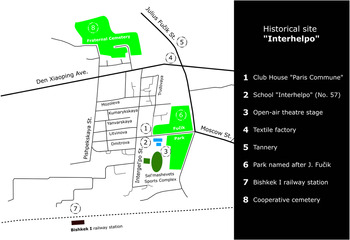
At first glance, present-day Bishkek, the capital of Republic of Kyrgyzstan in Central Asia, may seem like a typical representative of the (post-)Soviet city: prefabricated, modernist-style residential buildings along the old Sovyetskaya Boulevard (today named after the Soviet-Kirghiz politician Yusup Abdrakhmanov), extensive park areas, and a grid-like street network.Footnote 1 Yet, as the Line 2 trolleybus leaves the hectic bustle of the Osh Bazaar on Den Xiaoping Avenue, an oddly tranquil world reveals itself to the visitor: one- and two-level residential buildings with gabled roofs, mullioned windows, and massive exterior walls are unmistakably reminiscent of a small town in Central Europe. The residential area, unofficially known among local residents as “Intergel'po” is made up of Intergel'po and Trudovaya Street, which run vertically from north to south, and six smaller alleys (Mozoleva, Kumarykskaya, Yanvarskaya, Livtinova, Dimitrovna and Kensuyskaya) that run from east to west. To the east, Intergel'po borders Fuchik Park—named after the Czech communist writer Julius Fučík—while to the east, it coalesces into a new settlement area.
The location of the “Interhelpo District” in the western part of Bishkek. Sketch map created by the author with inkscape.

With the shady trees that line both its sides and its small corner shops, Intergel'po Street conveys a feeling of tranquility and comfort. Yet, the seemingly idyllic appearance entices the viewer's gaze away from the precarious living conditions under which the district's current residents are living. As the first port of call for internal migrants from the country's rural areas of the south, the peculiar looking district is characterized by stark poverty, neglect, and decay. When faced with this sight, it is hard to believe that its materiality is precisely what harbors an entirely different historical narrative, one that is closely interwoven with the genesis of the modern capital of Kyrgyzstan, which back then was known as Frunze, the capital of the Soviet titular republic Kirghizia. It is the marginalized history of the Czechoslovak industrial cooperative Interhelpo (literally “mutual support”), and the short-lived, yet actual success of real-practiced internationalism, which stands out as “one of the most striking fragments of the utopian history of Bishkek.”Footnote 2
While subject to two monographs in the Soviet Union, i.e., I.I. Samuel's Interhelpo: A Czechoslovak Industrial Cooperative in Kirghizia (1935, in Russian) and Janos Számuel-Szabó's On the Importance of Proletarian Internationalism: Interhelpo (1958, in Russian), and one in Czechoslovakia, namely, Pavel Pollák's The History of the Czechoslovak Workers' Cooperative Interhelpo in Soviet Kirghizia (1961, in Slovak), the history of the industrial cooperative and its role in crafting Kyrgyz urbanity has been largely displaced from collective memories in Kyrgyzstan and the successor states of Czechoslovakia alike.Footnote 3 Though recently, several smaller academic studies, unpublished theses, and journalistic works in Czech, Slovak, and Russian testify to a renewed interest in the topic, the role played by cooperatives of Western émigrés in the urbanization and industrialization of Soviet Central Asia has remained to this day virtually unknown to the wider English-speaking academic community.Footnote 4 In order to understand the baffling silence that prevails over one of the most successful Soviet industrial cooperatives of internationalists, it is important to understand that Interhelpo, once “a symbol of Czechoslovak left-wing internationalism,”Footnote 5 had been largely forgotten long before the end of the Soviet Union. By the post-WWII period, the once pioneering cooperative had already ceased playing a role in the imaginaries of contemporaries, thereby turning into a “depleted term that had only a very marginal impact on the consciousness of the Czechoslovak public.”Footnote 6 Similarly, a newspaper article published September 2, 1972, by the historian P. Nikishov in Sovetskaya Kirgizia on the historical background of “Interhelpo Street” (Ulitsa Intergel'po) indicates that, by the 1970s, the life of the cooperative had already turned into a subject of historical inquiry unknown to many local contemporaries of the time.Footnote 7 This may also explain why one does not encounter any mention of Interhelpo (and Czechoslovak internationalist cooperatives more generally) as a precursor of Soviet-Czechoslovak relations in Rachel Applebaum's recently published monograph, Empire of Friends: Soviet Power and Socialist Internationalism in Cold War Czechoslovakia.Footnote 8 Looking back at the pre-war period, she confines herself to the observation that “[d]uring Stalinism, the friendship project had been largely aimed at Czechoslovaks, who were supposed to emulate Soviet culture and politics.”Footnote 9 Yet, Applebaum is hardly to blame for this reading. In fact, it is true that little has generally been brought to light on the success and failures of Western internationalist communes in the early Soviet Union.Footnote 10 This paper seeks to address this research gap by shedding light on this trans-local historical complex from the southeastern geographical margins of the USSR: Kirghizia in Central Asia.Footnote 11 To this end, the present study is informed by a multi-scalar perspective that sets out “to approach the Soviet period from a de-centred perspective—neither from above nor from below but from the side, where politics and labour, the economy, the arts, and international relations all commingled.”Footnote 12 For the historical reconstruction of this trans-local trajectory of early-Soviet history, this paper draws from archival material accessed from the Central State Archive of the Kyrgyz Republic, the nachlass of Rudolf Mareček (the founder of Interhelpo), at the Museum of the Wallachian Region in Vsetín (Muzeum regionu Valašsko ve Vsetíně), as well as a wide range of understudied sources in Czech, Kyrgyz, Slovak, and Russian. These sources are further complemented by material from private archives courtesy of the descendants Maria Surova and Elvira Mareček. The latter includes a thorough documentation of Interhelpo in Soviet-era newspapers as well as unpublished photographs.Footnote 13 Transcending a purely historical analysis, the paper ultimately turns to the present and revisits Interhelpo as the material relict of an abandoned future anchored in the urban layers of the present-day city. Through biographical-narrative interviews and visual documentation conducted over a period of six months in Kyrgyzstan between 2018 and 2019, the paper ultimately engages with the question of the role played, almost a century later, by the materiality of the cooperative in the memory landscape of today's Bishkek.Footnote 14
“When we talk about emigration, we think of Slovak fathers, mothers and daughters who emigrated in droves to the USA, Canada, Argentina and Brazil at the end of the 19th century to earn their living,” bemoaned the Czechoslovak historian Pavel Pollák already in the 1960s in his essay on emigration to the Soviet Union in the twenties (“Die Auswanderung in die Sowjetunion in den zwanziger Jahren”).Footnote 15 Yet, according to Pollák, from 1921 to 1922, up to one million applications were filed by international workers to Soviet migration authorities (KomSTO) petitioning for emigration to the Soviet Union. Propelled by the news of the revolution, these émigrés were filled with the enthusiasm and desire to contribute to the building of what was, after all, to become the first workers’ country in history. Workers and farmers who went to Russia as qualified working forces “had no reason to assume that they would not have prospered overseas”; in spite of this, many decided to emigrate to the SSSR “to participate with their own hands in the building of the first country of workers and peasants.”Footnote 16 Bernstein and Cherniy in their pioneering study of the Seattle commune paint a similar picture:
Communes of the 1920s were not like the collective farms that Stalin's regime forced upon the countryside in the early 1930s. The communes, whose members were often politically active supporters of the regime, were attractive to Soviet leaders who wanted to bring technology, expertise, and politically reliable people to the countryside.Footnote 17
Aside from European internationalists, thousands of émigrés from the United States and Canada recruited from within the circles of the Society for Technical Aid to the Soviet Union were resettled to the Soviet Union, making up two of the largest groups of émigrés.Footnote 18 Until World War II, an estimated number of seventy to eighty thousand skilled foreign workers successfully migrated to the Soviet Union.Footnote 19 In fact, among the first communes of international workers was a US cooperative of “123 Russian American ‘re-emigrants’ boasting of having worked at the Ford Motor Company's Highland Park factory,” and led by an engineer from Detroit called Arthur Adams (1885–1969).Footnote 20 The cooperative had already arrived in 1921 with the task of turning a repair workshop into the country's first automobile plant within the vicinity of Moscow. The AMO factory, which later would be known as the ZiL Likhachov Plant, was a major site for the production of automobiles, trucks, military vehicles, and heavy equipment. In contrast to the AMO factory, which receives elaborate treatment in Lewis Siegelbaum's monograph Cars for Comrades: The Life of the Soviet Automobile (2008), another notable early commune was the less well-known American industrial autonomous colony Kuzbass, which was settled in the Kuznetsk Basin. On September 30, 1921, Lenin reaffirmed in a statement issued to the US-based Society for Technical Aid to Soviet Russia “that the visions of the American workers and engineers under the leadership of comrade Rütgers and Haywood enjoyed the full trust of the Soviet government, and that the Soviet government was prepared to grant full freedom and autonomy for their group as revolutionaries of the USSR.”Footnote 21
In what followed, over a thousand American workers accompanied by their families brought industrial machinery as well as mining, chemical, and metallurgical equipment. The commune was virtually in charge of the coal industry for the entire region, and extracted up to two million tons of coal annually. They were followed by rural communes from California, Arizona, Texas, and New Mexico who brought with them state-of-the-art equipment including tractors, steam ploughs, and thresher machines, and who settled in areas in the Ukraine, the Caucasus, the middle Volga area, and in the vicinity of Moscow. While some adopted socialist-Russian names such as Komuna Seyatel’ (“Commune Seeder”), Novyy mir (“New World”), or Selyanskaya Kul'tura (“Peasant Culture”), others retained the names indicating their places of origin such as Commune Harold, California, San Francisco (made up of Molokans), Seattle (made up of American Finns), or John Reed.Footnote 22 Though most of these communes were short-lived and were disbanded by 1927, they were followed by settlers from Switzerland, Germany, Czechoslovakia, Estonia, Austria (e.g., the six hundred strong Unfeld Commune in the Middle Volga region), Denmark, Italy (e.g., the three thousand strong Venezia Julia Commune), Sweden, Bulgaria, Hungary, Poland, Uruguay, Australia, and other countries.Footnote 23
The legal framework for the migration of the international working forces to the Soviet Union was established through a resolution on “Proletarian help for Soviet Russia” (proletarskaya pomoshch’ sovetskoy Rossii) adopted by the Fourth World Congress of the Communist International held between November 5 and December 5, 1922.Footnote 24 While the main objective of the global proletariat remained the “revolutionary political struggle of the workers and increased pressure on each and every separate government,” the resolution also suggested, “mobilising the entire economic power of the proletariat for the support of Soviet Russia.”Footnote 25 The resolution thus paved the way for “economic assistance campaigns for the immediate and real support in rebuilding [the Soviet] economy” (kampanii khozyaystvennoy pomoshchi nemedlennuyu i real'nuyu podderzhku v dele vosstanovleniya yeye khozyastva)—this included a call for machinery, equipment, as well as workforces.Footnote 26 Yet, in order to forestall the “mass resettlement of foreign workers” (massovoe pereselenie innostranykh rabochikh), which would further exacerbate the dire situation in the Soviet Union where mass unemployment prevailed, the call to action was limited to “individual specialists” (otdel'nymi spetsialistami).Footnote 27
Forging the “internationalist dream”: from Esperanto-language circle to an industrial cooperative of émigrés
Aside from economic challenges, the Russian civil war raged, manifesting itself in Central Asia in a grueling battle between Bolsheviks and Basmachis. On the side of the Bolsheviks, a native of Czechoslovakia by the name of Rudolf Pavlovič Mareček emerged as “an active participant in the fight for Soviet power in Semirechye,”Footnote 28 a mountain range now known by its indigenous name Zhetysu (“seven streams”) that stretches along today's Kyrgyz-Kazakh border. In the “Switzerland of Central Asia” Mareček, a passionate mountaineer reminisces about the “beautiful railways and motorways in the mountain landscapes of the Alps and Carpathian Mountains.”Footnote 29
Yet unlike Central Europe, the area in and around the Seven Stream region was practically completely pre-industrial. Mareček, haunted by the “memories of the rich technology of the capitalist west,” thus concluded that in Central Asia the most pressing question was how to achieve “the best possible transition” from “feudal and patriarchal backwardness to socialism, bypassing the stage of capitalist development.”Footnote 30 To this end, Mareček, who at that time also served as editor of the revolutionary newspaper The Dawn of Freedom (Zarya Svobody) in neighboring Verniy (present-day Almaty), initiated the organization of the agricultural commune Novaya Era at the shores of Issyk-Kul—out of which later the Kolkhoz Karl Marx would be formed.Footnote 31 Yet, true process in the economic development of the region was only possible, according to Маreček, through the organization of an industrial enterprise and the mechanization of production. “[O]ur qualified Czechoslovak workers can play there the role of an instructor (rol’ uchiteley),”Footnote 32 he would exhale in a touch of revolutionary enthusiasm paired with Western overconfidence.
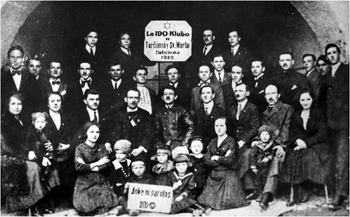
After his return to Czechoslovakia, which at that time had been hit by severe mass unemployment and housing shortages, Mareček revived the idea of an industrial cooperative in Central Asia. In 1923, in his home town Sv. Martin (present-day northern Slovakia), he recruited the first potential members from the circle of a language club for Ido, a constructed auxiliary language derived from Ludwik L. Zamenhof's Esperanto: the director of the consumer cooperative Bača, the bookbinder Ďuríček, the locksmith Ruček, and the three bricklayers Sousedík, Gurt, and Poljaška, all of whom expressed their interest in joining Mareček in his endeavor.
Turčiansky Svätý Martin in 1923: Gathering of the Ido Club “La Ido Klubo.” Source: Museum of the Wallachian Region in Vsetín.

Fifty years later, the bricklayer Albín Poljašek would remember this day in an interview with Miroslav Nedomu that was published in the Kirghiz factory newspaper Sel'mashevets:
It was February 1923 when at one evening R. Mareček brought the [Ido-language] journal Revuo Internacionala (The International Magazine) which at that time had been published in Moscow. Mareček showed me the article and told me how, on Lenin's advice, help organisations of international workers were founded with the aim of helping the young Soviet Republic in its industrial and economic development. He also told us how he had established the agricultural community Novaya Era there [in Kirghizia] . . . When he presented the above-mentioned journal to the members of the Ido Language Club, whose chairman I was at the time, he said: “Albín, with you we will really organise a help of workers, an industrial cooperative, and you will go with it to Kirghizia.”Footnote 33
On May 1, 1923, Interhelpo—an acronym of the Ido compound international laboristal helpo—was founded in 1923 in near-by Žilina on the initiative of Czechoslovak internationalists with the initial aim to provide “mutual proletarian help […] in processing raw materials in the Zhetysu Oblast.”Footnote 34
In the summer of the same year, members of the group established contact with the Germany-based Soviet diplomat Lev Mikhaylovich Khinchuk (1868–1944), then Chairman of the Central Union of Consumer Societies (Tsentrosoyuz), and arranged a meeting with him in Bonn. Khinchuk asked the group to file a request with Vladimir Antonov-Ovseyenko, at the time the authorized representative of the SSSR in Prague. In what followed, Václav Chlumecký, the senator of the Communist Party of Czechoslovakia, visited Moscow to negotiate a contract for the secondment of a Czechoslovak cooperative to the USSR.Footnote 35 The foundation of Interhelpo coincided in Czechoslovakia with the formation of other agricultural cooperatives such as the Kladno Commune (Armavir, Krasnodar Krai), the Slovak Commune (Stalingrad Guberniya), and Reflector (Ershovsk, Saratov Oblast) as well as other short-lived and failed endeavors such as Pflug (“plow”), Solidarita, and Čechocentr.Footnote 36 Yet, in contrast to these agricultural cooperatives, which achieved modest or virtually no success at all, Interhelpo's success lay in its fundamentally different economic layout; conceptualized as an industrial cooperative, it sought to bring together different skilled artisans, both women and men, with the goal of building industrial production sites from scratch in the previously non-industrialized Kara-Kirghiz Autonomous Oblast, which in 1926 would become the Kirghiz Autonomous Socialist Soviet Republic, and, ultimately, in 1936, the Kirghiz Soviet Socialist Republic.Footnote 37
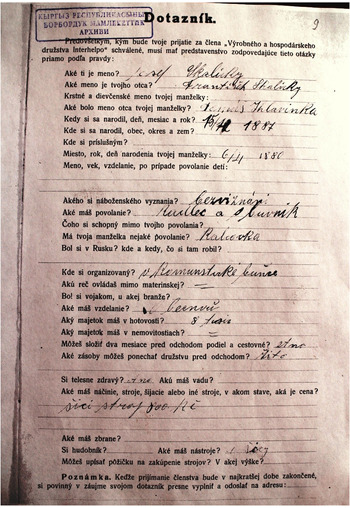
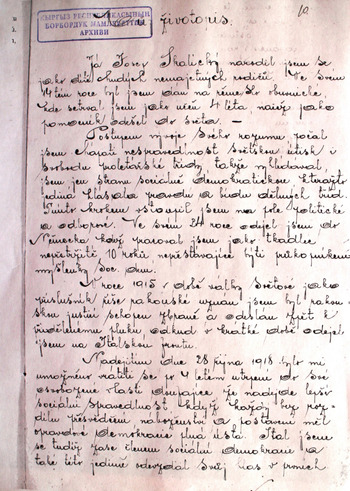
The on-going recruitment activities of the Slovak communist newspaper Pravda Khudobi that were organized in tandem with “comrade Grünwald,” first in Slovakia and then in Czechia and Moravia, proved successful. The foundation of what would become one of the most successful cooperatives of internationalists in Soviet history attracted Czech, Slovak, Hungarian, and German communists from Czechoslovakia and beyond (Carpatho-Ukraine). In fact, more people volunteered than places available.Footnote 38 Accordingly, the requirements for admittance to the cooperative were strict. Potential members had to prepare a hand-written autobiographical motivation letter and fill out a survey, demonstrating “membership in the Social Democratic Party, atheism, high professional qualifications, physical health.”Footnote 39
Survey filled out by Josef Skalický. Source: Central Archive Bishkek, F. 1914–3387, 1914 No3/216/33.

Autobiography by Josef Skalický. Source: Central Archive Bishkek, F. 1914–3387, 1914 No3 / 216 / 33.

In addition to this, they had to make a monetary contribution of 5,000 crowns, consisting of a 3,000 crowns cooperative share and a 2,000 crown travel fare.Footnote 40 The paid-in contributions went directly into the purchase of the most essential equipment: a brick press, a forest saw, lathes, a Fordson tractor with a plough, a small truck, a dynamo, twelve electric motors, a portable engine [lokomobila], a threshing machine, and other agricultural machines as well as equipment for the locksmiths, blacksmiths, shoemakers, and tailors workshop.Footnote 41
However, the monetary contribution, which, at that time, equaled the cost of a small residential building, made it impossible for poorer segments of society to become members of the cooperative.Footnote 42 This compelled most participants, such as Stefan Dubček—the father of the famous Czechoslovakian party official Dubček—to sell all their belongings and real estate, virtually burning bridges with their home in Central Europe.Footnote 43 “Most members of the cooperative had to sell all their property and still borrow to pay the required share and travel expenses”—remembers Karol Šulc from Nové Zámky (Northwestern Czechia), who, as a member of a social-democratic youth group of the railroad trade union proved particularly receptive to the promises of the October Revolution.Footnote 44
While no law prohibited emigration to the Soviet Union, in reality, Czechoslovak administrations made severe efforts to impede outward migration. With regard to the cooperative Interhelpo, a secret note was issued by the foreign ministry that urged the Interior ministry to take steps to dissuade potential émigrés. Houses were searched, information materials were confiscated, and the minister of social welfare wrote personal letters to every registered émigré, warning them away from emigration to the Soviet Union.Footnote 45 Against all odds, on March 29, 1925, a first train composing of 24 freight cars and 13 passenger cars departed with 117 cooperative members and 186 dependents from Žilina railway station to Pishpek—as today's Bishkek had been known up until the early Soviet period.Footnote 46 Aside from industrial equipment, the transport also included items to foster cultural life, i.e., music instruments for a “good, spirited orchestra,” and scientific and political literature to set up a local library.Footnote 47 The exact itinerary of the first train can be reconstructed thanks to an article published by the Czechoslovak historian Pavel Pollak in 1947 in the magazine Kultúrny Život (“Cultural Life”): Žilina – Kyiv – Penza – Samara – Buzuluk – Orenburg – Pishpek.Footnote 48
On the day of departure, the prominent Ukrainian Bolshevik leader Vladimir Alexandrovich Antonov-Ovseenko would address a cohort of 303 émigrés at the Žilina railway station with the sobering words: “You are going into a country mutilated by world war and civil war; in a country whose population is mainly living on a lower cultural level. You will endure great pain and suffer many failures.”Footnote 49 Yet, this warning came too late. Mareček, who received a monthly salary of 1,600 crowns for his recruitment activities, initially had hoped for deployment to the fertile lands of Zhetysu, which he had come to know during his previous activities in Central Asia.Footnote 50 His hopes for deployment to the town of Przhevalsk in the Zhetysu region were dashed only as late as August 1924 when a delegation of Interhelpo was received by Soviet authorities in Tashkent, then the capital of the Turkestan Autonomous Soviet Socialist Republic (1918–1924). During the meeting, the authorities of the Turkestan ASSR—a communist predecessor state that extended over the territories of Kyrgyzstan, Tajikistan, Turkmenistan, Uzbekistan, and Northern Kazakhstan—announced that they would instead be deployed to an area near Pishpek in the Kara-Kirghiz Autonomous Oblast. The decisive factor here may have been that the meeting coincided with the opening of the 170km rail connection between Lugovaya and Pishpek in August of the same year, through which the capital of the Kara-Kirghiz Autonomous Oblast (in contrast to Przhevalsk) “gained a direct rail connection to the world [přime železniční spojení se svetem].”Footnote 51
Yet, the damage was already done. Mareček's portrayal of their initial place of destination as a “land of pomegranates” left most of the émigrés ill-prepared for the harsh conditions that would await them in the Kyrgyz steppes.Footnote 52 Obviously pessimistic about the potential success of the mission in a non-industrialized and arid step region, Mareček, under still unclear circumstances, remained in Czechoslovakia.Footnote 53 To this day, his absence from the first convoy of Interhelpo remains the subject of controversy among historians as well as the descendants of Mareček and other Interhelpo members. While some portray him as a tragic figure that was barred by authorities from joining the cooperative he had devoted his life to, others see in him a scrupulous opportunist that would abandon his comrades at the moment of hardship. Mareček's foreword published in I.I. Samuel's Interhelpo—A Czechoslovak Industrial Kooperative in Kirghizia (1935, in Russian) provides illustrative insight into this dispute. In it, Mareček replies to allegations of betrayal by providing an apologetic narrative where he positions himself as the victim of a conspiracy by hostile elements within the cooperative. According to him, members such as the locksmith Donat Láníček from Znojmo (Southern Moravia), the locksmith František Jahoda from Brno and the shoemaker Ludovit Stoklásek from Zlín (Southeastern Moravia) mistook the cooperative as a passport office offering “free passage to the SSSR,” “expecting there a new America, in which one could enrich oneself easily with speculative projects.”Footnote 54 In an act of embezzlement, those members would have preferred the purchase of old machinery and equipment “informed by whatever motive” (proizvedennoy neizvestno iz kakoy pobuzhdeni). Recognizing that his decision not to board the first train was “widely exploited by the opposition,” he provides a narrative that turns accusations of cowardice into self-sacrifice: his decision was made with a heavy heart, informed “by tactical considerations” (iz takticheskikh soobrashenii) in order not to jeopardize the overall success of the project, given the internal discord and his previous arrests by Czechoslovak state authorities.Footnote 55
From Dream to Determination: Building the Soviet City in the Central Asian Steppe
When the first wave of a total of the 1,317 cooperative members arrived at the point where the railroad would end on April 24, 1925, they found a place not only free from capitalist suppression but devoid of the most essential aspects of urban life, lacking both electricity and a water network.Footnote 56 When the members first left their wagons to face an arid and desert-like wasteland outside a desolate Pishpek railway station—a euphemism for what was in fact only a wooden platform—many would exclaim bitterly: “now we have arrived at the end of the world”Footnote 57 (to sme teda prišli na koniec sveta). This disillusionment is reflected in an illustrative way in the accounts of various Interhelpo members such as the account of Kateřina Tišliarová—Prekopová's from Púchov (Northwestern Slovakia), daughter of the tinsmith Vincent Tišliar, who was thirteen when she arrived in Pishpek:
The landscape had nothing in common with the photographs with which Rudolf Mareček, the organiser of Interhelpo, had travelled around the country. “Yes, we have such a region” the local railways responded “with shady groves and plenty of spring water where beautiful apples grew, but Przhevalsk is quite far away.”Footnote 58
Pishpek was a small peripheral late-Tsarist colonial town, built on a rectangular grid, with over 752 households, consisting mainly of Russians and Ukrainians as well as Dungans, Tatars, and Uzbeks.Footnote 59 The colonial settlement was practically pre-industrial and had neither a power grid nor an irrigation system—the entire industry of the town was confined to two breweries, three tanneries, as well as eleven flour and oil mills that employed around a hundred workers.Footnote 60 Two modest land plots to the west of the town extending to roughly 43 hectares with clay deposits—suitable for the production of bricks—were leased by Narkomzem to the cooperative for twelve years.Footnote 61 In return, the cooperative committed itself to set up workshops for the manufacturing of bricks, roof tiles, as well as a blacksmith's shop within the first year, to be followed by residential housing and other manufacturing sites. According to the contract, 10 percent of the working places had to be filled with local trainees.Footnote 62 Shortly after their arrival, they commissioned a tannery to process local raw materials and organized agricultural production.Footnote 63 One Interhelpo member would recount visiting the land plot for the first time: known among locals as “Murzabaye,” possibly in reference to a previous landowner, the land plot appears to the newly arriving internationalists like “a kingdom of wilderness” (království divočiny) with high thistles and reed inhabited not only by pheasants, foxes, and hares but also steppe snakes and poisonous vipers.Footnote 64
On April 25, one day after the arrival, a first general assembly meeting of the cooperative was held at the near-by club house of the railroad workers.Footnote 65 In the absence of Marecek, the carpenter Filip Švolik from Bratislava was elected as the chairperson of the cooperative. However, no consensus could be reached as to whether Interhelpo was in fact a commune (komúna) or a cooperative (družstvo). This was due to the pioneering nature of Interhelpo—there were no industrial communes since industrial enterprises existed only in the form of state enterprises. Yet, the émigrés faced more serious issues of a practical nature. The cooperative had spent its entire resources on acquiring machines and equipment in Czechoslovakia. With only 332 rubles in the community treasury, they had to rely, from the very outset, on loans, the first of which was granted by the Kirghiz State Bank for the amount of 20,000 rubles.Footnote 66 Immediately after arrival, the question arose of what type of temporary accommodation would provide shelter until the housing barracks were completed. The initial plans to house the members in surrounding villages suggested by local authorities proved unrealistic, and the members were eventually housed in abandoned military barracks. A shared kitchen composing of a makeshift bakery and slaughterhouse was quickly set up, which further strained relations between the already disenchanted members of the cooperative: “When the Pálinkás’ cooked peppers and goulash according to Hungarian cuisine, Czechs protested. On the other hand, when Mrs. Švecová cooked dumplings (knedle), they [the Hungarians] did not like it. And the good Slovak bryndzové halušky [a kind of gnocchi with soft sheep cheese] remained only a faint memory of home.”Footnote 67 In spite of the difficult housing situation, within two months, shoemakers and locksmiths succeed in building up their workshops, and started their work by May 1925.
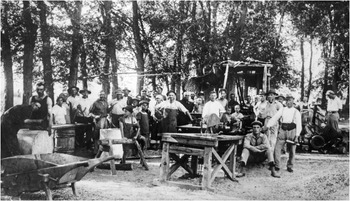
May 1925 in Pishpek: carpenters, locksmiths, and shoemakers start their work. Source: Museum of the Wallachian Region in Vsetín.

A tannery was established by “comrade Krajčovič” while a joiner's workshop was built up by “comrade Kováčik.” Under the guidance of the electrician Ondrej Pálinkás from Handlová, a 40 PS diesel generator was used to create electricity and to light the first light bulb in Pishpek. The electrification of the cooperative's quarter marked an important step in the industrialization of the republic after 1923, when electric energy was first used in the Kyzyl-Kiya mine (Batken region) to illuminate streets.Footnote 68 Yet, the decision to temporarily move into barely isolatable barracks was not only impracticable and inconvenient but proved fatal as winter approached. Severe housing conditions coupled with a particularly harsh winter of 1925 lead to the spread of lethal diseases such as malaria and typhoid, which killed up to thirty people, including all children up to the age of three. On November 15, 1925, an auxiliary transport (mezitransport) with sixty-three people arrived from Czechoslovakia, including two much needed medical doctors. Not surprisingly, this human tragedy urged some of the members to leave the cooperative and either return to Czechoslovakia or resettle to more urbanized areas of the USSR such as Rostov, Orenburg, or Novosibirsk.Footnote 69 Having barely recovered from the tragic human loss of the winter months, the cooperative suffered yet another major setback: On May 5, 1926, only a year after their arrival, a fire devastated the main production site where metal and wood processing facilities were located.Footnote 70 Interhelpo member Karel Šulc estimated the damage at 93,000 rubles.Footnote 71 Yet the year marks also the successful completion of the first major construction project in Pishpek, which by then had been rebranded as Frunze, following the Bolshevik leader Mikhail Vasilyevich Frunze, who descended from a local Russian-Romanian family. The building of the State Bank of the Kyrgyz SSR (gosudarstvennyy bank Kirgizskoy SSR) was built at the crossway of Erkindik Boulevard and Frunze Street with the support of masons, joiners, and locksmiths from the cooperative.Footnote 72 A year later, on May 2, 1927, a textile factory started its production activities with 725 spindles and 18 weaving looms supported by a 80 PS twin-cylinder diesel engine.Footnote 73 While the Western world, including their native homeland Czechoslovakia, faced severe economic crisis, Interhelpo started flourishing under Leninist Communism.
On weekends, the members also visited the surrounding villages in order to introduce the rural populations to modern production methods through practical work circles. The initial suspicion, Interhelpo members faced among the local population is aptly reflected in the biographical writings of the cooperative member and teacher Peter Jilemnický from Čadca (Northwestern Slovakia), who quotes an elderly village resident:
When you arrived here ten years ago and brought all kinds of odd machinery with you . . . our elders would say: “May Allah be with us, they are connected with evil spirits. They shall bring great catastrophe upon us, you will see!”Footnote 74
Yet the younger generations proved to be the most susceptible to the new production methods offered by the industrial cooperative.Footnote 75 One of the first local settlers to join the cooperative was Alexaňdra Bedřichová. Born in 1906, in the Ukrainian town of Kosjatyn near Kyiv to a family with eleven siblings, she had already come to Bishkek at the age of six. From the age of nineteen onward, she worked in the tobacco fields where she would also encounter the first members of Interhelpo:
On our plantation it has always been very joyful after work, the young men [chlapci] played the accordion, the young women [děvčata] sang, and because it was just across the river, soon young Czechoslovaks from Interhelpo would start to join us, too.Footnote 76
After familiarizing herself with “some Czech and Slovak words and songs” she would soon after join the cooperative as the “first Russian woman” [první Ruska] and start her work first in the spinning mill, and then, later, in the weaving plant. There she would also meet her future husband Benedikt Bedřich, an Interhelpo member of Czech descent.Footnote 77 Soon, she would be followed by many other locals, such as Zunun Tokhtakhunov, an ethnic Uyghur from Kaxgar (present-day Xinjiang), together with his Kyrgyz wife, Tokhtor Soltanov, an ethnic Kazakh, and Kulenda Jumabayeva, an ethnic Kyrgyz who like many local women (and, to a lesser extent, men) had acquired literacy only in adulthood thanks to the country-wide educational campaign known as Likbez (“Elimination of illiteracy”).Footnote 78 This socio-political function was not unique to Interhelpo. Beatrice Penati, for instance, in her article “The Hunt for Red Orient. A Soviet Industrial trest Between Moscow and Bukhara (1922-1929)” observes how a textile factory established by the Red East trust (Rus. Krasnyi Vostok; Uz. Qizil Sharq) in the Uzbek town Fargʻona (formerly New Margelan) “was perceived as (and to some extent was) the avant-garde of advancing industrial modernity in the region: it offered, ideally, emancipation from what the Soviets called ‘feudal patriarchal relics,’ especially for women; it created new forms of sociability; it dragged Muslim young people from the countryside into an embryo of the modern industrial city and it imposed a regulation of time and organization of labour radically opposed to the agricultural cycle and work in the fields.”Footnote 79
In face of the resulting challenge of securing communication across language boundaries—only 3 out of the 117 new arrivals were proficient in Russian at the time of arrival—co-operative members developed, in the spirit of the constructed language Ido, an organic working language known among cooperative members as spontánne esperanto.Footnote 80 This improvised mode of communicating (about which little is known until today) drew from a wide range of languages such as Czech, Slovak, German, Hungarian, as well as words and phrases borrowed from the languages of local residents and the constructed international language Ido alike.Footnote 81 One of the most illustrative accounts is that of Barbora Bláhová-Kékerová from Podhorod (Eastern Slovakia), who was an active member of Interhelpo between 1926–1933:
We counted people of 17 nationalities in Interhelpo. We were able to find a way to understand each other, some kind of international language was created—‘interhelpovish' [interhelpovština].Footnote 82
An article published in the local Soviet-Kirghiz newspaper Vecherniy Frunze on April 24, 1975, indicates that this multilingualism did indeed outlive the cooperative on an interpersonal level. Still, half a decade later, when at the occasion of the fiftieth anniversary of Interhelpo, former members of the cooperative gathered in Frunze with international guests from Ukraine and Czechoslovakia (Jendrulek Oldřich from the Czechoslovak radio and Rudolf Guck from the Czechoslovak newspaper “Light of Socialism”), and “at the gathering memoirs, poems and songs were heard in several languages - Kirghiz, Czech, Russian, Ukrainian and Ido.”Footnote 83
Beyond being of sociolinguistic curiosity, the multilingual environment of Interhelpo also allows conclusions to be drawn about the general political atmosphere in the early Soviet period. Ulrich Lins, in his recent monograph Dangerous Language—Esperanto under Hitler and Stalin argues that the existence of international auxiliary languages serves as a good barometer to measure the degree to which political regimes would tolerate the exchange with other countries on an inter-personal level and bottom-up (self-)development beyond the close confines of the national framework.Footnote 84 In this sense, the presence of a largely self-governing industrial cooperative of Esperanto-speaking internationalists in Soviet Central Asia also hints at the existence of a more pluralistically-oriented Soviet leadership, which, in stark contrast to the period that would ensue, could still envision urban development within the USSR in terms of mondial collaboration and internationalist solidarity in tandem with coequal international actors.
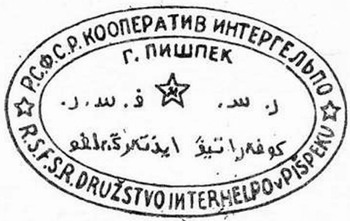
Stamp of Interhelpo, inscriptions in Latin, Cyrillic, and Arabic script. Source: Pavel Pollák, Internacionálná pomoc československého proletariátu národom SSSR. Dejiny československého robotníckeho družstva Interhelpo v sovietskej Kirgízii (Bratislava, 1961), appendix.

While initially relying on a hybrid make-shift language, over time, most of the members acquired language proficiency in at least two languages, as Josef Krátký, another member would recount: “My son spoke to his classmates in Kyrgyz, Russian or Slovak, depending on whom he was addressing.”Footnote 85 Over the years, and under the influence of policies of korenization, the cooperative expanded massively to include in their team many local members.Footnote 86 While European internationalists (Czechs, Slovaks, Germans, and Hungarians) had made up 155 of the 202 members in 1928, only three years later locals had outnumbered the émigrés. In addition to this, a group of 106 miners relocated to Kemerovo (near Novosibirsk) to form the cooperative Interhelpo-Proletár.Footnote 87 By 1932, the team comprised 223 Russians, 92 Czechs, 66 Ukrainians, 43 Slovaks, 37 Kyrgyz, 26 Gemans, 22 Hungarians, 3 Uyghur (Kasghar), 2 Uzbeks, 2 Mordovians, 2 Tatars, 1 Jew, 1 Armenian, and 1 Rusyn.Footnote 88
Participants of Interhelpo were internationalists but not dreamers: from 1925 onward, they engaged in more specific actions. Three years prior to the implementation of the first five-year plan (1928–1932), which would mark concerted efforts to industrialize in a “revolution from above,” the cooperative members built a whole urban microcosm from scratch, including an electric power station, textile and furniture factories, workshops for tailors, shoemakers and joiners, a school, a kindergarten, a tannery, a brewery, as well as unique residential buildings tailored to the architectural preferences of their constructors.Footnote 89 At a time when most houses of the town were made of clay or mud-bricks, the single-story houses made of burnt bricks constituted a remarkable leap forward in residential housing—accordingly, the house type was subsequently “exported” to other parts of the republic such as Kyzyl-Kiya and Osh in the south of the Kyrgyz SSR.Footnote 90 While real estate property of the cooperative totaled 535,200 rubles in 1927, it would grow to the amount of 2,283,800 by 1933.Footnote 91 Throughout the years of activity, the tannery produced between 1927 and 1939 different leather products equaling the amount of 7,126,837 rubles while the textile factory produced products between 1926 and 1939 equaling the amount of 12,900,040 rubles.Footnote 92 In 1937, for instance, the output (vypusk produktsii) totaled 603.100 rubles for the leather factory, 1,546,900 rubles for the textile factory, 1,154,600 thousand rubles for the metal factory, and 907,000 rubles for the furniture factory.Footnote 93 For the annual turnover, the Czechoslovak historian Pavel Pollák provides the following numbers:
Annual turnover of the Industrial Cooperative Interhelpo (1927–1933):Footnote 94

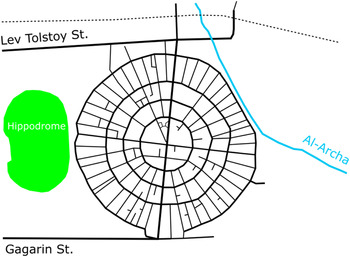
Under the auspices of the architect Andrey P. Zenkov, Interhelpo supported the construction of various public buildings including the House of the Council of People's Commissars (present-day Ministry of Culture and Information), a hotel (gostinitsa tsentralnaya), a hospital (kruglaya poliklinika ), as well as the former building of the state bank.Footnote 95 Yet, the arguably most visible material legacy of Interhelpo to date is Kruglyy Gorodok, literally “the round town” (nowadays Rabochiy Gorodok); between 1928 and 1932, Interhelpo members inspired by Ebenezer Howard's idea of the garden city and Friedrich Engel's quest for abolishing “the antithesis between town and country”Footnote 96 laid the foundation for a what would become the first “socialist” district at the outskirts of the newly emerging city of Soviet Frunze.
Layout of today's Rabochiy Gorodok (former Kruglyy Gorodok) in the western part of Bishkek, Kyrgyzstan. Sketch map created by the author with inkscape.

The experimental district, which in terms of spatial structure, scope, and semi-urban location somewhat resembled Leonid Sabsovich's idea of the sotsgorod (“socialist city”), composed of twenty-four radial and four circular ring streets and was envisaged to house thirty-two thousand residents—intended, first and foremost, for the railroad workers of the near-by Bishkek I railway station.Footnote 97 The development of the district was continued by Soviet authorities until the 1950s, when the construction of single and two-story buildings was increasingly seen as “irrational” in light of the limited space available for the urban development of Frunze and, ultimately, abandoned.Footnote 98 Interhelpo further assisted in the construction of the Chuy irrigation system, the sugar factory in Kant, and a meat-canning plant.Footnote 99 In addition to this, from 1927–1931, cooperative members supported another significant project crafted by USSR authorities: the construction of the Turkestan-Siberia Railway.Footnote 100
In addition to these construction projects, Interhelpo also contributed in fostering the cultural life of the early Soviet city. Already in December 1927, volunteers of the cooperative had formed a theatre group, which performed plays in the carpenter's workshop in Czech, Slovak, Hungarian, “and other languages”—the latter possibly alluding to performances in local languages.Footnote 101 Three years later in 1930, the Club of the Paris Commune (Klub pařížských komundartů) was built, and would serve as the main hub for cultural activities. An open letter to Czechoslovakia prepared by its members at the occasion of the cooperative's tenth anniversary provides a fascinating insight into everyday cultural life. Hereby, the clubhouse members would convene at the club every evening to watch “new movies, plays and operettas by our theatre group, or listen to the performance of our symphonic and brass band orchestra [našeho symfonického a dychového orchestra].”Footnote 102 Beyond this, it was also the site of an evening school (večerná univerzita) for adults and various interest groups (záujmove krúžky).Footnote 103 These interest groups included a theatre group under the direction of Eduard Peringer from Brno and a group of amateur photographers. The interest groups were frequented strongly by female members of the cooperative who could “engage in both work and social work, because they kn[e]w their children [were] in good care at the kindergarten.”Footnote 104.
On June 1, 1930, Julius Fučík, a well-known Czechoslovak journalist and active member of the Communist Party of Czechoslovakia visited together with a delegation of Czechoslovak Interhelpo workers. Impressed by the achievements of the cooperative, Fučík would devote his book In the Land, Where Tomorrow is Already Yesterday (V zemi, kde zítra již znamená včera, 1932), in which he portrays his travel's to the Soviet Union, to the cooperative in Frunze:
Comrades [from Interhelpo], this book thanks you for being born. You invited us to get to know your commune, and to share your experience with the workers of the country from which you came, and which did not have bread for you.Footnote 105
In return, the Park of the Frunze Plant (Park Zavoda Imeni Frunze), adjacent to the site of the cooperative, was named after the writer, and has retained its name until today.
The death of the “internationalist dream”: Centralization, Russification, and the Great Purge
Yet, while Interhelpo was on an official level hailed as an outstanding example of internationalism in practice, their institutional independence was increasingly curtailed by Soviet authorities. Under the influence of the Soviet grain procurement crises of 1927 and 1928 that shook the trust in the New Economic Policy (NEP) ideals of self-organized and self-sufficient production as reflected by the industrial cooperative had become increasingly contradictory to the centralizing desires of the Soviet leadership.Footnote 106 While initially all decisions in the cooperative were made at their own general meetings, municipality and party authorities increasingly sought to establish their own domination over the activities of the cooperative. The preparations for the structural change were made by a special commission of the Supreme Economic Council already in late 1927. In a protocol issued on December 23, 1927, “On measures necessary for the adjustment concerning foreign co-operatives and the Interhelpo Commune” the Supreme Economic Council urged the implementation of measures “to ensure that Interhelpo adopts new statutes on the basis of which it will be included into the socialist planning system.”Footnote 107 Within this framework, a commission headed by T. Bobrov, in an effort to “bring the bookkeeping in accordance with the laws of the Soviet Union,” was tasked with the translation of all accounting-related documents into Russian by 1928.Footnote 108 As Interhelpo was gradually integrated into the Soviet planned economy, their property was transferred to the neighboring Lenin commune, and workshops that proved unprofitable were closed down.Footnote 109 By the beginning of the 1930s, the commune was split up into seven branches, and, in accordance with the rationale of centralized economic planning, each was tasked with its own mono-production.Footnote 110 The retrospect account of the Interhelpo member Karol Šulc reflects the frustration that had prevailed inside the cooperative:
A group of experts was sent from Frunze to Interhelpo. However, they did not understand Interhelpo's political or industrial mission. They reached the conclusion that the cooperative had been among the concessions made during the out dated NEP period, and submitted a proposal for its liquidation to the party and Soviet authorities.Footnote 111
Šulc's criticism of an over-prioritisation of economic interests at the expense of socio-political interests reflects the contradictory nature of Stalinism, which Moshe Lewin described as a simultaneous “surging ahead in economic and military terms” and “moving backwards . . . in terms of social and political freedoms.”Footnote 112 For it is not only the self-managing economic model of the cooperative that came under harsh criticism. While initially fostered and supported as an emancipatory lingual instrument to instill a sense of internationalist solidarity among labor movements across the globe, the cooperative's link to Esperanto communities was increasingly viewed by Soviet authorities as a dangerous “leak,” through which socio-democratic ideology could infiltrate and jeopardize the Soviet Union. In August 1928, the first cracks appeared in the relationship between the Sennacieca Asocio Tutmonda (the “World National Association”), the Paris-based worldwide cultural Esperanto association, and its Soviet partner organization the Sovetrespublikara Esperantista Unio (Union of Esperantists of the Soviet Republics”). At the heart of the debate was the co-founder of SAT, Eugène Lanti, who was accused by fellow Soviet Esperantists of “ideological opportunism.” By his Soviet critics, his publication La Laborista Esperantismo (The Labor Esperantism) read as a bourgeois polemic that declared “the battle against imperialism vain and the right of nations to self-determination unworthy of support.”Footnote 113 However, this schism would not only upset the relationship between the SAT and the SEU but, ultimately, deal a fatal blow to the Soviet Esperanto movement itself, which after the loss of its function as internationalist mediator was pushed into insignificance by repressive measures.Footnote 114
This situation was further exacerbated by a Soviet-wide gradual trend toward centralization of education and Russification—starting from the introduction of Russian as a distinct subject in 1934 until the decree of March 13, 1938, which would make Russian language and literature mandatory subjects in all Soviet non-Russian schools.Footnote 115 While some members of Interhelpo viewed this trend with concern and suspicion, others took a more apologetic stance, such as the future politician Alexander Dubček. In his memoir Hope Dies Last (Naděje umírá poslední), he argued that the decision to introduce schooling in Russian was influenced less “by the pressure of the local Soviet authorities,” then by the pragmatic concerns of the local community itself.Footnote 116 A 1935 publication of the All-Union Cooperative Joint Publishing House (vsesoyuznyye kooperativnoye ob” yedinennoye izdatel'stvo) in Leningrad suggests that questions of Russification were subject to heated debate already at the time, both within the cooperative, and within circles in native Czechoslovakia. In his work Interhelpo: A Czechoslovak Industrial Cooperative in Kirghizia (in Russian, 1935), Ján Samuel, himself a member of the cooperative, took a polemical stance against the criticism raised by an unnamed social-democratic newspaper from Plzen—possibly alluding to the newspaper Nová Doba (The New Time), which had its editorial office in the workers' clubhouse Peklo (“The Hell”)Footnote 117:
We emphasise once again that if education at school is to be conducted in Russian, that it be conducted exclusively at our insistence [isklyuchitel'no po nashemu nastoyannyu], because we want our children to study in higher education institutions of the Soviet Union, and our children are already studying to become engineers, doctors [or] technicians. We try not to forget our native language by teaching it to our children. We ask the Pilsner Social Democrat newspaper why it does not write about the fact that in Slovakia, Carpathian Rusyns are forced to teach [their] children in Czech and how does the Czech bourgeoisie itself treat these national minorities?Footnote 118
Whether under the pressure of Russification or due to other reasons, many of the cooperative's original members returned to Czechoslovakia, which further shifted the ethnic composition in favor of local Russian-speakers.
In 1931, six years after the arrival of the first train from Czechoslovakia, the former initiator of Interhelpo, Rudolf Mareček, visited Frunze for the first time where he was welcomed by the Chairman of the Board Filip Švolík and other representatives of the cooperative. To his delight, he encountered a bustling “socialist town absorbed by green areas” (v zeleni utopal sotsialicheskiy gorodok) where “the factories already belched smoke” (uzhe dymilis fabriki).Footnote 119 Yet, appearances were deceiving. Centralization was already under way, and only one year later, on September 28, 1932, Interhelpo would be subjected to a massive and far-reaching restructuring: The cooperative was broken up into seven branches of industrial production no longer self-governed by its members but under the supervision of state authorities. Two years later, not only the cooperative as an institution but its members also were caught in the crossfire of power struggles that erupted at the leadership level of the USSR.
In the bloody events that followed the assassination of Sergey Kirov in 1934, later known as the “Great Purges,” dozens of Interhelpo members were deported to prison camps while a confirmed fourteen members were executed: Ondrej Pálinkáš from Handlová and secretary of the Party organization in Znojmo; Donát Laníček, the founding member of the Communist party in his native Ružomberok; Dominik Barla; František Smid from Kroměříž; Josef Skalický and Antonín Jilek from Postřelmov; Rudolf Horáček from Brezová; Viktor Smid from Spišská Nová Ves; Pavel Kainz from Palanka; Jindřich Neubauer from Přibyslav, František Svoboda and Viktor Doležal from Brno; Eduard Cípa from Teplice; and Arpád Lenárt from Dolné Saliby.Footnote 120 Ironically, because of their foreign origin, the internationalist émigrés were accused of being agents in the service of European powers. One victim, the textile worker Josef Skalický, had joined the cooperative as a keen communist and founding member of the Communist party in his native town Postřelmov (Northern Moravia).Footnote 121 Just three years before his execution, he would still write in a moving open letter to the cooperative during a period he had temporarily returned to Czechoslovakia for unknown reasons:
I am unemployed and have no hope of getting a job in the near future. I fondly remember our Interhelpo, who I was a member of, and where I was provided with everything I needed to live. I keep thinking about how to break away from loathsome bourgeois Czechoslovakia [nenáviděného buržoazního Československa] and return to you in Kyrgyzstan (…) I am followed around everywhere by police agents.Footnote 122
Toward the end of 1935, he succeeded in returning to Frunze. However, his happiness was short-lived. Three years later, on September 23, 1938, the NKVD Troika Kyrgyz SSR sentenced him to death based on allegations of espionage and anti-Soviet agitation. His family's property was confiscated, which left his wife Anna alone and deprived of all her possessions.Footnote 123 In the 1950s, the authorities informed her that he had died in a labor camp during the war. However, like many, he had already been killed in 1938 by the NKVD at the execution site near Chong-Tash.Footnote 124 While the final resting place of the other Interhelpo members that were killed remains unknown to this day, Skalický is listed alongside his fellow member Ondrej Pálinkáš among the 138 victims commemorated at the memorial site south of Bishkek. Other Interhelpo members, particularly but not exclusively those of German, Hungarian, and Slovak origin, were drafted into the working battalions of the NKVD. The president of the Public Association of the Slovak Descendants of Interhelpo (Obshchestvennoe obyedineniye Slovakov-Potomkov Intergel'po) Aleskandr Kiral recounts in 2010 in his talk “on the question of investigating the unknown pages of the history of the Interhelpo cooperative” (“K voprosu issledovaniya neizvestnykh stranits istorii kooperativa «Intergel'po»”) the mobilization of whole families forcefully drafted into the labor columns.Footnote 125 A particularly stark example is that of the Hungarian member of the cooperative Keker Anton and his children, Jezef, Pavel, Imre (the latter fifteen-years old), who were sent into a labor column for logging near the Russian city Chelyabinsk.Footnote 126
On June 13, 1940, the Industrial Cooperative Council (Sovet proizvodstvennogo kooperativa) of the Kyrgyz SSR ordered the restructuring of the cooperative and the closing of unprofitable branches of industrial manufacturing: the production of carpets, furniture, textiles, as well as the tailor's workshop are split up, and a textile cooperative is established.Footnote 127 On November 16, 1940, the Industrial Cooperative Council of the Kyrgyz SSR orders the formation of two industrial cooperatives from the remaining industrial manufacturing branches: the first, Metalzavod-Intergel'po, comprised an iron manufacturing and engineering plant with a foundry and the second, Mebel'shchik-Intergel'po, a furniture cooperative.Footnote 128 On November 24, 1941, the Industrial Cooperative Council of the Kyrgyz SSR ordered the evacuation of production plants from Voroshilovgrad (Luhansk) to the area of Interhelpo while from the former industrial cooperative only Metalzavod-Intergel'po remained operative.Footnote 129 After the break-out of WWII, the Pervomaysky plant evacuated from the Berdyansk Rayon (Ukrainian SSR) was placed in the mechanical workshops of the cooperative—which later would form the basis for the construction of an agricultural machine-manufacturing plant.Footnote 130 The largely defunct cooperative was finally liquidated on December 7, 1943, when the Council of the People's Commissars of the Kyrgyz SSR decided that a new engine repair facility would be established at the site of Metalzavod-Intergel'po.Footnote 131 The dissolution of the cooperative also marks the end of one of the most successful grassroots initiatives of real internationalism in the history of the Soviet Union, and its memory would be confined to a mantra-like memorialization at the occasion of celebrations held every ten years. On May 24, 1994, based on the law “on the rights and warranties of rehabilitated citizens, who suffered as a result of repression due to their political and religious beliefs, social, national or other characteristics” passed by the Republic of Kyrgyzstan, Interhelpo members persecuted and killed during the Stalinist repression were (posthumously) rehabilitated.Footnote 132
Exiled site, fossilized dreams: Interhelpo as “post-socialist” materiality
Once at the heart of the urbanization process in the early Soviet period, both the cooperative and its material legacy have been largely displaced from the collective imaginaries of the residents populating what has—in a third metamorphosis—transformed from Pishpek and Frunze into the capital of an independent state of Kyrgyzstan: Bishkek. When a local colleague of mine attempted to call a taxi service to ask for a ride to the “Intergel'po” district—in accordance with the Russian (mis-)pronunciation of the letter “h”—the operator was not only unable to determine the district's location but also could not verify whether such a locality existed in the first place. In spite of its relative proximity to the city center—located merely 1.5 km to the west of the well-known and centrally-located Osh Bazaar—embarking on a travel to the site resembled, in the eyes of another observant, the “illusion of travelling to another city which is not Bishkek.”Footnote 133 Reminiscent of a peripheral “post-Soviet” micro-district, the area is characterized by geographical marginalization and lack of maintenance. Yet, its atypical architecture, marked by two and three-story buildings with tiled roofs, make it distinct from its surroundings. Even to the unknown spectator these buildings appear as alien relicts of another historical trajectory that cannot be easily molded into the overarching narrative of centralized Soviet urban planning.
Mariusz Czepczynski, in his work in Cultural Landscapes of Post-Socialist Cities (2008), distinguishes between two forms of landscape transformation.Footnote 134 On the one hand, “landscape evolution,” he argues, corresponds with a gradual transformation driven by new philosophical or aesthetic ideas where the old landscape is gradually modified and superseded by the new.Footnote 135 On the other, “landscape revolution” corresponds to the rapid and total “conversion of political and iconographical systems” whose impact is “as fatal and turbulent as any revolution can be.”Footnote 136 In case of the latter, “[l]andscape then becomes a battlefield, where buildings and arrangements representing opposing ideas become enemies and rivals, as well as victims and winners.”Footnote 137 While Czepczynski attributes the case of urban transformation in the aftermath of the Soviet Union clearly to the latter, seeing in those processes evidence for “post-communist landscape cleansing,”Footnote 138 the case of Bishkek does not map well unto the scheme of a “one-way, linear transition” enshrined in the powerful grand narrative of “the great rupture.” Countering any simplistic framing within the paradigm of Soviet to post-Soviet transformation, the processes that mark urban reconfiguration in the period from the early 1990s until today appear, instead, multi-directional and asymmetrical.
In order to capture this complex process, I build on a typology proposed by Benjamin Forest and Juliet Johnson in their study “Unravelling the Threads of History: Soviet-Era Monuments and Post-Soviet National Identity in Moscow Soviet-era materiality” (2002).Footnote 139 In their paper, they distinguish between three analytical categories to describe the renegotiation of Soviet-era materiality, which are virtually applicable to the legacy of any ancien régime: contested, co-opted, and disavowed. The first category—contested —refers to sites that elicit competing narratives of the past, places where disputes on making-sense of the past erupt, and that manifest themselves.Footnote 140 An exemplary site of contestation in the urban landscape of present-day Bishkek constitutes, without a doubt, the central Ala-Too Square. Forming the city's geographical focal point the square appears as a site where the past collides with the present. While until 2003 the statue of Lenin imbued the site with the imaginary of a socialist future, a massive equestrian statue of the Kyrgyz epic hero Manas now thrones over the square, epitomizing the country's refashioned ethno-national past. Thus, Ala-Too Square can be understood as a site where the “new dreams” of a Kyrgyz past supersede the “old dreams” of a Soviet future.Footnote 141
In contrast to this, the second category—co-opted—corresponds to places that are reframed and incorporated relatively smoothly into the ideological landscape of the new regime.Footnote 142 In this context, the former Dzerzhinskiy Boulevard—a densely forested park-like street named after the Polish-Russian Feliks Edmund Dzierżyński, who was the founding father of the Soviet secret service—appears as a place where the past flows into the present. With every changing regime, the “green boulevard” was seamlessly co-opted into the new ideological landscape.Footnote 143 What had once been the “imperial garden” of a late-Tsarist colonial town was, in the Soviet period, reinvented as the gathering place of a newly flourishing Soviet-Kyrgyz intelligentsia, and then, in the post-Soviet period, as the “Boulevard of Independence” (Erkindik Prospekti). Symbolic of continuity rather than rupture, many city-dwellers until today continue to employ both names—Erkindik and Dzerzhinka—interchangeably, seemingly unaware of the starkly opposing political subtexts implied in both names. The third category—disavowed, or with the words of Forest and Johnson, “the Past as Pariah”Footnote 144—refers to sites of intervention where a site is either entirely destroyed or altered to the degree that it loses its original symbolism. An example of total erasure can be found, for instance, in the demolition of the Stalin statue located in front of the former Government House of the Soviets.
While not explicitly outlined in Forest and Johnson's article, their typology hints at the existence of a fourth category—which I propose to call the exiled site.Footnote 145 The idea of the exiled site refers to places symbolic of icons of previous societal projects that retains their original symbolism although they are marginalized and often forgotten. Borrowing from Walter Benjamin, they are broken out of the continuum of now-time (jetztzeit) and remain in the present as alien relicts of another time.Footnote 146 They correspond to a fragmented and diverging pattern in the historical experience that cannot be molded into an overarching narrative. Like contested places, they harbor the dormant potential of challenging the prevalent narrative through the diverging historical experience they are rooted in. Yet, unlike disavowed places, which elicit heated debates, and which are, as a result, often subjected to radical intervention, exiled sites are rather to be thought of as sites of abandonment and oblivion. They are unclaimed sites in the urban fabric of the present-day city. In this sense, one might argue that at the exiled site, the past neither collides with the present nor flows into it. Rather, the past becomes a “marginalised present” that coexists side-by-side with the “hegemonic present.” The impressions of a local colleague socialized in the center of Bishkek reflect the “exiled” nature of this site:
[G]reen but dusty, with non-paved roads (…) expensive cars lost in the courts which do not quite fit the background, hanging colourful laundry (…) with 50-60-year-old men already drunk in the afternoon, with a lot of cheerful kids… What was also interesting is that despite the fact that we intruded into different courts, we were never met with suspicious looks mutely asking, “What the hell are you doing here.” As if it was totally okay to be a stranger. Most probably because many people renting apartments at Interhelpo were also strangers.Footnote 147
While most of the apartment blocks in the city center are locked up behind fences following the bloody riots and pillaging that surrounded the 2010 Kyrgyz revolution, many courts in the residential area of Intergel'po were openly accessible, conveying a more candid atmosphere reminiscent of life in rural communities. In fact, many of the middle-aged sales women in the small makeshift shops on Intergel'po Street and Liftinova Street indicated that they had moved to the district from the rural south.Footnote 148
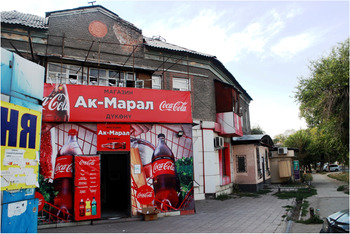
“Ak-Maral” convenience store in front of a two-level house built by Interhelpo. Private archive of the author.

This may also account for the fact that when some local colleagues entered one of the courts in the district, residents met them with the words “no rooms available” (net komnat), mistaking them for potential tenants in search of a first shelter upon their arrival to the city.
For two other informants socialized in the center of the city the sight of the district was appalling and distressing as it stood in stark contrast to the “unhurried” life in the center of the city with its cafes, restaurants, umbrageous alleys, and green parks filled with the sound of street musicians and the continuous flow of water in the irrigation ditches. In contrast to this, the streets of Intergel'po were largely deserted. Yet, a water tap in the backyard of a building complex formed a meeting point for the local dwellers, children and adults alike. The residential area of Intergel'po manifested itself not only as a marginalized place but, simultaneously, as a place of the marginalized. At the water taps located in the backyards convened the most vulnerable groups of the city who suffered from desolate living conditions and poverty, many of whom working at the near-by Osh Bazaar.Footnote 149
Already during the late Soviet period, makeshift walls have been installed in many of the buildings and turned into kommunalki, that is, shared flats inhabited by different families.Footnote 150 One building inhabited by residents had been originally built as a dorm. Due to its initial purpose, its architectural design did not offer different apartments but rather simple rooms without private kitchens and toilets. Only one elderly woman in her seventies indicated that she actually owned her room. She expressed her discontent with the building management for their neglect in maintaining the building, which lacked both central heating and running water, and provided an account of how “people in power” repeatedly sought to move the residents to other housing facilities in return for the payment of high sums that virtually no resident could afford and reminisced about the time “when the orchestra would play down in the park.”Footnote 151
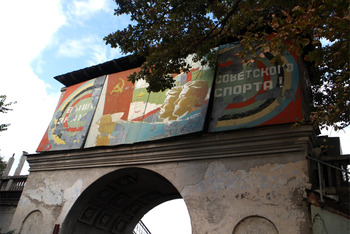
Entrance to the stadium. Sel'mashevets Sports Complex, Bishkek.

Aside from the park, during the Soviet period, two other sites were of paramount importance in shaping social life in Intergel'po: the agricultural machine-building plant Sel'mashevets, where a substantial number of its residents were employed, and the next-by sports complex that includes a basketball field and a football stadium with running tracks.Footnote 152 Aside from a local inn (kafe), the sports complex formed the nexus of social life in the district where most residents would spend their leisure time after work and during the weekends.Footnote 153 In this sense, with the vast sports complex and the large factory plant, the district appeared in many ways almost like the archetypical manifestation of a Soviet workers’ microcosm. Still today, the stadium hosts the local football club which frequently trains there. Lenin is standing tall in the entrance court of the sports complex and a motley-colored banner stating “Centre of Soviet Sport” greets the visitor upon arrival. In many ways, communal life in the district still appears to be largely characterized by the materiality produced during the Soviet period and, according to initial interviews conducted with residents, defined by stronger communal bonds when compared to the center and other micro-districts.Footnote 154 Yet, the historical experience that informed the formation of this urban materiality had been largely forgotten. In the accounts of most residents, the builders of the districts where either unknown, or misrepresented as “Czech prisoners of war” or “Czech war refugees,” who had ended up in Central Asia in the aftermath of World War II.
Today, almost a hundred years later, little reminds today's residents of the achievements of the cooperative. Only Nazdar, a small Czechoslovak association, tries to preserve its historical heritage with financially limited funds. The club office, which, like all other cultural associations of the Kyrgyz minorities, is located in the building of the national ensemble of nations, is like a small private museum: a small room on the edge filled with history books, archive photos and souvenirs from Slovakia, the Czech Republic, and Hungary. Yet, with the increasingly diminishing local Czech and Slovak communities left as the only actors actively engaging in the preservation of the cooperative's memory, the historical legacy of internationalist bottom-up activism is increasingly framed in more pronounced ethnic terms.Footnote 155 For instance, the state publication The People of Kyrgyzstan United in One Family (Narod Kyrgyzstana v sem'ye yedinoy) introduces the Czech community of Kyrgyzstan outright as the “guardians of the history of Interhelpo” (khraniteli istorii Intergel'po), while the publication Multinational Kyrgyzstan: One Homeland for All (Mnogonatsional'nyy Kyrgyzstan: odna rodina na vsekh) equates Interhelpo with “Czechoslovak comrades” at the expense not only of its Hungarian and German members but also of the significant number of local members, who equally “lay the foundation of industrialisation in Kirghizia.”Footnote 156 Thus, it must not come as a surprise that the only fictional work on the historical experience of the cooperative is in fact a 1982 Kyrgyz-language novel by the Soviet-Kyrgyz writer Kalkanbay Ashymbaev.Footnote 157 This again reconfirms the argument that the trans-local life trajectories ingrained in personal memory “cannot be territorially quarantined” given that they spill “over states’ boundaries both spatially and temporally.”Footnote 158
Yet, not all commemorative events are framed along ethnic lines: A small exhibition of the National History Museum held at the occasion of the cooperative's ninetieth anniversary in 2016 introduces the cooperative in more universal terms as the “missionaries of the dream of mankind” (adam kyyalyndagy missionerler). However, beyond the commemorative celebrations borrowed from the Soviet era that take place every ten years, the life of the cooperative is largely banished from the communicative memory of today's city citizens. Yevgeniya Mart'yanova, in an extensive newspaper article on the cooperative titled “On ‘mutual help’ across a century” (O ‘vzaimopomoshchi skvoz’ veka) raises the question, “[w]hat do we remember today about these people who endured deprivation and misfortune, yet in a superhuman effort [titanicheskym trudom] formed the industry and agriculture of this country [i.e. Kyrgyzstan] practically from zero” —only to answer it herself: “shameful and sad to say, but almost nothing.”Footnote 159 Sergey Kozhemyakin in his article “A feat of labour consigned to oblivion” (Trudovoy podvig predan zabveniyu) holds that the “memory of the cooperative's labour achievements is not only not supported on the state-level but systematically erased [planomerno unichtozhaetsya].”Footnote 160 In this context, he particularly refers to a controversial decision of the municipality in 2008 to relieve traffic congestion through the extension of Julius Fučík Street. The project had sparked protest among descendants of the cooperative and local residents of the area alike, as the new street would run directly through the Park named after Julius Fučík, splitting the green area in two. In the eyes of the journalist Kozhemyakin, the construction constituted an attack on “one of the last fruits of their labour.” Mart'yanova, while echoing his lamentations on the fate of the cooperative's legacy, suggests another explanation. Seeing in the collective amnesia not so much the result of a clear-cut state policy, she provides a more differentiated explanation linking chronic neglect to unfettered privatization: “There is not a single museum in Bishkek devoted to the cooperative, its archive was literally discarded into the dustbin [vybroshyon na svalku] after the privatisation of the Frunze factory.”Footnote 161 A similar sentiment also resounds in the article by Myrzayym Janybek Kyzy, who sees in Interhelpo more than just “a memory in form of a street name,” and bemoans the fact that while “only a few commemorative plaques remained on the buildings” (imarattarda gana bir neche eskerüü taktaylary kaldy) there is “no mention in the school books” (mektep kitebinde söz jok).Footnote 162 However, the latter is not entirely correct. Interhelpo is, if only briefly, discussed in the textbook History of Kyrgyzstan 11 (Kyrgyzstandyn Tarykhy 11) where it is mentioned by name twice.Footnote 163 Yet, in the absence of a museum (an existing museum had been closed after the end of the Soviet Union), both the material and immaterial legacy, that is, the narrated stories and lived experiences of the cooperative, face an uncertain future.
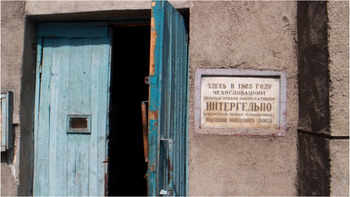
The acute discursive vulnerability of a historical experience that virtually lacks institutional support, revealed itself to me also during my own field work in August 2019. Located at the crossing of Den Xiaoping and Julius Fučík Sreet is the building of the former furniture factory of Interhelpo. Rebranded after the liquidation of the cooperative as Kyrgyzmebel, the site was privatized following the dissolution of the Soviet Union, and now belongs to the Dordoi Open Joint-Stock Company (otkrytoye aktsionernoye obshchestvo Dordoi), one of the country's largest corporate enterprises run by the former mayor of Bishkek Askarbek Salymbekov.Footnote 164 A warehouse worker in his midsixties told me in a mélange of Kyrgyz and Russian about the main building, whose historical outer facade had already been covered with blue-white plastic panels in the course of renovation work: Historical archive material of the industrial plant had been stored for a long time on the second floor of the building and had presumably been disposed of in the course of the renovation work. Identifying as ethnic Kyrgyz himself, the warehouse worker stressed the importance of preserving the historical legacy of “all that had contributed to the building of Frunze [now: Bishkek] from scratch,” and “paying respect to the deeds of those who came from afar.” Just opposite of the factory on Julius Fučik Street 38, a commemorative plaque—installed by Soviet-Kyrgyz authorities in 1957—bears witness to the first leather factory built by Interhelpo.Footnote 165 When I entered the historical building, which like the furniture factory had been, from its foundation, until recently processing leather, a middle-aged receptionist at the Ak-Maral Open Joint Stock Company explained to me that the site would be demolished soon after the company had closed down following insolvency. Together with what would be demolished, yet another commemorative plaque bearing witness to the history of internationalism in Bishkek is bound to vanish.
Commemorative plaque at the exterior wall of the closed tannery. Private archive of the author.

Conclusion: More than a faded dream, Interhelpo as a futurity
The historian Ronald Grigor Suny rightly observed in his recent work Red Flag Unfurled (2017) that “since the cause for which the USSR stood no longer holds its former potency, there appears less incentive to try to tell the story in its full complexity and moral ambiguity.”Footnote 166 As for today, voices that plead for a constructive and balanced engagement with the troublesome legacy of twentieth century socialism(s) lack institutional support and are thus under the constant threat of being marginalized by the hegemonic “post-socialist” narrative. The name of a documentary produced on the cooperative by the Czech National Television is, in this context, quite symptomatic: “Interhelpo – The History of an Illusion” (Interhelpo. Historie jedné iluze).Footnote 167 Internationalism is reframed in a revisionist and pessimistic narrative as no longer inspiring a vision that had successfully mobilized workers around the globe but as a fatal mirage that mislead the hard-working yet naïve Czechoslovak “utopians” into the wasteland of Central Asia. As myriad trans-local and cross-temporal historical experiences are reduced to a singular (and invariably negative) “Soviet experience,” genuine quests to make sense of this multilayered past are often discarded as the clinical symptoms of a haunting “Post-Soviet Nostalgia.”Footnote 168
While the nostalgia of a disenchanted present has been aptly unpacked by Svetlana Boym as a “longing for continuity in a fragmented world,” the historical trajectory of Interhelpo suggests quite the opposite.Footnote 169 It does not offer the ground to wallow in the representation of an idealized Soviet past disfigured as the “retrotopia” of reassuring certainties.Footnote 170 Instead, speaking with the words of Fredric Jameson, “[i]ts function lies not in helping us to imagine a better future but rather in demonstrating our utter incapacity to imagine such a future,” revealing “our imprisonment in a non-utopian present without historicity or futurity.”Footnote 171 At this point, the distinction between “passive reverie” and “active utopia” proposed by the anthropologist Anna Wood in her review of Felwin Sarr's renowned work Aftrotopia (2016) proves particularly helpful: “[f]ar from a ‘douce reverie’ it is an ‘active utopia’ envisioned as a guide to new ways of living now.”Footnote 172 Precisely at this point, its positionality as an “exiled site” proves to be particularly productive. From beneath the debris of a failed experiment of state socialism, it invites us to excavate the fragments of an alternative, yet abandoned historical pathway. As an outcast from our “non-utopian present” and alien relict in the urban fabric of today's neoliberal city, it speaks to the denizens of an “age of persistent instrumental crises”Footnote 173 from a different positionality: that of an abandoned futurity. Such “revitalising traces of the past” could effectively cause semiotic cracks in the surface on the newly minted “post-socialist” but no less ideological landscape.Footnote 174
Through these cracks, “unfinished futures” of the “socialist past” may again return with all its complexity and contradictions—informing the formation of alternative futures in a world in which “collective consciousness (not to mention collective action) is either seditious or naïve.”Footnote 175 Or speaking with the words of Alexei Yurchak in his reading of Frederic Jameson: “Discussing political regimes that are experienced as immutable and eternal […] the only potential for changing them may be to attempt imagining what is radically unimaginable in terms of the current political system.”Footnote 176 Yet the historical trajectory of Interhelpo cannot serve as a blueprint that offers readily available and immediate answers to the challenging questions of the crisis-ridden world of today. Nevertheless, it urges us to (re-)embark on an open-ended journey into the realm of an uncertain past, which David Lowenthal once paraphrased so famously as a “foreign country.”Footnote 177 It is the fairly “foreign country” of proactive “Soviet citizens,” everyday multilingualism, bottom-up urbanization, and internationalism in practice prior to the destructive momentum of Stalin's Great Terror (1936–1938). Informing the refurbished counter-narrative of a critical Left, the newly recomposed fragments of this marginalized past may, ultimately, serve as “linking patterns” that allow us to bridge the complicated history of socialism—from its beginning to our days—across the abysses that the traumatic disasters of twentieth century totalitarianism(s) have torn open. One of the few in Bishkek that continues to evoke the specter of this “unimaginable past” is Elvira Mareček, granddaughter of the cooperative's founder, who assessed the legacy of the cooperative as follows:
[The project of Interhelpo] cannot simply be discarded by saying that “it was nonsense” or that “it served no purpose.” Many people were ready to sacrifice their life for this idea. And, an idea is an idea. And, what if there are no people like this? What then? We see the result of this in the world we live today.Footnote 178