In order to conserve biological resources, egg production must be sustained and the breeding ground of the targeted species must be preserved. Therefore, the life history and reproductive biology of the species needs to be fully understood.
The coconut crab, Birgus latro (Linnaeus, 1767), is an anomuran crab that lives on oceanic islets and atolls as well as coastal areas of the tropical Indo-Pacific region. Populations in most habitats have been severely depleted or virtually extirpated due to habitat loss and its popularity as a food (Amesbury, Reference Amesbury1980; Wells et al., Reference Wells, Pyle and Collins1983; Fletcher, Reference Fletcher, Wright and Hill1993). Despite this serious situation, there have been few attempts based on scientific evidence to manage stocks of coconut crabs (Brown & Fielder, Reference Brown, Fielder, Brown and Fielder1991) because little is known about the whole life history and reproductive biology of this species. Nevertheless copulation (Helfman, Reference Helfman1977), egg hatching (Schiller et al., Reference Schiller, Fielder, Brown, Obed, Brown and Fielder1991) and sexual maturity size (Sato et al., Reference Sato, Yoseda, Abe and Shibuno2008; Sato & Yoseda, Reference Sato and Yoseda2008) have been reported, but information related to egg extrusion/fertilization of this species, for example, the place where females extrude/fertilize their eggs and the duration between mating and extrusion as not been clarified.
Since the 1940s, there has been controversy as to whether egg extrusion/fertilization occurs terrestrially or aquatically in coconut crabs. Male coconut crabs have spermatophores (Matthews, Reference Matthews1956; Tudge, Reference Tudge1991) and during mating deposit a spermatophore mass over the gonopores on the female's abdomen, which open at the base of the third pereiopods (Helfman, Reference Helfman1977). Female coconut crabs have no seminal receptacle so fertilization of eggs is presumed to occur externally as the eggs pass through the attached spermatophore mass upon being extruded from the female gonopores (Schiller et al., Reference Schiller, Fielder, Brown, Obed, Brown and Fielder1991). Based on observations of the morphology of spermatophores in coconut crabs, Matthews (Reference Matthews1956) concluded that their egg extrusion/fertilization occurs in the sea. Similarly, Fletcher (Reference Fletcher, Wright and Hill1993) also predicted their fertilization occurs in seawater because he observed that females with a spermatophore mass were often seen partly submerged in shallow seawater pools. To the contrary, Gibson-Hill (Reference Gibson-Hill1947) suggested their fertilization must take place in the jungle because females with eggs can be found high on plateau regions. Helfman (Reference Helfman1977) also described that, considering the many aspects of their biology that show adaptation to a terrestrial environment, it would be surprising if females had to be immersed in seawater at the time that the oocytes are fertilized.
As mentioned above, although field investigations of the reproductive ecology of the coconut crab have been conducted, no researcher has succeeded in observing the egg extrusion behaviour in the natural habitat. In this paper, we present observations documenting that the egg extrusion of coconut crab occurs terrestrially.
The field investigation was conducted on Hatoma Island, south-west of Okinawa, Japan (24º28′N 123º49′E), on the night of 5 June 2008. The reproductive season is from early June to late August on Hatoma Island (Sato & Yoseda, Reference Sato and Yoseda2008). At 0005 hours, a female in the course of egg extrusion was observed in a horizontal crevice (height, about 12 cm; width 80 cm; depth 80 cm) in the middle of a limestone wall on a rocky shore, 3 m from the sea horizontally. There was no pool of fresh water or seawater in the crevice although it was very humid inside the crevice (temperature, 24.3°C; humidity, 98.7%).
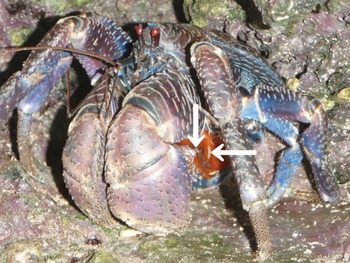
The female was at the inner part in the crevice and lifted up its body horizontally with all legs including the chelipeds, and the abdomen was curled under the body (Figure 1). At this moment, the coconut crab female had already started to extrude eggs, and deep orange-coloured and very thick eggs were observed between the body and abdomen. The pleopods were seen in the extruded eggs, which indicated that the whole volume of the egg mass was not fully extruded yet and the eggs did not attach to the pleopods thoroughly. Most of the extruded eggs clung to the pleopods and a few eggs were on the abdomen. Three pleopods alternately moved up and down slowly between her body and abdomen. By this action, eggs attached to the pleopods which touched repeatedly around the gonopores, where the spermatophore mass was deposited by the male. Hess & Bauer (Reference Hess and Bauer2002) suggested that the jostling and contact of eggs with spermatophores during egg extrusion may cause the spermatophores to split and release the sperm in anomuran crabs. We propose that this up and down motion of pleopods may function both to ensure adhesion of the eggs to the pleopods and enhance fertilization of the extruded eggs.
A coconut crab Birgus latro female in the course of egg extrusion. Deep-orange-coloured and very thick eggs were observed between the body and abdomen. The pleopods (indicated by arrows) were seen partly covered with the extruded eggs. Most extruded eggs clung to the pleopods and a few eggs were on the abdomen.

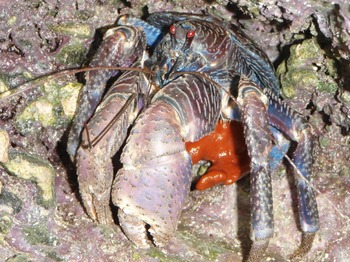
At 0007, the abdomen of the female was slightly extended backward or occasionally extended straight behind her, and then the abdomen could not be seen from the front of her because the abdomen was behind the enlarged egg mass (Figure 2). Consequently, the pleopods were moved back and forth, left and right slowly between the body and the ground; the pleopods moved only up and down between her body and abdomen when the abdomen was curled under the body. At this time, the egg mass was almost stable, which indicated that her egg extrusion had been completed. In addition, most of the extruded eggs seemed to have attached to the pleopods by this time because only a few eggs fell down from the pleopods even when the pleopods hung vertically down from the abdomen when it was extended straight backwards. Two small drops of the egg mass fell off her pleopods during the observation. After at least two hours had passed after 0007, the female remained at the same place in the crevice and kept the pleopods moving slowly between her body and ground alternately. This behaviour may let the extruded eggs be fertilized and/or attach to the pleopods thoroughly.
A coconut crab Birgus latro female in the course of egg extrusion. The abdomen was extended backward slightly or occasionally extended straight behind her, and then the abdomen was not seen from the anterior view because the abdomen was behind the egg mass. The pleopods alternately moved slowly between her body and the ground.

Our observations provide not only precise egg extrusion behaviour but also photographic evidence that coconut crab females extrude/fertilize eggs terrestrially, and that being submerged is not essential for egg extrusion/fertilization. Although we present here only a single observation of egg extrusion of this species in its natural habitat, we believe that this observation is not an exception. Egg extrusion on land is more realistic for this species compared with extrusion and fertilizing eggs in seawater based on our three years continued research on Hatoma Island. The egg extrusion required a long time, at least 2 h to extrude, fertilize and attach to the pleopods. If coconut crabs extrude eggs in water, for example in tide pools, the egg extrusion must be precisely associated with the tidal rhythm to avoid effects of wave action on the extrusion, fertilization and attachment of eggs to the pleopods, which would result in the egg extrusion being synchronized among females. If egg extruding in tide pools is synchronized among females, some investigators would probably have already witnessed and reported the egg extrusion/fertilization behaviour a long time ago.
Our conclusion that coconut crab females extrude and fertilize eggs on land is supported by other investigations conducted on the rocky shore on the nights of 18, 19 and 24 June in 2008, early in the reproductive season (Sato & Yoseda, Reference Sato and Yoseda2008). In these investigations, 126 females were observed. All ovigerous females (N = 11) had remnants of spermatophores and freshly extruded eggs, cellular cleavage was not advanced beyond the morula stage, and were covered with mud, especially on the dorsal surface of the thorax. We considered that these ovigerous females had extruded eggs within a short period prior to the observations because they had remnants of spermatophores. To the contrary, all non-ovigerous females (N = 108) and females with a spermatophore mass (N = 7) were not covered with mud. Why were only the ovigerous females covered with mud? This species generally makes use of various types of shelter, such as caves, crevices, tree roots, hollow logs or earth burrows (Fletcher, Reference Fletcher, Wright and Hill1993). They usually inhabit inland scrub or forest areas up to 3 km from the sea (Sheppard, 1979), have individual shelters and show homing behaviour to a particular crevice or sheltering site (Fletcher et al., Reference Fletcher, Brown and Fielder1990). However, females must migrate from the inland area to the coast during the reproductive season and usually remain within 100 metres of the shore for approximately 5–6 weeks (Schiller et al., Reference Schiller, Fielder, Brown, Obed, Brown and Fielder1991). Therefore, females would need to make temporary shelters during this period. Perhaps ovigerous females dig an earth burrow at their temporary shelters prior to egg extrusion after mating and then extrude and fertilize eggs in the burrows, which may result in mud adhesion to the ovigerous females immediately after egg extrusion. This observation on the mud adhesion also implies that they extrude and fertilize eggs on land, which is inside burrows or crevices, not in water. Based on our observations, we conclude here that the egg extrusion of the coconut crab occurs on land, in crevices or earth burrows, near the seashore. Therefore, it is important for sustaining egg production of this species to conserve rocky near-shore areas that form their breeding grounds.
This work was only possible thanks to the generous hospitality and cooperation of residents of Hatoma Island. We thank the editor, an anonymous referee and members of the Ishigaki Tropical Station, Seikai National Fisheries Research Institute, for helpful comments and discussions. This study was supported by a Grand-in-Aid for Young Scientists (B) (No. 20710184, to T.S.) from the Ministry of Education, Culture, Sports, Science and Technology.