Cover crops offer growers financial, agronomic, and environmental benefits, especially in a no-till production system (Snapp et al. Reference Snapp, Swinton, Labarta, Mutch, Black, Leep, Nyiraneza and O’Neil2005). The literature contains many reports of the environmental benefits of these conservation practices, such as reduced soil loss and less fuel usage (Fu et al. Reference Fu, Chen and McCool2006; Gyssels et al. Reference Gyssels, Poesen, Bochet and Li2005; Nearing et al. Reference Nearing, Jetten, Baffaut, Cerdan, Couturier, Hernandez, Le Bissonnais, Nichols, Nunes, Renschler and Souchère2005). However, the adoption of cover crops often removes mechanical weed removal as an option, placing greater reliance on herbicides. The appearance of new cases of herbicide-resistant weeds has limited postemergence options for use in row crops and contributed to greater use of residual herbicides (Young Reference Young2006).
Establishing an adequate cover crop stand is the first step and possibly the most important factor in achieving the benefits that cover crops can offer an agricultural system (Keeling et al. Reference Keeling, Matches, Brown and Karnezos1996; Walsh et al. Reference Walsh, DeFelice and Sims1993). Adequate equipment, planting method, appropriate seedbed, planting date, and seeding rate all play a role in cover crop establishment. In addition, some residual herbicides applied in row crops can affect cover crop germination and emergence in the fall (Rogers et al. Reference Rogers, Talbert and Frans1986). According to Walsh et al. (Reference Walsh, DeFelice and Sims1993), metribuzin plus chlorimuron applied at 400 g ai ha−1 and 39 g ai ha−1 PPI in soybean resulted in alfalfa (Medicago sativa L.) biomass reduction an average of 72%. In contrast, the same herbicide treatment did not affect hairy vetch and cereal rye. Alister and Kogan (Reference Alister and Kogan2005) also observed that imazapyr (20 g ai ha−1) plus imazapic (120 g ai ha−1) reduced the fresh weight of pea (Pisum sativum L.), alfalfa, and ryegrass (Lolium multiflorum Lam.) by 22%, 75%, and 63%, respectively. Similarly, Tharp and Kells (Reference Tharp and Kells2000) reported that S-metolachlor applied at 2.24 kg ai ha–1 and pendimethalin applied at 1.68 kg ai ha–1 reduced ryegrass density up to 94% and 46% in a greenhouse study.
The rate of herbicide degradation is dependent on soil characteristics such as pH, texture, organic matter, and cation exchange capacity (Walker and Barnes Reference Walker and Barnes1981; Anderson Reference Anderson1984). The effect of soil pH on herbicide persistence is known to play an important role for sulfonylureas and imidazolinones. Soil persistence of imazaquin and imazethapyr have been found to be greater in low-pH soils as a result of greater adsorption to the soil colloids, which results in lower availability for microbial degradation (Loux and Reese Reference Loux and Reese1992). Rogers et al. (Reference Rogers, Talbert and Frans1986) concluded that injury to hairy vetch and wheat following trifluralin, fluometuron, and linuron application differed significantly among soil textures (Sharkey silty>Dundee silty>Loring silt loam). Westra et al. (Reference Westra, Shaner, Westra and Chapman2014) found that the half-life of pyroxasulfone at 280 g ai ha−1 ranged from 104 to 137 d in a fine clay loam and from 46 to 48 d in a fine sandy loam.
Few studies have reported the potential of herbicide carryover applied in row crops to cover crops. With cover crop acreage increasing in the United States, this information has become important to avoid problems with cover crop establishment (SARE 2015). Hence, the objectives of these studies are to identify the sensitivity of cover crops to a low rate of soil-applied herbicides on a silt loam soil and to investigate the likelihood of herbicide carryover to fall-seeded cover crops following corn harvest. It is recognized that the “sensitivity trial” does not adequately assess the risk for carryover but does help to refine the list of herbicides that should be evaluated for carryover to cover crops. Furthermore, these results may provide an indication as to which crops have some tolerance to various herbicides, aiding weed control in the establishment phase of the cover crop.
Materials and Methods
Sensitivity Study
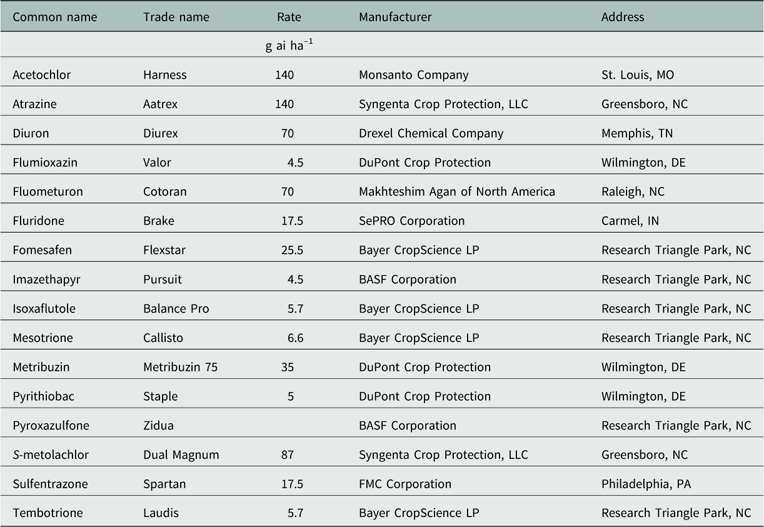
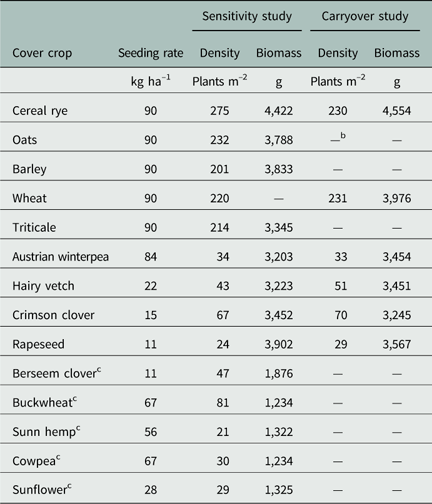
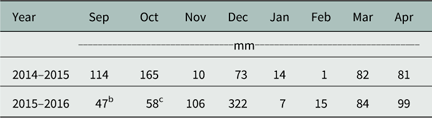
A field experiment was initiated in the fall of 2014 and 2015 at the University of Arkansas Agricultural Research & Extension Center in Fayetteville (36.4°N 94.9°W) to evaluate the sensitivity of cover crops to a low rate of soil-applied herbicides that are labeled for use in corn, cotton (Gossypium hirsutum L.), and soybean [Glycine max (L.) Merr.]. In both years, the experiment was conducted on a Razort silt loam soil (fine-loamy, mixed, active, mesic Mollic Hapludalfs) with 19% sand, 67% silt, 14% clay, pH 6.2, and 1.3% organic matter. The experimental design was a strip plot within a randomized complete block replicated four times. The strip plot was cover crop species, and the main plot was the herbicide treatments. Cover crops were planted on September 9, 2014 and September 19, 2015 using a 10-row Almaco Light-Duty Grain Drill with a single drop cone (Almaco Headquarters, Nevada, IA). Prior to cover crop sowing, the field was tilled to an approximate 10-cm depth using a disk followed by two passes of a field cultivator at a 5-cm depth. Herbicide treatments served as the main plot (Table 1) and cover crops as the strip plot (Table 2). Cover crop species evaluated and seeding rates are shown in Table 2. Herbicides were applied at a 1/16×labeled rate 1 d after cover crop planting with a CO2-pressurized backpack sprayer equipped with AIXR 110015 flat fan nozzles (TeeJet®, Spraying Systems Co., Wheaton, IL) delivering 140 L ha−1. A nontreated control was included for all cover crop species. One day after the herbicide application, the experimental site was irrigated (1.3 cm) using a traveling gun sprinkler to aid herbicide activation. Monthly rainfall amounts for each year are presented in Table 3.
Herbicide information for all products used in the sensitivity study.

Cover crop species seeding rate and density and biomass of nontreated control in the sensitivity and carryover studies.Footnote a

a Density data were collected 14 d after treatment. Biomass data were collected the following year for winter cover crop species and at first frost for summer cover crop species.
b Not evaluated in carryover study.
c Summer cover crop.
Monthly rainfall for 2014–2015 and 2015–2016 for the sensitivity and carryover studies.Footnote a

a Sensitivity study planting dates were September 9, 2014 and September 19, 2015. Carryover study planting dates were September 19, 2014 and October 1, 2015.
b For the sensitivity study, 2.5 cm of irrigation was applied in September 2015.
c For the sensitivity study, 1.3 cm of irrigation was applied in October 2015.
Carryover Study
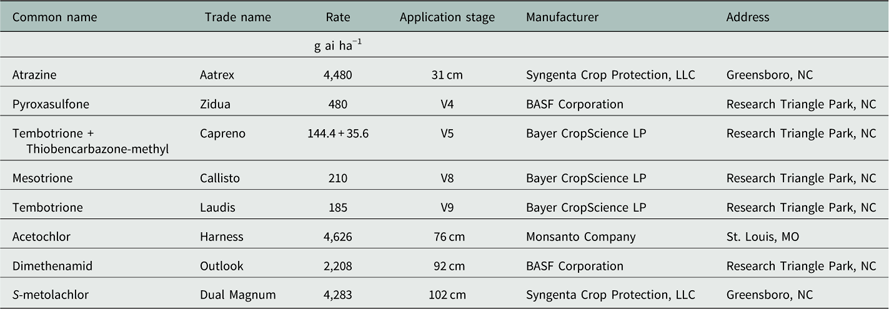
A field experiment was initiated in the summer of 2014 and 2015 at the University of Arkansas Agricultural Research & Extension Center in Fayetteville to evaluate the risk of carryover of residual herbicides applied in corn to cover crops planted after harvest. In both years, the experiment was conducted on a Captina silt loam soil (fine-silty, siliceous, active, mesic Typic Fragiudults) with 33% sand, 49% silt, 18% clay, pH 6.0, and 1.0% organic matter. Dekalb 46-36 corn hybrid was planted with a four-row planter (John Deere 6403; Deere and Company, Moline, IL) equipped with double-disk openers set to a 91-cm row spacing at a seeding rate of 62,000 seeds ha−1. Corn was planted on April 10, 2014 and April 3, 2015. The experimental design was a strip plot with a randomized complete block with four replications. Herbicide treatments served as the main plot (14.6 by 7.2 m) and cover crops as the strip plot (1.9 by 7.2 m). The herbicide treatments were applied at the latest stage of the corn crop allowed in each herbicide label at a 2×rate (Table 4) with a CO2-pressurized backpack sprayer equipped with AIXR 110015 flat fan nozzles (TeeJet®, Spraying Systems Co., Wheaton, IL) delivering 140 L ha−1. A nontreated control was included for all cover crop species. Austrian winterpea, cereal rye, crimson clover, hairy vetch, rapeseed, and wheat were sown on September 9, 2014 and September 21, 2015 using seeding rates shown in Table 2. Prior to cover crop sowing, the field was lightly disked in the direction of the corn rows. Cover crops were broadcasted in strips 1.9 by 90 m and immediately incorporated into the soil with a disk. Monthly rainfall data are presented in Table 3.
Herbicide information for all products used in the carryover study.

Data Collection
At 14 d after planting (DAP), cover crop density was determined by counting all emerged plants within a random 0.5-m2 quadrat in every subplot in the sensitivity study and two random 0.5-m2 quadrats in the carryover studies. No cover crop emergence was observed after 14 DAP. Similarly, aboveground biomass was collected from the same quadrat from which stand counts were taken. Aboveground biomass of summer cover crops was collected October 31, 2014 and November 8, 2015 in the sensitivity study, whereas aboveground biomass data of winter cover crops were collected on April 2, 2014 and April 6, 2015. Biomass samples were weighed after air-drying at 65 C for 5 d. Density and biomass for all nontreated cover crops for both the sensitivity and carryover studies are shown in Table 2. Cover crop densities and biomass were converted to a percentage reduction relative to the density and biomass of the nontreated control.
Data Analyses
All densities and biomass reduction data were analyzed in JMP 12 PRO (JMP, Version 12. SAS Institute Inc., Cary, NC). The analyses of stand and biomass reduction were performed by individual cover crops, because the objective of the study was to identify the sensitivity of each cover crop to the residual herbicides. Herbicide treatment was considered a fixed effect in the model, whereas replication was considered a random effect. No interaction was observed between herbicide treatment and year on stand and biomass reduction; hence, year was also considered a random effect. Means were separated using Fisher’s protected LSD at α=0.05.
Results and Discussion
Sensitivity Study
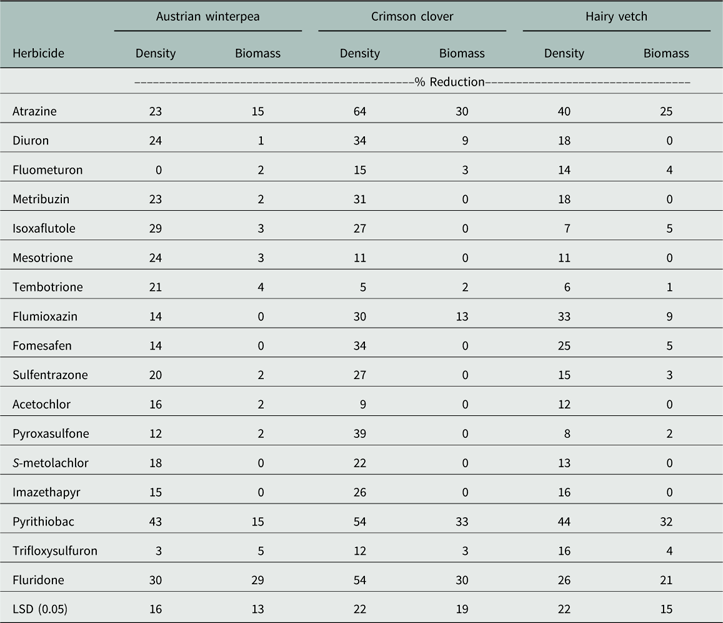
Analysis of cover crop densities showed that several herbicides reduced leguminous cover crop density (Table 5). The stand reduction provided by the photosystem II (PSII)–inhibiting herbicides atrazine, diuron, and metribuzin reduced leguminous cover crop densities 23% to 40% 14 d after treatment (DAT). Hairy vetch was affected only by atrazine, whereas crimson clover and Austrian winterpea were affected by all PSII-inhibiting herbicides, except fluometuron. Kells et al. (Reference Kells, Leep, Tesar, Leavitt and Cudnohufsky1990) reported that atrazine applied at 2.2 kg ha–1 to corn injured alfalfa 5% to 72% when planted the following year.
Sensitivity of leguminous winter cover crops to a 1/16xrate of residual herbicides averaged over 2014–2015 and 2015–2016.Footnote a , Footnote b

a Stand counts were taken 14 d after treatment.
b Biomass samples were collected in the spring of the following year.
The 4-hydroxyphenylpyruvate dioxygenase (HPPD)–inhibiting herbicides isoxaflutole, mesotrione, and tembotrione reduced Austrian winterpea density by 29%, 24%, and 21%, respectively, at 14 DAT (Table 5). Among HPPD-inhibiting herbicides, only isoxaflutole reduced stand of crimson clover (27%), albeit there was no reduction in biomass the following spring. No HPPD-inhibiting herbicide had a significant effect on hairy vetch stand or biomass (Table 5). Riddle et al. (Reference Riddle, O’Sullivan, Swanton and Van Acker2013) reported that a simulated carryover rate of mesotrione (28 g ha–1) injured pea (Pisum sativum L.) by 11% 39 DAP and reduced yield by 19%.
Sulfentrazone was the only protoporphyrinogen oxidase–inhibiting herbicide that decreased Austrian winterpea emergence (20%) 14 DAT (Table 5). Also, flumioxazin, fomesafen, and sulfentrazone decreased emergence of crimson clover by 30%, 34%, and 27%, whereas only fomesafen decreased hairy vetch emergence by 25%.
The very long chain fatty acid herbicides acetochlor and S-metolachlor also differed in their effect on leguminous cover crop emergence. Although acetochlor did not reduce emergence of any leguminouw cover crop, S-metolachlor reduced Austrian winterpea and crimson clover by 18% and 22%, respectively, 14 DAT (Table 5).
The three acetolactate synthase–inhibiting herbicides behaved differently. Pyrithiobac reduced Austrian winterpea, crimson clover, and hairy vetch emergence by 43%, 54%, and 44%, respectively, compared to the nontreated check, but trifloxysulfuron had no effect on leguminous cover crop emergence. Imazethapyr was detrimental only on crimson clover with 26% reduction. A study conducted in Mississippi showed that application of pyrithiobac at 86 g ha–1 to bare soil injured soybean planted 357 d after application (Smith et al. Reference Smith, Shaw and Miller2005).
Although several herbicides were detrimental to leguminous cover crop emergence, most of these reductions did not affect biomass production the subsequent spring. Among all herbicide treatments, only atrazine, fluridone, and pyrithiobac reduced biomass production of all leguminous cover crops evaluated (Table 5). Several reports confirm that atrazine residues can affect row crop and cover crop establishment (Burnside and Wicks Reference Burnside and Wicks1980). Robinson (Reference Robinson2008) reported that atrazine at 560 g ha−1 applied to corn 1 yr before transplanting carrot (Daucus carota L.), cucumber (Cucumis sativus L.), and onion (Allium cepa L.) reduced their yield by 25%, 67%, and 32%, respectively. Rafii and Ashton (Reference Rafii and Ashton1979) observed in a greenhouse trial that soybean treated with a 1/8×rate of fluridone had reduced shoot length and weight, severe chlorosis, and inhibition of trifoliate formation. Webster and Shaw (Reference Webster and Shaw1996) also reported that pyrithiobac applied at 140 g ha−1 PPI reduced soybean yield the following year. Based on their results and the results of this experiment, it is likely that pyrithiobac would affect small-seeded broadleaf cover crop establishment in the fall. However, all herbicides cited above have different persistence levels depending upon the soil characteristics and environmental conditions. Factors such as soil pH, soil texture, organic matter, temperature, and rainfall amount can drastically influence herbicide persistence in the soil (Smith et al. Reference Smith, Shaw and Miller2005; Pussemier et al. Reference Pussemier, Goux, Vanderheyden, Debongnie, Tresinie and Foucart1997; Shea and Weber Reference Shea and Weber1983).
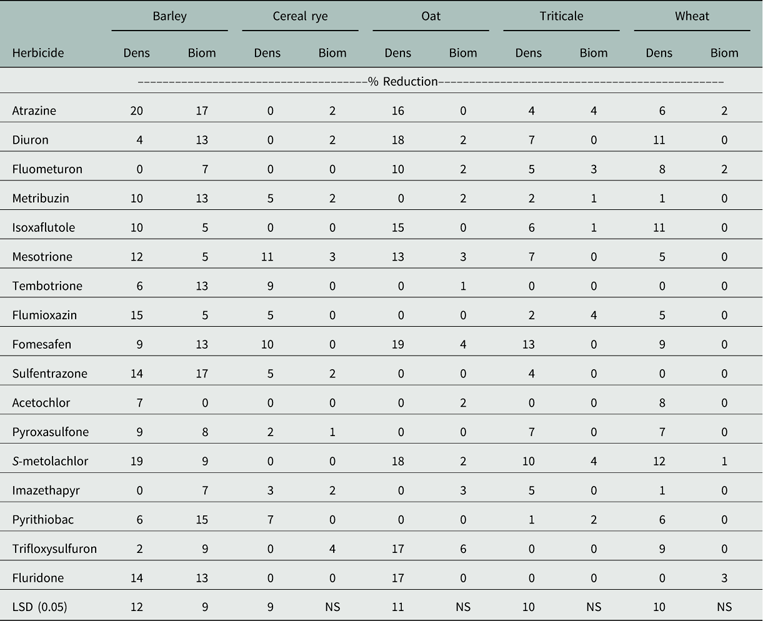
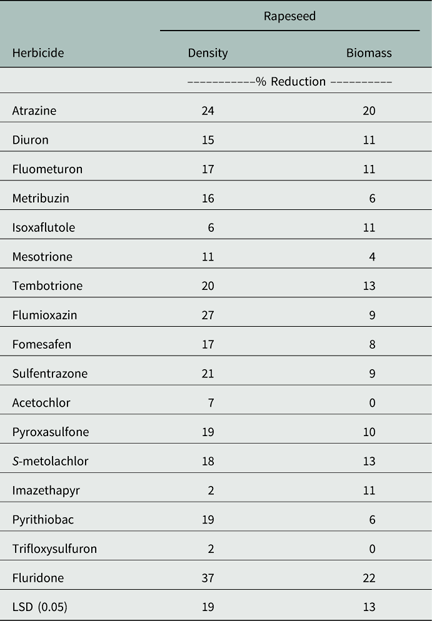
Higher levels of tolerance were observed with cereal cover crops (Table 6). Among PSII-inhibiting herbicides, only atrazine reduced emergence of barley (20%) and oats (16%), whereas diuron reduced barley (13%), oats (18%), and wheat (11%) emergence. Ivany et al. (Reference Ivany, Sadler, Kimball and McRae1985) reported that an application of atrazine at 1.12 kg ha–1 in corn did not show any effect on cereal rye and barley planted approximately 3 mo later. Isoxaflutole reduced emergence of oats and wheat by 15% and 11%, respectively. Mesotrione also was detrimental to cereal rye (11% emergence reduction) and oats (13% emergence reduction). Fomesafen reduced barley, cereal rye, oat, and triticale stands, whereas flumioxazin and sulfentrazone affected only barley (Table 6). S-metolachlor was the only very long chain fatty acid herbicide that reduced stand of cereal cover crops. Barley emergence was reduced 19% by S-metolachlor, whereas oats and wheat emergence reductions were 18% and 12%, respectively. Trifloxysulfuron was the most harmful acetolactate synthase–inhibiting herbicide, reducing stands of oats by 17%. Barley and oats were the only cereal cover crops that were sensitive to fluridone. Atrazine and fluridone were generally the most injurious to rapeseed based on stand and biomass reduction (Table 7).
Sensitivity of cereal cover crops to a 1/16xrate of residual herbicides in Fayetteville, AR, averaged over 2014–2015 and 2015–2016.Footnote a , Footnote b , Footnote c

a Stand counts were taken 14 d after treatment.
b Biomass samples were collected in the spring of the following year.
c Abbreviations: Biom, biomass; dens, density.
Sensitivity of rapeseed to a 1/16xrate of residual herbicide averaged over 2014–2015 and 2015–2016.Footnote a , Footnote b

a Stand counts were taken 14 d after treatment.
b Biomass samples were collected in the spring of the following year.
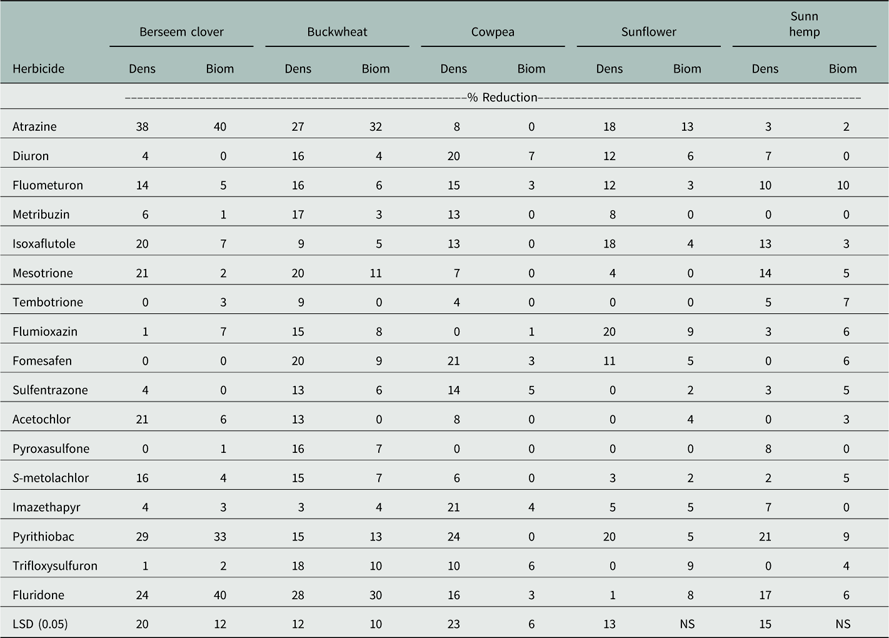
Similarly to winter cover crops, the sensitivity of summer cover crops also varied depending upon the cover crop species and herbicide (Table 8). Low rates of atrazine, isoxaflutole, fluridone, mesotrione, and pyrithiobac reduced berseem clover (Trifolium alexandrinum L.) emergence. However, the reduction of emergence only translated to reduced biomass in the atrazine, pyrithiobac, and fluridone treatments. Buckwheat (Fagopyrum esculentum Moench) was sensitive to several herbicide treatments, with stand loss ranging from 13% to 28%; however, only atrazine, fluridone, mesotrione, pyrithiobac, and trifloxysulfuron negatively affected buckwheat biomass (Table 8). Cowpea [Vigna unguiculata (L.) Walp.], sunflower (Helianthus annuus L.), and sunn hemp (Crotalaria juncea L.) were tolerant to a 1/16×rate of the evaluated herbicides. Johnson and Talbert (1996) observed that application of fomesafen at 0.28 kg ha–1 did not injure sunflower planted 16 wk after the application. Seed size of the cover crops seems to be an important factor in this study, as seen in other research (Ghersa and Martinez-Ghersa Reference Ghersa and Martınez-Ghersa2000). Regardless of the herbicide, small-seeded cover crops appeared to be more affected by a low rate of herbicides compared to the large-seeded cover crops (Table 8).
Sensitivity of summer cover crops to a 1/16xrate of residual herbicide averaged over 2014–2015 and 2015–2016.Footnote a , Footnote b , Footnote c

a Stand counts were taken 14 d after treatment.
b Biomass samples were collected in the spring of the following year.
c Abbreviations: Biom, biomass; dens, density.
Carryover Study
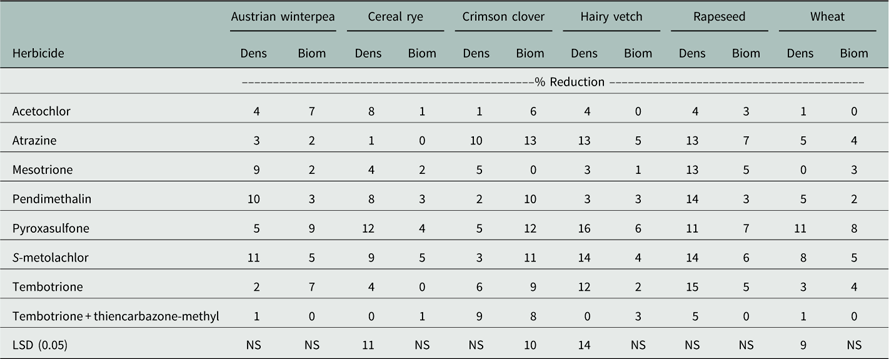
Results from the carryover study show that there is a low risk of herbicide carryover from residual herbicides commonly applied in corn to winter cover crops (Table 9). None of the herbicides used in the study had any impact on emergence and biomass production of Austrian winterpea. Similarly, none of the herbicides reduced crimson clover emergence; however, biomass production of crimson clover was significantly reduced by atrazine (13%), pendimethalin (10%), pyroxasulfone (12%), and S-metolachlor (11%). Cereal rye and wheat emergence were only affected by pyroxasulfone. No reduction in biomass occurred in any herbicide-treated plot. These results contrast with Ivany et al. (Reference Ivany, Sadler, Kimball and McRae1985), who observed 81% to 90% dry matter reduction for cereal rye following atrazine at 4.5 kg ha–1 in corn. However, their results may be due to conducting the field trial on a sandy soil with no irrigation.
Influence of residual herbicide applied in corn on winter cover crops in Fayetteville, AR, averaged over 2014–2015 and 2015–2016.Footnote a Footnote b

a Rates of each treatment are described in Table 4.
b Abbreviations: Biom, biomass; dens, density.
Practical Implications
The sensitivity study shows that there are several species that are sensitive to a low rate of residual herbicides commonly applied in corn, cotton, and soybean. It appears that small-seeded broadleaf cover crops are more likely to be affected by low concentrations of residual herbicides in the soil. However, these minor reductions in emergence and biomass production are unlikely to jeopardize cover crop adoption by farmers. Large-seeded cover crops such as winter cereal cover crops were tolerant to all herbicides used in this experiment. Long-term evaluation in different sites would provide a better understanding of the risks of planting cover crops subsequently to application of residual herbicides.
The carryover study provided evidence that herbicides commonly applied to irrigated corn have low risk for carryover to winter cover crops. The application of 2×rates of residual herbicides did not affect emergence and biomass production of cover crops. However, it is important to emphasize that persistence of herbicides in soils is likely to change depending on such variables as soil texture, temperature, pH, organic matter, rainfall, and irrigation regime (Walker and Barnes Reference Walker and Barnes1981). Hence, these results cannot be generalized over broad production practices, environments, and soils, because all these factors are probably linked to geographic regions. For example, Cornelius and Bradley (Reference Cornelius and Bradley2016) conducted a carryover study from corn to cover crops in Missouri and observed different levels of carryover between years attributable to differing amounts of rainfall each year. The extent of carryover from the herbicides evaluated in their study to cover crops was generally higher than in this research. However, their research was conducted under dryland conditions, whereas this study was conducted under furrow-irrigated conditions, as is typical of corn production in Arkansas.
Acknowledgments
Partial funding for this research was provided by the Arkansas Cotton Support Committee.