




No CrossRef data available.
AGENCY AND THE “STAR WAR” GLYPH: A historical reassessment of Classic Maya astrology and warfare
Published online by Cambridge University Press: 28 March 2006
Abstract
Several studies over the past 20 years have argued for an explicit connection between a hieroglyphic record of war, the so-called star war, and the observation of Venus. To the last, these studies have relied on statistical treatments or simple numerical coincidence to substantiate their claims. In this paper I challenge the results of these studies on two levels. First, I demonstrate that the iconographic evidence that inspired the association between Venus and the “star war” verb is itself unstable; then I appeal to the historical contexts of the rulers engaged in this warfare to see if, as individuals, there is evidence that they held such a belief. In both cases, I show that the evidence does not support a ritual timing of Classic Maya warfare by the phases of Venus. At end, I turn to philological consideration to propose a new reading for the “star war” verb.
Information
- Type
- Research Article
- Information
- Copyright
- © 2005 Cambridge University Press
An important question facing scholars investigating the ancient past is the extent to which intellectual activity may be recovered from the archaeological record by statistical means. If, for example, we look to studies of ancient European astronomy, we confront arguments for astronomical knowledge embedded in archaeological remains that rely entirely on statistical patterns. In 1981, Anthony Aveni provided a very poignant caveat to such treatments. Using the ceque lines of Cuzco, for instance, Aveni demonstrated that statistical treatments can prove misleading, if not completely wrong (Aveni 1981:305–318). In this case, statistical attempts to correlate the numerous ceque lines to astronomically observable phenomena require a conclusion that no association existed whatsoever. Nevertheless, in consulting ethnohistorical records, Aveni encountered a number of statements clearly designating an astronomical inspiration behind some of these lines. And some of these served very important calendric functions for the ritual and agricultural life of the city. Thus, Aveni presents a case in which the idiosyncrasies of history directly contradict the generalizations of statistics. As he concludes, “In Andean archaeoastronomy, ethnohistory does not confirm orientations—it generates the hypotheses and rationale for conceiving of them in the first place” (Aveni 1986:5).
While studies of Mesoamerican astronomy generally have heeded this warning, Maya studies should pay it particular attention. For it is in Classic Maya culture that we may go beyond ethnohistorical inspiration and appeal to actual historical records. In doing so, we gain the opportunity to question even lighter applications of statistical methods in reconstructing intellectual activity. In this paper, I do so explicitly by challenging the recovery of the type of astrology most commonly attributed to the ancient Maya: that concerning the “star war.” Popularized by Linda Schele and David Freidel in A Forest of Kings (1990), this astronomical association of a hieroglyphic verb was first hinted at by David Kelley (1977) and then reified by the work of Michael Closs (1978, 1981) and Floyd Lounsbury (1982). In sum, they noted that a verb containing an EK' (star) element and referring to military battle seemed to be related to the planet Venus. This work precipitated two more recent statistical studies that purported to corroborate the Venusian aspect of the hieroglyph (Aveni and Hotaling 1994:S21–S54; Nahm 1994:6–10). Scholars have since taken the interest in Venus records so far as to propose that the Middle Tablet of the Temple of Inscriptions at B'aakal (Palenque) explicitly recorded a maximum elongation of Venus (Closs 1994:230–231; Figure 1).

A passage from the Middle Tablet of the Temple of Inscriptions that has been considered a record of the maximum elongation of Venus.
In light of the advances made in the decipherment of the Maya hieroglyphic script during the 1990s, I suggest that we can now subvert the reliance of the “star war” theory on statistical suggestion. That is, our understanding of the script is now sufficient to produce a history that can guide our forays into the recovery of ancient Maya intellectual efforts akin to Aveni's ethnohistorical work. Further, rather than eliminating the human agent by attempting to correlate celestial events directly to a set of dates, I turn to the rulers themselves who commissioned the recording of specific battles with the “star war” verb for verification of the results produced by statistical analyses. This approach places the burden of proof on the beliefs and activities of individual people, thus bypassing appeals to the statistical revelation of “cultural attitudes.” The end result of the first part of this paper demonstrates that individually Maya rulers did not associate the idea behind the “star war” verb with the planet Venus, and so neither did they do so as a collective.
Having removed the statistical link between this verb and Venus, I then turn to textual exegesis to build on the suggestion in David Stuart's Ph.D. dissertation that meteor phenomena best bring together all the data we have concerning this verb and the type of battle it was intended to portray (Stuart 1995:310–311). This meteor association is further corroborated by grammatical considerations that lead to the reinterpretation of Mutul II's (Dos Pilas's) military history, which in turn reveals new insight into elite politics and the role of astrology in Classic Maya warfare. In the end, we find that a historical reassessment of ancient Maya astrology undoes many inferences of Venus “implications” in hieroglyphic texts—even the purported and heavily cited record of Venus in the inscriptions of B'aakal.
CHAK EK' HISTORIOGRAPHY
The glyph that I am concerned with—known generally as the “star war” verb but also as the shell-star or star-over-earth verb (Figure 2)—has been troublesome to Classic Maya scholarship for a number of years. The prevailing published opinion is that it indicated that battles were timed according to the phases of Venus (Aveni and Hotaling 1994:S21–S54; Coe 1993:189; Kelley 1977:57–74; Lounsbury 1982:143–169; Martin 1996:223; Nahm 1994:6–10; Schele and Freidel 1990). To understand this interpretation properly, I turn first to an aspect of the history of Maya studies. This historical sketch will demonstrate that the correlation between Venus and this glyph is more the result of methodological trends in modern archaeoastronomy than a product of Maya astronomical culture.

Variants of the “star war” verb from (a) Mutul (II) Hieroglyphic Stairway 4; (b) Mutul Temple IV, Lintel 2; (c) Caracol Stela 3.
Michael Coe (1992) has provided a good demonstration of how interpretations of Maya culture correlate historically to perspectives of the hieroglyphic writing. For the first 50 years of the twentieth century, for instance, American scholarship portrayed the Classic Maya as a humble collection of milpa farmers led by pacifistic priests obsessed with time and the celestial bodies. At one level, this is sensible, since the Dresden Codex was one of the best-understood ancient Maya artifacts during this time (Thompson 1972). In turn, the best-understood elements of this document were those pertaining to the celestial realm: the tables charting the phases of Venus and those recording eclipse periods of the moon (Lounsbury 1978:759–818; Thompson 1972). Early scholars were then justified in reconstructing Maya culture with deft use of Ockham's razor and this better-understood material.
Such an approach underlays the work of John Teeple early on and that of David Kelley and Dennis Tedlock more recently, all of whom sought evidence for the application in the inscriptional record of the knowledge explicitly recorded in the Dresden manuscript (Teeple 1930; Kelley 1977, 1980; D. Tedlock 1992). Specifically, these scholars investigated whether the dates recorded on the ancient monuments were separated by intervals corresponding to astronomical cycles. We can now put forward the critique that, in many cases, this methodology could have ascribed method to coincidences of numerical factorizations (Aldana 2001a:138–144). Yet to pre-decipherment Mayanists, when this approach appeared successful, belief in the astronomical acuity of even the earliest priests was strengthened (e.g. Dütting and Schramm 1985; Schele 1990).
The numbers, then, seemed to ratify astronomical content within the inscriptions; so did a partial understanding of the hieroglyphics. As early as the late nineteenth century, Ernst Förstemann recognized that the glyph couplet running all through the Venus Table appeared to refer to the planet. Later, Eric Thompson demonstrated in Maya Hieroglyphic Writing that Chak Ek' (Great Star) is the name in both modern and colonial Maya languages for Venus and that it corresponded nicely with Förstemann's glyph couplet (Thompson 1971:220–221). The EK' portion of this compound has been identified throughout Classic art, inscriptions, and iconography in the two variations used in the thirteenth-century Dresden document (Figure 3). Both variants have often been read as specifically standing for the planet Chak Ek', although Kelley (1980) has noted in passing that the strict identification of EK' with the planet Venus is “inaccurate.”

Ek' substituting for Chak Ek' in the Dresden Codex Venus Table.
We are now in a position to see how the creation of the “star war” verb interpretation grew out of a combination of methodological trends in Maya studies. That is, when Kelley, Closs, and Lounsbury noticed that a number of these verbs fell on dates corresponding to “Venus events,” they were actually following the two trends noted earlier: (1) seeking astronomical cycles within Classic-period inscriptions with little regard for context; and (2) identifying an instance of EK' as referring to Chak Ek'. Of course, following a trend or two is not in itself an error. What these three articles did, however, was perpetuate these trends at a time when the deciphering of the hieroglyphs was coming into its own—a time that should have called for a reevaluation of all iconographic-based methodologies. For instance, in 1995 Schele took up a number of new Long Count possibilities generated by Stephen Houston's new drawing of the Bonampak text in Room 2 (Schele and Grube 1995:160). Houston (personal communication 1999) believes that the day sign clearly is not Chikchan, as Lounsbury had read it. Schele argued that Chikchan was still a possibility, though this reading, of course, supported her interpretation of the text. In addition, Stuart has read the day sign as an uncommon variant of Ok (Schele and Grube 1995:308), pointing to evidence available in 1988. The upshot is that, without the Chikchan reading, an important part of the “star war” interpretation was called into question. Yet the momentum generated on the issue was already too great to be stopped for reassessment.
Hence, when I now attempt this long overdue reassessment, I do so against a substantial body of popular and technical literature (Aveni and Hotaling 1994:S21–S54; Coe 1993:189; Kelley 1977:57–74; Lounsbury 1982:143–169; Nahm 1994:6–10; Schele and Freidel 1990). This situation clearly demands that we carefully go through the inferences supporting the “star war” interpretation. In this portion of the article, I begin with the simpler identification of the ek' icon as Venus and then consider the larger association of Venus to the “star war” verb.
As noted earlier, the specific argument for the identification of EK' with Venus originated in the pages of the Dresden Codex. In that work, the phases of Venus are nested within a formulaic glyphic text. The compound Chak Ek' occurs in each column, but sometimes the Chak prefix is dropped (Figure 3). Scholars have noted this “substitution” and argued that Chak Ek' and EK' must be equivalent and that both served as proper names for Venus. Two factors argue against this being the case, and a third argument complicates the issue further.
First there is simple contextualization. If a scribe is recording the name of a specific planet over and over, he is undoubtedly warranted in referring to that planet occasionally as “the planet” (or “the celestial body”), with the referent remaining unambiguous (e.g. Venus is bound … Venus is bound … the planet is bound). This is all the more forgivable in the Dresden Codex, when the difference amounts to the writing of “the star” for “the great star.” Since the author of the manuscript was not writing this for a public audience (or possibly for anyone other than himself), such economy of words is not far-fetched but expected.
Second, the Eclipse Table, which follows the Venus Table in the Dresden Codex, contains a number of simple scribal errors. On page 53, for instance, the sequence 177, 353, 502 is recorded as the running sum of 177, 177, and 148, but it should have been 177, 354, 502. That this was a copyist's error is evident in the fact that the error is isolated and did not propagate through the table, as it would have through rolling computation. This example of scribal error allows for an alternative possibility that the occasional omission of the chak prefix in the Venus Table was an oversight.
Third, Barbara Tedlock notes that in modern K'iche and Colonial Yucatec languages, all planets are known as “red stars” (kaq ch'umil and chachac ek), which, given that chak translates as “red” or “great,” is a possible translation of chak ek' (Tedlock 1992:28). Since archaeoastronomical literature commonly invokes ethnographic and ethnohistoric analogy (or even continuity), we might be tempted to invoke them here and claim that the Venus Table does not provide the Maya name for Venus at all; the identity exists only in the numbers. That is, the table might have read (paraphrasing): “After 8 days, is bound in the north, … the planet; 236 days, is bound in the west…. the planet; after 326 days, is bound in the south…. the planet….” Since only Venus holds these characteristics, we can be assured that the table refers to that planet in particular, even though it is not named explicitly. Although this is a perfectly reasonable inference, a secure argument for it would require a much more extensive study, which is beyond the scope of this article.
There is even more evidence, though, to deny the identification of EK' with Chak Ek'. Several instances of the ek' glyph in context argue, for example, for strict reading as “celestial body.” In scenes from Bonampak (see Figure 4) and Copan (Structure 10L–22), patterns of multiple ek' signs in one iconographic construct imply that constellations were intended (Figure 4). Indeed, this is how Lounsbury and Schele interpreted them in their identifications of the peccaries and the turtle in the Bonampak murals. Interestingly, these two scholars were also in accord with Aveni and Closs (among others) who have argued that the placement of the ek' icon in a figure marks it as being affiliated with the planet Venus (Closs et al. 1984:221–247; Freidel et al. 1993:316, 361; Lounsbury 1982).

Multiple ek' icons in one image from Bonampak murals.
When we turn to the inscriptions, we find that Maya scribes were more meticulous than these arguments imply. In general, when depicting a being's identity, Maya scribes did so with a headdress or mask (Houston and Stuart 1996:297, 1998). Markings elsewhere on that being were meant to be representative. Water icons on a figure, for instance, meant that the body was made of water; “kawak” markings denoted that the thing was made of stone (Schele and Miller 1986:45–48). Following this logic, EK' markings should indicate that a body was composed of celestial “stuff.”
Finally, the “star” glyph shows up in at least three name sequences that also argue against its having a dual identity. In the early history of Caracol, for instance, the mother of Tum Ol K'inich was named Na Batz' Ek'. On an early Classic jade ornament, we find the name of a god as Sak' Ik'-Muyal? Ek'. Third, a late Classic stela at Copan records an explicit reference to “Ajaw Chak Ek' U Ok Jun Winik Ajaw.” The fact that these three uses of EK' in names require three elaborate and distinct adjectives implies that the Maya scribes were quite precise in attributing meaning. We should therefore honor this precision and read EK' exclusively as the generic term for celestial body.
ASTROLOGICAL REASSESSMENT
Thus, the association between Venus and the “star war” verb is called into question on epigraphic terms, but there has also been a strong astrological claim associated with the verb. While Schele, Freidel, Mary Miller, and Coe perpetuated this association in the popular literature, scholarly attempts at justifying the correlation all but disproved it. Prima facie, Aveni and Lorren Hotaling produced the most thorough and comprehensive study to date, subjecting old and new data to rigorous statistical analysis. Their chi-squared methodology led them to conclude that there could have been a correlation between war and Venus during the Classic period if, on the day of the given event, one allows the planet to have been near: first evening appearance, last evening appearance, first morning appearance, greatest elongation, maximum altitude, or just “high in the sky” (Aveni and Hotaling 1994:S35). Since proximity to one of these categories still could not account for all the data, they added the possibility that, when Venus was not visible, another planet “high in the sky” could substitute for it. Such broad conditions, it seems to me, do more to disprove the correlation than to corroborate it.
Close inspection also reveals specific problems with Aveni and Hotaling's study that have to do simply with data selection. That is, their analysis entailed a classification of Venus-related events into three categories. The first of these they described as “a linguistic glyph tag associated with a date—the so-called ‘star’ events connected with some form of the main sign T510 or ‘star verb’” (Aveni and Hotaling 1994:S24). Although nearly every data point they selected does connect an occurrence of the ek' glyph (T510) with a date, not all of those occurrences were as part of verbs or had to do with “star wars,” or even “star events.” In fact, a significant number were simply instances of the ek' glyph in the telling of the family history of Ix Batz' Ek'—that is, they were references to a person's name, not to a celestial body. In other cases, the EK'-related events were attributed to incorrectly read Long Count dates (Table 1). Removing these dates from their analysis does not disprove their conclusions, but it does reduce their corroborative evidence.
Non–“star war” events and erroneous dates used in studies seeking to corroborate the “star war” theory

Werner Nahm attempted a later study of similar data—apparently without knowledge of Aveni and Hotaling's study—that claimed to find a stronger, though more complex, correlation between Venus and warfare (Nahm 1994:6–10). However, in the next issue of Mexicon, the journal in which Nahm's paper was published, Hotaling refuted Nahm's findings primarily on the issue of data selection (Hotaling 1995:32–37). While some of Nahm's dates were the corrected versions of Aveni and Hotaling's numbers, several of his dates were “interpreted” to match his thesis. That is, when an event did not fit into one of the bins that corresponded to an expected Venus event, and when there was some ambiguity in the reading of that date, Nahm chose the date that best fit his hypothesis of a timing correlation. Hotaling demonstrated that without these manicured numbers, Nahm's study was far less conclusive.
The net result of these three studies is that, on a statistical level, it is difficult to say with any confidence that the “star war” verb was specifically connected to the movements of Chak Ek' for the Classic culture as a whole.
Moreover, while the statistical approach has been used most often, I believe it is the least effective method for revealing Maya astronomy now that we can read a large majority of the inscriptions. Simply put, the statistical approach hides all of the contingencies that make the astronomy worthy of study. And only in the history will we find the astronomy in which the Maya themselves were interested. Maya rulers, for example, had to make choices regarding whether war was politically warranted, whether a specific omen was relevant to the war at hand, and which wars should have been included in which historical records. All of these choices are unaccounted for in the earlier statistical analyses.
Furthermore, the issues confronting the researcher are generally overwhelmed in an article by the sheer complexity of a statistical analysis of astronomy, such that the assumptions behind the analysis are given little consideration (Aveni 1992:16–17)—hence, for example, the fact that there is no confirmed correlation between the Classic Maya and Julian calendars (Aldana 2001a, 2001b; Kelley 1983)—and so between the dates on the inscriptions and the events purported to be visible in the night sky—gets token acknowledgment, but the outcome of the statistical analysis is treated as giving real insight into Classic Maya culture.
To avoid these problems and make use of the hieroglyphic decipherment, I attempted local analyses to see if Maya rulers individually followed methods for timing their battles according to the vagaries of Venus. If groups of Maya rulers in time or space followed the dictates of the planet in their war plans, then surely a method for doing so would be identifiable in the military history left by particular rulers. This might even bring us one step closer to the actual court astronomers than could be achieved through all-inclusive statistical analyses.
Now, the extreme skeptic might question even the possibility that the ancient Maya would have been able technologically to time battles according to the phases of Venus. In fact, sufficient capturing of the phases of Venus would have been simple enough without resorting to any sophisticated mathematics. If, for example, a sky watcher kept a simple tally of the days of visibility of Venus during its different phases, she might come up with a record such as the one in Table 2. If this were her only familiarity with the planet, she could easily continue to track its movements by expecting one of four possible phases: (1) visibility in the morning sky for about the duration of one complete chol k'ij (260-day “sacred round”); (2) invisibility for more than 40 days; (3) visibility in the evening sky for another complete chol k'ij; and (4) invisibility for about another eight days.
A typical record of Chak Ek' observations for an 8-year perioda

Thus, a single observer over a span of eight years could accumulate the necessary information regarding the planet to begin timing ceremonial events by Venus's phases, were these desirable. This, of course, raises the question of how such timing might have been considered “desirable.” Ethnohistoric data and the Venus Table of the Dresden Codex suggest that the different phases of Venus might have carried different omens for the Classic Maya. For the modern researcher to determine when, or whether, Venus was in a given phase on a particular date in the Maya Long Count, though, one must first choose a calendar correlation between the Maya and Christian chronologies. To date, the practice has been to accept one of the three possibilities. Although this family of correlations bears the weight of some strong favorable opinions, as noted earlier, none of them yet has been unequivocally proved (Aldana 2001b; Kelley 1983).
In this paper, I avoid the issue entirely by working in a coordinate-free environment. That is, I do not look for any particular position in the Venus cycle; instead, I look for the clustering of positions within an arbitrarily anchored Venus Round. That is, from an arbitrary starting date I plotted the intervals produced by the dates of successive battles as fractions of the 583.92 period of Chak Ek'. Since I was looking specifically for clustering, the planetary cycle was graphed as a circle and marked with “star war” events at fractions of 360 degrees. Consequently, the data presented in this form consist only of those belonging to rulers who engaged in more than one “star war”—or, more precisely, who recorded more than one such war.
This last point, I think, brings up an even more valuable aspect of the historical approach—namely, the scribes were recording official history on the public monuments from which these battle records were extracted. If a ruler believed in the oracular quality of the “star war” battle, then surely he would have included that oracular character in the records that he presented to the public. If, for instance, he believed that “star wars” should be conducted (or would have favorable outcomes) only when undertaken under a specific station of Venus in its cycle, then the battles corroborating this belief most likely would have been publicly commemorated—or so the hypothesis goes.
Turning now to the record itself, I used the earliest occurrence of the “star war” verb in the inscriptional record as the arbitrary “zero” reference. This turned out to be Yajaw Te' K'inich's conquest of Mutul on 9.6.8.4.2 7 Ik' 0 Sip. Enough rulers recorded more than one “star war” to generalize the ensuing results over the entire Classic Maya region and period, even though we are concentrating on the beliefs of specific men. The plots for seven Classic Maya rulers are shown in Figure 5; a summary of all the data is presented in Table 3.

Positions of star war events in the cycle of Chak Ek': (a) Balam Ajaw, B'aakal (II); (b) Ruler 2, Yokib; (c) Balaj Chan K'awiil, Mutul (II); (d) Itzamnaaj K'awiil, Mutul (II); (e) Ruler 7, Yokib; (f) Yik'in Chan K'awiil, Mutul; (g) Itzamnaaj Balam and Yaxun Balam, Pa'chan; (h) graph showing all events superimposed. The last plot shows idealized Venus phases, with shaded periods of visibility (263 days each).
All securely dated “star war” events

A cursory review of the graphs in Figure 5 reveals that there is no significant clustering of the battles of any of the seven rulers into a potential Chak Ek' omen. By our primary criterion, therefore, we can say with confidence that individual rulers did not time their battles by the observable movements of Chak Ek'. This study has, however, produced a number of other significant results. The first addresses the aptness of the approach. Notice that by superimposing the wars of select rulers, the illusion of significant clustering may be produced. The military histories of Balam Ajaw and Ruler 2 of Yokiib (Piedras Negras) combined, for example, could suggest a strong preference for two regions in the Chak Ek' cycle approximately 245 days apart (150 degrees). Since all of these events transpired before the end of the twelfth k'atun, we might be tempted to suggest that this was the practice of all Early Classic rulers. Such an inference would ignore the fact, however, that we have other records of the “star war” verb not presented here because they were singularly recorded events in the tenure of a given ruler (Table 3). These extraneous records—to the graphs, at least—violate such a clustering and so demonstrate the need in this analysis (and others) to seek only clustering in the record of one ruler at a time.
The ruler whose record comes closest to clustering is Balaj Chan K'awiil, first ruler of Mutul II. All of his “star war” dates come from the hieroglyphic stairways around his city, and each battle is recorded only as a Calendar Round date. For one of these stairways, HS2, there is evidence that the steps were rearranged in Late Classic times (Houston 1993:45, 83), which has produced ambiguity in the record, because each Calendar Round recurred every 52 years. Fortunately, most of these dates can be uniquely identified within the life span of Balaj Chan K'awiil; thus, an accurate reconstruction of the chronology is possible.
One date, however, proves quixotic in this respect. Drawings of the monument suggest that the day of this battle was 3 Ix 16 Muwan. Because of the internal structure of the calendar, however, Ix cannot coincide with 16 Muwan. The day Ix can fall on 17 Muwan, though, and close inspection of the drawings allows for this reading as plausible. Moving on to the chol k'ij date, Houston believes that it was erroneously recorded. Instead of 3 Ix, he believes the battle occurred on 2 Ix (Houston 1993:105). This places the Long Count date (9.12.5.9.14) just days before another “star war” conflict that can be cross-dated with other inscriptions at Mutul II. The proximity of the two dates might indicate the length of the battle, or it might simply convey that the two battles were part of the same campaign.
I suggest that another possibility in rectifying the Calendar Round inconsistency is that we leave the chol k'ij date as 3 Ix and take the ja'ab as 17 Muwan. The event would then still occur within the time of conflict between Mutul and the splinter faction, but the actual battles would be spaced more evenly over a 20-year period. The historical aspect of this issue will be addressed more closely later, but for now we will consider the impact of the two alternatives from the point of view of Chak Ek'.
Using Houston's date of 9.12.5.9.14 2 Ix 17 Muwan, a clustering of dates in the planetary cycle is feasible. That is, all three “star wars” would have occurred within a 6% sector of the cycle—a 35-day period—and so would have easily fit within morning or evening visibility of Chak Ek', or superior conjunction. (Note that Balaj Chan K'awiil conducted only three “star wars” himself, for the 9.12.0.8.3 event was actually against him, overseen by Nuhn Ujol Chaak.) If one objects that two wars conducted within seven days of each other should really be considered one data point, then the cluster is reduced to two events in the same 6% sector. By contrast, if the 9.11.3.6.14 3 Ix 17 Muwan date is chosen, the clustering issue for all intents and purposes is moot: there is none.
Leaving aside a determination of this issue for the time being, and leaving the Petexbatun for the Usumacinta region, the situation at Pa'chan (Yaxchilan) presents an alternative to timing by celestial omens. Here, Yaxun Balam engaged in a “star war” exactly 10 tuns after the last battle conducted by his father, Itzamna Balam (9.15.13.6.9 and 9.15.3.6.9, respectively). The tun cycle in reference to an ancestral battle, then, proved to be the determining factor in the later definition of this type of battle. Further, Lintel 46 relates the completion by Itzamna Balam of a battle initiated by Joy Balam, his father. The precedent thus has been set at Pa'chan to correlate one's battles with those of one's ancestors by periods other than those pertaining to planetary cycles. This provides evidence, therefore, that the “star war” verb could be used for battles that were ritually timed, even though that timing had nothing to do with the movements of Chak Ek'.
Now that we have demonstrated the lack of a categorical affiliation of Venus with the battles of individual rulers, we should note that in Table 3 a couple of cases do exist in which the dates go beyond the issue of clustering to the “exact” matching of dates within the Chak Ek' cycle. Table 4 summarizes the campaigns waged by different rulers that are nevertheless separated by either integral multiples of 584 days or intervals of the more accurate synodic period of 583.92 days. To really understand what was going on here would require an extensive study of the political connections between each pair of rulers in question—a project outside the scope of this study yet taken up for specific cases elsewhere (Aldana 2001a). However, we can note here that since such connections exist in relatively few instances, the claim cannot be made that there is some inherent connection between Venus and the “star war” verb based on this data. Once we have reconstructed some understanding of this verb, though, we will take up one example of this timing practice to demonstrate the likely significance of the affiliation.
Exact matches in the Venus Round of wars by different rulers

Historically speaking, then, we conclude that there is no connection between Chak Ek' and the “star war” verb. Turning our attention to Figures 5h and 6, though, we encounter a different possibility—one also suggested by John Justeson (1989). Figure 5h shows the result of superimposing Figure 5a–g. Figure 6 shows all “star wars” known in the inscriptions and securely dated. In these two graphs, one can see conspicuous absences of any of these types of events. What these graphs suggest is that certain phases of Chak Ek' may have been considered bad omens for celestial battles by all rulers. Justeson (1989:108) used the 584,285 correlation, for example, to show that none of the “star war” dates occurred during Venus's superior conjunction phase. Since we are working in a coordinate-free space, however, we cannot confirm Justeson's suggestion. However, this does not imply that the “star war” glyph iconography is related to Chak Ek'; it implies only that the concept of this type of war (or maybe all wars) can be affected negatively by the phase of the planet. Further, if the planet is mainly considered a bad omen for this type of warfare, then we would expect that only the “star” meaning of the glyph was that intended. This study therefore adds more evidence that EK' is not generally a substitution for Chak Ek'.

Plots for all known star war events.
It now appears, however, that even the tangential information we had hoped to gain about Classic-period astronomers has been undone by this study. Had some method linking the timing of battles to the movements of the planets been observed, we might have gained insight into the job description of this particular member of Maya society. Now, though, the most one can say is that the astronomer may have been consulted only insofar as to inform the war council about whether Chak Ek' was visible in the night sky. What we have gained through this study, though, are increased degrees of freedom in which to explore the meaning of the star war verb. We thus approach it now without the conjectural bonds linking it to Venus.
CELESTIAL WARFARE
I now depart from the term “star war” and its associated rhetorical baggage and temporarily refer to this verb as the *EK'-X verb, where the asterisk denotes that we cannot be sure that the star was meant phonetically, and where the X is a variable that can take the values of KAB (place), -yi, CH'EN (cave), or an Emblem Glyph. I then turn to the linguistic positioning of the *EK'-X verb, which provides a number of clues on its own.
First, we recognize that regardless of whether EK' acts as a phonetic prefix or a logograph, the -yi acts as though it were a phonetic suffix. This tells us that the ending should be -Vy and that we are likely dealing with a completive medio-passive (Stuart et al. 1999:II-9–II-12).
Compositionally, I take the full form of the glyph to be that in which the -yi phoneme is underneath the EK' and framed by droplets. When present, then, the logographs making up the variable X are superimposed on the place of -yi. Corroborative evidence for this reading—as opposed to taking the “star-over-earth” grouping as the basis—comes from the Hieroglyphic Stairway of Mutul II. There we find the construct EK'-yi Mutul … where the -yi is present underneath the ek', and the value of X is displaced to the next glyph block. With this example, we must take the -yi as the phonetic termination of the verb that is composed solely of the star and the “water” droplets.
There is also an apparent pattern to the use of kab' and yi below the ek' sign. When, for example, Yajaw Te' K'inich of Caracol defeated the kingdom of Mutul in war, the event was recorded as “*EK'-yi Mutul u kajiy Yajaw Te' K'inich.” When Balaj Chan K'awiil defeated his step-brother, however, he used the phrase “*EK'-kab' … Nuhn Ujol Chaak u kajiy Balaj Chan K'awiil.” The difference is that when a place was specified, only the medio-passive suffix -yi was required, since kab' is implicit in the place name; when a person is referred to, though, *EK'-kab' was used to designate that the place of that person was acted on (Houston 1993).
Circumstantial evidence led Stuart (1995) to a reading of the *EK'-X verb that seemed to fit all available criteria. This evidence came from the inscriptions of Mutul II and the reign of Ruler 2. Therein, Stuart recognized an apparent substitution between the EK'-X verb and the phonetic spelling ju-bu-yi—the past tense of “to go down” (Stuart 1995:313). Later he was able to corroborate this reading with two other lines of evidence (David Stuart, personal communication 2000). From an inscription on the Hieroglyphic Stairway of Naranjo, Stuart found a statement recording “*EK'-yi u tok u pakal”—a much more direct substitution of the EK'-X verb for jubuy since the standard phrase for defeat in battle was jubuy u tok u pakal (went down his flint and shield). Second were the anomalous incised bones extracted from the tomb of Jasaw Chan K'awiil, the twenty-fifth ruler of Mutul, which depict supernatural scenes accompanied by hieroglyphic text (Figure 7). On one bone the Jaguar and Stingray Paddlers are shown navigating a canoe. A second bone continues the story, showing the canoe sinking. A third bone has a very similar scene except that Itzamna displaces the two paddlers to serve as the only oarsman. Relevant here is the fact that all three scenes—in the absence of any war imagery—are described in the text with the *EK'-X verb. Taking this evidence into account, we may constrain the possible readings of the *EK'-X verb at least to synonyms for “to go down.”

Incised bones from Jasaw Chan K'awiil's burial at Mutul. These show nonmilitary associations of the star war verb. (Drawing by Linda Schele, © David Schele, courtesy of Foundation for the Advancement of Mesoamerican Studies, Inc., www.famsi.org.)
Turning to Charles Wisdom's Chortí dictionary in accord with Houston and colleagues' reconstruction of Classic Maya linguistics, we encounter a provocative possibility. There we find two synonyms for jubuy: em and emaih (Wisdom 1950:52). When prefixed with ek', these terms do not change significantly. That is, emaih becomes ek'maih ‘go down, sink, settle,’ and ek'em is ‘descent, downgrade, setting.’ Also suggestive is that versions were used for the movement of the sun: ek'mayix e k'in ‘the sun went down’ and ek'mar e k'in ‘the setting of the sun,’ although not exclusively, as shown by ek'maih ubaj ‘let itself down’; ek'maih e te' ‘climb down a tree’; ek'maih e k'ahk' ‘the fire goes down.’ Thus, we can entertain the possibility that the ek' prefix is purely phonetic in function and that the verb is to be read ek'emey as a synonym for jubuy.
However, if we consider that the star and water droplet components of the verb may have been partially iconographic, and not solely phonetic, yet another twist must be considered. That is, the point of the droplets may be to depict motion. Then instead of a star over some variable glyph, the actual logograph was meant to depict a star in motion—a meteor. Stepping back from a strict focus on Classic Maya culture, there is good reason to suppose that this may have been intended. Tedlock, for instance, records that among the modern K'iche Maya a “shooting star or meteor is called a ch'ab'i q'aq', ‘flaming arrow’” and that “[t]hroughout the Maya area, meteors are thought to be evil omens forecasting sickness, war, and death” (Tedlock 1992:28). Similarly, Alan Sandstrom (1991:248) recorded that the modern Nahua of Veracruz conceived of meteors as arrows shot by the stars. Nor is the association confined to modern conceptualizations since Tedlock also has found that “[a] Colonial Quiché term for meteor was ch'olanic ch'umil, ‘star that makes war’” (B. Tedlock 1992:28–29).
Receding further into the past, we find that the Central Mexican codices promote the same association between meteors and arrows/war. In Bernardino de Sahagún's Florentine Codex (Sahagún 1953), for one, a star chart identifies several celestial phenomena. Below a comet and above the constellation of a scorpion's tail, a star was depicted with an arrow attached to it, with the caption glossing it as Citlaltlamina (Aveni 1980:32; Figure 8). The root, citlali, means “star,” while -tlamina derives from mina ‘herir a alguien, tirarle flechas’ (Siméon 1977:111, 277). That this is not simply a literal translation of the European phrase “shooting star” we recognize in the Mixtec codices, where the same association between celestial bodies and war exists.

Citlaltlamina—representation of a meteor in Sahagún's Florentine Codex.
The association can be made clearer by a review of meteoric phenomena. From a modern scientific point of view, meteors are created when pieces of cosmic dust enter the earth's atmosphere at high speed. The friction generated produces a glowing of the bodies proportional to their momenta. Within a tenth of a second the dust particles disintegrate, and the streaks of light end. A single observer would find it impossible to distinguish the meteor as being far from the realm of the stars. Therefore, he might well perceive them as interactions among the stars. Since the trajectories of sporadic meteors are essentially random but have detectable locales of origin and extinction, that interaction could be interpreted as the launching of a projectile by one celestial body toward another. Since the visibility of sporadic meteors does not change drastically over the course of the year, the attacking of one celestial body by another could not have been tied to a specific season or celestial event; instead, it must have been attributed solely to the will of the gods. To the Mesoamerican astronomers, then, meteors were not regularly occurring phenomena but irregular portents of the celestial realm.
Meteor showers, however, are seasonal phenomena. They occur when the earth passes through the orbit of a comet. That orbit contains dust particles that are fragments of the comet itself and that become meteors when they enter the earth's atmosphere. Because of the high density of dust particles in these orbits, many meteors per minute can be seen—hence, the phrase “meteor shower.” Since comet orbits intersect the earth's orbit in well-defined regions, modern scientists can predict the days on which we can expect to see meteor showers. Since they do occur fairly regularly, one could conceivably attempt a correlation of the major yearly meteor showers with the timing of warfare. This, however, would prove futile for (at least) two reasons: (1) the visibility of meteor showers varies because of a number of factors that would prove impossible to predict from a purely observational or arithmetically based astronomy (available to the Maya astronomer); and (2) comet orbits vary with time so that they sometimes do not intersect with the earth's orbit. Modern science's ability to calculate this variation becomes increasingly suspect the farther it projects into the past, making reconstructions for the Classic period unreliable. Moreover, Nikolai Grube's recent efforts to tie fire-drilling to meteor showers have demonstrated no connection (Grube 2000).
Now we are in a position to see the value of the Aztec mythology recorded in the 16th century as the second section of the Codex Chimalpopoca entitled Leyenda de los Soles. The interesting part of this story to us is what occurred after Nanahuatzin entered the sky to become Tonatiuh, the Sun. When he refused to move from the place he had taken, the gods who had gathered at Teotihuacan sent an obsidian hawk to find out why the Sun had become so obstinate. He replied that he would move only when they surrendered their kingdom to him and provided him with tribute:
Se consultaron los dioses y se enojó Tlahuizcalpanteuctli, que dijo: “¿Por qué no le flecho? Ojalá no se detuviera.” Le disparó y no le acertó. ¡Ah! ¡Ah! le dispara y flecha el Sol a Tlahuizcalpanteuctli con sus saetas de cañones de plumas rojas, y en seguida le tapó la cara con los nueve cielos juntos. Por que Tlahuizcalpanteuctli es el hielo [Velásquez 1975:120].
Since the story tells of the hurling of arrows among the celestial gods, we consider this passage a little more closely.
The key lies in the belligerent exchange between Tlahuizcalpanteuctli and Tonatiuh. When the former first asks his cohort, “¿Por qué no le flecho?” the term used is mina ‘tirarle flechas.’ In retribution, “ye ic quimina in cueçalmamazco inimiuh tonatiuh”—Tonatiuh fires back. Velásquez translated this statement as “le dispara y flecha el Sol a Tlahuizcalpanteuctli con sus saetas de cañones de plumas rojas,” which Thompson rendered as “the Sun shot at and hit Tlahuizcalpanteuctli with his spears with red feathering” (Thompson 1971:220).
A review of the footnotes to Velásquez's translation, however, turns up a more nuanced terminology. The term inimiuh does not change in Velásquez's translation, but neither does it corroborate Thompson's liberal translation as “spears.” It should remain simply the declension corresponding to “his arrows” where “his” refers to the Sun. Velásquez broke down the adjective cueçalmamazco into cuetzalin and mamaztli. According to Sahagún, the tail and wing feathers of a parrot that are red in color are “called cuetzalin which means flame of fire” (“las plumas de la cola y de las alas tienen bermejas, casi coloradas: llámanse estas plumas cuetzalin, que quiere decir llama de fuego”) (as quoted in Velásquez 1975:135). Hence, flames are the primary reference, not feathers. The second part, mamaztli, refers to the hollow of a feather's shank—its cañon—not the feather itself. The composite therefore became a poetic description of an arrow with a burning tail—that is, a ch'ab'i q'aq', or precisely the image in Figure 8 were it in rapid motion. Thus, the Leyenda de los Soles tells us that in Mesoamerica, earth-bound creatures could fling arrows only upward, but the inhabitants of the sky were able to hurl down meteors.
Yet another Mexica expression takes the association even further. The Nahuatl phrase auh topan onoc in mitl was translated literally by Rémi Siméon as “above us is the arrow.” Now if we go against our initial hunch and accept that the glyph itself was intended iconographically, then the glyph may be interpreted along this vein as “X is under the meteor/(arrow of the gods).” As for the meaning of the Nahuatl phrase, Siméon glossed it as “estamos sometidos, vencidos por las armas.” The metaphor thus matches perfectly the context of the Maya glyph, for it appears to have meant that in battle an army was defeated, yet it also held political overtones in that once vanquished, the losing city was placed under threat of military siege by the victorious army. Therefore, both meanings of the Nahuatl phrase are borne out by the history we have of the *EK'-X verb in Classic-period inscriptions.
If we have found myths telling the same basic story, then the idea behind the glyph may indeed have been that behind the Leyenda de los Soles. In turn, we are justified in entertaining the possibility that ek'emey actually was the reading of the verb in ancient times. When pressed to offer an explanation for the difference between its old meaning and that in Wisdom's dictionary, I suggest two possibilities. The first is simply one of historical process. Instead of projecting backward, though, we move forward in time to take into account the historical factors that came to bear on the Mayan language. That is, ek'em may originally have been the reading of the verb, with its meaning tied directly to descents in the celestial realm. Then an “under-the-arrow/descent” of a place would have been the Maya realization of being “auh topan onoc in mitl.” Indeed, the difference may be only an issue of translation, since the meanings are entirely consistent. With the decline of the role of astronomy and its cognitive replacement by the Catholic church (Aldana 2001a:273–312), however, the symbolism tying the verb to the stars may have been lost, so that Wisdom's Chortí consultants considered ek'em to be the strict synonym of em. Second, we might appeal to the difference between ritual and common language. That is, to the commoner, em and ek'em may have been synonymous, but to the scholar of the language (who was not consulted for the dictionary, or who would not divulge ritual knowledge), the two may have held the subtle difference that I argue.
TA:K VERSUS TZUK
With the association between the “star war” verb and Venus put to rest, and a better understanding of the meaning of the verb as describing descent—and quite possibly reading ek'emey—we are now in position to tackle the purported Venus reference in the Middle Tablet of the Temple of Inscriptions at B'aakal. Namely, we must address the accepted view proffered by Closs that the occurrence of the ek'emey glyph in K'inich Janahb Pakal's funerary temple does not refer to warfare or descent, but actually records the maximum elongation of Venus transpiring, notably, at the end of the twelfth k'atun (Closs 1978:158–163). The argument is based primarily on the identification of the glyph T559 as part of an appellation for Venus (Figure 9). Closs created this association by comparing the iconographic representations of death, gods, and dogs in the Dresden Codex to argue for (aj) tzul ajaw ‘the dog lord’ as the title in question.

The whole phrase in its (a) Classic and (b) Postclassic forms has been associated with Venus. When alone, the second glyph block in each version also has been associated with Venus.
Later, Closs returned to this argument to claim more specifically that “(Ah) Tsul Ahaw” was the title of Venus strictly when it was visible as the evening star (Closs 1994). This interpretation rested on the connection of seven of eleven occurrences of the glyphic compound to the visibility of Venus in the west using the 584,285 calendar correlation (Closs 1994:229). In analyzing the data, Closs recognized two of the eleven occurrences as recording only one phenomenon, reducing the numbers to seven out of ten. For the three that did not fit his interpretation, Closs offered an explanation based on his reading of the context. Two of these three are based on readings that are no longer accepted by leading epigraphers. For example, Closs translated yitaj as “sibling” and used this to argue for a “like-in-kind” relationship between the incumbent ruler and the planet Venus. Stuart and Schele have shown, however, that yitaj is best understood as “in the company of” someone else, or in cases of subordination, that something is done “in the presence” of a superior. Neither reading allows the relationship for which Closs argues, thus calling into question epigraphically his identification of the T559 glyphic compound as a title for Venus as evening star.
In her own work, Schele took a more epigraphic and iconographic approach to reading T559. Like Closs, she accepted the phonetic value of the glyph as tzu but in most contexts read the glyph as a logograph for tzuk in its Yucatec meaning of “partition.” When the same main glyph possessed an aj- prefix and an ajaw superfix, Schele read the compound as “aj tzuk ajaw,” which she translated as “the Bearded Lord” (Schele and Mathews 1998:146). The main impetus for this association seems to have been the instance of the glyph block on Stela B at Copan in which Waxaklajun Ubah K'awiil is dressed as the Jaguar God of the Underworld. Part of this costume incorporates a beard ornament, and one of the meanings of tzuk in Chortí is “beard” (Schele and Grube 1997:142; Schele and Mathews 1998:146). Schele did not find conflict with Closs's reading, however, since she suggested that the title can refer to both Venus and the sun (and the full moon is often recognized as the sun's twin). Further, she made extensive use throughout her work of Closs's interpretation of Janahb Pakal's phrase as a record of maximum elongation of Venus at the end of the twelfth k'atun (e.g. Schele and Mathews 1998:105; Schele and Grube 1994:130). Thus, she has left any ambiguity unaddressed.
At the 1999 Texas Meeting on Maya Hieroglyphics, Stuart offered a new reading of T559 as “-ta:k,” or -tahk. The phonetic substitution of “ta-ki” presented there is strong, yet it uses only the Classic-period inscriptional evidence (Stuart et al. 1999:11–25). Closs's reading, by contrast, seemed compelling because it made use of both the Postclassic codices and the Classic inscriptions. Therein he found a direct substitution between the glyph as the prefix in the spelling of dog as “tzu-lu (tzul)” and two separate instances of the glyph in the title “jun chanal tzu- ajaw”: one in the Dresden Codex, and the other in Janahb Pakal's funerary temple inscriptions. We therefore have a contradiction somewhere that involves tahk substituting for T559 in Classic times and tzu- substituting for it in Postclassic times.
We might then be safest in suggesting that these should not be considered the same glyph—that the potential for unambiguous resolution lies in the difference between the Postclassic and Classic versions. The earlier version is much more fluid in appearance, resembling something of the flora genus (Figure 9a). There is also usually an infix of some sort on either side of the central axis. This infix often takes the form of “k'in,” but it may also be a cross-hatched circle. The late version of T559, however, is much more rigid in appearance and has lost the off-axis infix for a small on-axis circle at the base of the central column.
But the problem here is clearest to the astronomically sensitive. Namely, Closs and Thompson identified these two versions because of one glyphic compound in particular. The same name or title appears in both the Postclassic Dresden Codex and the Classic-period hieroglyphic texts and has been associated with Venus (Figure 9). The only difference is that the Dresden Codex's version uses what we would identify as the tzu- “version,” and the Classic uses TAHK. If we tried to separate them temporally, one of these titles would be read jun chanal ajawtahk and the other jun chanal tzu-ajaw. The latter makes little sense, which led Closs to suggest tzul ajaw as a reading. But there is another way out.
The tzu- phoneme shows up in several contexts within the Dresden and Madrid codices. Various drawings of the death god show his ribs and anus in direct correspondence to the same markings on every occurrence of T559, the phonetic tzu, in Postclassic times (Figure 10). One word for stomach or midsection in Yucatec Maya is tzuk, and since the death god was often associated with flatulence and disease, the iconography here is—in some sense of the word—appropriate. Furthermore, depictions of dogs in the Madrid Codex present their midsections with the T559 glyph, as well.

(a) Postclassic phoneme tzu-; (b) death god from Madrid Codex.
So if the inspiration for the iconography of the phoneme tzu comes from the meaning of tzuk, then we have found a resolution to the temporally defined problem. That is, the -tahk suffix, as Stuart pointed out, functioned as a plural classifier. The examples he used to support his reading included ch'oktahk ‘youths,’ ch'ahomtahk ‘young males,’ and ajawtahk ‘lords’ (Stuart et al. 1999:11–25). In Colonial Yucatec, -tzuk could function in exactly the same way—that is, as a suffix indicating plurality (Barrera Vásquez 1995:866). Thus, the same glyph could have been read -tahk in Classic times and -tzuk in Postclassic Yucatec times, yet in both situations it had the same meaning. I suggest, therefore, that T559 was polyvalent such that it held both logographic and phonetic values in Postclassic times (Fox and Justeson 1984:17–76): as a phoneme, it represented tzu-, and as a logograph, it represented tzuk. The meticulous nature of the Maya scribes, it seems, was preserved in Postclassic times such that the scribes intended this subtle yet significant variation to demonstrate both the difference in language and the continuity in the underlying meaning.
With the reading of -tahk and -tzuk for T559, we are now able to read most of the phrase in the middle tablet of the Temple of Inscriptions at B'aakal phonetically (Figure 1). The phrase now reads “ek'emey elk'in ajawtahk ochk'in ajawtahk” and can be translated “the east lords, the west lords descend.” We can be sure that this had some supernatural meaning, given the rest of the inscription, but of its particular meaning we can only conjecture (Aldana 2001a). In any case, the text itself makes no reference to Venus, thus completing our assessment of the correlation between Venus and the “star war” verb.
Finally, several of the instances that serve as evidence for the -tahk reading of T559 in Classic times come from Balaj Chan K'awiil's military history. In the following short review, I note these readings while resolving the issue raised earlier concerning Balaj Chan K'awiil's possible clustering of ek'emey events within a Chak Ek' omen. This also will lead us through the promised example regarding the exact timing of a war using the canonical value for the planet's synodic period.
BALAJ CHAN K'AWIIL AND THE LORDS OF MUTUL
Conflict was predestined for Balaj Chan K'awiil for at least two reasons. First, he chose to use Mutul's Emblem Glyph for a different city not far from the original. Second, he established this city in a region that was already under the hegemony of Mutul's archenemy, Kan (Mathews and Willey 1991:55–57). Balaj Chan K'awiil apparently negotiated deftly to keep the inevitable confrontation at bay. But the peace did not last. On 9.11.4.5.14 6 Ix 2 K'ayab, more than 31 tun after taking office, he initiated an ek'emey kab' battle against his relative Nuhn Ujol Chaak, ajaw of Mutul (Schele and Grube 1994:118–119). The battle resulted in Nuhn Ujol Chaak's ouster from his kingdom and an (undeciphered) action taken against the ajawtahk of Mutul.
This exile seems to have been serious, as corroborated by a line in the inscriptions of Janahb Pakal's funerary temple. Near the end of the West Tablet we read that a little more than two years after the battle, on 9.11.6.16.17 13 Kaban 10 Ch'en, Nuhn Ujol Chaak arrived at B'aakal (see also Grube 1996:7–8; Schele and Grube 1994:118–133). House C at B'aakal also records that just before this arrival, Nuhn Ujol Chaak captured a palanquin from Itzamna Balam of Pa'chan (Grube 1996:7; Schele and Grube 1994:118–133). This was more than likely a favor for, or a collaboration with, Janahb Pakal that would return Nuhn Ujol Chaak to his throne. Schele and Grube make a similar inference: “[a]pparently the [Mutul] king went to battle with [Janahb] Pakal. We are not told what he wanted or what happened between the two rulers, but we think it likely that [Nuhn Ujol Chaak] was looking for help in his wars against Calakmul” (Schele and Grube 1994:124; names have been changed to reflect the conventions used in this article).
Unfortunately for the reinaugurated ruler of Mutul—using the reconstructed date proposed earlier—almost seven years after the visit to Janahb Pakal's kingdom, Balaj Chan K'awiil attacked him with even greater zeal. Whereas on 6 Ix 2 K'ayab Mutul was meteor-struck and Nuhn Ujol Chaak was driven out, on 9.11.13.6.14 3 Ix 17 Muwan, Nuhn Ujol Chaak was “meteored-burned-driven out” all as one clause, expressly naming him as the object of attack.
The defeated lord of Mutul could no longer hope to regain his throne through alliances and victories in tangential battles. Over the next five years, he prepared to go on the offensive against his half-brother. On 9.12.0.8.3 4 Ak'bal 11 Muwan, he and his thirteen ajawtahk had Balaj Chan K'awiil under the arrow and drove him out of Mutul II. The text in the hieroglyphic stairway records that Balaj Chan K'awiil was forced to “wander” for 5 tuns, 1 winal, and 18 k'ins (Mutul II Hieroglyphic Stairway 4, Step III). Sure enough, on 9.12.5.10.1 9 Imix 4 Pax, Balaj Chan K'awiil returned to meteor-strike, burn, and drive out Nuhn Ujol Chaak and arrive as k'ujul ajaw of Mutul II. The fact that he now included “captor of Tah Mo'” in his title implies that he, too, was forced to undertake martial campaigns before returning for his previous position. The entire drama came to a close on 9.12.6.16.17 11 Kaban 10 Zotz', when “jubuy u tok pakal Nuhn Ujol Chaak witzaj u bakil te-ja u ?il 13 tahk tun Mutul nal u kab'hiy Balaj Chan K'awiil k'uhul Ch'ok Mutul ajaw Bakab” (Nuhn Ujol Chaak's flint and shield were brought down by Balaj Chan K'awiil).
Within this statement lies an intriguing view into Maya political self-conceptualization. It also demonstrates that there was more than simply mortal politics at stake in these wars, as alluded to in Table 4. In the statement, the ruler of Mutul II recorded that he “mountained” the bones of the thirteen stones of Mutul. Schele considered this to be the “caching of bones of thirteen tzuk ‘divisions’ of mutul nal, ‘Tikal place,’ ” and so possibly “a metaphor for a huge military defeat of Tikal” (Schele and Grube 1994:133). While we know now that the tzuk reading does not hold, the new reading does not change the meaning. What is intriguing is the intellectual context into which this statement fits. That is, a contemporary of these rulers from the Usumacinta region performed a similar sequence of rituals on 9.10.17.2.14 13 Ix 17 Muwan.
Balam Ajaw ruled a city almost 60 km west of B'aakal, yet he used the same Emblem Glyph in his title (k'ujul B'aakal Ajaw). This appears to have been a counter-example to the Balaj Chan K'awiil affair in that this splinter faction resulted in an amiable and even prosperous relationship (Grube 1996:6–7). The whole series of military campaigns conducted by this ruler over a period of about six years was actually intended to aid Janahb Pakal and his troubled kingdom (Grube 1996:6–7). One of these battles occurred on the 13 Ix 17 Muwan date, after which he “mountained” the bones of his captives in a ceremony that involved u-sak ik'-il their souls and chan—the sky (Schele and Grube 1994:120).
This becomes very important because Balaj Chan K'awiil chose to conduct his own ek'emey kab' event exactly 5,840 days (10 canonical Venus cycles and 16 ja'ab) after the battle by Balam Ajaw. Apparently, since Nuhn Ujol Chaak was able to regain his throne after he was defeated by the ruler of Mutul II, Balaj Chan K'awiil turned to supernatural help for his second attack. Thus, by choosing 9.11.13.6.14 3 Ix 17 Muwan for the next battle, Balaj Chan K'awiil was numerologically invoking Chak Ek' and the sun. Perhaps this was an appeal to a Maya version of the Mexica Leyenda de los Soles, and the ruler was hoping to compare himself to the triumphant Tonatiuh. It then would have been quite fitting that Balaj Chan K'awiil attacked Nuhn Ujol Chaak but also invoked Nuhn Ujol Chaak's allies by tying his battle numerologically to their own. In some mystical space, then, Balaj Chan K'awiil would have been the sun; Nuhn Ujol Chaak, Venus; and Janahb Pakal and Balam Ajaw, the witnessing cohort.
Much later, a successor's panegyrist took it upon himself to rearrange the inscriptional record of Balaj Chan K'awiil's campaigns. In doing so, he attempted to follow the practice—common by the Middle Classic period—to record the attack by one's enemy before recording the military victory of interest (Grube 1996:3; Houston 1993:108). Naturally, this ancient spin doctor could not follow this trend too closely, for Balaj Chan K'awiil had launched two campaigns against Nuhn Ujol Chaak before Nuhn Ujol Chaak responded in kind. It seems, however, that he took the next best approach. Namely, the excessive appearance of a second unprovoked attack would have been removed by placing the 3 Ix 17 Muwan battle sequentially after the attack by Nuhn Ujol Chaak. That 3 Ix 17 Muwan does not come after 4 Ak'bal 11 Muwan and before 9 Imix 4 Pax would not have been easily detectable to the commoner or to scholars who were not looking specifically for inconsistencies, although the fact that the steps were rearranged was probably evidence enough to generate some kind of suspicion. With this organization, though, Balaj Chan K'awiil would have appeared justified in seeking retribution for an attack on him. The ensuing result of his own ouster was transformed to become ominous and sure. Potentially corroborating this interpretation is the fact that the end of the 3 Ix 17 Muwan phrase is missing in the stairway. Perhaps this end portion revealed the violation of chronology and for that reason was excluded in the (re)writing of history.
Lest one doubt this numerological intent by the ruler of Mutul II, the scribes of the rebellious faction substantiated it further at their next opportunity. For the next battle instigated by Balaj Chan K'awiil—the final defeat of Nuhn Ujol Chaak—the battle was commemorated with the “witzaj bak” parallel to Balam Ajaw's ritual, and it occurred exactly one k'atun after the meeting between Janahb Pakal and the exiled Nuhn Ujol Chaak (Grube 1996:9; Schele and Grube 1994:133). Thus, it seems that Balaj Chan K'awiil felt the need to tie his attacks numerologically to Nuhn Ujol Chaak's affiliation with B'aakal, yet when he was unable to perform the desired ceremony under Chak Ek' and solar auspices, Balaj Chan K'awiil settled for a k'atun commemoration.
This reconstruction, I believe, best accounts for all the data available while holding true to the hieroglyphs as originally recorded by the royal scribes (e.g., maintaining the coefficient 3). Further, with this chronology we can put to rest speculations about Chak Ek' as a favorable omen of war to the Classic Maya. And we note that the wars of the Maya may have involved a subtle astronumerological aesthetic that we are only just beginning to uncover.
CONCLUSION
In trying to come to grips with a phrase inscribed in Janahb Pakal's funerary temple we have followed the battle programs of several Classic-period rulers, peered into Postclassic oracular literature, and ventured into Mexica mythology. The result, however, is justifiable mainly by reference to strictly Classic Maya concepts and texts. In such an approach, this study parallels the work of Carolyn Tate on Pa'chan and that of David Stuart, Stephen Houston, and John Robertson on the language of the inscriptions (Tate 1992; Stuart et al. 1999). Namely, these approaches acknowledge that in the past it was most fruitful to pull together as many sources as possible to define the broad outlines of Maya culture. Now, however, it is necessary to refine our understanding by looking closely at the historical contexts of all our concepts so that we might at best approach an ethnography of an ancient culture.
In a vein similar to Hans Bielenstein's work on astrology in the Han dynasty of China, therefore, this paper demonstrates that not every interesting event in the night sky was important to Maya rulers (Bielenstein 1950, 1984). They were not, for instance, automatons programmed to wage war according to a celestial clock. They may have looked to the sky for portents in time of need, or appealed to its mythological composition, but in no way were they the slaves to a perceived cosmic order as portrayed by several Mayanists during this and the last centuries (cf. Aldana 2002, 2003). Indeed, the importance of a nocturnal event can be revealed only through a detailed examination of the history that led to its recording, and not casually ascribed to statistical implication. Such a history is now possible thanks to the meticulous nature of the Classic Maya scribe and to recent advances in the decipherment of the Maya hieroglyphic script.
RESUMEN
Desde el fin del siglo XIX, investigadores han buscado evidencia del uso de los periodos de los planetas dentro de las inscripciones jeroglíficas Maya. Aunque referencias al sol y la luna son comunes, hay muy pocas (el autor conoce solamente una: Venus en la estructura 10L-11 de Copan) que mencionan explícitamente los planetas en tiempos clásicos. Los demás referencias a los planetas se encuentran dentro de inferencias basadas en metáforas de terminología o en presencia implícita dentro de periodos astronómicos recuperados matemáticamente. El dicho “star war (guerra de estrella)” representa una interpretación, la cual utiliza ambos de estos tipos de argumento. Desarrollado durante los años 1970s y 1980s, proponentes de la interpretación del “star war” sugieren que las guerras de los maya clásicos fueron programadas de acuerdo con “eventos” del planeta Venus.
Este artículo reta la conexión iconográfica entre el verbo y Venus igual que contra la presencia recuperada estadísticamente de Venus detrás de las fechas en las cuales transpiraron estos eventos. Lo anterior se cumple mostrando que—fuera de la tabla de Venus en el Códice de Dresden—el glifo EK' no se debe leer como CHAK EK', Venus. Al contrario, EK' (sin prefijo) se debe ver como referente más general como ‘cuerpo celestial.’ Después, yo muestro que—aunque es posible que algunos métodos estadísticos respalden (débilmente) una asociación con Venus—cuando tratamos de las historias de los reyes como individuos, encontramos que no hay evidencia que ellos estaban programando sus batallas por los eventos de Venus.
Sin ligas con el planeta Venus, volteamos a consideraciones gramáticas para proponer que el verbo quizás se lee ek'em—‘descender’, pero más bien, se refiere a la guerra metafóricamente por medio de fenómenos de meteoros. El tratamiento de este verbo también requiere la rectificación de una curiosidad que existe entre versiones del mismo título/nombre que se encuentra en contextos clásicos y posclásicos. David Stuart ha descifrado la versión clásica como el logógrafo TAHK, pero Michael Cross ha leído ambos versiones como el fonema tzu o logográficamente como TZUL. El llama a éste con el nombre de Venus en forma de estrella de la tarde. Yo muestro que la lectura de TZUL es un error—que la resolución se encuentra en tratar ambas versiones logográficamente como sufijos plurales.
El resultado revela un papel de la astronomía más sutil dentro de la política maya clásica. Este tipo de sutilidad ahora se realiza por el desarrollo de una historia intelectual recuperada de los textos jeroglíficos.
ACKNOWLEDGMENTS
Special thanks are due to David Stuart who first pointed me toward a possible affiliation between meteors and the ek'em glyph, then assisted during the writing of this article through numerous conversations. Comments on early drafts by Bridie Andrews, William Fash, and Owen Gingerich, and on a later draft by Arleyn Simon, were especially helpful. The final version benefited greatly from reviews by David Kelley and Stephen Houston. I take responsibility for all interpretation. Permission to reproduce illustrations by Linda Schele was generously provided by the Foundation for the Advancement of Mesoamerican Studies, Inc. (FAMSI).
References
REFERENCES
Aldana, Gerardo
2001a
Oracular Science: Uncertainty in the History of Maya
Astronomy.
Ph.D. dissertation,
History of Science, Harvard University,
Cambridge, MA.Google Scholar
Aldana, Gerardo
2001b
K'in in the Hieroglyphic Record: Implications of a
Pattern of Dates at Copán, Honduras.
Mesoweb; available at: www.mesoweb.com/aldana/implications.html.Google Scholar
Aldana, Gerardo
2002
Solar Stelae and a Venus Window: Science and Royal Personality in
Late Classic Copán.
Archaeoastronomy
27:S30–S50.Google Scholar
Aldana, Gerardo
2003
K'uk'ulkan at Mayapan: Venus and Postclassic Maya
Statecraft.
Journal for the History of Astronomy
34:33–51.CrossRefGoogle Scholar
Aveni, Anthony F.
1980
Skywatchers of Ancient Mexico.
University of Texas Press,
Austin.Google Scholar
Aveni, Anthony F.
1981
Horizon Astronomy in Incaic Cuzco. In
Archaeoastronomy in the Americas, edited by
Ray Williamson, pp.
305–318.
Ballena,
Los Altos, CA.Google Scholar
Aveni, Anthony F.
1986
Introduction: Whither Archaeoastronomy? In
World Archaeoastronomy: Selected Papers from the Second Oxford
International Conference on Archaeoastronomy, 1986, edited by
Anthony F. Aveni, pp.
3–12.
Cambridge University Press,
New York.Google Scholar
Aveni, Anthony F.
1992
Introduction: Making Time. In
The Sky in Maya Literature, edited by
Anthony F. Aveni, pp.
16–17.
Oxford University Press,
Oxford.Google Scholar
Aveni, Anthony F., and
Lorren Hotaling
1994
Monumental Inscriptions and the Observational Basis of Maya
Planetary Astronomy.
Archaeoastronomy
19:S21–S54.Google Scholar
Barrera Vásquez, Alfredo
(director)
1995
Diccionario Maya.
Editorial Porrúa,
Mexico City.Google Scholar
Bielenstein, Hans
1950
An Interpretation of the Portents in the Ts'ien-Han Shu.
Bulletin of the Museum of Far Eastern Antiquities
22:127–143.Google Scholar
Bielenstein, Hans
1984
Han Portents and Prognostications.
Museum of Far Eastern Antiquities Bulletin
56:97–112.Google Scholar
Closs, Michael
1978
Venus in the Maya World: Glyphs, Gods and Associated Astronomical
Phenomena. In
Tercera Mesa Redonda de Palenque, Vol. IV, edited by
Merle Greene Robertson, pp.
158–163.
Pre-Columbian Art Research Center,
Palenque.Google Scholar
Closs, Michael
1981
Venus Dates Revisited.
Archaeoastronomy: The Bulletin of the Center for
Archaeoastronomy
4(4):38–41.Google Scholar
Closs, Michael
1994
A Glyph for Venus as Evening Star. In
Seventh Palenque Round Table, 1989, edited by
Merle Greene Robertson, pp.
229–236.
Pre-Columbian Art Research Institute,
San Francisco.Google Scholar
Closs, Michael,
Anthony F. Aveni, and
Bruce Crowley
1984
The Planet Venus and Temple 22 at Copán.
Indiana
9:221–247.Google Scholar
Dütting, Dieter, and
Mathias Schramm
1985
On the Astronomical Background of Mayan Historical Events.
In
Fifth Palenque Round Table, 1983, edited by
Virginia M. Fields, pp.
261–274.
Pre-Columbian Art Research Institute,
San Francisco.Google Scholar
Fox, James A., and
John S. Justeson
1984
Polyvalence in Mayan Hieroglyphic Writing. In
Phoneticism in Mayan Hieroglyphic Writing, edited by
John S. Justeson and
Lyle Campbell, pp.
17–76.
Institute for Mesoamerican Studies, Publication 9.
State University of New York,
Albany.Google Scholar
Freidel, David,
Linda Schele, and
Joy Parker
1993
Maya Cosmos.
William Morrow,
New York.Google Scholar
Grube, Nikolai
1996
Palenque in the Maya World. In
Eighth Palenque Round Table, 1993, edited by
Merle Greene Robertson, pp.
1–13.
Pre-Columbian Art Research Institute,
San Francisco.Google Scholar
Grube, Nikolai
2000
Fire Rituals in the Context of Classic Maya Initial Series. In The
Sacred and the Profane: Architecture and Identity in the Maya
Lowlands, pp.
93–109.
Acta Mesoamericana
10.Google Scholar
Hotaling, Lorren
1995
A Reply to Werner Nahm: Maya Warfare and the Venus Year.
Mexicon
17:32–37.Google Scholar
Houston, Stephen
1993
Hieroglyphs and History at Dos Pilas: Dynastic Politics of the
Classic Maya.
University of Texas Press,
Austin.Google Scholar
Houston, Stephen, and
David Stuart
1996
Of Gods, Glyphs, and Kings: Divinity and Rulership among the Classic
Maya.
Antiquity
70:289–312.CrossRefGoogle Scholar
Houston, Stephen, and
David Stuart
1998
The Ancient Maya Self: Personhood and Portraiture in the Classic
Period.
Res
33:73–101.Google Scholar
Justeson, John S.
1989
Ancient Maya Ethnoastronomy: An Overview of Hieroglyphic
Sources. In
World Archaeoastronomy: Selected Papers from the Second Oxford
International Conference on Archaeoastronomy, 1986, edited by
Anthony F. Aveni, pp.
76–129.
Cambridge University Press,
New York.Google Scholar
Kelley, David
1977
Maya Astronomical Tables and Inscriptions. In
Native American Astronomy, edited by
Anthony F. Aveni, pp.
57–74.
University of Texas Press,
Austin.Google Scholar
Kelley, David
1980
Astronomical Identities of Mesoamerican Gods.
Archaeoastronomy
11(2):1–54.Google Scholar
Kelley, David
1983
Maya Calendar Correlation Problem. In
Civilization in the Ancient Americas, edited by
Richard M. Leventhal and
Alan L. Kolata, pp.
157–208.
University of New Mexico Press,
Albuquerque.Google Scholar
Lounsbury, Floyd
1978
Maya Numeration, Computation, and Calendrical Astronomy. In
Dictionary of Scientific Biography,
vol. 15, edited by
Charles Coulson Gillispie, pp.
759–818.
Charles Scribner's Sons,
New York.Google Scholar
Lounsbury, Floyd
1982
Astronomical Knowledge and Its Uses at Bonampak,
México. In
Archaeoastronomy in the New World, edited by
Anthony F. Aveni, pp.
143–169.
Cambridge University Press,
Cambridge.Google Scholar
Martin, Simon
1996
Tikal's “Star War” against Naranjo. In
Eighth Palenque Round Table, 1993, edited by
Martha J. Macri and
Jan McHargue, pp.
223–236.
Pre-Columbian Art Research Institute,
San Francisco.Google Scholar
Mathews, Peter, and
Gordon R. Willey
1991
Prehistoric Polities of the Pasion Region: Hieroglyphic Texts and
Their Archaeological Settings. In
Classic Maya Political History: Hieroglyphic and Archaeological
Evidence, edited by
T. Patrick Culbert, pp.
30–71.
Cambridge University Press,
Cambridge.Google Scholar
Sahagún, Bernardino de
1953
Florentine Codex: General History of the Things of New Spain. Book
7: The Sun, Moon, and Stars, and the Binding of the Years.
School of American Research, Archaeological Institute of America
Monograph 14, Part 8, Book 7.
University of Utah Press,
Ogden.Google Scholar
Sandstrom, Alan
1991
Corn Is Our Blood: Culture and Ethnic Identity in a Contemporary
Aztec Indian Village.
University of Oklahoma Press,
Norman.Google Scholar
Schele, Linda
1990
Lounsbury's Contrived Numbers and Two 8 Eb Dates at
Copán.
Copán Notes 81.
Copan Mosaics Project, Institute Hondureño de Antropologia e
Historia,
Austin.Google Scholar
Schele, Linda, and
David Freidel
1990
A Forest of Kings: The Untold Story of the Ancient Maya.
William Morrow,
New York.Google Scholar
Schele, Linda, and
Nikolai Grube
1994
Notebook for the XVIII Maya Hieroglyphic Workshop at Texas:
Tlaloc-Venus Warfare: The Peten Wars 8.17.0.0.0–9.15.13.0.0.
Institute of Latin American Studies,
University of Texas, Austin.Google Scholar
Schele, Linda, and
Nikolai Grube
1995
Notebook for the XIX Maya Hieroglyphic Workshop at Texas: The Last
Two Hundred Years of Classic Maya History: Transmission, Termination,
Transformation Post 9.15.0.0.0.
Institute of Latin American Studies,
University of Texas, Austin.Google Scholar
Schele, Linda, and
Nikolai Grube
1997
Notebook for the XXI Maya Hieroglyphic Workshop: The Dresden
Codex.
Institute of Latin American Studies,
University of Texas, Austin.Google Scholar
Schele, Linda, and
Peter Mathews
1998
The Code of Kings: The Language of Seven Sacred Maya Temples and
Tombs.
Simon and Schuster,
New York.Google Scholar
Schele, Linda, and
Mary Miller
1986
Blood of Kings: Dynasty and Ritual in Maya Art.
George Braziller,
NY, in association with the Kimball Art Museum, New York.Google Scholar
Siméon, Rémi
1977
Diccionario de la lengua Náhuatl o mexicana.
Siglo Veintiuno,
Mexico City.Google Scholar
Stuart, David S.
1995
A Study of Maya Inscriptions.
Ph.D. Dissertation,
Vanderbilt University,
Nashville, TN.Google Scholar
Stuart, David,
Stephen Houston, and
John Robertson
1999
Notebook for the XXIIIrd Maya Hieroglyphic Forum at Texas.
Maya Workshop Foundation,
University of Texas Press,
Austin.Google Scholar
Tate, Carolyn E.
1992
Yaxchilan: The Design of a Maya Ceremonial City.
University of Texas Press,
Austin.Google Scholar
Tedlock, Barbara
1992
The Road of Light. In
The Sky in Maya Literature, edited by
Anthony F. Aveni, pp.
18–42.
Oxford University Press,
Oxford.Google Scholar
Tedlock, Dennis
1992
Myth, Math, and Correlation in Mayan Books. In
The Sky in Maya Literature, edited by
Anthony F. Aveni.
Oxford University Press,
New York.Google Scholar
Teeple, John
1930
Maya Astronomy.
Carnegie Institution of Washington Publication 103.
Carnegie Institution of Washington,
Washington, DC.Google Scholar
Thompson, J. Eric
1971
Maya Hieroglyphic Writing: An Introduction.
University of Oklahoma Press,
Norman.Google Scholar
Thompson, J. Eric
1972
A Commentary on the Dresden Codex.
Memoirs, vol. 93.
American Philosophical Society,
Philadelphia.Google Scholar
Velásquez, Primo Feliciano
(translator)
1975
Codice Chimalpopoca: Anales de Cuauhtitlan y Leyenda de los
Soles.
Universidad Nacional Autónoma de México,
Mexico City.Google Scholar
Wisdom, Charles
1950
Chorti–English Dictionary (1950).
Transcribed and transliterated by Brian Stross.
University of Texas,
Austin.Google Scholar
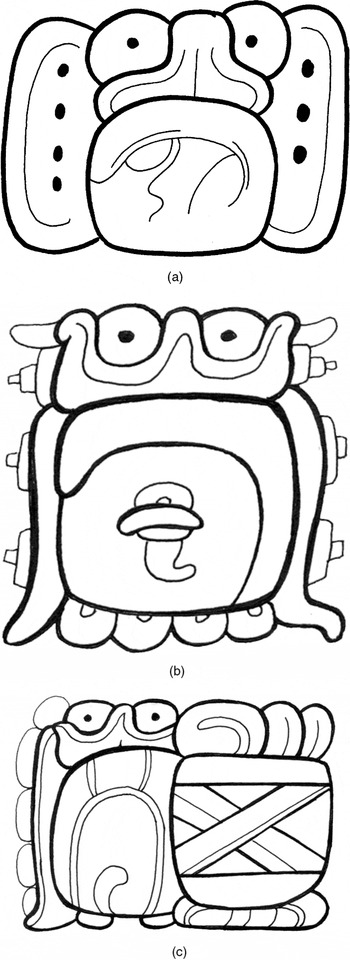
Variants of the “star war” verb from (a) Mutul (II) Hieroglyphic Stairway 4; (b) Mutul Temple IV, Lintel 2; (c) Caracol Stela 3.
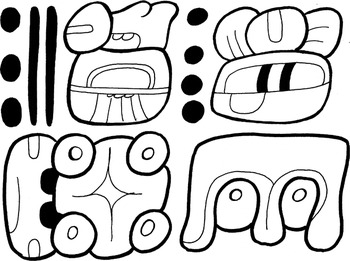
Ek' substituting for Chak Ek' in the Dresden Codex Venus Table.
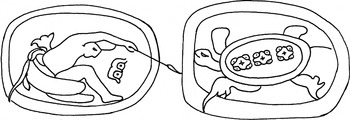
Multiple ek' icons in one image from Bonampak murals.
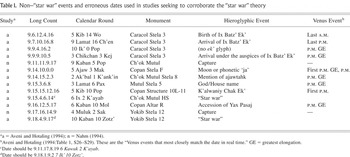
Non–“star war” events and erroneous dates used in studies seeking to corroborate the “star war” theory
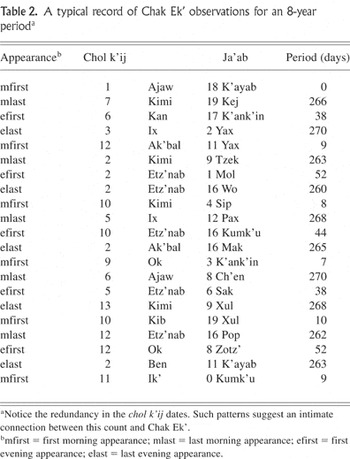
A typical record of Chak Ek' observations for an 8-year perioda
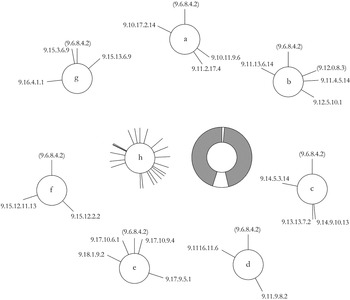
Positions of star war events in the cycle of Chak Ek': (a) Balam Ajaw, B'aakal (II); (b) Ruler 2, Yokib; (c) Balaj Chan K'awiil, Mutul (II); (d) Itzamnaaj K'awiil, Mutul (II); (e) Ruler 7, Yokib; (f) Yik'in Chan K'awiil, Mutul; (g) Itzamnaaj Balam and Yaxun Balam, Pa'chan; (h) graph showing all events superimposed. The last plot shows idealized Venus phases, with shaded periods of visibility (263 days each).
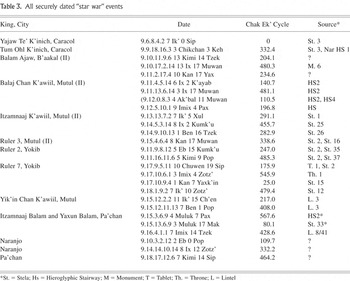
All securely dated “star war” events
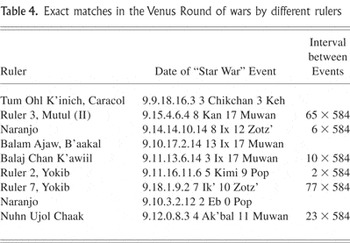
Exact matches in the Venus Round of wars by different rulers

Plots for all known star war events.
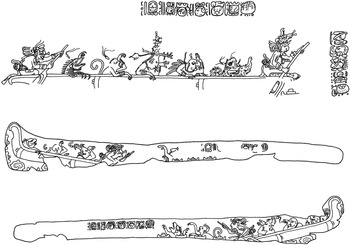
Incised bones from Jasaw Chan K'awiil's burial at Mutul. These show nonmilitary associations of the star war verb. (Drawing by Linda Schele, © David Schele, courtesy of Foundation for the Advancement of Mesoamerican Studies, Inc., www.famsi.org.)
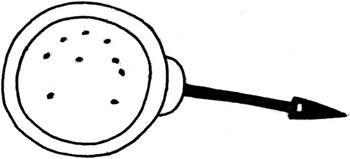
Citlaltlamina—representation of a meteor in Sahagún's Florentine Codex.
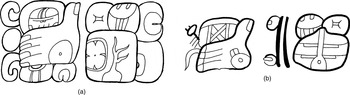
The whole phrase in its (a) Classic and (b) Postclassic forms has been associated with Venus. When alone, the second glyph block in each version also has been associated with Venus.
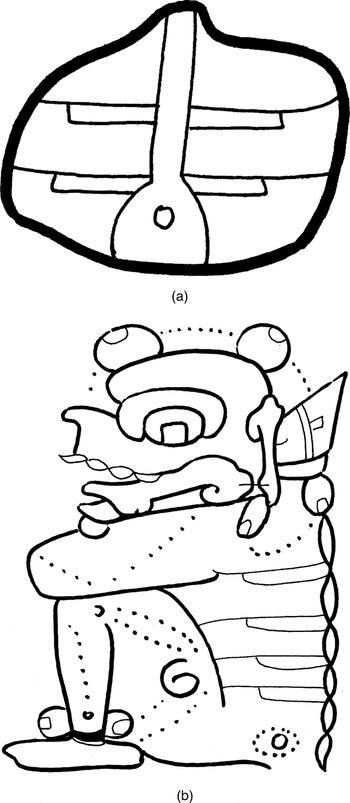
(a) Postclassic phoneme tzu-; (b) death god from Madrid Codex.
 You have
Access