INTRODUCTION
Employee innovative behavior (i.e., the generation, adoption, and implementation of new ideas) is key to organizational success in an ever uncertain and increasingly dynamic business environment (Chen, Li, Wu, & Chen, Reference Chen, Li, Wu and Chen2021; Janssen, van de Vliert, & West, Reference Janssen, van de Vliert and West2004; Yuan & Woodman, Reference Yuan and Woodman2010). Therefore, in the growing quest of driving forces for workplace innovative behavior (Damanpour & Aravind, Reference Damanpour and Aravind2012), a range of important antecedents has been identified, including both individual (e.g., openness to knowledge, core self-evaluation, and cognitive style) and contextual factors (e.g., rewards, leadership, and innovation climate) (Černe, Nerstad, Dysvik, & Škerlavaj, Reference Černe, Nerstad, Dysvik and Škerlavaj2014; Perry-Smith, Reference Perry-Smith2006). In general, management scholars have focused on mapping resources that contribute to innovative behavior (Jahanzeb, Fatima, Bouckenooghe, & Bashir, Reference Jahanzeb, Fatima, Bouckenooghe and Bashir2019), such as knowledge. A strategic asset of an organization, employee knowledge, encompasses the information, ideas, and expertise necessary for organizational members to fulfill their job duties (Tsai, Reference Tsai2001). It is thus not surprising that scholars and practitioners have shown a strong interest in encouraging knowledge sharing among employees (Wang & Noe, Reference Wang and Noe2010).
Nevertheless, not all employees are willing to dispense their knowledge (Stajkovic & Luthans, Reference Stajkovic and Luthans2001). A survey conducted by Peng (Reference Peng2013) on Chinese knowledge workers indicated that 46% of employees had ever engaged in knowledge hiding behavior. Huo, Cai, Luo, Men, and Jia (Reference Huo, Cai, Luo, Men and Jia2016) further reported that knowledge hiding may be more prevalent in China than in other countries, because the Chinese tend to treat knowledge as their territories. Knowledge hiding is embodied as an intentional attempt to withhold or conceal knowledge requested by a colleague and does not simply equal the absence of knowledge sharing (Connelly, Zweig, Webster, & Trougakos, Reference Connelly, Zweig, Webster and Trougakos2012). The two phenomena might appear quite behaviorally similar but motivations behind them are strikingly different. Knowledge hiding is a deliberate behavior driven by the orientation toward individual interests, whereas not sharing knowledge might sometimes be a result of the lack of knowledge (Connelly, Černe, Dysvik, & Skerlavaj, Reference Connelly, Černe, Dysvik and Skerlavaj2019). For example, one may be wrongly regarded as a knowledge hider because s/he does not respond to a knowledge request. However, this result may in fact be referable to the person's lack of that knowledge, rather than an unwillingness to share. In contrast, a true knowledge hider is one who possesses necessary knowledge but chooses to withhold it from a knowledge seeker (Connelly et al., Reference Connelly, Zweig, Webster and Trougakos2012).
Knowledge hiding is much more counterproductive to organizations and employees than the absence of knowledge sharing (Connelly et al., Reference Connelly, Zweig, Webster and Trougakos2012). For example, the hider's rejection of a knowledge request may fuel the seeker's distrust toward the hider and even retaliatory behaviors, thereby deteriorating personal relations between organizational members (Černe et al., Reference Černe, Nerstad, Dysvik and Škerlavaj2014). To worsen the situation, knowledge hiding inflicts arguably the most damage to knowledge exchange, that is, the basis of creativity (Men, Fong, Luo, Zhong, & Huo, Reference Men, Fong, Luo, Zhong and Huo2019), and deprives the knowledge seeker of the opportunity to co-create new knowledge (Burmeister, Fasbender, & Gerpott, Reference Burmeister, Fasbender and Gerpott2019). Thus, a handful of empirical studies argued that knowledge hiding had a negative effect on the creativity of both knowledge seekers and their teams (Arain, Bhatti, Hameed, & Fang, Reference Arain, Bhatti, Hameed and Fang2019; Bogilović, Černe, & Škerlavaj, Reference Bogilović, Černe and Škerlavaj2017; Jahanzeb et al., Reference Jahanzeb, Fatima, Bouckenooghe and Bashir2019; Rhee & Choi, Reference Rhee and Choi2017). In addition, the knowledge hider loses the opportunity to exchange knowledge with peers as well. As a result, during the process of idea generation, the hider is not able to expand knowledge or benefit from the divergent perspectives of coworkers (Rhee & Choi, Reference Rhee and Choi2017). However, literature on knowledge hiding to date has generally focused on the negative effects on its target, leaving unclear how it will affect the hider's own behavior. To bridge this gap, we investigate the detrimental effect of knowledge hiding on the innovative behavior of the hider and the mechanism underpinning this effect.
The theory of territorial behavior uncovers two basic types of territorial defense strategies: (1) reactionary defense, which occurs in response to an infringement attempt, and (2) anticipatory defense, which occurs prior to an infringement attempt (Brown, Lawrence, & Robinson, Reference Brown, Lawrence and Robinson2005). Reactionary defenses refer to actions an organizational member takes in reaction to an infringement attempt, and anticipatory defenses are those adopted to thwart potential infringement on one's territory before such an attempt even occurs (Brown et al., Reference Brown, Lawrence and Robinson2005). Research has revealed reactionary defense strategies to hide knowledge are commonly used by employees in order to prevent infringement on their knowledge territories. These may include evasion (e.g., providing incorrect information or promising to answer in the future), playing dumb (i.e., pretending to be ignorant), and rationalization (e.g., giving a reason for not sharing knowledge) (Connelly et al., Reference Connelly, Zweig, Webster and Trougakos2012). Knowledge hiding is a behavioral expression of territoriality, which reflects the hider's tendency of being possessive about knowledge (Das & Chakraborty, Reference Das and Chakraborty2018; Singh, Reference Singh2019). Moreover, knowledge requests to some extent act as a reminder to a knowledge hider that his/her knowledge is being coveted (Jahanzeb et al., Reference Jahanzeb, Fatima, Bouckenooghe and Bashir2019; Singh, Reference Singh2019). In this sense, is it possible that knowledge hiding will trigger the hider's use of anticipatory defense strategies in an effort to construct a ‘barricade’ impregnable to infringements before any knowledge request even occurs? And what influence will the specific strategy exert on the hider's innovative behavior?
To answer these questions, we propose that silence behavior might be an accessible anticipatory defense strategy triggered by knowledge hiding in Chinese organizations. Silence behavior allows employees to become ‘invisible’ in the organization (Brinsfield, Reference Brinsfield2013) and avoid possible knowledge requests. It is much emphasized and highly praised in Chinese culture (Duan, Bao, Huang, & Brinsfield, Reference Duan, Bao, Huang and Brinsfield2018). For example, Lao Tzu, a Taoist philosopher, believed that ‘it is better to keep silent than to incur troubles for speaking a lot’; Confucius, the founder of Confucianism, suggested that ‘a gentleman wishes to be slow to speak and quick to act’, advising people to be cautious and frugal with words. With the ‘virtue of silence’ widely acknowledged, silence becomes a typical self-protection behavior in Chinese organizations (Kang, Reference Kang2018). Therefore, we presume that, in Chinese organizations, silence behavior may be a readily accessible anticipatory defense strategy triggered by knowledge hiding to protect the hider's knowledge territory from future infringement. While withholding opinions pertaining to the organization, silent employees lose the opportunity to communicate with peers. This prevents them from expanding knowledge domains and in turn suppresses their innovative behavior. In other words, silence behavior may be a critical path from knowledge hiding to reduced likelihood of the innovative behavior of the hider.
If knowledge hiding impedes innovative behaviors by leading the hider to remain silent in Chinese organizations, it is necessary for managers to ascertain mitigators of this detrimental effect. To help address the issue, we contend that Zhongyong thinking can attenuate the positive relationship between knowledge hiding and silence behavior, and therefore buffer the detrimental effect of knowledge hiding on innovative behavior through silence behavior. Specifically, an entrenched philosophy of life in Chinese culture, Zhongyong has an inevitable impact on how people in this culture behave, communicate, and reconcile conflicts (Jing, Manman, & Ping, Reference Jing, Manman and Ping2014). The holistic perspective taken by higher Zhongyong thinkers serves the requirements of both the inner world and external environment and thus helps balance between organizational and individual interests (Jing et al., Reference Jing, Manman and Ping2014; Pan & Sun, Reference Pan and Sun2018). Given the destructive nature of employee silence (Brinsfield, Reference Brinsfield2013), we argue that knowledge hiding is unlikely to prompt Zhongyong-oriented knowledge hiders to adopt silence behavior as an anticipatory defense strategy. By examining the moderating role of Zhongyong thinking, we provide managers with insight into potential measures to buffer the indirect negative effect of knowledge hiding on innovative behavior through silence behavior.
This study contributes to knowledge management and innovation literature in several ways. First, drawing on the theory of territorial behavior, we develop a conceptual framework to delineate how knowledge hiding backfires on the hider's innovative behavior in Chinese organizations. In doing so, we respond to the call for a context-based investigation into what consequences knowledge hiding may have (Connelly et al., Reference Connelly, Zweig, Webster and Trougakos2012). Second, from the standpoint of Chinese culture, we demonstrate that silence behavior is a typical anticipatory defense strategy elicited by knowledge hiding and is disruptive to the hider's innovative behavior. Positioning silence behavior as a mediating mechanism is valuable because this helps uncover the process by which knowledge hiding impairs innovation of the hider in the Chinese context. Lastly, this study addresses the call to identify factors buffering the consequence of counterproductive knowledge behavior within a specific context (Connelly et al., Reference Connelly, Černe, Dysvik and Skerlavaj2019). Of particular relevance is that, by exploring possible moderators, we offer a Chinese solution to mitigate the detrimental consequences of knowledge hiding: Zhongyong thinking. Fostering this thinking style may be an easier practice in Chinese organizations since it is already embedded and recommended in Chinese culture. Figure 1 depicts our research model.
Theoretical model Note: Marquee represents the indirect effect of knowledge hiding on innovative behavior through silence behavior.

THEORETICAL BACKGROUND AND HYPOTHESES DEVELOPMENT
Knowledge Hiding and the Hider's Innovative Behavior
Innovative behavior is ‘an employee's intentional introduction or application of new ideas within a work, role, group, or organization’ (Janssen et al., Reference Janssen, van de Vliert and West2004). It embodies activities such as seeking new technologies, suggesting new approaches to objectives, applying new work methods, and investigating and securing resources to implement new ideas (Yuan & Woodman, Reference Yuan and Woodman2010). For example, frontline workers could increase their productivity by production skill improvement and procedure optimization. They may also discover hidden quality problems during production, thereby generating and applying creative ideas to product design (Janssen, Reference Janssen2000). Theorization of Janssen (Reference Janssen2000) and Scott and Bruce (Reference Scott and Bruce1994) is later developed to conceptualize innovation as a complex behavior consisting of two phases: development and implementation of novel ideas (Yuan & Woodman, Reference Yuan and Woodman2010). Notably, the first phase includes not only generating novel ideas by oneself but also adopting those from others (Arain et al., Reference Arain, Bhatti, Hameed and Fang2019).
These definitions suggest that innovative behavior begins with the development of new ideas (Yuan & Woodman, Reference Yuan and Woodman2010), featuring a novel combination of varied perspectives and approaches (Perry-Smith, Reference Perry-Smith2006). It is apparent that this process will require information and knowledge about a problem and prior knowledge regarding the task at hand (Gong, Kim, Lee, & Zhu, Reference Gong, Kim, Lee and Zhu2013). However, the ticklish question is that knowledge hiders may reject knowledge requests from coworkers in order to defend their knowledge territories from infringements (Connelly et al., Reference Connelly, Zweig, Webster and Trougakos2012), thus missing the opportunity to collect information and become aware of problems in the organization. Such knowledge is in fact necessary for generating new solutions because what is requested often reflects problems and difficulties their coworkers are confronted with (Rhee & Choi, Reference Rhee and Choi2017). This suggests that knowledge hiding will lessen a hider's ability to generate novel ideas (Bogilović et al., Reference Bogilović, Černe and Škerlavaj2017). Furthermore, as Černe et al. (Reference Černe, Nerstad, Dysvik and Škerlavaj2014) have demonstrated, when knowledge hiding is perceived, being a target of it instigates reciprocal distrust in the perpetrator. Such reactions not only undermine interpersonal relationships but also prompt the target to retaliate by concealing knowledge from the hider (Burmeister et al., Reference Burmeister, Fasbender and Gerpott2019; Xiao & Cooke, Reference Xiao and Cooke2019). This in turn prevents the hider from introducing new ideas of the seeker (Černe, Hernaus, Dysvik, & Škerlavaj, Reference Černe, Hernaus, Dysvik and Škerlavaj2017). Therefore, one can expect knowledge hiding to inhibit the development of new ideas, the first stage toward innovation.
Moreover, novel ideas introduce uncertainty (Baer, Reference Baer2012), such that whether employees will engage in the risky endeavor of implementing novel ideas (Yuan & Woodman, Reference Yuan and Woodman2010) largely depends on their ability or social relationships that can be leveraged to secure organizational resources from supporters (Baer, Reference Baer2012). However, this form of resource acquisition may be difficult for those whose social relationships have deteriorated due to knowledge hiding (Burmeister et al., Reference Burmeister, Fasbender and Gerpott2019; Xiao & Cooke, Reference Xiao and Cooke2019). That is, knowledge hiding may hinder the implementation of novel ideas, the second stage toward innovation. Given that knowledge hiding suppresses both essential stages of innovative behavior, we predict that:
Hypothesis 1: Knowledge hiding is negatively associated with the hider's innovative behavior.
Mediating Role of Silence Behavior
Silence behavior refers to ‘the conscious withholding of seemingly meaningful information, ideas, questions, concerns, and suggestions about potentially important work-related issues’ (Morrison & Milliken, Reference Morrison and Milliken2000). Brinsfield (Reference Brinsfield2013) argued that silence behavior was a typical means of self-protection for employees; by acting (and speaking) with discretion, employees keep a low profile in the organization, thus avoiding retaliation, criticism, and negative impact on career. Although both behaviorally appearing as the reluctance to speak up in the workplace, silence behavior and knowledge hiding are two distinct constructs (Xiao & Cooke, Reference Xiao and Cooke2019). First, knowledge hiding only occurs upon the initiation of a clear work-related knowledge request, whereas silence behavior does not rely on this prerequisite. Second, while knowledge hiding can be engaged using several strategies, such as evasive hiding and rationalized hiding, silence behavior only manifests itself as simply reducing the expression of work-related information. Third, knowledge hiding typically only involves know-how, whereas silence behavior represents a broader range of content from complaints, concerns to suggestions about potential organizational problems.
Silence behavior is entrenched in collectivist countries (Jain, Reference Jain2015). Collectivism is highly valued in China and maverick activities are less appreciated in this culture (Earley, Reference Earley1989). In similar situations where dissenters will be the minority of the group, people may refrain from speaking their minds (Duan et al., Reference Duan, Bao, Huang and Brinsfield2018). Moreover, in the context of Chinese culture where relationships and ‘face’ are stressed and traditional wisdom says that ‘Silence is golden’ and ‘The nail that sticks out gets hammered down’, people tend to take into account the feelings of peers and superiors for deciding whether to speak up in the workplace (Bedford, Reference Bedford2011). If speaking up is likely to harm the ‘face’ of someone, they may prefer to remain silent. Some scholars put that employees tend to remain silent (Morrison & Milliken, Reference Morrison and Milliken2000), considering unfavorable results that voice could have (e.g., being disliked by managers, causing jealousy among peers for exposing knowledge). Therefore, for employees under the influence of Chinese culture, silence might be an implicit yet prevalent code of behavior and a major self-protection strategy (Wang, Wu, Liu, Hao, & Wu, Reference Wang, Wu, Liu, Hao and Wu2019).
The theory of territorial behavior suggests that individuals who perceive potential threats to their knowledge territories are inclined to reinforce anticipatory defense strategies prior to any infringement attempt (Brown et al., Reference Brown, Lawrence and Robinson2005). Knowledge hiding reflects the hider's strong feeling of psychologically exclusive ownership toward knowledge assets (Das & Chakraborty, Reference Das and Chakraborty2018; Peng, Reference Peng2013) and vigilance against infringements (Singh, Reference Singh2019). It is possible that the hider regards knowledge requests as a signal of covetousness for their knowledge (Jahanzeb et al., Reference Jahanzeb, Fatima, Bouckenooghe and Bashir2019; Serenko & Bontis, Reference Serenko and Bontis2016). Therefore, knowledge hiding is expected to trigger the adoption of an anticipatory defense strategy before a knowledge request even occurs. By remaining silent, the hider cuts attention he/she receives in the organization to the minimum, thereby reducing the possibility of being requested for knowledge (Brinsfield, Reference Brinsfield2013). We propose that knowledge hiding is likely to prompt the hider to adopt silence behavior as an anticipatory strategy in Chinese organizations, which renders him/her in a hidden state without needing to expose knowledge or answer a number of questions.
Furthermore, Maqbool, Černe, and Bortoluzzi (Reference Maqbool, Černe and Bortoluzzi2019) confirmed that silence behavior inhibited interaction of organizational members and hence was harmful to innovation. Employee innovative behavior includes problem discovery and innovative problem-solving and relies on reciprocal exchanges of knowledge and information (Scott & Bruce, Reference Scott and Bruce1994). While holding back opinions on problems of the organization, silent employees lose the opportunity to uncover problems of the organization and communicate with coworkers about possible solutions (Morrison & Milliken, Reference Morrison and Milliken2000). This hampers the hiders’ expansion of knowledge domains and the development of novel ideas, which indeed are sustained by knowledge diversity and inclusiveness (Baer, Reference Baer2012; Men et al., Reference Men, Fong, Luo, Zhong and Huo2019). Ultimately, knowledge hiding curbs the follow-up innovative processes of support seeking and innovative problem-solving (Baer, Reference Baer2012; Yuan & Woodman, Reference Yuan and Woodman2010).
In line with our argument, we theorize silence behavior as a mediator between knowledge hiding and innovative behavior. According to the theory of territorial behavior, knowledge hiding leads the hider to adopt anticipatory defense strategies (in our case, silence behavior) for safeguarding his/her territory and deterring potential threats to competitiveness (Brown et al., Reference Brown, Lawrence and Robinson2005; Das & Chakraborty, Reference Das and Chakraborty2018). Although silence behavior builds a boundary seemingly impermeable for infringements on knowledge territory, it also separates the hider from the rest of the organization, reduces his/her interaction with other organizational members, and consequently impairs innovation (Brown et al., Reference Brown, Lawrence and Robinson2005). We, therefore, propose the following assumption:
Hypothesis 2: Silence behavior mediates the relationship between knowledge hiding and the hider's innovative behavior.
Zhongyong Thinking as a Moderator
Zhongyong thinking derives from Confucianism and has existed in China for over two thousand years (Pan & Sun, Reference Pan and Sun2018). Being one of the fundamental ways of thinking for Chinese people, it has a profound impact on life norms, meanings, and coping behaviors of the Chinese (Ji, Lee, & Guo, Reference Ji, Lee and Guo2010). Yang (Reference Yang2010) established that Zhongyong thinking was metacognitive in nature, encompassing skills of planning, monitoring, and evaluating progress. From a decision-making style perspective, Wu and Lin (Reference Wu and Lin2005) defined Zhongyong thinking as a behavioral choice to reach a balance between self-interest and collective interests. This deliberate choice is made following three principles: weighing and balancing, integrating, and harmony seeking. Weighing and balancing refer to the way an individual recognizes the dialectical relationships between contradictory elements and acknowledges that these elements can achieve a dynamic equilibrium through mutual complementation and mutual reinforcement. Integrating stands for how one should consider the needs and values of others and endeavor to build consensus. Harmony seeking means taking harmony as the code of behavior and adequately considering potential consequences in order to avoid extreme reactions. As the ultimate goal of holistic thinking and integration of diverse perspectives, harmony is at the core of Zhongyong thinking (Yang et al., Reference Yang, Zhang, Zhao, Zhao, Wang, Chen, Ding and Zhang2016).
Although silence behavior is an effective precaution to guard knowledge territories against infringements, it can be highly dysfunctional for organizations (Nechanska, Hughes, & Dundon, Reference Nechanska, Hughes and Dundon2020). Employee silence prevents timely identification and correction of problems that may cause damage to organizations (Brinsfield, Reference Brinsfield2013; Morrison & Milliken, Reference Morrison and Milliken2000). Having greater cognitive flexibility and a higher level of holistic thinking, Zhongyong-oriented employees are able to ascertain whether their behavior is situationally appropriate by stepping back to see the whole picture (Li, Reference Li2018). Hence, it is easier for such employees to understand that taking silence as a precaution could harm the organization. At the same time, to reconcile personal and organizational interests, such employees tend to take diverse perspectives, thus adopting strategies that help build consensus and derive a solution harmful to neither side (Ning, Omar, Ye, Ting, & Ning, Reference Ning, Omar, Ye, Ting and Ning2021; Yang et al., Reference Yang, Zhang, Zhao, Zhao, Wang, Chen, Ding and Zhang2016). Therefore, to the extent that Zhongyong-oriented employees strive for a ‘middle way’ between personal interests (e.g., knowledge territory protection) and organizational interests (e.g., business growth brought by problem-solving), they are not likely to use silence as an anticipatory defense strategy in order to hide knowledge.
Moreover, Zhongyong thinking disapproves of spontaneous decisions. Rather, it endorses deliberation on available cues from various perspectives, a trade-off between these cues, and inclusiveness of different possibilities (Cheung, Yang, Chiu, King, Chan, & Chan, Reference Cheung, Yang, Chiu, King, Chan and Chan2003; Pan & Sun, Reference Pan and Sun2018). High Zhongyong thinkers are able to devise multiple solutions to a problem based on multiple sources of information (Yang et al., Reference Yang, Zhang, Zhao, Zhao, Wang, Chen, Ding and Zhang2016). Zhou, Zhang, Li, Sun, and Luo (Reference Zhou, Zhang, Li, Sun and Luo2021) put that Zhongyong thinking facilitates flexible and integrated cognitive processing, which in turn brings creative solutions and changes by fostering creative thinking. Aside from simple and direct defense strategies such as silence behavior, we expect that Zhongyong-oriented employees can also produce other possible defense strategies to protect their knowledge territories, such as playing dumb, evasive hiding, and rationalized hiding (Connelly et al., Reference Connelly, Zweig, Webster and Trougakos2012; Singh, Reference Singh2019). In addition, as these employees pursue harmony and exercise creative problem-solving, they will recognize the course of action conducive to holistic harmony (Lin, Hong, Xiao, & Lian, Reference Lin, Hong, Xiao and Lian2020). Qu, Wu, Tang, Si, and Xia (Reference Qu, Wu, Tang, Si and Xia2018) stated that while expressing their appeals of interest, Zhongyong-oriented employees do not intend to disrupt the harmony between individualism and the organization. In this sense, a desirable defense strategy – which silence behavior is not – should guard personal knowledge territory against infringements without compromising collective interests. One such example is rationalized hiding, that is, to politely justify withholding the requested knowledge (Burmeister et al., Reference Burmeister, Fasbender and Gerpott2019). Consequently, even though sustained by a self-serving motive, knowledge hiding is not likely to induce Zhongyong-oriented hiders to adopt the defense strategy of silence behavior. Instead, they may resort to rationalized hiding or other defense strategies that can balance the interests of all sides.
In contrast, low Zhongyong thinkers tend to see things from the lens of personal interests, in the face of conflicts between personal and organizational interests (Wu & Lin, Reference Wu and Lin2005). Knowledge hiding is a perpetrator's behavioral expression of psychologically exclusive ownership toward knowledge assets (Das & Chakraborty, Reference Das and Chakraborty2018; Peng, Reference Peng2013). As the theory of territorial behavior suggests, the stronger an individual's behavioral expression of psychological ownership, the more likely the individual to adopt direct and effective defense strategies to prevent infringements on his/her territory (Brown et al., Reference Brown, Lawrence and Robinson2005). Useful in blocking future knowledge requests, silence behavior is evidently a simple but effective anticipatory defense strategy for employees in Chinese organizations who choose personal benefits over organizational interests. Given that the hider with a low level of Zhongyong thinking is inclined to prioritize personal benefits, we infer that knowledge hiding, a strong behavioral expression of psychological ownership toward knowledge, will induce such hiders to engage in silence behavior. Thus, we predict that:
Hypothesis 3: Zhongyong thinking moderates the relationship between knowledge hiding and silence behavior, such that this positive relationship is weaker when Zhongyong thinking is at a high level and is stronger when Zhongyong thinking is at a lower level.
Together, Hypothesis 2 and Hypothesis 3 indicate the presence of a moderated mediation relationship (Preacher, Rucker, & Hayes, Reference Preacher, Rucker and Hayes2007) where Zhongyong thinking moderates the indirect effect of knowledge hiding on the hider's innovative behavior through silence behavior. In the first place, we have suggested that thanks to their holistic thinking, greater cognitive flexibility, and creative problem-solving, employees with a high level of Zhongyong thinking can recognize the harm of silence behavior, develop wide-ranging defense strategies to protect knowledge territories from infringements, and choose strategies suitable for maintaining harmony among all sides. Therefore, though sustained by a self-serving motive, knowledge hiding is not likely to lead Zhongyong-oriented hiders to use silence behavior as an anticipatory defense strategy, because silence can be detrimental to the organization. This lower tendency of silence behavior will strengthen the ability to develop novel ideas (Zare & Flinchbaugh, Reference Zare and Flinchbaugh2019), thereby facilitating innovative behavior. Conversely, for employees with a low level of Zhongyong thinking, personal interests generally seem to be more important than organizational interests. They are more likely to engage in silence behavior, a simple, effective anticipatory defense strategy, in order to hide knowledge. This stronger tendency of silence behavior will, in turn, impede innovative behavior (Madrid, Patterson, & Leiva, Reference Madrid, Patterson and Leiva2015). In other words, the level of Zhongyong thinking determines the magnitude of the indirect effect of knowledge hiding on innovative behavior through silence behavior. Therefore, the following moderated mediation relationship is hypothesized:
Hypothesis 4: Zhongyong thinking moderates the indirect relationship between knowledge hiding and innovative behavior through silence behavior, such that this relationship is weaker when Zhongyong thinking is high than when it is low.
METHODS
Sample and Procedure
Respondents of this research came from a large-scale manufacturing conglomerate and an e-commerce company. Surveys were administered in the former's all six branches in Dongguan, Shenzhen, Shanghai, Chengdu, Chongqing, and Jinan, China. Their businesses range from power distribution, digital communication, and wideband multimedia devices to microelectronics products. All these branches have been established for more than 16 years with over 1,000 employees. The e-commerce company has been established for 12 years and specializes in food delivery, instant delivery service, and food supply chain. The branch where we conducted the investigation is in Xiamen, China, and has over 400 employees. Before the research, executives of the companies were informed of our purpose and procedure and that the research would be kept confidential so it would not have any adverse impact on their companies. With the support of executives, each branch assigned a human resources specialist to facilitate the investigation and provided a list of 100 random full-time employees (i.e., 700 employees in total) and their line managers. After that, with the assistance of the human resources specialists, we sent questionnaires to these employees via email or WeChat (a Chinese social media platform) and asked them to return completed questionnaires directly through email or WeChat. In order to avoid common method variance, data were collected through a time-lagged and multi-source survey (Podsakoff, MacKenzie, Lee, & Podsakoff, Reference Podsakoff, MacKenzie, Lee and Podsakoff2003). The investigation on full-time employees was completed in two waves. At Time 1, participants provided demographics and rated knowledge hiding, Zhongyong thinking, organizational climate, and intrinsic interest in innovation. At Time 2 (1 month later), they reported their silence behavior. Then, line managers were invited to evaluate the innovative behavior of their employees.
Among the 700 employees who received our request, 461 employees responded to the first survey (response rate = 65.8%) and 353 employees to the second survey (response rate = 76.6%). A total of 239 employees’ line managers accepted our survey invitation (response rate = 67.7%). Therefore, the final sample included 239 employees who responded to both surveys and were assessed by their line managers in terms of innovative behavior (Chen, Reference Chen2021). Of the respondents, 61.1% were female; 37.2% were frontline workers, salespersons, or office workers; 40.6% were frontline managers; 15.1% were middle-level managers; 7.1% were high-level managers; 11.7% aged between 20 and 25 years old; 43.9% aged between 26 and 30 years old; 18.4% aged between 31 and 35 years old; and 8.4% aged between 36 and 40 years old; 14.6% earned a high school diploma or below; 24.3% earned a college's degree; 57.3% earned a bachelor's degree; and 3.8% earned a master's degree or above. On average, they had been employed for 4.1 years (SD = 6.19) by the current company.
Measures
Except for demographics, all variables were rated on a Likert-type scale that ranged from 1 (strongly disagree) to 7 (strongly agree). Internal consistency reliability of the measures has proven acceptable in past studies. Complete items of all the scales are listed in Appendix I.
Knowledge hiding
Knowledge hiding was assessed with 12 items from Connelly et al. (Reference Connelly, Zweig, Webster and Trougakos2012). A sample item is ‘Agreed to help him/her but instead gave him/her information different from what she/he wanted’ (α = 0.71).
Silence behavior
Silence behavior was assessed with 5 items adapted from Tangirala and Ramanujam's (Reference Tangirala and Ramanujam2008) scale. A sample item is ‘I chose to remain silent when I had concerns about potential problems in my workgroup’ (α = 0.83).
Zhongyong thinking
Zhongyong thinking was assessed with 13 items from the scale developed by Wu and Lin (Reference Wu and Lin2005). A sample item is ‘I attempt to find out the opinions accepted by all parties when there are conflicting opinions’ (α = 0.85).
Innovative behavior
Innovative behavior was measured using 6 items from Scott and Bruce (Reference Scott and Bruce1994). A sample item is ‘Searching out new technologies, processes, techniques, and/or product ideas’ (α = 0.89).
Control variables
We included gender, age, education, positional level, and tenure as control variables (Yuan & Woodman, Reference Yuan and Woodman2010). Past research has suggested the intrinsic interest in innovation significantly affects innovative behavior (Tierney, Farmer, & Graen, Reference Tierney, Farmer and Graen1999). Thus, intrinsic interest in innovation was controlled for and measured using a 5-item scale developed by Tierney et al. (Reference Tierney, Farmer and Graen1999). A sample item is ‘I enjoy coming up with new ideas for products’ (α = 0.91). In addition, we controlled for organizational climate, which was found to have an important impact on innovative behavior (Sethibe & Steyn, Reference Sethibe and Steyn2016). A 10-item scale developed by Bock, Zmud, Kim, and Lee (Reference Bock, Zmud, Kim and Lee2005) was adopted. A sample item is ‘My team encourages finding new methods to perform a task’ (α = 0.78).
DATA ANALYSIS AND RESULTS
Discriminant Validity Analysis
Confirmatory factor analyses (CFAs) were performed using Mplus 7.0 software to ensure our focal constructs (knowledge hiding, silence behavior, Zhongyong thinking, and innovative behavior) had satisfactory discriminant validity. Item parceling was used to reduce observed indicators so as to improve the reliability of indicators and overcome non-convergence issues (Nasser & Wisenbaker, Reference Nasser and Wisenbaker2003). We compared the hypothesized 4-factor model with a series of nested 3-factor models and a 1-factor model. The CFAs show that our hypothesized 4-factor model fitted the data better than other alternative models (see Table 1), providing evidence of the construct distinctiveness. In particular, RMSEA (root mean square error of approximation) is an important indicator of goodness of fit used to compare the disparity between the hypothesized measurement model and the saturated model that provides a perfect fit. The greater the discrepancy, the less desirable the hypothesized measurement model (Hu & Bentler, Reference Hu and Bentler1999). The desirable goodness of fit of the hypothesized 4-factor measurement model is reflected by its RMSEA being smaller than that of the other three alternative models (see Table 1).
Confirmatory factor analysis results for model comparison

Notes: KH = knowledge hiding; SI = silence behavior; ZY = Zhongyong thinking; IB = innovative behavior. SRMR = standardized root mean square residual. CFI = comparative-fit index. N = 239. **p < 0.01.
To further examine the distinctiveness of knowledge hiding and silence behavior, we compared correlations between each of these variables with innovative behavior. Evidence for discriminant validity would be established if the two correlations were unequal (Cohen & Cohen, Reference Cohen and Cohen1983). Using the online utilizer (Lee & Preacher, Reference Lee and Preacher2013), the z-score was −1.99 for the difference between knowledge hiding–innovative behavior correlation and silence behavior–innovative behavior correlation (p < 0.05, two-tailed). This figure, together with the CFA results, supports the notion that knowledge hiding and silence behavior are distinguishable constructs.
Descriptive Statistics
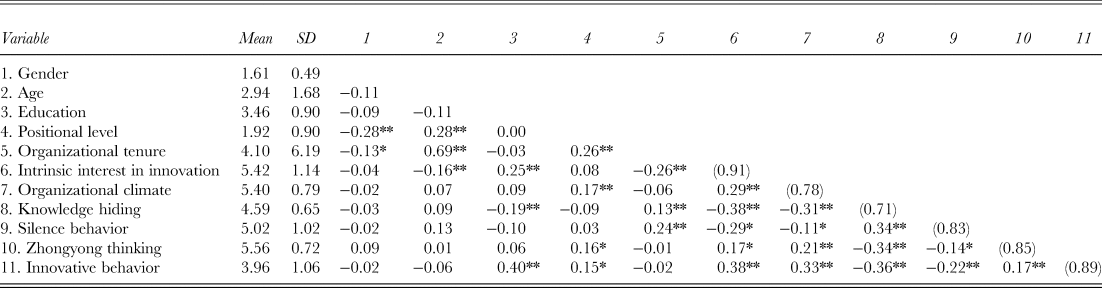
Table 2 presents the means, standard deviations, and correlation coefficients of the variables. Knowledge hiding is positively related to silence behavior (r = 0.34, p < 0.01) and negatively related to innovative behavior (r = −0.36, p < 0.01). Silence behavior is negatively related to innovative behavior (r = −0.22, p < 0.01). According to Bosco, Aguinis, Singh, Field, and Pierce (Reference Bosco, Aguinis, Singh, Field and Pierce2015), large effect sizes involving behaviors (knowledge hiding – silence behavior and knowledge hiding – innovative behavior in our study) are greater than roughly |r| = 0.25, and a medium effect size involving behaviors (silence behavior – innovative behavior in our study) is between roughly |r| = 0.10 and 0.25.
Zero-order correlations and descriptive statistics

Notes: N = 239. Gender was coded as: 1 = male and 2 = female. Age was coded as: 1 = 20–25 years of age, 2 = 26–30 years of age, …, 8 = 56–60 years of age, and 9 = 61 years of age or greater. Education was coded as: 1 = junior school, 2 = high school, 3 = college's degree, 4 = Bachelor's degree, and 5 = Master's degree or above. Positional level was coded as: 1 = frontline employee, 2 = frontline manager, 3 = middle-level manager, and 4 = high-level manager. Organizational tenure unit in years. Reliability on the diagonal. *p < 0.05, **p < 0.01.
Hypothesis Testing
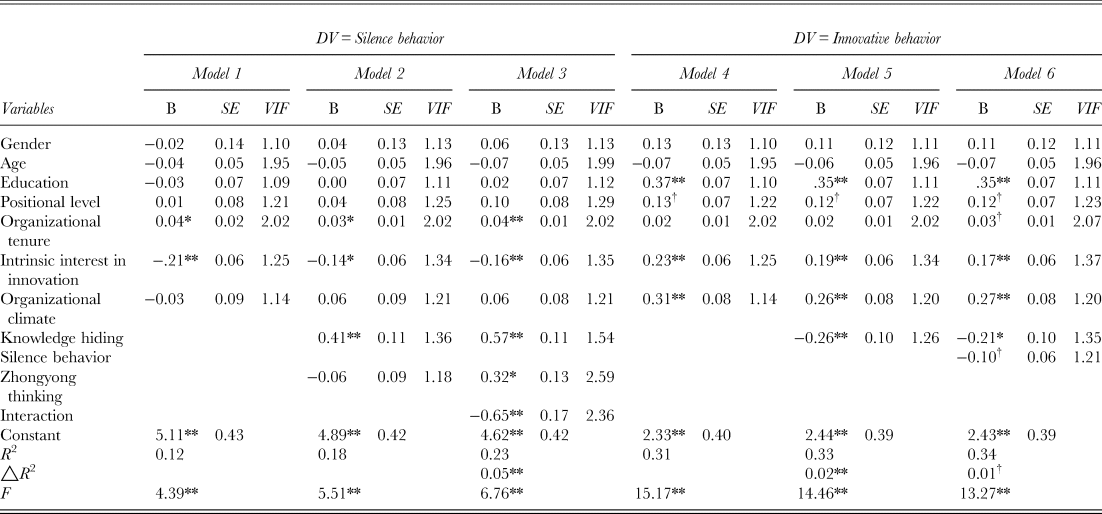
Hypotheses 1–3 were tested through multiple regression analysis. The moderated mediation (Hypothesis 4) was tested using PROCESS, an SPSS macro (Hayes, Reference Hayes2012; Preacher et al., Reference Preacher, Rucker and Hayes2007). We examined multicollinearity by the variance inflation factors (VIF). As shown in Table 3, VIF scores are below the cut-off of 10.0 proposed by Ryan (Reference Ryan1997) and the more conservative cut-off of 5 proposed by Ringle, Wende, and Becker (Reference Ringle, Wende and Becker2015), indicating that multicollinearity was not an issue in this study. Table 3 lists the ordinary least square regression results for the hypotheses.
Hierarchical regression analysis

Notes: VIF = variance inflation factor. Interaction = Knowledge hiding × Zhongyong thinking. N = 239. †<0.1, *p < 0.05, **p < .01.
Model 5 in Table 3 shows that gender (B = 0.11, SE = 0.12, p = 0.38), age (B = −0.06, SE = 0.05, p = 0.19), positional level (B = 0.12, SE = 0.07, p = 0.10), and organizational tenure (B = 0.02, SE = 0.01, p = 0.11) were not significantly associated with innovative behavior. However, education (B = 0.35, SE = 0.07, p < 0.01), intrinsic interest in innovation (B = 0.19, SE = 0.06, p < 0.01), and organizational climate (B = 0.26, SE = 0.08, p < 0.01) were significantly associated with innovative behavior. Collectively, these control variables accounted for 31% of variance in innovative behavior. Furthermore, consistent with Hypothesis 1, knowledge hiding had a significantly negative association with the hider's innovative behavior (B = −0.26, SE = 0.10, p < 0.01) and accounted for 2% of incremental variance in innovative behavior.
Hypothesis 2 predicts silence behavior will mediate the relationship between knowledge hiding and innovative behavior. This mediation was examined by following the suggestion of Baron and Kenny (Reference Baron and Kenny1986). First, Model 5 in Table 3 shows that knowledge hiding is negatively associated with innovative behavior (B = −0.26, SE = 0.10, p < 0.01; Model 5). Second, Model 2 in Table 3 shows that gender (B = 0.04, SE = 0.13, p = 0.79), age (B = −0.05, SE = 0.05, p = 0.36), education (B = 0.00, SE = 0.07, p = 0.98), positional level (B = 0.04, SE = 0.08, p = 0.58), and organizational climate (B = 0.06, SE = 0.09, p = 0.52) were not significantly associated with silence behavior. However, organizational tenure (B = 0.03, SE = 0.01, p < 0.05) and intrinsic interest in innovation (B = −0.14, SE = 0.06, p < 0.05) were significantly associated with silence behavior. These control variables accounted for 12% of variance in silence behavior. Furthermore, knowledge hiding was positively associated with silence behavior (B = 0.41, SE = 0.11, p < 0.01) and accounted for 6% of incremental variance in silence behavior. Lastly, after regressing innovative behavior on silence behavior, we found that silence behavior had a significant, negative relationship with innovative behavior (B = −0.10, SE = 0.06, p < 0.01; Model 6), but the effect of knowledge hiding on innovative behavior was reduced (B = −0.21, SE = 0.10, p < 0.05; Model 6). This means that silence behavior partially mediates the relationship between knowledge hiding and innovative behavior.
Moreover, a PROCESS analysis with 5,000 bootstrap samples was performed to further calculate estimates of the magnitude of direct and indirect effects. The magnitude of the direct effect of knowledge hiding on innovative behavior was −0.2148 (SE = 0.1024), at the 95% CI of [−0.4165, −0.0131]. The magnitude of the indirect effect of knowledge hiding on innovative behavior through silence behavior was −0.0445 (SE = 0.0261), at the 95% CI of [−0.1028, −0.0008]. These results indicate that Hypothesis 2 is supported.
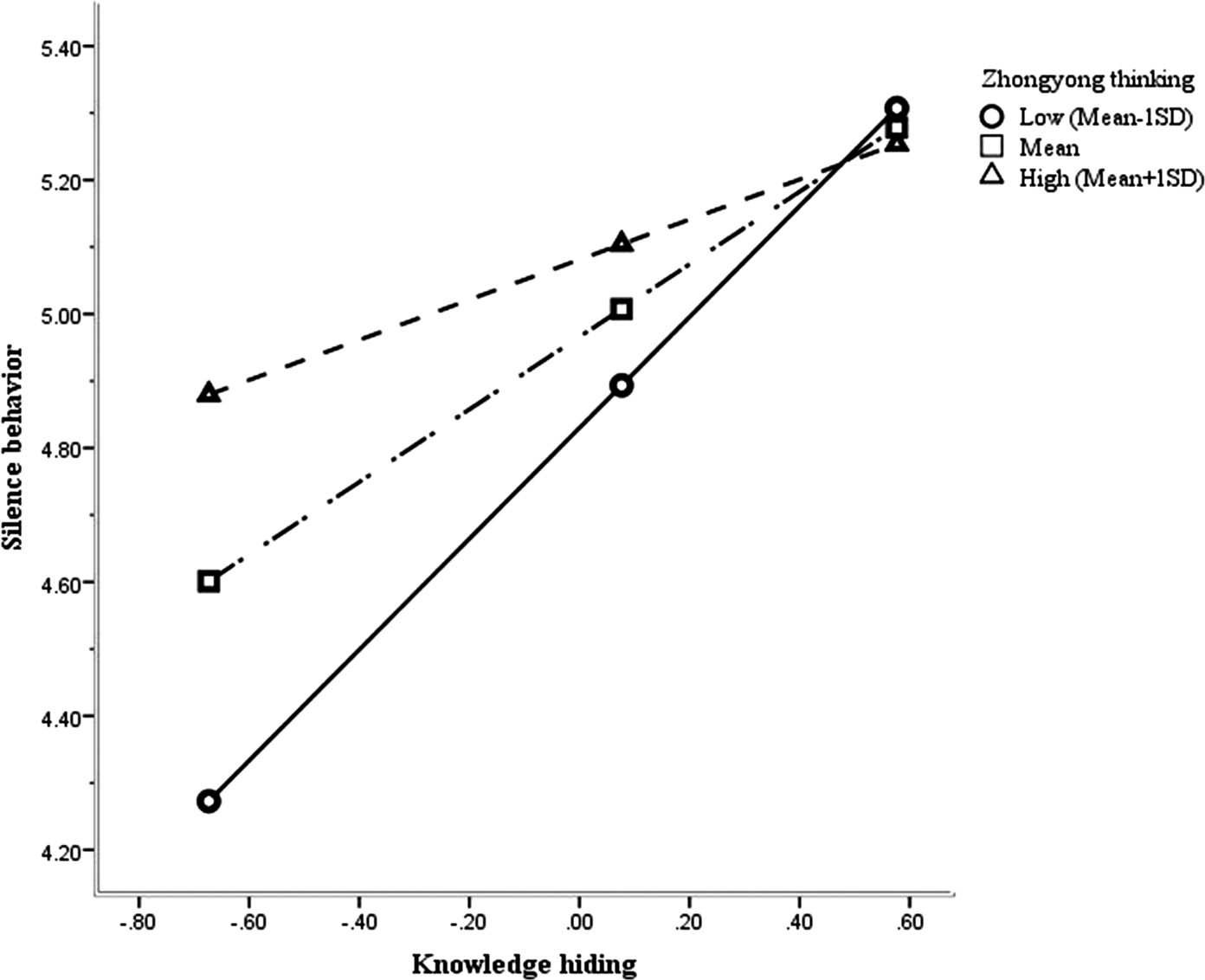
Hypothesis 3 postulates that Zhongyong thinking will moderate the relationship between knowledge hiding and silence behavior. To test the moderating effect, control variables (gender, age, education, positional level, tenure, organizational climate, and intrinsic interest in innovation) were added into the regression in the first step. In the second step, knowledge hiding and Zhongyong thinking were entered, and the interaction term of these two variables was entered in the final step. Model 3 in Table 3 indicates the interaction between knowledge hiding and Zhongyong thinking is significant (B = −0.65, SE = 0.17, p < 0.01). To discern the direction of Hypothesis 3, a simple slope analysis was conducted on high (1 SD above the mean) and low (1 SD below the mean) levels of Zhongyong thinking (Aiken, West, & Reno, Reference Aiken, West and Reno1991). Figure 2 illustrates that knowledge hiding is positively associated with silence behavior at the low level of Zhongyong thinking (slope = 1.043, t = 5.391, p < 0.01), but not at the high level of Zhongyong thinking (slope = 0.097, t = 0.718, ns). Hypothesis 3 is supported.
Interaction effect of knowledge hiding and Zhongyong thinking on silence behavior

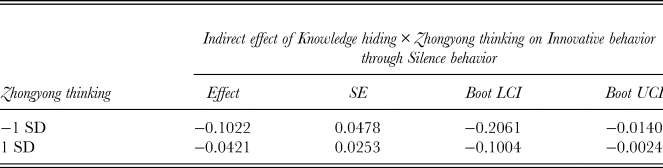
Hypothesis 4 proposes that Zhongyong thinking will moderate the indirect relationship between knowledge hiding and innovative behavior through silence behavior. A PROCESS analysis with 5,000 bootstrap samples was performed to test the moderated mediation, and the indirect effect of knowledge hiding on innovative behavior through silence behavior was analyzed at two levels of Zhongyong thinking (1 SD above and below the mean). Table 4 indicates the conditional indirect relationship is significant for both 1 SD below the mean (indirect effect = −0.1022, SE = 0.0478, 95% CI [−0.2061, −0.0140]) and 1 SD above the mean (indirect effect = −0.0421, SE = 0.0253, 95% CI [−0.1004, −0.0024]). Overall, our results support Hypothesis 4.
Conditional indirect effect of knowledge hiding on innovative behavior

Notes: Boot LCI = bootstrapped lower confidence interval; Boot UCI = bootstrapped upper confidence interval.
Test of Endogeneity Bias
To find out whether the model is robust to potential endogeneity bias, we searched for instrumental variables (Antonakis, Bendahan, Jacquart, & Lalive, Reference Antonakis, Bendahan, Jacquart and Lalive2010) and specified two alternative models for mediation analysis, as recommended by Shaver (Reference Shaver2005). First, we allowed for the error correlation between knowledge hiding and silence behavior in the first alternative model. To keep the model identified, knowledge complexity served as the instrumental variable for knowledge hiding, because it was directly associated with knowledge hiding but not with silence behavior (see Shaver, Reference Shaver2005). Connelly et al. (Reference Connelly, Zweig, Webster and Trougakos2012) used knowledge complexity as a proxy for the time and effort required to transfer knowledge to a colleague and suggested this characteristic of knowledge was positively related to knowledge hiding. Silence behavior was defined as the intentional withholding of potentially meaningful questions, suggestions, or concerns (Brinsfield, Reference Brinsfield2013; Tangirala & Ramanujam, Reference Tangirala and Ramanujam2008). At least conceptually, knowledge complexity should not be related to silence behavior, which stems from fears and implicit theories about the risks of speaking up (Morrison, See, & Pan, Reference Morrison, See and Pan2015). The results of the endogeneity bias test indicated that the error covariance was non-significant and the relationship between knowledge hiding and silence behavior remained positive and significant (B = 0.16, p < 0.05).
Analogous to the above procedures, the second alternative model allowed for the error correlation between silence behavior and innovative behavior. We used moral disengagement as the instrumental variable for silence behavior. While a positive association exists between moral disengagement and silence behavior (He, Peng, Zhao, & Estay, Reference He, Peng, Zhao and Estay2019), innovative behavior is an extra-role behavior that employees have no moral obligation to perform. Thus, at least conceptually, moral disengage should not be related to innovative behavior. In this model, error covariance was non-significant, and the relationship between silence behavior and innovative behavior remained negative and significant (B = −0.42, p < 0.01). Taken together, the results demonstrate a certain degree of robustness of our findings to endogeneity bias.
DISCUSSION
Building on the theory of territorial behavior, this article positions silence behavior as a key mechanism by which knowledge hiding relates to the hider's innovative behavior. Zhongyong thinking is found to (1) attenuate the relationship between knowledge hiding and silence behavior and (2) moderate the indirect relationship between knowledge hiding and innovative behavior through silence behavior.
Theoretical Contributions
First, this study examines the negative effect of knowledge hiding on the innovative behavior of the hider. For one thing, in search of countermeasures to knowledge hiding, numerous research efforts have been directed to identify its antecedents (Butt & Ahmad, Reference Butt and Ahmad2019; Gerpott, Fasbender, & Burmeister, Reference Gerpott, Fasbender and Burmeister2020; Pradhan, Srivastava, & Mishra, Reference Pradhan, Srivastava and Mishra2019). For another, despite extensive academic attention on the destructiveness of knowledge hiding, discoveries have largely centered around the influence on its targets. For example, extensive research has found that the knowledge hiding target could experience negative emotions and deterioration in interpersonal relations and that knowledge hiding demotivates knowledge seekers and their teams to generate novel ideas (Arain, Bhatti, Ashraf, & Fang, Reference Arain, Bhatti, Ashraf and Fang2018; Bogilović et al., Reference Bogilović, Černe and Škerlavaj2017). By contrast, how this self-serving behavior will backfire on the hider remains underinvestigated. Given that, this study expounds on how knowledge hiding disrupts the hider's novel idea generation and implementation, the two steps pivotal to innovative behavior. By revealing the negative link between knowledge hiding and the hider's innovative behavior, we create a more panoramic picture of the consequences of knowledge hiding.
Moreover, this study identifies a pathway with which knowledge hiding reduces the innovative behavior of the hider in Chinese organizations. We draw on the theory of territorial behavior to demonstrate that territorial behavior in the form of knowledge hiding impels the perpetrator to adopt silence behavior as an anticipatory defense strategy to prevent future knowledge infringements (Brown et al., Reference Brown, Lawrence and Robinson2005; Das & Chakraborty, Reference Das and Chakraborty2018; Singh, Reference Singh2019). Knowledge hiding is a negative work behavior that deviates from established social norms (Ilies, Peng, Savani, & Dimotakis, Reference Ilies, Peng, Savani and Dimotakis2013). The extant literature has focused on its emotional consequences, such as the perpetrators’ feeling of guilt and shame (Burmeister et al., Reference Burmeister, Fasbender and Gerpott2019). Beyond that, our findings point to the importance of understanding employees’ behavioral defense strategy in capturing the effects of knowledge hiding on work behavior. In addition, most prior studies within OB literature have considered voice efficacy and psychological safety as the main reasons for employee silence (Nechanska et al., Reference Nechanska, Hughes and Dundon2020). In particular, employees will remain silent if perceiving that their voice is futile and/or will not be listened to, or they will have to take risks to speak up (such as tarnishing of personal image, damage to personal relations, and career development restrictions) (Brinsfield, Reference Brinsfield2013; Grant, Reference Grant2013). In addition to the said reasons, we propose that, in Chinese organizations, another motivation for employee silence is to take silence behavior as a form of anticipatory defense strategy to prevent infringements on knowledge territories. In doing so, we extend the theoretical understanding of why employees often remain silent in Chinese organizations.
The last contribution lies in the moderating role of Zhongyong thinking, a construct reflecting the characteristics of Chinese culture (Yao, Yang, Dong, & Wang, Reference Yao, Yang, Dong and Wang2010). We show that knowledge hiding is not likely to lead Zhongyong-oriented employees to adopt silence behavior as a defense strategy. This attenuates the negative indirect relationship between knowledge hiding and innovative behavior through silence behavior. Introducing Zhongyong thinking as a moderator facilitates the understanding of individual dispositions (Rhee & Choi, Reference Rhee and Choi2017), rather than merely the context where the knowledge hider is situated (e.g., Černe et al., Reference Černe, Nerstad, Dysvik and Škerlavaj2014, Reference Černe, Hernaus, Dysvik and Škerlavaj2017). Although not directly related to our hypotheses, our results generally support prior empirical evidence that personal cognitive skills mitigate the consequences of counterproductive knowledge management behaviors (Bogilović et al., Reference Bogilović, Černe and Škerlavaj2017; Jahanzeb et al., Reference Jahanzeb, Fatima, Bouckenooghe and Bashir2019). Moreover, past work focusing on organization- or policy-based solutions (e.g., providing incentives for knowledge sharing and increasing employees’ opportunities for social interactions) has yielded less than satisfactory results in reducing potential threats of knowledge hiding (Černe et al., Reference Černe, Hernaus, Dysvik and Škerlavaj2017; Rodríguez-Gómez & Gairín, Reference Rodríguez-Gómez and Gairín2015). Our findings point out a feasible way in this regard: cultivating Zhongyong thinking (Yao et al., Reference Yao, Yang, Dong and Wang2010). Thus, we provide a new perspective to buffer the detrimental effect of knowledge hiding, enriching Chinese management research.
Management Implications
Psychological ownership of knowledge results in territoriality in the workplace (Peng, Reference Peng2013; Singh, Reference Singh2019). In order to protect personal interests, employees are prone to knowledge hiding, which in turn inhibits their innovative behavior. Therefore, it is beneficial to fully recognize the harm of knowledge hiding and its universality in organizations, create a motivating learning climate within the organization, establish a reward mechanism, and give affirmation and rewards to voluntary knowledge sharing (Bock et al., Reference Bock, Zmud, Kim and Lee2005). Other strategies to reduce the harmful effects of knowledge hiding include establishing a knowledge management system (Rodríguez-Gómez & Gairín, Reference Rodríguez-Gómez and Gairín2015), fostering a proactive and friendly organizational culture (Serenko & Bontis, Reference Serenko and Bontis2016), and reducing knowledge hiding by alleviating employees’ sense of knowledge territory (Singh, Reference Singh2019).
Previous studies have generally attributed silence behavior to a lack of opportunities to speak up, interpersonal trust, and dissatisfaction with the organization (Morrison & Milliken, Reference Morrison and Milliken2000; Nechanska et al., Reference Nechanska, Hughes and Dundon2020). Drawing from the theory of territorial behavior, this article reveals an additional reason, that is, knowledge territory protection, which invokes the use of silence as an anticipatory defense strategy. Silence behavior mediates the association between knowledge hiding and innovative behavior. To overcome this unwanted silence and promote employee voice behavior, organizations are advised to change leadership style (Detert & Burris, Reference Detert and Burris2007) or create a favorable organizational climate for voice engagement. Interventions in this aspect may include increasing the trust of managers in employees, making employees feel valued, and enhancing organizational commitment and job satisfaction (Brinsfield, Reference Brinsfield2013). These interventions are expected to reduce silence behavior invoked knowledge hiding, as well as the consequential influence on innovative behavior.
As noted, high Zhongyong thinkers are characterized by flexibility in coping with conflicts. As such, when claiming ownership of knowledge territories, they can better balance between organization and personal interests (Cheung et al., Reference Cheung, Yang, Chiu, King, Chan and Chan2003) by comparing the disadvantages of anticipatory or reactionary defense. Therefore, if the anticipatory defense in the form of silence behavior works to the disadvantage of the organization, Zhongyong-oriented employees will flexibly choose other harmless means. This finding suggests that assessing candidates’ Zhongyong tendency will be an advantageous recruitment practice. In addition, in terms of employee training, organizations can cultivate Zhongyong thinking from the three aspects of integration, harmony, and holistic thinking and rely on teamwork training and open communication platforms to promote workplace harmony (Wu & Lin, Reference Wu and Lin2005).
Limitations and Future Research Directions
Our findings should be interpreted in light of this study's limitations. First, data were collected from two companies in the e-commerce and manufacturing industries in one country. Although our theoretical arguments were general and not industry- or country-specific, we cannot rule out the possibility that industry or cultural factors might have affected our empirical results. For example, the cooperation and competition among employees vary across industries (Bullinger, Neyer, Rass, & Moeslein, Reference Bullinger, Neyer, Rass and Moeslein2010), which will result in a discrepancy in knowledge hiding and hence different defense strategy choices. In addition, cultural context may also intervene in the interaction among knowledge hiding, choice of defense strategies, and employees’ propensity to engage in innovative behavior. For example, in China and other high uncertainty avoidance countries (Kwon, Reference Kwon2012), people prefer a conservative way of behaving, which means a greater probability for employees to adopt silence behavior as the defense strategy and avert highly risky innovative behaviors (Zhang & Zhou, Reference Zhang and Zhou2014). Future research may alleviate these concerns by employing a different sampling approach, for example, random selection of employees from various countries or industries.
Second, our article unveils one of the paths from knowledge hiding to the hider's innovative behavior, adding to the research on knowledge hiding and the theory of territorial behavior. Although silence behavior is an effective defense to protect knowledge, it does not preclude the use of other strategies. Future researchers may want to explore other mechanisms to provide managers with multiple management interventions to attenuate the inhibitory effect of knowledge hiding on innovative behavior. In addition, while knowledge hiding, silence behavior, Zhongyong thinking, and innovative behavior are all individual-level constructs in this article, silence behavior and Zhongyong thinking may also function as organizational-level constructs, that is, organizational silence and organizational Zhongyong culture. This difference necessitates closer scrutiny of the links between individual-level knowledge hiding, organizational silence, and individual innovative behavior, as well as the examination of underpinning mechanisms.
Lastly, contradictory empirical results exist. Yao et al. (Reference Yao, Yang, Dong and Wang2010) reported a negative correlation between Zhongyong and innovative behavior, contrary to the positive result in our work. The contradiction can probably be accounted for by organizational-level contextual factors (such as organizational climate) already controlled for in this article or the suspected relationship between Zhongyong thinking and innovation. Other than that, another possible explanation lies in the different scales to assess Zhongyong thinking in the two studies. Whereas we used the 13-item scale developed by Wu and Lin (Reference Wu and Lin2005), Yao et al. (Reference Yao, Yang, Dong and Wang2010) adopted the 14-item scale of Chiu (Reference Chiu2000). Regardless of the reasons, these conflicting findings are interesting and valuable in that they offer a clue to a more complicated link between Zhongyong thinking and innovative behavior. Further investigation is warranted as to whether there are two parallel underlying mechanisms to encourage or inhibit innovative behavior.
DATA AVAILABILITY STATEMENT
The data that support the findings of this study are openly available in the Open Science Framework at https://osf.io/uyf3j
APPENDIX I
Knowledge Hiding (12-item scale developed by Connelly et al. (Reference Connelly, Zweig, Webster and Trougakos2012))
Please think of a recent episode in which a specific coworker requested knowledge from you. In this specific situation, you …
(1) Agreed to help him/her but never really intended to.
(2) Agreed to help him/her but instead gave him/her information different from what she/he wanted.
(3) Told him/her that I would help him/her out later but stalled as much as possible
(4) Offered him/her some other information instead of what he/she really wanted.
(5) Pretended that I did not know the information.
(6) Said that I did not know, even though I did.
(7) Pretended I did not know what she/he was talking about.
(8) Said that I was not very knowledgeable about the topic.
(9) Explained that I would like to tell him/her, but was not supposed to.
(10) Explained that the information is confidential and only available to people on a particular project.
(11) Told him/her that my boss would not let anyone share this knowledge.
(12) Said that I would not answer his/her questions.
Silence Behavior (5-item scale developed by Tangirala & Ramanujam (Reference Tangirala and Ramanujam2008))
(1) I chose to remain silent when I had concerns about the problems in my workgroup.
(2) Although I had ideas for improving my workgroup, I did not speak up.
(3) I said nothing to others about potential problems I noticed in the workgroup.
(4) I remained silent when I had information that might have helped prevent an incident in my workgroup.
(5) I kept quiet instead of asking questions when I wanted to get more information about my job.
Zhongyong Thinking (13-item scale developed by Wu & Lin (Reference Wu and Lin2005))
(1) I can take into account conflicting opinions in the discussion.
(2) I can listen to all the opinions when decisions are made.
(3) I am used to considering the same thing from different perspectives.
(4) I can consider all the possibilities when making decisions.
(5) I attempt to find out the opinions accepted by all parties when there are conflicting opinions.
(6) I attempt to compromise my own opinions from those of others.
(7) I can adjust my original idea after considering others’ opinions.
(8) I attempt to find a balance between my opinions and those of others.
(9) I anticipate I will acquire common views from discussion.
(10) While making my decisions, I usually adjust my method of expression for the sake of the harmony of the whole.
(11) While deciding on opinions, I attempt to enable the minority to accept the opinion of the majority harmoniously.
(12) I usually tactfully express opinions that may cause conflicts.
(13) I usually consider the harmony of the whole when deciding on opinions.
Innovative Behavior (6-item scale developed by Scott & Bruce (Reference Scott and Bruce1994))
Supervisors indicated how characteristic each of the following behaviors was of a particular employee:
(1) Searches out new technologies, processes, techniques, and/or product ideas.
(2) Investigates and secures funds needed to implement new ideas.
(3) Promotes and champions ideas to others.
(4) Generates creative ideas.
(5) Develops adequate plans and schedules for the implementation of new ideas.
(6) Is innovative.
Intrinsic Interest in Innovation (5-item scale developed by Tierney et al. (Reference Tierney, Farmer and Graen1999))
(1) I enjoy finding solutions to complex problems.
(2) I enjoy engaging in analytical thinking.
(3) I enjoy coming up with new ideas for products.
(4) I enjoy improving existing processes or products.
(5) I enjoy creating new procedures for work tasks.
Organizational Climate (10-item scale developed by Bock et al. (Reference Bock, Zmud, Kim and Lee2005))
(1) My team places much value on taking risks even if they turn out to be failures.
(2) My team encourages finding new methods to perform a task.
(3) My team encourages suggesting ideas for new opportunities
(4) I trust the manager's evaluation to be good.
(5) Objectives which are given to me are reasonable.
(6) The manager does not show favoritism to anyone.
(7) Members of my team maintain close ties with each other.
(8) Members of my team consider other members’ standpoints highly.
(9) Members of my team have a strong feeling of being ‘one team’.
(10) Members of my team cooperate well with each other.