Introduction
Alzheimer's disease (AD) is a progressive neurodegenerative disorder, characterised primarily by gradual memory loss, cognitive impairment and executive dysfunction. It is the leading cause of dementia, which currently affects over 50 million people worldwide and is projected to rise to 150 million by 2050 (Ref. Reference Nichols1). The lack of disease-modifying or curative treatments for AD represents a lasting impact on the health and lives of patients, as well as on the healthcare and social service sectors, with global annual costs surpassing $1 trillion (Ref. Reference Wimo2). This number is estimated to be more than doubled by 2050, putting the economic burden of dementia care higher than that of both cancer and heart disease (Ref. Reference Luengo-Fernandez, Leal and Gray3). Together these figures suggest a pressing need for improved AD and dementia diagnosis, treatment and prevention, along with a better understanding of the causes and mechanisms of the disease in the hopes of discovering a much-needed cure.
The two core pathological hallmarks of end-stage AD include amyloid plaques, containing aggregates of misfolded amyloid-β (Aβ) protein, and neurofibrillary tangles (NFTs) of hyperphosphorylated tau protein. Amyloid plaques are generated by the assembly of monomeric Aβ into oligomers and subsequently into fibrillar species, which aggregate in the extracellular space (Refs Reference DeTure and Dickson4, Reference Friedrich5, Reference Reitz6), whereas NFTs are formed in neuronal cell bodies and axons. Recent evidence suggests that amyloid plaques and fibrils alone are insufficient to induce an AD phenotype (Refs Reference Mucke7, Reference Kitazawa, Medeiros and LaFerla8) but play a role in the deposition and spread of tau tangles, which are more closely linked to neurotoxicity and symptom progression (Ref. Reference Bloom9). However, these pathological changes transpire numerous years prior to the onset of cognitive impairment, by which point considerable neuronal loss has occurred in the hippocampal area and has begun to spread into the neocortex (Ref. Reference Hadjichrysanthou10). Although NFTs could underlie progressive neuronal death, the presence and accumulation of Aβ species have nevertheless been associated with other prominent aspects of AD pathology. Soluble Aβ oligomers have been implicated to cause mitochondrial and endoplasmic reticulum dysfunction, leading to overproduction of reactive oxygen species (ROS) and subsequent oxidative stress and neuronal damage (Ref. Reference Cline11). Additionally, Aβ oligomers and fibrils can impair functional synaptic connections and activity, which is believed to underlie the cognitive decline, particularly in the prodromal and early stages of AD (Ref. Reference Resnick12).
Despite the significant advances made in understanding the pathological processes in AD, scientists have yet to discover what causes the majority of AD cases. Currently, there are several known genetic mutations that cause early-onset familial AD (fAD), a type of AD which is inherited in an autosomal dominant manner. fAD mutations are found in the APP gene, encoding the amyloid precursor protein from which Aβ is derived, as well as the PSEN1 and PSEN2 genes. These genes encode the presenilin 1 and 2 subunits of the γ-secretase enzyme which catalyses the cleavage of APP (Refs Reference Shepherd13, Reference Janssen14). However, fAD only represents ~1% of total AD cases, with the rest being defined as late-onset sporadic AD (sAD) (Ref. Reference DeTure and Dickson4). The causes of sAD are still unknown, but several factors have been shown to modify the risk of developing sAD, such as environmental, lifestyle, ethnic, socioeconomic and genetic factors (Refs Reference Crous-Bou15, Reference Chen and Zissimopoulos16). In particular, identifying the genetic risk factors of sAD has received much attention within AD research, aiming to uncover novel pathological pathways and mechanisms of the disease. Most notably, a variant of the APOE gene – APOE4 – has been identified as the biggest known genetic risk factor for AD (Ref. Reference Yamazaki17). The rise of next-generation sequencing technology has allowed for the identification of numerous other risk genes, some of which (e.g. TREM2, CD33, CR1, MS4A, ABCA7) have shown enrichment in microglia, the immune cells of the nervous system (Refs Reference Efthymiou and Goate18, Reference Jonsson19, Reference Griciuc20, Reference Lambert21) and in astrocytes (APOE, CLU) (Refs Reference Yamazaki17, Reference Tan22). This observation has prompted increasing interest in the potential role of microglia within the pathological landscape of AD because of their role in neuroinflammation. Neuroinflammation is noted as the third core neuropathological hallmark of AD, besides amyloid plaques and NFTs, and is typically defined as inflammation within the spinal cord or brain mediated by the production of chemokines (CXCL1, CCL5, CCL2), cytokines (interleukin (IL)-1β, IL-18, tumour necrosis factor alpha (TNFα)) and ROS (Ref. Reference Sung23). Many of these mediators are produced by microglia which account for ~10% of the adult brain cell population (Refs Reference Zhang and Jiang24, Reference DiSabato, Quan and Godbout25). The increase in the production of pro-inflammatory mediators results in synaptic dysfunction, neuronal death and inhibition of neurogenesis (Ref. Reference Leng and Edison26). Mounting evidence in recent years has shown that microglia exist in an aberrantly active state in AD, maintaining a chronic inflammatory phenotype in response to the pathological stimuli of Aβ and tau species (Ref. Reference Leng and Edison26). This activation of microglia has been implicated in further increasing protein aggregation and deposition and exacerbating neuronal damage and degeneration. It is believed to be a key mediator of cognitive deterioration in the mid- to late-stages of AD (Refs Reference Wang27, Reference Pascoal28). Similarly, astrocytes can respond to the neurotoxic stimuli present in AD and propagate inflammation and tissue damage. Reactive astrogliosis has been shown to occur in AD both as a result of microglia-secreted pro-inflammatory factors, such as IL-1, TNFα and C1q (Ref. Reference Liddelow29) and direct binding of Aβ species to astrocytic receptors. Moreover, sustained activation of astrocytes can lead to abnormal activation of the nuclear factor-κB pathway and subsequent secretion of pro-inflammatory molecules and ROS, and dysregulation of glucose metabolism, which can accelerate Aβ production and neuronal degeneration (Ref. Reference González-Reyes30). Furthermore, levels of inflammatory mediators, such as cytokines, chemokines and complement factors have been found to be elevated long before the clinical symptoms of AD, thus showing the importance of inflammation in the multifactorial pathogenesis of the disease (Ref. Reference Swardfager31). However, mechanisms by which neuroinflammation impacts the development and/or progression of AD have not yet been understood. Thus, elucidating the genetic and molecular triggers of neuroinflammation, and its role in AD pathology, is another challenge which is vital to understand how AD arises and progresses.
Model systems for Alzheimer's disease
The vast complexity of AD pathology has necessitated the development and refinement of various preclinical disease models, including, but not limited to, transgenic animals, two-dimensional (2D) cell cultures, three-dimensional (3D) cell cultures and 3D brain organoids. These models aim to mimic the human brain environment as closely as possible and are critical to understanding AD pathology and assessing novel therapeutics (Ref. Reference Drummond and Wisniewski32).
Transgenic animals
Transgenic animals (especially murine) are one of the most widely used and well-characterised model systems to study AD and have greatly advanced our knowledge of the genetic and molecular mechanisms of AD pathophysiology, as they provide the advantage of an in vivo environment with complex cell interactions, similar to the human brain. However, transgenic animals display inherent limitations which make it impossible for them to fully recapitulate all the hallmarks of AD or place them in a biologically relevant context. For example, transgenic mice, the most commonly used AD animal model, exhibit overt amyloid plaque deposition in the brain, through the insertion of human APP and/or PSEN1 genes, carrying known fAD-causing mutations, into the host genome (Refs Reference Kitazawa, Medeiros and LaFerla8, Reference Elder, Sosa and de Gasperi33). As such, they are engineered to overexpress the human AD transgenes at non-physiological levels (Ref. Reference Gunawardena and Goldstein34). This typically results in accelerated pathology with overt Aβ deposition and cognitive decline at an early age (Ref. Reference Mucke7), eliminating the age-dependent factor of AD pathogenesis. Additionally, human APP/PSEN1 transgenics fail to exhibit tau NFT pathology (Ref. Reference Sasaguri35), which can be observed only through the addition of a mutated human tau MAPT gene (Ref. Reference Oddo36); however, mutations in MAPT have not been linked to AD in humans, diminishing the fidelity of this model in recapitulating AD pathogenesis (Ref. Reference Hutton37). Thus, it is important to recognise that these animal models do not have AD, they recapitulate certain neuropathological aspects of AD, most commonly in a non-physiological manner (Ref. Reference Drummond and Wisniewski32). Transgenic animals also typically have a limited reproducibility of an sAD phenotype, because of the various genetic and environmental risk factors underlying its pathogenesis.
2D human induced pluripotent stem cell (iPSC)-derived neuronal culture models
With the rise of stem cell technology, new in vitro humanised models have been generated in attempts to circumvent these limitations seen with transgenic animals (Refs Reference Smits38, Reference Sakaguchi39, Reference Ballabio40). 2D iPSC-derived neuronal cell cultures have been a valuable tool in recapitulating some of the key features of AD pathology, such as elevated Aβ levels and tau hyperphosphorylation (Ref. Reference Penney, Ralvenius and Tsai41). Importantly, the breakthrough of iPSC technology has enabled the study of patient-specific disease signatures against a genuine genetic background. Thus, 2D iPSC-derived neuronal cultures have provided a simplified, yet biologically relevant medium to examine disease-specific cellular and molecular mechanisms, while also being a relatively inexpensive, well-established model system (Ref. Reference Zhang42). However, 2D cultures have inherent limitations, which preclude them from faithfully recapitulating the full extent of AD pathology. For example, 2D cultures do not exhibit Aβ plaques, as seen in the human brain. This is because of the organisation of the cells in a monolayer, resulting in increased diffusion of the Aβ species into the cell media, which are then lost upon replacement of the media (Ref. Reference Choi43). Additionally, because of spatial restrictions, 2D cultures lack cytoarchitecture, which limits the degree of cell-to-cell interactions which are fundamental when considering the spread and progression of AD pathology. Although 2D models are sufficient to demonstrate elements of the pathophysiological mechanisms of AD, they cannot reproduce all of the disease hallmarks, most commonly the production of NFTs and the presence of glial cells which play important roles in the pathogenesis of AD (Refs Reference González-Reyes30, Reference Slanzi44).
Human brain organoids
Because of the inherent limitations of the previously described model systems, 3D modelling technologies are being explored to improve our understanding of AD. In particular, human brain organoids have increasingly been used in recent years to model and study various neurodegenerative diseases, including AD. Brain organoids are a 3D self-assembling system, exhibiting functional and structural features of the foetal human brain. They are generated from human stem cell-derived embryoid bodies cultivated under 3D growth conditions (Refs Reference Lancaster45, Reference Qian46). Under such conditions, these stem cell aggregates possess the capacity to form organised structures, composed of neuronal progenitor and glial cell types and thus recapitulate the cellular and structural composition, and developmental trajectory, of the human brain (Refs Reference Qian46, Reference Qian, Song and Ming47). There are both unguided and guided approaches to generating brain organoids. The unguided brain organoid, the cerebral organoid, relies on spontaneous morphogenesis and the intrinsic signalling capacities of human iPSCs to mimic the developing brain. Therefore, single cerebral organoids often contain cells from different brain regions because of the heterogenous tissue populations (Ref. Reference Qian, Song and Ming47). Guided methodologies, on the other hand, utilise growth factors and small molecules to specify progenitor fate to generate spheroids, which can be fused to generate assembloids that can model the interactions between different brain regions, or brain region-specific organoids (Ref. Reference Qian, Song and Ming47). Numerous brain region-specific organoids have been generated, including cortical, hypothalamic, midbrain, pituitary and hippocampal organoids (Refs Reference Sakaguchi39, Reference Qian46, Reference Qian, Song and Ming47, Reference Lancaster48, Reference Kadoshima49).
The following sections aim to synthesise recent findings using organoids to model and recapitulate the primary pathological components of AD, namely Aβ and tau aggregation, neuroinflammation, mitochondrial dysfunction and oxidative stress, and synaptic and circuitry dysregulation. Additionally, the current limitations and future applications of the 3D modelling system will be discussed.
Modelling of AD pathology using human brain organoids
Brain organoids can recapitulate the cellular diversity, gene expression patterns and spatial organisation of the prenatal human brain. Consequently, they are a useful model to study complex cellular interactions and processes. The utilisation of the brain organoid model system has demonstrated several advantages over other model systems in terms of reconstructing the AD landscape of the human brain as closely as possible and has yielded new insights into the pathological mechanisms of the disease. For example, although the sAD phenotype is unable to be modelled in transgenic animals, one study showed that in a brain organoid model chemical induction with the molecule aftin-5 resulted in a time-dependent increase in Aβ production and the Aβ42/40 ratio as seen in sAD, suggesting that non-endogenous causes of sAD can be studied in a brain organoid system (Ref. Reference Pavoni50). Furthermore, the tighter, spherical cytoarchitecture of brain organoids limits Aβ diffusion, allowing for aggregation and plaque formation to occur, while also exhibiting concomitant NFT pathology, both of which are absent in 2D AD models (Ref. Reference Choi43). Additionally, the cellular organisation in brain organoids is more representative of the in vivo brain structure, with cortical layer differentiation being observed in organoids, which cannot be achieved in 2D cultures. The spherical nature of brain organoids thus facilitates a wider array of multidirectional cellular interactions (Refs Reference Bagley51, Reference Nascimento52, Reference Oliveira, Çerağ Yahya and Novarino53). Another advantage of the brain organoid model over 2D cultures is its usefulness to study the neuroinflammatory component of AD through co-culturing with microglia (Ref. Reference Abud54). In the 3D co-culture model microglia are able to penetrate and disperse within the organoid in a manner more closely resembling the human microenvironment which promotes their development and maturation (Refs Reference Oliveira, Çerağ Yahya and Novarino53, Reference Abud54), whereas 2D-cultured microglia retain a foetal transcriptomic signature (Ref. Reference Ormel55). This further creates an environment to investigate neuronal–glial interactions in organoids and enables the opportunity to study the spatiotemporal progression of neuroinflammation.
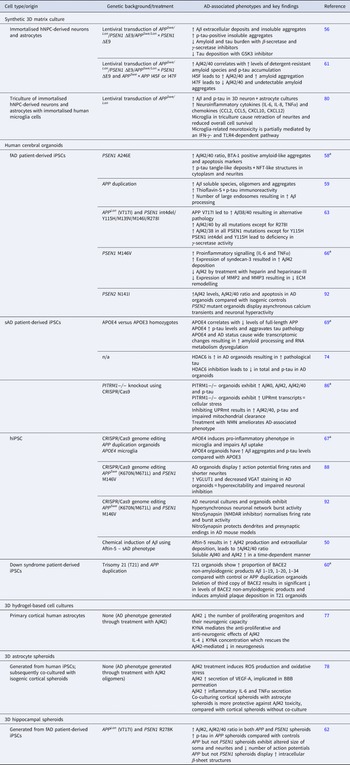
In recent years, 3D culture systems, including brain organoids, have demonstrated clear potential of recapitulating elements of AD pathology, including the deposition of Aβ plaques and NFTs, elevated levels of phospho-tau (p-tau) and pro-inflammatory molecules and elements of mitochondrial dysfunction, oxidative stress and synaptic dysfunction (Table 1). In this section, we aim to provide an overview of the potential of brain organoids as a humanised model system of AD pathology.
Summary of 3D culture models of AD

Aβ, amyloid-β; AD, Alzheimer's disease; APOE, apolipoprotein E; APP, amyloid precursor protein; BBB, blood–brain barrier; ECM, extracellular matrix; fAD, familial Alzheimer's disease; GSK, glycogen synthase kinase; HDAC, histone deacetylase; hNPCs, human neural precursor cells; IL, interleukin; IFN, interferon; iPSCs, induced pluripotent stem cells; KYNA, kynurenic acid; MMP, matrix metalloproteinase; n/a, not available; NFT, neurofibrillary tangle; NMDAR, N-methyl-d-aspartate receptor; PSEN, presenilin; p-tau, phosphorylated-tau; ROS, reactive oxygen species; sAD, sporadic Alzheimer's disease; TNF, tumour necrosis factor.
Human cerebral organoids contain numerous cell types including neural stem cells, intermediate neural progenitors and neurons.
a Denotes the presence of astrocytes in human cerebral organoids.
Aβ
Choi et al. were the first group to utilise a 3D cell culture model to study the pathogenesis of AD (Ref. Reference Choi56). They generated their 3D culture system using a human neural progenitor cell (ReN) line, engineered to express the fAD-causing APP Swedish (K670N/M671L) and London (V717I) mutations (APPSwe/Lon) and/or the PS1ΔE9 mutation. At 6 weeks post differentiation, compared with healthy controls, their fAD 3D culture exhibited highly elevated levels of secreted Aβ40 and Aβ42, which are the most abundant and amyloidogenic Aβ species found in AD (Refs Reference Choi56, Reference Chen57). Aβ42, although less abundant than Aβ40 in human AD brains, is especially fibrillogenic, and Choi et al. observed an increased Aβ42/40 ratio in their fAD 3D culture (Ref. Reference Choi56). Subsequent staining for insoluble Aβ deposits also revealed the presence of elevated extracellular Aβ aggregates in 6-week-old 3D cultures, indicating amyloid plaque-like deposition as seen in AD. Both levels of secreted Aβ and Aβ aggregates were reduced upon treatment with inhibitors of β-secretase and γ-secretase, which are involved in the proteolytic cleavage of APP into Aβ. Robust plaque-like pathology has since been reported in other studies using brain organoids with different fAD mutations (Refs Reference Gonzalez58, Reference Raja59, Reference Alić60). In a subsequent study, this group also generated 3D ReN cultures bearing mutations in the APP transmembrane domain, either I45F or I47F (Ref. Reference Kwak61). They found that the I45F mutation led to a drastic increase in the Aβ42/40 ratio which determined the higher aggregation propensity of Aβ, whereas a low Aβ42/40 ratio in the I47F brain organoids led to lower rates of aggregation. High Aβ42/40 ratios also correlated with increased cell death through elevated amounts of active caspase-3, a marker for cellular apoptosis (Ref. Reference Kwak61). Aβ accumulation was also studied in a hippocampal spheroid model by Pomeshchik et al., using AD patient-derived iPSCs harbouring either the APP London (V717I) mutation or the PSEN1 R278K mutation (Ref. Reference Pomeshchik62). They observed elevated Aβ42/40 ratios in both AD spheroid models compared with control ones; however, only the hippocampal neurons with APP V717I, and not PSEN1 R278K, exhibited a significantly higher intracellular β-sheet structure, indicative of increased protein aggregation. Furthermore, neurons only from the hippocampal spheroids with APP V717I displayed altered cell body size and neurite length, as well as a reduced number of action potential firings and a significantly more depolarised threshold (Ref. Reference Pomeshchik62). Together, these results suggest that the different fAD mutations in APP compared with PSEN1 trigger AD pathology in the hippocampus by mechanistically distinct pathways.
The differential effects of fAD mutations on Aβ accumulation were also examined by Arber et al. in patient cell-derived brain organoids, harbouring mutations in either APP or PSEN1 (Ref. Reference Arber63). They showed that the APP V717I mutation leads to altered processing of APP by γ-secretase, yielding skewed ratios of Aβ fragments of varying lengths. The resulting increased cleavage of Aβ38 and Aβ39 fragments may indicate that the canonical accumulation of Aβ42 species might not be the pathogenic trigger and that alternative APP-associated mechanisms underlie the pathogenicity of this mutation (Ref. Reference Quartey64). On the other hand, their panel of PSEN1 mutations revealed a reduced carboxypeptidase activity of γ-secretase, favouring the production of longer Aβ fragments, which are proposed to be more amyloidogenic. Conversely, a study by Alić et al. using iPSC-derived cerebral organoids from a Down syndrome (DS) patient with trisomy 21, showed the presence of a potential mechanism that could be involved in the prevention or delay of AD dementia in individuals with DS (Ref. Reference Alić60). DS patients carry a third copy of the APP gene on chromosome 21 which causes early-onset AD in over 40% of individuals over the age of 50 (Ref. Reference Holland65). However, Alić et al. demonstrated that the presence of a third copy of another gene, BACE2, on chromosome 21 resulted in increased cleavage of APP into shorter, non-amyloidogenic peptides 1–19, 1–20 and 1–34, and therefore attenuation of AD pathology (Ref. Reference Alić60). These organoids also displayed a higher ratio of non-amyloidogenic/amyloidogenic Aβ products, compared with isogenic euploid organoids as well as AD organoids harbouring an APP duplication mutation only. However, deletion of the third BACE2 gene copy completely reversed these effects and led to increased amyloid plaque staining instead (Ref. Reference Alić60), suggesting that a higher BACE2 copy number resulted in alternate APP processing which could delay the onset of AD in some individuals with DS, according to the authors (Ref. Reference Alić60).
In a study by Yan et al., the PSEN1 mutation M146V was shown to affect the expression of extracellular matrix (ECM)-modulating proteins in brain organoids, such as matrix metalloproteinases (MMPs) and syndecan-3, which can influence Aβ pathology (Ref. Reference Yan66). MMP2, which functions in ECM remodelling and axonal regeneration, and MMP3, which can degrade Aβ, were both downregulated in this model, indicating that dysfunction in ECM regulatory processes could be a factor in AD pathogenesis. Conversely, syndecan-3, which has been associated with plaque formation, was detected at higher levels. Interestingly, treatment with heparin or heparinase-III, anti-inflammatory molecules, was shown to reduce Aβ42 levels in their brain organoids (Ref. Reference Yan66).
The effects of APOE genotype on Aβ accumulation have also been examined using iPSC-derived brain organoids. Lin et al. showed that in organoids expressing APOE4 there is a robust increase in Aβ42 compared with APOE3 expressing brain organoids, although this difference became significant first at 6 months post differentiation (Ref. Reference Lin67). It is noteworthy that the organoids used by Lin et al. were generated from wild-type (WT) iPSCs and did not carry any fAD-causing mutations, which would have accelerated the production and accumulation of Aβ. Instead, they relied on a longer culture period for their observations and the effects on Aβ accumulation were a consequence of APOE genotype alone, which highlights the roles of APOE4 as a genetic risk factor for late-onset AD. They also found that the APOE4 genotype correlated with higher Aβ42 secretion, as well as an increased number of early endosomes in iPSC-derived neuronal cultures. Higher numbers of early endosomes have been reported in the brains of AD patients and have been linked to increased β-secretase processing of APP, generating Aβ precursors (Refs Reference Raja59, Reference Nixon68). On the other hand, a study by Zhao et al. using iPSCs derived from AD patients showed that AD status (disease versus healthy) determined Aβ accumulation, as opposed to APOE genotype (e3 versus e4) (Ref. Reference Zhao69). They did, however, also report that APOE4 genotype was associated with lower levels of full-length APP. Although their findings appear to contradict the ones made by Lin et al., Zhao et al. used culture times of only up to 12 weeks which could be insufficient time to study the contribution of late-onset risk factors to AD pathology. Instead, they used AD patient-derived cells, which could explain why they concluded that Aβ accumulation was determined by AD status rather than APOE genotype within their culture timespan. Furthermore, their use of enzyme-linked immunosorbent assay instead of western blot means that they could have detected Aβ sooner because of its secretion into the media preceding the formation of tissue-positive inclusions.
Tau
Tau is a protein abundantly expressed in neurons, where it primarily functions in stabilising the microtubule network in neuronal cell bodies and axons and facilitating axonal transport. In the adult human brain tau is present in six isoforms which differ in the number of amino-terminal inserts (0N, 1N, 2N) and carboxy-terminal repeats (3R, 4R) in the mRNA of the protein (Refs Reference Barbier70, Reference Arendt, Stieler and Holzer71). In AD all six isoforms are found in hyperphosphorylated tangles, in contrast to other tauopathies where certain isoforms are prevalent, making it an important distinction when modelling tau pathology in vitro (Ref. Reference Cherry72). However, 2D iPSC-derived neuronal cultures predominantly express the embryonic 0N3R isoform with little to no expression of the other isoforms, owing to their immature state and underlying the inability of the system to recapitulate AD-associated tau pathology (Refs Reference Choi43, Reference Arendt, Stieler and Holzer71). On the other hand, 3D culture systems enhance neuronal maturation and have shown expression of all six tau isoforms, creating a more accurate picture of tau pathology in AD.
3D models do in fact show robust tau pathology with elevated levels of phosphorylated tau at residues Ser199/Ser202/Thr205, as well as Ser396/Ser404, which are indicators of AD-associated tau hyperphosphorylation (Refs Reference Choi56, Reference Gonzalez58, Reference Moore73). Additionally, Gallyas silver staining (Ref. Reference Choi56) and thioflavin-S labelling (Ref. Reference Raja59) of fAD brain organoids have revealed the presence of tau-positive NFT-like insoluble inclusions in the cytoplasm and neurites. The accumulation of tau has further been associated with high Aβ42/40 ratios, whereby an increase in the Aβ42/40 ratio correlates with increased levels of p-tau, total tau and insoluble tau inclusions in 3D culture models (Ref. Reference Kwak61). Notably, treatments with a γ-secretase modulator, which specifically reduces the Aβ42/40 ratio, lead to a decrease in p-tau levels (Ref. Reference Kwak61), which is also observed after treatments with β-secretase and γ-secretase inhibitors. Inhibition of glycogen synthase kinase 3 (GSK3) also shows a marked reduction in p-tau, independent of Aβ levels, implicating it as an effector of tau pathology downstream of Aβ (Ref. Reference Choi56).
p-tau accumulation has been found to be modulated by the levels of histone deacetylase 6 (HDAC6) in the brain of the ADLPAPT mouse (5XFAD::JNPL3) AD model (Ref. Reference Choi74). Acetylated tau has been shown to be more aggregation-resistant, and acetylation at key sites competes with phosphorylation, preventing pathological changes in tau (Ref. Reference Choi74). HDAC6 deacetylates these tau residues, increasing the susceptibility to tangle formation. Additionally, HDAC6 is elevated in AD post-mortem brain tissue (Ref. Reference Ding, Dolan and Johnson75), as well as in AD brain organoids, indicating it could be a pathological driver in AD. Pharmacological inhibition of HDAC6 in AD brain organoids has shown a reduction in both p-tau and total tau (Ref. Reference Choi74), suggesting its potential as a putative drug target in AD.
APOE genotype has also been linked to tau levels. APOE4 brain organoids exhibit higher levels of p-tau at Ser202/Thr205 compared with APOE3 brain organoids (Ref. Reference Lin67). This has been observed for both soluble and insoluble p-tau, suggesting APOE4 could predispose to tangle formation. Furthermore, these elevations of p-tau in APOE4 brain organoids have been shown to correlate directly to ApoE4 protein levels, as opposed to AD status only (Ref. Reference Zhao69), implicating a possible causal relationship. However, it is unclear whether this effect is directly caused by APOE4 or secondary to impaired clearance of Aβ from the brain in APOE4 carriers.
Neuroinflammation
The presence and accumulation of Aβ and tau toxic species stimulates the sustained secretion of pro-inflammatory molecules in the central nervous system, causing further tissue damage and exacerbating the cognitive decline in AD. Although microglia are the primary cell type involved in inflammatory responses, neurons and astrocytes can trigger the signalling cascades that lead to microglial activation (Ref. Reference Baxter76). In their 3D model, bearing the PSEN1 M146V mutation and lacking microglia, Yan et al. showed that Aβ42 accumulation induced higher expression of TNFα and IL-6, two pro-inflammatory cytokines which are elevated in the brains of AD patients and have been linked to declining cognitive abilities (Ref. Reference Yan66). The authors note that the elevation of these cytokines could have been because of the presence of reactive astrocytes having neurotoxic effects, but they did not explicitly investigate the roles of astrocytes in their AD model. They also observed increased secretion of lactate dehydrogenase (LDH) in their brain organoids, indicating higher cytotoxic stress and apoptosis, which could be associated with Aβ42-mediated pro-inflammatory signalling. Treatment with heparin, an anti-inflammatory molecule, was shown to increase cell viability, whereas treatments with heparinase-III and N-[N-(3,5-difluorophenacetyl)-l-alanyl]-S-phenylglycine t-butyl ester (DAPT), a γ-secretase inhibitor, reduced LDH levels and promoted cell survival by reducing Aβ42 levels (Refs Reference Resnick12, Reference Yan66). Increased neuronal survival through anti-inflammatory molecule treatments demonstrates the detrimental, cytotoxic effects of inflammation in AD. Treatment with another anti-inflammatory cytokine, IL-4, has also been shown to promote cell viability and in particular increase the proliferative capacity and neurogenic potential of neural progenitor cells in 3D culture models (Ref. Reference Papadimitriou77). Neurogenesis is critically impaired in AD, which further correlates with decreased cognitive performance. It has been observed that reduced neurogenesis is associated with increased production of kynurenic acid (KYNA), secondary to higher Aβ accumulation (Ref. Reference Papadimitriou77). IL-4, on the other hand, upregulates neurogenesis and progenitor proliferation by suppressing KYNA production. These findings suggest that neuroinflammation not only exacerbates neuronal damage and death but also prevents the limited neuronal regeneration in AD.
The presence of Aβ oligomers has also been shown to upregulate the expression of vascular endothelial growth factor A (VEGF)-A in an astrosphere model (Ref. Reference Griffin78). VEGF-A primarily stimulates endothelial cell growth during blood vessel formation and can increase the permeability of endothelial cell layers during vascular remodelling. In AD, elevated levels of astrocyte-derived VEGF-A can result in increased permeability of the blood–brain barrier (BBB), leading to the extravasation of leucocytes from the peripheral bloodstream into the brain parenchyma (Ref. Reference Argaw79). This, in turn, can lead to further inflammatory signalling by the peripheral immune cells and increased neurotoxic stress and damage.
To study the role of microglia in neuroinflammation, Park et al. generated a triculture system using a 3D microfluidic platform (Ref. Reference Park80). Exogenous microglia migrated into a central chamber, containing their neuronal/astrocytic 3D cultures which bore the APPSwe/Lon mutation, and successfully penetrated and dispersed throughout them, mimicking the in vivo cellular environment. Park et al. showed that the 3D neuronal/astrocytic AD models secreted elevated levels of pro-inflammatory molecules such as the chemokine CCL2, as well as TNFα and interferon-γ, compared with controls (Ref. Reference Park80). The secretion of these molecules, primarily by activated astrocytes, induced the migratory phenotype in microglia, together with morphological changes consistent with an activated state of the microglia. Furthermore, microglia activation was observed to occur simultaneously to astrogliosis in the 3D AD culture, as seen by an increase in astrocytic glial fibrillary acidic protein (GFAP) staining (Ref. Reference Park80). The presence of the activated microglia in the AD cultures induced significant upregulation of pro-inflammatory markers compared with AD cultures lacking microglia. These included IL-6, IL-8 and TNFα, as well as chemokines CCL2, CCL5, CXCL10 and CXCL12, implicating microglia as widespread inflammatory mediators in AD (Ref. Reference Park80). Additionally, the 3D cultures containing microglia exhibited increased cellular and tissue damage compared with ones without microglia, resulting in reduced neuronal and astrocytic density and surface area, as well as retraction of neurites. These findings suggest that microglia-mediated neuroinflammation is a major contributor to neuronal loss in AD and an important mechanism to the progression of AD pathology.
APOE genotype has also been shown to affect the phenotype and functions of microglia. Microglia harbouring the e4 allele display altered transcriptional signatures, whereby genes related to cell movement and development are downregulated, and genes related to immunogenic activity are strongly upregulated (Ref. Reference Lin67). This denotes a phenotypic shift to a more active, pro-inflammatory state of the microglia which could underlie a mechanism for AD pathogenesis in APOE4 carriers. An APOE4 genotype has also been associated with increased cholesterol biosynthesis and reduced lipid catabolism and clearance in both microglia and astrocytes (Ref. Reference TCW81). This has been shown to occur in tandem with impaired lysosomal-mediated import and degradation in APOE4 versus APOE3 glia (Ref. Reference TCW81) which can lead to accumulations in intracellular lipids, as well as APP cleavage products including Aβ (Ref. Reference Zhang82). Dysregulation of lipid metabolism and lysosomal dysfunction in neuroglia have both been implicated as pathological hallmarks of AD. Additionally, co-culturing APOE4 microglia with AD brain organoids has revealed that these microglia exhibit altered morphologies in 3D culture, resulting in an impaired ability to sense extracellular Aβ, compared with APOE3 microglia (Ref. Reference Lin67). APOE4 microglia also show significantly slower uptake of Aβ42 compared with APOE3 microglia because of impaired phagocytosis. Consequently, AD brain organoids co-cultured with APOE4 microglia exhibit more extracellular Aβ aggregates than ones containing APOE3 microglia (Ref. Reference Lin67). This suggests that expression of APOE4 in microglia dysregulates the homoeostatic machinery of the cells, and the impaired clearance of Aβ species triggers further sustained neurotoxic pro-inflammatory signalling.
Mitochondrial dysfunction and oxidative stress
Mitochondrial dysfunction and overproduction of ROS are hallmarks of various neurodegenerative diseases including AD. It has been reported that mitochondrial bioenergetics are disrupted in the brains of AD patients, leading to glucose hypometabolism and reduction in adenosine triphosphate (ATP) synthesis because of impaired oxidative phosphorylation processes (Ref. Reference Wang83). Additionally, inefficiencies in the electron transport chain (ETC) machinery have been shown to increase the production of ROS, which are cytotoxic in high amounts, resulting in cell death. Additionally, ROS have been found to be elevated in brain organoids, secondary to elevated levels of Aβ42 (Refs Reference Griffin78, Reference Eckert, Schmitt and Götz84). Thus, understanding the principles behind mitochondrial dysfunction could elucidate a key step in the pathogenesis of AD.
One mitochondrial enzyme associated with AD-like pathology is pitrilysin metallopeptidase 1 (PITRM1). PITRM1 degrades the mitochondrial targeting sequence of peptides, priming them for mitochondrial import across the inner membrane, and is necessary for the processing and maturation of mitochondrial proteins (Ref. Reference Brunetti85). It has also been shown to degrade Aβ peptides and generate short, non-fibrillogenic fragments. Loss of function of PITRM1 can therefore lead to accumulation of peptides within the mitochondrial matrix, including Aβ, which can disrupt the mitochondrial membrane potential and interfere with the ETC, causing mitochondrial dysfunction (Ref. Reference Brunetti85). A study by Pérez et al. demonstrated the effects of PITRM1 loss in AD by generating homozygous knock-out brain organoids for the PITRM1 gene (Ref. Reference Pérez86). Initially, they observed that PITRM1 loss resulted in differential gene expression, compared with isogenic brain organoids, which affected normal mitochondrial function and oxidative phosphorylation in both neurons and glia. Additionally, PITRM1-deficient brain organoids exhibited increased Aβ40, Aβ42 and Aβ42/40, as well as detectable plaque pathology and tau hyperphosphorylation (Ref. Reference Pérez86). Levels of cleaved caspase-3 were also elevated, indicating increased cell death. These data suggest that PITRM1 loss can induce the major neuropathological features of AD and could represent a pathogenic mechanism in some AD cases.
Another significant observation made by Pérez et al. was that PITRM1 loss in brain organoids induced a dramatic upregulation of genes involved in the mitochondrial unfolded protein response (UPRmt) (Ref. Reference Pérez86). UPRmt, part of the integrated stress response (ISR), has been shown to induce the autophagy and clearance of defective mitochondria and can therefore be protective against mitochondrial damage (Ref. Reference Brunetti85). Inhibiting the ISR, in turn, led to an increase in Aβ42/40 and p-tau, as well as reduced mitochondrial clearance, which has been implicated in AD pathogenesis. Conversely, treatment of the PITRM1 knock-out brain organoids with nicotinamide mononucleotide (NMN), a nicotinamide adenine dinucleotide (NAD+) precursor, enhanced mitochondrial clearance and reduced Aβ42/40 and p-tau levels (Ref. Reference Pérez86), suggesting that targeting mitochondrial function and turnover could be a potential therapeutic strategy for AD.
Synaptic and network dysfunction
Disruption of normal synaptic function and connectivity is another hallmark of AD, initiated during the early stages of disease pathogenesis and underlying cognitive decline. It is believed that the small Aβ oligomers, as opposed to monomers or fibrils, are the major culprit behind synaptic dysfunction (Ref. Reference Marsh and Alifragis87). Aβ oligomers are known to localise to the postsynaptic terminals of excitatory neurons and act on N-methyl-d-aspartate receptors (NMDARs), inducing neurons into a hyperexcitable state and disrupting normal action potential firing patterns and long-term potentiation processes. However, newer models and approaches are now providing more evidence, allowing an increased understanding of the scope of synaptic dysfunction in AD.
A study by Ghatak et al. using brain organoids with either the PSEN1 M146V or APP Swedish mutation, showed that the AD brain organoids displayed increased action potential firing rates compared with WT brain organoids, indicating neuronal hyperexcitability because of the presence of AD mutations (Ref. Reference Ghatak88). Additionally, they found that the neurons in the AD brain organoids had shorter neurites and exhibited increased staining for vesicular glutamate transporter 1 (VGLUT1) and decreased staining for vesicular γ-aminobutyric acid (GABA) transporter. These data suggest that excitatory glutamate signalling is elevated in AD, while inhibitory GABA signalling is reduced, contributing to another pathological aspect of AD known as excitotoxicity. Increased concentrations of extracellular glutamate have been reported in AD and are associated with aberrant neuronal firing and the activation of calcium-dependent apoptotic pathways (Refs Reference Wang and Reddy89, Reference Hynd, Scott and Dodd90). Similarly, using 2D AD neuronal cultures Ghatak et al. also showed that the proportion of glutamatergic neurons was higher whereas that of GABAergic neurons was lower, compared with WT cultures (Ref. Reference Ghatak88). However, in a subsequent study it was shown that administration of an NMDAR antagonist, NitroSynapsin, was able to ameliorate the hyperexcitable phenotype of neurons in AD brain organoids by normalising glutamate-induced neuronal firing (Ref. Reference Ghatak91). Notably, blocking the hyperactivity of extra-synaptic NMDARs was shown to decrease AD-related pathological signalling (Refs Reference Wang and Reddy89, Reference Ghatak91), highlighting the possible pathological mechanism of hyperexcitability and proposing a putative therapeutic strategy against excitotoxicity in AD.
Similarly, Yin and VanDongen used AD patient iPSC-derived cerebral organoids with the PSEN2 N141I mutation to study network activity in AD through fluorescent calcium imaging (Ref. Reference Yin and Vandongen92). They showed that the calcium transients in their AD organoids were asynchronous but displayed a higher activity compared with isogenic control organoids, while also exhibiting a significantly higher amplitude and firing rate. Together, the results of Ghatak et al. and Yin and VanDongen demonstrate that disruptions in the normal function of γ-secretase, caused by fAD mutations in either PSEN1 or PSEN2, lead to downstream dysregulations in synaptic and network connectivity.
Current challenges and future directions
Evidently, 3D brain organoid systems provide great advantages over 2D cultures, exhibiting both Aβ and NFT pathology, synaptic and mitochondrial dysfunction, and neuroinflammation along with cell-to-cell interactions. As such, brain organoids have provided increased understanding of AD pathophysiology. However, there is still much progress that can be made to allow brain organoids to encapsulate the full aetiology of AD, including, but not limited to, integrating neuron–microglia interactions into the system, incorporating a vascular system, and recapitulating the age-related phenotype of AD.
Notably, the most commonly used AD brain organoids contain neuronal progenitor cells and neurons, which are derived from the ectoderm but lack microglial cells, which are derived from the mesoderm (Ref. Reference Bi93). As previously described, microglia have important immunological roles in AD development with their activation resulting in the release of inflammatory mediators which cause neuronal death/injury and synaptic damage (Ref. Reference Bi93). More recently, it has been shown that AD brain organoids containing microglia can be developed via co-culturing methods which involve co-culturing microglial cells with brain organoids and changing the culture formulations (Ref. Reference Bi93). There are a number of microglia differentiation protocols which allow microglia to be generated from iPSCs (Ref. Reference Sabogal-Guáqueta94). The first protocol for microglia differentiation from iPSCs was published in 2016 by Muffat and colleagues who cultivated human embryonic stem cells and iPSCs and tested for yolk-sac myelogenesis markers (e.g. VE-cadherin, PU.1 and CD41) which are vital for microglia maturation and viability. Embryoid bodies positive for these markers were further cultivated and differentiated into microglia by employing CSF1 and IL-34 (Refs Reference Sabogal-Guáqueta94, Reference Muffat95). More recently published protocols involve various culturing techniques including generation of microglia-like cells from iPSCs (Ref. Reference Abud54); from myeloid progenitors (Ref. Reference Douvaras96); from embryonic-like MYB-independent precursors (Ref. Reference Haenseler97); via co-culture of iPSCs with astrocytes (Ref. Reference Pandya98); using macrophage differentiation as an intermediate step and mimicking the mesoderm specification (Ref. Reference Takata99); by differentiation of iPSCs to primitive macrophage precursors (Refs Reference Brownjohn100, Reference Garcia-Reitboeck101) and by changing the culture medium to include factors such as IL-34, transforming growth factor-β1, macrophage colony-stimulating factor (M-CSF) and CD200 (Ref. Reference McQuade102). However, the application of these differentiation protocols to develop 3D brain organoids containing microglia proves more challenging and only a limited number of studies have been able to develop a 3D system which involves the interaction between microglia and neurons (Ref. Reference Sabogal-Guáqueta94). Muffat and colleagues demonstrated that in 2D culture microglia maintain their ‘resting’ rounded morphology, however, when cultured under 3D conditions they displayed an ‘activated’ ramified morphology (Refs Reference Sabogal-Guáqueta94, Reference Muffat95). Supporting this, both Abud et al. and Brownjohn et al. demonstrated that when human microglia-like cells are cultured with brain organoids they migrate into the organoid and display a highly ramified morphology. In both studies, the microglia were able to survive for several weeks (Refs Reference Abud54, Reference Sabogal-Guáqueta94, Reference Brownjohn100).
Additionally, brain organoids lack complete vascularisation which is necessary to encapsulate the in vivo environment of the brain (Ref. Reference Papaspyropoulos103). This limits their application for the study of angiogenesis and cerebrovascular disorders and has important implications for the study of AD as it means that brain organoids also lack a BBB which has been shown to be dysfunctional in AD before neurodegeneration occurs (Refs Reference Montagne, Zhao and Zlokovic104, Reference Cheah, Mason and Ling105). Although attempts have been made to reproduce the BBB in organoids via co-culture of pericytes, astrocytes and brain microvascular endothelial cells, there has been difficulty in modulating the BBB tight junctions which hinders the system from being fully functional (Refs Reference Cheah, Mason and Ling105, Reference Bergmann106, Reference Lauschke, Frederiksen and Hall107). However, it has been shown that brain organoids derived from human embryonic stem cells which were engineered to express human Ets variant transcription factor 2 (ETV2) were able to form vascular-like structures and several BBB characteristics including increased expression of tight junctions, trans-endothelial electrical resistance and nutrient transporters (Ref. Reference Cakir108). Additionally, brain organoids have been vascularised by co-culture with human umbilical vascular cells resulting in expression of P-glycoprotein, a BBB marker, improvements of the hypoxic state of the organoids, higher numbers of spontaneously active neurons and increased growth of the organoids (Refs Reference Shi109, Reference Matsui110). These findings provide a valid physiological representation of the brain and may allow for a greater understanding of the role of the BBB and vasculature in AD.
Specifically for the application of brain organoids to AD, a critical obstruction is that iPSC-derived neural cells exhibit a transcriptional profile analogous to the prenatal brain (Refs Reference Bi93, Reference Papaspyropoulos103, Reference Camp111). Previously, it has been reported that brain organoids exhibit internal cellular apoptosis and volume shrinkage after 180 days of culture as, without a vascular system, nutrients and oxygen cannot enter the innermost regions of the organoid (Refs Reference Bi93, Reference Kelava and Lancaster112). It is therefore challenging to recapitulate the age-related phenotypes of AD in brain organoids (Ref. Reference Bi93). This poses a major limitation as ageing is the core risk factor for developing AD meaning that current brain organoids do not sufficiently simulate the real AD brain (Refs Reference Bi93, Reference Papaspyropoulos103, Reference Kelava and Lancaster112). Telomere shortening has previously been used to induce ageing-specific phenotypes such as a reduced number of dendrites and increased mitochondrial stress in iPSCs; however, this has not yet been translated to organoid development (Ref. Reference Vera, Bosco and Studer113). Furthermore, overexpression of progeria, a variant of the lamin A/C gene which causes premature ageing, in iPSC-derived dopaminergic neurons resulted in dendrite degeneration, the accumulation of ROS and DNA damage (Ref. Reference Miller114). Recently, researchers have been able to grow brain organoids, harbouring the most common amyotrophic lateral sclerosis and frontotemporal dementia mutations, for 240 days which has not previously been possible (Ref. Reference Szebényi115). This provides hope that age-related phenotypes will soon be able to be translated from iPSC models to brain organoids, further increasing their validity as a model of AD.
Transplantation of brain organoids represents an attractive option for overcoming such limitations, including the involvement of neuron–microglia interactions and vasculature (Ref. Reference Song116). Numerous studies have demonstrated that organoids can be successfully transplanted into the mouse cortex leading to increased neurogenesis, cell survival and neuronal differentiation and maturation (Refs Reference Daviaud, Friedel and Zou117, Reference Mansour118, Reference Wang119). For instance, transplanted brain organoids have been shown to be vascularised by endothelial cells from the host mouse brain, facilitating functional synaptic connectivity and neuronal activity between the transplanted organoid and the host brain (Ref. Reference Mansour118). Additionally, whole-cell patch-clamp recordings have demonstrated that brain organoids undergo functional maturation after transplantation into the mouse brain (Ref. Reference Dong120). To date, the majority of brain organoid transplantation studies have focused on post-stroke repair (Refs Reference Wang119, Reference Wang121) and no study has yet focused on organoid transplantation for AD therapeutics. However, with further research transplantation of organoids presents a promising approach to allow further encapsulation of the in vivo human brain for AD research.
Brain organoids provide attractive alternative avenues for disease modelling and have enormous potential for drug screening and precision medicine applications. However, the advantage of organoids having the capacity to model complex processes contradicts the simple molecular assays typically used in targeted drug discovery (Ref. Reference Ooi122). Thus, it is more likely that organoids will be valuable at the target identification stage, increasing understanding of the molecules and/or pathways that modulate the progression of AD, or in the later stages of lead development where the aim is to select the most biologically active compound (Ref. Reference Ooi122). It is possible that in the future a patient's own cells could be reprogrammed to grow an organoid which could be used to assess which unique combination of drugs best suits their disease and allow clinicians to accurately predict the drug response in individual patients (Refs Reference Cheah, Mason and Ling105, 123). However, attempts to generate organoids derived from primary material have focused on epithelial tissue. Therefore, adapting the current patient-derived organoid technology to model AD using non-epithelial tissues would come with numerous technical limitations and further development of high-throughput methods and culture conditions would be required (Refs Reference Papaspyropoulos103, Reference Cheah, Mason and Ling105).
Conclusions
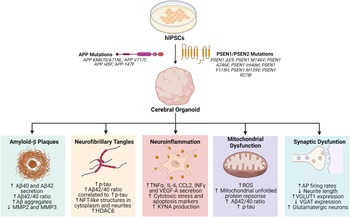
In summary, brain organoids recapitulate many features of the in vivo brain that cannot be achieved by cell and animal research. Brain organoids provide a useful model to study the mechanisms of AD pathology, including Aβ deposition, NFTs, neuroinflammation, oxidative stress, mitochondrial, synaptic and network dysfunction (Fig. 1). However, it is important to note that further research is required in order to fully encapsulate the whole pathology of some of these mechanisms, most notably developing co-culture methods to study the role of microglia in AD neuroinflammation pathology. AD brain organoids can be further developed, including incorporating BBB dysfunction and the ageing phenotype into these models. However, despite these required developments, brain organoids remain a useful tool for modelling AD pathogenesis and are likely to prove invaluable for drug screening and personalised medicine applications.
Overview of AD pathology modelled by human brain organoids. Aβ, amyloid-β; AD, Alzheimer's disease; AP, action potential; APP, amyloid precursor protein; HDAC, histone deacetylase; IL, interleukin; IFN, interferon; hiPSCs, human induced pluripotent stem cells; KYNA, kynurenic acid; MMP, matrix metalloproteinase; NFT, neurofibrillary tangle; PSEN, presenilin; p-tau, phosphorylated-tau; ROS, reactive oxygen species; TNF, tumour necrosis factor; VEGF, vascular endothelial growth factor; VGAT, vesicular GABA transporter; VGLUT, vesicular glutamate transporter. Figure created with BioRender.com.

Financial support
The work in the Kang Lab and Berg Lab is supported by Development Trust Relevant Dementia Research Projects at Institute of Medical Sciences, University of Aberdeen
Conflict of interest
The authors declare no conflicts of interest.