Introduction
Multiple lines of evidence suggest that during the manic phase, patients with bipolar disorder (BD) show altered processing of emotionally relevant information. For example, Murphy and colleagues found that manic BD patients showed a positive bias on an emotional go/no-go test (Murphy et al. Reference Murphy, Sahakian, Rubinsztein, Michael, Rogers, Robbins and Paykel1999) and made suboptimal choices and performed more slowly on a gambling game (Murphy et al. Reference Murphy, Rubinsztein, Michael, Rogers, Robbins, Paykel and Sahakian2001). More recent studies reported that manic BD patients made poor choices on the Iowa Gambling Task, tending to choose cards from more risky decks (Adida et al. in press), and showed poor probabilistic reward learning due to oversensitivity to occasional rewards when choosing stimuli primarily associated with punishment (Pizzagalli et al. Reference Pizzagalli, Goetz, Ostacher, Iosifescu and Perlis2008). Mood-congruent biases in episodic memory and face processing have also been reported in the manic state (Eich et al. Reference Eich, Macaulay and Lam1997; Lembke & Ketter, Reference Lembke and Ketter2002). Such patterns of cognitive performance contrast with those observed in the depressed state and during euthymia in BD patients (Rubinsztein et al. Reference Rubinsztein, Michael, Paykel and Sahakian2000, Reference Rubinsztein, Michael, Underwood, Tempest and Sahakian2006).
Positive mood induction is one tool that can be used to tease apart the relative contributions of state and trait factors in mediating the cognitive changes seen in manic BD patients. One study suggested that euthymic BD patients were less likely to take advice following positive mood induction (Mansell & Lam, Reference Mansell and Lam2006). However, no study to date has investigated the effect of positive mood induction on emotional processing in euthymic individuals with BD.
We therefore investigated the effect of positive mood induction on emotional processing in euthymic individuals with BD and healthy controls, using the Affective Go/No-go test (AGNG) and the Cambridge Gamble task (CGT). In contrast to other mood induction studies, which have generally used self-referent emotional memories or films/music with a strong emotional component, we manipulated mood using a simple feedback paradigm. Previously, we reported that euthymic individuals with BD were more sensitive to mood induction using this technique because they exhibited a longer-lasting positive mood than controls following the procedure (Farmer et al. Reference Farmer, Lam, Sahakian, Roiser, Burke, O'Neill, Keating, Smith and McGuffin2006). We hypothesized that positive mood induction in euthymic individuals with BD would also induce the same cognitive changes observed in the manic state. Specifically, we predicted that mood induction would elicit a positive emotional bias on the AGNG and impair decision making on the CGT.
Method
Participants
Fifteen participants who had participated in a genetic case–control study of BD and who fulfilled operational criteria for DSM-IV BD-I volunteered to participate in a pilot mood induction study. All BD cases had been interviewed previously using the Schedules for the Clinical Assessment of Neuropsychiatry (SCAN; Wing et al. Reference Wing, Babor, Brugha, Burke, Cooper, Giel, Jablenski, Regier and Sartorius1990) for psychopathology occurring in their worst episode of mania and their worst episode of depression; their results were entered into the CATEGO5 scoring program (Celik, Reference Celik2003) to assign a lifetime-ever diagnosis. All BD cases were taking mood-stabilizing medication at the time of the study. The Past History Schedule (McGuffin et al. Reference McGuffin, Katz and Aldrich1986) was administered by telephone to establish whether 19 volunteer age- and sex-matched control subjects had ever suffered or were currently suffering from any psychiatric or neurological disorder. All participants gave written informed consent and were screened with the Beck Depression Inventory (BDI; Beck et al. Reference Beck, Ward, Medelson and Erbaugh1961) and the Altman Mania Scale (AMS; Altman et al. Reference Altman, Hedeker, Peterson and Davis1997) by telephone 1 week prior to testing, as well as on the day of the mood induction procedure. This study was approved by the Joint South London and Maudsley National Health Service (NHS) Trust and Institute of Psychiatry Research Ethics Committee.
Procedure
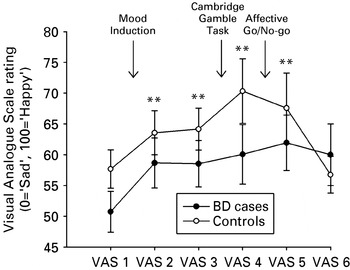
On the day of testing, all participants completed the National Adult Reading Test (NART; Nelson, Reference Nelson1982) to provide a proxy measure of IQ. Participants performed the AGNG and CGT approximately 15 min after completing a mood induction paradigm, and regularly filled out 100-mm mood-rating Visual Analogue Scales (VAS), with ‘Sad’ on the left and ‘Happy’ on the right of the scale, to confirm mood elevation (see Fig. 1). The AGNG and then the CGT were performed in the same order by every participant, who also performed a local-global processing task, data for which have been reported previously (Farmer et al. Reference Farmer, Lam, Sahakian, Roiser, Burke, O'Neill, Keating, Smith and McGuffin2006).
Study design and mood ratings. Positive mood induction resulted in increased subjective ratings of happiness in both bipolar disorder (BD) and control groups, as assessed by Visual Analogue Scales (VAS; results reported previously in Farmer et al. Reference Farmer, Lam, Sahakian, Roiser, Burke, O'Neill, Keating, Smith and McGuffin2006). Mood induction was performed between VAS 1 and VAS 2. The Affective Go/No-go test (AGNG) and the Cambridge Gamble Task (CGT) were performed between VAS 3 and VAS 5, approximately 15 min following mood induction, during which mood ratings remained elevated. ** Significant elevation in mood relative to VAS 1 at p<0.05. Values represent the mean, error bars standard error of the mean.

Mood induction paradigm (Farmer et al. Reference Farmer, Lam, Sahakian, Roiser, Burke, O'Neill, Keating, Smith and McGuffin2006)
An adaptation of the Go task (Johnson et al. Reference Johnson, Ruggero and Carver2005) was used to achieve mood induction, as described previously (Farmer et al. Reference Farmer, Lam, Sahakian, Roiser, Burke, O'Neill, Keating, Smith and McGuffin2006). In brief, participants performed a reaction time test analogous to the rodent 5-Choice Serial Reaction Time Task (Carli et al. Reference Carli, Robbins, Evenden and Everitt1983) in two blocks, each lasting 2 min. On each trial, participants made a speeded response to one of five lights by pressing one of five corresponding buttons. During the first block, participants received no feedback, but at the end of the block they were informed that their response time was ‘very fast’, irrespective of their actual performance. During the second block, participants were informed that a beep would sound every time they responded accurately and quickly. In fact, the program was set so that subjects were given positive feedback 70% of the time, irrespective of actual performance. As we have reported previously, this procedure resulted in a robust subjective mood enhancement, as assessed using VAS, in both BD cases and controls (see Fig. 1 and Farmer et al. Reference Farmer, Lam, Sahakian, Roiser, Burke, O'Neill, Keating, Smith and McGuffin2006).
The AGNG (Murphy et al. Reference Murphy, Sahakian, Rubinsztein, Michael, Rogers, Robbins and Paykel1999)
During the AGNG, positively and negatively toned words were presented randomly at a rate of one every 1.2 s on a computer screen. On each block of 18 words, half were positive and half negative. Participants were required to either make or withhold a response depending on the valence of the word, according to an instruction given at the beginning of the block (i.e. over the whole block participants responded to either positive (‘happy’) or negative (‘sad’) target words). There were 10 blocks in total, including two practice blocks at the beginning of the test. The target words changed every two blocks, such that half the blocks were ‘shift’ blocks (where the targets of the current block were the distractors in the previous block) and half the blocks were ‘non-shift’ blocks (where the target and distractor words of the current block matched those of the previous block). Outcome measures from this test include correct response latency, number of inappropriate responses (commission errors) and number of misses (omission errors) for each block. Each of these measures was calculated for the happy shift, happy non-shift, sad shift and sad non-shift conditions separately.
The CGT (Rogers et al. Reference Rogers, Everitt, Baldacchino, Blackshaw, Swainson, Wynne, Baker, Hunter, Carthy, Booker, London, Deakin, Sahakian and Robbins1999)
The CGT is a test of decision making and risk taking. On each trial, 10 boxes appeared of which between one and nine were red and the rest were blue. Participants were required to decide whether a yellow token had been hidden in a blue or a red box. They were then given the opportunity to win points by betting a percentage of their current points total on their decision (either 5, 25, 50, 75 or 95%). These bet options were presented sequentially in either ascending or descending order; in half of the games the ascending condition was used, and in half the descending condition. Participants played four games, each consisting of nine trials. This represents a slight difference from the original task (Rogers et al. Reference Rogers, Everitt, Baldacchino, Blackshaw, Swainson, Wynne, Baker, Hunter, Carthy, Booker, London, Deakin, Sahakian and Robbins1999), which contained eight games; the number of games was halved for the present study because of the time constraints imposed by the mood induction procedure. Outcome measures from this test include the proportion of choices of the most likely outcome, the percentage of points bet on trials where the most likely outcome was chosen and the latency to choose the most likely outcome. Each of these measures was calculated for the 6:4, 7:3, 8:2 and 9:1 ratios in the ascend and descend conditions separately.
Statistical analysis
Data were analysed using SPSS version 13 (SPSS Inc., Chicago, IL, USA). Where appropriate, data were transformed prior to analysis, as appropriate, to reduce skew and stabilize variances. However, all of the data reported in the text and figures describe untransformed values. Where test assumptions were met, parametric analyses were used (i.e. t tests and ANOVA), with an appropriate correction where the homogeneity of variance assumption was violated.
Data from the AGNG and CGT were analysed using repeated-measures ANOVA. For the AGNG, valence (positive/negative) and shift (shift/non-shift) were entered as within-subjects factors. For the CGT, ratio (6:4/7:3/8:2/9:1) and condition (ascend/descend) were entered as within-subjects factors. Group (BD case/control) was entered as the between-subjects factor in both analyses. As the cases were marginally older than the controls, age was entered as a covariate, where age correlated with the dependent measure in question, to confirm that any differences between the groups were not simply related to age. Proportions of choices of the most likely outcome data on the CGT were not normally distributed, and were analysed using the Mann–Whitney U test. Correlations between VAS ratings and performance on the AGNG and CGT were assessed using Pearson's r.
Results
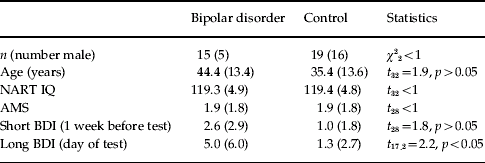
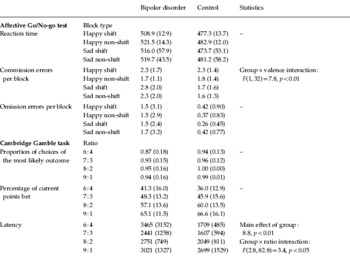
The two groups did not differ significantly on any demographic variable other than a slightly increased BDI score on the day of the test in the BD group (see Table 1). However, including BDI score as a covariate in the analyses did not change any of the results. Behavioural data are reported in Table 2. Mood induction using the ‘Go’ task significantly elevated mood in both groups, an effect that lasted until after the completion of the AGNG and CGT (see Fig. 1).
Demographic data

NART, National Adult Reading Test; AMS, Altman Mania Scale; BDI, Beck Depression Inventory.
Values represent the mean (standard deviation).
Data from the emotional processing tests

Values represent the mean (standard deviation).
The CGT
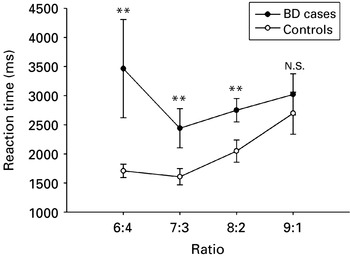
Data from one control were lost, and one BD case made too few choices of the most likely outcome to include their data in the analysis. The BD group responded more slowly on the CGT than controls [F(1, 30)=8.8, p<0.01, η=0.23], an effect that remained significant when age was included as a covariate [F(1, 29)=4.8, p<0.05]. This group difference was qualified by a significant group×ratio interaction [F(2.8, 82.8)=3.4, p<0.05, ε=0.83, η=0.1]. Post-hoc analysis including age as a covariate revealed that the BD group responded more slowly than controls at the 6:4, 7:3 and 8:2 ratios (p<0.05 for all) but did not differ significantly from the control group at the 9:1 ratio (p>0.1) (see Fig. 2). There was also a main effect of ratio [F(3, 87)=11.6, p<0.001], indicating that participants made their decisions more quickly at lower ratios than higher ratios. No other significant main effects or interactions were identified for latency or percentage bet, other than a main effect of ratio on percentage bet [F(2.5, 74.1)=60.9, p<0.001], indicating that participants placed higher bets on more likely outcomes. The BD cases and controls did not differ in terms of overall choice of the most likely outcome (z=1.6, p>0.1).
Latency (in ms) on the Cambridge Gamble Task (CGT). Bipolar disorder (BD) cases responded significantly more slowly than controls at more difficult decisions (6:4, 7:3 and 8:2 ratios) but not at the easiest decisions (9:1 ratio). ** p<0.05; n.s., non-significant. Values represent the mean, error bars standard error of the mean.

The AGNG
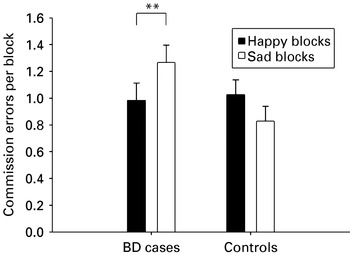
A significant group×valence interaction was identified for commission errors on the AGNG [F(1, 32=7.8), p<0.01]. Planned comparisons revealed a positive bias in the BD cases, who made significantly more inappropriate responses to positive distractor words than negative distractor words (i.e. a higher rate of commission errors during ‘sad’ target blocks than ‘happy’ target blocks) following mood induction [F(1, 14=4.7), p<0.05, η=0.25], whereas controls did not [F(1, 18=3.1), p=0.1, η=0.15] (see Fig. 3). All other main effects and interactions were non-significant, other than a main effect of group on latency that was no longer significant when age was included as a covariate.
Commission errors on the Affective Go/No-go test (AGNG). Bipolar disorder (BD) cases showed a significant positive bias, making significantly more inappropriate responses to positive words (i.e. on ‘sad’ target blocks) than negative words (i.e. on ‘happy’ target blocks), whereas controls did not. ** p<0.05. Values represent the mean, error bars standard error of the mean.

Relationship between mood and emotional processing measures
There were no significant correlations between performance on the AGNG or CGT and VAS ratings at the time of testing (p>0.1 for all).
Discussion
Euthymic individuals with BD exhibited a positive emotional bias and slower decision making compared with controls following positive mood induction. These changes are similar to those apparent in the manic state (Murphy et al. Reference Murphy, Sahakian, Rubinsztein, Michael, Rogers, Robbins and Paykel1999, Reference Murphy, Rubinsztein, Michael, Rogers, Robbins, Paykel and Sahakian2001), although Rubinsztein et al. (Reference Rubinsztein, Michael, Paykel and Sahakian2000) did report a trend towards slower responding on the CGT in euthymic BD patients. However, we did not identify differences between the groups on the CGT in ‘risk adjustment’ (the extent to which participants altered their betting behaviour as a function of risk) or the quality of decision making, effects that have been reported previously in manic bipolar patients (Murphy et al. Reference Murphy, Rubinsztein, Michael, Rogers, Robbins, Paykel and Sahakian2001). These data suggest that individuals with BD and healthy controls respond to positive mood induction in a qualitatively different manner. Although both groups showed an equivalent subjective improvement in mood following the mood induction procedure, as assessed by their subjective mood ratings during testing, their performance on objective tests of emotional processing was very different.
The mood induction paradigm we used was unusual in that it used feedback; more commonly, experimenters have made use of sad narratives or music to induce mood. One advantage of our technique over others is that it lessens the likelihood of cognitive priming, that is the activation of certain memories or beliefs that have nothing to do with the induced mood but that nonetheless may affect task performance. An additional advantage of this procedure is that it could be parametrically manipulated to produce a neutral or even a negative mood state by altering the nature of feedback provided during the Go task.
We did not perform the emotional processing tests both during mood induction and at baseline in the same participant because of concerns that practice effects might confound our results. However, previous studies investigating performance on the AGNG in BD patients reported no difference between euthymic BD patients and controls in terms of emotional bias (Rubinsztein et al. Reference Rubinsztein, Michael, Paykel and Sahakian2000), and a positive bias in manic patients (Murphy et al. Reference Murphy, Sahakian, Rubinsztein, Michael, Rogers, Robbins and Paykel1999). These findings suggest that emotional biases in BD patients mirror their current emotional state.
Some weaknesses of our study design merit comment. First, we included only 15 BD cases, who were of above-average IQ. These individuals may not be representative of the general BD population, and these results should therefore be treated with caution until independently replicated in a larger sample of more representative BD cases. Second, all BD cases were taking mood-stabilizing medications, which could interact with the effect of mood induction, although it might be expected that their primary effect would be to attenuate the effect of mood induction. Third, because of the lack of a neutral control condition, it is currently unclear whether the latency differences on the CGT are due to state or trait effects in BD. Previous studies investigating CGT performance in BD have reported that patients in the manic and depressed states make decisions significantly more slowly than controls (Murphy et al. Reference Murphy, Rubinsztein, Michael, Rogers, Robbins, Paykel and Sahakian2001; Rubinsztein et al. Reference Rubinsztein, Michael, Underwood, Tempest and Sahakian2006), with a trend towards slower responding in the euthymic state (Rubinsztein et al. Reference Rubinsztein, Michael, Paykel and Sahakian2000); another study reported that euthymic BD patients were unimpaired on the Iowa Gambling Task (Clark et al. Reference Clark, Iversen and Goodwin2002), whereas a more recent study using the same task reported deficits in the manic BD patients (Adida et al. in press). In the present study slower decision making was most apparent when the probability of being correct was lower, and unlike in the manic and depressed states, the BD cases in the present study did not exhibit poor quality of decision making on the CGT. We therefore hypothesize that the slowing observed at more difficult decisions on the CGT in the BD cases reflects their difficulty in overcoming the inclination to engage in behaviour with a high potential for negative consequences, which may have been elicited by the mood induction.
The results from both of the tests used in this study provide preliminary evidence that positive mood induction in euthymic individuals with BD is sufficient to re-establish the biases in information processing and disruptions to decision-making behaviour that occur in the manic state. We therefore speculate that such cognitive changes may occur relatively early on during the ascent into mania. Clinicians may be able use these findings during cognitive behavioural therapy to help guide individuals with BD to become aware of the automatic changes to emotional processing that occur during the early stages of mood elevation, and better regulate their mood while their insight is still relatively intact.
Declaration of Interest
The participants who agreed to participate in this pilot study had already participated in a case-control genetic study funded by GlaxoSmithKline Research and Development. Anne Farmer and Peter McGuffin have received consultancy fees and honoraria for presentations, chairing, and participating in expert panels, plus travel and subsistence costs from GlaxoSmithKline, Eli Lilly, Bristol–Myers Squibb and Lundbeck. Jonathan Roiser and Barbara Sahakian have performed consultancy work for Cambridge Cognition.