Prosociality has endured as a unique feature of human social morality. However, the development of children and adolescents’ prosocial behaviors has only recently attracted the attention of social scientists. This fact may reflect a modern version of Plato’s dilemma in his dialogue Lysis. The Greek philosopher questioned whether the concern for a friend’s sake is selfless or directed towards one’s own interest. There is still intense discussion about what the dimensions of prosocial behavior are, namely if the fulfillment of egotistic goals should be labeled under prosociality or if altruistic and egotistic forms of help, share and care are independent (Carlo, Knight, McGinley, Zamboanga, & Jarvis, Reference Carlo, Knight, McGinley, Zamboanga and Jarvis2010).
Theoretical divergences have led to mounting evidence regarding the characteristics and benefits of prosocial development. Advancements in the field have been followed by claims that new research efforts are needed to clarify the relationships between dispositional characteristics such as gender and prosocial behavior (Eisenberg et al., Reference Eisenberg, Fabes, Karbon, Murphy, Wosinski, Polazzi and Juhnke1996) across different social (Eisenberg et al., Reference Eisenberg, Guthrie, Murphy, Shepard, Cumberland, Carlo, Killen and Coplan2011) and cultural backgrounds (Carlo, Mestre, Samper, Tur, & Armenta, Reference Carlo, Mestre, Samper, Tur and Armenta2011). Unfortunately, these suggestions have not been followed up due to the lack of research instruments in several languages that may reproduce the latest trends in the field.
This study is guided by the above mentioned recommendations, aiming at evaluating three goals: to assess the psychometric properties of the Portuguese version of the Prosocial Tendencies Measure-Revised (PTM-R) (Carlo, Hausmann, Christiansen, & Randall, Reference Carlo, Hausmann, Christiansen and Randall2003), a questionnaire designed to assess early adolescents’ prosocial behaviors; to understand if the PTM-R factorial structure is invariant across gender and school retention groups (students who failed at least one school year and thus had to repeat it vs. those students that did not have such a record); finally, to assess the relation between types of prosocial behaviors and types of self-regulation in general as well as across gender and school retention groups. This is the most original feature of this study, since such relationships remain unexplored.
Prosocial behavior
Prosocial behavior may be defined as voluntary actions intended to benefit others (Eisenberg et al., Reference Eisenberg, Fabes, Karbon, Murphy, Wosinski, Polazzi and Juhnke1996; Padilla-Walker & Christensen, Reference Padilla-Walker and Christensen2011; Yoo, Feng, & Day, Reference Yoo, Feng and Day2013). Prosocial actions may assume distinct forms of helping, sharing or comforting others (Carlo, McGinley, Hayes, Batenhorst, & Wilkinson, Reference Carlo, McGinley, Hayes, Batenhorst and Wilkinson2007; Lenzi et al., Reference Lenzi, Vieno, Perkins, Pastore, Santinello and Mazzardis2012). These acts can reflect selfless orientations such as altruism, helping others in need (emotional and dire prosocial behavior), or anonymous help. They may also, however, comprise some type of ego-involvement in the case of public or compliant behaviors enacted to benefit others, but driven by social rewards or demands (Carlo et al., Reference Carlo, Knight, McGinley, Zamboanga and Jarvis2010).
Gender is one of the most noteworthy variables associated with prosocial variation. Girls show higher levels of prosocial behaviors when compared to boys (e.g., Fabes, Carlo, Kupanoff, & Laible, Reference Fabes, Carlo, Kupanoff and Laible1999). This difference is evident as early as 14 months’ old (Zahn-Wahler, Schiro, Robinson, Emde, & Schmitz, Reference Zahn-Waxler, Schiro, Robinson, Emde, Schmitz, Emde and Hewitt2001) and tends to remain stable throughout the lifespan (Eisenberg et al., Reference Eisenberg, Guthrie, Murphy, Shepard, Cumberland, Carlo, Killen and Coplan2011). Distinctive prosocial tendencies across gender groups have been related to individual factors, including girls’ higher standards of moral reasoning (Carlo et al., Reference Carlo, McGinley, Hayes, Batenhorst and Wilkinson2007) and greater perceived competence (Fabes et al., Reference Fabes, Carlo, Kupanoff and Laible1999). Conversely, boys’ lower levels of self-regulation and slower pubertal maturation (Carlo, Crockett, Wolff, & Beal, Reference Carlo, Crockett, Wolff and Beal2012) tend to undermine their ability to identify prosocial behaviors in comparison to girls (Eisenberg et al., Reference Eisenberg, Fabes, Karbon, Murphy, Wosinski, Polazzi and Juhnke1996).
Gender differences in prosocial development may also result from significant interactions between prosociality and social factors. Parental support and sympathy have been detailed as important predictors of prosocial behavior for both boys and girls (Carlo et al., Reference Carlo, Mestre, Samper, Tur and Armenta2011). However, gender-specific socialization practices foster greater prosociality among girls, especially in the case of emotional, dire and compliant prosocial behaviors (Carlo et al., Reference Carlo, Knight, McGinley, Zamboanga and Jarvis2010). Girls also tend to acknowledge higher levels of social support from friends and non-related adults, improving their chances of being prosocially involved (Lenzi et al., Reference Lenzi, Vieno, Perkins, Pastore, Santinello and Mazzardis2012). This does not mean that parents and friends benefit differently from the prosocial enactment of both boys and girls (Padilla-Walker & Christensen, Reference Padilla-Walker and Christensen2011). However, the type of prosocial behaviors adopted by girls and boys tends to be distinct across different social interactions: while girls are more often involved in altruistic and emotional prosocial behaviors, boys show a higher incidence of public prosocial behaviors (Carlo et al., Reference Carlo, Knight, McGinley, Zamboanga and Jarvis2010).
The level of prosociality may also vary across different patterns of school retention, given that prosocial behavior has a positive impact on school grades among at-risk children (Kilian & Kilian, Reference Kilian and Kilian2011) and early adolescents (Caprara et al., Reference Caprara, Kanacri, Gerbino, Zuffianò, Alessandri, Vecchio and Bridglall2014). More effective learning has been associated with a greater amount of appropriate social behaviors and social skills, such as prosocial tendency, have been linked to better school achievement (Killian & Killian, Reference Kilian and Kilian2011). However, the stability of specific types of prosocial behavior across different groups regarding their school record of success or failure, as well as the connections between different types of prosociality and different patterns of school retention, remain unknown.
Self-regulation
Self-regulation is generally described as the flexible regulation of cognition, behavior and emotion (Bridgett, Burt, Edwards, & Deater-Decker, Reference Bridgett, Burt, Edwards and Deater-Deckard2015). Cognitive self-regulation involves executive functions, the ability to set goals, plan actions, and to persist. Affective self-regulation involves strategies to adjust emotional states, such as reappraisal or suppression, as well as tonic or trait levels of emotion (Bridgett et al., Reference Bridgett, Burt, Edwards and Deater-Deckard2015). Behavioral self-regulation refers to the integration of working memory, attention, and inhibitory control to replace an impulsive response by a normative behavior (von Suchodoletz et al., Reference von Suchodoletz, Gestsdottir, Wanless, McClelland, Birgisdottir, Gunzenhauser and Ragnarsdottir2013). A complex interaction of heredity, maturation, and experience determines the development of self-regulation, meaning that overlaps and integration between the types of self-regulation are obvious and have been shown by neurological studies (Bridgett et al., Reference Bridgett, Burt, Edwards and Deater-Deckard2015).
Girls tend to exhibit higher levels of self-regulation in terms of social development and learning (Carlo et al., Reference Carlo, Crockett, Wolff and Beal2012; Schunk & Pajares, Reference Schunk, Pajares, Elliot and Dweck2005). These differences in behavioral self-regulation are visible as early as in kindergarten (Mathews, Ponitz, & Morrison, Reference Matthews, Ponitz and Morrison2009). However, gender differences in self-regulation development and learning are nuanced by the type of self-regulation, the nature of a given task (Kurman, Reference Kurman2004), culture (von Suchodoletz et al., Reference von Suchodoletz, Gestsdottir, Wanless, McClelland, Birgisdottir, Gunzenhauser and Ragnarsdottir2013), or the type of informant (von Suchodoletz et al., Reference von Suchodoletz, Gestsdottir, Wanless, McClelland, Birgisdottir, Gunzenhauser and Ragnarsdottir2013), leading to some mixed findings. For instance, Kurman (Reference Kurman2004) found that male adolescents showed higher cognitive self-regulation in Math than girls. The author suggests that gender stereotypes may regulate the levels of self-regulation, given that Math is usually seen as a masculine academic subject. On the other hand, while American girls showed significantly higher levels of self-regulation in kindergarten (Mathews, Ponitz, & Morrison, Reference Matthews, Ponitz and Morrison2009), an identical study did not replicate the same results for Icelandic and German children (von Suchodoletz et al., Reference von Suchodoletz, Gestsdottir, Wanless, McClelland, Birgisdottir, Gunzenhauser and Ragnarsdottir2013), showing the importance of cultural factors in the development of self-regulation.
Moreover, self-regulation tends to change according to different levels of academic performance. Strong evidence supports the premise that students who perform better in school make more effort, use more appropriate (meta)cognitive strategies and manage more competently their emotions and behaviors in order to fulfill their academic goals, compared to those students who do poorly in school (Schunk & Pajares, Reference Schunk, Pajares, Elliot and Dweck2005), including the ones who have already been retained (Chen, Hughes, & Kwok, Reference Chen, Hughes and Kwok2014). More recurrent success and a greater sense of self-efficacy, stronger positive vicariate learning experiences or social persuasion by adults and peers combine to show why girls and non-retained/successful students present higher levels of self-regulation (Schunk & Pajares, Reference Schunk, Pajares, Elliot and Dweck2005).
Prosocial behavior and self-regulation: grounds for the present study
Some evidence links greater self-regulation to more recurrent prosocial behaviors among children and early adolescents (Carlo et al., Reference Carlo, Crockett, Wolff and Beal2012; Laible, Carlo, Murphy, Augustine, & Roesch, Reference Laible, Carlo, Murphy, Augustine and Roesch2014). However, non-significant associations between the two constructs have also been detailed among late adolescents (Hardy, Bea, & Olsen, Reference Hardy, Bean and Olsen2015). Nonetheless, the existent literature does not include studies dedicated to the clarification of relations between specific forms of prosocial behaviors (e.g., altruism) and specific dimensions of self-regulation (e.g., cognitive self-regulation) (Carlo et al., Reference Carlo, Knight, McGinley, Zamboanga and Jarvis2010).
Considering the opportunities found in the literature, this study involves three goals: to translate, adapt and validate the Portuguese version of the PTM-R (Carlo et al., Reference Carlo, Hausmann, Christiansen and Randall2003); to understand if the PTM-R factorial structure is invariant across gender and school retention group; finally, to assess the relations between types of prosocial behaviors and different dimensions of self-regulation through convergent and divergent validity tests across overall participants, as well as gender and school retention groups. These goals comply with the need of making available a more refined self-rated measure of prosociality in the Portuguese language. In addition, this approach may increase the knowledge regarding the psychometric properties of the PTM-R in other cultural contexts.
Classic gender comparisons suggested in this work are needed, due to the fact that this particular research goal is innovative. School retention was also chosen as a source of comparison due to its developmental and cultural relevance. From a developmental standpoint, previous studies using the PTM-R have not contrasted subgroups of participants regarding academic risk criteria. This is a noteworthy gap in the literature, since the most remarkable form of risk in early adolescence is academic failure. Furthermore, the risk of academic failure has been linked to a progressive decrease of academic motivation and self-regulated behavior in the transition to adolescence (Schunk & Pajares, Reference Schunk, Pajares, Elliot and Dweck2005). From a contextual standpoint, comparisons based on school performance criteria are much needed in Portugal. Despite improvements made in recent decades, the country is still struggling with low rates of school attainment, compared to its European Union counterparts (Bettencourt, Reference Bettencourt2014).
The present study tests two hypotheses. First, a six-factor model is expected to be the most appropriate solution for the PTM-R, similarly to the original version in the English language (Carlo et al., Reference Carlo, Knight, McGinley, Zamboanga and Jarvis2010). Second, the six-factor solution of the PTM-R is likely to be invariant across gender and school retention groups. Gender invariance has been detailed in previous works (e.g., Carlo et al., Reference Carlo, Knight, McGinley, Zamboanga and Jarvis2010), but the PTM-R invariance across groups classified regarding their record of school retentions remains unexplored. Nevertheless, invariance is expected to be found in this case as well because, due to the novelty of the topic, no specific hypotheses have yet been outlined regarding the connections between each type of prosocial behavior and each type of self-regulation overall and across gender and school retention groups. Nevertheless, it is anticipated that, in general, positive connections among the different dimensions of both constructs will be more recurrent among girls and non-retained students.
Method
Participants
A cohort of 514 seventh graders from five public schools was invited to participate in the study; 403 of them participated (M = 11.81; SD = .92; 52.91% girls) and 111 (27.54%) did not have their parents’ consent. The number of participants was equivalent in gender to the group of those who did not participate, χ2 = (1, 402) = .091, p = .76). However, the participants had a higher chance of being younger than those that did not have parental consent to participate, t = (1, 402) = 256.91, p < .001).
One-hundred and fifteen participants (28.53%) had already been retained in school. With regard to the professional status of the participants’ fathers, and according to the Portuguese Classification of Occupations (Instituto Nacional de Estatística, 2010), 39.50% were non-specialized workers, 18.11% were administrative staff, 12.24% worked in services and sales, 7.52% were unemployed, 7.31% were middle or higher-level staff, 7.09% were specialized workers, 1.22% were military and .70% were retired; 6.31% of the participants did not report their fathers’ professional situation. Concomitantly, 38.70% of their mothers were non-specialized workers, 21.22% were administrative staff, 20.11% worked in services and sales, 9.15% were middle or higher-level staff, 7.40% were unemployed, .50% were specialized workers and .50% were retired; 2.42% of the participants did not report their mothers’ professional situation.
Measures
The protocol included a socio-demographic section, covering the participants’ characterization (age, gender, school retention record, parents’ professional status) as well as measures of their prosocial behavior and self-regulation.
Prosocial tendencies measure-revised (PTM-R)
The Prosocial Tendencies Measure-Revised (PTM-R) (Carlo et al., Reference Carlo, Hausmann, Christiansen and Randall2003) was used to assess prosocial behavior. This questionnaire encompasses 21 items divided into six subscales. Each subscale depicts a form of prosocial behavior: altruistic (four reverse coded items; sample item “I feel that if I help someone, they should help me in the future”); public (three items; “I can help others best when people are watching me”); emotional (five items; “I tend to help others especially when they are really emotional”), compliant (two items; “I never wait to help others when they ask for it”), anonymous (four items; “I prefer to help others without anyone knowing”) and dire (three items; “I usually help others when they are very upset”). It is important to highlight that, in order to assess a prosocial tendency, the items measure intended prosocial behavior (e.g., “I can help others best when people are watching me”) as well as enacted prosocial behavior (e.g., “I usually help others when they are very upset”). Response options range from 1 (does not describe me at all) to 5 (describes me greatly). Reliability scores for the original subscales of the PTM-R range from α = .62 (compliant) to α = .84 (emotional) (Carlo et al., Reference Carlo, Mestre, Samper, Tur and Armenta2011).
Abbreviated dysregulation inventory (ADI)
The participants’ self-regulation was assessed using the Abbreviated Dysregulation Inventory (ADI) (Mezzich, Tarter, Giancola, & Kirisci, Reference Mezzich, Tarter, Giancola and Kirisci2001; Motta, Rijo, Petiz, Souza, & Pereira, Reference Motta, Rijo, Petiz, Souza and Pereira2016). This instrument is organized in three subscales: cognitive dysregulation (10 reverse coded items; sample item “I develop a plan for all my important goals”), affective dysregulation (10 items; “When I am angry I lose control over my actions”), and behavioral dysregulation (10 items; “I get into arguments when people disagree with me”). Ratings range from 0 (never true) to 3 (always true). This structure is similar for the English and Portuguese version of the ADI according to confirmatory factorial analysis results. Reliability scores for the original subscales of the ADI range from α = .63 (cognitive dysregulation) to α = .85 (affective dysregulation) (Mezzich et al., Reference Mezzich, Tarter, Giancola and Kirisci2001). Reliability scores for the Portuguese version of this instrument’s subscales vary from α = .84 (affective dysregulation) to α = .86 (cognitive dysregulation) (Motta et al., Reference Motta, Rijo, Petiz, Souza and Pereira2016). In this study, reliability scores ranged from α = .81 for cognitive dysregulation to α = .85 for affective dysregulation. Higher rates on affective and behavioral dysregulation subscales indicate lower levels of self-regulation. Conversely, higher rates on cognitive dysregulation subscale mean higher rates of cognitive self-regulation. Therefore, we reversed the original codification of the behavioral and affective subscales in order to reflect the participants’ self-regulation levels as well as to facilitate the interpretation of results according to this conceptualization.
Procedures
Translation and adaptation of the PTM-R
The study was conducted after permission to adapt the PTM-R was granted by the first author of the original English version. The adaptation of the PTM-R followed a five-step approach suggested by Harkness, Villar, and Edwards (Reference Harkness, Villar, Edwards, Harkness, Braun, Johnson, Lyberg, Mohler, Pennell and Smith2010): translation, revision, adjudication, pretest, and documentation. The translation involved two bilingual psychologists, each one translating the PTM-R items. The revision consisted of a meeting with the first author for an item-by-item discussion in order to reach a consensual formulation for each item. The adjudication entailed a back translation of the translated items done by two English teachers. Later, they met with the first author to compare their versions of the items with the original items of the PTM-R. For each pair of original and back translated items, independent comparisons were made in terms of linguistic and cultural equivalences using a scale from 1 (not at all similar) to 7 (extremely similar) (Sperber, Devellis, & Boehlecke, Reference Sperber, Devellis and Boehlecke1994). The highest rated back translated item was retained, as long as ratings on linguistic and cultural equivalence were above the cut-off point in both criteria (> 6), otherwise adjustments were made. Ten of the translated items were rephrased or reworded.
Afterwards, eight early adolescents (M = 11.63; SD = .92) enrolled in an after-school program volunteered to participate in the pretest and had their parents’ informed consent to do so. Five of the participants were boys. The pretest was conducted according to a script which guided the administration of a first Portuguese version of the PTM-R and an item-by-item discussion between each participant and the first author. According to the feedback provided by the participants, ten items were slightly reworded and one (item 20) was entirely rephrased, due to lack of cultural equivalence.
Documentation encompassed an ongoing annotation of the problems found in the four steps described above in order to outline which adjustments were necessary.
Data collection procedures
Before being implemented, this study was approved by the Ethics Committee of the University Institute of Lisbon. This approval was followed by a formal request to the Regional Department of Education of the Azores Islands government for data collection. The region is considered an intermediate area (between 106 and 201 inhabitants by squared kilometer) and the population is homogenous regarding their ethnicity (.06% are immigrants). In the Azores Islands, the rate of middle school graduation (72.13%) is the lowest in the country (Conselho Nacional da Educação, 2014).
After obtaining official permission to conduct this study, all schools from one of the islands of the archipelago were invited and agreed to cooperate. After parental informed consent was obtained, a collective administration of the study’s protocol was conducted by class, in the classroom, by the first author. Data collection involved: explanation of research goals, asking the participants for their consent to participate and reading the instructions of each questionnaire. The participants had 60 minutes to complete the survey. Data collection occurred in April and May of 2015. Class lists were made available by school boards to identify the students who did not participate.
Data analyses
The analyses were made using AMOS 20.0 statistical software. The study of the psychometric properties of the Portuguese version of the PTM-R included confirmatory factor analysis (CFA), internal consistency analysis and factorial invariance tests. Psychometric analysis was completed by convergent and divergent validity tests, which also enabled an assessment of the relations between forms of prosociality and self-regulation overall and across gender and school retention groups.
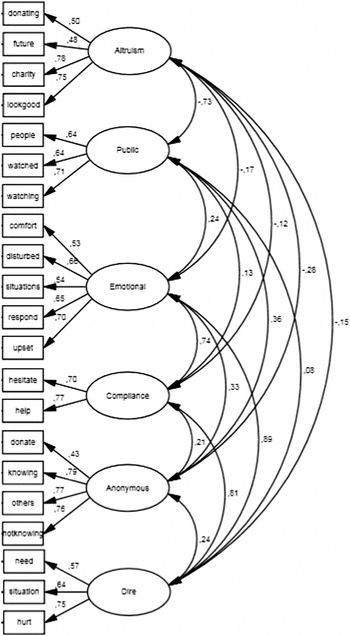
CFA was conducted to establish the six-factor model in the overall sample for the Portuguese version of the PTM-R (Figure 1). This step involved the comparison of the six-factor model with one, four, and five-factor models. These comparisons were made to control possible construct overlap due to high correlations between factors (Brown, Reference Brown2006). Multiple fit indices were used to evaluate patterns of fit for each of these measures. Statistical interpretation of fit indices tracked general recommendations found in the literature. Adequate fit is indicated by a comparative fit index (CFI) value of .90 or greater, a root mean square error of approximation (RMSEA) of .10 or lower and a standardized root mean square residual (SRMR) value of .10 or lower (Byrne, Reference Byrne2004). The Akaike information criterion (AIC) and the expected cross-validation index (ECVI) were also considered in assessing relative fit. In general, the AIC and the ECVI correct model fit for model complexity, and lower values indicate better model fit. By default, AMOS rescales AIC; so, when comparing models, the lowest AIC coefficient is 0. For the remaining models, AIC > 7 shows strong evidence that the alternative models should be ruled out (Burnham & Anderson, Reference Burnham and Anderson1998).
Standardized factor loadings and latent factor intercorrelations of the final six-factor (21-item) structure of the PTM-R.
Note: All parameters reported are standardized.

The evaluation of the psychometric properties of the PTM-R included an internal consistency analysis, which involved the calculation of Cronbach alpha estimates for each of the PTM-R subscales (DeVellis, Reference DeVellis2012).
Subsequently, measurement equivalence analyses were performed for both gender and school retention groups. The present study focused on item, functional, and scalar equivalence (Byrne, Reference Byrne2004). Item equivalence was analyzed by exploring the factorial invariance of the PTM-R, which was assessed by using multigroup CFA to fit a series of hierarchically nested factor structures (Byrne, Reference Byrne2004). A sequence of nested CFA models was examined going from the least restrictive to the most restrictive model of invariance. This statistical approach helps to determine if each item is equivalent across groups. The first step of factorial invariance tests consists of specifying a CFA model that allows the same set of items to create a factor in each group while allowing all other parameters to vary across groups. This configural model is progressively compared to a series of models that add constraints to some of its other parameters, starting by factor loadings, followed by item intercepts and error variances, assuming all of them to be invariant across the groups. Weak factorial invariance exists if the factor loadings are invariant across groups, whereas strong factorial invariance is met if the item intercepts are additionally invariant across groups. Finally, strict factorial invariance exists if the unique item error variances are invariant across groups (in addition to loadings and intercepts).
Functional and scalar equivalence was assessed by exploring the convergent and divergent validity equivalence between dimensions of prosocial behavior and different forms of self-regulation. This step involved a series of structural equation model analyses, regressing the six latent factors of the PTM-R onto each of the variables of interest (cognitive regulation, affective regulation, and behavioral regulation). First, these tests were conducted for the overall sample. Afterwards, a comparison was made between a fully unconstrained model to a model that constrained the slopes between the PTM-R scales and the construct validity scale, as well as the construct validity scale intercept across gender and school retention groups. Equivalence in slopes and intercepts suggests that a given PTM-R scale score is related to the same score on the construct validity variable for each group. However, groups may be different at the path level, enabling the study of associations between types of prosocial behaviors and different self-regulation processes for each subgroup (e.g., girls and boys).
In addition to the fit indices (CFI, RMSEA, and SRMR), the chi-square difference test (Δχ2) invariance and convergent and discriminant tests also evaluated the relative model fit. Considering that χ2 criteria are sensitive to minor fit modifications, additional parameters were considered to reach a more accurate evaluation of model fit, if necessary (Steiger, Reference Steiger1998). Thus, if the χ2 was accompanied by: (a) substantial drop in the practical fit indices and/or (b) a large (i.e., > 3) ratio of chi-square difference to degrees of freedom (Δχ2: Δdf), modification indices should be used to determine which parameters were significantly different across the groups. Once these parameters were allowed to be freely estimated across the groups, partial invariance could be attained if model fit indices showed adequate fit. Estimates for CFA, invariance tests as well as discriminant and convergent validity tests were calculated using asymptotically distribution-free extraction method, considering that some of the PTM-R subscales (e.g., public prosocial behavior) did not present a normal distribution (Fan, Thompson, & Weng, Reference Fan, Thompson and Wang1999).
Results
Confirmatory factor analysis
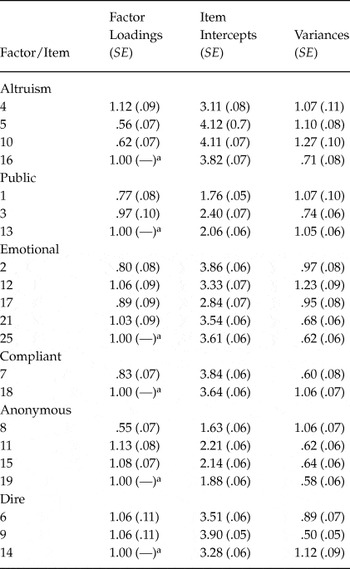
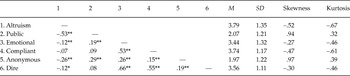
In the overall sample, the 21-item six-factor model (Figure 1) showed good fit, χ2 (174) = 1.725, p < .001, CFI = .95, RMSEA = .030, SRMR = .08. Factor loadings for this model were all positive and significant. All unstandardized item parameter estimates (factor loadings and item intercepts) as well as the respective standard errors for the overall 21-item factor solution of the PTM-R are presented in Table 1. Table 2 depicts the correlations as well as the descriptive statistics for the six factors of the PTM-R.
Unstandardized Item Parameter Estimates (and Standard Errors) for the Overall 21-Factor Model of the PTM-R

a Item loading fixed to one in order to set the metric of the latent variable; thus, no standard error was estimated.
Correlations, Means, Standard Deviations, Skewness and Kurtosis Estimates for the Six Factors of the PTM-R (n = 403)

* p < .05; **p < .01.
Competing models of the PTM-R were then tested. A unidimensional factor model did not demonstrate adequate fit, χ2(189) = 7.584, p < .001, CFI = .50, RMSEA = .130, SRMR = .28, thus suggesting that this factorial solution was not reasonable.
The correlation between emotional and dire subscales was strong (r = .89) and similar to the one found for the original version (Carlo et al., Reference Carlo, Knight, McGinley, Zamboanga and Jarvis2010). Thus, a five-factor solution in which one latent factor aggregated all emotional and dire items loadings was also tested. This model denoted adequate fit according to fit indices, χ2(179) = 1.804, p < .001, CFI = .94, RMSEA = .050, SRMR = .08. However, the AIC value difference was > 10 and the ECVI value was lower for the six-factor model (AIC = 414.118, ECVI = 1.030) when compared to this alternative five-factor solution (AIC = 426.838, ECVI = 1.062), suggesting that the six-factor solution had better fit.
Another five-factor solution was tested by aggregating compliant and emotional item loadings into the same latent factor, because these subscales were highly associated in the current study (r = .74) and in prior works (r = .83) (Carlo et al., Reference Carlo, Knight, McGinley, Zamboanga and Jarvis2010). This five-factor model presented adequate fit according to fit indices, χ2(179) = 1.928, p < .001, CFI = .94, RMSEA = .050, SRMR = .08. Both the AIC and ECVI values were lower for the six-factor model when compared to this five-factor solution (AIC = 449.140, ECVI = 1.117), demonstrating that the six-factor solution presented a better fit.
Then, a four-factor model was assessed. In this case, all emotional, compliant and dire subscales items were loaded into the same latent factor. This model also depicted an adequate fit according to fit indices, χ2(183) = 1.955, p < .001, CFI = .93, RMSEA = .050, SRMR = .08. However, the AIC and ECVI values were much higher than those found for the six-factor solution, (AIC = 453.689, ECV = 1.129). Hence, the analyses revealed that the six-factor solution was the most plausible model of the Portuguese version of the PTM-R for the overall sample, considering that all competing models resulted in no model convergence or poorer relative fit.
Internal consistency
Dire factor denoted a minimally acceptable internal consistency value (α = .67). Public (α = .70), compliant (α = .70), altruistic (α = .72), emotional (α = .75) and anonymous (α = .78) subscales showed acceptable alpha values (DeVellis, Reference DeVellis2012).
Factorial invariance analysis
Gender
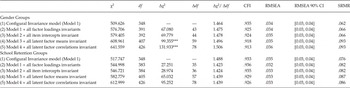
The configural model across gender had adequate fit, thus establishing the six-factor model of the PTM-R in Portuguese boys and girls. The weak factorial invariance model constraining the factor loadings to be equal across gender had adequate fit, so the weak factorial invariance model was retained. Both the strong and strict factorial invariance models had adequate fit, but the Δχ2 tests were significant for the strong and the strict invariance models. However, the Δχ2 / Δdf was also < 3 for both these models. Therefore, full factorial invariance across gender groups was also retained.
School retention
The configural model across school retention groups had adequate fit, thus establishing the six-factor model of the PTM-R for Portuguese students, with or without a school retention record. The weak, strong, and restrict factorial invariance models presented adequate fit. None of these models presented significant Δχ2 results. Also, the Δχ2 / Δdf was < 3 for all the examined models. Therefore, full factorial invariance across groups with different trajectories regarding school retention record was achieved. Factorial invariance tests across gender and school retention groups are summarized in Table 3.
Summary of the Factorial Invariance Tests Across Gender Groups and School Retention Groups

*** p < .001.
Convergent and divergent validity analyses
Overall sample
Structural equation modeling analysis regressing the six latent factors of the PTM-R onto each of the self-regulation dimensions denoted adequate fit, whether the variable of interest was cognitive regulation, χ2(412) = 1.645, p < .001, CFI = .93, RMSEA = .040, SRMR = .07, affective regulation, χ2(412) = 1.605, p < .001, CFI = .94, RMSEA = .040, SRMR = .07, or behavioral regulation χ2(412) = 1.514, p < .001, CFI = .94, RMSEA = .040, SRMR = .06.
Further examination of standardized regression weights estimates revealed positive significant associations between emotional prosocial behaviors (β = 35; p < .001) and cognitive self-regulation. Compliant prosocial behavior (β = .38; p < .01) showed a positive association with affective self-regulation, contrary to emotional (β = –.35; p < .01) and anonymous prosocial behavior (β = –.16; p < .05). Finally, a positive link between altruism and behavioral self-regulation was found (β = .42; p < .01) contrary to compliant prosocial behavior (β = –.29; p < .05).
Gender
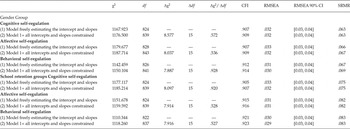
The models freely estimating the cognitive, affective, and behavioral self-regulation intercepts across gender groups had adequate fit, as well as the ones constraining both the slopes and the intercepts across gender groups. Across these groups, significant Δχ2 were not found for the comparisons between unconstrained and constrained models for different types of self-regulation. For all of these comparisons the Δχ2: Δdf test were < 3.
The inspection of standardized regression weights estimates showed that boys’ (β = –.58; p < .01) and girls’ emotional prosocial behaviors (β = .59; p < .001) had negative and positive relations respectively with cognitive self-regulation. Girls also showed a negative relation between their public prosocial behavior and their cognitive self-regulation (β = –.33; p < .05). Moreover, girls denoted a positive association between compliant prosocial behavior and affective self-regulation (β = .37; p < .05), as well as positive relations between anonymous (β = .60; p < .05) and public (β = .41; p < .05) prosociality and behavioral self-regulation.
School retention
The models freely estimating the cognitive, affective, and behavioral self-regulation intercepts across school retention groups had adequate fit. The models constraining both the slopes and the intercepts across the two groups also had adequate fit. Across school retention groups, significant Δχ2 for the comparisons between unconstrained and constrained models for different types of self-regulation were not found; also, the Δχ2: Δdf test were < 3 for all comparisons (Table 4).
Summary of the Construct Validity Equivalence Tests Across Gender Groups and School Retention Groups

Regression weights estimates showed a significant and similar negative association between emotional prosocial behavior and cognitive self-regulation for both the retained group (β = –.49; p = < .01) and the non-retained group (β = – .50; p = < .01).
In addition, a negative relation between anonymous prosocial behavior and affective self-regulation (β = –.36; p < .01) was found for the retained group. In turn, the non-retained group showed positive relations between compliant (β = .62; p < .01) and altruistic (β = .28; p < .05) prosocial behaviors and affective self-regulation. Moreover, this group presented a negative association between emotional prosocial behavior and affective self-regulation (β = –.52; p < .05). Finally, the non-retained group presented a positive relation between compliant (β = .60; p < .05) and altruistic (β = .52; p < .01) prosocial behaviors and behavioral self-regulation.
Discussion
Prosocial behavior has been portrayed as a distinctive feature of social morality across different civilizations. Social researchers have made noteworthy efforts to understand the conditions that may endorse the development of children and adolescents’ prosociality. Prior studies have demonstrated that variations in prosocial behavior are influenced by a wide collection of individual factors, namely by gender. However, multidimensional measures of prosocial behavior that facilitate more refined studies on this matter are not available in many languages, including Portuguese. Furthermore, researchers have not yet addressed differences in prosocial tendencies in general and across gender and risk groups based on self-regulatory processes.
This study intends to make three contributions to the literature: (a) to examine the psychometric properties of the Portuguese version of PTM-R (Carlo et al., Reference Carlo, Hausmann, Christiansen and Randall2003), a self-report measure designed to assess early adolescents’ prosocial behaviors; (b) to investigate if the structural solution of the PTM-R is invariant across gender and school retention (retained vs. non-retained students) groups; and (c) to test its convergent and discriminant validity by assessing the links between different types of prosocial behaviors and different forms of self-regulation in general and across gender and school retention subgroups.
The six-factor solution of the PTM-R proved to be the most adequate factorial structure of this instrument for Portuguese early adolescents. This model presented better fit and better results on comparative indexes (AIC and ECVI) when confronted with one, four, and five-factor structural alternatives. The six-model structure of the PTM-R is further sustained by psychometric qualities such as an adequate internal consistency for the different factors. As predicted, the PTM-R six-factor structure was invariant across gender and school retention groups. In the case of gender comparisons, the Δχ2 tests were significant for both the strong and the strict factorial invariance models, meaning that the factorial structures varied across boys and girls. Still, χ2 tests may fall short of accurately describing invariance across groups, due to the fact that χ2 criteria are sensitive to slight modifications of fit (Steiger, Reference Steiger1998). Therefore, Δ χ2/ Δdf was also considered in the interpretation of the results (Δχ2 / Δdf < 3) indicating invariance across groups. According to these criteria, invariance was found for multigroup CFA strong and strict factorial invariance models.
Altogether, CFA, internal consistency, and invariance analyses results sustain the premise that the proposed factorial structure of the PTM-R is valid for Portuguese early adolescents, addressing the first and the second aims of this study. These results also expand on previous findings suggesting that the PTM-R six-factor structure is valid across different ethnic groups (Carlo et al., Reference Carlo, Knight, McGinley, Zamboanga and Jarvis2010) and cultures (Carlo et al., Reference Carlo, Mestre, Samper, Tur and Armenta2011). Moreover, the current evidence emphasizes that multidimensional measures of prosocial behavior are more appropriate to capture the complexity of prosociality. Unidimensional measures of prosociality have been in use (e.g., Yoo et al., Reference Yoo, Feng and Day2013) and their application may be appropriate. Still, they may fail to capture specific features of prosocial behavior depending on its type (Carlo et al., Reference Carlo, Knight, McGinley, Zamboanga and Jarvis2010) or the recipient of a prosocial act (Padilla-Walker & Christensen, Reference Padilla-Walker and Christensen2011).
The results further sustain the premise that the PTM-R structure was stable when comparisons were made between students who already had a record of failing at least once in school as opposite to those who had never been retained. This represents a new finding regarding the use of the PTM-R, offering positive prospects regarding the appropriateness of this measure to understand how specific prosocial tendencies of different groups of students might be associated with different academic-related outcomes such as school grades, truancy or disciplinary record.
Convergent and discriminant tests involved an examination of the connections between different types of prosocial behavior and different forms of self-regulation. Although no specific hypotheses were formulated, most of the positive associations between the dimensions of both constructs were found for girls and students who had never been retained, as anticipated.
The results suggest that the relations between different dimensions of prosocial behavior and self-regulation in early adolescence are complex. Only one form of selfless prosociality (emotional prosocial behavior) was connected to cognitive self-regulation. Mixed findings described the remaining relations between prosociality dimensions and affective and behavioral self-regulation for the overall participants. For instance, a selfless form of prosocial behavior, altruism, denoted a positive link with behavioral self-regulation, while anonymous and emotional forms of prosociality were negatively associated with affective self-regulation. Interestingly, compliant prosocial behavior had a positive association with affective self-regulation, but a negative link with behavioral self-regulation. These results are consistent with the social developmental literature which presents early adolescence as period of intense emotional activation involving recurrent adjustment of affective states but, at the same time, marked by the development of cognitive abilities such as executive regulation and planning, which are both important for perspective taking and selfless acts enactment (Caprara et al., Reference Caprara, Kanacri, Gerbino, Zuffianò, Alessandri, Vecchio and Bridglall2014; Carlo et al., Reference Carlo, Knight, McGinley, Zamboanga and Jarvis2010; Fabes et al., Reference Fabes, Carlo, Kupanoff and Laible1999).
The comparisons between gender groups revealed a greater involvement of different self-regulatory processes in girls’ prosocial behaviors. This is an expected outcome, as girls denote greater and more precocious prosociality and self-regulation when compared to boys, as early as in kindergarten (Carlo et al., Reference Carlo, Crockett, Wolff and Beal2012; Mathews et al., Reference Matthews, Ponitz and Morrison2009; Zahn-Wexler et al., Reference Zahn-Waxler, Schiro, Robinson, Emde, Schmitz, Emde and Hewitt2001). Girls also tend to more easily recognize the use of prosocial behaviors, due to an earlier maturation of executive functions (e.g., attention) (Eisenberg et al., Reference Eisenberg, Fabes, Karbon, Murphy, Wosinski, Polazzi and Juhnke1996). However, the results do not present a distinctive pattern of differences across gender groups, with one relevant exception: the links between emotional prosocial behaviors and cognitive self-regulation. In the case of boys, a negative association among these two dimensions was found, whereas this relation is positive in the case of girls. This evidence is consistent with previous findings sustaining the premise that preadolescent girls are less driven by social rewards or costs resulting from selfless and emotive prosocial enactment (e.g., peer refusal of such behaviors) than boys (Carlo et al., Reference Carlo, Knight, McGinley, Zamboanga and Jarvis2010). This result might also reveal gender role expectations, in that caring and comforting expectations and affective self-regulation are usually greater among girls (Lenzi et al., Reference Lenzi, Vieno, Perkins, Pastore, Santinello and Mazzardis2012).
The links between different forms of prosocial behavior and behavioral self-regulation across school retention groups seem closer to showing a pattern that differentiates adolescents with and without a record of, at least, one academic retention. For instance, negative relations between emotional prosocial behaviors and cognitive self-regulation as well as between anonymous prosocial behavior and affective self-regulation were found for participants with a record of at least one school retention. Conversely, students who have not been retained in school show consistent positive connections between compliant and altruistic prosocial behaviors and affective and behavioral self-regulation. Successful students, including those who have not been retained previously, denote greater self-regulation levels and have a greater probability of being involved in more nurturing and reassuring social networks, including greater involvement with prosocial peers (Chen et al., Reference Chen, Hughes and Kwok2014; Schunk & Pajares, Reference Schunk, Pajares, Elliot and Dweck2005). These factors prompt a greater ability from these students to regulate their prosocial tendencies, including the imperative to help others according to contextual demands such as parental expectations and school rules, compared to those who have already failed in school.
Two important remarks should be made regarding some mixed, inconsistent findings from discriminant and convergent validity tests. First, it is important to recognize that the PTM-R is a complex measure combining items that assess prosocial motives and prosocial enactment that together reflect a prosocial tendency. It is feasible that the connections between self-regulation and prosocial behavior overall and across gender and school retention groups could be different if prosociality was measured only in terms of intended or enacted behaviors. The replication of the present study with other groups of early adolescents should not overlook this possibility in order to clarify the aim of this research. Second, the instrument used to assess self-regulation was originally developed to measure dysregulation among adolescents who were diagnosed with substance use disorders. This measure may be more sensitive in detecting relations between dysregulation and negative outcomes rather than between regulation and positive outcomes such as prosocial behavior.
The first implication of this study is to further demonstrate the multidimensionality of prosocial behavior in a different cultural context. It adds new evidence that the six dimensions of the PTM-R are relevant across other cultures and different ethnic groups (Carlo et al., Reference Carlo, Mestre, Samper, Tur and Armenta2011).
The most innovative implication of this study is to reveal some trends regarding the connections between distinct types of prosocial behaviors and different self-regulation dimensions across gender and school retention groups. Future studies may better explain these intricate associations by taking into account the recipients of adolescents’ prosocial behaviors (such as parents, teachers, or peers) as well as the contexts (family, school, or the community) in which they occur (Padilla-Walker & Cristensen, Reference Padilla-Walker and Christensen2011). In addition, if new research approaches are supported by longitudinal research designs, including studies using observational and laboratory methods (Eisenberg et al., Reference Eisenberg, Fabes, Karbon, Murphy, Wosinski, Polazzi and Juhnke1996), its results will help to better establish the consistency of connections between prosocial behavior and self-regulatory processes across the lifespan.
This study confirms that more attention is needed to understand the conditions under which vulnerable adolescents may regulate their prosocial behaviors. Further comparisons between groups based on various sets of individual and environmental risks are urgent, especially if the fact that vulnerable adolescents may usually feel less competent or lack opportunities to help, share, and console others is taken into account.
This article is, however, obviously incomplete without discussing the study’s weaknesses. First, some of the PTM-R items presented low loadings on some of the instrument’s subscales, despite the fact that the six-factor solution denoted better fit indexes compared to other solutions. Better loadings may be achieved by further improving the items of the Portuguese version of the PTM-R, to insure greater cultural equivalence. Additional analyses, such as temporal reliability tests, are also desirable.
Another limitation is that the present study relies on a unique source of information. This method is vulnerable to same-source bias or to the possibility that self-reported data may lead to spurious association between different variables. Thus, new studies involving adolescents, parents, and teachers are highly recommendable to replicate these findings.
Finally, the self-regulation questionnaire used in this study was the only available measure in Portuguese that met the research goals. Despite the fact that both the original and the Portuguese versions of the ADI have revealed good internal consistency and fit, according to confirmatory factor analyses (Motta et al., Reference Motta, Rijo, Petiz, Souza and Pereira2016), no invariance tests across different groups (e.g., gender) were conducted. Thus, the present findings, namely those related to associations between prosocial dimensions and self-regulatory types across different groups may have been influenced, in part, by measurement error.
This study involved the analysis of the psychometric properties of the Portuguese version of the PTM-R. The analyses strengthen the idea that prosocial behavior is a multidimensional construct across different cultures. In addition, this work highlighted the connections between distinct dimensions of prosociality assessed by the PTM-R and different types of self-regulation. Cognitive, affective, and behavioral regulation processes were more closely associated with different forms of prosocial behavior in the case of girls. Comparisons between school retention groups showed that that students who failed at least one school year and thus had to repeat it denoted poorer relations between prosocial behaviors and self-regulation dimensions, as opposed to more successful students.
The authors would like to thank Cláudio Cruz, Cristina Codorniz, Filipe Fernandes, and Joana Esteves for their help on the translation and adaptation of the PTM-R. The authors would also like to thank Meredith McGinley for her assistance with data analysis issues.
This work was funded by the Foundation for Science and Technology (SFRH/BPD/99616/2014).