Introduction
Parasites can influence hosts in many ways by affecting their behaviour (Levri, Reference Levri1999), reducing the male host's capability of fighting for female access, reducing testicle and clutch size (Schall & Dearing, Reference Schall and Dearing1987) and consequently changing their reproductive success (Dunlap & Schall, Reference Dunlap and Schall1995). Changes in male colouration can also be caused by some parasites and identified by females, reducing their mating success (Dunlap & Schall, Reference Dunlap and Schall1995).
The abundance of parasites in vertebrates may vary depending on the sex of the host; usually males have a higher parasite load, either due to behaviour (disputes over females and territory) or to physiological differences caused by different hormones, such as the presence of testosterone, which inhibits the immune system, favouring infection (Hamilton & Zuk, Reference Hamilton and Zuk1982; Folstad & Karter, Reference Folstad and Karter1992; Dunlap & Schall, Reference Dunlap and Schall1995; Zuk & McKean, Reference Zuk and McKean1996).
Climatic factors affect host (Hawkins et al., Reference Hawkins, Field, Cornell, Currie, Guégan, Kaufman, Kerr, Mittelbach, Oberdorff, O'Brien, Porter and Turner2003) and parasite (Minguez & Giambérini, Reference Minguez and Giambérini2012) species distribution and survival in nature. Spatial and temporal variation play an important role in helminth species abundance and composition (Hamann et al., Reference Hamann, Kehr and González2006; Brito et al., Reference Brito, Ferreira, Ribeiro, Anjos, Almeida, Mesquita and Vasconcellos2014a). Climatic variations can alter behavioural activity patterns and even the immune system of hosts, causing seasonal differences in parasite infections (Møller et al., Reference Møller, Erritzøe and Saino2003). Some ecological studies show that climate can affect parasite composition and abundance even in phylogenetically distant hosts (Altizer et al., Reference Altizer, Dobson, Hosseini, Hudson, Pascual and Rohani2006; Carvalho & Luque, Reference Carvalho and Luque2011). Abiotic conditions, such as rainfall and temperature, can increase helminth parasite abundance (Griffiths et al., Reference Griffiths, Jones and Christia1998; Gambhir et al., Reference Gambhir, Oinam and Lakshmipyari2012). Rainfall can also affect environmental moisture, indirectly impacting developmental stages of the parasite larvae (Narayanan et al., Reference Narayanan, Rao and Thontadaraya1961).
Additionally, phylogenetic relations, ecological adaptation and habitat use can also influence the composition and abundance of parasite species in different environments (Bush et al., Reference Bush, Aho and Kennedy1990; Janovy et al., Reference Janovy, Clopton and Percival1992; Brooks et al., Reference Brooks, León-Règagnon, McLennan and Zelmer2006; Brito et al., Reference Brito, Corso, Almeida, Ferreira, Almeida, Anjos, Mesquita and Vasconcellos2014b). Comparison of different parasite populations can reveal mechanisms of local adaptations to the environment and immune response of the host (Poulin, Reference Poulin1997; Poulin & Valtonen, Reference Poulin and Valtonen2001). According to Brito et al. (Reference Brito, Ferreira, Ribeiro, Anjos, Almeida, Mesquita and Vasconcellos2014a, Reference Brito, Ferreira, Ribeiro, Anjos, Almeida, Mesquita and Vasconcellosb), spatial and temporal variation and habitat use are crucial predictors of lizard parasite abundance in the semi-arid region of the Brazilian north-east. However, comparative studies of host populations are more common among fish, bird and mammal populations (Poulin et al., Reference Poulin, Guilhaumon, Randhawa, Luque and Mouillot2010), while lizard populations and their parasites in the Neotropical region are still to be analysed.
Tropidurus lizards are found in both open areas and forests throughout South America (Frost et al., Reference Frost, Rodrigues, Grant and Titus2001). Tropidurus hispidus (Spix, 1825) is a diurnal, abundant, sit-and-wait forager (Rodrigues, Reference Rodrigues1987) with an opportunistic feeding behaviour (Vitt, Reference Vitt1995). Its habitat use varies between the dry and rainy season (Kolodiuk et al., Reference Kolodiuk, Ribeiro and Freire2009), and its diet changes according to prey availability (Gomes et al., Reference Gomes, Caldas, Santos, Silva, Santana, Rocha, Ferreira and Faria2015), which can increase the chances of infection by different parasite species (Griffiths et al., Reference Griffiths, Jones and Christia1998).
Here we evaluate the effect of host condition (body size, sex and reproduction), abiotic variables and seasonality on the helminth species abundance and composition in T. hispidus lizards from Caatinga, Restinga and Atlantic Forest environments in north-eastern Brazil.
Materials and methods
Collection and examination of lizards
An average of ten adult lizards per month were captured in the areas of Caatinga (07°29′S, 36°20′W), Atlantic Forest (07°08′S, 34°50′W) and Restinga (6°17′S, 35°02′W) in the municipalities of Cabaceiras and João Pessoa in the state of Paraíba and in Barra do Cunhaú, Canguaretama municipality, Rio Grande do Norte state, respectively. Field trips were carried out from November 2010 to February 2012, covering at least a 12-month period for each area in order to observe seasonal variation and the effect of the reproduction period on the parasite abundance. Caatinga is a semi-arid area with low rainfall (250–800 mm/year), mostly concentrated between November and April (Nimer, Reference Nimer1989). The temperature varies between 22 and 26°C (Nimer, Reference Nimer1989). In the Atlantic Forest region there is continuous rainfall almost throughout the year, with an annual average of 1859 mm (IBGE, 1985). The temperature varies between 23 and 26°C. In the Restinga area, rainfall is concentrated between March and September, with an annual average of 1625 mm, and the temperature varies between 21 and 33°C (IDEMA, 2000).
Lizards were collected manually and sacrificed immediately after capture with a lethal dose of Thiopental®. Then, lizard snout–vent length (SVL) was measured with a metal ruler (to 0.1 cm), lizards were fixed with 10% formalin and deposited in 70% alcohol at the Herpetological Collection of the Federal University of Paraíba (CHUFPB). The lizards were dissected in the laboratory and their gonads were analysed to determine sex and sexual maturity. Males with developed testicles and epididymis with convolutions, and females with vitellogenic follicles in the ovaries and/or eggs in the oviducts, were considered reproductively active. The size at maturity of each sex and population was defined by the smallest reproductively active lizard.
Subsequently, helminth parasites from the body cavity, lungs and gastrointestinal tract of each lizard were collected under a stereomicroscope magnifying glass, deposited in the Parasitological Collection of the Regional University of Cariri (URCA-P), assembled on slides with lactophenol and later analysed by light microscopy. Parasite prevalence, intensity and abundance were calculated according to the specifications of Bush et al. (Reference Bush, Lafferty, Lotz and Shostaki1997).
Data analysis
The General Linear Model was used (GLM) from Statistica software version 8.0 (StatSoft Inc., Tulsa, Oklahoma, USA), considering the Poisson distribution, to investigate the effect of seasonal variation on the parasite abundance in T. hispidus from the three studied environments and between sexes. Only the most prevalent helminth species (>5%) from adult hosts were considered, to avoid the influence of ontogenetic factors. Helminth species were classified according to their life cycle (monoxenic and heteroxenic), and whether the abundance of parasites varied seasonally according to their life cycle was analysed.
Two linear regressions were performed with Statistica software version 8.0 to evaluate the influence of the monthly proportion of reproductively active individuals on parasite prevalence, and to evaluate the effect of the SVL of the lizards on the abundance of helminths.
A Canonical Correspondence Analysis (CCA) coupled with 9999 random permutations was used throughout the Monte Carlo test using Canoco 4.5 (Ter Braak, Reference Ter Braak1986), to verify whether biotic and abiotic factors influence the abundance of helminth species in the lizards. We considered the following abiotic factors: annual temperature, seasonal temperature, annual temperature amplitude, annual rainfall, rainfall in the wet months, rainfall in the dry months and the area of collection of the specimens (obtained from WordClim; Hijmans et al., Reference Hijmans, Cameron, Parra, Jones and Jarvis2005). The biotic data used in the analyses were: SVL, sex, abundance and richness of parasite species. All of these variables were correlated to the abundance of helminth species found in the three studied environments.
Results
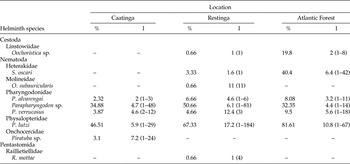
Four hundred and eleven lizards were collected (Restinga: 72 males and 77 females; Caatinga: 67 males and 61 females; Atlantic Forest: 54 males and 80 females). One Cestoda, one Pentastomida and seven Nematoda species were found. The helminth species were mostly those with an indirect life cycle: Oochoristica sp. (Luhe, 1898), infecting the stomach and intestine; Strongyluris oscari (Travassos, 1923), in intestine; Physaloptera lutzi (Cristofaro et al., 1976), in stomach, intestine and lungs; Piratuba sp. (Freitas & Lent, 1947), in the body cavity; and Raillietiella mottae (Almeida et al., Reference Almeida, Freire and Lopes2008), in the lungs. Only Parapharyngodon sp. (Chartteji, 1933), infecting the stomach, intestine and lungs, P. alvarengai (Freitas, 1957) and P. verrucosus (Freitas & Dobbin, 1959), in the intestine, and Oswaldocruzia subauricularis (Travassos, 1917), in stomach, were monoxenic (see Riley, Reference Riley1986; Anderson, Reference Anderson2000; Bush et al., Reference Bush, Fernández, Esch and Seed2001). This was the first record of Piratuba sp., P. verrucosus and O. subauricularis infecting T. hispidus lizards (table 1).
The prevalence (%) and intensity (I) of infection of helminth species in T. hispidus from three locations in Caatinga, Restinga and Atlantic Forest; ranges given in brackets.

Helminth composition and levels of infection
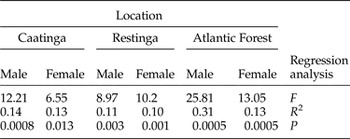
No sexual dimorphism was observed in SVL (Wald = 4.7, df = 2, P > 0.09), and the linear regression analysis revealed that helminth abundance is positively correlated with body size (table 2).
Linear regression analysis between snout/vent length (SVL) of male and female T. hispidus from Caatinga, Restinga and Atlantic Forest and total abundance of helminth species.

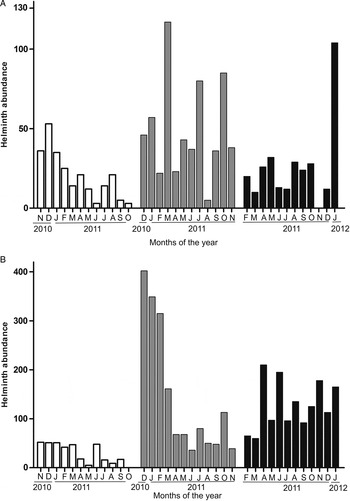
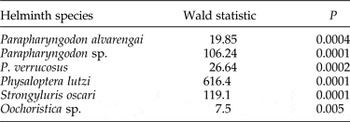
Lizards from the Restinga environment showed higher helminth parasite abundance (W = 716.6, GLM = 2, P < 0.001) and richness; the helminth species showed differences in abundance between the areas (table 3). Both the sampling period and lizard sex were correlated with parasite abundance in the Restinga (month: W = 519.32; sex: W = 9.42; month/sex: W = 285.34, GLM = 11, P < 0.001) and Atlantic Forest areas (month: W = 118.57; sex: W = 12.18; month/sex: W = 231.62, GLM = 11, P < 0.001). Only T. hispidus from Caatinga did not show significant differences of infection by helminths between sexes (month: W = 154.57; sex: W = 0.678, P > 0.4; month/sex: W = 90.27, GLM = 11, P < 0.001). We also observed higher levels of infection for both males and females during the reproductive and rainy months (fig. 1). The proportion of individuals found in the reproductive period influenced the prevalence of parasites in the Caatinga (F = 18.67, R 2 = 77.9, P < 0.02) but not in the Restinga (F = 0.3514, R 2 = −14.9, P > 0.05) and Atlantic Forest (F = 6.05, R 2 = 50.2, P > 0.06) areas.
Total monthly abundance of individuals of (A) monoxenous and (B) heteroxenous helminth species from the three locations Caatinga (white bars), Restinga (grey bars) and Atlantic Forest (black bars) from November 2010 to January 2012.

General linear model to show the changes in the abundance of selected helminth species and the prevalence of infection higher than 5% in T. hispidus from the three locations of Caatinga, Restinga and Atlantic Forest.

Biotic and abiotic conditions and life cycle
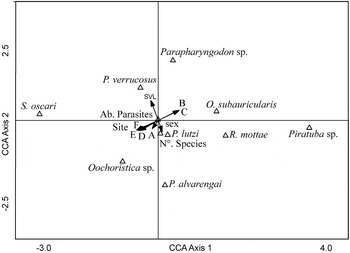
Biotic and abiotic factors significantly influenced helminth species abundance (first canonic axis; trace = 0.078; F ratio = 14.888; P = 0.0001). Similarly, canonical axes were significant (fig. 2) (trace = 0.150; F ratio = 7.490; P = 0.0001).
Graphical representation of the Canonical Correspondence Analysis (CCA), to show abiotic and biotic characteristics (arrows) and helminth species (triangles) including general abundance and species richness in Tropidurus hispidus. Ab. Parasites, overall helminth abundance; SVL, snout–vent length; A, annual temperature; B, seasonal temperature; C, annual temperature amplitude; D, annual rainfall; E, rainfall in the wet months; and F, rainfall in the driest months.

Oochoristica sp. abundance was related to the studied area (site), annual temperature (A), annual rainfall (D), rainfall in the wet months (E) and rainfall in the driest months (F). Oswaldocruzia subauricularis abundance was related to seasonal temperature (B) and annual temperature amplitude (C), while SVL was related to overall helminth abundance (Ab. Parasites) and P. verrucosus abundance. Species richness (N°. Species) and abundance of P. lutzi were related to lizard sex.
In Caatinga, helminth abundance peaked during rainy months (November to April) and monoxenic and heteroxenic species exhibited significant differences in their monthly abundance (fig. 1). This indicates that temporal variation and reproduction period affected the fluctuation of parasite species. The abundance of helminth species decreased in the driest months of the year. In Restinga, parasite abundance varied between species. Monoxenic and heteroxenic helminths were more abundant in the driest months (October to May) (fig. 1). In the Atlantic Forest, the abundance of helminth species with a prevalence greater than 5% was higher between April and November and, overall, heteroxenic species were more abundant than monoxenic species (fig. 1).
Discussion
The body size of the host is clearly one of the main influences in parasite populations (Poulin, Reference Poulin2004; Kamiya et al., Reference Kamiya, O'Dwyer, Nakagawa and Poulin2014). Other studies with Tropidurus lizards found a positive relationship between body size and the intensity of parasite infection (Anjos et al., Reference Anjos, Ávila, Ribeiro, Almeida and Silva2012; Pereira et al., Reference Pereira, Sousa and Lima2012). Corroborating the island biogeography theory (see MacArthur & Wilson, Reference MacArthur and Wilson1967), the body of the host acts as an island to the parasite species. Bigger hosts can provide greater habitat variability and, consequently, promote greater parasite abundance and diversity (Kamiya et al., Reference Kamiya, O'Dwyer, Nakagawa and Poulin2014). Additionally, Poulin & Nascimento (Reference Poulin and Nascimento2007) found an isometric relationship between host biomass and parasite biomass, which indicates that larger-sized hosts can support more parasites, thereby corroborating our linear regression results showing that the largest lizards (both males and females) had greater parasite abundance in all the areas analysed.
Host sex (and the differences associated with it, such as hormonal and behavioural differences) is closely related to parasite number, population dynamics and infections caused by them (Hamilton & Zuk, Reference Hamilton and Zuk1982; Schall & Dearing, Reference Schall and Dearing1987; Folstad & Karter, Reference Folstad and Karter1992; Dunlap & Schall, Reference Dunlap and Schall1995; Salvador et al., Reference Salvador, Veiga, Martin, Lopez, Abelenda and Marisa1996; Roulin et al., Reference Roulin, Riols, Dijkstra and Ducrest2001; Martínez-Padilha et al., Reference Martínez-Padilha, Mougeot, Rodríguez-Pérez and Bortolotti2007; Galdino et al., Reference Galdino, Ávila, Bezerra, Passos, Melo and Zanchi-Silva2014). Male lizards in the Restinga and Atlantic Forest areas might show higher levels of helminth abundance caused by some of these factors, such as high testosterone concentrations and the stress caused by fighting for territory (Schall & Dearing, Reference Schall and Dearing1987; Salvador et al., Reference Salvador, Veiga, Martin, Lopez, Abelenda and Marisa1996). Males of T. hispidus are known for their territorial behaviour, but some differences in helminth species abundance between males and females can also be related to diet, sexual dimorphism and differences in habitat use by each sex (Aho, Reference Aho, Esch, Bush and Aho1990; Fontes et al., Reference Fontes, Vicente, Kiefer and Sluys2003; Pereira et al., Reference Pereira, Sousa and Lima2012).
The comparison between the proportion of reproductive individuals per month and helminth prevalence was statistically significant in Caatinga. Regardless of specific species, the reproductive condition can increase the level of stress through the intensification of social contact, fights for territory and/or a greater resource allocation to reproduction. These factors could enhance the propensity for becoming infected (Schall & Dearing, Reference Schall and Dearing1987; Carvalho & Luque, Reference Carvalho and Luque2011). Physiological mechanisms originating from hormonal differences can be considered as being responsible for the different levels of infection found during the reproduction period of males and females (Zuk & McKean, Reference Zuk and McKean1996).
Monoxenic species can be especially susceptible to moisture and environmental temperature variation, because the infection is caused directly by ingesting eggs (orally) or by larvae (through the skin) (Anderson, Reference Anderson2000). This could explain the relationship between the rainiest months and the greater abundance of monoxenic helminth parasites. In Restinga, the greater abundance of monoxenic and heteroxenic parasite species in the dry season can be related to seasonal changes in diet. Because some insects used as intermediate hosts exhibit seasonal variation in their abundance, the composition and establishment of heteroxenic helminth species can also be affected (Vasconcellos et al., Reference Vasconcellos, Andreazze, Almeida, Araujo, Oliveira and Oliveira2010). We did not observe either temporal variation or differences in the reproduction period in the Atlantic Forest, so the variation found in the helminth populations here may be a consequence of other factors, such as habitat use and/or type of prey ingested (Roca et al., Reference Roca, Carretero, Llorene, Montori and Martin2005; Hamann et al., Reference Hamann, Kehr and González2006, Reference Hamann, Kehr and González2014; Brito et al., Reference Brito, Corso, Almeida, Ferreira, Almeida, Anjos, Mesquita and Vasconcellos2014b). Also, the ontogeny and diet of the host determined the helminth assemblage in T. torquatus in the Atlantic Forest (Pereira et al., Reference Pereira, Gomides, Sousa, Lima and Luque2013), and the type of soil and fauna (eggs, predators or parasite larvae) can also affect the reproduction and survival of parasites (Harwood, Reference Harwood1936; Thieltges et al., Reference Thieltges, Jensen and Poulin2008), showing effects on their abundance in the definitive host(s) (Harwood, Reference Harwood1936).
The helminth species infection model of T. hispidus in the three studied areas is composed of generalist species, whose abundance is related to the host body size and reproduction, and to the rainy period. It was impossible to isolate a unique condition as being responsible for the variation in the helminth abundance. Thus, both the environment and some host aspects are influential factors in the organization of the helminth community components in T. hispidus from the studied areas. We emphasize the importance of how the study of the same species across different environments can reveal geographic and seasonal differences in the acquisition and abundance of helminth species.
Acknowledgements
We are grateful to Taís Costa, Maria C.B.T. Cavalcanti and anonymous reviewers for their valuable suggestions and comments on the manuscript. Finally, we thank Proof-Reading-Service Ltda, for professional revision of the English version of the manuscript.
Financial support
We are grateful to Conselho Nacional de Desenvolvimento Científico e Tecnológico – CNPq for the research grant awarded to W.O.A. (PQ-311713/2012-2); to Fundação Cearense de Apoio ao Desenvolvimento Científico e Tecnológico – FUNCAP for the research grant awarded to J.A.A.F. and post-doctoral fellowship to S.V.B. (DCR-0024-00744.01.00/13); and to Coordenação de Aperfeiçoamento de Pessoal de Nível Superior – CAPES for the research grant awarded to V.F.L. and A.M.A.P.
Conflict of interest
None.
Ethical standards
All authors gave their consent to participation in the study. The study was approved by the Instituto Chico Mendes de Conservação da Biodiversidade with permission to collect the animals.