Introduction
Magnesium (Mg) is a key dietary element and Kruse et al. (Reference KRUSE, ORENT and McCOLLUM1932) were probably the first to report that Mg was indispensable for animal growth and survival. It is the fourth most abundant cation in living organisms (Wolf and Cittadini, Reference WOLF and CITTADINI2003), second to potassium in abundance in the soft tissues (Suttle, Reference SUTTLE2010) and to calcium (Ca) in bone tissues (Morii, Reference MORII2007a). Mg deficiency may lead to serious biochemical and symptomatic changes (Coudray et al., Reference COUDRAY, RAMBEAU, FEILLET-COUDRAY, GUEUX, TRESSOL, MAZUR and RAYSSIGUIER2005) and symptoms of deficiency have been described in growing chicks by Almquist (Reference ALMQUIST1942), Bird (Reference BIRD1949), and Gardiner et al. (Reference GARDINER, ROGLER and PARKER1960); in growing ducks by Van Reen and Pearson (Reference VAN REEN and PEARSON1953) and in laying hens by Cox and Sell (Reference COX and SELL1967). Clinically, as observed by these authors, Mg deficiency in growing poultry is characterised by poor growth and feathering, decreased muscle tone, incoordination, squatting, fine palpable tremors, convulsive attacks, coma, and death; in laying hens, symptoms include reduced egg production, hypomagnesemia, decreased feed consumption, nervous tremors, and seizures. Mg is involved in the metabolism of amino acids, fat and sugars and in bone Ca and vitamin D metabolism (Morii, Reference MORII2007a). However, research on Mg metabolism of poultry is scant, probably because common feedstuffs contain sufficient Mg to cover requirements and Mg deficiencies are unheard of (Suttle, Reference SUTTLE2010). Nevertheless, it has recently been suggested that supplemental Mg in poultry diets can exert positive effects on meat quality and growth in some situations or at certain stages of development (Guo et al., Reference GUO, ZHANG, YUAN and NIE2003; Gaal et al., Reference GAAL, SAFAR, GULYAS and STADIER2004; Sahin et al., Reference SAHIN, ORDERCI, SAHIN, CIKIM and KUCUK2005; Yang et al., Reference YANG, GAO, YUAN, ZHANG, WANG and WU2012). Nelson et al. (Reference NELSON, KIRBY, JOHNSON and BEASLEY1981) pointed out that the relevance of the balance of particular minerals, for example, Ca and phosphorus (P) was well recognised but that no or little effort had been made to balance the overall mineral content of the diet in feed formulations, though its significance has been suggested for many years. A more or less balanced condition of Ca, Mg, and P in the ration is essential to normal growth and functioning (Haag and Palmer, Reference HAAG and PALMER1928). Failure to monitor Mg content of poultry diets may contribute to the ambiguity of ascertaining its P requirement (Lee and Britton, Reference LEE and BRITTON1980).
To the best of our knowledge, the role of Mg as a nutritional element has not been comprehensively reviewed in poultry yet. The objectives of this review thus are to describe the role of Mg in poultry nutrition since the first published data became available; to describe its interaction with various dietary constituents, especially Ca and P and to discuss possible effects of supplemental Mg on bird performance and the availability of other nutrients.
Absorption and excretion of Mg
Mg passes through the intestinal epithelium by one of three possible mechanisms: passive diffusion, solvent drag, and active transport (Kimura, Reference KIMURA2007). Rat studies have made evident that the mode of Mg transport changes from mainly a passive mechanism in young animals to mainly a carrier-mediated mechanism in the adult animals (Meneely et al., Reference MENEELY, LEEPER and GHISHAN1982). In humans, although Mg absorption increases with each increment in intake, fractional Mg absorption falls progressively so that absorption as a function of intake is curvilinear (Fine et al., Reference FINE, SANTA ANA, PORTER and FORDTRAN1991). Intestinal Mg absorption is augmented to some extent by vitamin D and its metabolites because of the chemical similarity of Ca and Mg (Kimura, Reference KIMURA2007). However, no convincing evidence is available suggesting that the intestine adapts to a chronic low or high Mg intake, as it does with Ca (Fine et al., Reference FINE, SANTA ANA, PORTER and FORDTRAN1991). According to Guenter and Sell (Reference GUENTER and SELL1973), in the mature chicken most of the total dietary Mg absorption occurs in the duodenum (34%), followed by the ileum (16%) and the colon (13%), with only limited absorption in the jejunum (3%). In broilers, the main site of absorption of Mg was reported to lie between the lower duodenum and the lower jejunum (Van der Klis et al., Reference VAN DER KLIS, VERSTEGEN and DE WIT1990). Mg is endogenously excreted in both urine and faeces (Matsui, Reference MATSUI2007), and excretion with urine is the main regulator of Mg body homeostasis (Taylor and Kirkley, Reference TAYLOR and KIRKLEY1967; Kimura, Reference KIMURA2007). The primary sites of Mg secretion into the intestine were found to be the duodenum and the upper ileum (Guenter and Sell, Reference GUENTER and SELL1973; Van der Klis et al., Reference VAN DER KLIS, VERSTEGEN and DE WIT1990) however, some Mg secretion also occurs in the rectum (Van der Klis et al., Reference VAN DER KLIS, VERSTEGEN and DE WIT1990). Thus, the faeces may contain more Mg than is introduced directly into the alimentary tract with the diet (Mendel and Benedict, Reference MENDEL and BENEDICT1909). Moreover, endogenous Mg excretion increases with an increase in dietary Mg (Guenter and Sell, Reference GUENTER and SELL1974).
Interaction with Ca and P
Mg metabolism is closely associated with Ca and P (McDonald et al., Reference MCDONALD, EDWARDS, GREENHALGH, MORGAN, SINCLAIR and WILKINSON2011). Forbes (Reference FORBES1924) reported that the use of Ca and P compounds appeared to be determined largely by the relative proportions in which these elements and Mg were available in the ration. Intake of soluble Mg causes an increase in Ca excretion in adult animals and hinders its deposition in young animals (Malcolm, Reference MALCOLM1905). Buckner et al. (Reference BUCKNER, MARTIN and INSKO1932) showed that the addition of Mg to the rations fed to the chicks disturbed the Ca and P balance necessary for normal bone formation during the first six weeks of age. Similarly, when either the Ca or P content of the diet was increased, the quantity of Mg required in the diet for maximal weight gain also increased (Nugara and Edwards, Reference NUGARA and EDWARDS1962; Reference NUGARA and EDWARDS1963). Gaal et al. (Reference GAAL, SAFAR, GULYAS and STADIER2004) concluded that the commercial diet of chickens younger than 3 weeks of age should not be supplemented with Mg, which led to leg bone malformation and development of porosis-like symptoms.
An antagonistic relationship also seems to exist between Ca and Mg in relation to skeletal integrity and egg shell quality in laying hens (Atteh and Leeson, Reference ATTEH and LEESON1983b; Hess and Britton, 1997). Increasing dietary Mg in laying hens had no significant effect on Ca retention although egg shell Ca content and bone Ca were significantly reduced and shell Mg increased (Atteh and Leeson, Reference ATTEH and LEESON1983b). Stillmak and Sunde (Reference STILLMAK and SUNDE1971) reported that excess levels of Mg (1% of diet) in layer diets caused a cathartic action that shortened the time required for passage of feed through the hen digestive tract and resulted in a Ca deficiency. Other researchers, however, found no detrimental effects of excess Mg until a level of 8,380 mg/kg (Mehring and Johnson, Reference MEHRING and JOHNSON1965) or even 12,000 mg/kg feed (McWard, Reference MCWARD1967) for laying chickens.
Different explanations are possible for the effects of increased dietary Mg level on Ca and P metabolism, as follows:
1. The effect could be the result of the acid-base balance change in the body (Nelson et al., Reference NELSON, KIRBY, JOHNSON and BEASLEY1981).
2. Increasing dietary Mg levels could interfere directly with the process of calcification, leading to an increase in the incidence of leg problems (Atteh and Leeson, Reference ATTEH and LEESON1983a) and a decrease in bone ash in chicks (Nugara and Edwards, Reference NUGARA and EDWARDS1963). The reduction in bone ash percentage could be the result of excessive cartilage proliferation, lack of mineralisation, excessive osteoclastic resorption, or combinations of these factors (Lee et al., Reference LEE, BRITTON and ROWLAND1980).
3. As Mg intake increases, P absorption progressively decreases (Fine et al., Reference FINE, SANTA ANA, PORTER and FORDTRAN1991), possibly because of formation of insoluble Mg-phosphate complexes (Kimura, Reference KIMURA2007).
4. High dietary Mg level may hinder absorption of Ca2+ from the intestine because Ca and Mg absorption from the intestine occurs by a common mechanism for divalent ions (Nugara and Edwards, Reference NUGARA and EDWARDS1963; Fine et al., Reference FINE, SANTA ANA, PORTER and FORDTRAN1991).
5. Because excessive dietary Mg is cathartic, there may be malabsorption of nutrients essential for bone growth, especially Ca and P (Stillmak and Sunde, Reference STILLMAK and SUNDE1971). The addition of 0.3% of Mg (as MgO) to a corn-soy basal diet was the threshold for catharsis in broilers (Lee and Britton, Reference LEE and BRITTON1987). The authors pointed out that Mg-induced catharsis was the result not only of the hyperosmotic effect of Mg per se but also of endocrine or neural arcs that affected Cl secretion or absorption.
6. High dietary levels of Mg reduce the activity of intestinal alkaline phosphatase and phytase in chicks while high levels of phosphate have no effect (McCuaig et al., Reference MCCUAIG, DAVIES and MOTZOK1972).
7. Higher Mg concentrations relative to phytic acid in vitro result in greater complex formation (Mg-phytate), leading to relatively greater insolubility of the complex (Cheryan et al., Reference CHERYAN, ANDERSON and GRYNSPAN1983) and thus to reduced availability of Mg and P.
8. It has been suggested that excess Mg in laying hens might reduce parathyroid hormone activity, which reduces blood Ca and thus shell quality and egg production (Hess and Britton, 1997).
The variety of mechanisms suggested demonstrates the need for close regulation of any change in Mg level in poultry diets. Nutritionists today strive for optimisation in P content of poultry diets, because of the high costs of P supplements, finiteness of phosphate rock, and negative ecological impact of high excreta P. An uncontrolled Mg supplementation to commercial poultry feed may disturb P as well Ca availability and thus negatively impact bird performance and bone health.
Interaction with elements other than Ca and P
Goldenberg and Sobel (Reference GOLDENBERG and SOBEL1951) reported that in vitro calcification was inhibited in the presence of both Mg and fluoride but not in the presence of fluoride alone. Gardiner et al. (Reference GARDINER, ROGLER and PARKER1961), Griffith et al. (Reference GRIFFITH, PARKER and ROGLER1963), and Spierto et al. (Reference SPIERTO, ROGLER and PARKER1969) showed that inclusion of fluoride and Mg in the same diet caused a greater depression in growth than fluoride alone. Furthermore, the addition of both fluoride and Mg to the diet resulted in a characteristic leg weakness, reduced bone ash, and a reduction in both the Ca and P content of the bone in chicks. These changes were not observed when the fluoride or Mg was added singly to the diet. Further, Griffith et al. (Reference GRIFFITH, PARKER and ROGLER1964) reported that bone, liver, and total and diffusible plasma Mg contents were greater in chicks fed diets containing high levels of both Mg and fluoride than in birds fed diets high in either Mg or fluoride alone, suggesting the possibility that these two elements form a stable complex (a Mg-fluorophosphate) that might have inhibited an enzyme system involved in bone and muscle metabolism.
Interactions have also been described for manganese (Mn) and zinc (Zn). A high dietary Mg intake decreases the percentage of Mn retention and increases Mn requirement for proper bone tissue structure in young turkeys (Woerpel and Balloun, Reference WOERPEL and BALLOUN1964). The addition of Mg to a sesame meal ration decreases the availability of Zn to the chicks (Lease and Williams, Reference LEASE and WILLIAMS1967). Atteh and Leeson (Reference ATTEH and LEESON1983b) reported that increasing dietary Mg level significantly (P<0.01) reduced bone Zn content while concomitantly increasing bone Mg levels in laying hens. Lease and Williams (Reference LEASE and WILLIAMS1967) suggested that Mg interferes with full use of the Zn but not through a mechanism of Zn binding. It is more likely that less Zn is absorbed from the diet because of competitive inhibition by high levels of Mg (Atteh and Leeson, Reference ATTEH and LEESON1983b). A negative effect of increased dietary Mg on metabolism of other cations is possibly a result of an antagonistic relationship of these elements (Woerpel and Balloun, Reference WOERPEL and BALLOUN1964).
Effects of Mg supplementation
Mg can reduce oxidation and could be used to improve and stabilise chicken meat quality (Guo et al., Reference GUO, ZHANG, YUAN and NIE2003). Afanasev et al. (Reference AFANASEV, SUSLOVA, CHEREMISINA, ABRAMOVA and KORKINA1995) demonstrated that Mg anti-oxidation activities are a consequence of both the scavenging of free radicals and the inhibition of xanthine oxidase and NADPH oxidase activities. Liu et al. (Reference LIU, GUO and WANG2007a) postulated that Mg may influence lipid peroxidation in the muscles of broiler chickens partly through affecting reactive oxygen species production. Accordingly, Mg deficiency induces an increase in hydrogen peroxide production and decreases catalase activity in chick embryo hepatocytes in vitro, subsequently causing oxidative stress and cell peroxidative damage (Yang et al., Reference YANG, WU, CHEN, QIAO, CAO, YUAN, NIE and GUO2005). Improvements in performance and digestibility of dry matter, crude protein, and ether extract were found in Mg-supplemented, heat-stressed quail (Sahin et al., Reference SAHIN, ORDERCI, SAHIN, CIKIM and KUCUK2005). Further, Yang et al. (Reference YANG, GAO, YUAN, ZHANG, WANG and WU2012) reported that dietary MgSO4 supplementation significantly prevented heat stress-induced oxidative damage and improved growth performance in broilers compared with that of control because of restoration of the activity of anti-oxidative enzymes. However, the abovementioned studies used basal diets with Mg content equal to or exceeding NRC (1994) or Gesellschaft für Ernährungsphysiologie (GfE, 1999) recommendations for this element. Thus, the effects of supplemental Mg may not always be comprehensible because the requirement for this element has been already covered by the basal diet. Even if the additional supplemental Mg was absorbed, it would be simply excreted by the kidney (Taylor and Kirkley, Reference TAYLOR and KIRKLEY1967; Saris et al., Reference SARIS, MERVAALA, KARPPANEN, KHAWAJA and LEWENSTAM2000; Kimura, Reference KIMURA2007). Whether there is a higher requirement for Mg under heat stress in poultry is unclear. Moreover, it has been reported that Mg supplementation has cathartic (Lee and Britton, Reference LEE and BRITTON1987) and laxative effects (Van der Hoeven-Hangoor et al., Reference VAN DER HOEVEN-HANGOOR, VAN DE LINDE, PATON, VERSTEGEN and HENDRIKS2013) in the intestine of broiler chicks, which could reduce absorption of nutrients from the digestive tract. Van der Hoeven-Hangoor et al. (Reference VAN DER HOEVEN-HANGOOR, VAN DE LINDE, PATON, VERSTEGEN and HENDRIKS2013) concluded that adding Mg to the diet (0.255, 1.02, and 2.04 g/kg) of broilers increases the digesta and excreta moisture content in a linear manner.
Mg availability in feedstuffs
The assessment of dietary requirements involves the determination of the Mg availability in feedstuffs and supplements (Guenter and Sell, Reference GUENTER and SELL1974). However, published data on Mg availability in poultry species are limited.
growth, bone ash and Mg, and plasma Mg
Body weight, blood Mg, or bone ash can be used as indicators of Mg availability. McGillivray and Smidt (Reference MCGILLIVRAY and SMIDT1975) used semi-purified diets for biological evaluation of Mg sources in broilers. Anhydrous MgSO4 as the reference standard provided levels of added Mg ranging from 0 to 500 mg/kg. Based on growth analytical reagent grade MgSO4×7H2O, MgO, and MgCO3 were superior sources of Mg compared with anhydrous MgSO4. In contrast, bone ash percentages were similar for all sources including anhydrous MgSO4. Stillmak and Sunde (Reference STILLMAK and SUNDE1971) reported based on tibia ash and body weight that Mg and Ca from dolomite were less available to chicks than that supplied from Ca and Mg carbonate.
Stillmak and Sunde (Reference STILLMAK and SUNDE1971) chose plasma Mg level as an indicator of Mg availability in chicks because of its positive linear correlation with the level of dietary Mg, as shown by Gardiner et al. (Reference GARDINER, ROGLER and PARKER1960). Based on this criterion, the authors concluded that the Mg in dolomite was less available than that contained in MgCO3. Liu et al. (Reference LIU, GUO, WANG and NIE2007b), using serum Mg, reported higher bioavailability values for organic (Mg-L-aspartate) compared to inorganic (MgO) Mg sources. However, serum Mg concentration may be influenced by changes in serum pH, serum albumin, and other anionic ligands (Kimura, Reference KIMURA2007). It also should be emphasised that the values based on growth, bone, or blood criteria provide only relative values of Mg availability and are not quantitative. Thus, such values are difficult to consider in feed formulation but can be used for qualitative comparison among Mg sources.
Mg digestibility
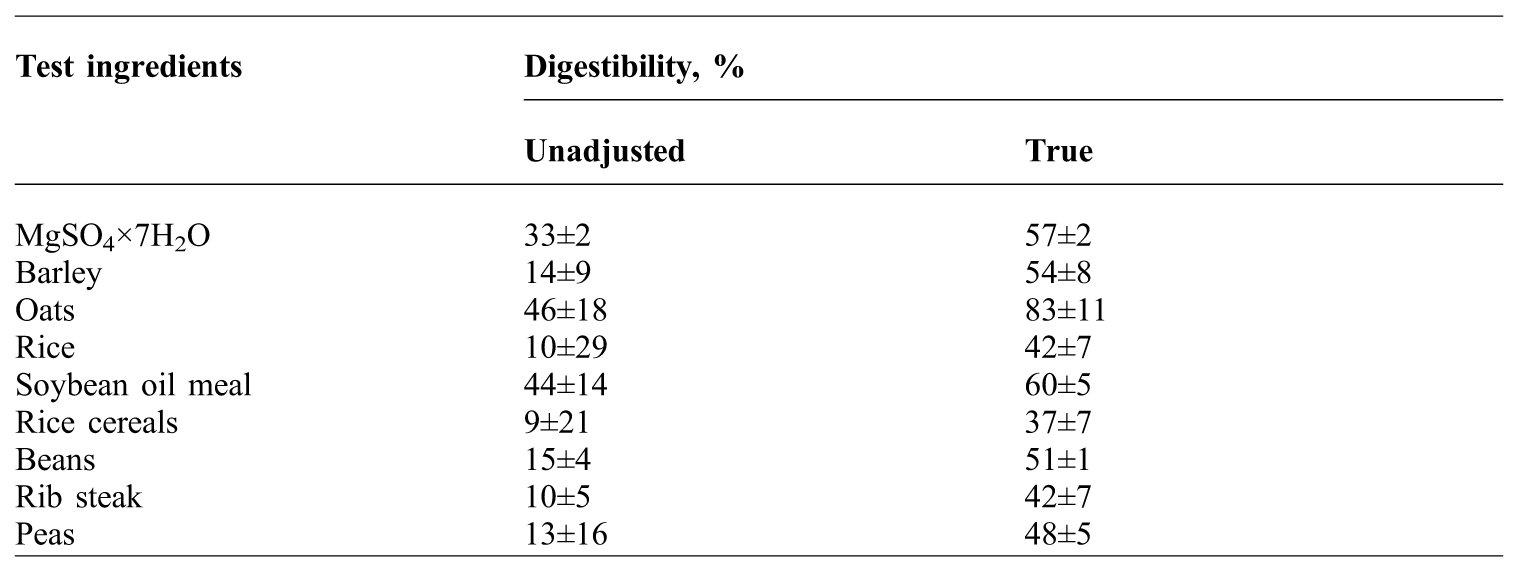
Measurement of Mg digestibility is a direct approach for comparing different Mg supplements (Coudray et al., Reference COUDRAY, RAMBEAU, FEILLET-COUDRAY, GUEUX, TRESSOL, MAZUR and RAYSSIGUIER2005). However, imprecision in Mg intake and endogenous Mg excretion may affect results of a conventional balance study (Coudray et al., Reference COUDRAY, RAMBEAU, FEILLET-COUDRAY, GUEUX, TRESSOL, MAZUR and RAYSSIGUIER2005). Guenter and Sell (Reference GUENTER and SELL1974) suggested a procedure that combined the comparative-balance and isotope-dilution techniques for segregating the Mg in digesta or faeces according to dietary or endogenous origin in mature chickens. Test feedstuffs were added to a semi-purified basal diet (22 mg Mg/kg) to provide 300 mg Mg/kg. Thus, Mg content in the test diets was below the requirements for this element. With this approach, the authors could determine the true availability of Mg in various feedstuffs (Table 1).
The unadjusted and true digestibility of Mg (mean±SEM) from some feedstuffs (Guenter and Sell, Reference GUENTER and SELL1974).

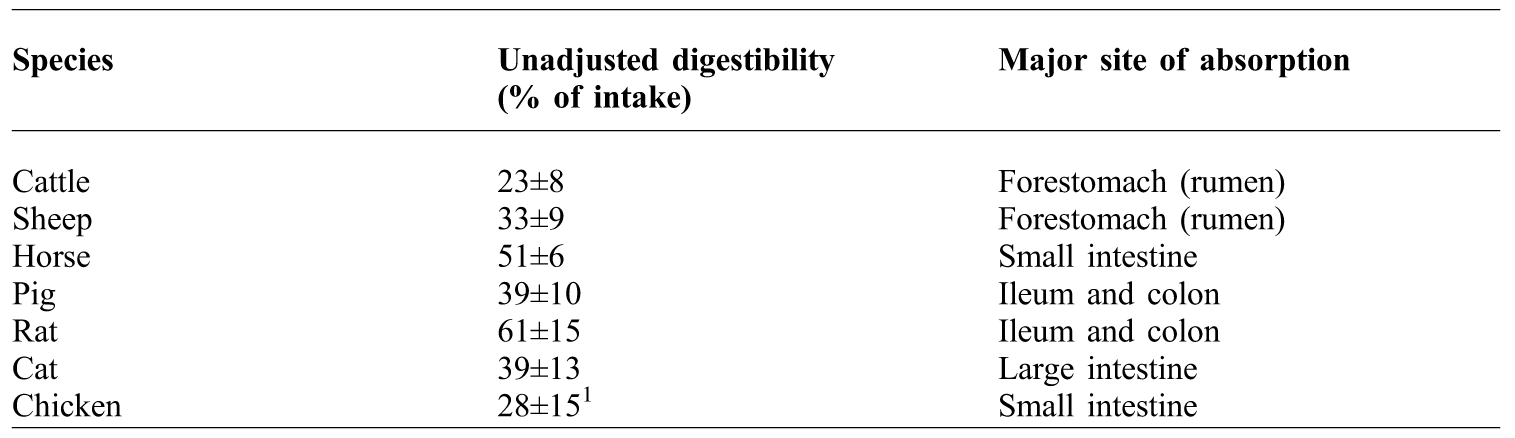
Guenter and Sell (Reference GUENTER and SELL1974) concluded that more reliable information about Mg availability was obtained on the basis of ‘true’ availability data because of a significant amount of endogenous Mg excreted. Unadjusted digestibility of Mg among animal species is presented in Table 2. Apparent digestibility determined by Guenter and Sell (Reference GUENTER and SELL1974) in chicken appears to be lower than in other monogastric animals. However, a direct comparison is difficult because the data of Matsui (Reference MATSUI2007) originated from many different publications that used different methods in such evaluation.
Mg digestibility (mean±standard deviation) in some species (Matsui, Reference MATSUI2007).
1 Calculated from unadjusted availability for 15 feedstuffs (Guenter and Sell, Reference GUENTER and SELL1974).
Viveros et al. (Reference VIVEROS, BRENES, ARIJA and CENTENO2002) found with almost constant Mg in the diet (1.8-2.0 g/kg) average Mg retentions of 28% in 6-wk-old and of 27% in 3-wk-old broilers. Nieß et al. (2005), using whole body analysis, reported Mg retention values of 10% for broilers. However, in these last two studies, the Mg content in the diets was much greater than the requirement for this element in broilers. Because of the importance of the passive process, the amount of Mg in the digestive tract is the major factor controlling the quantity of Mg absorbed (Coudray et al., Reference COUDRAY, RAMBEAU, FEILLET-COUDRAY, GUEUX, TRESSOL, MAZUR and RAYSSIGUIER2005). The average true digestibility for chicken based on the data in Table 1 is 52±13%. The Mg retention values (with an adjustment for endogenous faecal excretion) reported by Nwokolo et al. (Reference NWOKOLO, BRAGG and KITTS1976) were an average of 68% for palm kernel meal, soybean meal, and cottonseed and rapeseed meal. True retention of Mg was 53 to 67% for seven samples of rapeseed meal in another study (Nwokolo and Bragg, Reference NWOKOLO and BRAGG1980). Thus, the digestibility data without adjustment for the level of Mg supply or for endogenous Mg excretion have only limited value in assessing Mg availability in different feedstuffs for poultry.
Effect of different dietary constituents on Mg availability
fat
Atteh et al. (Reference ATTEH, LEESON and JULIAN1983) reported that Mg retention, bone ash, and Mg were significantly reduced when corn oil was the source of dietary fat in broilers in comparison to animal-vegetable fat. In another study, Atteh and Leeson (Reference ATTEH and LEESON1984) investigated the effect of inclusion of 8% oleic/palmitic or a 50/50 mixture of oleic and palmitic acids as the major source of fat in the presence of 0.8, 1.2, or 1.6% Ca in broiler diets. The authors reported a significant interaction between type of dietary fatty acid and Ca level on Mg and Ca retention. The fat's negative effect on mineral metabolism is the result of the formation of insoluble soaps from fatty acids and these minerals during digestion, making both these minerals and the fatty acids unavailable (Atteh and Leeson, Reference ATTEH and LEESON1984). However, there was no significant effect of the fat or Ca level on shell ash, shell Ca, Mg, and P content or on feed intake, weight gain, and egg production in laying hens (Atteh and Leeson, Reference ATTEH and LEESON1985).
protein
Bunce et al. (Reference BUNCE, REEVES, OBA and SAUBERLICH1963) showed that the Mg requirement in chicks and rats was directly related to the level of dietary protein. In their study, when Mg was limiting, an increase in the dietary protein level retarded growth and increased mortality in the chick. Thereby, the urinary excretion of certain amino acids increased and serum protein levels decreased. Edwards et al. (Reference EDWARDS, FULLER and HESS1960) demonstrated that the energy and protein content of the ration exerted major effects on the chick's requirement for Mg when expressed as a percentage of the diet.
carbohydrates
Scholz and Featherston (Reference SCHOLZ and FEATHERSTON1967) showed that chicks fed diets containing lactose exhibited decreased mortality, increased feed and water consumption, higher plasma and femur Mg levels, and higher haematocrit values than did chicks fed similar diets differing only in carbohydrate source (glucose, sucrose, and starch). The authors suggested that lactose exerted a beneficial effect in diets marginal in Mg content through increased feed, and hence, increased Mg consumption.
phytate
Dietary phytate decreased Mg absorption by the formation of insoluble Ca-Mg-phytate complexes under the pH conditions of the small intestine in growing rats (Pallauf et al., Reference PALLAUF, PIETSCH and RIMBACH1998). McWard (Reference MCWARD1969) demonstrated that supplementing phytic acid to the purified diet resulted in an increased need for Mg by the chick.
Mg requirements
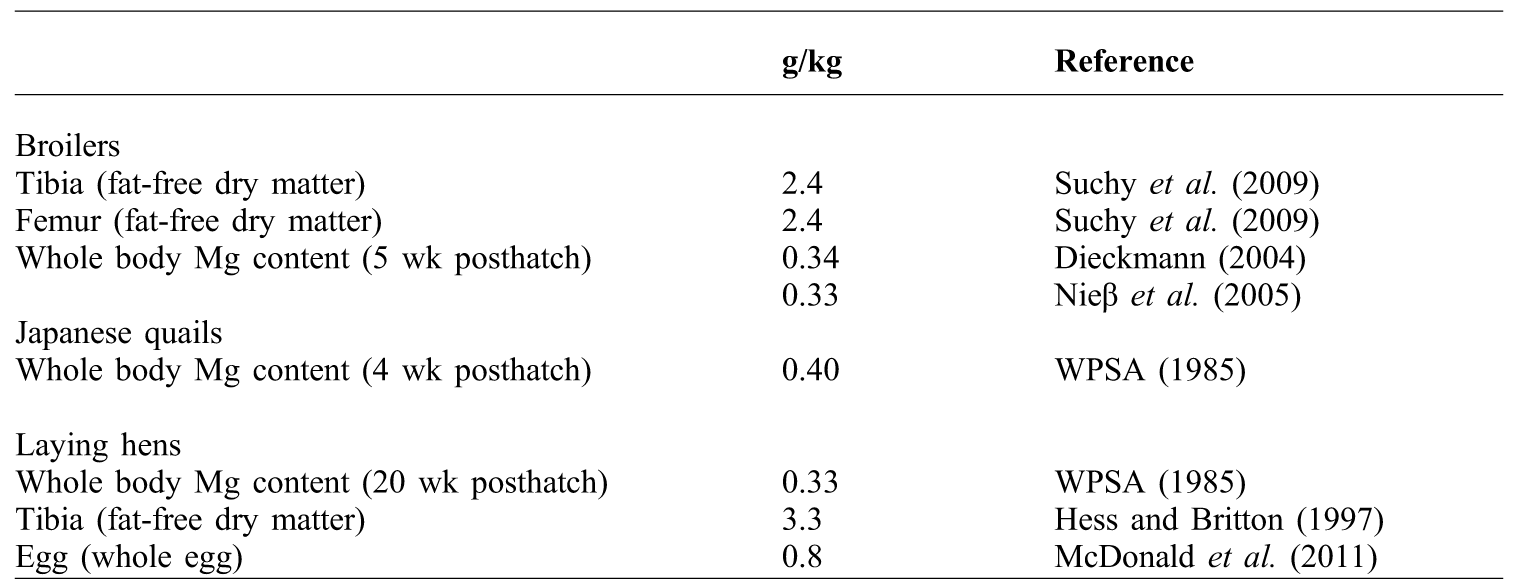
About two thirds of total Mg in the body exists in bone tissues and the remaining part in the soft tissues (Morii, Reference MORII2007b). Thus, about 65% of total Mg retention is in the skeleton in growing birds. Mg content in whole body, eggs, and some bones in poultry is presented in Table 3.
Mg content in whole body, eggs, and some bones in poultry.
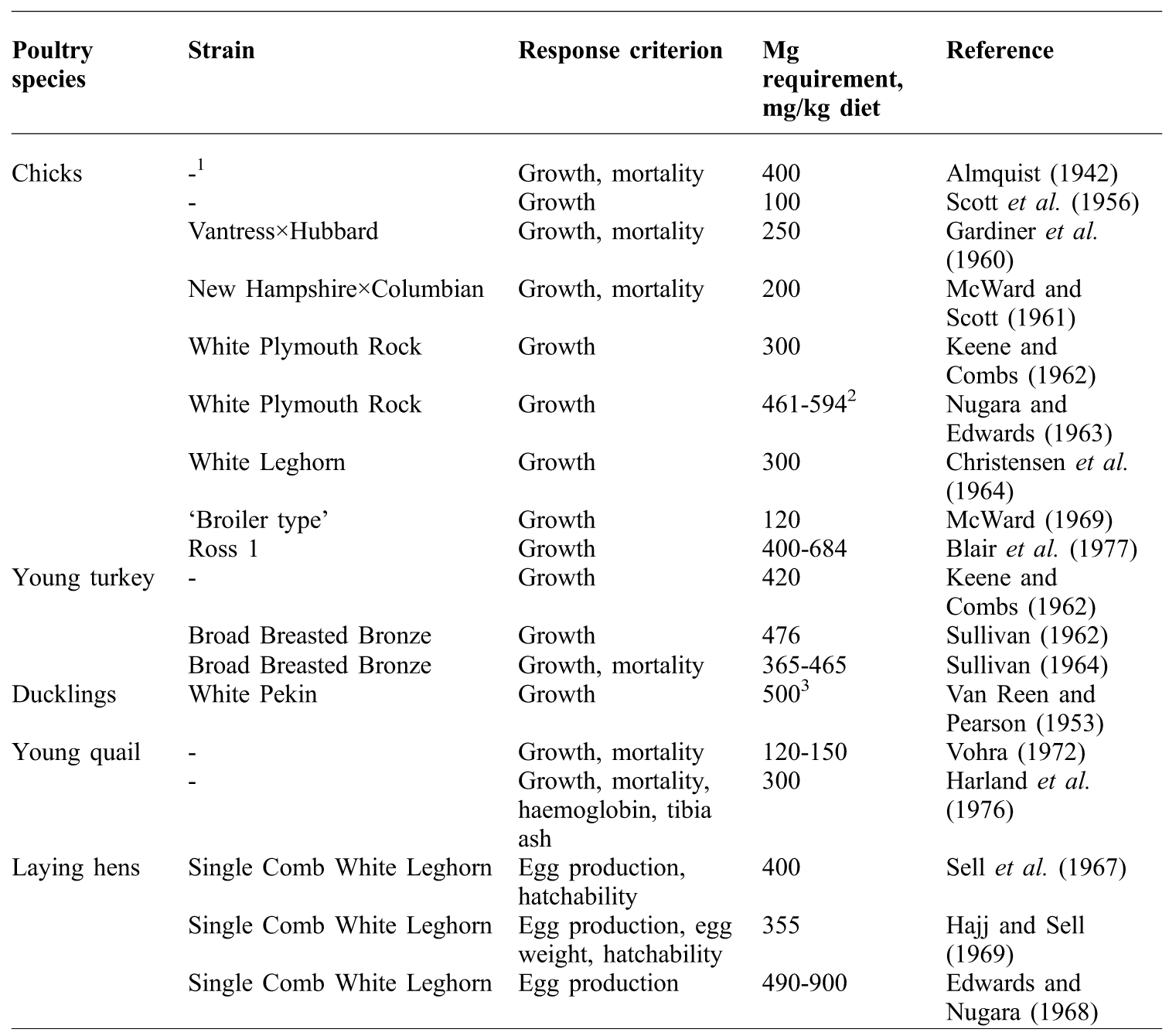
Although the differences in Mg availability between various feedstuffs are obvious, NRC (1994) and GfE (1999) give the Mg requirements for poultry based on total Mg. The precise determination of Mg requirements of farm animals is necessary, depending on the stage of growth, performance, and reproduction of the animals (Gaal et al., Reference GAAL, SAFAR, GULYAS and STADIER2004). Requirements for available Mg in the diet would be the most appropriate Mg form for such recommendations. The Mg requirement of the growing chick decreases as it gets older (Mahoney et al., Reference MAHONEY, ALSTER and CAREW1992), which is reflected in the GfE (1999) (0.45-0.30 g/kg) but not in the NRC (1994) (0.6 g/kg for the first five weeks) recommendations. Suttle (Reference SUTTLE2010) pointed out that uniformly high Mg recommendations of the NRC (1994) for broilers, young turkey, and laying hens contain a generous safety margin. The recommendations for Mg content in the diets determined by various authors are presented in Table 4.
Mg recommendation for poultry species as suggested by different authors.
1 Unknown; 2 the requirement increased by increasing Ca and P content of the diet; 3 for the first 16 days post-hatch.
As can be seen from Table 4, the literature on Mg recommendations for poultry is old, and a substantial improvement has been achieved in broiler and layer performance since these publications appeared. An enhancement in performance is also valid for other poultry species. However, it does not necessarily follow that because of a higher performance, the dietary requirements for Mg for modern poultry lines must be higher than those indicated in Table 4. Actually, it might even be the contrary as has been demonstrated for P (Waldroup et al., Reference WALDROUP, KERSEY, SALEH, FRITTS, YAN, STILBORN, CRUM and RABOY2000; Dhandu and Angel, Reference DHANDU and ANGEL2003; Angel et al., Reference ANGEL, SAYLOR, DHANDU, POWERS and APPLEGATE2005). Moreover, other factors such as species and strain of birds, diet, and environment might have contributed to the variation among different researchers in conclusions regarding the Mg requirement (Sullivan, Reference SULLIVAN1964). Christensen et al. (Reference CHRISTENSEN, NESHEIM, HUTT and COLE1964) reported that the difference in Mg metabolism between two strains of White Leghorn chicks was apparently associated with differences in amount and availability of Mg in the egg shell.
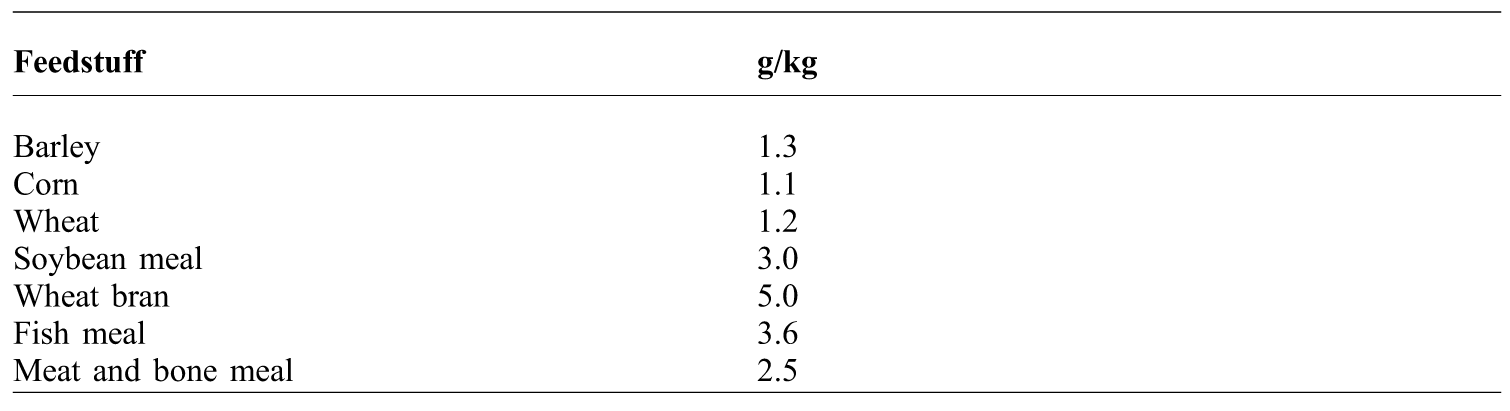
The raw materials used in compounding poultry feed are mostly sufficient in Mg (Table 5).
Mg content in some feedstuffs for poultry (dry matter basis) (McDonald et al., Reference MCDONALD, EDWARDS, GREENHALGH, MORGAN, SINCLAIR and WILKINSON2011).
A reference practical diet for chicks (NRC, 1994) with 58% ground yellow corn and 35% soybean meal would contain on average 1500-1800 mg Mg/kg feed (dependent on the natural variation in Mg content) only from these ingredients. These values are 3-4 times greater than those recommended by NRC (1994) or GfE (1999). Even considering natural variation in Mg content in feedstuffs (Suttle, Reference SUTTLE2010), Mg deficiency is not to be expected under practical feeding in poultry. Thus, additional Mg supplementation to the diets in commercial practice is unnecessary and even might be detrimental to performance, bone health, and litter quality. The anti-oxidative effects of supplemental Mg are contradictory in some cases and need further investigation. Establishing a more balanced relationship among Mg, Ca, and P in rations for poultry is required for compounding balanced poultry diets, and further research is needed for this purpose.
Conclusions
Mg is an essential element in poultry nutrition. Most of the feedstuff used in compounding poultry feed contains Mg to an extent that makes Mg deficiency unlikely under practical conditions. Thus, supplementation of Mg to poultry diets does not seem necessary. However, in some situations, such as improving and stabilising poultry meat quality, supplementation could be rational. Understanding at what stages of development such supplementation can be reasonable and considering possible effects on availability of other elements, especially Ca and P, could help in designing balanced poultry diets aimed at achieving maximal performance. It would be desirable if the ratios of these three minerals in the poultry diets could be given on an available basis. Therefore, further research is required to evaluate Mg in terms of its availability to different poultry species.