Over the last two decades, the overseas Taiwan studies field has seen a rapid expansion in the scope of its institutions and the size of its research community. There are now over a dozen active Taiwan studies programmes or centres on both sides of the Atlantic.Footnote 1 One of the critical moments in the development of this dynamic field in Europe was the establishment of the European Association of Taiwan Studies (EATS) in 2004. The EATS annual conference is held in a different European city each year and plays a key role in creating a community of scholars who work on Taiwan across different disciplines.Footnote 2 The counterpart of EATS in North America is the North American Taiwan Studies Association (NATSA), a graduate student-operated organization that was founded in 1994 and has continued to be vibrant in the new millennium. More recently, the World Congress of Taiwan Studies has been established, with initial conferences held at Academia Sinica in 2012, SOAS in 2015 and back to Academia Sinica in 2018.
The vast majority of Taiwan studies centres and programmes concentrate on organizing academic events such as conferences or workshops. Publications are often produced from revised versions of these conference papers, contributing to the growing number of books in the field. Shelley Rigger showed how Taiwan studies academic book publications rose from minimal levels in the mid-1980s to impressive numbers by the late 1990s and early 2000s.Footnote 3 Jonathan Sullivan found similar rising trends in articles on Taiwan published in academic journals.Footnote 4 In Europe, there are now two academic book series that publish exclusively on Taiwan: the Routledge Research on Taiwan series and the Harrassowitz studia formosiana. In the United States, from the 1980s onwards, a number of US publishing houses, including Indiana University Press, M.E. Sharpe, Duke University Press, Hawai'i University Press and Columbia University Press, became known for being more open to Taiwan-related subjects, although the closure of the M.E. Sharpe Taiwan in the Modern World series suggests a less rosy trend for Taiwan-related publications in North America in the post-2000 period.Footnote 5 However, two recent important publication-related developments for the field are the establishment of the International Journal of Taiwan Studies and the Brill book series on Taiwan studies in 2018.
In Europe, several Taiwan programmes have attempted to develop Taiwan studies teaching courses, yet these courses have tended to be in isolation and not well integrated into existing academic programmes. More importantly, the majority have not endured. For example, of the eight UK universities that initially introduced Taiwan-focused courses, only one was still offering courses in the 2017/18 academic year.Footnote 6 In North America, there has been a proliferation of Taiwan-related courses in higher education institutions over the past decade. Based on an ongoing survey conducted by NATSA, more than 100 Taiwan courses (defined as devoting at least one-third of course content to Taiwan or Taiwan–China relations) have been offered in 50 universities in the US and Canada.Footnote 7 The survey also shows that these courses are taught in a wide range of departments or interdisciplinary programmes.Footnote 8
SOAS University of London (SOAS hereafter) and the University of Texas at Austin (UT Austin hereafter), however, have distinguished themselves in that not only have they developed Taiwan-focused courses in multiple disciplines and sustained continuity over an extended period of time, but they have also established Taiwan studies degrees. Ostensibly different in several important aspects such as basic structure, trajectory of development and institutional status, these two programmes nonetheless share a number of particularly meaningful commonalities. The purpose of this paper is to compare the experiences of these two institutions in developing such comprehensive Taiwan studies teaching programmes.Footnote 9 We begin with a review of the origins of these unique teaching programmes, their distinct development trajectories and key features. Next, we offer a comparative analysis of how they were able not only to survive but also expand their offerings and thrive in an academic environment that normally tends to be hostile to such niche appeal programmes. Finally, we discuss some of the remaining challenges facing these teaching programmes.
We argue that with the right design, firm commitment and long-term funding support, Taiwan studies teaching programmes can be viable and make an important contribution to the field. Many of those who have completed our Taiwan courses at the postgraduate level have gone on to further studies, embarked on non-academic careers utilizing the knowledge they have acquired or, in the cases of those who have received PhD degrees, secured university teaching positions. Taiwan courses at the undergraduate level fill a significant gap in the university curriculum on East Asia. Given that Taiwan has historically been a meeting place of different geopolitical and cultural matrixes, these courses broaden the horizon of the students’ knowledge and instil a stronger sense of global connectedness.
The recent surge in Taiwan studies in higher education institutions in both Europe and North America may be appropriately viewed as a post-Cold War phenomenon, driven by a different set of dynamics. Importantly, the notion of soft power has come to exert a visible impact on the policies of public diplomacy adopted by many countries. Taiwan has joined this trend with vigour and flair in recent years. Prompted by the immediate goal of increasing international visibility, various Taiwanese government agencies have offered project sponsorships for academic and non-academic institutions and have met with positive responses in Europe and the United States. On the one hand, faced with declining resources and budget difficulties, academics in these places have been actively seeking external financial support for research and programme development. On the other hand, Taiwan's energetic creative industry, unique geopolitical position and impressive efforts in pursuing progressive values such as democracy and LGBTQ rights offer abundant materials for courses with a niche appeal. The auspicious convergence of goals and interests have played a key role in the building and thriving of the Taiwan studies teaching programmes at SOAS and UT Austin.
Programme Origins and Development
SOAS
When the SOAS Taiwan studies programme was established in 1999, Taiwan had a much smaller presence in European campuses than in US campuses.Footnote 10 At this point in time, there was very little coverage of Taiwan in European courses. Where Taiwan did feature, it tended to be on the margins of Chinese studies. For instance, SOAS courses on Chinese politics or economics offered at most a week of studies covering Taiwan.
When the SOAS Taiwan programme was established, a conscious decision was made to keep it separate from the China Centre and department. Instead, reflecting its initial social science focus, it was located in the Faculty of Law and Social Sciences. This reflects an overall trend in European Taiwan studies in that social sciences have tended to dominate in areas such as conference panels, courses and publications.Footnote 11 In the first year of the Taiwan studies programme at SOAS, preparations were made both for its inaugural conference and for the first teaching course focused on Taiwan. The course, “Contemporary Taiwan: the evolution of a new development model,” was introduced for the 2000/2001 academic year. It was a co-taught year-long course for postgraduates and included sections on Taiwan's history, domestic and external politics, society, and economic development. This course ran for five years through to 2005 and represents the first period of the SOAS Taiwan teaching programme.
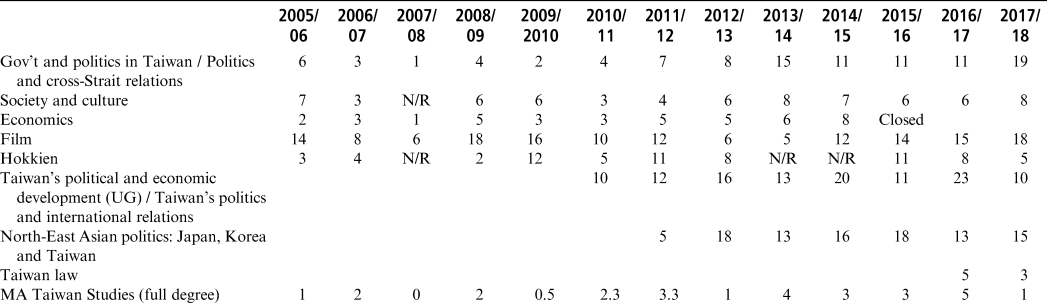
The trends in student numbers taking the SOAS Taiwan studies courses are shown in Tables 1 to 3. The numbers of students taking “Contemporary Taiwan” fluctuated, ranging from 12 in its first year to 7 in the final year. It was not a core course for any degree and, given the extensive range of course options available on interdisciplinary area studies degrees, there was always uncertainty over student numbers. The first major change in the teaching programme came in 2005 when the “Contemporary Taiwan” course was replaced with three term-long specialized courses. These were “Government and politics in Taiwan,” “Society and culture in Taiwan” and “Economic development of modern Taiwan.” These courses were located in the politics, China and Inner Asia, and economics departments, respectively. Thus, unlike the original course, they were taught using a more disciplinary approach. For instance, the “Government and politics” course was designed to understand Taiwan's political development through a range of comparative politics theories and frameworks. In addition, the China and Inner Asia department introduced a year-long elementary Hokkien course, available to both undergraduates and postgraduates, and also a new term-long course on “Modern film from Taiwan and the Chinese diaspora.” This expansion of courses made it possible to introduce the MA Taiwan Studies degree from 2006, the first such postgraduate degree in the West.Footnote 12 Students enrolled on the full degree were required to take all four of the new specialized courses, along with a further year-long course (or two half units). The Hokkien course was available as an optional course. In addition, students on the MA degree were required to produce a 10,000 word dissertation on a topic closely related to one of the core Taiwan courses.
Student Numbers for Taiwan Courses at SOAS, 2005–2018

Notes: In 2010/11, “Government and politics in Taiwan” was closed and a new year-long course, “Taiwan's politics and cross-Strait relations,” was introduced. From 2016/17, the undergraduate course was redesigned and renamed “Taiwan's politics and international relations.”
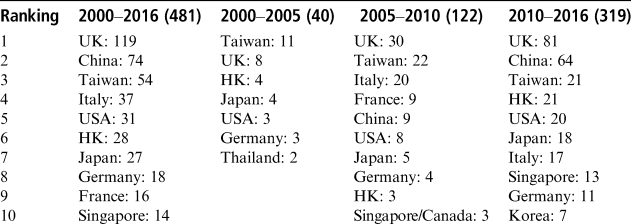
Most Common of 36 Nationalities Taking Taiwan Courses at SOAS

Notes:
Number in brackets in header row indicates total number of students enrolled. Table does not include data for the Hokkien course.
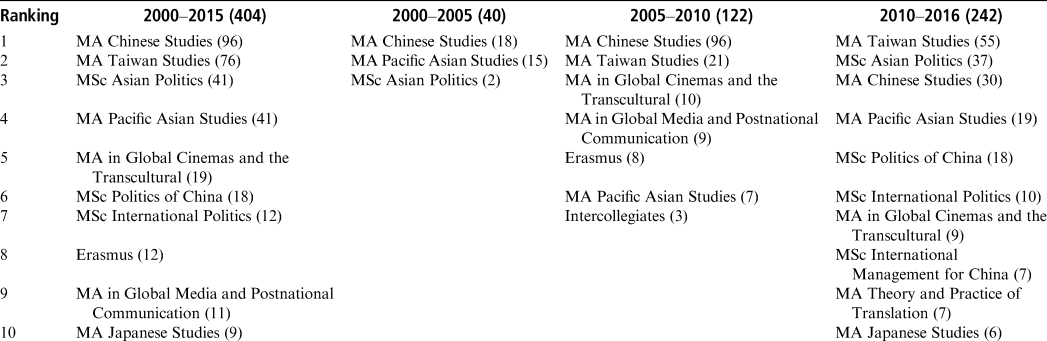
Most Common Degrees for Students Taking Taiwan Postgraduate Courses at SOAS

Notes:
Number in brackets in header row indicates total number of students enrolled. Table does not include data on Hokkien course.
The new course structure ran from 2005 through to 2010 and represents the second period of the Taiwan teaching programme at SOAS. The recruitment pattern following the introduction of the new specialized courses was mixed. The total number of students embarking on Taiwan courses rose significantly, from 40 in the first five years (2000–2005) to 122 in the second period (2005–2010). At the level of individual courses though, the picture did not look so promising. Student numbers were particularly poor for the economics course. In contrast, “Modern film from Taiwan” was initially by far the most popular course option. The low point for the teaching programme came in 2007/08, when two courses did not run at all and two courses only ran with a single student each.
The MA Taiwan Studies degree has remained a small niche programme. Although there are healthy numbers of applicants, only one or two signed up for the full degree in the early years.Footnote 13 However, since all the core courses were available on a wide range of other degrees, what mattered was whether sufficient students could be attracted to take Taiwan courses with these other programmes.
The next major change in the SOAS Taiwan teaching programme came following the addition of a senior teaching fellow in Taiwan studies, a post sponsored by Taiwan's Ministry of Education in 2009. This appointment made the expansion of three major areas possible. First, from 2010/11 the one-term “Government and politics in Taiwan” course was replaced by a year-long course, “Taiwan's politics and cross-Strait relations.” This allowed for more in-depth coverage of both Taiwan's domestic politics and external relations. The course was made a compulsory core course for the MA Taiwan Studies degree and a core course for the new MSc Politics of China degree from 2011; it was also available on a range of other postgraduate degrees. Second, the first undergraduate Taiwan course, “Taiwan's political and economic development,” was created in 2010. The year-long course, based in the politics department, was designed along the lines of the old “Contemporary Taiwan” course to incorporate quite a broad social science appeal. This co-taught course incorporated political history, domestic politics and external relations, as well as economic development. The third area of expansion was the creation of a new year-long comparative course, “North-East Asian politics: Japan, Korea and Taiwan.” The first half of this course uses comparative politics frameworks to examine the three North-East Asian democracies, while in the second term the focus switches to comparative political economy.
Tables 1 to 3 show that the newly expanded course structure has proved to be very successful. First, the total number of students increased from 122 in the second period (2005–2010) to 319 in the third period (2010–2016). The new year-long “Taiwan's politics and cross-Strait relations” course has developed into one of the most popular courses, with 15 taking the course in 2013/14 and 19 in 2017/18. It also attracts significant numbers of auditing students. The undergraduate course has also been popular, gaining the record for the highest numbers of any Taiwan course, with 23 taking the class in 2016/17. Finally, the “North-East Asian politics” course has proved to be the most popular course on average numbers. What has been especially interesting about this course is that it has attracted students who originally had a focus on Japan or Korea but who became increasingly interested in comparative analysis with Taiwan through taking the course. There has even been a small increase in the numbers taking the MA degree, with five enrolling in 2016.
Another way we can get a sense of the popularity of the Taiwan courses is to compare their numbers with similar regional disciplinary courses. For example, there were 11 students taking “Taiwan's politics and cross-Strait relations” in 2014/15 and 2015/16, while there were 12 and 14 students taking the domestic politics of China course, and only four taking the new Japan politics course. Similarly, a comparison of the popular Taiwan film course and the China film and theatre course reveals very similar numbers. Naturally, there are less students taking MA Taiwan Studies than MA Chinese Studies; however, the numbers tend to be similar to those on MA Korean Studies. In other words, if we consider the relative size of Taiwan to China, Korea and Japan, the numbers opting to take Taiwan courses and degrees at SOAS are quite impressive.
UT Austin
The Taiwan studies programme was formally launched at UT Austin in 2009 as one of several area programmes in East and South Asia within the department of Asian studies. It contains two distinct components: one at the postgraduate level, the other at the undergraduate level.
Postgraduate level
Historical factors have played a role in shaping the direction in which UT's Taiwan studies programme has developed, particularly in relation to its emphasis on doctoral student training. In 1979, when Taiwan studies as a whole was still in an embryonic stage, the late Professor Jeannette Faurot organized the first large-scale international symposium on Taiwan literature at UT. This landmark event was followed by four books on Taiwan literature, authored or edited by members of the UT faculty and published by prestigious presses in the three ensuing decades. Roughly in the same period, several UT graduates returned to Taiwan and subsequently emerged as significant players in the rise of Taiwan's “new cinema” movement in the 1980s and in the institutionalization process of Taiwanese literary studies within Taiwan's own academy, a particularly vibrant phenomenon in the post-martial law period.Footnote 14 The above has made UT's Asian studies a “centre” of sorts in the sub-field of Taiwanese literary studies in the West.
As luck would have it, the founding of the Taiwan studies programme at UT coincided with a new search in its host department and provided a sound justification for the hiring of a second China literature faculty member with a strong interest in Taiwan. The Asian studies department at UT, therefore, has became one of the few graduate institutions that places equal weight on China and Taiwan in its study of modern Chinese literature and culture. This shift of focus has been reflected in the creation of the following graduate seminars: “Cultural formations in modern Taiwan” (autumn 2009), “Modern institution of literature: China and Taiwan” (spring 2011); “Literary/cultural scholarships: modern China and Taiwan” (autumn 2012, spring 2018); and “Literary fields: modern China and Taiwan” (spring 2014).
The impact of this new orientation has been manifested in a number of concrete ways. First, there has been an increase in student numbers. Before the founding of the Taiwan studies programme, there were three PhD students at UT specializing in the literature and film of Taiwan and twice as many doctoral students working on China-focused topics. Following strong and better coordinated efforts at recruitment and acquiring funding, five new graduate students interested in Taiwan joined the programme in 2009, 2010, 2011, 2013 and 2015, respectively, increasing the total number of Taiwan-focused doctoral students from three to eight. A new admission with a five-year financial package has just been issued in spring 2018 to an outstanding applicant proposing to study Taiwan literature. Second, conscious efforts have been made to help doctoral students develop original research projects that promise to shed light on significant historical transformations. Two dissertation projects that were completed in 2015 and 2016, for example, dealt with filmmaking in Taiwan's post-“new cinema” era and the tension-ridden reception of Korean popular culture in Taiwan since the early 2000s. The same big-picture approach underlies research for two other dissertations: “Rhetoric of the Lyrical: Written Vernacular Chinese and Lyrical Prose Writing in Taiwan, 1960s–1990s” and “The 1990s Gender Progressiveness in the Post-Martial Taiwan.”
Building on its accumulated strength, UT's Taiwan studies programme envisions itself as a training ground for the next generation of scholars in Taiwanese literature and culture. Judging from the success in the timely completion of PhD degrees in 2008, 2015 and 2016, with two more dissertation oral defences scheduled for spring and summer of 2018, and the increasing number of high-calibre applicants the programme has been receiving in the last few years, it seems that the programme is on track to achieve this goal.
Undergraduate level
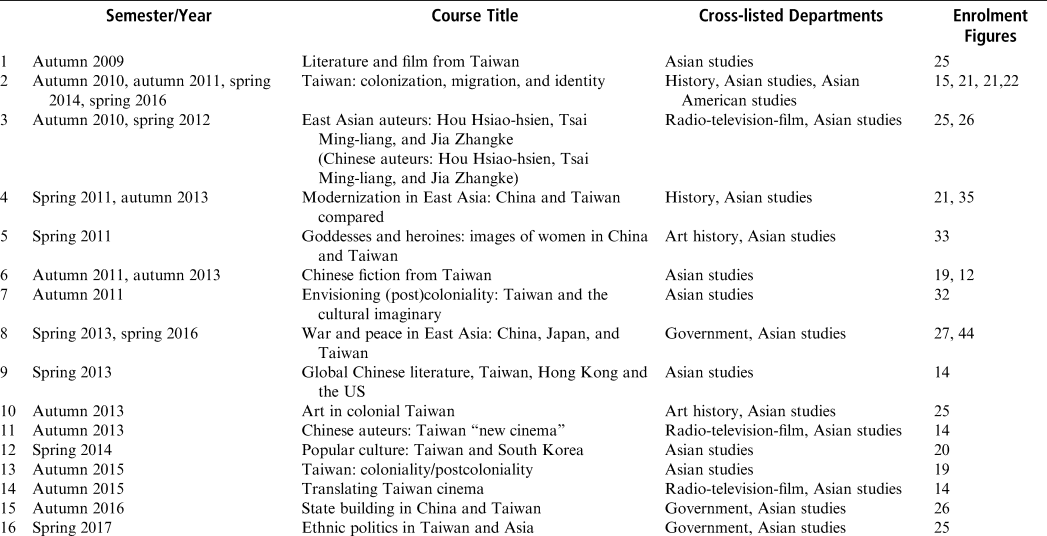
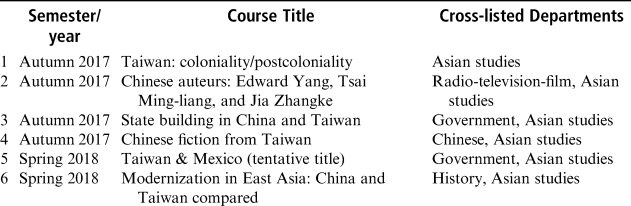
In 2009, a proposal to establish a Taiwan studies track as part of the Asian studies major at UT Austin was submitted to different levels of the university bureaucracy (College of Liberal Arts, Executive Vice-Chancellor for Academic Affairs of the University of Texas System, and Faculty Council). The proposal was approved, and an undergraduate degree programme in Taiwan studies, likely the first of its kind outside of Asia, was officially added to the 2010–2012 catalogue of courses offered by the university. In order to supply the Taiwan studies majors with sufficient courses to meet their degree requirements, the core faculty of the Taiwan studies programme began to actively recruit tenured and tenure-track faculty members in various departments at UT to develop new Taiwan-focused courses at the upper-division undergraduate level.Footnote 15 The efforts were very well received, resulting in an impressive number of new Taiwan courses being taught in the next ten years. Before 2009, only two Taiwan-focused courses, “Chinese fiction from Taiwan” and “Taiwan: colonization, migration, and identity,” were regularly taught at UT every two or three years.Footnote 16 To date, however, a total of 29 undergraduate Taiwan courses on 16 different topics have been offered by UT faculty in six different departments (Asian studies, history, government, radio-tv-film, art history, and Asian American studies) from three colleges (Liberal Arts, Communication, and Fine Arts).Footnote 17 The full list of Taiwan courses run between 2009 and spring 2017 is displayed in Table 4, and the most recent courses since autumn 2017 are shown in Table 5.
Taiwan Courses at UT-Austin, Autumn 2009–Spring 2017

Taiwan Courses at UT-Austin, Autumn 2017–Spring 2018

Graduate Courses on Taiwan at UT-Austin

Seven of the topics listed in the tables have been taught multiple times (nos. 2, 3, 6, 7, 11, 13 and 15 in Table 4), typically with growing enrolment figures. In fact, the majority of these courses were fully enrolled at the number proposed by the instructors. By and large, three to four Taiwan-focused courses are offered in every academic year, and the average student enrolment is around 22 (the lowest enrolment figure is 9; the highest 44).
At the outset, there was some apprehension about the sustainability of this model. More specifically, there were concerns about whether the pool of faculty interested in developing Taiwan courses would shrink. Fortunately, this has turned out not to be the case. Efforts at recruiting faculty members to develop and teach new courses on Taiwan have persistently been met with enthusiasm. Three more new courses, on the topics of history of food and healing in Taiwan, cross-Strait relations, and contemporary Taiwanese media, will be added to the list in the next two or three years. As a result, although Taiwan studies remains a very small degree programme (seven students have opted to major in Taiwan studies since 2010 and only three have graduated so far, in 2011, 2012 and 2015), the number of students who have taken Taiwan courses is quite large. From autumn 2009 to spring 2018, a total of 671 undergraduate students at UT elected to study some aspects of Taiwan in an extensive, systematic and in-depth manner in the classroom environment.
Comparing the Taiwan Teaching Programmes at SOAS and UT Austin
SOAS and UT Austin have provided two very different models. To make a meaningful comparison of these two teaching programmes, it is necessary to look not only at their structure, institutional status and trajectory of development, but also at the enabling conditions and what they ultimately share in common.
Over a period of 18 years (2000–2018) and through three different phases, the Taiwan programme at SOAS has evolved from a single co-taught year-long course to its current range of courses of six postgraduate and two undergraduate modules. Although the overall programme is managed by the Centre of Taiwan Studies, the courses are divided between those based in disciplinary departments and those in the department of East Asian languages and cultures. Graduates either move on to further studies or use what they have learned in a wide range of non-academic careers such as in the media, think tanks and government service.
The UT Taiwan studies programme developed within a shorter time span (2009–2018). Structurally speaking, it is embedded within the department of Asian studies as one of several area programmes (South Asia, Japan, Korea, etc.). The doctoral students in the programme normally take six to eight years to complete the degree, and receive a PhD in “Asian Cultures and Languages (ACL),” which is “designed for students who intend to pursue a career in scholarly research and university teaching on Asia.” Undergraduate students of the programme receive a BA degree in Asian studies, with a Taiwan studies concentration, upon graduation. They can declare their major in any year of the college programme, so long as they fulfil the course and language requirements.Footnote 18 Nearly all Taiwan studies students are double majors or even triple majors (claiming multiple majors is extremely common for UT undergraduate students).
Evidently, the fundamental differences between these two programmes have a great deal to do with their individual academic contexts. In SOAS, the teaching focus has mainly been on students on one-year MA/MSc postgraduate programmes. By contrast, at Austin, as is the case in many North American universities, MA programmes have become increasingly a bridge between a BA and a PhD degree, providing additional time for students to make career decisions, while greater resources are poured into undergraduate and doctoral programmes. Despite the fact that they are targeted at different levels of the student population, these two teaching programmes share some significant common features. On the one hand, the numbers of majors in both programmes are relatively small. On the other hand, both have achieved impressive accomplishments in offering a large number of high-quality courses on Taiwan and have demonstrated strong capabilities in organizing or facilitating public events and academic activities about Taiwan. The latter point will be further addressed in the next section. The former claim is readily supported by the total numbers of students who have taken the Taiwan courses offered in these two programmes: 640 at SOAS (from 2000 to 2018), and 701 at UT Austin (from 2009 to 2018).
Here, again, different environmental factors play a part. Courses offered at SOAS have tended to be permanent, run on an annual basis and generally are taught by the same faculty members each year. At UT Austin, because the Taiwan courses are “outsourced” to faculty members in various departments and colleges across campus, the inventory is much larger (16 different topics so far), the contents more diverse, and there is an inherent unpredictability in the curricular pattern (only a few “core courses” are offered on a regular basis). Such differences are easily explained by the institutional context. Whereas it takes considerably longer to get new courses officially approved in the UK higher education system, it is extremely common for university faculty in the US to propose different course topics on a yearly basis. In addition, at UT Austin, because its course content pertains to global culture, the Taiwan course can be used to fulfil a general elective requirement for undergraduate students in most disciplinary departments.Footnote 19 There are also incentives for faculty members to offer such courses: they can enrich individual scholars’ teaching portfolios while providing an opportunity for them to explore new areas of research. Several faculty members have in fact pursued specific Taiwan-related research either during or after teaching the course.Footnote 20 Finally, the consistently robust enrolment numbers for these Taiwan courses are positively perceived by the departments in which they are originated.Footnote 21
General Contributions
As argued in the foregoing section, aside from the training of future scholars in Taiwanese literature at UT, the large number of solid college-level Taiwan courses that the Taiwan studies programmes at SOAS and UT Austin have continued to offer ought to be considered their most significant contribution. The impact of these courses may even outweigh that of the MA and BA degree programmes per se: all students who have taken these courses, whether as majors or not, are likely to spread the seeds of knowledge about Taiwan after they graduate.
Another tangible contribution is the vibrant communities these two programmes have created through organizing or facilitating Taiwan-related public events and academic activities. Such communities raise the visibility of Taiwan at both local and translocal levels and are inevitably the product of continuous efforts over many years, an effect that is difficult to attain by institutions that only host Taiwan-related events during the award periods of short-term grants.
Finally, it is particularly noteworthy that despite their tiny numbers, the core faculty members in both of these Taiwan studies programmes have produced an impressive output of monographs, series, readers and sourcebooks while dedicating themselves to the programmes’ day-to-day operations. That many of these publications have been adopted as textbooks by universities worldwide is certainly an important contribution to the field.
Academic Events Programme
SOAS
The distinguishing point about SOAS has been the way that the events programme has been designed to complement and support the Taiwan teaching programme. First, the Taiwan studies seminar series runs with approximately weekly events throughout the regular terms. As much as possible, the seminar themes are closely related to the core courses, so politics, social, cultural, modern history and film-related topics dominate the seminar speakers’ themes. Moreover, the public seminar events tend to be held on the days when teaching on Taiwan is concentrated. A similar approach has been adopted with the “Understanding Taiwan through film and documentaries” screening series. The themes of the screened films again tend to be closely linked to the core courses. Students are encouraged to join in the seminar and screening Q&A sessions and these events will also feature in the next class discussions. In the first class at the start of the academic year, new students are informed that over the coming year they will meet many of the key authors in the field and from their course reading lists. SOAS also tries to make sure that some of the events programme is linked to current affairs. For example, there has been a long series of pre- and post-election roundtables. Similarly, SOAS has tried to attract politicians and cultural figures with practical experience to speak and interact with students. To this end, SOAS has organized a series of closed-door sessions where both serving and former government ministers have direct contact with students. Similarly, numerous film makers have been invited to London to discuss their work following the film screenings.
Apart from the term-time seminars, SOAS has aimed to run one annual conference each year on a different theme. Again, the expectation is that they will be closely linked to one of the core courses. Many of the conferences have been small, publication-oriented workshops, but SOAS has tended to allow postgraduate students to attend. For instance, in 2014 SOAS invited postgraduate students to join a conference on Taiwan's social movements which included scholars and activists. After attending the conference, a number of students went on to develop dissertation topics on this social movement theme and some even used interview data from the conference participants. One particularly influential event was the World Congress of Taiwan, which was hosted by SOAS in 2015. This offered the school's students an opportunity to engage with most of the key figures in the field.
A key element of the SOAS postgraduate programme is the research dissertation. One way the Taiwan programme tries to help students prepare for this is to encourage them to join the MA panel at the EATS conference. For example, six of the SOAS Taiwan studies students were selected to present their preliminary research projects at the EATS conferences in Poland (2015) and Switzerland (2018). Joining such a conference allows students to not only receive feedback on their research design but also to gain the experience of being on the same agenda as the leading Taiwan studies scholars in Europe and to meet Taiwan studies students from other universities. The Centre follows this up with the free annual SOAS Taiwan Studies Summer School. This is normally a four-day event with a series of lectures and student research presentations. Students planning to write their dissertations on a Taiwan topic are encouraged to give brief presentations and will receive feedback from the teaching team as well as their SOAS and non-SOAS peers.
UT Austin
Although with less frequency than the weekly events organized by the SOAS Taiwan studies programme, major symposia, workshops and film festivals were hosted by the UT Taiwan studies programme throughout the last decade. Such events brought to the UT campus more than 30 US, Asia and Europe-based scholars who specialize in Taiwanese literary studies, as well as such distinguished writers as Pai Hsien-yung 白先勇, Huang Chun-ming 黃春明, Chu Tien-wen 朱天文 and Liu Ke-hsiang 劉克襄, and film critic/producer Peggy Hsiung-ping Chiao 焦雄屏. These activities were closely tied to the literature-focused graduate sector of the UT Taiwan studies programme, and served to keep its doctoral students abreast of the latest cultural and theoretical discourses in the field.
Unlike SOAS, however, UT does not have a Centre of Taiwan Studies. As a result, many public academic events on Taiwan have been organized by members of the extended Taiwan studies team across campus. A prominent example is Professor Lin Tse-min in the government department, whose “Taiwan and Asia series,” supported by a grant from Taiwan's Ministry of Foreign Affairs, has brought distinguished scholars and public figures in Taiwan's political scene to UT.
In retrospect, the major international conference, “Taiwan Literature in East Asia: Methodology and Comparative Framework,” organized by the programme in June 2011, was a landmark event. It ushered in a period of steady increase in Taiwan-related activities on the UT campus, which has been initiated by a network of UT academic staff coalesced around the programme and interested in promoting Taiwan studies. These activities were sponsored by multiple sponsoring agents, both externally and internally, including the Chiang Ching-kuo Foundation, Taiwan's Ministry of Culture, Ministry of Foreign Affairs and National Central Library, and UT's own China Endowment, Institute of Historical Studies, Perry-Castañeda Library, Graduate Studies Office, School of Fine Arts, and the Julian Suez Excellence Endowment in Chinese. In all of these cases, the Taiwan studies programme played an essential facilitating role, supplying these events with interested and knowledgeable audience and participants as well as personnel support.
Publications for Teaching
SOAS
The SOAS programme is further distinguished by its promotion of publications useful for teaching on its Taiwan courses. A number of Taiwan conferences have led to book publications that have been widely used on SOAS courses, for example the Chang, Fell and Klöter edited volume, What Has Changed: Taiwan Before and After the Change in Ruling Parties, and the Ash, Garver and Prime edited publication, Taiwan's Democracy: Economic and Political Challenges.Footnote 22 The establishment of the Routledge Research on Taiwan book series, edited by the Centre of Taiwan Studies’ director Dafydd Fell, has further contributed to the publication of relevant teaching books. For instance, Fell's Government and Politics in Taiwan is the core textbook for two of the SOAS courses, while other books in the series such as Schubert and Damm's Taiwanese Identity in the 21st Century are also used extensively on SOAS courses.Footnote 23 Another teaching-related publication has been the Hokkien textbook compiled over a decade by SOAS professor Bernhard Fuehrer with Yang Hsiu-fang 楊秀芳.Footnote 24 This is now being used for the first time after SOAS reintroduced the course in 2015/16.Footnote 25
UT Austin
Several books on modern Taiwanese literature published by UT faculty members in the decades preceding the Taiwan studies programme have regularly appeared on reading lists for college-level courses dealing with literature written in Chinese – for example, Carver and Chang's edited Bamboo Shoots After the Rain: Contemporary Stories by Women Writers of Taiwan and Chang's Literary Culture in Taiwan: Martial Law to Market Law.Footnote 26 This tradition has been maintained since the programme's establishment. The Columbia Sourcebook of Literary Taiwan, which makes available to English readers for the first time many useful research materials from the literary history of colonial and contemporary Taiwan, for example, is co-edited by the director of the programme, Sung-sheng Yvonne Chang, and A Passage to China: Literature, Loyalism, and Colonial Taiwan is co-edited/authored by another member of the programme, Tsai Chien-hsin.Footnote 27
What Are the Winning Strategies?
Can Taiwan studies at SOAS and at UT Austin be considered as successful teaching programmes? On the most basic level, the fact that the programmes have not only survived (unlike in many other institutions where Taiwan courses were dropped after a few trials) but have also progressively expanded in size and scope can be viewed as an achievement. The numbers of students taking courses in both places have increased over time, with very positive student feedback. What is more, evidence suggests that considerable recognition has been given to both programmes. The founder of the SOAS Taiwan programme, Professor Robert Ash, has been awarded the Prize of the French Taiwanese Cultural Foundation (2008) and the ROC Friendship Medal of Diplomacy (2012) for his contribution to the field. The SOAS Taiwan teaching team has come second in the University Director's Teaching Prize and is nominated on an annual basis. Doctoral students at UT Austin have been awarded prestigious fellowships, including the Fulbright Scholarship, Chiang Ching-kuo Dissertation Fellowship and the Harrington Fellowships. One of these students was elected as the president of the North American Taiwan Studies Association (NATSA) in 2016. In a 2014 statement prepared for external review, the chair of the Asian studies department wrote: “our Taiwan Studies doctoral program is unique and has no real external competition.” Over the past few years, the programme has increasingly attracted top-notch graduate students as well as visiting scholars, which in itself is testimony to this claim.
There are, needless to say, some inherent constraints to all Taiwan studies programmes. As pointed out above, in spite of their structural differences, the Taiwan studies programmes at SOAS and UT Austin share something in common in their general contributions to the field; the same can be said about the strategies both programmes have adopted to overcome the constraints they face.
Securing External Funding
One of the most fundamental challenges for all Taiwan studies programmes around the world has been short-term funding. Both SOAS and UT Austin have been fortunate to have enjoyed continuous external funding since the start of their programmes in 1999 and 2009, respectively. This funding has been mostly in three-year funding terms and has covered both academic events and teaching projects. Such long-term funding was particularly valuable in the initial phases of the programmes, as without such external funding it would have been harder to convince the university administration and the departmental curricular committees to approve the launching of niche appeal degrees and courses.
For the SOAS programme, the external funding has been important when resisting pressures to cut courses with low student numbers. Such a challenge arose when a new course structure was introduced after 2005, as there were a number of years when student numbers for some courses were especially low. It takes time for courses to become well known among students and the school as a whole. Thus, without external funding some Taiwan courses could have been cut soon after their initial introduction. Instead, we have seen how courses such as those based in the SOAS politics department have grown in popularity over time. While in many universities Taiwan courses often are run on an irregular basis, with the exception of “Elementary Hokkien” SOAS has always run its courses on an annual basis.Footnote 28 A key factor in its ability to run courses annually has been long-term funding, and this has enabled awareness of courses to be raised. While SOAS relied mainly on Ministry of Foreign Affairs funding in the first decade, it was the introduction of the Ministry of Education (MoE)-funded senior teaching fellow in 2009 that was critical in enabling the programme to expand radically. Nine years later as it is coming to the end of the third MoE funding term, SOAS is able to consider course expansion at a time when there is significant school-wide pressure to cut courses.Footnote 29
The Taiwan studies programme at UT Austin has also received external funding from the MoE in Taiwan since 2009, and it is now in the last year of its third three-year funding period (2015–2018). The majority of the undergraduate Taiwan courses at UT have benefited directly from this funding, either through the sponsored visiting lecturer programme during the second funding term (2012–2015) or, more importantly, from the course development grants it has enabled the programme to offer to those faculty members interested in designing and teaching new Taiwan courses. These grants have helped academics in various departments of UT who are originally not Taiwan specialists to conduct necessary research for developing new Taiwan-focused courses. In addition, in the aftermath of the 2008 financial crisis, UT Austin adopted draconian measures to downsize the graduate programmes in the Liberal Arts College; it was this external funding that allowed the Taiwan studies programme to offer partial student financial aid to relieve this pressure.
As the Taiwan studies programme at UT must share staff and accounting assistance with five or six other programmes in its host departments, the director of the programme is offered relief from one course per year so that she may attend to the programme's administrative duties. It is also important to note that matching funds have been a condition of the MoE funding, and UT has from the outset agreed to support one to two graduate students in the Taiwan studies programme with either teaching assistant positions or other types of university fellowships. Securing such a “cost-sharing” agreement from the host institution is undoubtedly a precondition for the long-term funding that ensures the survival of UT's Taiwan studies programme.
Sharing Resources Internally
Adequate human resources pose a serious challenge for all Taiwan studies programmes. Most Taiwan programmes rely heavily on a single individual; some of these individuals are even employed on a part-time or on a short-term (sometimes even annual) contract.Footnote 30 Even today at SOAS only one member of the team is employed full time to work on Taiwan-specific projects. At UT Austin, both faculty members in the Taiwan studies programme are at the same time the main (and only) China specialists in the department of Asian studies. They are responsible for teaching required China courses and supervising Chinese graduate students. With such a small core team there are naturally limits on what can be covered in terms of teaching and dissertation supervision. Both institutions have developed a number of strategies to keep the academic coverage on Taiwan as comprehensive as possible, and some aspects of these strategies are strikingly similar.
At SOAS, the Taiwan studies programme engages colleagues employed by the school who have a Taiwan research interest to become more involved in the programme's activities and then encourages them to bring Taiwan aspects into their teaching. The Taiwan studies team includes tenured members of faculty who contribute to one or more of the Taiwan courses. For example, after a number of years at SOAS, a colleague in the Law School introduced a new postgraduate course, “Law, rights and society in Taiwan,” in 2016.
As mentioned above, the majority of Taiwan courses at UT have been taught by colleagues from departments other than the Asian studies department, where the Taiwan studies programme is housed. The situation is therefore fundamentally similar to that at SOAS, except that SOAS has a more permanent inventory of Taiwan courses than UT, where only three core Taiwan courses are taught regularly every two or three years. This strategy seems to yield similar benefits as well. By involving those colleagues in the teaching activities of the Taiwan programme, an expanded team is formed. In the case of UT, some of these faculty also serve on the PhD committees of students on the programme; others, such as Madeline Hsu and Lin Tse-min, have taken the initiative in applying for grants and organizing Taiwan-related events. By and by, a Taiwan-centred community has come into existence on both the UT campus and in SOAS.
Integration into Existing Academic Structures
The SOAS programme has learned that it is vital to integrate its Taiwan courses with a variety of disciplinary and regional area studies programmes in order to maintain healthy student numbers. For example, a major reason the SOAS Taiwan film course has proved to be such consistent performer is because in addition to area studies students it has also attracted students undertaking film studies, literature and critical media degrees. This has meant that even when area studies degrees have had poor years, the film course has still performed well. In contrast, the economic development course was not integrated with any programmes from the economics department and thus struggled to attract enough students from area studies alone. The Taiwan studies programme has benefited even more from its courses being made either core or compulsory courses on degree programmes. In addition to the compulsory courses on the MA Taiwan Studies degree, a number of courses have become core courses in the post-2010 era. For instance, a factor in why “Taiwan's politics and cross-Strait relations” has had a higher and more stable intake than its predecessor is its core course status on the new MSc Politics of China degree. Similarly, the “North-East Asian politics” course has benefited from being designated as a core course on the MSc Asian Politics degree programme.
In this respect, there are key differences between SOAS and UT Austin. As one of several area programmes within the department of Asian studies, UT's Taiwan studies programme is by definition incorporated in its host department's institutional structure. To a large extent, the success of its postgraduate sector can be attributed to the nourishment it receives from other East Asian and South Asian faculty members in the department. The factors that affect the undergraduate enrolments are not the same as those at SOAS, either. As mentioned above, Taiwan courses meet an essential elective requirement (that of Global Culture) for UT's undergraduate students. In addition, as these courses are cross-listed in both the instructors’ home departments (history, government, etc.) and the department of Asian studies, they are able to attract students from both academic units. Except for one of the core courses, “Chinese fiction from Taiwan,” which sets a low closing limit for enrolment because of its language component, and a couple of courses taught by visiting scholars that were added to the schedule at a relatively late time, enrolments for the majority of the Taiwan courses at UT have always been at a satisfactory level, with 20 to 40 students per class. Indeed, some courses are even closed for registration before the semester begins. It may be argued that instead of being integrated into existing degree programmes, as is the case at SOAS, the Taiwan courses at UT benefit from the overall academic structure of the university and its special emphasis on global culture as part of the general degree requirements.
Maintaining Integrity and Overcoming Scepticism
The post-Cold War world order has rendered obsolete the old-style ideological wars the Taiwanese government used to wage on the international stage. With the arrival of the age of the internet, moreover, the ability of any player to control, let alone to monopolize, the ways messages are received has been drastically reduced, and the emphasis has increasingly been shifted to the scale of attention one is able to draw for one's messages. With all the benefits of an open society and a realistic understanding of the inherent disadvantages of a moderate-sized political and economic entity, the Taiwanese government seems to have been pursuing a public diplomacy that focuses more on branding Taiwan on the cultural front rather than pushing specific political agendas. This has meant that the work of Western academics interested in promoting Taiwan as an academic subject has been less hampered by the kind of political interference that has been associated with the PRC-backed Confucius Institutes. In sum, it is the quality and relevance of these courses, which build on an objective standing point, intellectual depth and relevance to the contemporary world, that allow SOAS and UT Austin to effectively compete with the ever-growing number of courses vying for student attention on university campuses.
There are, however, always complicated implications when academic institutions accept funding from a foreign government.Footnote 31 An important foundation for the healthy growth of the SOAS and UT Austin Taiwan programmes is their ability to safeguard intellectual integrity despite reliance on external funding. Both programmes have successfully adhered to academic principles of neutrality and avoided identification with any particular political camp in Taiwan. In addition, participating parties, including the diplomatic agencies that handle the MoE and MFA grants, have all carefully observed established conventions and proper protocols without crossing the line that separates “soft power” efforts from explicit acts of propaganda. Owing to the fact that the Taiwan studies programme at SOAS is relatively more social science oriented than the programme offered by UT Austin, which features a heavy humanities focus, the ways these two programmes approach this issue diverge to some extent.
SOAS: balanced, non-partisan stance
Taiwan is a multi-party democracy. Changes in ruling parties are a key feature of such a political system. The SOAS programme was launched under the KMT government in 1999 and saw its first significant expansion under the DPP government in 2006. When the KMT returned to power in 2008, with its reputation for reverting to cultural and education policies that prioritize Chinese culture, there were concerns that funding would be withdrawn from overseas Taiwan studies programmes. Yet the next major expansion in the SOAS teaching programme and the establishment of the UT Austin degree came after the KMT resumed control in 2008. Thus, a key task for any Taiwan studies programme relying on Taiwanese funding has been to maintain political neutrality.
Taiwanese academics are often labelled as belonging to one or other of Taiwan's political camps, and such categorization is also often applied to overseas scholars working on Taiwan. Given that SOAS has tended to have a large number of political science courses, maintaining a non-partisan reputation has been quite challenging. In order to run a serious politics-focused set of courses, it is necessary to host academic speakers and politicians associated with the main political camps in Taiwan. SOAS has dealt with this by prioritizing serious academic speakers in the field of Taiwan's political studies and ensuring that, over any given year, there is a good balance of speakers from all the major political camps in Taiwan. In other words, it is important that students are exposed to a wide variety of perspectives on Taiwan.
UT Austin: contextual/comparative approaches
Since UT Austin's doctoral programme in Taiwan studies is humanities oriented, the importance of historical lineage, cultural traditions, artistic genres and conventions outweighs other factors that constitute modern society and nation-state. However, the programme still finds itself confronted with issues that stem from the shifting disciplinary identity of “Taiwan studies.” For historical reasons, the boundary between Chinese and Taiwanese literary studies was rather blurred in North American universities before China opened its doors in the 1980s. Prior to that, writers and literary trends from contemporary Taiwan tended to be indiscriminately labelled as “Chinese” and at times they even received greater academic attention than those on mainland China. In recent decades, however, there has been an increasing awareness that literary traditions in Taiwan ought to be more appropriately studied separately and within their own context. The research directions of the literary faculty within the UT Taiwan studies programme fully reflect this awareness. Trained as comparative literature scholars, they are interested in finding conceptual frameworks that put into better perspective the intricate literary relations between China and Taiwan. Chang's “Introduction” to The Columbia Sourcebook of Literary Taiwan, for example, emphatically calls for a comparative approach that situates Taiwan within the East Asian context,Footnote 32 and the crux of Tsai's A Passage to China: Literature, Loyalism, and Colonial Taiwan is precisely concerned with lineage and interconnectedness as they were manifested in literature from Taiwan's Japanese period.Footnote 33
Echoing their teachers’ research directions, doctoral students in the UT Taiwan programme also tend to highlight the situatedness of cultural Taiwan in their dissertation projects. One of them explores the stylistic transformation of prose genres in contemporary Taiwan, tracing its origins to developments in China's Republican era. Another is interested in language politics in the recent cinema of the Sinophone world, using the revival of localist comedies in Taiwan as a point of departure. A dissertation project that has recently been completed deals with the consumption of “Koreanness” among the Taiwanese populace caught in between the Korean wave and competition in the semi-conductor industry. As future scholars, they promise to carry on theoretical and methodological explorations undertaken by faculty members and students in the Taiwan programme at UT Austin.
Those teaching the wide range of undergraduate Taiwan courses at UT Austin started with such topics as literature, film, migration and identity formation, post-coloniality and gender issues, but they have quickly expanded the programme to include social sciences topics, particularly in the field of political science. Rather than automatically subsuming Taiwan under the umbrella of China studies – and echoing their colleagues in literature – these scholars often adopt a comparative approach: juxtaposing Taiwan's democratization and economic developments with those in China, or situating Taiwan within regional or cross-regional contexts. Viewing Taiwan through the lenses of such diverse branches of knowledge yields fresh insights and broadens the students’ horizons. This fruitful use of comparative approaches at UT has borne similar positive results to those experienced at SOAS following the introduction of its comparative “North-East Asian politics” course.
Conclusion: Future Challenges and Prospects
In this paper, we have shown how both programmes have developed key strategies to not only survive but thrive in a competitive and hostile academic environment for niche programmes. Despite this success, we argue that there are a number of issues that will continue to challenge such programmes in the future.
First, as we have shown, external funding represents both an opportunity and a challenge. Such funding has allowed the development of programmes that would not normally be considered viable in today's financially constrained university environment. However, term-based external funding that is reviewed either annually or every few years without guaranteed renewal poses huge challenges not only to teaching programmes, which require a lengthy application process, but also to faculty and student retention. For instance, short-term teaching contracts are fine for an entry-level position; however, these staff will be put off staying owing to the lack of a tenure track in such positions. Furthermore, when the Taiwan grant award period at UT Austin shifted from the calendar year to the academic year in 2014/15, it left a one-semester gap, causing two students to withdraw from the Taiwan studies degree track as they were unable to take a required course in time to graduate. For any programme to be institutionalized, it needs to secure predictable, long-term funding or greater financial self-sufficiency through better student recruitment, otherwise even relatively mature programmes, such as those at SOAS or UT Austin, come under threat if their key figure leaves or retires. In both institutions, teaching programmes are reliant both on short-term posts and tenured faculty who contribute to the teaching of Taiwan courses. The courses depend on the good will of tenured faculty members who are willing to bring Taiwan into their teaching when they were not hired specifically to teach Taiwan courses and who may well be pressured to shift their teaching focus to more financially profitable subjects. When these faculty members leave or retire, it is unlikely that they will be replaced by anyone with a Taiwan focus, and so these courses can come under threat.
A final challenge for Taiwan programmes is administration. Running an extensive academic events programme incurs administrative and time costs. External funders are generally reluctant to subsidize administration, and the running of niche regional centre activities is not a major priority for universities. Therefore, the administration burden tends to fall on academics who are already under a range of regular administration, teaching and publication pressures. This means that in the long term, it will be difficult to sustain such high levels of academic event programmes without institutionalized administrative support.
Biographical notes
Dafydd FELL is the reader in comparative politics with special reference to Taiwan at the department of politics and international studies of SOAS University of London. He is director of the SOAS Centre of Taiwan Studies and the book series editor for the Routledge Research on Taiwan series. He works on Taiwan's electoral and party politics, as well as social movements.
Sung-sheng Yvonne CHANG is professor of Chinese and comparative literature at the University of Texas at Austin. She is author of Literary Culture in Taiwan: Martial Law to Market Law; Transformations of a Literary Field: On Contemporary Taiwanese Fiction; and Modernism and the Nativist Resistance: Contemporary Chinese Fiction from Taiwan. She is the editor of Bamboo Shoots After the Rain: Contemporary Stories by Women Writers of Taiwan.