

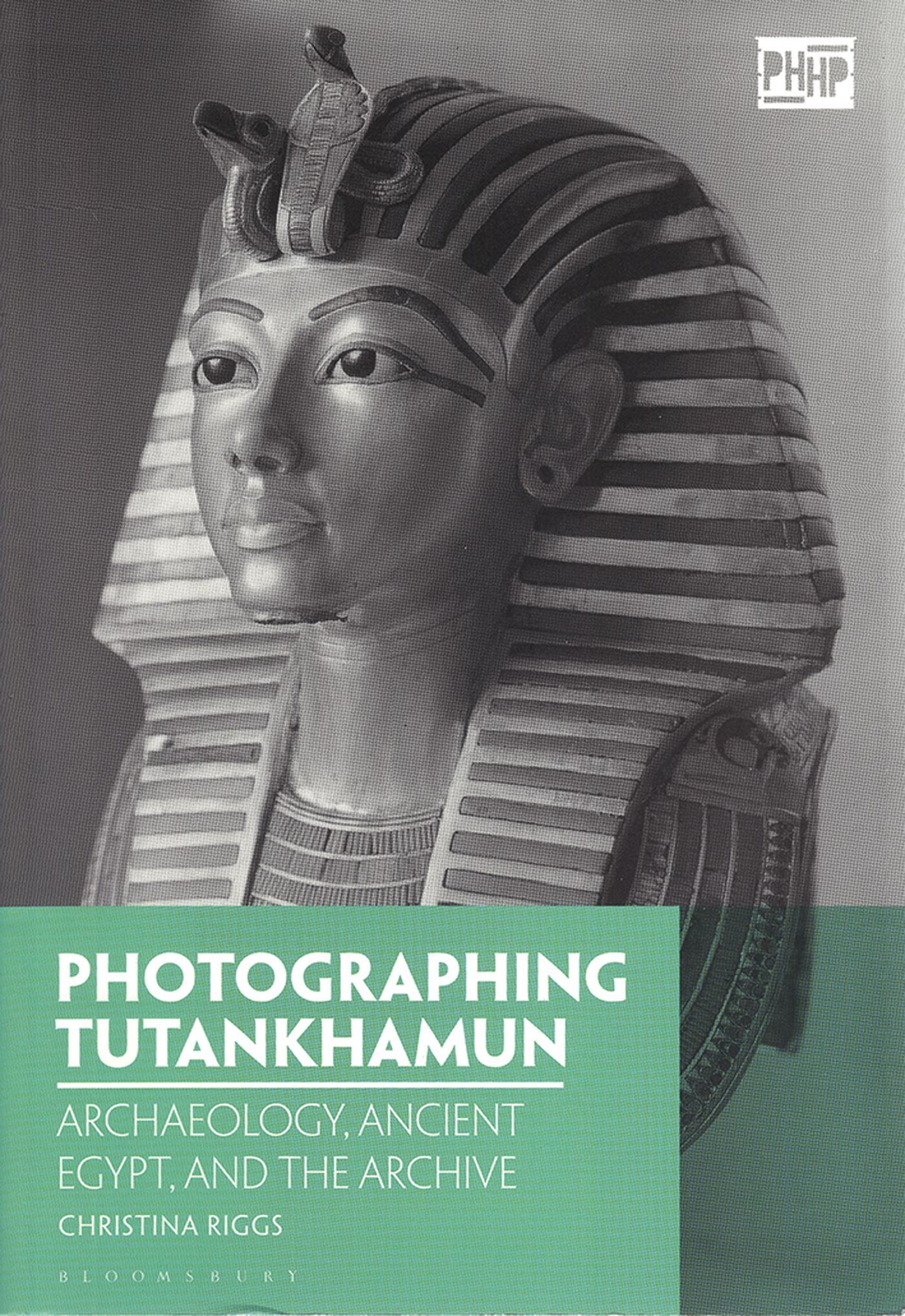
The iconic status of Tutankhamun is such that most readers of Christina Riggs's excellent new book will come to the text with a certain visual baggage. We have seen the famous mask so many times it has started to lose all meaning: a cliché burdened by archaeological legend and cultural myth. Photographing Tutankhamun is well aware that its central subject looms over the public perception of archaeology and Egyptology in ways that might undermine serious, critical research in these fields. Rather than rebuke this myth-making from a position of academic superiority, however, Riggs shows how the motives, practices and epistemologies of archaeology are entangled with such visualities and mythologies in ways that go far beyond commodification and self-promotion.
Photography, it is argued early in this book, “made modern archaeology possible” (p. 5). While this claim is not new, Riggs offers a welcome corrective to some of the more abstract thinking in this area with a work that is both conceptually ambitious and historically grounded. Written in a clear and engaging style, Photographing Tutankhamun will no doubt become an essential text in the emerging (and increasingly overlapping) sub-disciplines of photographic history and the history of archaeology, but it should also find a readership beyond these fields, offering a valuable model for a certain kind of socially engaged yet empirically rich scholarship that is not afraid to experiment with disciplinary boundaries.
At the core of this project is a return to the archive; specifically, a wide-ranging series of photographs made by Harry Burton at the tomb of Tutankhamun between 1922 and 1933, now held by the Griffith Institute in Oxford and the Metropolitan Museum in New York. Riggs undertakes a close reading of these dual archives to locate “the different meanings, modalities and rhetorical and evidentiary values that emerged through the interrelationship of photography and archaeology in the first decades of the twentieth century, and beyond” (p. 3). Comprising some 3400 images and associated documents and ephemera, the ‘archive’ is not a passive source in Photographing Tutankhamun, but rather an active interlocutor in the argument put forward. Accordingly, the micro-historical approach that Riggs develops takes us from an in-depth examination of Burton's images as visual-material objects to a detailed contextualisation of their production, circulation, archivisation and subsequent use.
We start, fittingly, at the very threshold of the tomb, with Howard Carter crouched before the open shrine doors of Tutankhamun's burial chamber. As Riggs reminds us, this “moment of discovery” (p. 1) has been carefully staged for the camera, a theme that will be picked up throughout the book. From here, Riggs provides a useful overview of the various types of image produced by Burton during his time on the excavation, as well as the immediate—and sometimes fraught—socio-political context of their creation. Attention then shifts to the archive itself, distributed between Oxford and New York. Through a series of historical ‘glimpses’, we encounter Burton's photographs as material objects floating across the Atlantic, as visual records in dire need of organisation and as archival trophies marshalled into publication. Where other writers may have struggled to navigate this photographic “mesh” (p. 42), Riggs balances detail and wider context in a manner that “takes photographs and archives as dynamic participants in our understanding of both historical practices and history itself” (p. 8).
With this archival grounding firmly established, we return to the tomb, exploring first the messy practicalities of making photographs in Egypt at this time, then how different images helped to mediate and, in some cases, construct a particular idea of archaeological finds as objects or ‘treasures’. The embodied work of excavation comes under renewed scrutiny in Chapter 5, as pictured in Burton's own photographs and the wider imagery produced by journalists and tourists at the site. The final two chapters take a broader view to consider how photographs shaped the public presentation of the tomb in the 1920s and 1930s (entangled with questions of commerce, nation building and self-promotion), and, finally, how the archive would be redeployed and transformed from the late 1960s onwards as part of a heritage complex made up of publications, digitised collections and exhibitions, not least the British Museum's record-breaking ‘Treasures of Tutankhamun’.
At every turn in this account, Riggs makes a particular effort to look beyond the familiar image and idea of ‘King Tut’. This is manifest in various ways, from a focus on the “women's work” (p. 38) of photographic cataloguing, to a careful examination of the asymmetries of labour on site, where Carter and Burton worked with a multitude of largely unnamed Egyptian assistants. The absence or exclusion of such actors from the historical record is highlighted and—as far as possible—rectified by Riggs in a series of archival ‘excavations’ that show how “mundane processes” of documentation, cataloguing and publicity may become “significant within larger schemes of value” (p. 68). What cannot be addressed here, however—and this is something Riggs underlines at various points in the text—are the photographic choices made by Egyptians themselves, who regularly visited the tomb in both a personal and official capacity. This “shadow archive” (p. 142), as Riggs describes it, gives some indication of the marginalised, invisible and overlooked narratives that historians of archaeology might help tease out through in-depth photographic research.
Photographing Tutankhamun is a remarkable achievement for many different reasons, but it is perhaps this contribution that makes the book stand out. To place photographs at the centre of archaeological and historical enquiry without being subservient to the specificities of the photographic medium means continually moving between the visual and the material, between site and archive, between fleeting moments and protracted afterlives. Riggs's ability to look across social, empirical and theoretical domains and not lose sight of the idiosyncrasies of Tutankhamun offers a valuable case study in recognising the oscillations and contingencies underpinning the work of photographs in archaeological practice. There are “privileges and presumptions” to be mapped out here to be sure (p. 230), but also opportunities for rethinking disciplinary frameworks that can only come from a close and critical reading of the archive.


