

I. Introduction
This is an essay about the relationship between taxation and liberty. Applying insights from constitutional economics1
Constitutional economics applies economic analysis to constitutional principles. The phrase “constitutional economics” was first introduced into academic discourse at a Heritage Foundation conference by Richard B. McKenzie in 1982. The term applies to a field of research that has been described as “an integral, but distinguishable, part of the subdiscipline of public choice.” The basic idea behind constitutional economics is that social interactions and economic productivity are determined not only by resource constraints, but also by the set of foundational rules (constitutional arrangements) that establish the “rules of the game” played during times of ordinary politics. See James M. Buchanan, “The Domain of Constitutional Economics,” Constitutional Political Economy 1, no. 1 (Winter 1990): 1–18; Scott Gordon, “The New Contractarians,” Journal of Political Economy 84, no. 3 (June 1976): 573–90; and Randall G. Holcombe, “Constitutions as Constraints: A Case Study of Three American Constitutions,” Constitutional Political Economy 2, no. 3 (Fall 1991): 303–22.
As a descriptive matter, government, in its role as tax collector, should be viewed as an investor in all of the individuals and enterprises (firms) from which it collects revenues. Throughout this essay, I refer to the government as an “investor,” despite the fact that, unlike private-sector investors, the government does not formally contribute capital in the form of debt or equity to the firms and individuals from which it collects taxes. Conceptualizing the government as an investor is meant to emphasize the fact that, like private-sector investors, government not only removes wealth from private-sector individuals and businesses (through taxes and regulation), but also can, in theory, contribute to the growth of the private sector by enforcing contracts and creating a stable business environment in which companies can operate.
Of course, not all entities that make claims on the cash flows of businesses and individuals are benign. Extortion rings and organized crime syndicates destroy more wealth than they create. Legitimate government investment crosses the line into illegitimate wealth appropriation when it ceases to be governed by constitutional rules of law.
However, at least in theory, the government does expend resources to supply goods and services such as contract enforcement, police protection, road construction and maintenance, the negotiation of trade agreements, and mail delivery, to mention only a few. A government invests in individuals by providing subsidized education, promoting research, and making similar investments that facilitate the development of human capital. I consider these expenditures by government to be analogous to the investments made by nongovernment investors, particularly since the quality of the government's provision of these services will have a direct effect on the government's revenues. In this way, the government displays many characteristics of an equity claimant (shareholder) and many characteristics of a fixed claimant (lender), but it has certain “rights” (legal privileges assumed as a matter of power) not shared with other claimants on a firm's cash flows.
This simple observation leads to a couple of useful normative insights about the ability of private citizens to successfully control the growth of the state during times of ordinary politics. For example, applying insights from constitutional economics to my “government as investor” framework leads to useful policy proposals about how the power of government can be restrained by constitutional rules regarding tax policy.
In particular, since government is a claimant on a firm's cash flows, it should not be able to engage in conduct that is prohibited to other investors. For example, just as private investors cannot make unilateral changes to the agreements they have reached with borrowers after their investment has been made, the government should have greater constraints on its ability to change its claims on the earnings and capital gains of people and firms after those entities have begun to pay taxes. More fundamentally, the role of the state as an investor in people and businesses should be formally recognized for what it is. Recognizing the state as an investor in businesses poses a fundamental challenge for democracy.
In its role as investor, the state, just like other investors, is justified in imposing constraints on people and businesses in order to protect its claims on the cash flows of the individuals and firms in which it invests. There are two problems, however, with this analogy between the state and private investors. First, while all investors can impose constraints as a condition on making an investment, in the private sector these constraints are the product of a consensual, noncoercive bargaining process. By contrast, the government can pass laws that affect the firms it taxes. These laws, of course, do not reflect arms-length bargaining between individuals and firms and the state. This distinction, however, is easy to overstate, as governments (particularly democracies) are constrained by competition for industry and capital, and by the desire to promote growth in order to remain in power.2
Ian Ayres and Jonathan R. Macey, “Institutional and Evolutionary Failure and Economic Development in the Middle East,” Yale Journal of International Law 30, no. 1 (2005): 398–429.
Second, in its role as the state, the government has obligations to protect its citizens and to enforce contracts. Clearly there is a conflict between the government's role as creditor and the government's role as neutral arbiter and protector of rights. This conflict should be resolved at the constitutional level.
In Section II, I discuss various arguments that have been put forward about the role of government in the collection of taxes, with particular emphasis on Ayn Rand and Robert Nozick. I examine the fundamental tension between the necessity of levying taxes to fund government and the elusive goal of creating a minimal state. I illustrate this problem by examining the history of taxation in the United States.
The discussion in Section II illustrates the fact that those in favor of a “night-watchman state” have not done a particularly credible job of explaining how such a state might fund itself. The problem of funding a night- watchman state is simply a variant on the perennial question of how to limit governmental power. It is an important variant, however, because it suggests an answer to the puzzle of why the government, once it has obtained the power to collect revenue by force in the form of its taxing authority, does not use that authority to take all of the revenues generated by the private sector. In other words, it is clear why the government's revenues are not zero: some money is necessary to fund even the minimal state. But if those funds can be collected by force, then why doesn't the government take everything? And what explains the cross-sectional variations over time and among countries with respect to levels of taxation and methodologies of taxation?
I continue in Section III with a discussion of the incentives that government, like other financial claimants on firms' cash flows, has to affect the behavior of the firms in which it is an investor. The key point here is that the interests of different claim-holders are both varied and conflicting. The precise nature of the claim held by a particular creditor will critically determine the nature of the incentives of that claim-holder. Employees' incentives and interests are different from those of shareholders, whose interests diverge from those of managers, suppliers, customers, and, of course, government. Among the various claimants to the cash flows of businesses, the nature of the government's claims has not been well specified in earlier work. One of the goals of this essay is to remedy that gap.
The critical attribute distinguishing government in its role as an investor from all other investors is that government has powers of observation (monitoring rights) and powers of coercion (access to criminal and civil sanctions) unavailable to ordinary investors. These differences are differences in degree, not in kind: all investors retain some ability to monitor and control the firms in which they invest. Along these lines, fraud committed against private investors is punishable with imprisonment, as is fraud against the government. It is, of course, true that private parties have to persuade the government to bring a criminal case, and that private parties do not operate their own prisons. An independent judiciary and independent prosecutors serve to mitigate this distinction.
The government's abilities to monitor and control are extensive, but, like other investors, the government does not enjoy plenary power in this regard (and even if it did, it would be limited by its own incompetence, as one routinely observes in the emergence of thriving black markets under even the most totalitarian governmental regimes).
In Section IV, I examine the possibility of making changes to the terms of government's legal claims on the cash flows of individuals and businesses in order to limit the power of government to intrude in people's lives. Here the argument turns to constitutional economics, in which constitutional provisions pertaining to the tax code are considered as a means to bolster other structural constitutional provisions that promote liberty.
II. Taxation and the Minimal State
The classic “night-watchman state” (what Robert Nozick calls a minimal state)3
Robert Nozick, Anarchy, State, and Utopia (New York: Basic Books, 1974), ix.
The state and the various bureaucratic organs through which it operates have long been viewed as institutions with discrete, albeit complex, sets of preferences. The state enacts policies that reflect the goals of those in power, to be sure, but the goals of those in positions of power are influenced by the incentive structure of the institutional environment in which they find themselves. Thus, the public policies that we ultimately observe reflect the preferences of those holding policymaking positions within government. Before these preferences find expression in the form of regulation, however, they will have been influenced by the institutions in which the policymakers have been operating. The power of institutions to shape preferences is, of course, greatly enhanced by the fact that the individuals who rise to the most powerful positions in a bureaucracy are those who are most successful in learning, and ultimately mastering, the institutional culture of the organization in which they work. In other words, for better or for worse, bureaucrats influence policy and shape the preferences of the agencies in which they operate.
A. The problem of taxation from the perspective of the minimal state
Public choice theorists such as James M. Buchanan and Gordon Tullock,4
James M. Buchanan and Gordon Tullock, The Calculus of Consent: Logical Foundations of Constitutional Democracy (Ann Arbor: University of Michigan Press, 1962).
Michael Oakeshott, On Human Conduct (Oxford: Oxford University Press, 1975); Michael Oakeshott, The Politics of Faith and the Politics of Scepticism, ed. Timothy Fuller (New Haven, CT, and London: Yale University Press, 1996).
John Locke, Two Treatises of Government, ed. Peter Laslett (Cambridge: Cambridge University Press, 1988).
Nozick, Anarchy, State, and Utopia, ix.
Embracing in a disciplined fashion Thomas Hobbes's assumptions about the proclivities of man and the nature of the state requires one to recognize that government is the ultimate “necessary evil.”8
Thomas Hobbes, Leviathan, ed. Edwin Curley (Indianapolis: Hacket Publishing Company, 1994). Hobbes was of the view that until man organizes a strong system of government, he will exist merely in a state of nature in which, in order to survive, each individual acts independently and autonomously, purely in his own self-interest. Absent the allocation of massive power to government, man lives in a “state of war,” and life is “solitary, poor, nasty, brutish, and short” (ibid., book 1, p. 13). The only way out of the state of nature is through social contract: mutually beneficial agreements that require each individual to exchange his freedom of action for the security provided by a strong central government.
Oakeshott, The Politics of Faith and the Politics of Scepticism, 33.
One of the more perplexing problems in applying political philosophy to reality is how to pay for the work of the state. Even if, like Robert Nozick (and John Locke and Herbert Spencer before him), we confine the state to an institutional role in which it is organized exclusively to provide for “protection against force, theft, fraud, enforcement of contracts, and so on,”10
Nozick, Anarchy, State, and Utopia, ix.
Nozick observes that, in the state of nature, people acting in their own rational self-interest would develop a voluntary association, indistinguishable for all intents and purposes from the modern state, which would exercise monopoly power over the use of force and afford protection of the rights of the people residing within its jurisdictional boundaries.11
Ibid., 115–19.
Ibid., 115 (italics omitted).
Bruce Ackerman, “Constitutional Politics, Constitutional Law,” Yale Law Journal 99 (1989): 453–91; Bruce Ackerman, We the People: Foundations (Cambridge, MA: Harvard University Press, 1991); Bruce Ackerman, We the People: Transformations (Cambridge, MA: Harvard University Press, 1998).
Problems arise when one examines Nozick's conception of property rights a bit further. Nozick argues, rather convincingly I might add, that the state is not justified in engaging in the redistribution of wealth, so long as the initial allocation of property rights against which the state is acting was originally established through just transfer or just acquisition of property.14
Nozick, Anarchy, State, and Utopia, 153.
Ibid., 169–72.
Ibid., 172. Of course, there are worse things than forced labor (or taxation, for that matter). See H. L. A. Hart, Essays in Jurisprudence and Philosophy (Oxford: Oxford University Press, 1974), 206 (arguing that it is not appropriate to “lump together” the taking of a man's income to save others from some great suffering, and killing him or taking one of his vital organs for the same purpose).
The problem with this analysis is that if taxes are evil, there would appear to be no way to finance the many night-watchman functions necessary to permit individuals to pursue their individual ideas of the good. Nozick's answer to the question of how to control the minimal state is that unfettered markets, voluntary associations, and private philanthropy produce sufficient pressure to protect private ordering. While Nozick's approach has the virtue of limiting (or eradicating) the state, in order for the approach to succeed, either coercion must ultimately be necessary, or else people will have to be a lot more cooperative and charitable than Hobbes—and experience—suggest is likely to be the case. In this way, Nozick's view of the world seems as naive as that of Ayn Rand, who, like Nozick, seems to think that government can be organized as a voluntary association without the power to coerce.
Rand thought that, in a just society, a contract between government and its citizens would specify that government has the sole right to use force. With the right to resort to force removed from human interaction, individuals would be free to exercise their rights to pursue the goals fashioned by their own reason. Government would be characterized by three institutions: a military to protect the citizenry against foreign invaders; police to maintain civil order; and a fair, objective court system to enforce the contractual agreements entered into in the private sector. Eschewing the notion of a state powerful enough to force the payment of taxes, Rand adopted a very optimistic view of how government would fund itself in her idealized world:
In a fully free society, taxation—or, to be exact, payment for governmental services—would be voluntary. Since the proper services of a government—the police, the armed forces, the law courts—are demonstrably needed by individual citizens and affect their interests directly, the citizens would (and should) be willing to pay for such services, as they pay for insurance.17
Ayn Rand, “Government Financing in a Free Society,” in Rand, The Virtue of Selfishness (New York: Signet, 1964), 116. Rand embraced the view that the ability to reason was the quintessential human attribute, and that the right to one's own life was the single most valuable right in a just society. According to Rand: “No individual or private group or private organization has the legal power to initiate the use of physical force against other individuals or groups and to compel them to act against their own voluntary choice.” Ayn Rand, Capitalism: The Unknown Ideal (New York: Signet, 1967), 46.
Rand's view of human nature and the potential to limit government through good intentions seems impossibly romantic. From a rational choice perspective, the problems with the voluntary approaches to taxation suggested by Nozick and Rand seem almost too obvious to mention. One problem is estimating the amount that one should pay for government services. If payment is voluntary, people will tend to underpay. Another problem is massive free-riding. Why should individuals make voluntary payments to the government unless other people do so? Rational people will know that others are withholding payments and that they too can withhold payment without the system collapsing, because if only a small number of citizens withhold payment, the system will not suffer. Hoping that others will pay enough to fund government services, large numbers of people are likely to withhold payment.
While it is true that millions of people contribute to a myriad of charities, particularly in the United States, the total amount raised by government in taxes is orders of magnitude higher than that raised by charities and philanthropic organizations. For example, in 2004, total charitable giving was an all-time record $250 billion, an upturn of 5 percent over the previous year.18
See American Association of Fundraising Counsel, Giving USA (Bloomington: Indiana University Press, 2005).
Office of Management and Budget, Budget of the United States Government, Fiscal Year 2004, historical tables, http://www.whitehouse.gov/omb/budget/fy2004/sheets/hist02z1.xls (accessed August 2, 2005). On the one hand, this data likely understates the difference between private philanthropy and government taxing authority, since it excludes state and local taxes, as well as sales tax and property tax revenues. On the other hand, if taxes went down, people would have more income, and would be less reliant on government largesse, so charitable giving would increase, in all likelihood.
In other words, since the decision about whether to make or withhold contributions is not coerced or made under the threat of force, many individuals will elect to withhold payment or to pay only a token amount. Similarly, those who disagree with government policy (such as those against whom contracts are being enforced) are likely to decide not to pay.20
As Will Rogers famously observed, “The income tax has made more liars of men than the game of golf.” Libertarians do not believe that contracts between private parties can be enforced without coercion; the claim that taxes can be collected without coercion is even more far-fetched. I am grateful to Eric Mack for this point.
Putting aside the rather utopian idea of making taxes voluntary, the next best alternative would be to establish a simple system that imposed rules that caused as few distortions in the private sector of the economy as possible. From the perspective of those interested in devising legal rules that might be successful in controlling government, the flat tax is viewed as the most attractive method of organizing a mandatory tax system. The first sustained argument in favor of a flat tax was developed by F. A. Hayek.21
F. A. Hayek, “Progressive Taxation Reconsidered,” in Mary Sennholz, ed., On Freedom and Free Enterprise (Princeton, NJ: D. van Nostrand, 1956), 265–84.
National income is the total net value of all goods and services produced within a nation over a specified period (usually one year). A nation's national income will equal the sum of wages, profits, rents, interest and dividends, and pension payments to residents of the nation. Thus, for example, if national income were $10,000 trillion, and the government required $2,500 trillion, the top tax rate would be 25 percent, because the overall level of taxation ($2,500 trillion) is 25 percent of national income.
Milton Friedman, Capitalism and Freedom (Chicago: University of Chicago Press, 1962): 161–76. Friedman and Hayek had similar views in the sense that both favored a flat tax in the form of a proportional income tax, as opposed to a flat tax in the form of equal lump-sum payments for all. Both opposed modern progressive income taxes in which people pay higher percentages of their income in taxes as their income increases. For more analysis of the flat-tax idea, see the National Center for Policy Analysis Idea House website, http://www.ncpn.org/n/pi/taxes/flattax.html (accessed January 10, 2005); Robert E. Hall and Alvin Rabushka, The Flat Tax, 2d ed. (Stanford, CA: Hoover Institution Press, 1995); and Robert E. Hall and Alvin Rabushka, Tax Notes (August 4, 1995), at http://www-hoover.stanford.edu/PRESSWEBSITE/FlatTax/notes.html.
The government-as-investor approach trumpeted in this essay is in certain ways more radical and in certain ways more conservative than the flat-tax approach advocated by others. The flat-tax approach attempts to limit government's ability to treat similarly situated individuals differently. The government-as-investor approach is silent on this important issue.
Like the flat-tax concept, the government-as-investor approach recognizes the government's power to collect taxes by force, but attempts to simplify and limit this power. Moreover, like the flat-tax approach, the government-as-investor approach also endeavors to simplify the government's role, but in a much different way. The flat-tax approach is pragmatic: it posits that the flat tax is fairer and simpler to administer. The government-as-investor approach simply attempts to reconceptualize the relationship between the government and taxpayers in a more systematic way. This reconceptualization should lead to a better understanding of the nature of taxation and provide a more solid basis for limiting the government's interference in the economic privacy of its citizens.
The most widely accepted flat-tax proposal, offered by Robert E. Hall and Alvin Rabushka, recommends replacing the various personal federal marginal income tax rates in the U.S. (currently set at 10 percent, 15 percent, 25 percent, 28 percent, 33 percent, and 35 percent) with a 19 percent federal tax rate for both individuals and businesses.24
See Hall and Rabushka, The Flat Tax.
In addition to lowering transaction costs and achieving greater simplicity, a flat tax would further the policy goal of creating an equitable tax system by better ensuring that people with similar incomes bear similar tax burdens. A third benefit of the flat tax is that it would promote efficiency by eliminating the current tax system's distortion between consumption and investment. The current graduated income tax system distorts the decision whether to consume or to invest, by taxing income from investment but not taxing consumption. Eliminating this distortion, it is argued, will lead to greater incentives for people to work and to engage in entrepreneurial activity, thus resulting in greater capital formation, which in turn will lead to higher national income (GDP) and a higher standard of living.
As with the current “progressive” tax system, however, the flat-tax system advances no theory regarding what taxation itself illustrates about the relationship between the state (in its capacity as tax collector) and the citizens (who pay taxes). Absent such a theory, it is impossible to defend any particular system of taxation. The state-as-investor theory proposed in this essay fills this gap.
In his Nobel prize winning essay, Ronald Coase addressed the question of why some economic activity is organized across markets, while other activity is organized within firms. Across markets, market prices determine whether transactions will take place; within firms, however, transactions are made by entrepreneurial coordination. As the price of transacting across markets goes up (that is, as transaction costs increase), more economic activity will be organized within firms. As the cost of entrepreneurial coordination goes up (that is, as agency costs increase), more activity will be organized across markets.25
Ronald H. Coase, “The Nature of the Firm,” Economica 4 (1937): 386–405.
Ibid., 401.
If the state, like the firm, is simply a legal fiction representing the complex set of contractual relationships among the various inputs, it stands to reason that, following Coase, one should focus on the characteristics of the contracts that constitute the state in order to understand it fully. The government as tax collector resembles a contractual claimant on the cash flows of the people and firms it taxes. To the extent that a government's tax collections are morally defensible, they must be based on some theory of express or implied consent; otherwise, taxation really is, as the saying goes, “theft.”
However, regardless of the morality of taxation, government must be given the power to tax coercively if it is to survive. When this tax takes the form of an income tax, it gives the government a share of the profits of the individuals and firms subject to the government's taxing authority. This, in turn, places the government in the position of an investor with a stake in every person or firm in society.27
See Sumeet Sagoo, “History of the Income Tax in the United States,” http://print.infoplease.com/ipa/A0005921.html (accessed January 15, 2005).
Government has not always played the role of an investor in the people and businesses it governs. A brief history of taxation in the United States illustrates this point.
B. Taxation in the United States
Income taxes were not made a “permanent fixture” of the U.S. tax system until 1913, when the Sixteenth Amendment to the Constitution, which settled the constitutional issue of whether Congress had the legal authority to tax income, came into effect. This constitutional amendment formally empowered the federal government to impose taxes on the incomes of both individuals and corporations.28
United States Constitution, Sixteenth Amendment, March 15, 1913.
Sagoo, “History of the Income Tax in the United States.”
The United States was a tax haven in its early history. From 1791 to 1802, the United States government was supported by sales taxes levied on distilled spirits, carriages, refined sugar, tobacco and snuff, property sold at auction, corporate bonds, and slaves. The necessity of financing the War of 1812 led to new sales taxes on gold, silverware, jewelry, and watches. In 1817, Congress abolished these sales taxes and relied instead on tariffs on imported goods to provide sufficient funds for running the government.
In 1862, Congress enacted the nation's first income tax law in order to finance the Civil War. This income tax was eliminated in 1872 and renewed briefly in 1894. In 1895, the U.S. Supreme Court held that the income tax was unconstitutional because it was not apportioned among the states in conformity with the Constitution. In the same ruling, the Court also held that a tax on the income generated from property ownership was the same thing as a tax on the property itself.30
Pollock v. Farmers' Loan and Trust Co., 158 U.S. 601 (1895). Though the Court held that the apportionment problem it identified was relevant only to income from property ownership, and not to labor or business income, the Court invalidated the entire income tax on the theory that the unconstitutional provisions were not severable from the provisions that were constitutional. The Court's decision in Pollock also invalidated the imposition of a progressive federal tax on high incomes on the grounds that taxing higher incomes at a higher rate violated constitutional substantive due process protections for property rights.
The income tax of 1862 closely resembled the modern income tax system in several ways. First, the statute established the federal office of the Commissioner of Internal Revenue, which was given the authority possessed by that bureaucracy today. Specifically, the IRS had the authority to assess, levy, and collect taxes, and the right to enforce the tax laws through seizure of property and income, civil suits, and criminal prosecution and referrals. In addition, the income tax of 1862 was based on modern principles of graduated, or progressive, taxation and the principle of withholding income at the source. During the Civil War, a person earning from $6,000 to $10,000 per year paid tax at the rate of 3 percent. Those with incomes of more than $10,000 paid taxes at the rate of 5 percent. A $3,000 minimum threshold effectively limited the tax to the top 1 percent of the economic order.31
Akhil Amar, America's Constitution: A Biography (New York: Random House, 2005), 496; Act of October 3, 1913, 38 Stat. 166 (1913); Sharon Nantell, “A Cultural Perspective on American Tax Policy,” Chapman Law Review 2, no. 1 (1999): 33–50.
Sales and excise taxes were reintroduced and an inheritance tax also was enacted. By 1866, internal revenue collections reached more than $310 million, their highest point in the nation's ninety-year history. This figure was not reached again until 1911.32
Sagoo, History of the Income Tax in the United States.
The government's ability to use the coercive power of the state to impose taxes is by now well settled as a matter of law, if not of morality. One moral justification for giving government the power to tax is that such power is justified simply because the state needs revenue and the state is legitimate. As such, it is argued, the taxing power of the state is a straightforward aspect of the social contract that exists between citizens and the state. Under the terms of this contract, people cede to the state the power to coercively tax so that it may solve the collective action problems that plague any attempt to implement a voluntary system of tax collection.
Alternatively, one can claim that the state lacks the power to impose taxes under some natural rights theory. But as long as the state has the power to collect taxes in practice, this argument is purely theoretical and academic. To put it another way, governments compete for the right to control various land masses. States that lack the power to tax inevitably will fail in Darwinian competition for power and authority with rival states. For this reason alone, taxation will survive as a feature of civil life. This is troubling to those interested in controlling the power of government, not only for the obvious reasons that taxation creates distortions in the real economy and provides the state with sufficient resources to create a leviathan that can destroy fundamental rights and quash dissent, but also for other reasons.
One such reason is that the power to tax creates new, powerful, and inexorable incentives for private-sector actors to withdraw from productive activity and divert their energy and resources to rent-seeking. This rent-seeking takes the form of petitioning government for various forms of support, including relief from the payment of existing taxes, the imposition of new or higher taxes on current competitors and potential competitors, and even forbearance from the imposition of new or higher taxes.33
Richard L. Doernberg and Fred S. McChesney, “On the Accelerating Rate and Decreasing Durability of Tax Reform,” Minnesota Law Review 71 (1987): 913; Richard L. Doernberg and Fred S. McChesney, “Doing Good or Doing Well? Congress and the Tax Reform Act of 1986,” New York University Law Review 62 (1987): 891–915; Fred S. McChesney, “Rent Extraction and Rent Creation in the Economic Theory of Regulation,” Journal of Legal Studies 16 (1987): 101–19. For a provocative critique of the economic theory of regulation as applied to tax policy, see Daniel N. Shaviro, “Beyond Public Choice and Public Interest: A Study of the Legislative Process as Illustrated by Tax Legislation in the 1980s,” University of Pennsylvania Law Review 139 (1990): 6–7, 108 (describing public choice as a theory that predicts that regulation and legislation are products supplied to well-organized interest groups that are struggling to maximize the incomes of their members, often at the expense of the less well-organized). Thus, legal rules and public policy are, in effect, sold to the highest bidder, with bids being paid in the currency of votes, campaign contributions, and personal benefits such as honoraria. See also Timothy J. Conlan, Margaret T. Wrightson, and David R. Beam, Taxing Choices: The Politics of Tax Reform (Washington, DC: Congressional Quarterly Press, 1990); and Scott Gordon, “The New Contractarians,” Journal of Political Economy 84, no. 3 (June 1976): 573–90.
The Reagan tax cut revolution ended with President Bill Clinton's signing of the Revenue Reconciliation Act of 1993, which dramatically increased taxes on higher income recipients. In 1997, under pressure from congressional Democrats, Clinton signed another tax act, which cut taxes almost to the levels they had been before the 1993 Clinton tax increases. Additional tax laws were signed by President George W. Bush in 2001, 2002, and 2003. For example, the Job Creation and Workers Assistance Act of 2002 provided tax relief to businesses, a thirteen-week extension on unemployment insurance, and tax breaks for taxpayers affected by the September 11, 2001, terrorist attacks. The Jobs and Growth Tax Relief and Reconciliation Act of 2003, a ten-year, $350 billion tax package and the third-largest tax cut in U.S. history, temporarily reduced taxes on corporate dividend payments, reduced capital-gains taxes, and increased child credits for most taxpayers.
The point of this brief history has been to show that the government's role as income tax collector is rather recent in time, formally beginning only in 1913 with the passage of the Sixteenth Amendment to the Constitution. Since then, the debate has been about the precise form that the income tax should take, rather than about how the imposition of the tax has changed the relationship between taxpayers and the state. In my view, two questions arise in the wake of the rather recent imposition of the income tax: (1) How can we better understand the nature of the claims that the state has on the income of people and firms in its jurisdiction? And (2) how can those claims best be controlled? These are the issues to which I turn in the remaining sections of this essay.
III. Understanding and Controlling Government's Claims on Private-Sector Cash Flows
A significant gap in the public choice and constitutional economics literature concerns the role of taxation in affecting the government's incentives to intervene in private-sector ordering. In its role as tax collector, government is the largest, most ubiquitous “residual claimant” on the cash flows of the firms in any economy. This simple observation suggests that scholars and policymakers can avail themselves of the rich and burgeoning literature in financial economics on the incentives that such residual claimants have to manage the cash flows associated with their investments.
A standard claim made by financial economists is that “[t]he state, thanks to its tax claim on cash flows, is de facto the largest minority shareholder in most corporations.”34
Mihir Desai, Alexander Dyck, and Luigi Zingales, “Theft and Taxes,” ECGI Finance Paper 63/2004, SSRN paper 629350, http://papers.ssrn.com/sol3/papers.cfm?abstract_id=629350 (December 2004). Desai, Dyck, and Zingales have argued that as tax rates go up, insiders are more likely to divert cash to themselves at the expense of shareholders. In contrast, stricter enforcement of the tax code by the state reduces corporate insiders' ability to divert resources to themselves, and therefore can have the surprising effect of raising the value of investments in a company in spite of the increase in the tax burden. Thus, Desai, Dyck, and Zingales argue that when a corporate governance system is ineffective (i.e., when it is easy to engage in tax evasion), an increase in the tax rate can reduce tax revenues.
Economist Alan Auerbach recently has claimed that the government has a significant ownership interest in the U.S. equity market “through its claim to future tax revenues.” Auerbach recognizes the fact that there are some differences between pure equity claims and tax claims. For example, he recognizes that the government's equity claims do not apply selectively to particular companies and do not carry voting rights. Auerbach, however, overlooks other important distinctions. In particular, his analysis ignores the fact that government requires that tax payments be made periodically and cannot be reinvested by taxpayers. However, the empirical result of Auerbach's analysis—that federal government revenue is very sensitive to stock market returns—is interesting and important, and suggests that the analysis presented in this essay, which models the government as an investor, is quite robust. See Alan Auerbach, “How Much Equity Does the Government Hold?” American Economic Review 94, no. 2 (2004): 155–64.
It is accurate to view the government as a claimant on the cash flows generated by the real economy, but its claims are rather unique in nature. Thus, the government-as-investor paradigm can be quite useful in constitutional economics, but only if the nature of the government's claims on people's earnings is understood with some reasonable level of precision and specificity. The government is a residual claimant in the sense that, like other residual claimants such as shareholders, the government receives more income when earnings rise (because people pay more taxes), less income when earnings decline, and no income when earnings fall to zero. However, unlike other residual claimants, the government's claim to distributions is periodic. In other words, a corporation's board of directors can determine, within reason, that distributions of dividends are not in the investors' best interests because reinvesting the funds in the firm would be more likely to maximize the value of the equity investors' stakes. Of course, the government does not permit taxpayers to make this determination. Thus, tax payments are not like dividend payments because, unlike dividend payments, tax payments are not within the discretion of the taxpayer.
In addition, ordinary residual claimants lack control rights. Shareholders have voting rights, but the power to control the corporation and to direct management lies exclusively within the purview of the board of directors.36
For example, the Model Business Corporation Act (MBCA), in force in the majority of U.S. jurisdictions, provides that “[a]ll corporate powers shall be exercised by or under the authority of, and the business and affairs of the corporation managed by or under the direction of, its board of directors” (MBCA Section 8.01[b]). Section 141(a) of the General Corporate Law of Delaware provides that corporations are managed “by or under the direction of” their boards of directors.
Interestingly, it is not possible for firms to strike a deal with the government similar to the deal that management strikes with investors in the context of a leveraged buyout. It is impossible for a firm to “capitalize” the present value of its future tax obligations to the government, borrow that sum, and pay off the government in the current time period, thereby discharging its obligation to pay taxes in the future. This is surprising, in light of the fact that firms and the government (particularly incumbent politicians and bureaucrats) might benefit from engaging in this sort of financing.
Unlike other minority investors, the government has virtually unfettered power to impose rules that affect the behavior of corporations and individuals. Along these lines, it is particularly misleading to characterize the government as a “minority” shareholder, because minority shareholders generally do not even have the potential to direct the management of the firms in which they have invested, much less the actual power to do so. Thus, while it is true that the government is a residual claimant on the cash flows of the firms and individuals in an economy, these residual claims are not quite the same as the claims of other holders of equity stakes in firms. The government has more management rights and stronger rights to distributions (in the sense that boards of directors have less discretion in making tax payments to the government than in making dividend payments to shareholders).
Analyzing the government as an investor in the firms in which it owns claims (that is, all firms subject to its taxing authority) blurs the standard distinction between capitalism and socialism. Capitalism generally refers to legal and economic systems that are characterized by (1) the right of individuals and groups of individuals acting as “legal persons” (or corporations) to buy and sell capital goods such as land, labor, and money in free-market transactions and (2) a sharp separation between the public sphere and the private sphere. In these systems, people rely on government to enforce contracts, to defend private property rights, and otherwise to support a private system of exchange. Socialism is a catch-all phrase used to describe various theories that embrace governmental ownership and administration of the means of production and distribution of goods and services. Nevertheless, under capitalism, residual claimants are joint-owners of the firms in which they invest. Thus, in its capacity as tax collector, even the most free-market-oriented governmental system has significant socialist attributes from a financial perspective, because such a government is a residual claimant in all of the firms and individuals that pay taxes.
Unlike most residual claimants, the government lacks voting rights in firms, although the government is free to directly involve itself in firm management in myriad other ways, including passing laws and regulations that regulate the conduct of the firm. Similarly, equity investors are, by definition, last in line to receive distributions when the firms in which they have invested file for bankruptcy protection or liquidate their assets. By contrast, the government generally enjoys a priority in bankruptcy more akin to that of a fixed claimant than an equity claimant. In bankruptcies in which the debtor company is liquidated (which are treated under Chapter 7 of the Bankruptcy Code), typically the debtor's liabilities far outweigh its assets, and the court distributes all available assets that are not given an exemption from creditors' claims under state law. As a practical matter, when an individual or a business is filing for bankruptcy, many tax claims will not be discharged, so the government can collect after the bankruptcy is finalized and the debtor's other debts are discharged.37
Under certain extremely limited circumstances, tax obligations are dischargeable in bankruptcy. For example, a taxpayer can obtain a discharge where: (a) the tax owed is for a year for which a tax return is due more than three years prior to the filing of the bankruptcy petition; and (b) the taxes owed are taxes for which the debtor filed a tax return more than two years prior to the filing of the bankruptcy petition; and (c) the tax was assessed more than 240 days prior to the filing of the bankruptcy petition; and (d) the tax owed is not due to a fraudulent tax return; and (e) the taxpayer did not attempt to evade or defeat the tax; and (f) the tax was not assessable at the time of the filing of the bankruptcy petition; and (g) the tax was not secured by specific assets of the debtor.
Similarly, in a filing for corporate reorganization under Chapter 11 of the Bankruptcy Code (which allows companies, and some individuals, to postpone payments to creditors and earn operating revenue while obtaining necessary goods and services), the debtor will propose a plan of reorganization, which specifies how, and the extent to which, each class of creditor will be repaid, if at all. Most taxes that were incurred within three years of filing the petition for reorganization under Chapter 11 are not dischargeable and must be paid prior to the claims of shareholders or unsecured claimants.38
In Chapter 11, the debtor can pay these taxes over a period of six years from the date of assessment, including interest.
Taxes that are not dischargeable in bankruptcy under Chapter 11 and must be paid include the following: (a) income taxes for tax years ending on or before the date of filing the bankruptcy petition, for which a return is due (including extensions) within three years of the filing of the bankruptcy petition; (b) income taxes assessed within 240 days before the date of filing the petition; (c) the employer's share of employment taxes on wages, salaries, or commissions (including vacation, severance, and sick leave pay) paid as priority claims under 11 U.S.C. 507(a)(3) or for which a return is due within three years of the filing of the bankruptcy petition, including a return for which an extension of the filing date was obtained; and (d) excise taxes on transactions occurring before the date of filing of the bankruptcy petition, for which a return, if required, is due (including extensions) within three years of the filing of the bankruptcy petition (if a return is not required, these excise taxes include only those on transactions occurring during the three years immediately before the date of filing the petition).
The recently enacted Bankruptcy Abuse and Fraud Prevention Act of 2005 (S-256) makes it much more difficult to eliminate (discharge) consumer debts through bankruptcy and is likely to reduce the number of bankruptcy filings and to increase the ability of creditors to collect unsecured debts. The specific provisions of the bankruptcy law discussed here were not affected by the new statute. Under the new act, filing bankruptcy requires more paperwork, more supporting documents, more court scrutiny, and, because of the increased complexity, more legal fees. The new law will be effective for bankruptcy petitions filed on or after October 17, 2005. The new law is the first significant revision to the bankruptcy laws in more than twenty-five years. Among its many changes, it dramatically alters the availability of bankruptcy for all individual debtors, creates new rules and procedures for cases involving “health care businesses” and “personal consumer information,” sets limitations on a debtor's exclusive right to file a Chapter 11 plan of reorganization, and establishes stricter post-petition deposit requirements that a utility service can require from a debtor. Its impact is likely to be felt by individuals and businesses for years to come.
Equity claimants are never paid when companies are liquidated, but sometimes receive a new class of equity securities in the reorganized entity. Thus, another reason why it is inaccurate to characterize the government as a pure residual claimant is because the government's claims against bankrupt firms more closely resemble those of creditors than those of shareholders.
While generally the government enjoys greater advantage in relation to the people and firms in which it invests than other, nongovernment residual claimants, this is not universally true. Another important distinction between the government's claims on firms' profits and the claims of other residual claimants relates to the ability of nongovernment residual claimants to “alienate” or trade their claims in secondary markets, and otherwise to pick and choose among the firms in which they invest. Nongovernment investors can decline to invest in certain firms, can invest disproportionately in some firms rather than others, and can (should they object to the way their firms are being managed) sell their claims to other, more optimistic shareholders. Additionally, nongovernment equity investors can actively participate in the market for corporate control, thereby influencing how the firms in which they invest are managed through the operation of the capital markets. Individual investors can choose whether or not to diversify and can diversify internationally as well as domestically. Governments, by contrast, cannot do any of these things. They invest proportionately in all firms, and their claims are rather “lumpy” in the sense that they receive the same percentage of profits in all firms, at least in tax systems that are considered to be “just.”
While it is true, of course, that firms and individuals who cannot and/or do not have any earnings do not pay any taxes (at least where there is no wealth tax), where these taxable entities have the potential to generate earnings, the government is still an investor. Its investment simply takes the form of a call option on the potential future earnings of the person or firm not currently earning money or paying taxes.
Thus, the differences between the government and other residual claimants are far more profound than is generally acknowledged in the finance literature, but this does not mean that there are no common features. Both government and individual investors enjoy “limited liability” in that their exposure to loss is limited to the amount of their investments. Most significantly, like shareholders and other residual claimants, the government benefits from increases in firms' net earnings (earnings after interest, depreciation, and amortization) in the form of increased revenues, and it suffers decreased revenues when firms' net earnings decline.
The government, like private equity investors, enjoys (or suffers the consequences of) the gains (or losses) resulting from the appreciation (or decline) in the value of the assets of the firms in which it has invested. When a firm increases in value by making positive present-value investments, shareholders and other equity investors benefit from increases in the value of the firm. This is a straightforward implication of the basic financial insight that equity values represent the present value to investors of the future earnings stream of the company. When a firm invests in a positive present-value project, the market will assess the value to investors of the future earnings to be realized from that project, will discount those future earnings to present value, and will adjust equity values accordingly. This explains why firms with no current earnings can trade at positive share prices. Such firms have projects that investors view favorably, and the share price reflects the present value of the future earnings of the firm. A critical function of the market, in other words, is to translate expected future profitability into high current share prices. In this way, current investors enjoy the benefits of current investments in projects that do not generate current revenue, and may not generate such revenue for a long time to come. The benefits of such investments are reflected immediately in firms' share prices. At the same time, of course, where the market is pessimistic about the long-term value of this sort of investment, current share prices will suffer from a firm's investment in such long-term projects.
The government also benefits from future investments, at least under certain circumstances. For example, when equity investors sell their shares for a capital gain, which reflects improvements in firms' investments, the government receives taxes on those capital gains. However, the government, unlike other equity claimants, does not benefit when a firm makes positive present-value investments absent a sale of shares by investors on which a capital gain is realized. This is a critical distinction because it means that the government, unlike other equity investors, is much more interested in short-term payouts rather than long-term payouts by the firms in which it has made investments. Where private-sector investors generally will prefer that firms reinvest earnings rather than make dividend payments, government tax policy is effectuated so as to require immediate “dividend” distributions in the form of taxes. In addition, when firms pay dividends, the government benefits from such dividend payments because it can collect taxes on such distributions. Likewise, when investors sell their investments, the government collects taxes on that transaction as well. By contrast, the government does not benefit when firms choose not to pay dividends and instead reinvest their earnings. The government does not benefit from reinvestment policy unless and until the investors in the firms making such reinvestments choose to sell their shares, which they are unlikely to do (if they can help it), in order to avoid sharing their gains with their fellow investor—the government.
Finally, while the government owns residual claims in all of the individuals and firms subject to its taxing authority, the government itself has no residual claimants on its income. Government officials cannot sell or bequeath their offices, nor can they sell their claims on future tax revenues after they have left office. This means that those in control of government must obtain all of the benefits of their investment policies immediately or forfeit them forever. One way for present-day government officials to obtain present benefits from future tax revenues, of course, is through deficit financing. Today's government borrowing is paid for out of future tax revenues. This provides strong incentives for incumbent politicians to authorize the issuance of debt.
For example, as Daniel N. Shaviro has pointed out, tax cuts, such as those implemented by the Bush administration between 2001 and 2003,
seem to have been aimed at shrinking the size of government. The idea apparently was to force eventual spending discipline, even (or perhaps especially) with respect to Social Security and Medicare, by turning reduced tax revenues into a political fact on the ground that would be difficult to reverse. In fact, however, the idea that the tax cuts would make the government smaller seems to have rested on spending illusion, or confusion between the actual size of government, in terms of its allocative and distributional effects, and the observed dollar flows that are denominated “taxes” and “spending.”41
Daniel N. Shaviro, “The Bush Administration's Huge Tax Cuts: Steps Towards Bigger Government?” (September 2003), NYU Law School, Public Law Research Paper No. 67; and NYU Center for Law and Business Research Paper No. 03-17, http://ssrn.com/abstract=444201.
Thus, borrowing by government appears to be “even more” rational than borrowing by private-sector market participants. This is so because when government borrows, it passes the chore of organizing repayment and living under the constraints of budget deficits to future generations of bureaucrats and politicians. Shaviro has argued, however, that there exists a “long-term budget constraint,” which requires that government inflows and outlays “must ultimately be equal in present value.”42
Ibid.
Viewed through the government-as-investor framework of this essay, however, there appear to be two questionable assumptions in Shaviro's analysis. The first is the assumption that there is a “long-term budget constraint” on the government, which seems wrong for two reasons. The first reason is that governments, just like private firms, can default on their obligations and either decline to pay their obligations entirely or reach some agreement with their creditors in which the creditors accept a lower interest rate and extended payment terms in order to avoid complete default by the government to which they have extended credit. The second reason is that for governments, unlike private firms, these “reorganizations” can be accomplished informally, either by legislative fiat or by changing the terms of existing bargains with creditors by inflating the currency with which the government's obligations are repaid. However these reorganizations are accomplished, the result is that governments end up repaying less than what was required in the original bargain and sometimes pay nothing at all. Of course, in a world of perfect information, creditors will adjust the amount and the terms on which they extend credit to the government so as to compensate for the risk of insolvency by the state. But states are notoriously unpredictable.
A second questionable assumption made by Shaviro relates to his observation that tax cuts will not necessarily make the government smaller. In response to this, I would point out that deficits will constrain future government spending because rational creditors will be unwilling to lend to a highly leveraged government that may not be able to repay the funds. Thus, tax cuts combined with government borrowing ultimately will limit the growth of government.
Similarly, Shaviro's claim that future tax increases necessitated by present tax cuts are likely to make the government bigger both allocatively and distributionally seems wrong. While it is true that future tax increases will require the government to collect more money in the future from people (that is, to change the nature of the residual claims it holds against firms and individuals), if this money is simply channeled directly to the government's creditors, it will not necessarily lead to bigger government as Shaviro asserts. It also is the case that, to the extent that the government's debt burden leads the government to cut programs in order to be able to meet the principal and interest payments due on its debt obligations, current borrowing may in fact reduce the future size of government.
Shaviro is correct in his basic point that government borrowing can maintain the current size of government or even increase it during times of tax cuts, so that, in the present, tax cuts will not constrain the growth of government. Tax cuts today, however, are quite likely to constrain the growth of government in the future. From a public choice perspective, then, the government (like other firms) must choose whether to act in its role as investor or in its role as borrower in order to fund current projects. Since politicians have shorter-term time horizons than private-sector actors, politicians are likely to prefer paying for programs through borrowing. But is this also true for firms and individuals? They, too, are likely to prefer deficit spending. To the extent that low taxes and big government now mean high taxes in the future, firms will prefer deficit spending because such spending will impose barriers to entry on rival firms. As the government's claims on businesses increase, it is harder for new firms to justify entering existing markets, given the size of the government's claim on their future revenues. This serves as a barrier to entry to potential rivals that protects incumbent firms.
While it is true that when taxes rise, they rise for all firms both old and new, it also is the case that the early years of a new firm's business constitute the critical “make or break” period for a new firm. To see this point, simply imagine that there are two competing firms that are identical in every way except that firm “A” was able to organize, solicit initial capital investments, and enter the market under a low-tax regime, and firm “B” had to get its start under a high-tax regime. Firm A, the firm with the head start, is more likely to survive. More importantly, once firm A is underway, firm B will have a harder time getting started, because potential initial investors must compete with a rival investor—the government—that will have a higher priority for the cash flows of the business, so new equity will be “crowded out” by higher taxes. This means that the firm that got an early start under the lower-tax regime inevitably will face fewer rivals than it otherwise would have faced had taxes not been raised.
The government's claims on the profits of people and businesses bear a certain resemblance to equity claims, but in other respects more closely resemble debt. Thus, it is erroneous simply to call the government a minority shareholder in all firms.43
See Auerbach, “How Much Equity Does the Government Hold?,” and the text accompanying note 35 above.
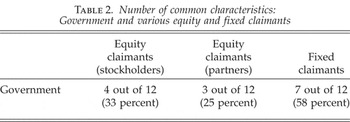
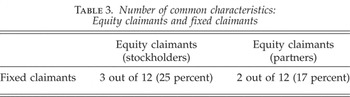
Tables 1, 2, and 3 provide an overview of the similarities and differences between the government and other sorts of investors, along with a quantitative analysis of these similarities and differences. Note that, when examined in appropriate detail, the nature of the government's residual claims on the earnings of individuals and firms differs from both the claims of equity claimants and those of fixed claimants. There are similarities between the government's claims and those of both fixed claimants and equity claimants, but significant differences remain.
Characteristics of the government and other investors

Number of common characteristics: Government and various equity and fixed claimants

Number of common characteristics: Equity claimants and fixed claimants

IV. Constitutional Economics and Securities Design: Controlling the Power of the Government to Enforce Its Claims as an Investor
It seems clear that regardless of whether one views a modern market-based economic system as a spontaneously generated natural phenomenon, as a complex social contract among citizens, or as an economic institution created and sustained by rationally self-interested politicians and bureaucrats, the government cannot exist without taxes, and taxes cannot be collected without coercion. The notion of government sustaining itself through “voluntary” contributions by grateful citizens seems farcical. So too does the notion that the government's claims on the cash flows of the people and firms subject to its jurisdiction can simply be characterized as similar to the weak claims held by minority shareholders.
It is not helpful merely to hope that perhaps, some day, the Sixteenth Amendment will be repealed and the government will be transformed into a grateful recipient of voluntary largesse freely contributed to its coffers by private-sector participants. In this essay, my policy proposal is far more modest. I simply advocate a change in the way that we view the phenomenon of corporate and individual income tax as a conceptual matter. Instead of viewing taxation as some sort of sui generis, intellectually unique claim by the government on the earnings of people and businesses, I believe that the government's claims to remittances from the income of firms and individuals (taxes) should be viewed as returns on investments made by the government in society. The government's claims are legitimate only so long as it actually has made such investments. Otherwise, like the Mafia, the government's tax receipts represent simple extortion, from an ethical point of view.
The government, in other words, is a “stakeholder” in the economy. Specifically, it is a well-entrenched equity holder whose fortunes rise and fall with the fortunes of the economy it putatively “controls.”
It seems far more productive, not to mention accurate, to conceptualize the government as an entrenched equity claimant on all cash flows within the economy—a claimant that enjoys a unique constellation of rights to the cash flows of all income-generating entities within its borders (rights not shared by its private-sector counterparts). Thinking about the government in this way has a couple of advantages over the current, unspecified conception of the nature of taxation. First, viewing the government in this way is consistent with a contractarian conception of the government, in which the exercise of governmental power must be explained as consistent with individual rights and rationalized as furthering individual interests. The investor-firm relationship is much easier to conceptualize along contractarian lines than the government-firm relationship. Second, viewing the government as an investor makes it clear why it would be legitimate to limit the power of the government to collect its residual claims, and to limit its ability to make midstream changes to the nature of its residual claims.
This conceptualization also allows us to concentrate on what is important: how to create constitutional rules that restrict the government's apparently unconstrained ability to turn its “power to tax” into the “power to destroy.”44
McCulloch v. Maryland, 17 U.S. 316 (1819), 17 U.S. 316 (Wheat).
Constitutional economics, a subdiscipline of public choice, is a relatively new field.45
See note 1 and the sources cited there for elaboration on the origins and meaning of constitutional economics.
Public Law 104-168, 110 Stat. 1452, codified at 26 U.S.C. Section 7433 (2004).
The statute requires Internal Revenue Service (IRS) employees to explain and respect taxpayers' rights to privacy and confidentiality, and their right to know why the IRS is requesting information, how it will be used, and what will happen if the taxpayer refuses to provide the requested information. Recourse is available to taxpayers who are not treated in a professional, fair, and courteous manner. Taxpayers have the right to represent themselves or to designate an advocate (who must be an attorney, certified public accountant, or other person authorized by the IRS) to represent them before the IRS. Taxpayers also can make sound recordings of any meetings with IRS employees, and can avail themselves of the Taxpayer Advocate Service to help resolve problems with the IRS. Taxpayers also have the right to appeal adverse rulings about their taxes to a neutral arbiter, and the IRS can be held liable for negligently or intentionally breaching taxpayers' rights under the statute.
This law did not curb the government's ability to collect taxes, but it did curb the government's ability to abuse the rights of ordinary citizens during the tax collection process. However, taxpayers' bills of rights are, under the framework established in this essay, fundamentally misconceived, because they do not accurately reflect the relationship between the citizen and the government in the context of taxation.
The first and most important way to utilize the framework employed in this essay for public-regarding and liberty-preserving purposes is to formalize the framework by giving explicit recognition to the role of the government as an investor. In particular, formal recognition should be given to the fact that when the government is engaged in the collection of revenue, it is acting as an investor/creditor, rather than as an institution in possession of some sort of unarticulated, unquestionable, and unlimited fundamental right to the income of the people and entities being taxed. For example, as a matter of constitutional law, the government in pursuit of its claims against the earnings of citizens and firms should give formal, legal respect to the fact that people do—and should be encouraged to—make highly asset-specific and undiversifiable investments on the basis of the tax code then in effect. The government's taxing power, if unabated, can usurp the value of those investments. This not only provides a strong disincentive to make such investments in the first place, but it also constitutes a taking of the personal property rights of the people and firms whose investments are so taxed.
While the government's taxing authority (power) is not questioned here, the legitimacy of changes in tax policy is subject to doubt. Like other creditors' claims, the government's claims should not be subject to nonconsensual revision after investments have been made. Investment decisions, whether they are the capital-budgeting decisions of firms or the decisions of individuals to invest in their own human capital, should not be subject to ex-post expropriation by government. For example, once an individual has begun a specialized education program such as law school or vocational school, the government should not be able unilaterally to change the tax regime that governs the income earned by that person. Similarly, once a new firm is chartered, the terms of the government's claims against the earnings of that firm should be frozen in place. Otherwise, after an individual or firm has made an individual-specific or firm-specific investment in human capital or asset-specific capital, respectively, that investment would be subject to expropriation by government unless individuals and firms are protected by constitutional rules.47
Constitutional rules are more difficult to change than ordinary rules and tend to be more durable.
The foregoing policy proposal is subject to the criticisms that it is both unrealistic and undemocratic because it prevents changes in tax policies that might either be desirable or, at least, favored by a majority of people. These criticisms are invalid for four reasons. First, the government is always free to lower people's taxes. Second, where a change in tax policy is proposed, and the result is uncertain, people should have the choice of “opting into” the new system or continuing under the previous system. This would give the government the flexibility to implement new tax policies, but only when such policies benefit taxpayers. Third, the clear advantages of this proposal in terms of fairness and predictability indicate that it is preferable to the alternative, which is the current system that allows the government to make even retroactive changes in tax policy and tax rates.
Finally, with respect to complexity, the current tax code is extremely complex, and the work of preparing taxes is done by professionals and with automated tax-preparation software. As such, it is not unrealistic to think that taxpayers and the government could manage the complexity of introducing an option that gave taxpayers the choice of paying either under an “old” tax system or under a “new” tax system. Indeed, with the alternative minimum tax currently in effect, the government exercises an option to collect the higher of the alternative minimum tax or the amount owed under the traditional tax calculation with deductions included.48
For a discussion of the Alternative Minimum Tax (Tax Reform Act of 1969 [P.L. 91-172]), see U.S. General Accounting Office, “Alternative Minimum Tax: An Overview of Its Rationale and Impact on Individual Taxpayers,” statement by James R. White, Director, Tax Issues, before the U.S. Senate Committee on Finance, document GAO-01-500T, March 8, 2001, available at http://www.gao.gov/.
In order to transform this idea into a specific policy recommendation, I suggest rewording some of the provisions of the Fifth Amendment to the Constitution. In its current form, the amendment provides that “[n]o person shall be … deprived of life, liberty, or property, without due process of law; nor shall private property be taken for public use without just compensation.” Here, in order to constrain the government's taxing authority, I would rewrite this section to read as follows:
No person shall be … deprived of life, liberty, or property, through any means of taxation or otherwise, without due process of law; nor shall private property, including intellectual property or human capital, gained through education or in any other manner, be taken by means of any tax increase or otherwise for any use without just compensation.
The reality that the government does, and should, have the authority to raise revenue through taxation is not being questioned here. However, the state should not be able to impose a tax increase of any sort unless it can meet the burden of justifying the increase, not on the basis of the government's “need” but on the basis of a quid pro quo received by every member of the group on whom the increase will be imposed. That is, the justification should be made on the basis of some improvement in the nature or quality of public services or protections (defense, for example) offered by the government, an improvement that is being produced in response to some changed circumstance that justifies the increase.
In his 1985 book Takings, Richard Epstein argues that the takings clause of the U.S. Constitution should be broadly interpreted to provide protection for the common-law property rights in place when the Constitution was promulgated, as those rights were articulated by William Blackstone.49
Richard A. Epstein, Takings: Private Property and the Power of Eminent Domain (Cambridge, MA, and London: Harvard University Press, 1985), 297–303.
William Blackstone, Commentaries on the Laws of England, 4 vols. (Chicago: University of Chicago Press, 1979), vol. 2, p. 217.
Epstein maintains that if a taking is unjustified or not for public use, or if a justified taking is uncompensated, then the plaintiff is entitled to some recovery. Epstein argues that “[t]he modern effort to distance the takings clause from general laws cannot be maintained. All regulations, all taxes, and all modifications of liability rules are takings of private property prima facie compensable by the state.”51
Epstein, Takings, 301.
Epstein argues that many contemporary taxes, including windfall profit taxes, state severance taxes, estate and gift taxation, and the progressive income tax are unconstitutional. He also argues that the modern welfare state's massive framework of transfer payments—including welfare, Social Security, unemployment benefits, food stamps, and farm subsidies—is unconstitutional under his analysis. Following this radical diagnosis, Epstein favors a relatively modest treatment regime, which would include the reform of the tax system to eliminate progressivity, invalidation of the minimum wage, and elimination of zoning laws.
My approach is in the spirit of Epstein's and is broadly consistent with his theory. There are three important differences, however, between my approach to takings and Epstein's. First, I favor change through a constitutional amendment, rather than through an activist judiciary, both because implementing such radical changes without a constitutional amendment would be inconsistent with the Sixteenth Amendment and because judicial activism of this magnitude would provoke a confrontation between the judiciary and the Congress that the judiciary would be unlikely to win.
Second, while Epstein focuses on history and the common law to support his views on the takings clause, my approach focuses on the modern reality that returns on human capital have replaced income from property ownership as the paradigmatic source of wealth. Consequently, takings jurisprudence should be updated to reflect this modern reality.
Third, where Epstein examines taxes in general, my focus is on tax increases. The reason for this difference is that I am looking at taxation from the perspective of the incentives that people and firms have to make new investments in human capital and in other forms of productive enterprise. Such investments are made with knowledge of the current tax system. Tax increases, therefore, reduce the value of people's investments and should be viewed more skeptically from a constitutional perspective than the taxes that were in place prior to such investments being made.
The same analysis does not apply to tax cuts. Under the government-as-investor analytical framework proposed here, of course, the government would be free to lower taxes at any time, just as any other investor could decide voluntarily to grant more liberal terms to a firm in which he or she invested.
Recognizing the government as an investor in business does not pose a fundamental challenge for democracy. It does, however, allow one to analyze the role of the government with more clarity and sharper focus and to understand the conflicts of interest that affect the government in its dual role as investor/tax collector and, simultaneously, as regulator of business.
In its role as investor, the government is justified in imposing constraints on people and businesses in order to protect its claims on cash flows. For example, once the government's role as tax collector is conceptualized as placing the government in the role of an investor, it follows logically that, since government is simply a claimant on firms' cash flows, it should not be able to engage in certain conduct, including collection activities that would be prohibited to other investors.
However, in its executive, legislative, and judicial roles, the government also has obligations to protect its citizens and to enforce contracts. There is a distinct conflict between the government's role as creditor and the government's role as neutral arbiter and protector of rights. For example, by denying or diminishing the claims of other creditors, either legislatively or judicially, the government is advancing its own private interests as an investor by increasing the resources available to satisfy its own claims.
The hope here is that people's conception of the phenomenon of taxation can be transformed from the current conception of taxation authority as a “state power” to a more refined conception of taxation authority as simply another aspect of the social contract that morally binds individuals to the state. It is to be hoped that the conceptual reassessment I am advocating here would be transformative from a policy perspective in two divergent ways. First, it would better legitimize the government's revenue collection function by providing a morally comprehensible basis for the government's claims on the earnings of firms and people. Second, it would provide citizens with a much stronger possibility of achieving the elusive goal of stability in tax policy. To better ensure stability, citizens and businesses should be given perfect buyout rights against the government's claims on their future cash flows. By this I mean that people should be able to choose whether they prefer to continue to meet their traditional periodic tax obligations to the government or whether they prefer to make a onetime lump-sum payment equal to the estimated present value of those future tax obligations.
Of course, estimating the present value of the future earnings of firms or individuals would be neither a simple nor a precise exercise. Such estimates, however, are necessarily and routinely performed by capital markets when securities are priced and when personal loans are made. Markets do it all the time. Here a sort of market constraint would work: If the government set the buyout price too high, one simply would not choose the buyout option. If the government set the buyout price too low, people would rush to invoke their buyout option (and the only consequence would be a shortfall in government revenue).
The buyout system proposed here, which flows logically from the concept of “government as investor,” would permit individuals to “bet against” the government's statistical guess about their longevity and future earnings capacity. It also would enable people to obtain a binding commitment from the government against any future tax obligations. Of course, people would be able to borrow from private sources such as banks to obtain the payoff sums necessary to discharge all or part of their expected tax obligations. This buyout possibility should be viewed as a right, not a privilege.
V. Conclusion
This essay has advanced the descriptive assertion that the government's role as tax collector is that of an investor, or, to be more precise, that of a residual claimant on the earnings of all of the people and firms subject to the taxing power of the state. Building on this conceptual framework, I have made the normative claim that the role of the government as an investor in people and businesses should be formally recognized for what it is. Thus, the entire relationship between modern democracy and its citizens would be strengthened, as citizens could finally be viewed as equal contracting partners with the government, without jeopardizing the government's ability to collect the revenues it needs to provide for the protection of its citizens.
The core question in political theory is “What is the state?” The core question in political philosophy is “What ought the state to be?”52
See Buchanan and Tullock, The Calculus of Consent, 1: “Political theory has concerned itself with the question: What is the State? Political philosophy has extended this to: What ought the State to be? Political ‘science’ has asked: How is the State organized?”
The framework advanced here also suggests that people should be able to make a once-in-a-lifetime payment in lieu of taxes to the government in order to discharge their tax liability. In these ways, the proposal here seems superior to the flat-tax proposal advocated most recently by Hall and Rabushka, and originally by Hayek and Friedman. This approach also seems superior to the utopian suggestion offered by Ayn Rand that taxation be voluntary, as well as to the unrealistic suggestion made by Nozick that income taxes violate man's natural rights.