INTRODUCTION
Self-reseeding annual legumes play an important role in Mediterranean natural pastures because of their considerable yield, good quality forage and nitrogen fixation capacity, which contribute to improving soil fertility. These species survive hot and dry periods as seeds, germinating only when favourable soil moisture and temperatures occur.
Scorpiurus muricatus L. (syn: Scorpiurus subvillosus, Scorpiurus sulcatus) (common names: prickly scorpion's tail and caterpillar plant) is included in this group of species. It is widely distributed as a spontaneous plant in Mediterranean areas, particularly in Morocco, Algeria, Portugal, Spain, southern France, southern Italy and Sicily (Bensalem et al. Reference Bensalem, Abdelguerfi and Abdelguerfi-Berrekia1990; Beale et al. Reference Beale, Lahlou and Bounejmate1991; Licitra et al. Reference Licitra, Carpino, Schadt, Avondo and Barresi1997), because of its broad tolerance to soil type and pH (Ehrman & Cocks Reference Ehrman and Cocks1990) and its high drought tolerance (El Shaer Reference El Shaer1995). Prickly scorpion's tail produces a significant biomass (Le Houérou Reference Le Houérou2001) of good quality (Licitra et al. Reference Licitra, Carpino, Schadt, Avondo and Barresi1997). In Sicily, farmers ascribe to this species a very high palatability and a high galactogogue (a substance that is used to increase the production of milk in humans and other animals) effect, so that its abundance increases the value (not only nutritional but also economic) of the pasture. Moreover, S. muricatus contributes considerably to meeting animal requirements and to improving the quality of cheese (Carpino et al. Reference Carpino, Mallia, La Terra, Melilli, Licitra, Acree, Barbano and Van Soest2004). Unfortunately, the occurrence of S. muricatus in some Mediterranean pastures has been gradually decreasing in the last 30 years, mainly because of overgrazing and intensive management techniques (Galvano et al. Reference Galvano, Alizzio and Sinatra1980; Gresta et al. Reference Gresta, Avola and Abbate2007).
Although S. muricatus could represent a very interesting species for Mediterranean areas, the use of this annual legume as forage in agricultural cropping systems is not well documented. Concerning its genetic aspects, very few collection and evaluation studies of S. muricatus germplasm have been carried out (Patanè et al. Reference Patanè, Sortino, Abbate, Di Prima and Mincione1997; Yahiaoui-Younsi et al. Reference Yahiaoui-Younsi, Abdelguerfi and Bouazza2000). It is evident that there are still large gaps in the knowledge of the genetic diversity of this species; therefore, the aim of the present study was to assess the genetic variation, based on pheno-morphological and agronomic traits, among natural populations of S. muricatus collected in different environments throughout Sicily, and to analyse the relationships between pheno-morphological traits and the environmental factors of the collection sites.
MATERIALS AND METHODS
Germplasm collection and climatic characterization of the sites
Twenty-eight natural populations of S. muricatus were collected throughout Sicily from June to July 2005. For each population, mature pods were harvested from a minimum of 30 randomly chosen plants, over an area of 50–100 m2. The pods were bulked and then threshed in the laboratory. This seed mixture was considered as representative of the natural population sampled.
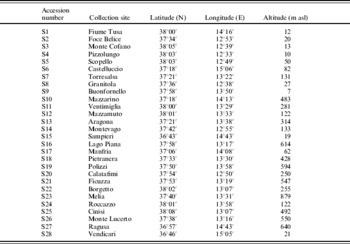
On each collection site, latitude, longitude and altitude were recorded using a portable Global Positioning System (GPS) receiver (Table 1). Other climatic parameters were gathered from the data recorded in the ‘Climatologia della Sicilia’ (Cartabellotta et al. Reference Cartabellotta, Drago, Lo Bianco and Lombardo1998) and each collection site was matched with data from the closest weather station with similar altitude and having a minimum of 30 years of consistent data. Twenty-four parameters of climate data from each weather station were considered: mean maximum, mean average and mean minimum year temperature; mean average temperature in winter (December–February), spring (March–May), summer (June–August) and autumn (September–November); maximum and minimum absolute year temperature; mean rainfall in winter, spring, summer, autumn and whole year; maximum and minimum absolute year rainfall; annual rainfall days; mean annual evapotranspiration (ETP); cold period (number of months with mean minimum temperature <7°C); humidity index (rainfall/ETP); Lang index (Ir), calculated as R/T, where R is the mean annual rainfall and T is the mean annual temperature (Kira Reference Kira1976); De Martonne index (Ia), calculated as R/(T+10) (De Martonne Reference De Martonne1927); Emberger index (Iq), calculated as [R/(T A2−T B2)]×100, where T A is the mean maximum temperature of hottest month and T B is mean maximum temperature of coldest month (Emberger Reference Emberger1955); and Thornthwaite index (Im), calculated as (R−ETP)/ETP×100 (Thornthwaite Reference Thornthwaite1948).
Geographic locations of 28 collection sites of S. muricatus populations

Experimental site
Both the pheno-morphological and the agronomic evaluation of the collected populations were carried out during the 2005/06 growing season in a hilly area of Sicily (37°30′N, 13°31′E, 178 m asl) on a Vertic haploxerept, where the previous crop was wheat. The topsoil (0–400 mm) had the following characteristics: 380 g/kg clay, 250 g/kg silt and 370 g/kg sand, pH 8·4, 12·7 g/kg organic matter and 0·85 g/kg total N.
The climate of the experimental site is semi-arid Mediterranean (as defined by Thornthwaite Reference Thornthwaite1948). Long-term mean annual rainfall is c. 550 mm, mostly concentrated during the autumn–winter period (0·74) and with a lesser amount during spring (0·18). The means of the minimum and maximum temperature are 10·0 and 23·3°C, respectively.
The total rainfall at the experimental site during the 2005/06 growing season was 558 mm, which was very close to the long-term period average. Rainfall distribution was quite similar to the average, with the exception of the autumn rainfall, which was concentrated mainly in December. During the growing season, the mean monthly temperature was slightly lower than average and the minimum mean temperature was higher than average during the first growth phase (December–February).
Pheno-morphological characterization of spaced plants
For each population, 150 scarified seeds were sown into ‘Jiffy pots’ on 30 November 2005. After 6 weeks, 21 seedlings of each population were transplanted to the field (seven plants per plot spaced at 1×1 m). A randomized block design with three replications was used. The soil was not fertilized and weeds were manually removed. The trial was conducted under rain fed conditions, but one irrigation (2 litres per plant) was given at transplantation.
Five plants per plot were randomly selected and the following phenological and morphological characters were recorded for each plant: days from sowing to first flower (FD), days to first pod (FP), plant height and plant diameter (PH and PD; measured 160 days after sowing), growth habit (GH; 0=prostrate, 5=erect), stem colour (SC; 0=green, 5=intensely red-pigmented), length of the peduncle of the first flower (LP), length of the leaf below the first flower (LL), leaf width (LW), stipule length (SL) and leaf length/leaf width ratio (LL/LW). Moreover, for each population, an equal weight of mature seeds from each of the selected plants was bulked and a representative sample was extracted to record the following characters: seed area (SA), seed perimeter (SP), length of the major (LMA) and length of the minor (LMI) axis of the seed, seed elongation (SE; calculated as LMA/LMI) and seed compactness (SComp), calculated as  . All the seed measurements were obtained on digital photographs using the image analysis software Image Tool 3.0 (UTHSCSA 2008). Mean seed weight (SW) was also determined for each sample.
Agronomic evaluation in dense stands
The 28 populations of S. muricatus were sown on 22 December 2005 at 250 viable seeds/m2 in micro-plots (four rows 2 m long and 0·25 m apart). A randomized block design with three replications was used. Plots were not fertilized and the trial was carried out under rain fed conditions. Weeds were manually removed.
For each population, dry matter (DM) yield was recorded by cutting half of each plot 135 days after sowing when all populations showed first pods set. Sward height was measured before cutting. A forage sample was separated into botanical fractions: stems, leaves, flowers and pods, which were then dried at 60°C to a constant weight, ground to a fine powder and analysed for total N content. The same sub-plots were mowed at maturity (June–July 2006) to determine pod yield after spring mowing. The other half-plots were left uncut and were then harvested at maturity (June 2006) to assess biomass and pod production. Pods were always passed through a laboratory hulling machine to assess seed production. Seed/pod ratio was determined as the ratio of the total weight of seeds to the total pod weight (including the seed and the pod wall).
Statistical analyses
The main descriptive statistics were calculated for all recorded pheno-morphological and agronomic traits. In both experiments, an analysis of variance (ANOVA procedure; SAS Institute Inc. 2002) was performed for each character according to the experimental design to test the significance of population effects. All variables measured as proportions were arcsine-transformed before analysis.
A principal component analysis (PCA) was performed (PRINCOMP procedure; SAS Institute Inc. 2002) using pheno-morphological data to establish the importance of different traits in explaining multivariate polymorphisms. The mean values per population and trait were previously standardized to a mean equal to 0 and a standard deviation equal to 1. The inclusion of strongly correlated variables can lead to weighting of the analysis in favour of those variables (Pengelly & Maass Reference Pengelly and Maass2001). To avoid this element of distortion, correlations among all variables were calculated and one of the variables was removed from the analysis in cases where two variables were highly correlated (r>0·70). According to Kaiser's criteria (Kaiser Reference Kaiser1960), only those principal components (PCs) showing an eigenvalue ⩾1 were retained for cluster analysis (CLUSTER procedure; SAS Institute Inc. 2002), adopting Euclidean distance as a measure of dissimilarity and the Ward method as the clustering algorithm. Estimates of the number of clusters were achieved using pseudo F and t2 statistics (Milligan & Cooper Reference Milligan and Cooper1985). Moreover, the mean values of the pheno-morphological and agronomic traits were calculated for each cluster.
Finally, relationships among the pheno-morphological and agronomic traits and the geographical and climatic factors of the collection sites were assessed and discussed.
RESULTS
Geographic variation and climatic differences of the collection sites
Latitude of collection sites varied from 36°43′N to 38°08′N and longitude ranged from 12°33′E to 15°06′E. The lowest collection altitude was 7 m asl, while the highest was 879 m asl. More than 0·50 of the S. muricatus populations were collected at an altitude below 200 m asl and only 0·11 were sampled at over 600 m asl.
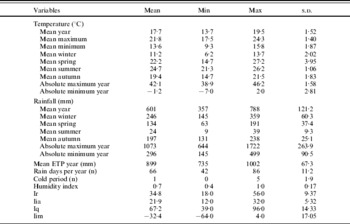
A wide variability of climatic conditions using a minimum of 30 years climate data was found among the collection sites (Table 2). The mean annual rainfall varied between 353 and 788 mm, while the mean spring rainfall ranged from 63 to 191 mm. The mean annual temperature ranged from 13·7 to 19·5°C.
Range of variation of climatic characteristics among the 28 collection sites

Most populations (0·57) were from the semi-arid zone, 0·36 were from the dry-subhumid zone and only 0·07 were from the subhumid Mediterranean climate zone, as defined by Thornthwaite (Reference Thornthwaite1948).
Pheno-morphological variability
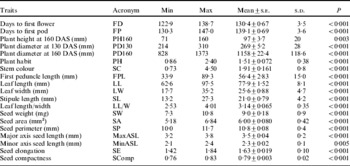
The ANOVA performed on the 28 S. muricatus populations showed highly significant differences for all the recorded traits. The mean, standard deviation and range of variation for each of the 20 traits observed on spaced plants are provided in Table 3.
Range of variation, means and standard deviation (s.d.) for 20 phenological and morphological traits recorded on 28 S. muricatus populations

P is the significance of differences between the 28 populations determined by ANOVA.
On average, the flowering time (FD) was 130 days after sowing, ranging from 123 (S15) to 139 (S1) days.
Although significant differences in plant growth habit were observed among the 28 populations studied, the variability for this trait was rather low and ranged between prostrate and semi-prostrate types. None of the plants within each population showed an erect growth habit. A wide variability was found for SC, which ranged from total green to intensely red pigmented.
The variability of the characters of leaves (length, width and length of stipule) was generally very wide; however, the greatest variability among populations was observed for the length of the peduncle of the first flower, which ranged from 33·9 to 89·3 mm.
Although differences among the S. muricatus populations were significant (P<0·01) for seed traits (weight, area, perimeter, length of major and minor axis, elongation and compactness), the variability of these traits was, on the whole, rather low.
Later flowering populations had larger leaves, longer stipules and peduncles and smaller seeds than earlier flowering ones. No relationship was found between days to first flower and plant height or diameter. Highly significant correlations were detected among the biometrical characters of leaves (length, width and length of stipule) and between them and peduncle length.
Agronomic evaluation
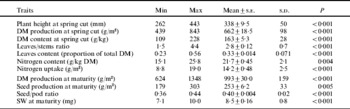
The analysis of traits of agronomic interest revealed very large differences in DM yield at spring cut (mean: 661 g/m2; range: 439–843 g/m2) and in leaf/stem ratio (range: 1·5–4·4; Table 4).
Range of variation, means and standard deviation (s.d.) for 11 agronomical traits recorded on 28 S. muricatus populations

P is the significance of differences between the 28 populations determined by ANOVA.
On average, biomass N content was 21·7 g/kg. Great differences were observed for this trait among the 28 populations studied, with a range from 15·1 to 25·8 g/kg. No correlation was found between biomass N content and DM production. In contrast, a positive significant relationship was observed between biomass N content and the incidence of leaves on total biomass.
On average, biomass and seed production at maturity were 993 and 253 g/m2, respectively. A large variability was observed for both traits among the populations under study. A lower variability was found for both seed/pod ratio and SW.
PCA and cluster analysis
PCA was performed taking only 12 variables into account, which were selected among the 19 pheno-morphological traits observed, as described above.
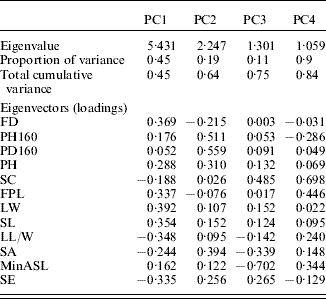
The first four components with eigenvalues greater than 1 explained 0·84 of the total variation in the observed variables, which, according to Mardia et al. (Reference Mardia, Kent and Bibby1979), is a good summary of the original data set. Table 5 shows the proportion of variation for the first four PCs and the vector loadings for each character and PC. PC1 accounted for 0·45 of the total variation estimated and it was correlated with days to first flower and to size of leaves (including width, length/width ratio and SL). The second PC explained 0·19 of the variance and was associated with plant dimensions (height and diameter at 160 days from sowing) and SA. PC3 accounted for 0·11 of the total variation of the data set and was correlated mainly with minor axis seed length. The fourth PC explained only 0·09 of the variance and was correlated mainly with SC and first peduncle length (FPL).
Eigenvalues, cumulative variance of the first four PCs and correlation coefficients between the PCs and the 12 selected characters
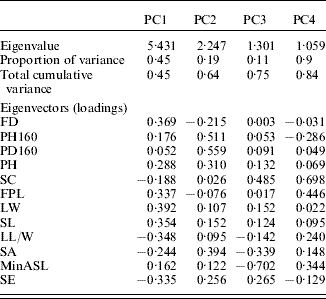
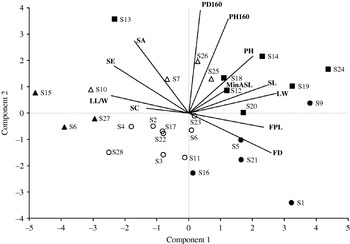
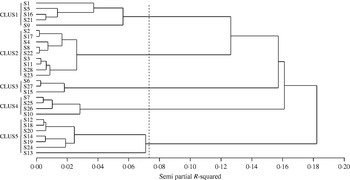
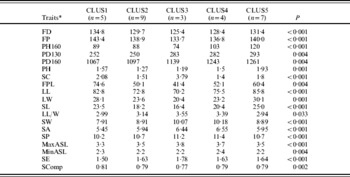
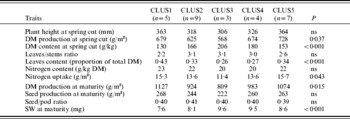
Figure 1 shows the distribution of the S. muricatus populations on the biplot of the first two PCs, the vectors of the original variables and their contribution (represented by length of the vector) to the PCs. The similarities identified by PCA among the 28 S. muricatus populations were investigated using cluster analysis on the basis of the four PCs with eigenvalues higher than 1, and a dendrogram was produced (Fig. 2). Five clusters were clearly identifiable. A summary of the pheno-morphological and agronomic characteristics of each group is given in Tables 6 and 7. Group 1 included five populations (all collected in northern Sicily) characterized by very late flowering, large leaves, small seeds and a high biomass production at maturity. Group 2 clustered nine populations collected mainly in coastal zones of the island. They had in common intermediate flowering, absent or limited stem pigmentation and small- to average-sized leaves and seeds. Group 3 included only three populations from the south-eastern part of Sicily, which were characterized by very early flowering, high levels of pigmentation on stems, small leaves and low biomass and seed production. Group 4 consisted of four populations with early to average flowering, low levels of pigmentation on stems and large seeds. Group 5 included seven populations characterized by average to late flowering, plant growth habit more erect than the other groups, large size and weight of seeds, large leaves and a high forage production, particularly at spring cut.
Biplot for first two PCs. The 12 lines intersecting at (0,0) represent the original variables (see Table 3 for acronyms). The length of each vector is proportional to its contribution to the PCs. Symbols correspond to the different groups defined by cluster analysis.

Dendrogram classification of S. muricatus populations clustered with Ward's method, truncated at 5-group level (vertical dotted line).

Mean values of phenological and morphological traits in the groups obtained by cluster analysis

* See Table 3 for acronyms and description of the traits.
Mean values of agronomical traits in the groups obtained by cluster analysis

ns, not significant.
Pheno-morphological and agronomic traits in relation to the environmental characteristics of the collection site
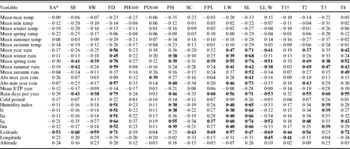
Environmental characteristics that affected the pheno-morphological and agronomic traits of the natural populations to a greater degree were: latitude (0·69 of the correlations were significant), spring rainfall (0·63) and rain days per year (0·63) (Table 8). Moreover, these three environmental characteristics are partially interrelated in Sicily: a greater number of rain days and a stronger spring rainfall occur in the northern part of Sicily. Altitude was not significantly correlated with any of the pheno-morphological or agronomic traits.
Correlation coefficients between pheno-morphological and agronomical traits and climatic and geographic variables

* See Table 3 for acronyms and description of the traits.
† T1, DM production at spring cut; T2, leaves content; T3, nitrogen content; T4, seed production at maturity.
Values in bold are significant at P<0·05.
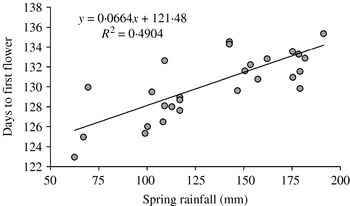
A strong positive correlation was found between days from sowing to the first flower and spring rainfall at the collection site (Fig. 3). Furthermore, a strong positive correlation was observed between days to first flower and humidity index (rainfall/ETP).
Relationship between mean spring rainfall of the collection sites and the flowering time (days from sowing to the first flower).

DM yield at spring cut exhibited significant correlations with latitude (positive) and longitude (negative); thus, it seems that the most productive S. muricatus populations tended to come from the northern and western areas of Sicily. Seed production at maturity, an agronomic trait essential for the exploitation of the species in agricultural systems, was highly correlated with spring rainfall (r=0·52), number of rain days per year (r=0·55) and latitude of the collection site (r=0·72).
DISCUSSION
Differences among S. muricatus populations were highly significant for all the recorded pheno-morphological traits, whereas the variability within populations was rather low (data not shown). This probably reflects that S. muricatus is a self-pollinating species (Dominguez & Galiano Reference Dominguez and Galiano1974; Vereshchagina et al. Reference Vereshchagina, Novoselova and Kolyasnikova2003) and several authors consider that inbreeding reduces genetic variation within populations (as reviewed in Hamrick & Godt Reference Hamrick, Godt, Brown, Clegg, Kahler and Weir1989 and in Charlesworth & Charlesworth Reference Charlesworth and Charlesworth1995).
Flowering time, expressed as number of days from sowing to first flower open, ranged from 123 to 139 days; Patanè et al. (Reference Patanè, Sortino, Abbate, Di Prima and Mincione1997) found a greater range (28 days) in their study of seven Sicilian ecotypes of S. muricatus. Yahiaoui-Younsi et al. (Reference Yahiaoui-Younsi, Abdelguerfi and Bouazza2000) observed a range of 32 days for this phenological trait in a study carried out in Algeria on 106 populations. It is likely that, in the present trial, the postponement of the sowing date (because of unfavourable climatic conditions) led to a delay in the flowering time, with an effective reduction in the differences observed for this character among the populations.
The high DM yield obtained (661 g/m2, on average) confirms that S. muricatus represents a very interesting species for crop–livestock farming systems of the Mediterranean area. Moreover, the wide variability observed among populations underscores the possibility of improving such trait via plant selection and breeding.
On average, biomass N content was 21·7 g/kg; this value is lower than usually found in other forage and pasture legumes (Trifolium alexandrinum, Vicia sativa, Trigonella foenum-graecum and Hedysarum coronarium) common in semi-arid Mediterranean environments. In a study of Mediterranean native pasture forage quality, Licitra et al. (Reference Licitra, Carpino, Schadt, Avondo and Barresi1997) found N contents of 37 and 20 g/kg in biomass of S. muricatus at early vegetative and early seed set stages, respectively.
The variability observed for the pheno-morphological and agronomic traits was frequently associated with environmental variations at the collection sites. Days from sowing to the first flower exhibited strong positive correlations with spring rainfall and with humidity index. This result is in accordance with the findings of Yahiaoui-Younsi et al. (Reference Yahiaoui-Younsi, Abdelguerfi and Bouazza2000), who worked on prickly scorpion's tail populations in Algeria. Ehrman & Cocks (Reference Ehrman and Cocks1990) showed that, in general, annual legumes from Syria have flowering times that are correlated with rainfall at their site of origin. However, several authors have mentioned that flowering time is most sensitive to changes in the length of the growing season (Woodward & Morley Reference Woodward and Morley1974; Rossiter & Collins Reference Rossiter and Collins1988; Bennett Reference Bennett1997; Loi et al. Reference Loi, Howieson, Cocks and Carr1999). Del Pozo et al. (Reference Del Pozo, Ovalle, Aronson and Avendaño2002) obtained similar results for Medicago polymorpha L., which were interpreted as a phenological adaptation to the length of the growing season.
S. muricatus populations originating from subhumid or dry-subhumid Mediterranean climate zones showed greater leaf dimensions (length, width and length of the stipule) when compared with those originating from semi-arid zones. Similar results were found by Zoghlami & Zouaghi (Reference Zoghlami and Zouaghi2003) for Astragalus hamosus L. and by Davies & Young (Reference Davies and Young1967) for white clover (Trifolium repens).
SW decreased with an increasing number of rain days per year and spring rainfall; in other words, populations originating from sites characterized by a water supply insufficient for reproduction had heavier seeds. In contrast, Piano et al. (Reference Piano, Pecetti and Carroni1996) performed a study in Sardinia on subterranean clover and found that individual SW increases with increasing annual rainfall of the collection site: smaller seeds mature and attain viability faster and need less water for germination than larger seeds (Francis & Gladstones Reference Francis and Gladstones1974; Pecetti & Piano Reference Pecetti and Piano1994). In the present study, S. muricatus populations of drier areas produced a lesser number of seeds per plant, but these were heavier than populations from more humid areas; large seeds are associated with high seedling vigour and this probably would enable the plants to begin the reproductive phase relatively earlier, which reduces the risk of water stress during seed development (Berger et al. Reference Berger, Robertson and Cocks2002). Ehrman & Cocks (Reference Ehrman and Cocks1996) did not find differences in seed size and hardseededness among populations of S. muricatus collected from very different climatic zones of Syria. Hardseededness is particularly important in legume species of dry areas, as it allows seeds to overcome summer drought and false break of season and to germinate only when conditions are really favourable (Taylor Reference Taylor1993; Loi et al. Reference Loi, Porqueddu, Veronesi and Cocks1995; Norman et al. Reference Norman, Cocks, Smith and Nutt1998).
S. muricatus populations originating from drier environments showed, on the whole, a more prostrate growth habit. It is likely that grazing pressure on the poor forage availability is greater in environments characterized by scarce rainfall; in these conditions, a prostrate growth habit confers greater persistence than an erect habit (Curll & Jones Reference Curll, Jones, Martin, Matches, Barnes, Brougham, Clements and Sheath1989).
In conclusion, the present study provides evidence that a large variability in both pheno-morphological and agronomic characters clearly exists among Sicilian natural populations of S. muricatus. This variability was frequently associated with environmental variations at the collection sites. The adaption to specific agro-ecologies is confirmed by similarity in clustering where populations coming from similar environments were clustered together.
From a breeding point of view, the presence of a large diversity appears to be a great advantage when searching for suitable S. muricatus material to exploit in pastures and crop–livestock farming systems of Mediterranean areas.
Further research into S. muricatus diversity should aim at confirming the diversity described in the current paper using other techniques, including molecular characterization. Finally, the specific study of patterns of variation in different environments and seasons would be advantageous.
The authors thank Mr V. Cannella and Mr F. Labbruzzo for their technical assistance. This work was funded by the project ‘Sistemi foraggeri per la valorizzazione e salvaguardia delle aree svantaggiate meridionali’ from Sicilian Department of Agriculture.