Introduction
Abundance and distribution of many large mammal species has been severely reduced due to loss of habitats, poaching and environmental changes. Many species, especially endangered ones, now occur only in small disjunct populations facing a high risk of extinction because of combined effects, namely loss of genetic diversity, inbreeding depression, as well as demographic and environmental stochasticity (Hedrick & Kalinowski, Reference Hedrick and Kalinowski2000).
Facilitating the movements between remaining sub-populations through corridors for gene flow and other links between critical habitats or by physical translocation of individuals (Lipsey et al., Reference Lipsey, Matthew, Seddon, Armstrong and Maloney2007) could partially mitigate these problems. In small and severely fragmented populations, conservationist translocation – ‘the intentional release of animals into the wild in an attempt to establish, restore, or increase a population’ (Griffith et al., Reference Griffith, Scott, Carpenter and Reed1989) – is the only conservation option available, despite the costs and the technical difficulties involved.
The success assessment of release or reintroduction programmes depends on the specific objective of the release, such as establishing a population in a given location, ensuring genetic diversity and restoring gene flow between sub-populations (Armstrong et al., Reference Armstrong, Seddon, Moehrenschlager and Fath2019). A long-term manatee release programme has been conducted and is currently being employed on the Florida manatee (Adimey et al., Reference Adimey, Ross, Hall, Reid, Barlas, Keith-Diagne and Bonde2016).
The Antillean manatee (Trichechus manatus manatus) is an endangered subspecies of the West Indian manatees (Trichechus manatus). Based on interviews, the Brazilian Antillean manatee population in the 1980s was roughly estimated to be around 500 individuals (Luna & Passavante, Reference Luna and Passavante2010). Later, an aerial survey indicated an average of 1104 with a variation from 485–2221 individuals between the states of Ceará and Alagoas, north-east Brazil (Alves et al., Reference Alves, Kinas, Marmontel, Borges, Costa, Schiel and Araújo2016). However, no other surveys have been conducted and the size of the manatee population in Brazil remains uncertain. This species is categorized as ‘Endangered’ in the Red Book of Endangered Brazilian Fauna, according to the list of the Chico Mendes Institute for Biodiversity Conservation (ICMBio, 2018), and ‘Vulnerable’ to extinction at the global level (Deutsch et al., Reference Deutsch, Self-Sulivan and Mignucci-Giannoni2008).
Rescue, rehabilitation and release of manatees are some of the main conservation actions for the species that have been utilized in Brazil (Luna et al., Reference Luna, Balensiefer, Fragoso, Stephano and Attademo2018). These actions have been carried out by Brazilian Northeast Aquatic Mammals Stranding Network (REMANE), composed of federal government officials, universities and non-governmental organizations (NGOs) (ICMBio, 2018). Since 1994, the Brazilian West Indian Manatee Release Program has successfully released manatees in the states of Alagoas and Paraíba (Luna & Passavante, Reference Luna and Passavante2010; Normande et al., Reference Normande, Luna, Malhado, Borges, Viana-Junior, Attademo and Ladle2015, Reference Normande, Attademo, Luna and Soorae2016a).
Other countries, namely the USA, Puerto Rico, Mexico and Belize, have similar programmes for the rescue, rehabilitation and release of manatees (Adimey et al., Reference Adimey, Mignucci-Giannoni, Auil-Gomez, Silva, Alvite, Morales-Vela, Lima, Rosas, Hines, Reynolds, Aragones, Mignucci-Giannoni and Marmontel2012). The common challenge of these programmes is to evaluate the success of survival and adaptation of manatees released into the wild in the short term. For the medium and long term, the challenge is the establishment of populations and genetic variability to reduce the risk of extinction of the species in each country (Adimey et al., Reference Adimey, Mignucci-Giannoni, Auil-Gomez, Silva, Alvite, Morales-Vela, Lima, Rosas, Hines, Reynolds, Aragones, Mignucci-Giannoni and Marmontel2012; Normande et al., Reference Normande, Luna, Malhado, Borges, Viana-Junior, Attademo and Ladle2015).
The use of telemetry, and other marking methods, has been an important tool to assess the release success of manatees, as it allows the evaluation of aspects related to survival, habitat use, movements and distribution (Normande et al., Reference Normande, Luna, Malhado, Borges, Viana-Junior, Attademo and Ladle2015). Areas where the species was considered locally extinct until the early 1990s, such as northern Alagoas and southern Pernambuco, have recently been recolonized through manatee reintroduction, enabling gene exchange between these groups (Normande et al., Reference Normande, Luna, Malhado, Borges, Viana-Junior, Attademo and Ladle2015; Attademo et al., Reference Attademo, Nascimento, Sousa, Vergara-Parente, Alencar, Freire, Oliveira and Luna2020). The state of Pernambuco, previously considered an area of discontinuity of manatees, has now evidenced their regular presence along its coast (Attademo et al., Reference Attademo, Nascimento, Sousa, Vergara-Parente, Alencar, Freire, Oliveira and Luna2020). It should be noted that Pernambuco is located between the states of Alagoas and Paraíba, where the release of manatees has been occurring in Brazil since 1994 (Luna & Passavante, Reference Luna and Passavante2010).
The reproduction of manatees released into the wild is an indicator of the success of the Manatee Release Program, monitoring the effects of releases on the establishment of populations. This study reports cases of reproduction success of Antillean manatees released into the wild in Brazil and evaluates the effectiveness of management actions for conservation over 26 years of the Release Program in the country.
Materials and methods
Four acclimatization enclosures were used by released manatees from 1994 until present. Three enclosures were located in ICMBio/Costa dos Corais Protected Area (Alagoas) and one in ICMBio/Barra do Rio Mamanguape Protected Area (Paraíba). Two enclosures built in the sea in the municipalities of Paripueira and Porto de Pedras, both in Alagoas State, were deactivated in 1994 and 2008, respectively. The other two, active to present, are located in the Tatuamunha estuary, Porto de Pedras/Alagoas (09°13′05.47″S 35°19′59.01″W) and the Mamanguape estuary, Rio Tinto/Paraíba (06°46′43.68″S 34°55′50.88″W).
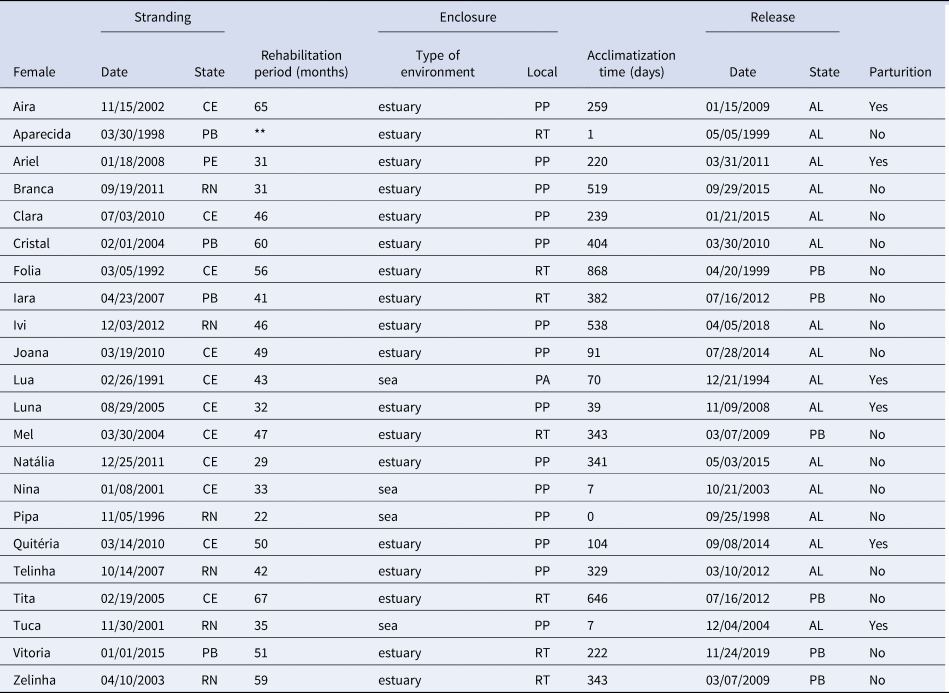
Before release, all adult females were tagged with telemetry, transponder and/or cookie monitoring devices (Reid et al., Reference Reid, Rathbun and Wilcox1991). For the evaluation of reproductive success, only females were considered, as it allowed identification of maternity, even without capturing the calves for the genetic analysis. We used data on 22 females of Antillean manatees released into the wild in Brazil, between 1994 and 2020 (Table 1). Sixteen females were released in ICMBio Costa dos Corais Protected Area and six in ICMBio Barra de Mamanguape Protected Area. Twenty of the females had been stranded and rescued as newborn calves on the Brazilian north-eastern coast. One female was born in captivity (Ariel) and remained under parental care until three years of age. The last one, named Aparecida, had been stranded as an adult in Paraíba State and was very weak at time of rescue. All stranded females went through a rehabilitation process in artificial enclosures in Itamaracá, Pernambuco State, and received intensive care for a few years before transfer to acclimatization enclosures. All females went through a similar feeding process; however, the time they spent in the enclosures varied (Acclimatization time, Table 1).
Females released in Brazil from 1994 to 2020, stranding date, release, rehabilitation period, and acclimatization time.

CE, Ceará State; RN, Rio Grande do Norte State; PB, Paraíba State; PE, Pernambuco State, AL, Alagoas State; PP, Porto de Pedras municipality; PA, Paripueira municipality; RT, Rio Tinto municipality.
The ICMBio team confirmed the births of calves through in situ observation. Parental relationship was verified through field observation, capture, photographic recording, or stranding records of the calves. The birthplace was defined as the location where the mother and the calf were observed for the first time by the monitoring teams. Calves were detected only by observer eye contact to avoid interference or influence on survival. In case of need of medical care or after one year of age, the calves were captured and handled for sex confirmation, collection of biometric data and sampling. In some cases, calves exposed the belly and the sex could be confirmed before one year.
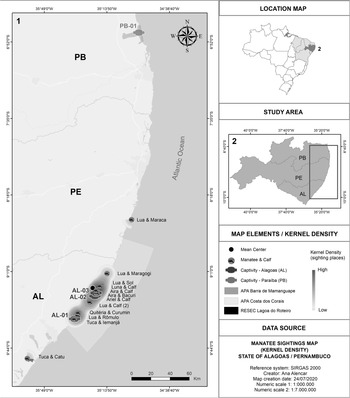
The geographic position of the first record was plotted on a map using QGis. The Kernel Density analysis was superimposed on the shapefile to identify the areas with the highest records of a mother with a calf. The geostatistical analysis of Mean Center was performed to investigate and understand the spatial distribution of individual's occurrences, which identified the central mean of the set of points for the locations of individuals.
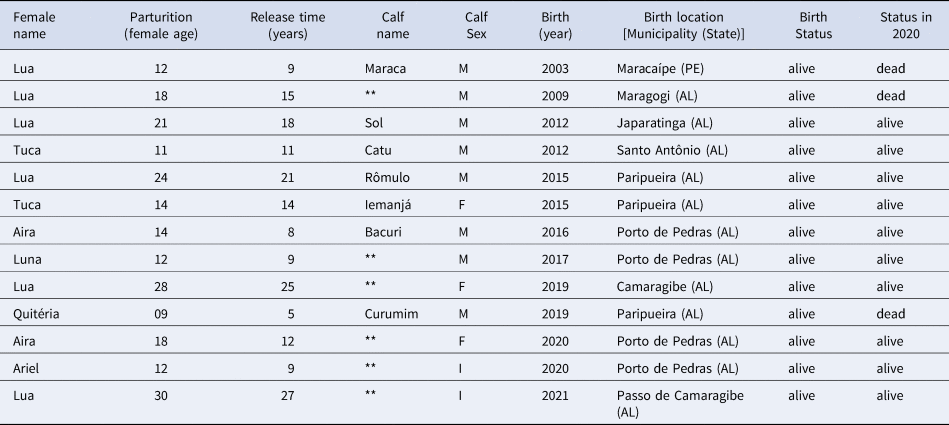
To evaluate the reproductive success, we determined the age of females during parturition, the time after release when the birth was recorded, the number of deliveries per animal, the interval between parturitions (for females that had more than one successful birth), and the place where the presence of the mother and the offspring was recorded (Table 2).
Records of females released by the Manatee Program, with verified births of calves in north-eastern Brazil

PE, Pernambuco State; AL, Alagoas State; M, male; F, female; I, indeterminate; **Unnamed.
Results
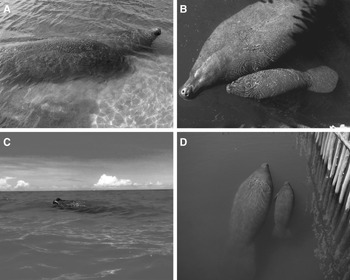
We documented the births of 13 calves from six reintroduced females during the study period. Ten calves (76.9%) remain alive while three (23.1%) have died. All births occurred in Alagoas State. Six (37.5%) of the 16 females released in Alagoas have confirmed reproduction. The progenitors of the calves were Lua (01S0112/04; N = 6), Tuca (01S0112/116; N = 2), Aira (01S0112/124; N = 2), Luna (S0112/186; N = 1), Quitéria (S0112/270; N = 1) and Ariel (01S0112/203; N = 1) (Figure 1; Table 2). Two parturient females (33.33%) delivered their calves in the sea and four (66.66%) in the estuary.
Births registered to manatee females. (A) Tuca and Katu (ICMBio collection); (B) Aira and Bacuri (photo by Iran Normande/ICMBio collection); (C) Lua and calf not named (photo by Ledenilson Santos/ICMBio collection); (D) Quitéria and Curumim (photo by Alexandra Costa/ICMBio collection).

The mean age of females at the first pregnancy with successful delivery was 11.7 (±1.49) years and 8.0 (±1.41) years for the time after release. Quitéria was the youngest female to have first delivery (9 years) and the earliest calving after release (5 years).
The average interval between parturition of females that had more than one delivery was 3.6 (±1.18) years. Lua had most deliveries with six offspring and an average delivery interval of three years, the shortest interval being two years and the longest, six years. Tuca had an interval of three years and Aira had an interval of four years; both females had two deliveries.
The average time for rehabilitation of parturient females and females with no offspring was 43 (±13.2) and 46 (±12.7) months, respectively. All parturient females had less than eight months of acclimatization, while females who had no offspring needed on average 11 (±7.8) months of acclimatization. Among the offspring, 61.5% (8/13) were males, 23.1% (3/13) females and 15.4% (2/13) of undetermined sex.
Of the 13 births documented, 11 (84.6%) occurred within the ICMBio Costa dos Corais Protected Area (APACC), one (7.7%) in the Lagoa do Roteiro (AL) State Ecological Reserve and one (7.7%) outside a protected area (in 2018, the area was designated as a State Protected Area – APA dos Recifes de Serrambi – Serrambi Reefs Protected Area).
The area near the acclimatization enclosure had the most documented locations for recently released manatees with their calves in the Tatuamunha River, Porto de Pedras, Alagoas, coastline near the mouth of the river (AL-03). In light of that, Kernel analysis was used to evaluate the continuous permanence of females with their offspring and the use of areas occupied by manatees in the estuary and the adjacent coastal region (Figure 2).
Spatial distribution of sightings of female manatees with offspring on the coast of Alagoas and Pernambuco states. AL-01: Captivity acclimatization (sea) in Paripueira/AL; AL-02: Captivity acclimatization (sea) in Porto de Pedras/AL; AL-03: Captivity acclimatization (estuary) in Porto de Pedras; PB-01: Captivity acclimatization (estuary) in Barra de Mamanguape/PB.

Three calves died and the survival rate was 0.75. Two of the calves that died were from Lua and one from Quitéria. The first death occurred in Pernambuco State in 2003, at 10 days after birth and the cause of death is unknown (Lima et al., Reference Lima, Alvite, Vergara-Parente, Castro, Paszkiewicz and Gonzalez2005). The death of the second calf was located in Alagoas in 2009, with death attributed to blunt head trauma. The third calf that died was from Quitéria, whose birth was recorded in Santo Antônio River, south Alagoas State, in 2019. A few weeks after birth, the bodies of the female and the calf were sighted near the port region in Pernambuco State. The female's death occurred during the period of the oil accident that occurred in Brazil in 2019. Initially, the hypothesis was raised that there may be a relationship with the accident, but laboratory tests did not confirm this hypothesis. The calf was rescued alive, close to the female carcass and died in captivity, about three days after the rescue. At necropsy, a possible malformation of the heart was verified, but the complementary examinations did not confirm this and the report that was presented was inconclusive. The relationship of the strandings of these two manatees with the oil accident has not been confirmed, but these strandings are strange, since both animals had a good body score. Thus, the survival rate of the remaining 10 successful calves was 1.0 after the first year of life.
The monitoring with radiotelemetry of female manatees released ranged from 21 to 5370 days and only Lua had the monitoring device on her during the first calving event. Thus, in most of the cases the data were not sufficient to assess whether the equipment affected the birth of calves. However, as in cases of potential stress, in female manatees that have been constantly monitored with radiotelemetry equipment, the female may not ovulate, resulting in lower ovulation and therefore a reduced reproductive potential. But in the case of Lua, the telemetry equipment did not hamper her successful delivery.
Discussion
The reproductive period of manatees is usually seasonal and when the females come into heat, mating herds are formed, and the identification of paternity is only possible through genetic studies (Pomeroy et al., Reference Pomeroy, Twiss, Robinson, Würsig, Thewissen and Kovacs2018). However, in these studies the seasonality of births could not be evaluated, as not all observations were carried out at the time of calving, and in some cases the age information was imprecise. In Brazil, we avoid capturing and approaching females with small offspring, especially when they occur on beaches and not in rivers. For this reason, samples were also not collected from the offspring for the genetic identification of the breeding male.
West Indian manatees can reach sexual maturity from 3–4 years of age (Hartman, Reference Hartman1979; Reynolds & Odell, Reference Reynolds and Odell1991; Marmontel, Reference Marmontel, O'Shea, Ackerman and Percival1995), although in many cases most individuals are only able to reproduce successfully between 5–8 years (Marmontel, Reference Marmontel, O'Shea, Ackerman and Percival1995). Apparently, reproductive adaptation of reintroduced females has been slower, as the animals started to reproduce at 11.7 years old on average. After release, manatees undergo a period of adaptation to the natural environment and commonly experience weight loss and increased stress. The first months after release, with increased stressors and behavioural changes, can result in the female not ovulating, therefore, they have a reduced reproductive potential soon after release. This lower reproductive potential may be due to the manatees living in captive conditions during the rehabilitation and acclimatization period where their daily needs are met, however, during the first years after release they were in more stressful conditions while adapting to natural conditions.
The gestational time of manatees is ~13 months with 2–4 years of parental care, resulting in the calving interval for the species at ~2–5 years (Odell, Reference Odell1982; Reep & Bonde, Reference Reep and Bonde2021). In our study, we observed a similar interval for the females we monitored. The largest interval occurred between the first and second deliveries of Lua, with an interval of six years. After that, the average of intervals for her was 3.8 years, corroborating with the literature. The offspring survival rate of 0.75, is within the range described for manatees native to Florida, which ranged from 0.60 (Reid & O'Shea, Reference Reid and O'Shea1989) to 0.81 (Langtimm et al., Reference Langtimm, Beck, Edwards, Fick-Child, Ackerman, Barton and Hartley2004), a situation close to normal, attesting the success of releases. The deaths of three offspring occurred before the first year of life, which was also expected, since the survival rate gradually increases according to age, reaching 0.91 and 0.97 in the second and third years of life, respectively (Langtimm et al., Reference Langtimm, Beck, Edwards, Fick-Child, Ackerman, Barton and Hartley2004).
Although there are release sites in the states of Alagoas and Paraíba, both in Federal Protected Areas, all births were registered in Alagoas State, which may be related to shelter, adequate habitat, food and fresh water availability, and a significantly higher number of females reintroduced into that area. Furthermore, releases started later in Alagoas and the females released in that state began to give birth eight years after release. In Paraíba, the female releases were later and are currently being monitored, completing 11 years in 2020, within the average age of parturient females in Alagoas. Therefore, we suspect that the females released in Paraíba will soon start to reproduce, since they are already adapted to natural conditions. These females have been observed in copulation behaviour and their habitats complement environmental factors possibly associated with births, such as water temperature, food supply and fresh water availability (Jiménez, Reference Jiménez2005; Olivera-Gómez & Mellink, Reference Olivera-Gómez and Mellink2005).
Two newborn calves were found dead in Olinda and Recife, both in Pernambuco State (2017 and 2019; respectively ICMBio data). At this time and location, the released female Quitéria was being monitored and suspected of being pregnant; however, maternity implicating Quitéria to the calf required confirmation through genetic analyses. Neither calf was observed with their mother beforehand, nor were any of the females handled to check for postpartum signs. Therefore, the two newborns documented by the ICMBio team, were not considered in this study. The high concentration of births in the region near the release site may be related to favourable environmental attributes, such as food (algae, seagrass, mangrove) availability, calm areas, as well as the presence of an estuary as a source for fresh water.
Manatees that use the region close to the acclimatization enclosure become familiar with the area where they were released. This results in ensuring a safer place for calving with subsequent use of the enclosure if needed. Aira had two deliveries in the Tatuamunha estuary, where the Alagoas acclimatization enclosure is located. Her calf, Bacuri, ~4 years old, successfully weaned and is no longer accompanying Aira; nevertheless, he spends much of his time in the Tatuamunha region, his birthplace. Since August 2020, Bacuri has been seen in a constant copulatory behaviour with other reintroduced females that use the same region. Only one birth was recorded outside a Protected Area.
Although the releases occurred in Protected Areas, released females may use a wide area outside these areas, reaching up to 19.96 km2 (Normande et al., Reference Normande, Malhado, Reid, Viana, Savaget, Correia, Luna and Ladle2016b). In both regions where births are concentrated, there are regulations for the transit of vessels, limiting their size or speed. The major identified cause of death of manatees in Florida (USA) is related to collision with water vessels (Lightsey et al., Reference Lightsey, Rommel, Costidis and Pitchford2006) and, in Brazil, there are reports of injuries caused by collision with vessels (Borges et al., Reference Borges, Vergara-Parente, Alvite, Marcondes and Lima2007); thus, these regulations may positively affect the reproductive success of females released into the wild.
Except for Lua during her first calving event, other females released in Brazil did not reproduce while being monitored with radiotelemetry equipment, which may have hindered their use of places where they had previously been during pregnancy or copulation time. The reduction in management and monitoring may have influenced their reproductive success. In addition, the monitoring equipment, consisting of a belt on the tail peduncle connected with a tether to a floating transmitter, might somehow have affected the copulation behaviour or produced sounds underwater that made advances by wild manatees less likely. However, in Florida, Puerto Rico and Belize, there are records of successful breeding behaviours involving tagged manatees (Reid & O'Shea, Reference Reid and O'Shea1989; Reep & Bonde, Reference Reep and Bonde2021). However, for Brazil the data are not enough to make recommendations regarding the use of telemetry equipment and its impact on manatee reproduction. More research is needed in this area. Another factor is that telemetry monitoring occurs mainly during the first year after release, rarely occurring for a longer time, due to certain circumstances and safeguards to protect that manatee from becoming fouled in gear or entangled. As births occurred on average only after eight years post release, the females were no longer expected to be radio tagged at the time of pregnancy.
Ariel was born in captivity at ICMBio/CMA, with known paternity (Neptune 01S0111/03) and maternity (Sereia 01S0112/02) (Luna, Reference Luna2013) and parental normalization until the age of three, without artificial formula feeding by handlers. Due to her captive birth conditions, she had not been in the wild until she was transferred to the acclimatization enclosure, and later released on March 2011. Her radiotelemetry equipment broke free and she was no longer monitored. She had been considered ‘missing’ since that time. Only in September 2020, Ariel was spotted again and was easily identifiable due to a scar on her body. Later, when sighted, she was with a calf and no actions were taken to identify its sex in order to avoid stress and possible premature separation of mother and calf. This case illustrates those manatees born in captivity can contribute to wild manatee populations, since they may have the ability to adapt and reproduce after release.
Except for inseparable cow/calf pairs, generally West Indian manatees are solitary, but they can remain in groups, which are usually associated with reproduction or good quality habitat. The greatest social bond between them is the mother–calf relationship (Folkens & Reeves, Reference Folkens and Reeves2002; Reep & Bonde, Reference Reep and Bonde2021). Our study also showed this strong parental link, including learning behaviour. Unlike wild manatees that have never been in captivity, released manatees tend to have a strong bond with humans. These manatees are constantly observed with stereotyped behaviour associated with the period in captivity (Anzolin et al., Reference Anzolin, Carvalho, Viana, Normande and Souto2014).
In instances of physical interactions between released manatees and people on beaches, rivers and estuaries, negative interactions can occur, such as vandalism, harassment, feeding and offerings of fresh water, even when the animals approach feeding and resting areas with their offspring. The Brazilian laws restrict these practices, as they constitute an evident threat to the well-being of manatees. Although in general the calves born to released females have a behaviour similar to native manatees, at least one calf (Katu) showed behaviour similar to anthropothized behaviour, as observed in released progeny.
The Brazilian Manatee Release Program analysed the survival success rate after one year of release of the manatees and found that about 75% released between 1994 and 2012 survived in the wild for at least one year (Normande et al., Reference Normande, Luna, Malhado, Borges, Viana-Junior, Attademo and Ladle2015, Reference Normande, Malhado, Reid, Viana, Savaget, Correia, Luna and Ladle2016b). After that period, no new analyses have investigated the success rate of released manatees. Continuous long-term efforts and a strategic choice of release sites have allowed the base for recolonization of areas where a species was considered extinct, such as the northern Alagoas and southern Pernambuco States (Normande et al., Reference Normande, Attademo, Luna and Soorae2016a). The data obtained in this study demonstrate that manatees have not only managed to survive in the wild after their release, they have also had success in breeding, giving birth to healthy calves, and performing parental care.
The assessment of the conservation status of a species regarding the degree of threat is used as one of the main tools for calculation of the generation length. According to the IUCN (IUCN Standards and Petitions Committee, 2019), this value reflects the renewal rate of breeders in a population and thus the ability to establish or extinguish this species. Using the calculations standardized by the IUCN, the generational period for manatee is ~20 years (Deutsch et al., Reference Deutsch, Self-Sulivan and Mignucci-Giannoni2008). Considering that the Release Program in Brazil completed 26 years in 2020, reproductive results and population renewal effects of released manatees continue to be documented.
The results achieved in this study are directly linked to conservation actions adopted by ICMBio/CMA, such as rescue, rehabilitation and release, as well as socio-educational measures aimed to have communities committed to the entire process. The creation of Protected Areas and the implementation of management instruments, such as action plans, are essential to protect critical habitats for the species, without which manatee rescue, rehabilitation and release would inevitably not succeed. Along with education and awareness efforts, these actions represent hope for the recovery of manatees, one of the most endangered species in Brazil.
Conclusions
The population of Antillean manatees in Brazil benefits from the Release Program implemented. The results presented show that although it takes longer to start reproducing, a significant number of females adapted to natural conditions, and were successful in reproduction. After the reproduction start, the interval between deliveries tends to be like those reported for native wild females. The offspring survival rate is compatible with those detected in wild manatees. Most births occurred close to the release area. Protected areas are crucial for the species conservation. Captive breeding, if necessary and if carried out accordingly, could contribute to species conservation. Due to the long life cycle, rescue, rehabilitation and release efforts need to continue to be effective in the long term. Long-term monitoring, using different methodologies, is essential to measure the effectiveness of the manatee release programme in Brazil.
Data
The data that support the findings of this study are available from the corresponding author, Attademo and Luna, upon reasonable request.
Acknowledgements
Fernanda Attademo and Alexandra Costa were supported by GEF-Mar – ICMBio research grant. The authors would like to thank the partners Fundação Mamíferos Aquáticos and Instituto Mamíferos Aquáticos, for the care of some animals. To the veterinarians Ana Paula Brito, Augusto Freire, Jociery Vergara, Michelly Gadelha and Milton Marcondes, to biologists, handlers, monitors and interns for clinical support. To ICMBio/CMA, ICMBio/APACC, ICMBio/APA Barra de Mamanguape and ICMBio/CEPENE, SOS Mata Atlântica and Fundação Toyota, Project ‘Viva o Peixe-Boi Marinho’; sponsored by Petrobras through the Petrobras Socioambiental Program; National Program for the Conservation of Manatee, sponsored by ‘Fundação Grupo O Boticário de Proteção à Natureza’ for the financial support of attendance and monitoring.
Author contributions
Fernanda Loffler Niemeyer Attademo: Designing the study, carrying out the study, interpreting the findings, writing the article; Iran Campello Normande: Carrying out the study, interpreting the findings and writing the article; Glaucia Pereira Sousa: Carrying out the study; Alexandra Fernandes Costa: Carrying out the study, interpreting the findings and writing the article; João Carlos Gomes Borges: Carrying out the study, interpreting the findings and writing the article; Ana Emília Barbosa de Alencar: Interpreting the findings, writing the article and map making; Ernesto Frederico da Costa Foppel: Carrying out the study; Fábia de Oliveira Luna: Designing the study, carrying out the study, writing the article and coordination.
Financial support
This work was not directly supported.
Conflict of interest
The authors declare no conflict of interest.
Ethical standards
Licenses Sistema de Autorização e Informação em Biodiversidade (SISBIO): #55433; #43406 and #20685.