Introduction
Research shows that major depression and dysthymia are about twice as common in women as in men (Weissman & Klerman, Reference Weissman and Klerman1977; Kessler et al. Reference Kessler, Berglund, Demler, Jin, Koretz, Merikangas, Rush, Walters and Wang2003). Furthermore, women often have higher symptom severity and distress related to depression (Kornstein et al. Reference Kornstein, Schatzberg, Thase, Yonkers, McCullough, Keitner, Gelenberg, Ryan, Hess, Harrison, Davis and Keller2000). Research also suggests differences in coping styles between men and women experiencing depression (Boughton & Street, Reference Boughton and Street2007). For example, men are more likely to externalise their depression and are less likely to express their emotions affectively (Addis, Reference Addis2008; Warren, Reference Warren1983; Wilhelm et al. Reference Wilhelm, Parker, Geerlings and Wedgwood2008). To cope with declining mood, men more often exhibit externalising behaviours such as drinking, self-harm and aggression (Addis, Reference Addis2008; Wilhelm et al. Reference Wilhelm, Parker, Geerlings and Wedgwood2008) and engage in activities that may distract them, such as sports or other hobbies (Angst et al. Reference Angst, Gamma, Gastpar, Lépine, Mendlewicz and Tylee2002). According to Addis (Reference Addis2008), this tendency for external responses may be shaped by masculine norms that promote action.
Women, on the other hand, more regularly internalise their depression and cope through more emotionally-focused behaviours such as crying, worrying and ruminating (Kilmartin, Reference Kilmartin2005). Women also more often respond to depression by seeking social support, talking about sadness and discussing their emotional distress with others (Kilmartin, Reference Kilmartin2005; Boughton & Street, Reference Boughton and Street2007; Wilhelm et al. Reference Wilhelm, Parker, Geerlings and Wedgwood2008). According to Boughton and Street (Reference Boughton and Street2007), women have a tendency to place a higher value on the quality of their interpersonal relationships than men, which explains the propensity for depressed women to solicit more interpersonal support in response to sadness.
Beliefs about the reasons for depression
Differences in coping styles between men and women may be related to their beliefs about depression. Several studies have investigated the beliefs about the causes of mental illness that patients endorse. Some examples of the causes include biological factors (e.g. genetics, biochemical imbalance), interpersonal problems (e.g. lack of social support, relationship distress) and environmental factors (e.g. stress, personal or close others illness; Addis et al. Reference Addis, Truax and Jacobson1995; Atkinson et al. Reference Atkinson, Worthington, Dana and Good1991; Foulks et al. Reference Foulks, Persons and Merkel1986). The way individuals perceive depressive illness is likely to affect its course, the type of treatment sought, adherence with treatment and response to treatment (Addis & Carpenter, Reference Addis and Carpenter1999; Addis & Jacobson, Reference Addis and Jacobson1996).
The majority of the depressed patients believe in a non-biological (e.g. psychological or environmental) cause for their depression (Addis et al. Reference Addis, Truax and Jacobson1995; Bann et al. Reference Bann, Parker, Bradwejn, Davidson, Vitiello and Gadde2004; Thwaites et al. Reference Thwaites, Dagnan, Huey and Addis2004) compared with biological ones (Addis et al. Reference Addis, Truax and Jacobson1995; Bann et al. Reference Bann, Parker, Bradwejn, Davidson, Vitiello and Gadde2004; Prins et al. Reference Prins, Verhaak, Bensing and van der Meer2008; Thwaites et al. Reference Thwaites, Dagnan, Huey and Addis2004; van Voorhees et al. Reference van Voorhees, Fogel, Houston, Cooper, Wang and Ford2005). However, evidence also suggests that patients who have previous experience with treatment (e.g. psychotherapy or medication) are more likely to endorse a biological cause of depression (Khalsa et al. Reference Khalsa, McCarthy, Sharpless, Barrett and Barber2011; Schweizer et al. Reference Schweizer, Peeters, Huibers, Roelofs, van Os and Arntz2010; Thwaites et al. Reference Thwaites, Dagnan, Huey and Addis2004), which was found to apply to both women and men (Srinivasan et al. Reference Srinivasan, Cohen and Parikh2003). Patient beliefs about the causes of depression may influence treatment preferences and treatment utilisation (Schweizer et al. Reference Schweizer, Peeters, Huibers, Roelofs, van Os and Arntz2010). Other attributions for the etiology or cause of depression also may differ by gender. As already mentioned, research shows that women are more likely to attribute their depression to interpersonal relationships, whereas men are more likely to attribute their depression to work or school concerns (Angst et al. Reference Angst, Gamma, Gastpar, Lépine, Mendlewicz and Tylee2002; Robbins & Tanck, Reference Robbins and Tanck1991; Virtanen et al. Reference Virtanen, Honkonen, Kivimäki, Ahola, Vahtera, Aromaa and Lönnqvist2007). However, other research has failed to identify consistent gender differences in the perceived causes of depression (Khalsa et al. Reference Khalsa, McCarthy, Sharpless, Barrett and Barber2011).
Treatment preferences in depression
Beliefs about depression are also likely to influence treatment acceptability and preferences (Cooper et al. Reference Cooper, Gonzales, Gallo, Rost, Meredith, Rubenstein, Wang and Ford2003; Sidani et al. Reference Sidani, Miranda, Epstein, Bootzin, Cousins and Moritz2009). An extensive review by van Schaik et al. (Reference van Schaik, Klijn, van Hout, van Marwijk, Beekman, de Haan and van Dyck2004) showed that depressed patients preferred psychotherapy over medication treatment. In terms of the efficacy of treatments, depressed patients also perceived psychotherapy and counseling to be the best treatment options in two studies (Cooper et al. Reference Cooper, Gonzales, Gallo, Rost, Meredith, Rubenstein, Wang and Ford2003; Löwe et al. Reference Löwe, Schulz, Gräfe and Wilke2006). However, some studies have found that depressed patients believed more in the helpfulness of antidepressant drugs than counseling (Bann et al. Reference Bann, Parker, Bradwejn, Davidson, Vitiello and Gadde2004; Jorm et al. Reference Jorm, Medway, Christensen, Korten, Jacomb and Rodgers2000).
Research has shown that among a sample of primary care patients, women are generally more accepting of treatment in general for their depression as compared to men (Churchill et al. Reference Churchill, Khaira, Gretton, Chilvers, Dewey, Duggan and Lee2000). Furthermore, women favoured counseling slightly more often than men in some studies (Churchill et al. Reference Churchill, Khaira, Gretton, Chilvers, Dewey, Duggan and Lee2000; Dwight-Johnson et al. Reference Dwight-Johnson, Sherbourne, Liao and Wells2000). Also, men are more likely to believe that antidepressants are addictive in nature compared to women (Churchill et al. Reference Churchill, Khaira, Gretton, Chilvers, Dewey, Duggan and Lee2000). Other research, however, has failed to find consistent gender differences in treatment preferences (Khalsa et al. Reference Khalsa, McCarthy, Sharpless, Barrett and Barber2011).
Rationale for current study
When asked, people give various reasons for why they are depressed. Previous studies have reported conflicting findings regarding the reasons men versus women give for their depression. In addition, it is unclear how people's reasons for their depression may relate to their beliefs about various treatments, such as antidepressant medication. Furthermore, few studies to date have investigated these factors in a more severely depressed population, such as patients currently hospitalised for their depression. Thus, this study explored gender differences in the reasons people give for why they feel depressed using a sample of inpatients diagnosed with depressive disorders. Considering previous findings that show differences in depression based on gender, the present study examined how people's reasons for their depression may also differ by gender and the relationship between these reasons for depression and other treatment-related beliefs.
Method
Procedure
Study recruitment occurred from October, 2009 to December, 2010. Medical charts were screened by a research assistant (RA) to identify patients meeting the study inclusion/exclusion criteria. After identifying a potential participant, the RA asked the treating physician for permission to approach the patient about study participation. If permission was granted, the RA provided a brief explanation of the study according to procedures approved by the institutional review board. The RA reviewed the complete consent form with the patient and answered any questions. After signing the consent form, the patient was given an assessment packet to complete. The RA collected the completed assessment packet from the patient. Patients also completed measures of expectancies related to participation in hypothetical clinical trials, which is reported elsewhere (Gaudiano et al. Reference Gaudiano, Hughes and Miller2013). Patients were paid $15 for completing the study.
Sample
Participants were 52 inpatients recruited from a psychiatric hospital in the Northeastern US Inclusion criteria were: (1) chart diagnosis of a DSM-IV depressive disorder, including major depressive disorder, dysthymia, or depression NOS; (2) over age 18; and (3) ability to speak and read English sufficiently to complete study procedures. Exclusion criteria were: (1) the following chart diagnoses: bipolar disorder, psychotic disorder (e.g. schizophrenia), mental retardation, or cognitive disorder (e.g. dementia); or (2) involuntary hospitalisation.
Measures
Reasons for Depression Scale (RFD)
The RFD is a 48-item self-report measure in which respondents rate their level of agreement with various causes for their depression (Addis et al. Reference Addis, Truax and Jacobson1995). Items are rated on a 4-point Likert scale, ranging from 1 (definitely not a reason) to 4 (definitely a reason). The RFD has 9 subscales: characterological (stable sense of having a depressive character); existential (stable disillusionment with life); achievement (failure to achieve goals); interpersonal conflict (problems in relationships); intimacy (lack of intimacy); relationship (concerns about a relationship with a spouse/partner); childhood (negative childhood events); physical (poor physical care/lack of activity); and biological (biological causes including heredity and chemical imbalances). Previous research has demonstrated the reliability and validity of the RFD in clinical and nonclinical populations (Thwaites et al. Reference Thwaites, Dagnan, Huey and Addis2004). In order to assess the number of patients who overall endorsed or did not endorse a particular cause, the mean of the items for each subscale was computed. We then also dichotomised the sample as either endorsing (≥3, ‘probably’ or ‘definitely’ a reason) or not endorsing (<3, ‘probably not’ or ‘definitely not’ a reason) each reason category. Internal consistency according to Cronbach's alpha in the current sample was 0.94.
Beliefs about Medicines Questionnaire (BMQ)
The BMQ is an 18-item self-report measure that assesses people's beliefs about taking prescribed medication for controlling their illness and concerns about potential side effects (Horne & Weinman, Reference Horne and Weinman1999). Respondents rate their agreement on a Likert-type scale, ranging from 1 (strongly agree) to 5 (strongly disagree). The following subscale scores can be calculated from the BMQ: concerns (personal concerns about the adverse effects of the medication including dependence and side effects); necessity (perceived need to take prescribed medication); over prescription (belief that doctors overprescribe medication in general); and harm (beliefs that medication is more harmful than beneficial in general). The mean of the individual items was calculated for each subscale, with higher scores indicating more negative beliefs about medication. Research has shown the scale to be predictive of outcomes associated with antidepressant treatment (Aikens et al. Reference Aikens, Nease, Nau, Klinkman and Schwenk2005). Internal consistency according to Cronbach's alpha in the current sample was 0.87.
Beliefs about Psychotherapy Scale (BPS)
The BPS is an 8-item self-report measure assessing patients’ beliefs about psychotherapy (Bystritsky et al. Reference Bystritsky, Wagner, Russo, Stein, Sherbourne, Craske and Roy-Byrne2005). Respondents rate their agreement to items on a Likert-type scale, ranging from 1 (strongly disagree) to 5 (strongly agree). Items were summed to derive a total score, with higher scores indicating more positive beliefs about psychotherapy. Previous research in a sample with emotional disorders showed that the scale has good internal consistency and concurrent validity (Bystritsky et al. Reference Bystritsky, Wagner, Russo, Stein, Sherbourne, Craske and Roy-Byrne2005). Internal consistency according to Cronbach's alpha in the current sample was 0.72.
Beck Depression Inventory-II (BDI-II)
The BDI-II is a 21-item self-report instrument that assesses cognitive and somatic symptoms of depression (Steer et al. Reference Steer, Ball, Ranieri and Beck1999). The psychometric properties of the BDI are well established (Beck et al. Reference Beck, Steer and Garbin1988). Internal consistency according to Cronbach's alpha in the current sample was 0.89.
Treatment acceptability
Patients were asked to rate the personal acceptability of antidepressant medication and individual psychotherapy for treating their depression (adapted from C.L. Battle & I.W. Miller, unpub. scale: Treatment Options Questionnaire, Brown University). Respondents were instructed: ‘Given how you have been feeling during the past few weeks/months, how likely are you to try the following types of treatment?’ or, if already using the treatment, ‘How likely is it that you would continue to engage in that type of treatment?’ Individual counseling or psychotherapy was described as follows: ‘by this we mean seeing an outpatient counselor or therapist, for example a social worker or psychologist.’ Antidepressant medication was described as follows: ‘by this we mean taking medication for your depression prescribed either by your primary care doctor, nurse, or psychiatrist; some examples include Zoloft, Prozac, and Wellbutrin.’ Respondents rated the degree to which they would be willing to use (or continue to use) each treatment from 1 (definitely would not) to 7 (definitely would).
Data analysis
First, we conducted chi square tests to examine gender differences on the RFD subscales. For subscales showing a significant gender difference, we tested gender as a moderator of the relationship between the reason for depression and the following: medication beliefs (BMQ), psychotherapy beliefs (BPS) and the treatment acceptability (antidepressants and psychotherapy) variables. Moderation formally examines whether the strength of a relationship between two variables differs as a function of a third variable. As recommended by Whisman & McClellend (Reference Whisman and McClelland2005) for cross-sectional data, we conducted partial correlations between the interaction term (gender X reasons for depression subscale) and the other study variables described above, controlling for the main effects (gender and reasons for depression subscale). Categorical variables were dummy coded (–0.5 and 0.5). A sample size of 52 with an alpha of 0.05 and two-tailed test provided 0.80 power to detect a correlation of r = 0.37 or higher (Faul et al. Reference Faul, Erdfelder, Buchner and Lang2009), representing a moderately strong effect.
Results
Sample characteristics
Mean age of the sample was 40.0 (SD = 12.6) and mean years of education completed was 12.8 years (SD = 3.1). A total of 58.5 % of the sample were women, 92.2 % were white, 3.8 % were Hispanic, 28.8 % were currently married, 64 % had a chart diagnosis of major depressive disorder, 36 % had a chart diagnosis of depressive disorder not otherwise specified, and 45.3 % earned an annual income of less than US$30 000. Their mean BDI-II score was 32.1 (SD = 10.8), which is in the severe range. The study participation rate (consented/approached) was 75.6 %.
Endorsement of reasons for depression
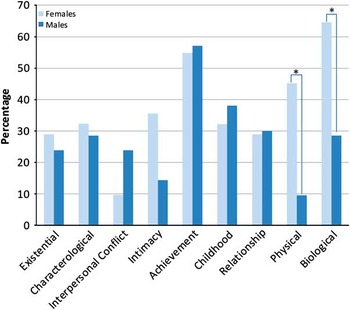
First, we calculated the overall percentages of patients endorsing each RFD category: characterological (30.8 %); achievement (55.8 %); interpersonal conflict (15.4 %); intimacy (26.9 %); relationship (29.4 %); childhood (34.6 %); existential (26.9 %); physical (30.8 %); and biological (50 %). Results showed that only the achievement and biological categories were reasons for depression clearly endorsed by the majority (⩾50 %) of the overall sample (see Fig. 1).
(Colour online) Endorsement of reasons for depression by gender (*p <0.05).

Gender differences
We also examined reasons for depression by gender. Independent sample t-tests and chi square tests revealed no significant gender differences for demographics (age, marital status, race/ethnicity, education or diagnosis) or other study variables (BMQ, BPS, antidepressant acceptability or psychotherapy acceptability). Also, BDI scores also did not differ significantly by gender (men: M = 28.9, SD = 8.3; women: M = 34.1, SD = 11.8; t = 1.67, p = 0.101).
Chi square tests revealed that there were significant differences on two RFD subscales. For the biological subscale, significantly more women (64.5 %) compared with men (28.6 %) endorsed this category (chi square = 6.47, df = 1, p = 0.011). For the physical subscale, significantly more women (45.2 %) compared with men (9.5 %) endorsed this category (chi square = 7.46, df = 1, p = 0.006; Fig. 1). Gender differences for the biological (p = 0.032, Exp(B) = 3.85) and physical (p = 0.022, Exp(B) = 6.81) subscales remained significant in logistic regression analyses after controlling for BDI scores.
Zero order correlations
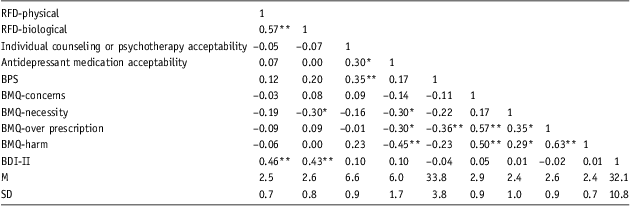
The zero order correlations were computed between the physical and biological subscales and the other study variables (see Table 1). Physical and biological reasons for depression were positively correlated with each other and with depression severity. Higher biological subscale scores were correlated with greater belief in the necessity of medication. More negative views about medication were associated with lower antidepressant acceptability. Antidepressant and psychotherapy acceptability were positively correlated with each other. The BMQ subscales tended to be intercorrelated as expected.
Correlations with physical and biological reasons for depression
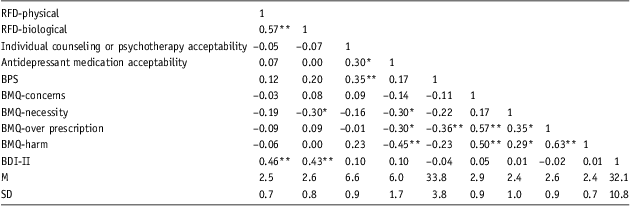
*p < 0.05, **p < 0.01
BDI-II – Beck Depression Inventory-II; BMQ – Beliefs about Medicines Questionnaire; BPS – Beliefs about Psychotherapy Scale; RFD – Reasons for Depression Scale
Moderation analyses
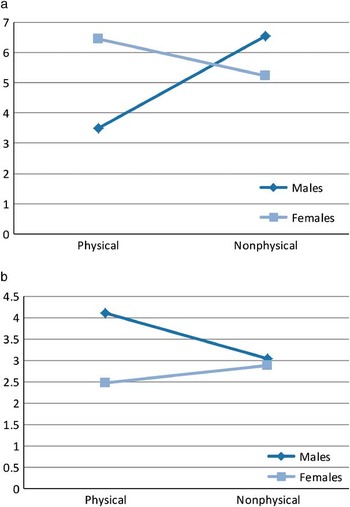
We examined gender as a statistical moderator of the relationship between the physical or biological subscales and the other study variables. For the physical subscale, gender moderated the relationship with antidepressant acceptability (r = –0.38, p = 0.006) and BMQ-concerns subscale (r = 0.30, p = 0.033). Moderation effects for antidepressant acceptability (r = –0.42, p = 0.003) and BMQ-concerns (r = 0.29, p = 0.041) remained significant after also controlling for BDI scores. In other words, the associations between physical reasons for depression and antidepressant acceptability and medication concerns differed depending on gender. The moderation effects are graphically depicted in Figure 2. Males endorsing physical reasons for depression were less likely than women to view antidepressant medication as acceptable and have more concerns about adverse effects of medication for depression. No moderation effects were found between the physical subscale and the other variables, or the biological subscale.
(Colour online) Moderation effects of gender by endorsement of physical reasons for depression on antidepressant acceptability (a) and concerns about medication (b)

Discussion
This research further explores how beliefs about depression differ by gender, possible differences in what men and women cite as reasons for their depression, and how these reasons might relate to differences in treatment preferences across gender. Results indicating that women were more likely to endorse both physical and biological reasons for their depression suggest that hospitalised women may have a more body-focused or internalised view of their illness (e.g. body image, genetic predisposition), whereas men have a more externally-focused or environmental view. This is consistent with some of the past research in this area (Angst et al. Reference Angst, Gamma, Gastpar, Lépine, Mendlewicz and Tylee2002; Boughton & Street, Reference Boughton and Street2007; Kilmartin, Reference Kilmartin2005; Robbins & Tanck, Reference Robbins and Tanck1991; Wilhelm et al. Reference Wilhelm, Parker, Geerlings and Wedgwood2008).
Gender also acted as a moderator of the endorsement of physical reasons for depression. Results showed that males who endorsed physical reasons for depression viewed antidepressant treatment less favourably compared with women. If men in general have a more externalised view of depression, one explanation is that men who endorse physical attributions believe that the appropriate treatment also should be more external (e.g. physical activity) rather than internal (e.g. medication treatment) in nature. Addis (Reference Addis2008) suggested that the tendency for men to cope with their depression externally may be rooted in following masculine norms that promote action. Men who believe in physical reasons for their depression may be inclined to view medication as a passive response that does not address the causes of their depression. Therefore, men may prefer treatment (such as physical activity) where they are able to take action and feel in more control of coping with their depression. No significant gender main effects were found for demographic variables, depression severity, negative beliefs about psychotherapy or medication, antidepressant acceptability, or psychotherapy acceptability.
To better understand the findings, it is helpful to examine the types of items that patients were responding to on the RFD questionnaire (Addis et al. Reference Addis, Truax and Jacobson1995; Thwaites et al. Reference Thwaites, Dagnan, Huey and Addis2004). For example, the majority of the sample (both men and women) endorsed achievement reasons, which included items such as ‘I've failed to achieve a specific goal I set for myself’ or ‘I can't accomplish what I want to’. Furthermore, women endorsed significantly more biological reasons including ‘It's basically caused by genetics’ and ‘I have a chemical imbalance’. Women also endorsed more physical reasons including items such as ‘I don't eat well enough’ or ‘I don't get enough exercise’. However, men versus women might have interpreted the physical reasons for depression items in different ways. The men who endorsed physical reasons for depression tended to have more negative views about medication and found antidepressants less acceptable than women who endorsed these same items. Thus, men and women appeared to have differing interpretations of how to treat their depression when physical reasons were the perceived cause.
The correlations among the different variables also produced interesting results. Physical reasons for depression were correlated positively with biological reasons for depression, suggesting that endorsing one means that the patient is likely to endorse the other, or endorse neither. In addition, both physical and biological reasons were positively associated with depression level, suggesting that these particular reasons are more commonly accepted in patients with more severe symptoms. Also, endorsement of biological reasons for depression and antidepressant acceptability were positively correlated with more positive beliefs about medication. Also as expected, psychotherapy acceptability was positively correlated with more positive beliefs about the benefits of psychotherapy. Another interesting finding was that psychotherapy and antidepressant acceptability were positively correlated with each other, which may suggest that openness to one treatment modality relates to being open to others, even when they are different.
Several potential limitations warrant additional consideration. First, our sample size was only modest and thus we had lower statistical power for testing moderation effects. The moderating effects of gender on reasons for depression and treatment should be tested in larger samples. Furthermore, our sample consisted of only hospitalised patients and thus these results may not generalise to depressed patients in outpatient treatment or the general population. For example, it is possible that patients’ beliefs about treatment were influenced by the messages they received from their treatment providers and being in the hospital setting. Future research should explore these variables in an outpatient setting where depression may be less severe, potentially affecting ratings of biological and physical reasons for depression, which were positively correlated with depression severity in our sample. Depression diagnoses were derived from chart review and were not based on independent clinical interviews, but the use of chart diagnoses ensured that the sample was more naturalistic and potentially generalisable.
Our findings have several potential clinical implications for hospitalised patients with depression. It is important to consider that our sample completed the study during inpatient hospitalisation. The primary modality of inpatient psychiatric treatment, especially in the US, involves pharmacotherapy. Our results suggest that patients who do not consider their depression to be biologically-based may have more negative beliefs about medication and find antidepressants less acceptable. Given the literature suggesting that some types of psychosocial intervention may be as efficacious as medication for moderate to severe depression (DeRubeis et al. Reference DeRubeis, Hollon, Amsterdam, Shelton, Young, Salomon, O'Reardon, Lovett, Gladis, Brown and Gallop2005), treatment outcome might be improved if matched to the preferences of the individual patient (Kwan et al. Reference Kwan, Dimidjian and Rizvi2010). Hospitalised men in particular may find biological explanations for depression less acceptable and have more negative views about medication. Thus, certain patients may require specific attention to develop an acceptable treatment plan that they are likely to adhere to. Another general clinical implication of our study is that even people who endorse similar reasons for depression may still differ in the conclusions that they draw from those beliefs. As we found, men and women endorsing physical reasons for depression nevertheless had differing views about the acceptability of taking psychiatric medication as the treatment (women positive views versus men more negative views). Although there are potential challenges and disadvantages when accounting for patient preferences in clinical trials (Shadish et al. Reference Shadish, Clark and Steiner2008), incorporating preferences into treatment research may improve the external validity of studies and more accurately reflect the effectiveness of treatments when they are implemented in the community (Long et al. Reference Long, Little and Lin2008). Thus far, trials conducted in depressed samples using matching designs have produced mixed results (Gelhorn et al. Reference Gelhorn, Sexton and Classi2011), but further research is warranted. It is our hope that further studying individual differences and contextual factors in hospitalised patients will allow for better treatment matching and improved treatment outcomes for patients with beliefs that do not necessarily fit with this setting.
Acknowledgements
Preparation of this manuscript was supported in part by a grant (MH076937) from the National Institutes of Health awarded to Dr Gaudiano.