Oral storytelling is considered a foundational element of literacy acquisition because it relies on a combination of linguistic and cognitive abilities on the part of the child. More specifically, the child needs to make clear distinctions among characters - as well as between new and given information - to develop what Berman and Slobin (Reference Berman and Slobin1994) call a “theory of the listener” (p. 359). To develop this theory, the child has to determine who the main characters in the story are, refer to them appropriately, and shift reference to other characters in ways the listener can follow. This is especially the case when the story is produced in the absence of mutual knowledge; such “naïve listener” narratives rely almost exclusively on discourse-internal organization, wherein all utterances produced are related to all other utterances, and relations among them are reflected in the referential choices narrators make (Halliday & Hasan, Reference Halliday and Hasan1976; Hickmann, Reference Hickmann2003; Hickmann et al., Reference Hickmann, Schimke, Colonna, Serratrice and Allen2015). Oral narratives may, therefore, be particularly well-suited for studying the acquisition of referential behaviors in the first few years of formal schooling (Bamberg, Reference Bamberg1986; Chen & Lei, Reference Chen and Lei2013; Karmiloff-Smith, Reference Karmiloff-Smith and Deutsch1981, Reference Karmiloff-Smith1985). Emergent bilingual children face unique challenges in this task (Bedore et al., Reference Bedore, Peña, Gillam and Tsung-Han2010; Simon-Cereijido & Gutiérrez-Clellen, Reference Simon-Cereijido and Gutiérrez-Clellen2009; Uccelli & Paéz, Reference Uccelli and Paéz2007); most notably, they have to navigate the referential systems of their two languages - which may differ in terms of which forms are used to represent which functions - as well as which forms are obligatory versus optional (Chen & Pan, Reference Chen and Pan2009; Chen & Lei, Reference Chen and Lei2013; Qi, Reference Qi2010; Serratrice & Hervé, Reference Serratrice, Hervé, Serratrice and Allen2015).
In the present study, therefore, the English narratives of Spanish–English emergent bilinguals in the first and second grade were analyzed to examine how children used referential forms for the functions of maintaining and switching reference to various characters in an orally heard wordless picture book (Berman, Reference Berman1997; Colozzo & Whitely, Reference Colozzo and Whitely2015). Analysis of stories told in English allowed us to extend the existing literature base about the second-language linguistic skills of children who speak Spanish as a home language by examining their use of referential forms in narrative retells. This may be especially telling since most Spanish-speaking children in US schools will only ever be assessed in English. Particular attention is paid to the primacy of characters as possible thematic protagonists, thus adding to the research that has been conducted with bilingual children in the area of referencing in oral narratives (Chen & Lei, Reference Chen and Lei2013; Chen & Pan, Reference Chen and Pan2009; Mishina-Mori et al., Reference Mishina-Mori, Nagai, Yujobo, Bertolini and Kaplan2018; Muranaka-Vuletich, Reference Muranaka-Vuletich2017; Serratrice, Reference Serratrice2007).
Development of strategic referencing in monolingual children
Effective storytelling requires children to understand both the various forms that referential expressions can take and the discourse conditions under which these forms can - and should - be used to meet communicative goals (Serratrice, Reference Serratrice2008). Since the appropriate use of referential cohesion is integral to the development of communicative competence (Heilmann et al., Reference Heilmann, Miller, Nockerts and Dunaway2010), oral narratives provide an optimal context for studying children’s ability to make such decisions because they enable researchers to analyze interrelations between the linguistic forms and the discourse functions they serve (Bamberg, Reference Bamberg1986). Further, the syntactic constraints of a language govern the distribution of forms that each referential function is generally associated with. These vary by the level of accessibility and predictability they provide to the listener, such that less predictable information is coded more explicitly. Information that is new to the listener is typically expressed using nominal forms, while given information is either pronominalized or expressed using a null form, depending on the syntactic and pragmatic affordances of the language (Gutiérrez-Clellen & Heinrichs-Ramos, Reference Gutiérrez-Clellen and Heinrichs-Ramos1993; Hickmann & Hendriks, Reference Hickmann and Hendriks1999; Hickmann et al., Reference Hickmann, Hendriks, Roland and Liang1996). Thus, in the process of telling stories children need to make decisions about which referential forms are not only syntactically and pragmatically appropriate but also easily (unambiguously) interpretable.
Appropriate referencing is thus both linguistically and cognitively challenging and develops late relative to other language skills, even in monolinguals (Berman, Reference Berman1997); studies suggest that monolingual children do not typically achieve consistent discourse-internal referencing before the age of 6 (Bamberg, Reference Bamberg1986; Karmiloff-Smith, Reference Karmiloff-Smith and Deutsch1981, Reference Karmiloff-Smith1985), and maybe as late as age 10 (Berman, Reference Berman and Bavin2009; Wigglesworth, Reference Wigglesworth1997). Referential forms emerge early in development, but the ability to use them appropriately for various narrative functions takes much longer (Hickmann et al., Reference Hickmann, Schimke, Colonna, Serratrice and Allen2015; Serratrice, Reference Serratrice2008).
In addition, a large amount of research suggests that appropriate maintenance behaviors are the earliest to develop while switching reference is more challenging because narrators have to consider not only whether the character is already known to the listener but also how present the character is in the listener’s attention (Aksu-Koç & Nicolopoulou Reference Aksu-Koc and Nicolopoulou2015; Hickmann & Hendriks, Reference Hickmann and Hendriks1999; Orsolini et al., Reference Orsolini, Rossi and Pontecorvo1996; Vion & Colas, Reference Vion and Colas1999; Wong & Johnston, Reference Wong and Johnston2004). This “attentional status” (Wong & Johnston, Reference Wong and Johnston2004, p. 653) harkens back to the theory of the listener proposed by Berman & Slobin (Reference Berman and Slobin1994).
To this end, there is general agreement that by the age of 5, monolingual children can successfully maintain reference using null or pronominal forms, rather than relying only on nominal forms. This has been found in Spanish (Gutiérrez-Clellen & Heinrichs-Ramos, Reference Gutiérrez-Clellen and Heinrichs-Ramos1993), Cantonese (Wong & Johnston, Reference Wong and Johnston2004), Italian (Orsolini et al., Reference Orsolini, Rossi and Pontecorvo1996), French (Hickmann & Hendriks, Reference Hickmann and Hendriks1999; Vion & Colas, Reference Vion and Colas1999), Turkish (Aksu-Koç & Nicolopolou, Reference Aksu-Koc and Nicolopoulou2015), German (Hickmann & Hendriks, Reference Hickmann and Hendriks1999), and English (Hickmann & Hendriks, Reference Hickmann and Hendriks1999). Beyond 5 years of age, children begin to develop the ability to use more informative nominal forms to switch reference to previously mentioned characters, although findings differ in terms of the age at which children can do this successfully.
One of the first decisions children make when retelling a story is who the most important characters are. As they develop a theory of the listener, they attempt to use referencing in ways that will keep these main characters, or thematic protagonists, at the forefront of the listener’s mind, while backgrounding more minor, or non-thematic, protagonists. However, early development is characterized by a preponderance of pronominal references to both thematic and non-thematic characters regardless of function (Colozzo & Whiteley, Reference Colozzo and Whitely2015; Hickmann et al., Reference Hickmann, Hendriks, Roland and Liang1996; Orsolini et al., Reference Orsolini, Rossi and Pontecorvo1996). At these earliest stages, pronouns are used deictically (dependent on the external context) rather than anaphorically (used as a discourse-internal continuity marker), acting as a default form to meet various functions (Bamberg, Reference Bamberg1986; Berman, Reference Berman and Bavin2009; Hendriks, Koster, & Hoeks, Reference Hendriks, Koster and Hoeks2014). This interaction between macro-level discourse goals and micro-level referencing choices has long been studied by scholars such as Karmiloff-Smith (Reference Karmiloff-Smith and Deutsch1981, Reference Karmiloff-Smith1985) and Bamberg (Reference Bamberg1986) and continues to be investigated with monolinguals in various languages (Chen & Lei, Reference Chen and Lei2013; Gutiérrez-Clellen & Heinrichs-Ramos, Reference Gutiérrez-Clellen and Heinrichs-Ramos1993; Orsolini et al., Reference Orsolini, Rossi and Pontecorvo1996).
As development progresses, children begin to use pronominals anaphorically, most notably to maintain reference to those they identify as thematic protagonists. In contrast, they begin to use nominals both to switch and maintain reference to those they consider non-thematic characters (Bamberg, Reference Bamberg1986; Kail & Hickman, Reference Kail and Hickmann1992; Karmiloff-Smith, Reference Karmiloff-Smith and Deutsch1981). This is especially the case in stories where there is a clear singular main character; children at this stage use pronominals exclusively to refer to this character, both to switch and to maintain reference, a strategy that has been termed the thematic subject strategy (Karmiloff-Smith, Reference Karmiloff-Smith and Deutsch1981; Bamberg, Reference Bamberg1986, 1987; Wigglesworth, Reference Wigglesworth1997). This strategy has been observed among monolingual children in various languages, including English, French, German, and Chinese (Bamberg, 1987, Hickmann et al., Reference Hickmann, Schimke, Colonna, Serratrice and Allen2015, Hickmann & Hendriks, Reference Hickmann and Hendriks1999; Kail & Hickmann, Reference Kail and Hickmann1992; Karmiloff-Smith, Reference Karmiloff-Smith and Deutsch1981).
As children’s referencing strategies become more sophisticated - thanks to home and school experiences with stories, adult modeling, and increased cognitive resources - they become more sensitive to discourse constraints on the use of various forms (Colozzo & Whiteley, Reference Colozzo and Whitely2015; Orsolini et al., Reference Orsolini, Rossi and Pontecorvo1996). They continue to refine their theory of the listener (Berman & Slobin, Reference Berman and Slobin1994), and the thematic subject strategy begins to fade out (Bamberg, Reference Bamberg1986). With the development of the ability to organize narrative information at both the discursive and sentential levels, children are more capable of attending to the cohesiveness of their narrative productions, beginning to use referential forms more appropriately to refer to both thematic and non-thematic protagonists (Halliday & Hasan, Reference Halliday and Hasan1976; Wigglesworth, Reference Wigglesworth1997).
One of the primary features of this move beyond local sentential organization is that the use of anaphoric pronominalization becomes solidified (Karmiloff-Smith, Reference Karmiloff-Smith and Deutsch1981). That is, children more consistently use pronominals to maintain reference to characters who have continuously been the main focus of attention and more nominals to switch reference (Hickmann & Hendriks, Reference Hickmann and Hendriks1999; Orsolini et al., Reference Orsolini, Rossi and Pontecorvo1996), regardless of character primacy. This final stage of referential development - which most closely mirrors adult use of forms - is often referred to as an anaphoric strategy, wherein narrators choose which form to use based both on linguistic and discourse constraints. By this point, children can integrate individual utterances into a larger discourse, making use of referential forms in a way that makes stories comprehensible and coherent to the listener (Karmiloff-Smith, Reference Karmiloff-Smith1985; Orsolini et al., Reference Orsolini, Rossi and Pontecorvo1996).
Development of strategic referencing in bilingual children
Some research suggests that the developmental trajectory of referencing among bilinguals is qualitatively similar to that of monolinguals, even given the demands of continually processing the rules governing their two linguistic systems (Carvalho et al., Reference Carvalho, Orozco and Shin2015; Hulk & Müller, Reference Hulk and Müller2000). For example, Serratrice (Reference Serratrice2007) analyzed the oral narratives of 8-year-old Italian–English bilingual children alongside those of age-matched monolingual English and Italian-speaking children and found that the bilingual children performed similarly to monolinguals in both languages, with all groups using more nominals to switch reference and bilingual children using pronominals and null forms to maintain reference in ways appropriate to each language. Chen and Lei’s (Reference Chen and Lei2013) work comparing 9 and 10-year-old Chinese–English bilinguals to monolinguals in both languages also found that there were no salient differences in how the groups used referential forms, with all groups preferring nominals to switch reference and pronominals to maintain reference in English.
Although the principles governing discourse may be similar across languages, language-specific rules about how forms and functions can map onto each other can present difficulties for children (Hickmann & Hendriks, Reference Hickmann and Hendriks1999). For young emergent bilingual children living in English-dominant societies, these challenges can be exacerbated by the fact that they are early in their development of both the home language and English. Therefore, they have less exposure to both languages than their monolingual counterparts to English, limiting the linguistic knowledge they have to draw on (Bayley & Pease-Alvarez, Reference Bayley, Pease-Alvarez, Arnold, Blake, Davidson, Schwenter and Soloman1994).
Many studies, however, have not considered how children referred differently to specific characters. A character-specific analysis can provide an additional level of nuance among bilingual children just like it does among monolinguals. In a study with 4- and 5-year-old and 8 and 9-year-old Japanese–English bilingual or Japanese monolingual children, Muranaka-Vuletich (Reference Muranaka-Vuletich2017) compared how children in the two groups used referential forms to refer to the likely thematic protagonist versus other characters. She found that the null form was the most commonly used form for all referential functions in both age and language groups, but that children were also more likely to use the null form to refer to the primary thematic protagonist than other characters across functions. Chen and Pan (Reference Chen and Pan2009) similarly found that by the age of 8, 70% of Chinese–English bilingual children in their study used pronominals appropriately to maintain reference to the thematic protagonist but were significantly less likely to do so than bilingual adults. In general, further research is needed to generate a deeper understanding of the complexities of referencing behaviors and their development for young emergent bilingual students, especially in bilingual instructional contexts.
How the Spanish referential system differs from English
Spanish is the most widely spoken language among US bilingual children (National Center for Education Statistics, 2019), and it is a pronoun-drop language, meaning that explicit pronominals are not generally required due to the information encoded in the verb form. Therefore, the null form can be used in Spanish to serve both maintenance and switching functions (Silva-Corvalán, Reference Silva-Corvalán2014). In contrast, the null form is only allowed in English under strict constraints and can be considered a form of implicit pronominalization (Hickmann, Reference Hickmann2003). Despite the optional nature of overt pronominals, some research has shown that adult Spanish speakers use them more frequently to switch than to maintain reference, a pattern not seen in young Spanish-speaking children (Shin & Cairns, Reference Shin and Cairns2012; Shin & Otheguy, Reference Shin, Otheguy, Lacorte and Leeman2007). This explicit pronominalization increases comprehensibility in that it makes it easier for the listener to track the referent. In one of the few studies to investigate the referencing behaviors of Spanish–English bilingual children, Montrul and Sanchez-Walker (Reference Montrul, Sánchez-Walker, Carvalho, Orozco and Shin2015) assessed Spanish–English bilinguals ranging in age from 6 to 17 years old on a spontaneous narrative task and found that in Spanish, children produced significantly higher rates of overt pronominals to maintain reference than monolinguals. To summarize, Spanish is a pronoun-drop language, meaning that pronouns may not be used when enough information about the referent is inferable. Such null pronoun references are much more common in Spanish than in English given the increased flexibility that verbal and grammatical inflection allow for in Spanish. In contrast, null pronouns are only used in English under certain circumstances when the subject can be pragmatically inferred.
Language development in dual language programs
It is well-established that Spanish-speaking children enrolled in dual language immersion programs perform better than those enrolled in English-only over time (Alvear, Reference Alvear2019; Collier & Thomas, Reference Collier and Thomas2017; Thomas & Collier, Reference Thomas and Collier1997, Reference Thomas and Collier2002). However, much of the research has reported academic outcomes rather than language outcomes, where the literature is more limited. One exception is a longitudinal study that investigated language outcomes for children enrolled in bilingual versus English-only programs (Collins, Reference Collins2014), which found that from kindergarten to second grade, children who received bilingual instruction made significant gains on a language composite measure in both Spanish and English, nearly reaching age-appropriate levels of proficiency by second grade.
Oral narrative assessment has been used in research with bilingual children in different instructional contexts, although such differences are not always taken into account when analyzing children’s performance (Iluz-Cohen & Walters, Reference Iluz-Cohen and Walters2012; Uccelli & Paéz, Reference Uccelli and Paéz2007). Some of these studies found that even children enrolled in bilingual programs performed better in English than Spanish (Gutiérrez-Clellen, Reference Gutiérrez-Clellen2002), while other research has reported that children performed comparably on English and Spanish story structure across instructional contexts (Squires et al., Reference Squires, Lugo-Neris, Peña, Bedore, Bohman and Gillam2014). Overall, the question of how instructional context may influence proficient referencing in English remains largely unanswered.
Purpose of the study
The purpose of this study is to add to the research that has been conducted with bilingual children in the area of referencing in oral narratives (Chen & Lei, Reference Chen and Lei2013; Chen & Pan, Reference Chen and Pan2009; Mishina-Mori et al., Reference Mishina-Mori, Nagai, Yujobo, Bertolini and Kaplan2018; Muranaka-Vuletich, Reference Muranaka-Vuletich2017; Serratrice, Reference Serratrice2007), especially concerning Spanish–English emergent bilingual children in the early years of formal schooling in the USA. Much of the previous research investigating the use of different referential forms to switch or maintain reference to characters in a story has been done with monolingual children in various languages (Bamberg, Reference Bamberg1986; Colozzo & Whitely, Reference Colozzo and Whitely2015; Gutiérrez-Clellen & Heinrichs-Ramos, Reference Gutiérrez-Clellen and Heinrichs-Ramos1993; Orsolini et al., Reference Orsolini, Rossi and Pontecorvo1996; Wigglesworth, Reference Wigglesworth1997). Even relevant research done with Spanish–English bilingual children has investigated Spanish development only (Bayley & Pease-Alvarez, Reference Bayley, Pease-Alvarez, Arnold, Blake, Davidson, Schwenter and Soloman1994; Montrul & Sánchez-Walker, Reference Montrul, Sánchez-Walker, Carvalho, Orozco and Shin2015). Thus, there is a need for examinations of English development among the large and growing Spanish–English emergent bilingual population in the USA, especially research that considers how children use referential forms at different ages in the early years of school (Berman, Reference Berman1997; Colozzo & Whitely, Reference Colozzo and Whitely2015).
The question guiding this study was the following: are there differences between first- and second-grade Spanish–English emergent bilinguals in two instructional contexts in terms of the referential forms (nominal, pronominal) they use for different functions (switch, maintain) when referring to thematic protagonists in English narrative retells?
Hypotheses
Given findings from previous research, there were two grade-level hypotheses. In both, it was expected that second graders would use a higher proportion of referential forms appropriately for each function than first graders (Chen & Pan, Reference Chen and Pan2009; Serratrice, Reference Serratrice2007). First, it was hypothesized that first graders would identify one thematic protagonist and use a high proportion of pronominals to both maintain and switch reference to that character (Karmiloff-Smith, Reference Karmiloff-Smith and Deutsch1981; Bamberg, Reference Bamberg1986, Reference Bamberg1997; Wigglesworth, Reference Wigglesworth1997). In contrast, it was expected that second graders would use a significantly higher proportion of nominals to switch reference to all characters than first graders, while also using a higher proportion of pronominals to maintain reference. This would suggest that the older children were moving toward a more adult-like anaphoric referencing strategy (Karmiloff-Smith, Reference Karmiloff-Smith1985; Orsolini et al., Reference Orsolini, Rossi and Pontecorvo1996).
The third hypothesis was related to instructional context differences. It was not known what to expect given that there has not been previous research exploring such differences. While it might seem intuitive that children in English-only settings would use referencing in more adult-like ways than children in dual language immersion settings due to greater exposure to instruction in English, it is also possible based on a vast literature on the benefits of dual language immersion that they would perform equally well in dual language immersion programs (Alvear, Reference Alvear2019; Collier & Thomas, Reference Collier and Thomas2017; Collins, Reference Collins2014; Thomas & Collier, Reference Thomas and Collier1997, Reference Thomas and Collier2002). Notably, this is one of the first studies to examine the development of English for Spanish–English bilinguals enrolled in such programs.
Methods and data sources
Data for this cross-sectional study were gathered from 105 first- and second-grade Spanish–English emergent bilingual children who were assessed in three waves (2013, 2015, and 2017).Footnote 1 All children resided in a mid-sized urban area in the Pacific Northwest and were identified on a home language survey as “speaking Spanish as a first language.” Forty children were first graders (mean age 7;2 years) and 65 were second graders (mean age 8;1 years). Sixty children were enrolled in dual language immersion programs (20 first graders, 40 second graders), and 45 were enrolled in English-only instructional programs (20 first graders, 25 second graders). Overall, 84 children qualified for English language development (ELD) services, 17 did not qualify due to high English test scores, and data were missing for four children. Of the 84 children who qualified for ELD services, 42 were in dual language immersion (12 first graders and 30 second graders) and 42 were in English-only instruction (19 first graders and 23 second graders).
Retell assessments using wordless picture books Frog, where are you? (Mayer, Reference Mayer1969), Frog goes to dinner (Mayer, Reference Mayer1974), and Frog on his Own (Mayer, Reference Mayer1973) were conducted individually by either the principal investigator (Spanish and English) or a trained graduate research assistant (English) in a quiet space in the school. All children were assessed in Spanish first and in English approximately a week later. Audio scripts provided by Miller et al. (Reference Miller, Andriacchi and Nockerts2015) were used to record a highly proficient bilingual speaker reading each story. The scripts are designed to have comparable lengths, sentence complexity, and levels of cohesion and have been used with Spanish–English bilinguals in other studies (Bedore et al., Reference Bedore, Peña, Gillam and Tsung-Han2010; Simon-Cereijido & Gutiérrez-Clellen, Reference Simon-Cereijido and Gutiérrez-Clellen2009). Books were randomly counterbalanced within and across grades, and each child heard a different book in each language. Each assessment session lasted approximately 20 min, and the assessor spoke only the target language for the entire session. Footnote 2 Only English data are reported in the present article. While presenting only English data represents a potential limitation of this study, this second-language analysis of emergent bilingual students is relevant for two reasons. First, the majority of emergent bilingual students in elementary Spanish–English dual language immersion programs receive the majority of daily instruction in Spanish. The ELD of students who receive instruction primarily in Spanish is an understudied area and thus warrants further attention. Second, much of the previous research in which this study is rooted has investigated the first or dominant language development of emergent bilingual students.
To begin the session, the assessor read the title of the book and told the child they would be asked to retell the story in their own words after listening and that they would not be able to look at the pictures while doing so. Children listened to the story using headphones, ensuring a naïve listener condition (Berman & Slobin, Reference Berman and Slobin1994; Boyd & Nauclér, Reference Boyd, Nauclér, Verhoeven and Strömqvist2001; Strong, Reference Strong1998) that was expected to influence children’s referencing decisions, especially for second graders (Aksu-Koç & Nicolopoulou, Reference Aksu-Koc and Nicolopoulou2015; Hickmann & Hendriks, Reference Hickmann and Hendriks1999; Kail & Hickmann, Reference Kail and Hickmann1992; Serratrice, Reference Serratrice2007).
Following a protocol set forth by previous narrative research, the child was given the option to review the book one more time before giving it to the assessor to put away (Reese et al., Reference Reese, Suggate, Long and Schaughency2010; Suggate et al., Reference Suggate, Schaughency and Reese2011). Then the audio-recorder was turned on, and children were asked to begin the retell. The assessor remained silent throughout the retell, except in the case of pauses lasting more than 3 s, at which point she gave a general prompt such as “tell me more” or “anything else?” (Miller et al., Reference Miller, Andriacchi and Nockerts2015). Once the child retold most of the story, the researcher asked “is that all you remember?” to end the assessment (Justice et al., Reference Justice, Bowles, Kaderavek, Ukrainetz, Eisenberg and Gillam2006, Reference Justice, Bowles and Gosse2010).
Coding procedures
Narratives were transcribed and segmented into C-units using Loban’s (Reference Loban1976) criteria: a main clause and any subordinate clauses. Coding of C-units was modified in the case of coordinated clauses with omitted subjects in the second main clause, as recommended for Spanish–English bilingual children (Gutiérrez-Clellen & Hofstetter, Reference Gutiérrez-Clellen and Hofstetter1994; Miller et al., Reference Miller, Heilmann, Nockerts, Iglesias, Fabiano and Francis2006). Modified C-unit coding was used for transcripts in both languages.
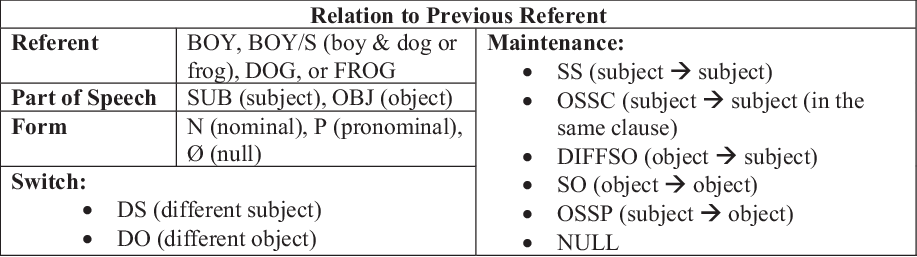
Transcripts were then coded for referencing using criteria drawn from previous work in this area (Bamberg, Reference Bamberg1986; Wigglesworth, Reference Wigglesworth1997) by three trained coders. All subject and object references to the possible protagonists in the stories – the boy (BOY), the dog (DOG) or frog (FROG),Footnote 3 and the boy and frog or dog together (BOY/S) – were coded for form (nominal, pronominal) and function (switch, maintenance). Both overt and null pronouns were considered pronominals. Function was identified by a variety of codes pertaining to either a switch or maintenance in relation to the previous referent (see Figure 1). For example, switches in reference were identified as either referring to a different subject (DS) or different object (DO) than the referent in the same position in the previous clause. Maintenance was also identified in a variety of ways, for example, when reference was made to the same subject as the previous clause (SS) or when the subject of a clause is the same referent as the object in the previous clause (OSSP).
Analytic coding scheme.

In making decisions about switching or maintaining reference, coding went beyond consideration of just the preceding clause (Bamberg, Reference Bamberg1986), especially in cases where preceding utterances represented generic background information about the setting (i.e., “there was a cliff”) or did not include an animate referent that advanced the action of the story (i.e., “it was a big frog”). In addition, when referents were coded as pronominal, the relationship between the pronoun and its antecedent was identified, taking into account its role in the previous coded clause (Wigglesworth, Reference Wigglesworth1997). For example, a pronominal subject can typically refer unambiguously to either the subject or the object of the previous clause. In such cases, references were coded as maintenance unless the coder determined there was a reasonable likelihood of ambiguity.
After the three coders established baseline reliability on one transcript for each story and addressed inconsistencies, 25% of transcripts (27/105) were double-coded to establish inter-rater reliability. This was done by calculating the percentage of agreement between the two raters in classifying each referential form used for each function. Overall inter-rater reliability was 87%. Examples of first- and second-grade recordings are accessible below.

Findings
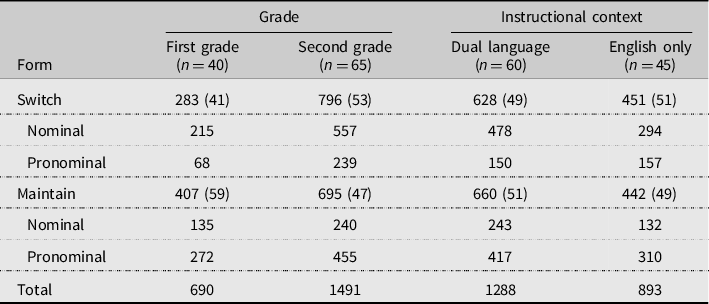
The purpose of this study was to investigate whether there would be differences in the ways that first- and second-grade Spanish–English emergent bilinguals in two different instructional contexts used referential forms for different functions when referring to characters in narrative retells. Table 1 shows descriptive statistics for the overall number of referential forms used for each function by children at each grade level and within each instructional context.
Total number of referential forms used to refer to all potential thematic protagonists (percent of total within parentheses)

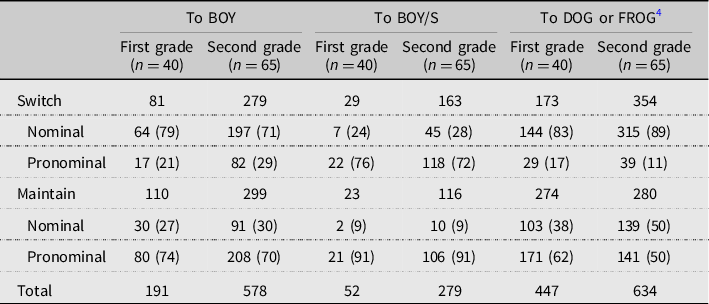
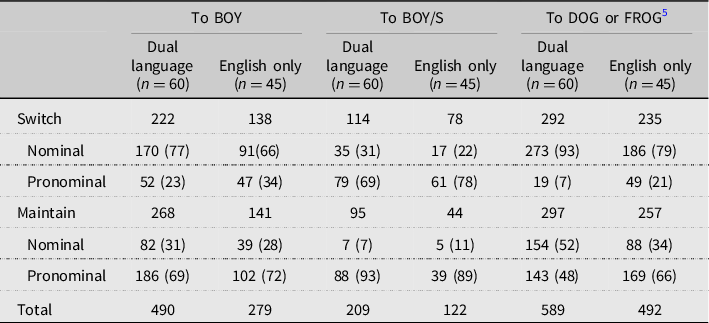
Tables 2 and 3 show the number of referential forms used for each function to refer to possible thematic protagonists by grade and instructional context, with the percent of the total within each group in parentheses. A visual examination of the proportions in Table 2 suggests that BOY/S (boy and dog or frog) was the most likely thematic protagonist identified by children across grades and instructional contexts, as evidenced by the fact that 76% of forms used to switch reference to BOY/S at first grade and 72% at second grade were pronominal, compared to 21% (first grade) and 29% (second grade) for BOY and only 17% (first grade) and 11% (second grade) for DOG or FROG. This pattern of pronominalization for both switching and maintaining reference to one chosen character - BOY/S, in this case - is common among monolingual children in various languages (Bamberg, 1987, Hickmann et al., Reference Hickmann, Schimke, Colonna, Serratrice and Allen2015, Hickmann & Hendriks, Reference Hickmann and Hendriks1999; Kail & Hickmann, Reference Kail and Hickmann1992; Karmiloff-Smith, Reference Karmiloff-Smith and Deutsch1981). The same pattern is evident in Table 3, which shows that 69% of forms used to switch reference to BOY/S in dual language immersion contexts and 78% in English-only were pronominal, compared to 23% (DL) and 34% (EO) for BOY and only 7% (DL) and 21% (EO) for DOG or FROG.
Total number of referential forms used to refer to individual potential thematic protagonists by grade (percent of total function references within parentheses)

Total number of referential forms used to refer to individual potential thematic protagonists by instructional context (percent of total function references within parentheses)

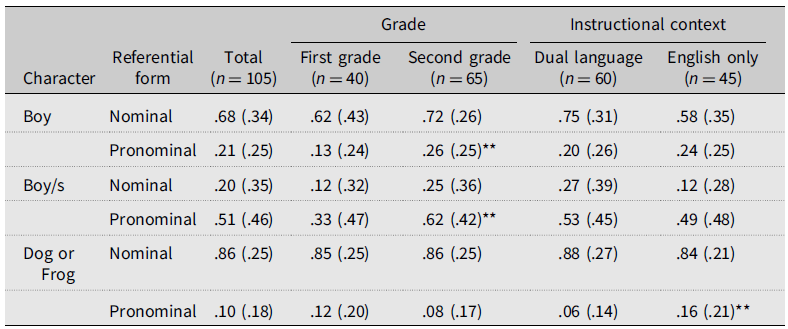
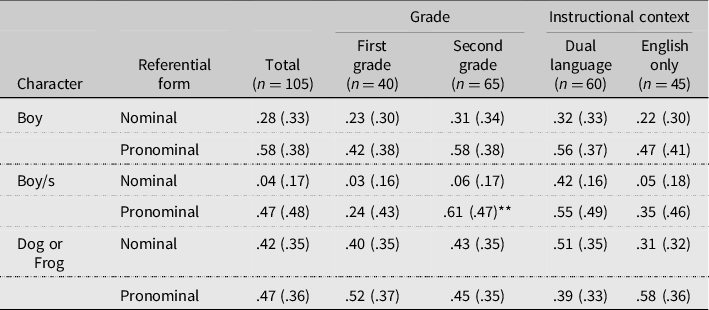
To investigate differences in referential behaviors between grades and instructional contexts, mean proportions of each form used for each function were calculated. A 2 (grade) × 2 (instructional context) between-groups multivariate analysis of variance was conducted. Preliminary assumption testing was conducted to check for normality, linearity, univariate and multivariate outliers, homogeneity of variance–covariance matrices, and multicollinearity, with no serious violations noted. Results revealed a main effect of grade on the combined dependent variables, F(12,90) = 3.42, p = .001; Wilks’ lambda = .69; partial eta squared = .32. When results for the dependent variables were considered separately, three differences reached statistical significance, using a Bonferroni adjusted alpha level of p = .004 (see Tables 4 and 5). Two of these differences were in switching behaviors. First, the proportion of pronominals used to switch reference to BOY, F(1,101) = 8.82, p = .004, partial eta squared = .08 differed in that second graders used a significantly higher proportion of pronominals (M = .26, SD = .25) than first graders (M = .13, SD = .24) (see Table 4). The second difference in switching was the proportion of pronominals second graders used to switch reference to BOY/S, F(1,101) = 11.37, p < .001, partial eta squared = .10; an inspection of the means indicated that second graders used a significantly higher proportion of pronominals (M = .62, SD = .42) than first graders (M = .33, SD = .47).
Mean proportions of referential forms used to switch reference to potential thematic protagonists (standard deviation in parentheses) Footnote 6

**indicates significance at the p < .004 level.
Mean proportions of referential forms used to maintain reference to potential thematic protagonists (standard deviation in parentheses)

**indicates significance at the p < .004 level.
The third significant difference by grade was the proportion of pronominals used to maintain reference to BOY/S, F(1,101) = 14.97, p = .000, partial eta squared = .13. An inspection of the means indicated that second graders used a significantly higher proportion of pronominals (M = .61, SD = .47) than first graders (M = .24, SD = .43) (see Table 5).
In addition to grade-level differences, results also revealed a main effect of instructional context on the combined dependent variables, F(12,90) = .004, Wilks’ Lambda = .73, partial eta squared = .26. When results for the dependent variables were considered separately, there was only one difference that reached statistical significance, using a Bonferroni adjusted alpha level of p = .004. The proportion of pronominals used to switch reference to DOG or FROG (F(1,101) = 9.18, p = .003, partial eta squared = .08) differed in that children enrolled in English-only instructional contexts used a significantly higher proportion of pronominals (M = .16, SD = .21) than those enrolled in dual language immersion (M = .06, SD = .14) (see Table 4). No significant interactions between grade and instructional contexts were found.
Discussion
In the present study, the referencing behaviors of first- and second-grade Spanish–English emergent bilinguals in two different instructional contexts were compared in terms of the forms children used for various functions when referring to three possible thematic protagonists in English oral narrative retells. In some ways, findings corroborate those from previous work, while in others they make important new contributions to the field and invite further study.
There were two hypotheses related to grade-level differences. First, it was expected that first graders would identify one thematic protagonist and use a high proportion of pronominals to both maintain and switch reference to that character, which would suggest they were exhibiting a thematic subject strategy (Bamberg, Reference Bamberg1986, Reference Bamberg1997; Hickmann et al., Reference Hickmann, Schimke, Colonna, Serratrice and Allen2015, Hickmann & Hendriks, Reference Hickmann and Hendriks1999; Kail & Hickmann, Reference Kail and Hickmann1992; Karmiloff-Smith, Reference Karmiloff-Smith and Deutsch1981; Wigglesworth, Reference Wigglesworth1997). Results were only partly in line with previous research; first graders did use more than four times as many pronominals as nominals to refer to boy/s, which was not the case for either of the other two possible protagonists. However, second graders in the present study showed the same pattern, also using four times as many pronominals as nominals to refer to boy/s. Thus, children at both grades seemed to identify the boy and dog or frog acting in tandem as the most likely thematic protagonist. Further, second graders unexpectedly used a significantly higher proportion of pronominals to both switch and maintain reference to this character than first graders, suggesting that the thematic subject strategy was even more pronounced among second graders than first graders. Thus, children in this study exhibited referencing behaviors in their second language that were similar to those of younger English-speaking monolinguals (Wigglesworth, Reference Wigglesworth1997).
Results for the second-grade-level hypothesis add nuance to this finding. It was expected that the older children would use a higher proportion of nominals to switch reference to all characters, while also using a higher proportion of pronominals to maintain reference than first graders. This would provide evidence of movement toward a more adult-like anaphoric strategy (Karmiloff-Smith, Reference Karmiloff-Smith1985; Hickmann & Hendriks, Reference Hickmann and Hendriks1999; Orsolini et al., Reference Orsolini, Rossi and Pontecorvo1996; Serratrice, Reference Serratrice2007). As noted above, second graders did use a significantly higher proportion of pronominals relative to first graders to maintain reference to boy/s, which was expected given developmental findings from previous studies (Chen & Lei, Reference Chen and Lei2013; Karmiloff-Smith, Reference Karmiloff-Smith1985). However, they did not do so for the other characters. In addition, there were no significant grade-level differences in the proportion of nominals used to switch reference.
One possible explanation for these grade-level findings is that first graders may have been at the beginning of the thematic subject stage of development and not yet using referential forms in English in strategic ways (Wigglesworth, Reference Wigglesworth1997), and second graders may have still been in this stage. Taking the documented difficulty of switching into account, it may not be surprising children at both grades performed similarly well in maintenance functions, while struggling with appropriate switching behaviors in their second language (Aksu-Koç & Nicolopoulou, Reference Aksu-Koc and Nicolopoulou2015; Hickmann & Hendriks, Reference Hickmann and Hendriks1999; Orsolini et al., Reference Orsolini, Rossi and Pontecorvo1996; Vion & Colas, Reference Vion and Colas1999; Wong & Johnston, Reference Wong and Johnston2004). As noted earlier, past literature has found that by 5 years of age, monolingual children consistently maintain reference using null or pronominal forms. This is true for monolingual children who speak Cantonese (Wong & Johnston, Reference Wong and Johnston2004), Italian (Orsolini et al., Reference Orsolini, Rossi and Pontecorvo1996), French (Hickmann & Hendriks, Reference Hickmann and Hendriks1999; Vion & Colas, Reference Vion and Colas1999), Turkish (Aksu-Koç & Nicolopolou, Reference Aksu-Koc and Nicolopoulou2015), German (Hickmann & Hendriks, Reference Hickmann and Hendriks1999), or English (Hickmann & Hendriks, Reference Hickmann and Hendriks1999). Unfortunately, existing literature cannot pinpoint at what point beyond 5 years old do children consistently use nominal forms to switch reference for previously mentioned characters. Thus, the grade-level results reported here warrant more attention, but what they do confirm is that choices about which referential forms to use for which functions continue to be challenging for emergent bilinguals in their second language throughout the early years of school (Hickmann et al., Reference Hickmann, Schimke, Colonna, Serratrice and Allen2015; Muranaka-Vuletich, Reference Muranaka-Vuletich2017; Shin & Cairns, Reference Shin and Cairns2012).
These findings additionally suggest that there are important differences in the development of strategic referencing behaviors for emergent bilingual students relative to monolinguals regardless of instructional context. In particular, consideration needs to be given to the possibility that children’s Spanish narrative proficiency - which was not measured in this study - affected their English referencing behaviors. This is especially relevant given the dual language immersion context in which the majority of instruction occurs in Spanish. While we cannot account for a possible transfer given the limited information we had about children’s Spanish proficiency and exposure outside of school, previous research has found that even though Spanish is a pronoun-drop language, overt pronominals are used more frequently to switch than to maintain reference among adult Spanish speakers (Shin & Otheguy, Reference Shin, Otheguy, Lacorte and Leeman2007). In terms of comprehensibility, the use of the null form may make it difficult for the listener to track the subject (Shin & Cairns, Reference Shin and Cairns2012). It is possible that in the present study, the fact that second graders used a higher proportion of pronominals than first graders to switch reference to two of the three characters reflects an overextension of this strategy into their second language. However, instructional context findings complicate this theory, since children in English-only contexts used a higher proportion of pronominals to switch to the dog or frog exclusively. If the use of pronominals to switch is the result of a cross-linguistic transfer, then we might expect children in dual language immersion contexts to be more likely to do so, since they receive daily instruction in Spanish. Thus, despite our inability to analyze possible cross-linguistic influence, studying English referencing behaviors in children enrolled in such programs highlights issues for further study related to bilingual development in US schools.
In terms of other instructional context differences, it was not known what to expect given that there has not been previous work that considered such differences. However, research like that reported in this article is important given the growing number of Spanish–English dual language immersion programs in the USA and the language development implications of such programs for Spanish-speaking bilingual children. While children in English-only settings are exposed to more instructional English, children in dual language immersion classrooms have greater opportunities to develop their academic Spanish, which likely supports their development in English as well (Alvear, Reference Alvear2019; Collier & Thomas, Reference Collier and Thomas2017). Although the literacy and oral language development of dual language immersion students are not yet fully understood, research suggests that these linguistic skills follow a longer developmental timeline compared to monolingual students in English-only contexts (Hammer et al., Reference Hammer, Hoff, Uchikoshi, Gillanders, Castro and Sandilos2014; Lindholm-Leary, Reference Lindholm-Leary2012). Our finding that emergent bilingual students continued to demonstrate an overreliance on pronominal forms to switch reference beyond the age of 5 is in line with this and further suggests that differences in literacy and oral language development among emergent bilingual students may extend beyond the grades that we investigated. It is therefore important to continue examining the referencing behaviors of emergent bilingual children in different instructional contexts throughout the elementary years of schooling.
Conclusion and limitations
Considered alongside previous research, findings from this study suggest that narrative referencing is a complex task involving various levels of consideration both for children and researchers analyzing those narratives. The development of referencing in emergent bilinguals, in particular, provides a ripe venue for learning more about bilingual language development. There are also important similarities and differences in the present study relative to those that came before. Like many previous studies with bilingual children, the assessment task in the present study used a naïve listener condition (Chen & Pan, Reference Chen and Pan2009; Chen & Lei, 2012; Mishina-Mori et al., Reference Mishina-Mori, Nagai, Yujobo, Bertolini and Kaplan2018; Muranaka-Vuletich, Reference Muranaka-Vuletich2017), which required children to develop a theory of the listener (Berman & Slobin, Reference Berman and Slobin1994) that accounted for a lack of shared knowledge. Unlike many previous studies, however, children were asked to retell a story they heard rather than tell a spontaneous story. This could have influenced children’s stories in that the scripts used for the stories were very explicit and used an abundance of nominals for both functions (Miller et al., Reference Miller, Andriacchi and Nockerts2015).
Another important difference in the present study is that our findings were analyzed using individual references as the unit of analysis, rather than children’s overall strategies (Wigglesworth, Reference Wigglesworth1997). Thus, it may be overreaching to draw conclusions about the strategies they were using beyond individual referencing choices or to attribute strategy characteristics to a grade level as a group, rather than to individual students. Nonetheless, calculating both totals and proportions of referential forms and functions and comparing them across grades and instructional contexts enabled us to consider how children were deploying references strategically (or not).
Finally, it is important to note that this study was not without limitations. First, little was known about children’s Spanish or English oral language proficiency beyond their English Language Learner (ELL) status and performance on the narrative task. Because of the way children are identified as Spanish speaking based on a home language survey, there was likely a vast range of receptive and productive Spanish and English represented in the sample. Second, due to the small number of participants, we did not conduct analyses separately for children at each grade level across instructional contexts. Such analyses undoubtedly would have enriched the study. Finally, we did not observe instruction in any classrooms, so we cannot speak to possible differences in the ways that language and literacy instruction was delivered across contexts.
In closing, this study was designed to extend the existing literature base about the English oral discourse and linguistic skills of children who speak Spanish as a home language by examining their use of referential forms in narrative retells. To this end, findings contribute to our understanding of the development of a complex set of skills in a growing population of children in US public schools. Most notably, findings from this study that are inconsistent with previous research underscore the need for studies with linguistically diverse emergent bilingual populations, whose patterns of development may differ depending on the languages they speak and the instructional contexts in which they are enrolled.
Despite the inability to offer cross-linguistic analysis of referencing behaviors in both languages of instruction, this study offers important insights regarding the complexities of second-language development in a unique instructional context, as English is the second language for the participants of the present study and the development of a second language may look different than that of a first.
Supplementary material
To view supplementary material for this article, please visit https://doi.org/10.1017/S0142716421000278