

Nanomedicine is the intersection of the field of nanotechnology with the field of medicine. In order to understand the basis for this intersection, it is first important to learn a little bit about nanotechnology in general as well as a few fundamentals of medicine and specific fields of science and engineering. In this book, I will use an approach to teaching championed by Dr. Albert Baez, a Harvard professor (and father to singer Joan Baez), called the “spiral approach” to teaching (Baez, Reference BAEZ1967). The idea is to first introduce a concept at a very simple level and then gradually peel away the layers to go into greater depth and level of understanding, like peeling back the layers of an onion. I will introduce basic concepts in earlier chapters and then go into much more detail in later chapters.
1.1 Nanotechnology: Why Is Something So Small So Big?
Nanomedicine was first popularized as a future form of medicine by futurist Robert Freitas in his pioneering initial book (Freitas, Reference FREITAS1999), which continued in a multivolume format. He has continued to write, not only more books on different aspects of the subject but, also, articles in scientific journals (Freitas, Reference FREITAS2005). The idea of nanomedicine was popularized by Freitas over 20 years ago. His work helped inspire this author. While his artwork seems more in the realm of science fiction than reality, the actual writing raises many of the promises of nanomedicine and is well worth reading (Freitas, Reference FREITAS1999, Reference FREITAS2005). Although depicted more from the viewpoint of nanorobotics, with engineering nanomanufactured devices rather than biomimetic self-assembled nanodelivery systems, as emphasized by this author in an earlier work (Leary, Reference LEARY2010), his work has enthused and inspired many, including this author.
The size of the scalpel determines the precision of the surgery. Nanotechnology affords us the chance to construct nanotools that are on the size scale of molecules, allowing us to treat each cell of the human body as a patient. Human disease, while frequently described in terms of either a collection of symptoms or the organ affected, is ultimately a disease of individual cells. To understand the underlying mechanisms of human disease, it is necessary to study the disease changes at the level of the single cell. Nanomedicine ultimately will allow for eradication or amelioration of human disease at the single-cell level using large numbers of self-assembling nanomedical devices that effectively parallel-process disease at the level of millions of cells simultaneously. Like nanotechnology itself, which is an atom-by-atom approach to the construction of nanodevices, nanomedicine is a cell-by-cell approach to human disease. Recently a new gene-editing technology, CRISPR (Doudna and Sternberg, Reference DOUDNA and STERNBERG2018), has allowed us to use nanomedical delivery techniques not only to perform “nanosurgery” on a single cell but even to edit a single DNA base pair (or more bases) that causes genetic diseases. In these cases, first applied to human patients in 2020, we can now practice nanosurgery on defective molecules within a single cell. We will see more and more of this in the future as well as clever uses of nanodelivery systems to target CRISPR technology to specific single cells within the human body. This will be discussed more in Chapter 9.
Since these nanotools are self-assembling, nanomedicine has the potential to perform parallel-processing single-cell medicine on a massive scale. These nanotools can be made of biocompatible and biodegradable nanomaterials. They can be “smart” by using sophisticated targeting strategies that can perform error checking to prevent harm even if a very small fraction of them is mistargeted. Built-in molecular biosensors can provide controlled drug delivery with feedback control for individual cell dosing.
If designed to repair existing cells, rather than to just destroy diseased cells, these nanomedical devices can perform in situ regenerative medicine, reprogramming cells along less dangerous cell pathways, allowing tissues and organs to not be destroyed by the treatments, and providing an attractive alternative to allogeneic organ transplants.
Nanomedical tools, while tiny in size, can have a huge impact on medicine and healthcare. Earlier and more sensitive diagnosis will lead to presymptomatic diagnosis and treatment of disease, before permanent damage to tissues and organs. This should result in the delivery of better medicine at lower costs with better outcomes.
1.1.1 Definitions of Nanotechnology Based on Size
Attempts to simply define nanotechnology in terms of a particular size range are well intentioned but overly simplistic. The National Nanotechnology Initiative included not only nanomedicine applications of nanotechnology but also its more general impact (Sargent, Reference SARGENT2010). That size limit is often set at about 100 nm, but that is not a highly agreed-upon value. How does a nanostructure differ from conventional large proteins or other chemical molecules or polymers of a similar size?
Size alone does not make this distinction. Nanostructures are fundamentally different forms of matter than simple chemicals. Their size and organization frequently take advantage of the quantum mechanical properties of these structures to have unique properties. A simple example is the extraordinary fluorescence properties and photostability of quantum dots or nanocrystals that cannot be explained in terms of the elemental composition alone.
1.1.2 Bottom-Up Rather Than Top-Down Approach
Nanotechnology is not just based on its nanoscale dimensions. For most of human history, manufacturing came from sculpting bigger objects down into smaller objects. Nanotechnology represents a bottom-up, atom-by-atom assembly (Leary, Reference LEARY2010) (Figure 1.1).
The old paradigm for most of the past few thousand years of human endeavors has been to ‘‘sculpt’’ larger objects into smaller objects: sculpture of Aphrodite (a) (source: www.ancientsculpture.net/images/products/small/252.jpg). The new paradigm of nanotechnology inverts this top-down process to a bottom-up approach (b), assembling nanomaterials atom by atom, as shown in (c), whereby 36 cobalt atoms are arranged in a ‘‘quantum corral’’ (source: www.aip.org/png/html/mirage.html).

1.1.3 Nanoscale Systems Are on the Right Scale for Nanomedicine
It is important to have tools on the proper scale for the job. Nanomedicine, as single-cell medicine, requires that the tools be smaller than the objects (i.e., single cells) they are dealing with, as shown by this classic nanomedicine size scale (Figure 1.2).
As shown in this “nanoscale” figure, nanomedicine tools must be smaller than a human cell so that single-cell treatments are possible.

Atom-by-atom assembly, or “nanomanufacturing,” still has some issues in terms of speed and practicality, but many nanostructures in biology use the laws of thermodynamics for “self-assembly.” The concept of nanotechnology was first mentioned by Nobel Laureate Richard Feynman, who in his famous 1959 “nanotechnology” lecture “Plenty of Room at the Bottom” proposed that atom-by-atom assembly of materials might someday be possible (Feynman, Reference FEYNMAN1960). Many people think that “molecular manufacturing” proposed by futurist Eric Drexler in his 1991 MIT PhD dissertation is science fiction. Unlike conventional chemical batch synthesis of finished products from raw materials, molecular manufacturing would create products in an atom-by-atom assembly in a form of desktop manufacturing (Drexler, Reference DREXLER1991). As of 2021, this has not yet been accomplished to the degree of real molecular manufacturing, as envisioned by Drexler and others (Figure 1.3).
The original concept of nanomanufacturing, as envisioned by Eric Drexler, is that one would need tiny machines capable of positioning atoms one at a time (source: http://metamodern.com/2009/02/27/high-throughput-nanomanufacturing). This challenging paradigm has yet to be fully realized, although there are a number of researchers attempting it.

The reality is that most nanomanufacturing will be done by thermodynamically driven self-assembly, in the same way that nature makes nanostructures such as Phi-29 RNA nanomotor structures.

Due to its controversial status, Drexler’s molecular manufacturing was overtly removed, perhaps unfairly, from the National Nanotechnology Initiative passed by Congress and signed into law in 2001. The original law sunset in 2008 and has not been formally renewed (Sargent, Reference SARGENT2010). But Drexler’s molecular manufacturing is a topic that will probably not go away, nor should it. If it were indeed possible, it would revolutionize manufacturing as we know it, giving us a form of “3D atomic printing” that would be the nanotechnology equivalent of current 3D printing (Figure 1.4).
In a rather heated series of back-and-forth debates, Eric Drexler and Richard Smalley argued about the feasibility of molecular manufacturing. Smalley contended that it was impossible due to the inability to pick up and position atoms quickly enough, whereas Drexler countered that smaller components could self-assemble and then be positioned as larger pieces later in the process.

However, quite independently of science fiction, nanomanufacturing has been going on in the biological world for many millions or even billions of years. There are numerous nanomanufactured structures in biological organisms that perform nanomanufacturing of self-assembling structures quite naturally through the laws of thermodynamics. Self-assembling nanostructures, including a wide variety of nanoparticles of diverse compositions, are being nanomanufactured by thermodynamically driven self-assembly in many laboratories, including those of this author, around the world these days (cf. reviews: Haglund, Seale, and Leary, Reference HAGLUND, SEALE and LEARY2009; Leary, Reference LEARY2019; Seale and Leary, Reference SEALE, LEARY and BAKER2009). Indeed, our own bodies are full of self-assembling, nanomanufactured components, and viruses are truly one of nature’s self-manufacturing and self-assembling nanoparticle structures. Interestingly, these naturally occurring viral nanoparticles have also evolved over the millennia into a form of “nanomachines” that quite efficiently use host cell machinery to manufacture nanoparticle subcomponents for later self-assembly during the replication process. Through biomimicry (Benyus, Reference BENYUS1997), nature inspires some of us to learn how to design synthetic nanoparticles, mimicking viruses, that do not replicate for their own purposes but rather to manufacture molecules therapeutic against a wide variety of diseases, as described in more detail later in this book. These “smart nanoparticles” are an important part of a new drug-device strategy (Figure 1.5).
“Smart” nanoparticles capable of both diagnostics and therapeutics will allow a new stage of “theranostics” in modern medicine.

1.2 The Progression of Medicine
The field of medicine has steadily progressed, particularly over the past 150 years with the discovery of disease pathogens, the importance of sterility in surgical interventions, the development of antimicrobials and vaccines, in vivo imaging, and a general embrace of new technologies. Nanotechnology just represents the next major technology to be applied to medicine. But its application will represent a fundamental paradigm shift from organ-level disease treatments to single-cell treatments. One area of medicine that has embraced nanomedicine concepts is ophthalmology (Zarbin et al., Reference ZARBIN, MONTEMAGNO, LEARY and RITCH2010a, Reference ZARBIN, MONTEMAGNO, LEARY and RITCH2010b, Reference ZARBIN, MONTEMAGNO, LEARY and RITCH2011, Reference ZARBIN, MONTEMAGNO, LEARY and RITCH2012).
1.2.1 Human Disease Really Happens at a Single-Cell Level
Human disease happens at a single-cell level, but we typically only define and treat disease when it affects the organ. We need a paradigm shift in our thinking if we are to fully understand and appreciate the power and promise of nanomedicine. We need to start thinking about human disease at a more fundamental and presymptomatic level. Indeed, if we are to be more forward-thinking and start understanding human disease in terms of regenerative medicine, or treating disease at an earlier presymptomatic single-cell level, we will need to move our thinking to abnormal changes happening within individual cells rather than macroscopic changes at the organ level. The purpose of medicine must become the way to keep people healthy and not allow them to become diseased. That will require fundamental changes in the ways we train doctors – to get them to think in terms of single-cell molecular biology and how to intervene at the single-cell level to keep patients healthy. By the time a patient manifests disease at the organ level, the disease may have already caused irreversible damage. We must also change our thinking about aging and start thinking about aging as not natural but rather the accumulation of unrepaired damage at the single-cell level. While that may appear too expensive a process, it is cheaper to repair damage at the early stages rather than waiting until extensive organ damage occurs. However, for this to happen – namely, medical interdiction at very early stages of disease – there must be molecular diagnostics at a presymptomatic stage of disease. Current healthcare practice and economics preclude this approach due to a failure to take into account the total bottom line in healthcare costs. Until that attitude changes, we will continue to ignore disease at the early stage when it is comparatively inexpensive to treat and then spend huge amounts of money later when the disease has progressed to a serious or even life-threatening stage – a case of bad healthcare economics!
1.2.2 Conventional “Modern” Medicine
Conventional medicine has progressed from fairly primitive surgical methods including “exploratory surgery” to today’s more sophisticated and noninvasive in vivo imaging by simple X-rays, CT scans, MRI scans, and PET scans followed by minimally invasive laparoscopic surgery and even robotic-aided microsurgery. But with the exception of a limited number of targeted antibody therapies for specific cancers, drug therapy remains mostly untargeted drugs by either intravenous or oral administration. This has led to a crisis in the pharmaceutical industry whereby the number of drugs approved by the FDA each year has gone down drastically in the past 15 years while the cost of development has more than quadrupled. It is an unsustainable model. An easy initial partial fix to this problem is to repackage existing FDA-approved drugs into nano packages with targeted delivery and increased circulation times not only to enhance effectiveness but also to reduce side effects that can seriously affect patient health and well-being. We also need to incorporate individual genomics to know which drugs should not be administered to specific persons. This would be a huge advance for the pharmaceutical industry and lower their risk in development of new drugs. If you can exclude the people who would have severely adverse effects, beyond unpleasant side effects, many more drugs would be available for the rest of us!
1.2.3 “Personalized” or “Molecular” Medicine
There are essentially two main problems with our current approach to medicine. First, there are many very good drugs that cannot be used due to the extreme side effects, including death, in a subset of patients. Without patient-specific predictive information to tell us which patients should not receive specific drugs, we end up excluding these drugs from their effective use in the majority of patients. There is no way to win this game based on “population medicine.” The only way to win the game is to practice individual or personalized medicine. Now that we have the genomes of tens of thousands of individual human beings sequenced, we can start to use that information to decide which drugs to give, or not to give, to individual human beings. This will allow us to include many drugs that are good and appropriate for most people, but perhaps deleterious or even lethal to some people. That advance will totally change the drug industry and make drugs more affordable by avoiding the very large and expensive clinical trials which will become largely unnecessary. These large clinical study sizes are a result of us playing a game of Russian roulette with enough people sampled to start seeing the outlier patients. That is ultimately a poor way to test new drugs. We need a greater understanding of the causes of adverse side effects based on information from individual human genomes and also modeling of the differing biochemistry and metabolism of individual humans.
This problem will be gradually overcome when we have enough specific genome information for each patient to allow us to distinguish which patients should, or should not, receive specific drugs. Some of this can be done through rapid testing of specific portions of the individual patient genome through single nucleotide polymorphism (SNP) chips that examine the DNA variations in specific genes from individual to individual. But some of this work will be difficult and slow going, particularly with multigene disorders, and we will ultimately need to use whole genome information for each individual.
1.2.4 Nanomedicine “Single-Cell” Medicine
Personalized medicine will solve only part of the problem. That still leaves the serious problem of untargeted drug delivery whereby those drugs go everywhere in a patient’s body and cause unintended damage to other tissues and organs as part of the processes we refer to as side effects or, medically speaking, contraindications.
Nanomedicine is the process of treating the body, especially at a single-cell level, using nanodelivery systems to improve the targeting of drug/gene therapies to specific desired cells and to allow much smaller amounts of drugs to be put into the body in the first place. Clearly, by lowering the amount of drug needed by tenfold or a hundredfold, we are going to make a lot of progress in lessening side effects and dangerous patient outcomes. Paying attention to the design of nanomedical systems that have long circulation times in vivo is perhaps as important as targeting. The future of medicine lies in the combination of both personalized medicine and nanomedicine (Leary, Reference LEARY2010) (Figure 1.6).
Conventional medicine still mostly uses hand-guided surgery (source: www.texasheartinstitute.org/HIC/Topics/images/ordome.jpg), with some robot-guided microsurgery.

The future of medicine will combine the capabilities of “personalized medicine” using pharmacogenomics based on the individual patient’s genome.

Nanomedicine will work in close relation with “personalized medicine to provide superb targeting and drug delivery capabilities” or provide for real-time fluorescence-guided surgery to better see tumor margins.

1.3 How Conventional Medicine Works for Diagnosis of Disease
Conventional medicine works in a series of well-defined steps initiated upon the development of patient symptoms. The following six steps should be familiar to anyone navigating the current medical care system.
1.3.1 Identification of the “Diseased State”
The first step is the identification of a “diseased state” by a patient who “doesn’t feel right or well” and then goes or is taken to a clinic or a hospital emergency room. This initial self-diagnosis by the patient is highly subjective and based on symptoms that are hard to distinguish between different medical problems.
1.3.2 Collection of Medical Data by Health Professionals
The second step begins with attempts by nurses and doctors to collect simple measurements (e.g., temperature, blood pressure, heartbeat rate, palpitation to find “where it hurts” and/or any abnormal lump). By the time these measurements are taken, the disease may have become quite advanced. In addition, measurements taken in the doctor’s office at a single time point are a poor substitute for continuous measurements taken over days, weeks, or months.
1.3.3 Analysis of Initial Medical Data on Patient
This is followed by a third step whereby clinical tests (e.g., blood chemistry; urine chemical analysis; blood, urine, or sputum cultures to detect abnormal numbers or types of microbes; blood cell numbers and percentages by cell subpopulation types; biopsies of tissues and their interpretation by histopathologists) are administered to try to narrow down the disease diagnosis possibilities.
1.3.4 More Advanced Examinations of the Patient
The previous step is often followed by internal examinations using noninvasive imaging, such as standard x-rays, computerized tomography (CT) scans, magnetic resonance imaging (MRI) scans, and positron emission tomography (PET) functional imaging. Before the advent of modern noninvasive imaging methods, the patient was literally opened (i.e., exploratory surgery) by a surgeon. But due to the extreme invasiveness and the risk of infection, this is seldom done anymore. It should be seen only in cases where noninvasive diagnostics fail to diagnose the disease.
1.3.5 Comparison of Patient Data with “Normal” Ranges
In almost all cases, individual results are compared with the “normal” ranges of individuals thought not to be diseased. This step brings home the point that we are still practicing population rather than personalized medicine. We attempt to determine the status of the individual patient in terms of a mythical average patient or some population-based limits of what is considered normal. Actually, this population-based diagnostic is less serious in its implications.
1.3.6 Molecular Tests to Determine Disease State
While still in their infancy, molecular tests (e.g., gene relocations, amplified gene copies) are performed. Occasionally, tests on relatives of the patient are used to establish genetically determined diseases. We will see more and more molecular tests as we start to understand disease at the single-cell and molecular level.
1.4 How Conventional Medicine Works for Treatment of Disease
To a large extent, conventional medicine is designed to stabilize the patient so that the patient heals himself or herself. That process is aided by surgery or treatments with drugs to lower tumor or infectious disease load, but the body still must mostly overcome the disease by itself. A typical sequence of events in the course of conventional therapy consists of the following steps.
1.4.1 Stabilization of the Patient: “Heal Thyself”
The major first step is stabilization of the patient (e.g., via intravenous hydration with saline, blood transfusions, simple medicines to lower dangerous fevers) so that the patient can apply a “heal thyself” strategy. The problem is that by the time many symptoms appear, it may be difficult or even impossible to stabilize the patient to enable self-healing.
1.4.2 Surgical Repair of Injuries
If the patient is not likely to accomplish this without additional help, the next step is surgical repair of injuries (i.e., reconstructive surgery), surgical or radiation removal of diseased tissues or organs, or, in the case of nonsurgical interventions, treatment with chemical drugs that are delivered locally (e.g., ointments to skin, injection of drugs into tissues or organs). However, surgery is still a macroscopic exercise whereby many normal cells (e.g., in a tumor margin) are sacrificed to try to ensure that all diseased cells are removed. This can and frequently does lead to serious organ failures and other postsurgical complications.
1.4.3 Treatment with Drugs Locally
Whenever possible, we try to treat the medical problem locally. That can involve treatment with bandages to bind up and protect open wounds from infection, treatment with antibiotic ointments, or possibly treatment with local anesthetics to reduce pain locally. This is frequently done with skin diseases but is much harder to accomplish with internal diseases.
1.4.4 Treatment with Drugs Systemically
If the problem is more systemic and cannot be solved with localized therapies, medications are delivered systemically (e.g., chemotherapy), usually by either oral or intravenous routes. Interestingly, nanomedicine may provide a third alternative by using drug-carrying nanoparticles that are able to penetrate the skin and then distribute medications further in the body through either the blood or lymphatic systems. This would reduce the risk of infections caused by rupturing the skin, which protects us from many pathogens in the environment.
1.4.5 Treatment with Targeted Therapies
Patients for whom appropriate therapies exist might be treated with targeted therapies (e.g., currently, monoclonal antibodies targeted against diseased cells), although these are still limited to a small number of diseases. The next stage beyond these targeted antibodies is the arena of nanomedicine. The earliest forms of these nanomedical approaches are already being used in limited clinical trials and will soon start to become available. They should offer an improvement in circulation time and targeting, with subsequent decreases in side effects such as neutropenia, which is caused by destruction of neutrophils that have phagocytosed a fraction of those targeted antibodies before they could find their proper targets.
1.5 Factors Limiting the Progress of Medicine
Interestingly, the rate of progress of medicine is limited less by the pace of scientific progress than by other factors frequently beyond the control of researchers, physicians, and healthcare companies. A number of factors, including economics, politics, ethics, legalities, and government regulations, can significantly affect how quickly, or even whether at all, new advances in medicine are implemented in our healthcare systems.
1.5.1 Economics
Especially in today’s economy, healthcare costs are being driven by the rising prices of drugs, devices, and procedures. If new drugs, devices, or procedures are to have any hope of being accepted, they must provide savings in terms of overall patient outcomes and total care costs. Nanomedicine – by providing better therapeutics at lower doses, and targeting these doses – will reduce costly side effects and improve patient outcomes. Individual genomics will help prevent adverse medical events by revealing which patients should not receive certain drugs. It will also provide better prognostic information as to which procedure is likely to be most effective for a given patient. The current guessing game of trying one drug or procedure at a time and proceeding until an effective one is found is not only very costly. The wrong drug or procedure may preclude choosing the better option since the patient has been adversely changed by that prior incorrect or suboptimal medical path.
1.5.2 Politics
Although we would like to think that the politicians who make our laws always have our best interests in mind from a medical point of view, that is sadly not the case at this point in time. Without citing specific examples, we see the effects of an influx of money from lobbyists or attempts to emotionally manipulate voters with rhetoric and misstatements of the facts. These political factors can impede or even completely block the implementation of new medical progress for all of the wrong reasons. Conversely, money, rather than medical necessity, may drive the use of drugs that are, at best, completely useless and a waste of money and, at worst, potentially harmful to patients.
1.5.3 Ethics
I deliberately discuss ethics before legal aspects of nanomedicine. Just because something is legal does not make it ethical. As with any new technology, the law has not yet encountered the ethical boundaries. The purpose of the law is to constrain bad behavior when people are unable to self-constrain using a proper sense of morals and ethics. It is still early in the evolution of nanomedicine, but as it is increasingly used, we will begin to see areas and instances where we need to restrain ourselves. Otherwise, we will need laws to govern our use of nanomedicine. There are still only a small number of published papers that are devoted to these issues, and I include only one example here (Juliano, Reference JULIANO2012). There will be more discussion of this topic in Chapter 14.
Diagnostics always precedes effective treatment. This creates a moral dilemma of disease diagnosis where there is no effective treatment. Some argue that diagnosis under these conditions is in some way immoral. However, people can not only plan their lives with a diagnosis but also be prediagnosis and ready for treatment when those new treatment modalities arrive. Indeed, one strategy, while somewhat controversial, is that some doctors try to keep their patients with currently untreatable diseases alive long enough to benefit from new medical treatment advances. Those decisions should probably be left to the patient and his or her own doctor.
1.5.4 Legalities
The real or imagined threat of lawsuits in our litigious society either protects us from potentially dangerous new medical treatments or prevents us from potential benefits. Fear of lawsuits has made us a very risk-averse society. Most humans are poor at risk assessment. Telling people that some drug or behavior puts them at 10 times the risk is misleading if that initial risk is already very low. Ten times a small number is still a small number! We need to see risk in a more realistic fashion to make proper use of risk assessment in our decision-making processes. There will be more discussion of this important topic in Chapter 14.
Hopefully, the possibility of new nanomedical advances that greatly lower the risks through huge decreases in doses and better drug targeting will allow us to more freely explore the benefits of nanomedicine. With current larger doses and lack of targeting, the consequences of incorrect or suboptimal drugs or procedures are sufficiently high that we must prevent the procedure for everyone. Even if 99 percent of people will benefit, if the effects on the remaining 1 percent are sufficiently severe, the drug will not be available for the majority of people who would benefit. In some cases, those benefits may rise to the level of saving lives. Again, a combination of individual genomics for personalized medicine and nanomedicine should greatly affect the negative legal effects. It is difficult to understand why big pharma has not more fully embraced personalized medicine that would indicate which patients should not receive a given treatment. This knowledge would greatly expand the use of drugs that are good for 99 percent of the population but not good for the remaining 1 percent. The problem is that 1 percent of a large number is still a large number. Why not eliminate the 1 percent problem up front with personalized medicine? The cost of whole-genome sequencing is now sufficiently low that it is worth analyzing the genomes of all patients. The argument that we don’t know the importance of small differences in genetic sequences from individual to individual, while currently true, means that we will never know the importance (or not) of these individual variations unless we look at a large number of patients. In this day of big data and relatively low whole-genome sequencing costs, the benefits of analyzing this vast amount of data should far outweigh the costs.
1.5.5 Regulation
Most would agree that one proper function of government is to provide regulations that protect its citizens from dangerous substances or procedures. It also provides a level playing field so that companies do not lower their prices by cutting corners and engaging in risky business behaviors. Regulation is increasingly important in medicine, where these drugs or procedures may come from different countries that might have significantly lower standards of protection. In the USA, we have a regulatory agency, the Food and Drug Administration, that oversees the potential introduction of all new medical drugs, devices, or procedures. In the case of nanomedicine, that may also involve the introduction of new “combo drugs” (i.e., drug and device) systems. Unfortunately, there is reluctance from many pharmaceutical companies to apply for combo status due to the perceived additional hurdles in the drug approval process.
1.6 Some Specific Problems with Conventional Medicine
We frequently tolerate high barriers for the introduction of new medical drugs and procedures, but we forget that many of the current ones were either grandfathered in or approved at a time when data or information was either limited or incorrect. The bar for current approval is set much higher than in the past. Many good prescription drugs in common use today would never have made it to market in the current risk-averse climate. We also fail to consider the steep price we pay for a medical system largely driven by patient symptoms.
1.6.1 Consequences of Waiting for Patient Symptoms
While the consequences of waiting for the patient to self-identify symptoms are obvious in the case of heart attacks and similar catastrophic health events, there can nonetheless be serious consequences for delayed self-diagnoses based on patient recognition of symptoms. The sensitivity of tumor detection by “feel” is very bad. For example, by the time most patients can detect a palpable tumor (i.e., they feel an abnormal lump), that lump probably contains millions of tumor cells that may or may not have metastasized to neighboring tissues or organs. The difference in subsequent treatment may then change from relatively simple surgery to the need for systemic chemotherapy. Waiting for symptoms to appear means that many patients perceive that “something is wrong” with their bodies only after a disease is quite advanced.
1.6.2 Trained People and Modern Drugs Are Expensive
Despite the current trend to blame the rising cost of modern medicine on corporate greed, there are also some good reasons for at least some of this increased cost. A century ago, a doctor needed a good “bedside manner” because in many cases, particularly before the advent of antibiotics, a doctor could do little for a patient except comfort them and hold their hand while they died. Modern medicine has extended the average human life span more than 50 percent during the last 100 years through a combination of advanced medical procedures and new drugs. For example, we are now able to save newborn babies weighing less than 2 pounds (less than 1 kilogram). That is astounding medical progress! But we are greedy and want even more. The easier advances have already been made. New advances are more difficult and will require much more research and development and clinical trials – all of which are expensive. The training of new doctors and nurses has become even more expensive since they need to not only master standard medical protcols but also understand and properly utilize these new advanced procedures and more sophisticated medications.
Drug development has become very expensive and can take years and more than a billion dollars (USD) to bring to market. One point I will emphasize repeatedly in this book is that the current model for “blockbuster,” untargeted drugs is unsustainable. But nanomedicine, as a paradigm shift rather than an extrapolation based on exciting paradigms, can provide some of the solutions by providing sophisticated targeting of drugs to diseased cells and packaging of those drugs in nanodelivery devices that will allow a more than tenfold reduction in dose to achieve similar, or better, therapeutic effects.
1.6.3 Diagnostic Technologies Are Still Relatively Primitive and/or Expensive
While noninvasive imaging technologies such as MRI, CT, or PET imaging have provided huge advances, it is still difficult to detect disease at very early stages. Although these imaging techniques can help guide surgery, they are still at a relatively crude spatial resolution. But some nanomedical techniques currently being developed can provide as much as 100 times the spatial resolution, allowing, for example, real-time fluorescence-guided surgery, which has already been performed on the first human patients (van Dam et al., Reference VAN DAM, THEMELIS and CRANE2011).
1.6.4 Relatively Crude Targeting of Drugs
Many modern drugs are PEGylated, meaning that there has been a layer of polyethylene glycol added to minimize immune system destruction and elimination of the drug to increase overall circulation time. This allows the lowering of doses, which can reduce the number and intensity of side effects. But most drugs are still untargeted, and drug pharmacokinetics follows an exponential decay and yields only about a 1–2 percent effective delivery.
1.7 Some Ways Nanotechnologies Will Impact Healthcare
The simple answer as to how nanotechnology will impact healthcare is that earlier and more sophisticated diagnoses increase chances of survival. Nanotechnology can be used to detect disease earlier through a variety of means to be discussed later in this book. By the time some macroscale physical symptoms are evident to either the doctor or the patient, permanent and irreversible damage to the patient may already have occurred. Nanotechnology will likely have a big impact on healthcare over the next several decades.
1.7.1 Nanomedicine Will Be Proactive Rather Than Reactive Medicine
Conventional medicine is reactive to tissue-level problems that are happening at the symptomatic level. Nanomedicine promises to diagnose and treat problems at the molecular level inside single cells, prior to traditional symptoms. Not only is conventional medicine reactive to symptoms, but there is also the potential for significant irreversible tissue or organ damage by the time a patient feels symptoms and seeks medical attention. Many symptoms are late-stage indications of important medical problems. Earlier, presymptomatic diagnosis and treatment usually lead to a better prognosis and patient outcomes. Interestingly, presymptomatic diagnosis is happening with increasing frequency due to the improved resolution and sensitivity of in vivo imaging (e.g., CT, MRI, or PET scans) originally being used for totally different diagnostic reasons. For example, the patient may be in for symptoms of gall bladder problems and then be diagnosed with a cancer due to discovery of a tumor during a routine in vivo imaging scan.
Nanomedical diagnostics will provide even more opportunities to diagnose diseases at the presymptomatic stage due to improved sensitivity. These nanomedical diagnoses and follow-up treatments will provide opportunities to be proactive, rather than reactive, to human disease. While many people cite increased costs as a reason not to use early diagnostics, the true costs of waiting until major or even irreversible organ damage can be far greater. Most current cost-benefit analyses fail to include the true bottom line of total costs.
1.7.2 Possibility of “Regenerative Medicine”
By providing very early diagnostics and therapy prior to actual significant tissue or organ damage, we may also have the opportunity to repair the damage before it is irreversible. These treatments will provide a new and potent form of medicine known as regenerative nanomedicine. Ultimately, it will be seen as far more cost-effective than our current approaches. Keeping a patient healthy is far less expensive than waiting until they are quite ill and require costly, and often futile, treatments. Bottom-line cost-benefit analysis must be performed with the total costs both to the patient and to society; currently, this frequently ignores longer-term indirect costs that can be much larger than immediate direct costs. Very early diagnostics and treatments, including regenerative medicine, can have a huge impact on society. For big pharma, this represents a new opportunity. Whereas one-time-use drugs to cure disease self-limit their own sales, recurring treatments to prevent disease can provide long-term sales benefits. Regenerative medicine drug development is a new frontier and opportunity for drug developers.
1.7.3 Blurring of Distinctions between Prevention and Treatment
All of this will lead, as it should, to a blurring of the distinction between prevention and treatment. Disease is frequently defined either by a set of symptoms or by specific injury to a given tissue or organ. If we can diagnose potential problems at a very early stage and intervene appropriately, at what point will we actually “prevent” disease? When we prevent advanced disease, we may prevent the conventional symptoms of that disease from even appearing. An example is the early introduction of antivirals to HIV-infected individuals who no longer displayed the unusual symptoms of thrush seen in AIDS patients in the early 1980s. Whereas some may argue that such early intervention is costly or unnecessary, the overall cost to both the patient and society at large may be much less, since prevention frequently is less expensive than later-stage treatments. It also means that our concept of “disease” must change to the point where current manifestations of disease are seen as a failure to maintain wellness, which should be the goal. It does mean that if we deploy very early medical approaches to many more people, those medical treatments must be as inexpensive as possible and be highly effective. Such a combination of low cost and high effectiveness is not easy to achieve. Perhaps we need a new government–industry partnership that rewards efforts to lower healthcare costs and produce a healthier population. We must move away from a fee-for-service healthcare system and toward a system where healthcare services are rewarded for preventing the development of serious health problems. While some of this has admirably been attempted by a few healthcare maintenance organizations (HMOs), a larger and longer-term effort needs to be implemented.
1.7.4 Ophthalmology Has Embraced a Nanomedicine Approach
One field of medicine that has embraced the nanomedicine approach is ophthalmology (Zarbin et al., Reference ZARBIN, MONTEMAGNO, LEARY and RITCH2010a), from a sense of the future (Zarbin et al., Reference ZARBIN, MONTEMAGNO, LEARY and RITCH2010b) to artificial vision (Zarbin et al., Reference ZARBIN, MONTEMAGNO, LEARY and RITCH2011). Although still in the early stages, the field of ophthalmology is gradually making practical advances using nanotechnology and nanomedicine. It is also trying forms of regenerative medicine to actually fix the underlying medical problems (Zarbin et al., Reference ZARBIN, MONTEMAGNO, LEARY and RITCH2012).
1.8 “Nano Hype” versus Reality
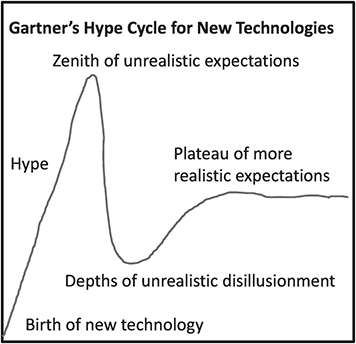
As with any new technology, there is a tendency to “hype” (i.e., exaggerate the importance of) the apparent merits of the technology. On the other end of the spectrum, there is the tendency, particularly of people who feel threatened by the new technology, to put it down or outright dismiss it. This is a familiar pattern of acceptance illustrated by the so-called Gartner Hype Cycle (Gartner, 2020). We have already had unreasonable hype and unrealistic disillusionment, and right now we are in a period of adjusting our expectations to be more realistic. However, nanomedicine is real and will slowly become the new norm for drug delivery (Leary, Reference LEARY2013) (Figure 1.7).
A modified Gartner Hype Cycle for new technologies starts out with hype and then plunges into “depths of unrealistic disillusionment,” until it stabilizes at a “plateau of more realistic expectations.”
1.9 Why Nanomedicine Will Happen: The Perfect Storm
Why will nanomedicine happen despite the naysayers? The answer is simple – there appears to be a “perfect storm” of factors driving the healthcare system toward this particular solution with respect to nanomedicine and healthcare (Junger, Reference JUNGER1997). The perfect storm paradigm is based on the “perfect storm” that hit North America between October 28 and November 4, 1991. On October 27, Hurricane Grace formed near Bermuda and moved toward the coast of the southeastern United States. Grace continued to move north, where it encountered a massive low-pressure system moving south from Canada. The clash of systems over the Atlantic Ocean caused 40–80-foot waves on October 30. It became the basis of a book (Junger, Reference JUNGER1997) and a Hollywood movie. Beyond that, it became synonymous with the coming together of multiple forces driving things in a particular direction. In this case, I am implying that there is a perfect storm of factors in science and healthcare driving us toward the adoption of nanomedicine for targeted drug delivery combined with individual human genomics to produce personalized medicine.
Chapter 1 Study Questions
1.1 Why does size matter in bionanotechnology and nanomedicine?
1.2 Medicine has traditionally approached disease at the organ level. How is nanomedicine a fundamentally different approach?
1.3 Manufacturing nanoscale devices was not thought possible due to a variety of factors in molecular manufacturing. What are some of those factors, and how are many bio-nano devices actually assembled in the real world?
1.4 What are some of the reasons why nanomedicine will have a big impact on the future of medicine?
1.5 Why is nanotechnology (and nanomedicine) frequently called a bottom-up rather than top-down approach?
1.6 What are some of the advantages of targeted drug delivery?
1.7 Why can nanomedicine be called a presymptomatic form of medicine, and what advantages/disadvantages does this provide?
1.8 How can nanomedicine be thought of as proactive rather than reactive?
1.9 Why is symptom-based diagnosis so problematic?
1.10 Why can nanomedicine be thought of as “massively parallel processing single-cell medicine”?
1.11 Personalized medicine uses genomic information about the individual to provide some important advantages over conventional medicine. What are some of these advantages?
1.12 How is the concept of “disease state” different in nanomedicine as opposed to conventional medicine?
1.13 Why is the use of “normal” ranges not a good way to determine whether someone is ill?
1.14 What does the medical maxim “heal thyself” mean in terms of what conventional medicine provides?
1.15 Often the scientific attributes of a new technology (e.g., nanomedicine) do not wholly determine whether that technology is adopted. What are some of these nonscientific factors that may delay, or even prevent, adoption of a new technology such as nanomedicine?
1.16 When diagnosis and treatment are done presymptomatically, there is a blurring of whether we are treating disease or preventing disease. What are some of the major implications of this blurring process?
1.17 What are some of the moral/ethical dilemmas of diagnosing diseases that are not yet treatable?
1.18 Why is early diagnosis important with respect to prognosis?


